How to Avoid the Mirror in Character Descriptions

26 Apr
Kelli Jo Ford's story, "You Will Miss Me When I Burn," was published in Virginia Quarterly Review.

Kelli Jo Ford’s story, “You Will Miss Me When I Burn,” was published in Virginia Quarterly Review.

We’ve all written this type of character description: the character walks past a mirror, stops, and examines the face and person it reveals. It’s a simple strategy that allows the story to tell the reader, “Here is what this person looks like.” The problem is that it’s overused. People really do look in mirrors, of course, and sometimes it’s necessary in fiction. I’m not suggesting that mirrors should never appear in our writing. But they shouldn’t be used as a crutch. There are other ways to describe characters, and some of them can feel so active that we don’t even realize a description has occurred.

An excellent example of an active character description can be found in Kelli Jo Ford’s story, “You Will Miss Me When I Burn,” published in Virginia Quarterly Review, where you can read it now.

How the Story Works

The story is about a North Texas rancher whose home lies in the potential path of a wildfire. He has a fatalistic attitude toward this disaster and drives to his son’s house, not with the intention to try to save the place but to help his horse. Here is the beginning of the scene. Pay attention to how the characters are described:

At my boy, Pitch’s, house, I clamped my hat down on my head and intended on walking straight to the door but ended up going around his truck because that’s where the wind blew me. I banged on the front door once and pushed it open. “Fat Mare needs shoeing, Pitch,” I yelled, going on in. I knew him and that wife of his would be sleeping because they work the night shift at the factory down the road. I called for him again, and he came out of the bedroom, pulling a long-handle shirt over his head and stomping his foot down into his boot.

“You’ll break the back of your boot like that,” I said, but you can’t tell that boy nothing. I tossed him a sausage biscuit I brought, and he grabbed a Dr Pepper from the fridge, opened it up, and took three long swallows without coming up for air. With his head tilted back like that, I could see where my boy was losing the hair on his head, and I felt proud to have a full head of my own, proud I didn’t work indoors under fake lighting on another man’s schedule. But it got me antsy.

We learn a great deal about the narrator and his son, even though the passage mostly contains action rather than an extended statement of what the characters look like. Here’s how it works:

  • The narrator enters the scene with resistance to his arrival. The wind literally blows him off his path, but he keeps going. This doesn’t mean that you need a stiff wind blowing throughout every scene of your work, but it is useful to create some sort of friction. After all, would The Lord of the Rings still feel as tense if Boromir’s line was, “Yes, one simply walks into Mordor”?
  • The narrator has a plan. He wants his horse shoed, and this is why he doesn’t bother with niceties when he walks in the door. Because he knows what he wants, he can pursue it immediately and directly: “I banged on the front door once and pushed it open. “Fat Mare needs shoeing, Pitch,” I yelled, going on in.”
  • The narrator acts based on particular knowledge, which lets him predict certain aspects of the scene he’s entering: “I knew him and that wife of his would be sleeping.”
  • When the second character appears, there’s no dilly-dally, only his first relevant act: “he came out of the bedroom, pulling a long-handle shirt over his head and stomping his foot down into his boot.”
  • The narrator comments on this action, and his comments reveal two things: his son doesn’t know how to put on a boot, and the narrator does; the narrator is willing to call him out on it, but his son doesn’t care.
  • Some basic mechanics (eating, drinking) are handled quickly and efficiently, boiled down to a single detail that captures something essential about the characters’ personalities: “I tossed him a sausage biscuit I brought, and he grabbed a Dr Pepper from the fridge, opened it up, and took three long swallows without coming up for air.”
  • We’re finally given a physical description (the son is going bald), and it’s delivered in a kind of looking-in-the-mirror moment. What makes it work is how quickly the description gives way to something else: the narrator’s attitude about what he sees (“I felt proud to have a full head of my own”).
  • The passage ends with a bridge to the next thing: “it got me antsy.” This is important. All prose is, generally, about propelling the reader into the next sentence, paragraph, scene, and page. You want to avoid endings (even the end of a paragraph is an ending) that do not suggest something further.

The result is a descriptive passage that feels active and pushes the reader into wondering what will happen next.

The Writing Exercise

Let’s write an active descriptive passage, using “You Will Miss Me When I Burn” by Kelli Jo Ford as a model:

  1. Create resistance to your character’s entry to a scene. Ford uses wind (which is important given the fire that looms on the horizon), but you can use anything at your disposal: some physical object or piece of geography or the knowledge of what is to come, which might lead to dread or fear or worry.
  2. Give the character a plan. If you find yourself writing a scene where characters simply wander aimlessly, beware. It can be done, of course, but it’s risky to write scenes hoping something will happen. Let the character’s entry to the scene be the precipitating action. What does your character intend to accomplish?
  3. Give the character knowledge and the ability to predict the future. The character ought to know something about the scene she’s entering. In the absence of knowledge, create suspicion. After all, lack of knowledge never stopped anyone from guessing, even wildly inaccurately.
  4. Let the second character enter with a bang. Lead with an action that sums up that character, the sort of thing that might cause others to say, “Well, of course he did.”
  5. Let the first character comment on this action. It should bug the character, or the character should find fault with it—or appreciate it mightily. In short, make the action positive or negative, something that causes a reaction. Neutral is bad for narrative.
  6. Boil mechanics down to essential elements. If a character moves, speaks, eats, drinks, or does anything else, don’t try to capture the entire movement. Instead, choose one part of it that reveals something about the character. Imagine that the scene takes place in the dark—and then a camera flashes. What does the sudden light reveal?
  7. Transition quickly from description to attitude. If a character observes something, make the observation prompt a reaction, one with attitude (good or bad, it doesn’t matter). For bonus points, turn the observation inward. The best characters tend to be self-centered, and so everything they see prompts them to think about themselves.
  8. End on a positive or negative note. Tilt the deck so that the marbles you’ve placed on it roll one direction or another.

The goal is to convey basic information about characters in a way that seems active and compelling.

Good luck.

An Interview with Melissa Stephenson

21 Apr
Melissa Stephenson wrote about running and single-parenting in her Washington Post essay, "As a mom, I couldn’t afford to fall apart after my divorce. Then running saved me."

Melissa Stephenson wrote about running and single-parenting in her Washington Post essay, “As a mom, I couldn’t afford to fall apart after my divorce. Then running saved me.”

Melissa Stephenson lives, runs, parents, and writes in Missoula, Montana. Her fiction, non-fiction, and poetry have previously appeared in Cutbank, Other Voices, Thin Air, The Chattahoochee Review, New South, Memoir (and), The Mid American Review, and Passages North. She’s currently hard at work completing a collection of poems and revising her memoir.

To read an exercise about showing and telling, click here.

In this interview, Stephenson discusses finding the structure of her essay, why “less is more” can convey more emotion, and how her poetry informs her nonfiction.

Michael Noll

Structure is a problem for any personal essayist, I think, and so I’m interested in how you found the structure for this essay. It begins by laying out the conflict—you were going through a difficult period in your life but needed to keep it together for your kids—and the solution to the conflict, which was running. Then, you tell a story about your second marathon. Did you always use this structure–front loading context and finishing with the narrative? If not, what helped you find it?

Melissa Stephenson

Inspired by Ann Hood’s essay “Ten Things I Learned from Knitting,” I tried to write a piece about running and grief a couple of years ago. Hood writes about knitting her way through grief after her young daughter’s sudden death. After a attempting to use the Ten Things structure, I shelved the piece. It felt long, lofty, and unruly. A few months after running my second marathon, I came across a call for essay submissions about “badass moms.” I hadn’t written for any parenting publications, and I didn’t necessarily want to. But the prompt got me thinking about using the second marathon as the structure for the essay on running and grief. My goal in the first paragraph was to introduce the connection between grief and running in a concise and concrete way. Once I got that paragraph down, I simply had to write to and through the narrative of the marathon.

Michael Noll

This sentence really affected me:

“The next summer, I completed my first full marathon on my daughter’s fifth birthday, crossing the finish line to drive myself home.”

The emotion in it is clear, and so it makes sense to give the sentence its own paragraph—to make it stand out. But it’s also quite spare in terms of detail. We don’t learn anything else about the birthday, nothing about a party or a cake or celebration, nothing else about how you felt except your time. Were you ever tempted to write more? I ask because the question of how much detail to provide—and which details—is a difficult one. What was your guiding principle?

Melissa Stephenson

Haruki Murakami wrote about the connections between running and writing in What I Talk About When I Talk About Running.

Haruki Murakami wrote about the connections between running and writing in What I Talk About When I Talk About Running.

There are a couple of reasons why this moment is so sparse.

  1. Once I had a draft of this essay, I realized the length and content would work well for an online publication, so compression was key. Most of the bigger online personal narrative publishers, like Washington Post or New York Times, prefer 800-1200 word pieces. I made many cuts in favor of economy.
  2. I also wanted to capture the anti-climactic feeling I had with the half marathon and the first full marathon. In his book What I Talk About When I Talk About Running, Haruki Murakami describes his first marathon finish this way, “The finish line. I finally reached the end. Strangely, I have no feeling of accomplishment. The only thing I feel is utter relief that I don’t have to run anymore.” I felt this, too. I lived in a town without family, raising two kids with almost sole custody, and I woke up most days stunned by this new, isolated life. I’d imagined the finish line as a giant party, full of familiar faces, hugs, and cheers. Truth is most of my friends were home with children. One friend did show up to the finish line, but I was too nauseous to talk to her. And I wore a t-shirt with the words, Happy Birthday Hadley on the back, which is something my daughter still talks about. But I finished with this deep, hollow feeling, like walking around with the Grand Canyon inside you. That single line seemed the simplest way to capture that.

Michael Noll

The story of the second marathon fills a number of paragraphs, and, as someone who’s run a marathon (just one, though!), I understand how this is possible. The race is so long that it has many stages and points along a narrative arc. On the other hand, the action is sort of the same throughout: running, more running, suffering, a bit of ecstasy, and more suffering. How did you approach finding the narrative within the race?

Melissa Stephenson

This is the one section I’m surprised the Washington Post editor did not trim. Since I’d set out wanting to tell the story of that marathon, I naturally went into it in detail. I knew this decision meant narrowing my target audience to runners (a 4:12 marathon finish doesn’t mean much to those who haven’t run a race of some sort).  I did tweak this section many times to make it concise and also as non-runner-friendly as possible.

The second marathon was so important because it’s the event that finally captured the ups and downs of the past few years all in the span of four hours. I didn’t truly know why I was running (and kept running) until that marathon. The only thing that got me through was the gut-deep feeling that I had something to prove to myself, though I wouldn’t know exactly what that was until I finished the essay.

Michael Noll

I really like how the essay ends, both the line of dialogue and the final paragraph. Endings are difficult in personal essays. There’s a desire to wrap it up–to put a kind of emotional exclamation mark at the end. But there’s also the need to not overdo it. How did you know when you’d found the right end for this essay?

Melissa Stephenson

Writing this ending was a pretty divine experience in that I’d planted the seeds for it as I drafted but had no idea what the ending would be until I got there (aside from finishing the marathon). I never intended to include my brother’s death in this piece. I’ve been working on a memoir about that for a few years now, and I try to keep it from leaking into my other work. But once grief was on the plate, I realized why grieving as sole caretaker of two young children left no room for self-pity or solitude, and how running helped me deal with that.

I also didn’t include the words I’d whispered to my children on first mention of that moment because I thought they weren’t important to the essay. Once I made it to the end and wrote the line about the things I’m ashamed they might remember, I saw the opening for what I’d told them. As soon as I wrote, “This is what not quitting looks like,” I saw the connections I’d made without knowing it: My brother quit, my life hadn’t turned out the way I’d expected, and running helped me not quit. That’s when I truly understood the essay, myself, and the running.

On a nuts-and-bolts note, I’m a poet as well, and I love writing endings. Once the content is there, endings become a mix of cadence, imagery, and releasing just enough insight without (as you wisely note) overdoing it. I’ll write them, tweak them, and read them out loud until each word resonates. Then I’ll go back and tweak the whole essay to make sure the information is released in a way that makes the ending feel as surprising and inevitable as possible.

April 2016

Michael Noll Michael Noll is the Editor of Read to Write Stories.

How to Use Showing and Telling in a Personal Essay

19 Apr
In this essay at the Washington Post, Melissa Stephenson tells the story of how running helped her cope with being a single mom

In her essay at the Washington Post, Melissa Stephenson tells the story of how running helped her cope with the stress of being a single mom.

The personal essay genre can be found across the Internet and in print magazines, and because of these many outlets, the form has given writers from many different backgrounds and experiences the chance to tell their stories. These many voices have led to a lot of innovation within the genre, yet when I teach structure in the personal essay, I try to show how almost every essay contains certain elements: a narrative, sure, but also passages revealing context (explaining how the reader should understand the narrative) and emotional importance (showing why the narrative matters to the people involved). The question becomes this: How does a writer weight each of these elements and arrange them? What is the focus of the essay?

A great place to find one answer to these questions is Melissa Stephenson’s essay, “As a mom, I couldn’t afford to fall apart after my divorce. Then running saved me.” It was published in The Washington Post, where you can read it now.

How the Essay Works

The essay begins by introducing two clear problems: 1) the writer is a newly single mom and in need of a way to manage the stress of the situation, and 2) her preferred coping mechanism, running, has become difficult due to knee pain. Then, the essay gives context for this situation. In the past, she dealt with problems in a particular way (“I drank too much, stayed up late listening to music, cried when I wanted and left the house for hours on a whim.”). Now, though, that approach isn’t possible because she has kids. She doesn’t have “the luxury of falling apart.”

We’re mostly not shown this information but, rather, told it. This runs counter to one of the basic workshop lessons: show, don’t tell. Yet this is impractical advice. Telling is essential to storytelling (see what I did there?). The opening of the essay grabs our attention through statements of fact—facts that that reveal the conflict faced by the writer.

The essay continues telling us things, most importantly that Stephenson continues running but also seeks medical care, eventually entering and finishing a half marathon. It’s a moment that reveals the emotional importance of the essay: “No one came to meet me at the finish line. Perhaps it’s the lesson I needed: You’re in this by yourself. Single. Solo. Alone.”

But this moment comes only a third of the way into the essay. Most of the attention is paid to Stephenson’s second marathon and the successes and challenges she encounters during it. Here’s why this is interesting from a craft standpoint: for the most part, we don’t learn anything in the course of the race that don’t already know. She needs to run, experiences pain, and fights through it, all of which we’ve already been told. What the race does, then, is show us Stephenson’s experience of these things. It’s one thing to tell a reader that you need to run and are willing to fight through pain and sorrow to do it, but it’s quite another to show it.

And what gets shown? Details of the pain and race but also details of Stephenson’s thoughts during the pain:

That familiar tightening seized my right knee — a pain I’d spent three years eradicating. For an entire mile I processed a single, circular thought: Is that my knee? No. It’s just a glitch. I’m just settling in. But wait. That is my knee. Is that my hip? And my knee?

Showing doesn’t only mean descriptions of setting and character. It can also mean simply slowing down, settling into a moment.

Stephenson uses telling to set up the conflict that she intends to show the reader. Without the telling, the reader might not care as much about the marathon, and without the showing, the essay would lose a great deal of emotional punch. Both are necessary.

The Writing Exercise

Let’s use showing and telling to set up and dramatize a narrative:

  1. Introduce a problem and solution. Stephenson does this in both her title and first paragraph. Try using her title as a model: “As a ___, I couldn’t ____ (or needed to ____). ___ saved me.” While Stephenson was writing a personal essay, this exercise can work with fiction as well, even third-person stories.
  2. Introduce a problem with the solution. Stephenson’s solution is running, but her knee hurts. We don’t get a lot of details about it at the beginning, only that it involves arthritic pain. More detail—showing the reader this pain—wouldn’t really advance the essay at this point. The point is that the pain makes it difficult to run. So, introduce something that makes your solution difficult to pursue. Don’t worry about describing it in detail.
  3. Introduce emotional importance. Stephenson does this with a statement of fact—”No one came to meet me at the finish line”—and a direct statement of what that fact meant to her: “Perhaps it’s the lesson I needed: You’re in this by yourself. Single. Solo. Alone.” So, find a moment or fact that clearly conveys a clear emotion. Stephenson felt alone. The feeling was so profound that she was forced to grapple with it. How do you—or your character—grapple with the emotional fact?
  4. Use a narrative to show everything you’ve introduced. So far, we’ve been telling the reader things. Now it’s time to show the reader. Stephenson does this with a blow-by-blow account of her second marathon. It presents the problem and solution and obstacle (pain) in detail and also gives her thought process as she experienced each one. Earlier, she was telling the reader what the situation is, but now she is showing what the situation felt like. So, find a narrative (an extended story or an anecdote) that can be told with descriptions of exterior and interior details that will show your readers everything you just told them.

The goal is to use telling to establish a situation (problem, solution, obstacles) and then to use showing to reveal the what the situation felt like—the experience of it.

Good luck.

An Interview with Kaitlyn Greenidge

18 Apr
Kaitlyn Greenidge is the author of We Love You, Charlie Freeman, has been called "auspicious," "complex," and "caustically funny."

Kaitlyn Greenidge is the author of We Love You, Charlie Freeman, which has been called “auspicious,” “complex,” and “caustically funny.”

Kaitlyn Greenidge was born in Boston and received her MFA from Hunter College. She’s the author of the novel We Love You, Charlie Freeman, and her wer work has appeared in The Believer, American Short Fiction, Guernica, Kweli Journal, The Feminist Wire, Afro Pop Magazine, Green Mountains Review and other places. She is the recipient of fellowships from Lower Manhattan Community Council’s Work-Space Program; Bread Loaf Writers’ Conference and other prizes. She currently lives in Brooklyn.

To read an exercise on introducing characters, click here.

In this interview, Greenidge discusses describing characters, acknowledging the role of power in race, and finding an agent who appreciated her novel.

Michael Noll

I love the way you introduce Charlie. A character says that “it’s best we all meet Charlie now,” but the introduction isn’t given to the reader in a direct way. First, we see the place where Charlie lives. Then, we’re told that he’s sitting beside a fern and that a man kneels beside him—and then we’re introduced to the man. Only after this do we get to see Charlie. I love this approach because it takes the weight off his character. It’s as if the novel is saying that Charlie is important, yes, but he’s less important the everything around him. Was this introduction to Charlie simply how it arrived on the page? Or did you write it with a particular goal in mind?

Kaitlyn Greenidge

I didn’t want this novel to be about chimpanzees. That isn’t, to me, what this novel is about or what it is concerned with. So, it was important to let the reader know this from the beginning. Part of it was just keeping the reader’s interest in that first chapter. Part of it was also me, as a writer, not being ready to engage with the character of Charlie yet. All of those things went into that first introduction to the character.

Michael Noll

I also love the description of Dr. Paulson, in particular this:

When she parted her lips to grin, behind her white, white teeth, I caught a glimpse of her tongue. It was the yellowest, craggiest, driest tongue I had ever seen. It surely did not belong in that mouth, in her, and I shot a look at my mother, who widened her eyes, who gave one quick shake of her head that told me to ignore it.

It’s a monstrous trait, that tongue. In an interview with Lambda Literary, you said that you love the grotesque and the mechanics of horror stories, and the tongue certainly seems to fit. It’s also a detail that turns Dr. Paulson into a kind of monster. In that same interview, you talked about writing fully-developed characters, and so I’m curious how a detail like this works in terms of character development. Did you worry that giving characters monstrous characteristics would make them more difficult to develop? Or is the monstrosity part of that complexity? It’s certainly part of what makes the book so compelling.

Kaitlyn Greenidge

That was more a private joke with myself, while I was writing. I had a teacher in school when I was a kid who used to eat chalk. He carried a stick of it in his back pocket and during class, he would bring it out and lick it. His tongue was pebbled and yellow. And, no one ever mentioned it! It was like, is no one else seeing this, how disgusting it is? So, when I was writing, I just wanted to include that detail as a reminder and a joke with some younger part of myself.

I love the grotesque but it’s very rare that I recognize it as initially repulsive. It takes a very specific visual to repulse me. But most things that people find grotesque, I just like to look at and think about.  I think human bodies are just endlessly fascinating and beautiful looking, even when they have yellow, craggy tongues and even when they are licking chalk.

Michael Noll

The characters are put into situations that highlight their blackness and make them objects of fascination and study. For example, Laurel likes to say of her childhood in Maine that she was the only black person in a one-hundred mile radius. The town of the novel is segregated, and the school that the girls attend is mostly white. At the Toneybee Institute, the family is made a literal object of study, and several reviewers have pointed out connections to the Tuskegee Institute. There’s a sense, then, that the Freemans’ weird situation isn’t, actually, so weird. When you began to sketch out the plot of the novel, did you have ideas or themes in mind? Did you, in other words, have something you wanted to say? Or did you invent the premise and plot first and discover what it had to say about the world?

Kaitlyn Greenidge

Kaitlyn Greenidge's highly anticipated debut novel, We Love You, Charlie Freeman, tells the story of an African-American family who moves to a research institute to live with a chimpanzee.

Kaitlyn Greenidge’s highly anticipated debut novel, We Love You, Charlie Freeman, tells the story of an African-American family who moves to a research institute to live with a chimpanzee.

I wanted to write about race in post-Civil Rights America. Which is a very big and wide topic. But I wanted to talk about the ways in which we don’t really have a way to describe living race right now, because we are so averse in America to talking about power.

I just read an editorial on Al Jazeera, about how “cultural appropriation” is a meaningless term. It’s an old argument, one that anyone familiar with that debate can recognize. Basically, culture is universal, all cultures borrow from each other, it was 19th century racists who popularized the idea of distinct, cultural productions in the first place so why do we cling to that idea?

All those historical facts are true, but they are missing that question of power. What does it mean that I probably won’t be hired at many places because my hair is in dreadlocks but an upper-middle class white man could wear the same hairstyle to work and be considered a wonderful iconoclast? That is a question of power, that those who go on and on about how it’s all the same never really have an answer for that.

I grew up in the 90s, when so much talk about race was about “diversity”, how everyone everywhere came from a different culture so let’s all flatten it out. The Irish potato famine is the same pain as the Holocaust is the same pain as American slavery so let’s just not talk about any of it. That is ludicrous, of course, and not how memory or history or culture or politics works. But it’s a convenient idea to cling to in order to avoid really talking about all the ways our wounds are different, and how they are serving, or not serving, us well.

It’s similar to that self-serving, smug, and ultimately meaningless phrase “Everyone is racist.” Usually, the unspoken follow-up to that sentence is “so don’t worry about it/don’t try to talk about it.” We have to get to a point where we have another way to talk about racism and white supremacy beyond just calling people out. Calling people and institutions out is a powerful tool, but we also have to get to a point where we can have conversations past naming someone or a practice or an institution as racist. What does it mean to work to change an institution? Knowing that we are all imperfect, that we will never live in a utopia, that there will always be bias, that over 500 years of racist thinking and oppression cannot simply be erased over night? How do we get to a point where we get real gains, and keep them for another generation to build on? One of the heartbreaking things about studying race post-the Civil Rights era is how many things have been lost, even in the last 8 years, how much we’ve lost. It’s terrifying. So how do we begin to keep what we’ve got and what’s working?

Michael Noll

I recently interviewed Daniel Jose Older about his essay, “Diversity Is Not Enough: Race, Power, Publishing.” He said that he loves books that multitask and that demand multiple things of the reader. So, for example, he’s written Half-Resurrection Blues, an urban fantasy novel about ghosts, monsters, and paranormal detectives, but it’s also a novel that has a lot to say about issues of race. Kiese Laymon’s Long Division does something similar: it contains time travel and an absurdist vocabulary contest, and it’s very much a book about race. In his case, he struggled to find an appreciative editor and publisher for that book. Your book also seems like it’s multi-tasking. Did you ever think, Uh oh, I’m taking on too much? Was it ever suggested to you that the novel contained too many different elements—or elements that seem too different to some readers?

Kaitlyn Greenidge

Never by my agent or my editor. When I sent it out to some agents, that was definitely a response. But Carrie read it and got it immediately. My editor Andra read it and got it as well. That was most important to me: that the people I worked with on it understood that it is a book that is “multi-tasking”, as you put it. That is a natural place for me to read from. My older sister was in college in the early to mid nineties, just in time to be hit with the full bloom of post-modern theory. She brought some of that stuff home to me and tried to talk to me about it. Like, I remember, she rented The Celluloid Closet and Paris is Burning for me when I was in elementary and middle school and we’d watch them together while she babysat me. And so, I grew up reading things for multiple meanings at a really early age—not because I was some genius, but because I was lucky enough to have an older sibling to say, “Hey, you can read things this way.” It was great: like discovering a secret code. It also meant that I could indulge in reading “low” culture books and avoid the classics, because I could always look for (and invent in my imagination) that subtext. I like books that do that and I always wanted to write one.

April 2016

Michael Noll Michael Noll is the Editor of Read to Write Stories.

An Interview with Manuel Gonzales

14 Apr
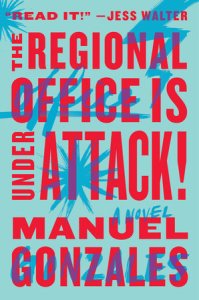
Manuel Gonzales is the author of The Regional Office Is Under Attack!, which the New York Times called "rollicking good fun on the surface, action-packed and shiny in all the right places" and also "thoughtful and well considered."

Manuel Gonzales is the author of The Regional Office Is Under Attack!, which the New York Times called “rollicking good fun on the surface, action-packed and shiny in all the right places” and also “thoughtful and well considered.”

Manuel Gonzales is the author of the novel The Regional Office is Under Attack! and the acclaimed story collection The Miniature Wife, winner of the American Academy of Arts and Letters Sue Kaufman Prize for First Fiction and the John Gardner Fiction Book Award. A graduate of the Columbia University Creative Writing Program, he teaches writing at the University of Kentucky and the Institute of American Indian Arts. He has published fiction and nonfiction in Open City, Fence, One Story, Esquire, McSweeney’s Quarterly Concern, and The Believer. Gonzales lives in Kentucky with his wife and two children.

To read an exercise on building character within action scenes based on Gonzales’ new novel The Regional Office Is Under Attack!, click here.

In this interview, Gonzales discusses moving from stories to a novel, writing novel sections out of order, and moving through time within a narrative.

Michael Noll

This novel contains so much of what you did in The Miniature Wife. There’s the wry, corporate in-house documentary tone that was in “Farewell, Africa,” the genre sensibility of stories like “All of Me” and “Wolf,” and the sense of tense waiting that was in “Pilot, Copilot, Writer.” This is one of the concerns that story writers have–how will my voice and style translate to the length and form of the novel? How did you approach that jump? Did you always know the sort of novel that you wanted to write? Or were there abandoned projects and starts before settling on The Regional Office Is Under Attack!?

Manuel Gonzales

I didn’t always know the kind of novel I wanted to write next. The stories—they came out over ten or eleven years, and for a long stretch the stories, as a book, had been abandoned and I was working on two different novels, neither of which came to light, for good reason. And to be honest, the in-house documentary tone didn’t arrive in this novel till the very end of rewriting it. What happened was I had an image in my head of a man trying to grab a woman out of a detention center—La Femme Nikita-style—to turn her into a trained assassin of sorts, and she stomps his foot and makes a break for it—but when I wrote that, I didn’t know what was going to happen, where this was headed. For a long time, the early drafts contained long-ish, self-contained sections that, in hindsight, read very much like their own short stories, and I think that’s what got me through early drafts—I wrote it as if it were nothing more than longish short stories that followed the same action but contained their own mini-arcs.

Michael Noll

The novel starts with the weirdness of the place and world—a description of the Regional Office. Then, we briefly meet Rose as she is preparing to attack the Office. And then we’re given some backstory about her, and that backstory seems to have a different voice than the previous two chapters: it’s still funny and sharp, but it also wouldn’t be out of place in a completely realistic novel. Is this simply the voice that arrived on the page when you wrote her character? Or were you consciously trying to ground the novel’s fantastic world with a recognizable voice?

Manuel Gonzales

That backstory might have a slightly different feel, especially early on, because it was written early in the process and part of the writing was exploration—who is Rose, what does she sound like, how does she move—and the moment of her waiting to start the attack was written at the end, after I decided the whole book needed an overhaul, a new kind of beginning. And by that time I had a clearer idea of Rose, of her sense of humor, of her bravado propped up by her foul mouth and disaffected youth. What’s nice, too, though, is that in that section of attack, she’s older and has a different sense of her self, even. She’s been through the recruitment and training and has more bravado because of it—even if most of it’s false bravado—and by happy accident, I feel the narrative tones match the different kinds of Rose in those different points in her life.

Michael Noll

In all of your work, I’ve admired how you’re able to create space within moments of action for—I don’t even know what to call it, not action, maybe, instead, moments for the character to talk about something else. You have one of those moments near the beginning of the novel. Rose is repelling down a ventilation shaft, and she’s not wearing gloves, which makes her think about the man who tells her to wear gloves, which makes her think about her job and the mission in general, and then she’s wondering about things and only barely paying attention to the task at hand—or, we’re barely paying attention to it as readers. Passages like this make me wonder if you ever find yourself writing, “This happened and this and this and this” and unable to break out of the immediate present and let a character think? Or is this simply some of the magic you’ve got as a writer?

Manuel Gonzales

I don’t know that I would call it some of the magic I’ve got as a writer—or that I have magic as a writer—but more that this is how I see action happening. I find myself easily distracted ALL THE TIME doing any number of simple or complicated tasks, and it drives my family totally bonkers because in getting distracted I forget the task I’m in and move to something else. In fact, I’ve been answering this question for the past twenty minutes, not these questions, this ONE question—and so it seems only natural to me, right?, that you find yourself in a situation where you’re supposed to be laser-focused but not everyone is good at laser-focus, and your mind wanders to the things it worries or cares about—a guy, a girl, that really pretty cardinal on the fence outside your kitchen window, whatever. And you have to bring yourself back to the task at hand, or the external world itself brings you back against your will.

Michael Noll

You’re able to get a lot of pages out of a relatively short period of time. So, for example, you’re able to get 50 pages or so out of the initial attack on the Regional Office. Another writer might have covered much more ground and time in that number of pages. What was your approach to the timeframe of the novel?

Manuel Gonzales

My original thought was to focus mostly just on the day of the attack, just that one day, and toy with the peripheral characters—though of course by default the ones I singled out as peripheral became central—but I wanted to slow down the time of the action mainly because that’s how time works, in my mind, anyway. Things happen really fast and then not at all, and then really fast again, but also I wanted to offer full storylines of characters. I wanted to play around with cutting away from the action to give the reader something different, to delay the gratification but also to create a rounder world, richer characters. But then inevitably, too, cutting away from one moment of action usually meant cutting away to another moment of action. And then I realized I couldn’t tell the whole story of what I wanted to tell—what happened to these people after the attack—unless I also jumped forward in time, and jumping forward meant I could also jump backward, and then time went all topsy-turvy, jingly-jangly, and I decided the topsy-turvy jingly-jangly approach was the best approach for me.

April 2016

Michael Noll Michael Noll is the Editor of Read to Write Stories.

How to Build Character within Action Scenes

12 Apr
Manuel Gonzales' novel The Regional Office Is Under Attack! is the much-anticipated follow-up to his terrific story collection, The Miniature Wife.

Manuel Gonzales’ novel The Regional Office Is Under Attack! is the much-anticipated follow-up to his terrific story collection, The Miniature Wife.

The most boring prose is often supposed to be the most exciting: action scenes. No matter how exquisitely detailed and choreographed a scene’s punches, kicks, shouts, commands, charges, and retreats, the reader can bear only so much. After more than a few sentences—or perhaps a paragraph or two at most—it simply washes over us, unseen. Our eyes glaze over. So, good writers will mix something into their action sequences, and usually that something builds character.

One of the best at this strategy is Manuel Gonzales, who does it again and again in his weird and wonderful new novel The Regional Office Is Under Attack!. You can read first pages of the book here

How the Novel Works

Action scenes can be some of the most difficult moments to write because the action draws the eye. Once someone is fighting or running or whatever, it’s hard to look away. But that is exactly what action sequences need. They must offer more than choreographed motion. Watch how Gonzales avoid that trap in this early scene from the novel. In it, the leader of one group has just given the sign to begin an attack on the headquarters of another group:

Finally she gave that signal and the fucking mercs were off, pouring out of their vans like mechanized roaches, and then they were gone, and Colleen, jog-walking right behind the mercs as they charged into the offices of the Morrison World Travel Concern, patted Rose on her ass and gave her a peck on the cheek and told her, “Nice work, kid,” and then waved casually over her shoulder and called out, “See you on the other side,” as she ran to catch up with the grunts, leaving Rose standing on the sidewalk feeling like she felt that one summer she agreed to help out with the pre-K kids at church camp, how relieved she’d felt every fucking day when it was recess and all those little shits had run screaming and hitting and shoving out of the multipurpose room and into the play yard and all she’d wanted to do was sit down and revel in the peace and quiet for one goddamn minute.

The passage begins with a series of actions but ends with the memory of a pre-K kids church camp. It’s a significant jump. What makes it work? The less-polished version of this jump, which most of us have written, is this: action action action, which made her think about that time… It’s the same thing that Gonzales has written, with one big exception: it includes the phrase “which made her think.” Other versions of this include “which reminded her” and “which transported her” and “which made her feel.”  The difference between these and what Gonzales writes is that his version is faster (“feeling like she felt that one summer…”) and doesn’t necessarily imply that the character herself is stopping in the middle of a battle to think, “Oh, this is just like that one time at church camp.”

We tend to value realism, but in action scenes, verisimilitude can get in the way. If a writer tries too hard to recreate action as it’s experienced by a character, the result isn’t automatically good prose. Would this character think about church camp in this moment? Maybe not. But she has a feeling, and the writer is pausing to tell us, the readers, what that feeling is—a feeling that the character perhaps understands without thinking about it.

Gonzales steps out of the immediate action with another strategy as well. This passage comes shortly after the first one:

Rose dropped twenty or thirty feet and then caught hold of the rope, threw her feet against the aluminum of the vent shaft, leaving deep boot marks in it, almost breaking the shaft off its column. She should have been wearing gloves. She hated wearing gloves, though, hated the way they constricted her hands, the way she couldn’t grip things as well as she liked…

Again, the passage starts with action and then moves out of it into a short meditation on gloves. Is the character actually thinking about gloves in this moment? Sort of, as you’ll see when you continue reading the scene. But she’s not thinking, “I hate gloves, the way they constrict my hands.” Why would she? She understands this hatred and doesn’t need to state it explicitly, even to herself. The moment is meant for the readers alone, an attempt to reveal something about the character based on what she’s doing at that moment: hanging on a rope without gloves.

The Writing Exercise 

Let’s create space to build character within an action sequence, using The Regional Office Is Under Attack! by Manuel Gonzales as a model:

  1. Choose an action sequence. It can be anything from attacking a building to preparing dinner. Your characters are doing something.
  2. Write the basic action as a list. Gonzales actually puts his action in the first example into a single sentence. Try doing the same thing. You can always add more detail later. Get the essential parts of the movement: where it takes place, who is involved, and which objects are used.
  3. Step away from the action (Method 1). Make a comparison. Gonzales does it with the word feeling. The way his character feels in the midst of this action is like the way she felt in this other, very different moment. To do this, you can drop the word feeling into almost any point in the list of actions, like this: She spread peanut butter on the slice of bread, feeling like she felt that one…. Or, don’t use feeling at all. The action itself, not the way it feels but the actual movement, can be similar to something else, like this: She spread peanut butter on the slice of bread the way masons apply mortar to bricks. 
  4. Move into the comparison. Gonzales moves his character out of the attack and into church camp. In my examples, the character could move into whatever spreading peanut butter feels like or into her past as a bricklayer. You’ve opened the door into someplace other than the present moment; now walk through it.
  5. Step away from the action (Method 2). Select one of the objects you mentioned in the list of actions. Comment on it. Gonzales does this through absence: no gloves. Then he tells the reader something about the character’s relationship to that object (or its absence). Try doing the same thing. Make a statement about your character’s relationship to an object in the scene. Then, as with the previous method, step through the door you’ve opened. What else is connected to that object or the character’s experience of it?
  6. Return to the action. Once you’ve shown or told us what you wanted to show or tell, walk back through the door and into the present moment. The action resumes.

The goal is to create simultaneity in action scenes by adding other moments, times, and experiences to the present moment of action.

Good luck.

How to Introduce a Character with Misdirection

5 Apr
Kaitlyn Greenidge's highly anticipated debut novel, We Love You, Charlie Freeman, tells the story of an African-American family who moves to a research institute to live with a chimpanzee.

Kaitlyn Greenidge’s highly anticipated debut novel, We Love You, Charlie Freeman, tells the story of the Freemans, an African-American family that moves into a research institute to live with a chimpanzee.

The introduction of one of the most famous characters in literature happens without the reader’s knowledge. In The Great Gatsby, Nick Carraway attends a party at Gatsby’s house but nobody’s seen Gatsby. People are trading rumors (“I’ll bet he killed a man”), and so Nick goes searching—into Gatsby’s mansion, into his library—before finding himself outside again, talking to a guy about the army. Someone asks if he’s having a good time, and Nick says, “I haven’t even seen the host.” That’s when the introduction happens: “I’m Gatsby,” the other man says.

This is an important piece of strategy on Fitzgerald’s part because the reader badly wants to see Gatsby. In a way, he’s the entire point of the novel, as the title indicates. But if Fitzgerald had introduced this great character directly, the reader might have been disappointed. No description would have matched the hype. So Fitzgerald snuck him onto the page.

Kaitlyn Greenidge does something similar in her novel We Love You, Charlie Freeman. The novel is named after a character who is surrounded, early on, by intrigue so substantial that any direct description might disappoint. You can read her approach to this problem in the novel’s opening pages.

How the Novel Works

The novel has a bold premise: The Freeman family is moving into a research institute in rural Massachusetts to be part of an experiment. They will live (and raise their daughters) alongside a chimpanzee named Charlie. The novel begins with the Freemans driving to this institute, where they meet some of the staff and then, finally, Charlie. The introduction is prefaced with this line: “Dr. Paulson thinks it’s best we all meet Charlie now.” It’s a dramatic moment, and here’s how Greenidge handles it:

Charlie lived behind a door in the living room. He had a large, oval-shaped space with low ceilings and no windows and no furniture. Instead, there were bundles of pastel-colored blankets heaped up on the scarred wooden floor. Even from where I stood, I could tell the blankets were the scratchy kind, cheap wool. The room was full of plants—house ferns and weak African violets and nodding painted ladies. “They’re here to simulate the natural world,” Dr. Paulson told us, but I thought it was an empty gesture. Charlie had never known any forests and yet Dr. Paulsen assumed some essential part of him pined for them.

Charlie sat beside a fern. A man knelt beside him. “That’s Max, my assistant,” Dr. Paulsen said.

Max was wearing jeans and a red T-shirt, his lab coat balled up on the floor. He was pale, with messy red hair. He was trying to grow a beard, probably just graduated from college a couple years earlier.

Charlie has taken Max’s glasses and is licking them, and Max is trying to distract Charlie so that he can get them back. We watch this “very gentle disagreement” for a bit, until Dr. Paulsen calls Max and he carries over Charlie. Finally, we see Charlie directly. It’s a good description, with strong, specific imagery. But it’s also clear that Charlie is just a chimpanzee—no more, no less—and quickly the novel returns to the other characters and their reactions to Charlie, ending with the narrator’s mother holding him with tears in her eyes.

So, what can we learn from this?

In this novel, as with The Great Gatsby, the title character isn’t actually as important as the supporting cast. The most interesting scenes take place around the title character, with other characters reacting to him. So, the introduction reflects this fact. In both novels, we’re first shown the people around the title character before the character himself.

The Writing Exercise 

Let’s add introduce a character through misdirection, using We Love You, Charlie Freeman by Kaitlyn Greenidge as a model:

  1. Bring the reader into a place where the character is present. The key is for the reader to know that in this place, somewhere, is the character. Horror stories do this all the time: somewhere in this spooky place is the monster, we’re just not sure where.
  2. Give the reader a reason to want to meet the character. Both Fitzgerald and Greenidge do this by putting the character in the title and making them the ostensible reason for the story to exist. Without rich, mysterious Gatsby living next door, there’s no novel. Without Charlie, there’s no experiment. So, give your reader a sense for what role this character will play in your story.
  3. Introduce the character through place. We see Charlie’s home behind the door before we see Charlie. The home is filled with details (the lack of windows, the blankets, the plants) that tell us a lot—not so much about Charlie but about the people around him at the institute. So, think about the place where your character is found. If people entered that place for the first time, eager to meet the character, what details would they notice? What would they discern from them?
  4. Introduce the character through other characters. Charlie is named, but we don’t see him. Instead, we’re shown Max. As with the details about place, the details about Max and how he interacts with Charlie reveal a lot about him. So, show the character interacting with someone else and then focus on that someone else. Again, what details would people notice, and what would they think about them?
  5. Finally, show the character. The details should be specific. Greenidge mentions Charlie’s smell, “old and sharp, like a bottle of witch hazel.”
  6. Return to the other characters or the place. Remember what is important. In Greenidge’s case, the real focus is the effect that Charlie has on the Freemans. With Fitzgerald, the focus is the effect that Gatsby has one everyone else. Show enough of the main character and then return to the effect that he or she has.

The goal is to introduce a character by revealing the world and characters around him or her.

Good luck.

An Interview with Keith Lee Morris

2 Apr
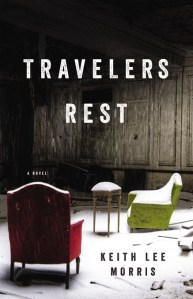
Keith Lee Morris' novel Travelers Rest culminates in "an operatic grand finale," according to a reviewer for England's The Independent.

Keith Lee Morris’ novel Travelers Rest culminates in “an operatic grand finale,” according to a reviewer for The Independent.

Keith Lee Morris is the author of three previous novels, The Greyhound God and The Dart League King, a Barnes & Noble Discover pick, and, most recently, Travelers Rest. His short stories have been published in New Stories from the South, Tin House, A Public Space, New England Review, and Southern Review, which awarded him its Eudora Welty Prize in Fiction. Morris lives in South Carolina, where he is a professor of creative writing at Clemson University.

To read an exercise on skipping over implausibility inspired by Travelers Rest, click here.

In this interview, Morris discusses pushing against conventional reality in stories, making predictions about characters, and the tonal difference between allowing characters to react to or ignore unusual details in a story.

Michael Noll

The novel’s first chapter is utterly realistic. The characters seem like “real” people, the situation (pulling off the highway due to snow) is plausible, and it’s certainly true that there are many small, beautiful, forgotten towns just off the Interstate. And yet there’s something about the last line of the chapter—”You’d never even know they were here”—that is full of foreboding. What was your approach to this chapter? It poses a certain challenge: you’re setting up the reader for a world that will gradually get stranger and stranger. Did you have a plan for how to plant the seeds for those changes?

Keith Lee Morris

The truth is, the first chapter wasn’t written until after the first draft of the novel was complete. The book originally began with what is now Chapter 3, Uncle Robbie waking up in the hotel in the middle of the night. But in talking to people who read the first draft, I got the idea that the opening was a little too abrupt and confusing. So the decision to include the first two introductory chapters was initially a practical move. But you’re right—Chapter 1 sets up a number of the elements that will be in play throughout the novel—the constant snowfall, the tensions between family members, the strange but oddly familiar small town. Nothing overtly strange happens, but things feel strange; that’s enough for the time being. In the next several chapters, the boundaries of conventional reality feel like they’re getting pushed up against a little bit, but nothing truly “otherworldly” happens for a while—and yet the reader senses that it’s coming.

Michael Noll

The novel is told from four different characters’ perspectives. It’s a structure that carries risks: you might lose the reader while changing POV, or the reader might feel more attached to one than the others, or the reader might feel that the shifts intrude upon the suspense that’s being built in each chapter. How did you balance the POV and the shifts to maintain a steady amount of suspense and interest in each character?

Keith Lee Morris

One of the key things to me is that readers have to get their hopes up for each character in a way that’s particular to that character. Very early on in a narrative we begin to make predictions, project outcomes—we do it unconsciously. If we like the characters, we begin to form an idea of what we hope will happen and also what we most deeply fear. Each character has to seem at least somewhat equal in that regard—if we don’t know what we want for a certain character, what we’re afraid might befall them, our interest is bound to lag behind in the chapters devoted to that character’s POV. So part of the battle is to make sure the reader can identify what would make each character happiest and what could potentially destroy him/her. And then I think it’s important to end the chapters on a strong note. I’ve always thought the most important sentence in any story or chapter or even entire novel is the last one. It’s what the reader’s left with. If you leave the character in an interesting place, the reader will be eager each time to pick him/her up again.

Michael Noll

When I was studying for a MFA, one of my writing professors said that the surest way to help readers buy into implausible parts of a story was to acknowledge them. So, if there’s a body on the street and everyone’s just carrying on as if nothing is wrong, a character ought to say, “That’s weird.” It seems like you’re doing something similar in the novel, particularly in one of Tonio’s early chapters, when he walks out of the hotel and thinks, “What the hell went on in this town, anyway? Who exactly lived here?” Of course, it’s natural for a character to wonder about things that seem a little off, but did you also feel that you needed to nod to the reader, to say, “Yeah, it’s kind of odd. You’re not crazy. Stick with me?”

Keith Lee Morris

Keith Lee Morris builds upon the long tradition of haunted hotels with his spooky, unsettling novel Travelers Rest.

Keith Lee Morris builds upon the long tradition of haunted hotels with his spooky, unsettling novel Travelers Rest.

To me it’s a tonal thing. Sure, if you want the reader to take the events of the story at face value, then those events have to seem plausible, and one way to make them seem plausible is to have the characters react in a way that seems to anticipate the way that we ourselves, or at least some other  reasonable person, might react. But maybe that’s not what you want. Authors like Barthelme and Delillo and even Flannery O’Connor get a lot of mileage out of having characters react (or fail to, as is often the case) in a way that we might not normally expect—they ignore the dead bodies in the street, so to speak. And in the case of those authors, the characters’ failure to respond in a “realistic” or predictable way lends the narrative the feeling of absurdity or irony that they’re after; the technique also produces a lot of the funniest passages—think of the Willie Mink scene in White Noise, for instance, in which one character fails to respond at all coherently or logically to the threat of being shot. Or an even better example– the “Misfit” scene in “A Good Man Is Hard to Find,” in which O’Connor uses the oddness of the characters’ responses to make the scene both unexpectedly horrifying and uncomfortably amusing—it’s the strangely implausible nature of both the action and the reactions that literally leaves us not knowing whether to laugh or cry. In Travelers Rest, yes, you’re right, it mostly served my purposes to try keep the reader and the characters on the same page in terms of their feelings about the strangeness of the situation—although there are occasions, as in the Julia sections, in which she seems to embrace the bizarre and rather dangerous situation she finds herself in, that it’s not working that way entirely.

Michael Noll

The novel is set in a kind of nowhere place, like the hotel in The Shining or the island in the television show Lost. The rules are different than in the regular world, but I wonder if they’re trying to reveal something about the regular world. For example, late in the novel Dewey thinks that “any time you imagined something, that imagined thing took its place in the world, in the mind of the person who imagined it, which was as real a place as Kalamazoo, Michigan, or Schenectady, New York, or maybe even more real, maybe the only real place.” This is undeniably true, as any artist or imaginative person can attest, but it’s also a bit dangerous, as your novel suggests. What drew you to this idea, the tension between dreaming and being swept away by the dream?

Keith Lee Morris

So much of our experience is internal and subjective. We pretend things that happen entirely in our own heads aren’t “real”—but they are real in the sense that they take their place in our memories and our thoughts in the same way that external events do, events that people other than ourselves can recognize as having taken place. If I dream that my wife is cheating on me with my best friend, it’s likely to change the way I feel about both of them when I wake up, at least until I get a cup of coffee and starting thinking more clearly. Most of us can sort out the differences between our own dreams or superstitions or initial misperceptions and the “facts” of the external world, but not always, and many people have trouble with it a lot of the time—it’s probably as good an explanation as any for why Donald Trump is currently the frontrunner for the nomination of one of our two major parties. We live with examples of mass delusion all the time. In the novel, I’m trying to point out how thin the line is between our perceptible fictions and fact, how susceptible we are to our own self-created illusions, and how the consequences can be very real.

April 2016

Michael Noll Michael Noll is the Editor of Read to Write Stories.

An Interview with Daniel José Older

31 Mar
Daniel José Older is the author of the Bone Street Rumba urban fantasy series, the Young Adult novel Shadowshaper. His essay, "Diversity Is Not Enough: Race, Power, and Publishing," addresses the institutional bias present in the publishing industry.

Daniel José Older is the author of the Bone Street Rumba urban fantasy series, the Young Adult novel Shadowshaper. His essay, “Diversity Is Not Enough: Race, Power, and Publishing,” addresses the institutional bias of the publishing industry.

Daniel José Older is the author of the Bone Street Rumba urban fantasy series and the Young Adult novel Shadowshaper, which was nominated for the Kirkus Prize in Young Readers’ Literature. His first collection of short stories, Salsa Nocturna, and the Locus and World Fantasy-nominated anthology Long Hidden: Speculative Fiction from the Margins of History, which he co-edited, are available from Crossed Genres Publications.

To read an exercise about becoming a better reader, click here.

In this interview, Older discusses the self-fulfilling prophecy of marketing, why categories in publishing matter, and what meaningful change in terms of diversity would look like.

Michael Noll

You write, “The publishing industry, people often say as if it’s a gigantic revelation, needs to make money and as such, it responds to The Market, and people don’t buy books about characters of color.” You add that this is marketing code for “you people don’t read” and an assumption that “white kids won’t buy a book with a black kid on the cover — or so The Market says, despite millions of music albums that are sold in just that way.”

This seems like the central crux of what you’re writing about: the belief that white people will only read about characters who are like them–or seem like them. And if they do read books about non-white characters, it’s often out of weird impulses of guilt and the need to be vindicated. For example, it seems not surprising that, at least here in Texas, To Kill a Mockingbird is required reading and, say, Invisible Man isn’t. How much of this—at least, thinking about the difference between books and music albums—is due to the age of the consumer? Would it make a difference if “adult” books were marketed to teens?

Daniel José Older

I’m honestly not sure. I’ll say this: Marketing is a self-fulfilling prophecy. There are certain assumptions in play until something comes along that ruptures them. And this applies to all genres. People tend to walk the line. That’s why courage comes into play, the courage to try new things. It’s wide-ranging, and industry-wide issue, not just editors and marketing people.

White writers have been writing to white audiences for decades but it was called being universal, which is a code word for white. Readers of color read white writers—even when they’re writing for write audiences—but the opposite isn’t always true. The industry isn’t representative of its readership. White writers can write for white audiences, and, at the same time, they can write to the industry.

Michael Noll

In the essay, you tell a story about attending a conference where an agent was asked about the industry’s diversity problem, and the agent said this: “I think the change is going to have to come from within those who are affected.” You write, “This is the language of privilege: it’s not the intangible Market that’s to blame, it’s the writers of color, who maybe don’t have what it takes and don’t submit enough anyway.”

What I find really interesting is what you write a bit later: “We’re not writing for editors and agents, we’re writing past them. We’re writing for us, for each other.” I immediately thought of Kiese Laymon, a writer who, as much as anyone I can think of, has said that he’s writing for black audiences and entering a discussion with black writers.

You write about what white people need to do in order to dismantle white supremacy, but is this the opposing response? How do you think about your own readership?

Daniel José Older

I’ve talked to entirely white audiences and audiences that were entirely people of color. The reaction in both has been positive, but it’s different, too. There are different laugh lines. I tell this story: I read once to an all-white audience, and they were into it. Mesmerized is the word. But they didn’t laugh once. It was a horror story, and when I’d written it on a bus in Brooklyn, I’d been cackling. When I read the same story to people of color, they were on the floor. Both audiences were into it. At one point, I was going to stop reading, and it was at a moment of tension, a cliffhanger, and the white audience said, “Don’t stop.” There’s a difference in how different audiences respond.

White people are hungry to talk about race. They don’t necessarily have the language to do it. But when I speak on race, the reception is warm and curious, even if they don’t have the language.

Michael Noll

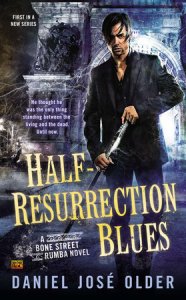
Daniel José Older's urban fantasy novel Half-Resurrection Blues has been called "Noir for the Now."

Daniel José Older’s urban fantasy novel Half-Resurrection Blues has been called “Noir for the Now.”

You write, “Many of our gifts and challenges won’t be seen or recognized within a white cultural context. Nuances of codeswitching, racial microaggressions, the emotional reality of surviving white supremacy, self-translation – these are all layers of the non-white experience that rarely make it into mainstream literature, even when the characters look like us.”

I thought of this in connection with your urban fantasy novel Half-Resurrection Blues. It’s certainly working within the genre of ghost and paranormal thrillers. But there were moments when the fact that it was written by a writer who wasn’t white—and that it was about characters who weren’t white—was very clear. And those moments were great, at least to my mind, because they elevated the book above other similar books. Other books have cool monsters and cool worlds of the dead, but they don’t always comment on society. Did you set out to write a book about, as you say, “Nuances of codeswitching, racial microaggressions, the emotional reality of surviving white supremacy, self-translation”? Or is this simply an essential part of your work?

Daniel José Older

It feels natural to do it. It’s also what I know to be true. Write what’s true and then try to say something. Ultimately, it’s about asking books to multitask. You’ve got this entire book, and you can do a lot of things in it. When a book demands a lot from you, it asks you to step up to its level.

Michael Noll

Do you think the industry shares your enthusiasm for books that multitask? You sometimes hear about books that operate within multiple genres or are doing multiple things and that agents, editors, and booksellers don’t know how to categorize the book.

Daniel José Older

We have a flawed category system. I write urban fantasy, which is a weird term. Urban is code for characters who are black or brown. Then you throw in fantasy, which is almost entirely white. There are very few fantasy writers of color.

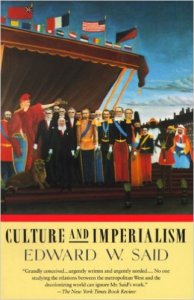
Edward W. Said's book Culture and Imperialism demonstrates that Western imperialism's most effective tools for dominating other cultures have been literary in nature as much as political and economic.

Edward W. Said’s Culture and Imperialism demonstrates that Western imperialism’s most effective tools for dominating other cultures have been literary as much as political and economic.

But there’s probably no way not to have a flawed system. Categories are inherently messy. I’m reading Culture and Imperialism by Edward Said, and he traces the need to categorize back to the nation-state—the idea of borders. And now, of course, we’re talking about walls. With nationalism, we’re talking about how we value life. In a micro way, this is the case in literature: which books are sci-fi, which are high literature even though they have robots in them. All of these are questions about power.

The categories matter. Slavery was invented by white people, but it’s become “black history.” We need to be clear who was doing the enslaving or it gets erased. It’s talked about as a black people problem and is written about in passive voice, without identifying who was doing the enslaving. In the same way, sexual assault is talked about as a woman’s problem. You won’t find it in the men’s section.

Michael Noll

You write, “The question industry professionals need to ask themselves is: How can I use my position to help create a literary world that is diverse, equitable, and doesn’t just represent the same segment of society it always has since its inception? What concrete actions can I take to make actual change and move beyond the tired conversation we’ve been having for decades?” That work, you add, “means taking courageous, real-world steps, not just changing mission statements or submissions guidelines.”

It’s been two years since you published this essay. Have any answers occurred to you? Have you seen this in action?

Daniel José Older

We need to go from a flash-in-the-pan to a sustained movement. The question is how to make even more sustained, not just a buzz word but an actual revolutionary change, not just a new face on the same old shit. A good example of this, in a positive way, is We Need Diverse Books.

All-American Boys tells the story of an act of police violence from the view of the victim and the police officer.

The novel All-American Boys tells the story of an act of police violence from the view of the victim and the police officer.

Because of how publishing works, how long it takes for books to come out, any changes won’t be apparent for a couple of years. One example is All-American Boys, which is about police brutality. That book was rushed—and rushed in a good way. There was a sense that it needed to get out there.

But we need to be on guard against white fatigue, the sense of, well, we’ve had enough diversity. If we’re not careful and precise in these changes, we’ll get something that isn’t good. Diversity doesn’t just mean diverse characters. It means diverse writers as well. If it just amounts to stories about characters of color being told by white authors, that’s not victory. That’s not the point of this movement. There’s a long history of co-option, and it’s especially dangerous. There are quotas in effect—literally. Publishers will say, we already have a black book. But it’s a book by a white person. A black writer is trying to get a book published and can’t because a white person already took that spot.

Michael Noll

So, does that mean creating new imprints and houses? Or changing the existing ones?

Daniel José Older

There’s a new Muslim imprint at Simon & Schuster that looks really interesting, but it can’t be the only answer. There’s no white imprint. It’s mainstream publishing, and that’s what we need to transform.

March 2016

Michael Noll Michael Noll is the Editor of Read to Write Stories.

How to Become a Better Reader

29 Mar
Daniel José Older wrote about the need to transform publishing his essay, "Diversity Is Not Enough: Race, Power, Publishing."

A new anthology of essays on publishing contains Daniel José Older’s excellent essay, “Diversity Is Not Enough: Race, Power, Publishing.”

A few weeks ago, in a university creative writing class that I teach, I was leading a discussion about a student’s story and someone asked, “Wait, is the narrator a man or a woman?” I realized that I wasn’t sure. I had assumed it was a man, but several students pointed out lines that clearly indicated it was a woman. So I began scanning the text, looking for words or phrases that might have pointed me in the wrong direction. There weren’t any. The language and details were clear. The confusion stemmed from the fact that the narrator slept with girls. Several students correctly pointed out that assuming that this character was a man was an example of heteronormative thinking. (If you’re not familiar with that term, as my spell checking software clearly isn’t, it’s the idea that heterosexuality is the baseline and everything else is different and unusual.) I felt pretty dumb. I had misread the story because of my own inherent bias.

This was a humbling experience and a reminder that I must continually monitor my perceptions. Just because I want to believe that I’m unbiased doesn’t mean that I actually am. And my biases almost certainly aren’t confined to gender.

Daniel José Older addresses such biases directly in his excellent essay “Diversity Is Not Enough: Race, Power, Publishing.” It was first published at BuzzFeed and included in the timely and necessary anthology from Milkweed Press, Literary Publishing in the Twenty-First Century.

Why We Need to Become Better Readers

Like most educated people, I like to think that I’m thoughtful and open-minded. As a reader, writer, and teacher, I’ve tried to educate myself about race, ethnicity, gender, and sexuality. And so my wrong assumption about the workshop story bothered me a lot. I came up with excuses for my mistake, like the fact that the student had turned in the story at the last minute—as a result, I’d read it much more quickly than I normally would. If I’d had more time, I would have caught and corrected my own bias.

But this is life, especially in publishing: from top to bottom, there isn’t enough time. Journal editors are flooded with manuscripts, as are agents and book editors and marketers and booksellers. We believe that our decisions are made based on aesthetics and craft, but, in my case, I’m still a straight white guy from rural Kansas. It’s not at all surprising that I make assumptions that are more grounded in bias than reality—and, for that (for leading a class discussion without understanding that the discussion was slanted based on my own biases), I owe my class an apology. I need to do better, and I’m not alone.

Most people in the publishing industry are, like me, white, and, like me, most probably carry with them unacknowledged bias.

Results from a study on diversity within the publishing industry, by

Results from a study on diversity within the publishing industry by the Cooperative Children’s Book Center.

Recent research by the Cooperative Children’s Book Center reveals just how white the industry is: nearly 80%. Whitest of all are book reviewers at nearly 90%. The decisions that these white industry professionals make about books inevitably reflect unacknowledged bias. This is precisely what Older talks about in “Diversity Is Not Enough: Race, Power, and Publishing.

Older tells a story about how “a few years ago, someone in the publishing industry crossed out a line I wrote in a novel.” In the scene, “a Latina character feeling uncomfortable in a shnitzy part of Brooklyn because all the other women of color had little white babies and all the white people were looking at her sideways. The note beside the crossout said: ‘Doesn’t happen in this day and age.’”

Older explains that his personal outrage isn’t the point. Instead, he writes, “I want to take a moment to recognize a more unspoken consequence of having a mostly white industry dictate mostly white standards to a mostly white author-base: the stories that won’t get told.”

Some agents and editors get it. But some don’t. Older describes a panel where agents were asked “what they could do to help shift the troubling lack of diversity.” One agent said, “I think the change is going to have to come from within those who are affected,” meaning writers of color. Another, when asked why “less than 1% of her submissions were from people of color,” said, “This seems like a question for an author to answer.”

Older succinctly puts the problem this way: “The question industry professionals need to ask themselves is: ‘How can I use my position to help create a literary world that is diverse, equitable, and doesn’t just represent the same segment of society it always has since its inception? What concrete actions can I take to make actual change and move beyond the tired conversation we’ve been having for decades?’”

It’s a terrific question, with a couple of surprisingly simple answers. First, the industry needs more diversity: in publishing houses, in agencies, in book reviewers and book buyers and marketers. Second, industry professionals (book editors, agents, journal editors, reviewers, and reading series coordinators) must go out and find diverse writers. This is something I’ve tried to do at Read to Write Stories. Early on, I realized that, when I was coming up with writers I wanted to feature, they were mostly white and mostly men. This was partly due to my own bias and partly due to the industry that I relied upon for book suggestions. I was almost certainly excited about authors that I’d been told to get excited about. I needed to be proactive—to search journals for writers and to return to journals, like Boston Review and Guernica, that seemed to be publishing more writers of color.

Does this search take work? Sure. But it’s been some of the most rewarding work I’ve ever done. (I say work, but, in truth, it’s a community effort. I’ve discovered many, many terrific authors just by paying attention to what books Roxane Gay and Nina Swamidoss McConigley are talking about on social media). I’ve read authors that I may have otherwise missed—Kiese Laymon, Dolen Perkins-Valdez, Michelle Serros, Bae Suah, and Daniel José Older to name just a few—but who I now find myself returning to again and again because of what they have to say and because of their astonishing craft.

As writing teachers and members of writing groups and workshops, we must read more diverse stories. It makes us better readers for our peers in workshop, better members of the literary community, and better writers because we are engaging with terrific work that will inspire and challenge us. Challenge is perhaps the key word. Because I love Kiese Laymon’s work, I teach it often, and the response is often mixed. Some people find the language difficult—or the structure or the plot. Certainly, everyone has different tastes, but it’s also the case that there are many “difficult” writers who have been canonized, not just deceased ones like Faulkner but also living, breathing, award-winning writers like Jennifer Egan, whose great, structurally-challenging novel A Visit from the Goon Squad was deservedly praised. And, of course, not all writers of color are writing “difficult” fiction. Some, like Daniel José Older, are smart, writing terrifically entertaining genre works. His novel Half-Resurrection Blues is a paranormal detective story and has one of the best monsters I’ve read in a long time.

So, start reading. Will it inoculate you from criticism, remove all biases, and make you always correct about matters of diversity? No. I can attest to this personally. But it’s a place to begin.

An Exercise in Better Reading 

Let’s expand our reading, using Daniel José Older’s essay “Diversity Is Not Enough: Race, Power, Publishing” as a primer:

  1. Find a book written by a person of color, a woman, a disabled person, or someone identifies as LGBTQ. There are many included here at Read to Write Stories. You can also look here: We Need Diverse Books, Lambda Literary, the Bailey’s Women’s Prize for Fiction, the Asian American Writers Workshop, The Mixed Experience, Huizache, and Authors of Color. If you’re a teacher or student, consider checking out VONA Voices. If you’re at AWP this week, here’s a panel that speaks to these concerns: Reimagining Literary Spaces.
  2. Read the entire book. Don’t give up, even if the book seems difficult or dull. Personal aesthetics are malleable. Our sense of what is good changes based on what we’ve read. We are, in effect, continually holding whatever we’re reading against the models in our head. So, in order to hone your aesthetic, you must add more models.
  3. Find another book by another writer who isn’t a straight, able-bodied, white man and read it. Don’t stop with just one book. Don’t make an author speak for his or her race/ethnicity/gender/sexuality. Don’t let one writer’s style become The Style for Everyone Who Looks Like Him or Her. Most of us are guilty of this. Whatever book has grabbed the nation’s attention overshadows many other excellent books. Give yourself the opportunity to find them.
  4. Recommend the books to others. Unless a book is getting the gold-standard marketing push from its publisher, its success will depend upon word of mouth. So, tell people about the book. Give it to people to read. Share reviews of the book on Facebook and Twitter. Review the book on Amazon. (Even if you don’t like Amazon’s business model, the presence or lack of reviews on its site affects a book’s sales in all venues.) Books only get read if people know about them, so spread the word.

The goal is to discover the many wonderful books that are being written today. By reading books we might otherwise not find, we become better readers for ourselves and for our fellow writers.