How to Create Depth of Time in Dialogue

13 Oct
A Chicago Tribune review called Debra Monroe's memoir, My Unsentimental Education, a genuine look at how "sometimes you go sideways or down before you go up."

A Chicago Tribune review called Debra Monroe’s memoir, My Unsentimental Education, “a genuine look at how ‘sometimes you go sideways or down before you go up.'”

Good prose isn’t tied to any moment, scene, or place. A passage may be set in a bar on Friday, but the prose can move to a park on Thursday if it wants. It’s this ability to hover and jump that makes a the language of a story or essay seem dynamic. If, at any moment, the writer can take us by the hand and leap, like Dickens’ Christmas ghosts, into another place and time, then we always quiver with just a bit of expectation: what will the writer do next? We’re used to this quality in narration, but skillful writers can achieve the same effect in dialogue.

A good example of dialogue that moves in and out of time can be found in Debra Monroe’s essay, “You’re in Trouble. Am I Right?” You can read it now at Longreads. It’s also included, in slightly longer and different form, in Monroe’s new memoir, My Unsentimental Education.

How the Essay Works

The essay is about Monroe’s experience as a young college student, struggling to find her way in a writing class and with a new boyfriend. At one point, after meeting the boy, she receives a call at the restaurant where she worked:

I was waiting tables one night when my boss, Kristine, called me to the phone. “Debra!” she said, accented, authoritarian. She was German. She’d married an American soldier during the Allied Occupation. She left the receiver uncovered. “It is a phone call from a boy!”

Here is what the boy says (after Monroe has expected to make a date for later in the week). Pay attention to how smoothly the passage moves in and out of time:

Tonight, he said. With Kristine listening I didn’t feel I could say I didn’t get off work until late and had class in the morning. I said I’d call him when I got home. I hung up. Kristine said: “Our poetess has an admirer.” She’d once seen notes I’d scrawled on a napkin. For what class? she’d asked. For a poem, I’d answered, embarrassed. Poetry was a private emission I couldn’t seem to stop. Wonderful, she’d said. And did I know the work of Gottfried Benn? I didn’t.

“Young people are naturally interested in opposite sex,” she said now. “But no more phonings at work.”

A couple of things are immediately noticeable:

  1. Some dialogue is put into quotation marks, and other dialogue is not. There is probably an editor out there with rules about this, but I don’t know them. The rules, if they exist, probably change depending on the circumstances. In this case, the dialogue from the past isn’t put into quotation marks, and the dialogue from the present is, with the exception of when the boy says, “Tonight.” A better way to look at this distinction (quotation marks versus no quote marks) might be this: the dialogue that reveals voice is put into quotation marks, which tend to highlight something, make it stand out. The less distinctive lines are not put set off in the same way.
  2. The present action vanishes. After Kristine says, “Our poetess has an admirer,” there is no attribution or description of scene before she next says, “Young people are naturally interested in opposite sex.” This is a sophisticated piece of craft. Even good writers fall into the tick-tock of dialogue-description: “Blah blah,” he said, scratching his nose. What Monroe does is give a line of dialogue that references something from the past (which we do all the time in conversation, continually referencing past things we’ve said, inside jokes, conversations interrupted, movie quotes). Rather than describe how Kristine says, “Our poetess has an admirer,” Monroe gives the context for the line and even writes dialogue that took place in that contextual moment.
  3. The present action returns, unannounced. Monroe doesn’t write, “Back in the restaurant, Kristine said…” She immediately jumps into what Kristine says, trusting the reader to keep up. The result is a rush through time and context and between exterior action and private revelation (“Poetry was a private emission I couldn’t seem to stop”). This rush is what makes the prose dynamic and interesting. Like a waterbug or Steph Curry, it never moves in a straight line, and so we lean forward, waiting to see what will happen next.

The Writing Exercise

Let’s write dialogue that jumps through time, using “You’re in Trouble. Am I Right” by Debra Monroe as a model:

  1. Choose the moment of dialogue. Don’t choose a moment of high suspense, like a dying character’s last words. Choose a moment that is simply part of your narrative, not the last note of a passage but a moment that exists somewhere in the middle. (The more intensely the reader is waiting for something, as at the end of a scene, the harder it is to avoid, or jump away from, that thing they’re waiting for.) Ideally, the dialogue occurs between characters who have a history, long or short, rather than characters who’ve just met.
  2. Write a line of dialogue that references something from the past. As humans, we have a lovely tendency to reference moments from our past, moments of connection between us and the ones we love (or simply the people around us). It’s why you can spend time with a group of friends and learn a great deal about an absent friend: the others can’t help talking about her. It’s also why the new person to a group is often occasionally lost in conversation, unable to understand the references to shared moments that the others make. So, include one of these moments in your dialogue. Let your character reference a past joke, conflict, or conversation. Or let the character make a joke, observation, or reference to something from the past (it can be anything, really). In other words, let the dialogue reveal the history of the relationship between the characters.
  3. Jump into the reference. Your readers are the new members of the group. They don’t understand the reference. So, tell them about it. Jump into the moment being referenced and either explain or show through scene what was being referenced.
  4. Return to the present moment without transition. It’s almost always the case that transitions are unnecessary. The reader, if you’ve set the scene and context clearly enough, will keep up. Plus, transitions are boring. Plus, sharp juxtapositions are interesting. Monroe juxtaposes Gottfried Benn and “Young people are naturally interested in sex,” which is charming and weird, and so we’re drawn into what gets said next.

The goal is to write dialogue that conveys a sense of time. As a side effect, you may also be able to replace a mundane dialogue tag and description with a flashback or reference that must be explained.

Good luck.
How to Know What’s Worth Showing

6 Oct
Dolen Perkins-Valdez's New York Times bestselling novel Balm follows three African-American characters who have moved to Chicago after the Civil War.

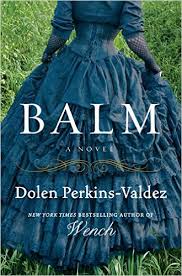
Dolen Perkins-Valdez’s New York Times bestselling novel Balm follows three African-American characters who have moved to Chicago after the Civil War.

When I was a writing student, a teacher in my program was famous for leaning back after a workshop discussion and saying, “Just tell me a story.” As a piece of advice, it’s almost absurdly on point. “Just tell me a story” is what readers across the country are thinking when they pick up a book. They are rarely interested in matters of craft and language. The problem for writers is that short stories and novels are far different from the stories we tell at bars: they’re much longer. Even if you transcribed the tale of that person you know who goes on and on, the result would be much less than 4000 words, the length of a medium-sized story. So what are all those words doing? That’s probably the biggest question that beginning writers ask. The answer is found in learning what information advances the story and what does not.

One of the clearest examples you’ll ever see of the distinction between story-advancing information and details that should be quickly summarized can be found in Dolen Perkins-Valdez’s novel Balm. You can read the opening pages of the New York Times bestseller at the HarperCollins website.

How the Novel Works

Early in the novel, there is a scene in which one of the main characters, Hemp, has moved to Chicago to search for his wife. He’s introduced to Mrs. Jenkins, a woman who takes boarders, and we’re shown their initial conversation:

She narrowed her eyes, wrinkling a scar across her face that had taken some of the bridge of her nose with it. “I don’t allow no riffraff in my house. That include liars and cheats and no counts, the don’t-want and the can’t-do. My husband and me is God-fearing people.”

“Yes, ma’am.”

This dialogue and scene serves two clear purposes. First, it tells the story: how Hemp found a room. But it also shows the reader a character, Mrs. Jenkins, in all her glory. The dialogue is terrific (“I don’t allow no riffraff in my house. That include liars and cheats and no counts, the don’t-want and the can’t-do”) and brings her character to life, so to speak. We can hear her voice. The rest of the scene continues that process of bringing-to-life for both characters:

“I cook once a day. In the morning before you go off to work, you and the mens sit down with my husband. You got to fend for your other eats.”

“Yes, ma’am.”

“Course I don’t allow for no loafing. You can’t sit round here all day.”

“Yes, ma’am.”

“Come on eat. It’s some hoecakes left. You look hungry as a mule. Then get yourself on out in them streets and get some work.”

“Yes, thank you,  ma’am.”

“You don’t say much, do you? That’s good. Ain’t room but for one talker round here. Haw!”

The conversation ends with Hemp explaining that he’s looking for his wife and Mrs. Jenkins promising to keep “an ear on it.” As a scene, it makes sense. We’ve been introduced to the characters and given a feel for their personalities; we’ve been drawn into their lives. We’ve also been introduced to the stakes of the story: Will Hemp find his wife? But look at what the novel does next:

Hemp got work loading ship a week later and earned his first wages as a free man. He bought a sack, shoes, pants, but even his first paying job could not help him shake the sadness. He asked everyone he met, but no one knew of a woman fitting Annie’s description. He decided it would be better for him to stay in one place. It did not make sense for both him and Annie to be moving around.

Before the month was out he knew that as nice as Mr. Jenkins was, he could not go on sleeping in that tight, dark room.

While the novel dramatizes and puts in-scene the initial conversation with Mrs. Jenkins, it summarizes a month of conflict: Hemp’s search for a job, his fruitless search for his wife, and his decision to find a new place to live. All of that could have been the subject of engrossing scenes, yet Perkins-Valdez summarized it. Why? The answer could tell us something about what is important in a story. In this case, what was important was establishing the characters, their voices, their desires. Once we understand those things—once we get a feel for the characters—we don’t need to see their every move. We intuitively understand how those summarized scenes might have played out, and we can skip ahead to another pivotal moment.

The Writing Exercise

Let’s dramatize character and voice and summarize action, using Balm by Dolen Perkins-Valdez as a model:

  1. Choose a pivotal moment in your story. By pivotal, I mean that someone acts, something changes, or a decision gets made. Our usual approach is often to put this moment in scene, but we’re going to try a different approach.
  2. Find or create an interaction that occurs before the pivotal moment. As in Balm, the interaction can be between two characters: a conversation or any moment that requires the characters to work together or against each other or do something at the same time. But the interaction can also be between the character and an object or place: think about Jack London’s famous story “To Build a Fire” and its scene with the man interacting with the wood that he’s trying to burn.
  3. Use that interaction to show off a character. The scene from Balm could easily come with a title: “This is what Mrs. Perkins is like and how newly-arrived Hemp reacts to her.” All of the dialogue and descriptions (“narrowed her eyes, wrinkling a scar”) actively build our sense of Mrs. Perkins. Hemp’s simple dialogue (“Yes, ma’am”) does the same thing. The goal is to give the reader an understanding of who these characters are. Once we have that, we will usually understand their actions. So, choose a moment that allows you, through dialogue or action, to show off the characters, to give the reader a sense for who they are.
  4. Give the scene purpose. In Balm, Hemp is looking for a room and for his wife. He’s not simply shooting the breeze with Mrs. Jenkins. In your scene, something needs to be at stake. The stakes can easily be resolved, as they are in Balm: Hemp gets a room but doesn’t find out anything about his wife. Not every scene needs a pulsing, Hans Zimmer drumbeat in the background. But every scene needs a reason to exist.
  5. After the scene is over, summarize the pivotal moment. Balm summarizes Hemp’s search for a job and his wife and his decision to find a new place to live. After seeing his conversation with Mrs. Jenkins, we can imagine him doing these things, and so it’s not necessary to show them. In the same way, you can dramatize a character-building moment and then trust that the traits you established will be clear enough to make sense during a quick summary of events.

The goal is to build a story that relies more on character and voice (which are inherently interesting) and less on minute-to-minute action (which can become tedious).

Good luck.

An Interview with Rene S. Perez II

1 Oct
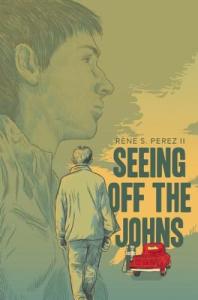
Rene S. Perez II won the Alfredo Cisneros del Moral Foundation Award for his story collection, Along These Highways. His latest book is the novel Seeing Off the Johns.

Rene S. Perez II won the Alfredo Cisneros del Moral Foundation Award for his story collection, Along These Highways. His latest book is the novel Seeing Off the Johns.

Rene S. Perez II is the author the story collection, Along These Highways, which won the Alfredo Cisneros del Moral Foundation Award and the 2013 NACCS Tejas Award for Fiction. His newest book is the novel Seeing Off the Johns. Perez was born in Kingsville, Texas, and raised in Corpus Christi. He received an MFA from Texas State University and currently teaches high school in Austin.

To read an exercise about backstory inspired by Seeing Off the Johns, click here.

In this interview, Perez discusses why teens want realistic stories, even if those stories are sad; the formatting challenges of italics in POV shifts, and what happens when the novel you’re writing suddenly disappears from your computer.

Michael Noll

This book is ferociously sad—and not in a gratuitous way, I might add. There’s a kind of firm reality to it that I recognize from my own childhood and hometown, and so I was able to connect with these characters very easily. And yet—whew, that opening is a tear-jerker. Did this make it a difficult novel to pitch and sell? Young Adult novels aren’t strangers to sad topics (John Green, The Fault in Our Stars), but this feels somehow different, if only because it’s a more realistic novel than that one, less of a romantic comedy (even though it has a romance). I’m curious if anyone (publishers, readers, writers) pushed back against the opening.

Rene S. Perez II

I never considered that I was writing a YA book. I think the very fact that I stumbled upon one by virtue of the age of my protagonist while not trying to write one can be both a big help and potentially a detriment. When I finished the first draft of the novel, I thought that I could get at least considered/read by presses and agents. I queried four agents. Three replied back, likely due to the “success” of my first book. Each of those who responded all said the same thing: It’s too sad. They wanted me to highlight the romance, and one even asked, if it were possible, focus less on the deaths at the center of the story.

When I found my eventual publisher, they got what I was going for and were all in. What they did want to change, initially, is the ending. I was hesitant to do so and mentioned that in my first conversation with my editor. When she read through again, she saw why the novel has to end how it does. It’s basically stayed the same, story-wise.

So, in those regards, sure, there was some pushback. I do think, however, that since this is being marketed as a YA book, the fact that I never initially set out to write a YA book but to write a realistic novel about the weight of a tragedy on a town, it will resonate more clearly with young readers. I really do think young readers want to be taken seriously. They want to engage in discourse on the big questions. They appreciate knowing the kiddie gloves have been taken off.

Michael Noll

The POV shifts are fascinating. In the first, we have so much empathy for the Johns and their families. Then we’re introduced to Chon, and we begin to see the Johns, especially John Mejia, in a less empathetic way. We begin to dislike him, just as Chon does. But then this feeling gets complicated by more shifts. This seems like a difficult thing to pull off, to successfully get the reader to reconsider an attitude toward a character. How did you approach this challenge?

Rene S. Perez II

The shifts are from close third-person focus on Chon, our protagonist, to an omniscient third-person narration that zoom out wide to show the tragedy’s effect on the town. With that, we get to see how Chon’s initially low opinion of Mejia is counter to the town’s adulation of him. But as the novel goes on, we see the town shifting—forgetting or divesting from the promise Mejia, and both Johns, had. We see Chon recognize it, and the curve of his feelings toward the Johns, Mejia in particular, and the curve of the town’s feelings intersect. Shifting from Chon to the town, zooming in and out, helped to show Chon change, and it changes the reader too.

Seeing Off the Johns, the debut novel from Rene Perez II, is a BookPage Teen Top Pick and has been called "a searing, mature novel."

Seeing Off the Johns, the debut novel from Rene Perez II, is a BookPage Teen Top Pick and has been called “a searing, mature novel.”

Michael Noll

Still on the subject of POV, how much planning did you do? When you began the novel, did you have a sense for which characters would receive their own POV and where those chapters would appear in the novel? Or was this something you discovered while writing the book?

Rene S. Perez II

As far as planning goes, I knew from the first time I filled the blank page that I would move from the town to Chon and back out. In fact, the original manuscript of Seeing Off the Johns had the town sections in italic typeface. I decided before word one that there would be italic sections and regular sections. Having allowed myself that, within the italic sections, I was able to really stretch out and get comfortable within the omniscience. I am able to jump ahead and back in time. I am able to tell biographical details of people in town or histories of places. I really gave myself license to push that as far as I needed, because I knew that the visual cue of the italics would let the reader know toe expect those shifts.

When Lee Byrd, my editor at Cinco Puntos, gave me her first notes, she did away with the italics. Just like that. It was a lot to get used to for me after having written in so specific a way. But now that I read it without the italics, it makes for a more interesting read. It certainly makes it seem like I was being more daring formally than I really was.

Michael Noll

You’re a high school teacher, and an English teacher to boot, and so I know you’re putting in a lot of hours on planning and grading. Where do you find the time to write? What’s your strategy?

Rene S. Perez II

I wish I would tell you that I have some solid work ethic that I organize my life into being able to write every day. Hell, I can’t even motivate myself to write every day. What I do is make sure to always have access to notes. In various forms ranging from texting myself to notes on my phone to e-mailing myself to always having my notebooks handy, I am always ready to put down ideas for characters or stories or plot points of larger works. Then, as that becomes more fruitful, I pick times when I can sit and either transcribe paragraphs or sentences I’ve handwritten into a larger work or get started on a story.

That’s how I work. I always allow ideas to at least start. I always have a couple stories and, as has been the case for the last 5 years, a novel in progress. That way I can always turn from one project to another. I tell myself I work best on something when I’m stealing time from something else. If I always have something I’m itching to work on, when I am done with school work and the baby’s bathed and in bed, or on weekends when my wife is stepping up so I can sequester myself in one of my writing holes, quality writing happens.

Michael Noll

A few years ago, I heard you say that you’d just lost a novel through a computer failure. Was this novel? What happened? Did you rewrite the entire thing?

Rene S. Perez II

Ah, the lost novel! I started writing Seeing Off the Johns while waiting for the first book to happen. When I finished SotJ, the collection, Along These Highways, was out. I showed SotJ to an editor who gave very thoughtful feedback. She said something was missing. I could feel it too. Now, while waiting to hear back on SotJ, around 2011, I had started to write another novel. It was cool and noir-ish and rolling along quite well. I was almost done with a first draft when I lost it. At that point I knew I only had two options: I could either set about to rewrite the lost novel or I could fix SotJ. I chose to write a play instead. When I finished that, push came to shove. I tore SotJ apart. I felt like a mechanic in a hollowed out car needing to find a faulty plug and put the damn thing back together. I figured it out (in the first draft, I was satisfied with the novel being 3-dimensional because of the POV shifts, but I’d neglected to make Chon fully rounded) and fixed it, and now the Johns is almost out.

A postscript on the lost novel: I’m still chipping away at the rewriting in notes and on the manuscript, but I’ve also started a new novel. We’ll see which happens first.

September 2015

Michael Noll Michael Noll is the Editor of Read to Write Stories.

How to Jump Out of Scene into Backstory

29 Sep
Seeing Off the Johns, the debut novel from Rene Perez II, is a BookPage Teen Top Pick and has been called "a searing, mature novel."

Seeing Off the Johns, the debut novel from Rene S. Perez II, is a BookPage Teen Top Pick and has been called “a searing, mature novel.”

Some famous writer or another once said that stories and novels don’t portray a life but, rather, a glimpse of one part of the life that suggests the entirety of the whole. This is all well and good until you try it. You find yourself wondering, “Which snapshot is the right one?” or “What part of my life suggests the whole thing? I hope it’s not the part where I forgot to put on deodorant.” It can be an impossible question to answer. A better question might be this: How can a particular scene or moment reveal the constant process of change that is part of any life?

This is what Rene S. Perez II does in his debut novel, Seeing Off the JohnsIt will be published on November 3, which means you can take off work to buy it and tell your boss that you were voting.

How the Novel Works

Early in the novel, there is a scene with two couples meeting for dinner. Their sons are long-time friends and have just left home together to attend the University of Texas and play together on the baseball team:

He held out a glass of bourbon to Andres while Angie poured a couple of margaritas in stemware waiting on the table. They raised their glasses, the four of them, and looked at each other as though they’d all just rolled out of bed after an afternoon of intimacy.

“To our boys,” Angie said.

The novel uses this moment as an opportunity to give a brief history of the relationship between the Mejias and Robisons, a history that begins this way: “They had always gotten on this well, despite their difference in age.” We learn that the Robisons are older. They’re white and the Mejias are Hispanic. They’re upper class, and the Mejias are working class. The history of the relationship, then, is, to some extent, the history of how the couples dealt with these differences.

The passage tells that history from the Mejias’ point of view and begins with a description with the meals that the Mejias prepare for guests:

The Mejias rarely strayed from their standard foods—fideo and meat, tacos and chalupas, easy ricotta-free lasagna, beef and, more rarely, chicken enchiladas.

Then, the novel sets up the difference between the Mejias’ food and the Robisons’ food:

The Mejias had felt a sting of embarrassment when they went to the first of their dinners with the Robisons. They knew the Robisons were well off—Arn was the youngest grandchild and sole remaining Greentonite of Samuel and Wilhelmina Robison, who’d made a small fortune on a ranch outside of town. Arn had inherited money from them. He’d worked hard all his life as a horse doctor and hit big on some investments. But the Mejias weren’t prepared for the kind of food the Robisons were used to.

And what is that difference?

That first meal together, the Robisons served blackened catfish, which Julie thought was too fancy for her taste.

But what makes the passage interesting is the next line:

Over a decade of dinners, though, the Mejias accepted that there would be the occasional lobster tail or swordfish or prime rib or hundred-dollar bottle of bourbon.

This is how a novel or story uses a snapshot to suggest a life. Seeing Off the Johns starts with a dinner and uses it as touchstone for the entire 20-year relationship between the two couples. In that history, we learn not just the differences between the couples but how they’ve navigated those differences, and it’s that struggle that reveals the life and makes for interesting drama.

The Writing Exercise

Let’s reveal a life with a scene, using Seeing Off the Johns by Rene Perez II as a model:

  1. Choose a scene that contains a recurring moment. Perez builds his scene around a dinner, something that occurs every day and is shared by these couples on a regular basis. There are many potential, daily moments like this, and there are also other less mundane ones: recurring arguments, recurring obstacles, recurring bad habits or giving-in to vices. Even first-time moments (sex, drugs, murder) are often part of longer arcs: “the character walked this street every day until…” or “she’d been coming to the same bar for years, but on this night…” So, first, figure out which scene you’ll use as the jumping-off point for the backstory.
  2. Jump from scene to backstory. You can make the jump by reversing the order of the lines used to introduce the scene. “She’d been coming to the same bar for years, but on this night…” becomes “On every other night at the bar…” This is essentially what Perez does: “They had always gotten on this well, despite their difference in age.” The line could have read, “Every other time they’d met for dinner, they’d gotten on this well.” What he adds is the word despite, which is a great way to add tension. It adds a charge to the mundane: “She’d been coming to the same bar for years and never been hit on despite…” Give the line a try by combining the usual with the word despite.
  3. Build a narrative upon that despiteThe word inherently suggests story. Why didn’t guys hit on the woman? Why did the Mejias and Robisons get along? The answer almost certainty involves a revealing detail about human nature (She was six-foot-five and intimidating to the sort of men that drank at the bar) or a character’s decision (Over a decade of dinners, though, the Mejias accepted that there would be the occasional lobster tail or swordfish or prime rib or hundred-dollar bottle of bourbon.) Note that word accepted. They could have refused to accepted the difference in wealth, but they didn’t. They decided to get along. What you get, then, is a narrative that goes something like this: ___ has been happening for a long time despite ___, and the only reason this scene is happening now is because _____.

The goal is to craft piece of backstory that jumps out of a scene and illuminates the lives behind the scene.

Good luck.

An Interview with Matthew Salesses

24 Sep
Matthew Salesses is a Ph.D. student in Creative Writing at the University of Houston and, already, the author of three books, most recently the novel The Hundred Year Flood.

Matthew Salesses is a Ph.D. student in Creative Writing at the University of Houston and, already, the author of three books, most recently the novel The Hundred Year Flood.

Matthew Salesses is the author of The Hundred-Year Flood. His other books include the essay collection Different Racisms and the novel I’m Not Saying, I’m Just Saying. He was adopted from Korea and has written for NPR Code Switch, The New York Times Motherlode, Salon, The Good Men Project, The Toast, The Millions, Glimmer Train, PEN/Guernica, and has received awards from the Bread Loaf Writers’ Conference, Glimmer Train, Mid-American Review, PANK, HTMLGIANT, Emerson College, Inprint, and the University of Houston.

To read an excerpt from The Hundred-Year Flood and an exercise on finding a story’s beginning, click here.

In this interview, Salesses discusses chapter beginnings, the inspiration of The English Patient, and how the critical rhetoric around a book matters.

Michael Noll

The first paragraph of Chapter II is dazzling in how much information it handles in such a compact, tight narrative passage.
 How long did it take to get it into its current form? 

Matthew Salesses

It was actually shorter before. I added Tee’s response and the container (as a way to show Tee’s version of passivity and activeness) very late in my edits. Tee’s girlfriend’s words in Boston act like a kind of prophecy. She says things that can guide him either by following them or resisting them, but they break up before the plot starts. Her words echo.

Michael Noll

I’m curious about the pacing of this novel. There’s a kind of dreamlike quality to it. It switches back and forth between characters (Katka and Ynez, for instance) in a way that they begin to blend together. And in the switch, the narrator will do things like pick up a book and read a line like this: “The presence of want awakens in him nostalgia for wholeness.” It’s such an ethereal, meaning-packed line. What models did you have for this sort of narration?

Matthew Salesses

I thought a lot about Ondaatje’s The English Patient, even as far as the books he uses in it as a guide. The line from Anne Carson [“The presence of want awakens in him nostalgia for wholeness”] was, for a long time, a line from Henry Miller: “the guardians of secret crimes” or something.

Michael Noll

Matthew Saleses' novel The Hundred-Year Flood has been called "epic and devastating and full of natural majesty." It follows a young man to Prague as he struggles to understand his identity and how it fits into the world.

Matthew Salesses’ novel The Hundred-Year Flood has been called “epic and devastating and full of natural majesty.” It follows a young man to Prague as he struggles to understand his identity and how it fits into the world.

The novel is very much about art and questions of how the artist and subject are revealed (or not) in a piece of artwork. So, the characters discuss poetry, we see various paintings and their creation, and the narrator spends a lot of time thinking about big questions about identity, memory, and art. This seems to be where the heart of the novel lies, which makes me curious about plot. How did you find or develop a plot mechanism that would give you the space needed for the characters to address these questions?

Matthew Salesses

Interesting! It makes me happy that different readers can bring to the book different interpretations. I didn’t think about the art/subject question in terms of plot. The plot is basically a love story. Though it’s a love story that begins with Tee as an artist’s model, as an object, of sorts.

Michael Noll

You’ve written in various places about how people of color are treated in American literature. It’s not, you’ve said, simply that most books are about white characters but that when people of color do appear in novels and stories, they’re portrayed in a handful of predictable ways. There aren’t many novels in which, as in this case, a Korean-American travels abroad. The Innocent Abroad and The Ugly American are almost always white. Do issues like these inform your writing? In other words, do you see a lack or absence in the books around you and think, “I’m going to fill that absence?” Or are you simply writing the stories that occur to you and then realizing that there is very little else like them?

Matthew Salesses

I was actually thinking of books about other Americans abroad as “like mine.” Most people don’t seem to see the book as part of that tradition. It’s kind of fascinating. We need more books where people of color do things white Americans have done in fiction for ages. But on the other hand, the fact that my book is seen as filling an absence creates the situation where we don’t get more of those books. It’s like we’re expected to plug holes.

September 2015

Michael Noll Michael Noll is the Editor of Read to Write Stories.

How to Fast Forward to the Real Story

22 Sep
Matthew Saleses' novel The Hundred-Year Flood has been called "epic and devastating and full of natural majesty." It follows a young man to Prague as he struggles to understand his identity and how it fits into the world.

Matthew Salesses’ novel The Hundred-Year Flood has been called “epic and devastating and full of natural majesty.” It follows a young man to Prague as he struggles to understand his identity and how it fits into the world.

A smart guy named Aristotle once wrote that a dramatic structure (story) has three parts: a beginning, a middle, and an end. This sounds like common sense until you try to put it into action. Pretty quickly, you’ll realize that something as simple as a beginning is actually difficult to find. Where does a story begin? Unless the story starts with your character’s birth or conception or with the Big Bang, the first page won’t necessarily be connected to any chronological beginning. So, you must locate a moment somewhere in the character’s lifespan that makes sense as a place to start.

Matthew Salesses uses a great fast-forwarding strategy to discover such a beginning in his new novel The Hundred-Year Flood. You can read an excerpt at Hyphen Magazine.

How the Novel Works

When I was in grad school, it was a running joke in workshop that the professor would, at some point in a class, hold up the story being discussed and tear off the first three pages. The point was that writers, like old television sets, often needed time to warm up. The place where the story began was usually on page four, not page one. What got dropped to the floor usually consisted of backstory. With that in mind, look how Salesses begins The Hundred-Year Flood. (It’s actually the start of Chapter 2. The first chapter is a teaser for where the novel is headed: a hospital rehabilitation center, with the character remembering who he is.)

The day Tee decided to go to Prague, his girlfriend pulled him aside at a birthday party in Boston. The talk had turned to 9/11. “Stop acting so tragic,” his girlfriend said in his ear. “For God’s sake, others are suffering worse. Your uncle only killed himself. He didn’t die in the towers.” That was when Tee knew he couldn’t stay in America. He downed his IPA and said, “Only?” Everyone was talking about death, but he had to keep quiet. He was filling a container inside of him. Into it, he put the things he couldn’t say—about the seduction of forgetting. When his container was full, he would dump himself out in one dramatic move. A case in point: by the end of that week, he had broken up with his girlfriend and requested a leave of absence.

This paragraph contains multiple opportunities to begin a story: 9/11, the day Tee’s uncle committed suicide, and any number of scenes that would have charted the rising conflict between Tee and his girlfriend. All of these could have been good places to start. In fact, another writer might have chosen one of them. But Salesses did not. He chose to begin the novel with his character moving to Prague, and all of the action takes place there, with the flood from the title serving as a kind of ticking clock for Tee to resolve the issues that took him to the city in the first place. As an arc, it makes perfect sense, and it gives the novel a sense of coherent wholeness.

That said, given the events identified in the paragraph above, there was no structural requirement for Salesses to frame the story as he did. One of the mistakes that beginning writers often make is believing that there is some golden ratio for narrative, that if they can simply locate that ratio in their story, everything will come together. This is part of the allure of screenwriting books that lay out story beats like connect-the-dots puzzles. Those guides can work for some writers, but for many other writers, discovering the arc for their stories is a process of trial and error. The genius of Salesses’ novel is not that it frames the story as it does but that it identifies its frame and then quickly moves the reader into it. There’s no need to rip away the first three pages. He condenses them into a single paragraph, orienting the reader, and then the novel is on its way.

The Writing Exercise

Let’s write fast-forward through alternate beginnings using The Hundred-Year Flood by Matthew Salesses as a model:

  1. Identify the story you want to tell. One approach is to think about what will appear on the back cover of the book. Here’s what appears on Salesses’ novel: “Tee contemplates his own place in life as both mixed and adopted and as an American in a strange land full of heroes, myths, and ghosts.” This is what the novel is about, and the story is whatever series of events best allows Salesses to portray Tee’s contemplation. In literary fiction, the story, or plot, often stems from an internal conflict as much as from an external one. So, figuring out where to begin often requires knowing what that internal conflict is. Try summing it up with an internal action word: contemplates, struggles, grapples, wrestles.
  2. List possible starting points for that conflict. Perhaps the conflict predates the character, which is sometimes the case with internal conflicts that result from external conflict (war, bias, hatred). Perhaps it begins with a relationship gone sour (romantic, parental, work, neighbor). It might start with an event with a quick resolution (like death, as in the death of Tee’s uncle or the deaths on 9/11) but with emotional consequences that ripple away from the event. Or, as in Salesses’ novel, the conflict might begin in earnest when the character makes a decision. After all, a conflict requires two actors. If one side is doing nothing or not resisting (even passively), then there isn’t really a conflict, only the potential for one. List as many possible starting points for your conflict as you can.
  3. Pick one. The story has to begin somewhere. Which of the points on your list seems to have the most immediate potential for narrative? The answer might leap out at you, or you may need to start writing from each point and see where your writing sustains itself and keeps going and where your writing peters out. To some extent, a beginning is about energy. Without that energy, the story can’t go anywhere.
  4. Summarize the points leading up to the chosen beginning. Try giving yourself a temporary title for a paragraph: How the character/narrator got to this point. Keep it short and quick. If you’ve got kids, imagine telling someone this summary over the phone while your kids jump up, reaching for your phone. You may end up using this paragraph to start your story. Or, it may serve as a warm-up that eventually is discarded. Either way, the paragraph can prepare your mind for the narrative you want to tell and the arc that you’ve created.

Good luck.

An Interview with Steve Adams

17 Sep
Steve Adams has won multiple awards for his writing, most recently a Pushcart Prize for his memoir, "Touch."

Steve Adams is a writing coach has won multiple awards for his stories, plays, and essays, most recently a Pushcart Prize for his memoir, “Touch.”

Steve Adams lives in Austin, Texas, where he is a writing coach. His memoir, “Touch,” appeared in The Pushcart Prize XXXVIII. He also has been published in Glimmer Train, The Missouri Review, The Pinch and Notre Dame Magazine. His plays and musicals have been produced in New York City.

To read Adams’ essay, “Waiting Till the Wait Is Over” and an exercise on directing the reader’s gaze, click here.

In this interview, Adams discusses writing for an imagined audience, shifting POV without knowing it, and circumventing chronology.

Michael Noll

You make an interesting nod to the reader at the beginning of the second paragraph: “People who have issues with hunting do not understand hunting as I experienced it.” Did this line always exist in the essay, or were you anticipating something about the particular audience for this particular magazine—that readers might have issues with hunting?


Steve Adams

I did not write this essay for that particular magazine, but wrote it, as I do most of my pieces, because a story or essay idea came to me. Afterward I try to find a home for it. That particular line was for my imagined audience while writing it. I’m a liberal, but I’m also a liberal from Texas with a hunting background, and posts from friends on Facebook and elsewhere in social media are not always forgiving or understanding toward hunters. I have a paranoid vision of a reader out there who’s screaming “Bambi killer!” at me. And though I happen to be one, I haven’t hunted since I was a teenager. So I placed that line there to try to buy time from that reader, to establish the possibility that there might be more going on with hunting, at least under proper conditions, than just slaying animals.

The original concept, before I even knew an essay would come from it, occurred in a random conversation at a party in 2002 when I was finishing up my MFA at The New School. I’d developed a reputation for being a guy who produced pages (whether good or bad) regularly, and classmates began asking me for advice along those lines. Writing’s tough for everyone, but I had no idea of the degree that a lot of otherwise gifted writers struggle to simply get words to the page. I’m a writing coach now, and I realize The New School is where I began coaching writers. Anyway, this friend and I were talking in 2002—I specifically remember we were standing a door frame leading to a living room—and somehow via the conversation (thanks, Rebecca!) we discovered that I wasn’t just a natural at producing pages, but that I’d had perhaps the best training possible for such work, and at a very formative age. It was a huge “Aha!” moment for me. Then maybe three years ago I came across the crazy/stupid/wonderful German word “sitzfleisch,” which describes the same capacity, namely being able to keep your butt (or your sit-flesh) in a chair and see a project through to completion.

Michael Noll

You also make a cool chronological move: telling the history of your experience with hunting from first grade to age 14 and, then, shifting back in time (“But I’ve jumped ahead. I want to go back to age 5.”) This seems like a move that many writers could borrow since chronology can be such a trap. We get caught in it and can’t escape, which limits our ability to make sense of events (a process that tends to be circular, not straightforward). How did you find this strategy? Purposefully or through happy accident?

Steve Adams

Good point regarding chronology. I worked with those sentences quite a bit trying to get the passage to feel “right.” First I listed a brief sequence of events, then circled back through expanding on them, and then told the reader I wanted to stop and go back and explore the larger meaning, the larger story they tell. I didn’t decide on that technique beforehand, but tried to follow what the essay seemed to want at the time, which is what I always do if I can. By the circling, as you noted, I think I was instinctively trying to circumvent being locked into strict chronology. I wanted the reader to pull up at that moment, to look back and instead of seeing those moments as separate and linear, to see them as a whole. I also wanted the reader to stop and consider what it might mean that as a child I carried a lethal firearm beside my father and knew full well it was lethal, as well as that if I did something really stupid I could accidentally take his life. He gave me an enormous responsibility by putting a gun in my hands, but also a staggering trust. The gesture carries immense personal weight for me.

Michael Noll

Steve Adams' essay, "Waiting Till the Wait Is Over," is a meditation on hunting and writing and the surprising connection between the two.

Steve Adams’ essay, “Waiting Till the Wait Is Over,” is a meditation on hunting and writing and the surprising connection between the two.

I love your shifts in perspective. For example, you start one paragraph like this: “Picture me beside him, our feet hanging off the platform’s edge.” And the very next paragraph starts this way: “Here is how you manage your presence on the deer blind.” This is the sort of thing that would seem to be forbidden by workshop teachers, but it’s really effective in drawing in the reader. Do you have a particular strategy for switching POV?

Steve Adams

I don’t have a particular strategy so much. And frankly, I wasn’t even aware I’d done that until you brought it up. But I went over that passage a lot, and again, in a focused creative state trying to make it “right.” And I just made that move and worked with it, much as a painter might intuitively decide their painting needs more yellow in the upper right hand corner, and without analyzing why (“why” doesn’t matter as much as “what”), does the work of adding it in. I was keenly aware of how the words sounded. But looking back and putting on my analytical goggles, I think part of my attempt was to break up the narrative flow. Like in the passage above where I break up chronology, I wanted to get the reader to slow down and consider not just the facts of this child’s experience (freezing, feet going to sleep, nose running, unable to move except in the smallest and smoothest of increments), but the fact that this particular child raised in this particular tradition wouldn’t even think twice about such discomforts, thereby (hopefully) causing the reader to frame them and that unit of thought as a whole unto itself that would connect to the discipline of writing.

Michael Noll

The essay is about the writing process, which is surprising given that it’s published in a general-interest magazine, not one aimed solely at writers. Is that why the writing aspect of it doesn’t appear until the end? Were you trying to draw the reader in with hunting and then make the connection with writing after the reader has bought into the story you’re telling?

Steve Adams

Notre Dame Magazine is an interesting hybrid sort of magazine. It’s general interest and focuses a lot on work from Notre Dame alums, but also has a section toward the back called Crosscurrents devoted to more personal essays. They’ve racked up a number of “notable” mentions from the Best American Essay series, and I know of one essay that was published in the series in 2013. My essay went in their magazine almost as-is. I’ve just placed a second piece with them so clearly we’ve got a sympatico relationship happening. They don’t shy from a piece that has a spiritual or ethical component (and not just Christian), and there’s definitely a strain of spiritualism through my essay and the next essay they took.

More than anything with this piece I just wanted to find a way to connect hunting, once I realized the impact it had on my life, with the discipline of writing. By my way of thinking, done right, both are spiritual disciplines. Both demand patience and endurance and usually a degree of hardship before you experience a shift in perspective. And I believe my instinct with this piece was to establish hunting as such a discipline first and foremost, then take a quick dip into meditation, and finally do that swoop into writing at the end, hopefully bringing it all together in a single gesture.

September 2015

Michael Noll Michael Noll is the Editor of Read to Write Stories.

How to Direct the Reader’s Gaze

15 Sep
Steve Adams' essay, "Waiting Till the Wait Is Over," is a meditation on hunting and writing and the surprising connection between the two.

Steve Adams’ essay, “Waiting Till the Wait Is Over,” is a meditation on hunting and writing and the surprising connection between the two.


If anything defines great writing, it’s the ability to control chronology and time. Inexperienced writers will start a chapter or story with an alarm clock and end the piece when the character goes to bed or passes out. In other words, their structure is driven by time and consciousness. A few weeks ago, I wrote about creating pockets of narrative as a way to avoid the chronology trap: the tendency to kill tension by narrating a story blow-by-blow, one thing after another. But that’s only one method for corralling time. Another great strategy is to step outside of chronology to point the reader toward what is important.

This strategy is put to excellent use in Steve Adams’ essay, “Waiting Till the Wait Is Over,” which was published in Notre Dame Magazine, where you can read it now.

How the Essay Works

The essay begins as a story about learning to hunt: “The greatest gift my father may have ever given me came as a byproduct of a wish — he wanted me to be a hunter.” The first paragraph ends with a condensed history of his education as a hunter:

I was fishing with him as early as age 3; at 7 carrying a BB gun as we skirted a cornfield for doves; by 9 crouching in a duck blind with my pint-sized 410 shotgun at the ready; and at 11 sitting next to him up high in a tree blind as we hunted deer.

The essay then elaborates on this brief chronology with several paragraphs of specific details:

  • “at 3 I could be quiet and still in a boat”
  • “By first grade I knew how to scan a trail for snakes, for copperheads and rattlers.”
  • “In the third grade I was carrying a firearm that could kill my father.”
  • “When I was 11 my father drove us from our home in Grand Prairie, one of the suburbs of Dallas-Fort Worth, down to his lease in the Texas hill country.”
  • “A few years later he bought me a rifle small enough to manage, a Winchester lever-action 30-30.”

The chronology of how Adams learned to hunt is now firmly established in the reader’s mind. Now, watch what he does next:

But I’ve jumped ahead. I want to go back to age 5. Or 6 or 7. To consider the hours I spent fishing in the boat with my father, walking beside him hunting doves, hunkered in the duck blind waiting for the birds to fly in. I sat beside him in the tree blind and never saw him shoot, or shoot at, a deer.

Story matters. As readers and viewers, we often demand an ending. I’ve heard many people say that once they start a book, they rarely quit before reaching the end. At movie theaters, you almost never see people walk out, even when them films turns out to be terrible. We are, it seems, genetically obligated to follow a story until the very end. Adams accounts for this, twice telling us the basic sequence of events that mark his becoming a hunter. But that chronology isn’t what he really wants to write about. And so, once he’s charted the story, he points us toward what he feels is truly important. He’s not subtle about it: “But I’ve jumped ahead. I want to go back to age 5. Or 6 or 7. To consider…”

I often say this in classes, but subtlety isn’t always a virtue. In workshop, students often use the word authority, and for a long time, when I was a student, that term had a fuzzy meaning. How did one gain authority? What made prose confident? The answer, I’ve come to believe, is that stating things clearly when clarity is called for. Adams writes, essentially, “That’s the outline of the story, but, now, look here. Pay attention to this.” He steps outside of the forward momentum of chronology and focuses on a particular idea, a particular moment—the aboutness of the story, the reason he’s telling it in the first place.

The Writing Exercise

Let’s step outside of chronology and direct the reader’s attention using “Waiting Till the Wait Is Over” by Steve Adams as a model:

  1. State what will happen in the story. Adams does this with his first line: his father wanted him to be a hunter. The suggestion is that this is exactly what happened. How can you state the chronological end of your story in the same way? You can use Adams’ template: “My ____ wanted me to _____.” The understanding behind such a statement is that you, the writer (or your character), either did or did not do what was desired. You can also cut the second party and make the statement personal: “I wanted to _____.” The word wanted can also be replaced with words like loved, feared, hated, or obsessed over.
  2. Give the basic chronology of the story. Adams’ father wanted him to become a hunter, and over the course of 14 years, that’s exactly what happened. Adams highlights moments along the way that stand out to him. Almost any narrative can be broken down this way: I was headed here, and along the way, this and this and this happened. You’re basically giving the short version of your story.
  3. Redirect the reader toward what’s important. Most stories are not, ultimately, about the ending of their plot. Instead, they’re about the meaning or unexpected consequences of that plot. Even The Lord of the Rings is not really a story about a hobbit tossing a ring into a mountain of fire; it’s about the passing of magic from the world, and Tolkien repeatedly directs our attention toward this consequence of the plot. So, consider a moment along your narrative arc that seems worth of considered attention. Put another way, what part of the story does your mind return to, over and over? What moment have you analyzed from every possible direction? Something is happening in that moment, and after you’ve laid out the basic chronology, you can go back and examine what it is. Try using Adams’ model: “But I’ve jumped ahead. I want to go back to ____.”
  4. Dig into that moment. Adams doesn’t stop telling his story, he just slows down. What details can you give about the moment you’ve returned to? What did you think about at the time? What do you think about now, when remembering it? When I was a kid, there was a TV show in which a girl could touch two fingers together and stop time in its tracks. In going back, you’ve created a similar moment. Time has stopped, and in that pause, what do you see?

Good luck.

An Interview with J. Ryan Stradal

10 Sep
J. Ryan Stradal's debut novel Kitchens of the Great Midwest was called "an impressive feat of narrative jujitsu" by The New York Times Book Review.

J. Ryan Stradal’s debut novel Kitchens of the Great Midwest was called “an impressive feat of narrative jujitsu” by The New York Times Book Review.

J. Ryan Stradal is the author of the debut novel Kitchens of the Great Midwest. He edits the fiction section of The Nervous Breakdown with Gina Frangello. His writing has appeared in The Rumpus, the Los Angeles Review of Books, and McSweeney’s: The Goods. Born and raised in Minnesota, he now lives in Los Angeles and has worked as a TV producer, notably for the History Channel’s Ice Road Truckers and Discovery Channel’s Deadliest Catch.

To read an excerpt from Kitchens of the Great Midwest and an exercise on writing character descriptions, click here.

In this interview, Stradal discusses the challenge of covering large time periods, novel pacing, and the influence of Minnesota’s most famous writer.

Michael Noll

You cover a lot of ground in the first chapter, from Lars’ childhood to his post-high school days to married life. Spanning so much time would seem to pose a challenge for the narrative: how to make individual events taking place over a decade or more cohere? How did you approach this problem? Lutefisk seems to be a big part of the answer.

J. Ryan Stradal

I just tried to concentrate on the moments that I considered to be essential. They weren’t always the most apparent life-defining moments, but moments that, if a character looked back, they would consider to be a vital fork in the road. Lutefisk and the other food that enjoyed their moments in the sun as window dressing for each chapter just helped give these disparate moments a unifying theme.

Michael Noll

The first page contains a couple of story-propelling lines. Here’s one:

“Lars blamed his sorry luck with women on his lack of teenage romance, and he blamed his lack of teenage romance on the fact that he was the worst-smelling kid in his grade, every year.”

A line like that seems to beg for an explanation: Tell us why he smelled so terrible! Here’s another line:

“Fish Boy” they called him, year round, and it was all the fault of an old Swedish woman named Dorothy Seaborg.

Again, that line begs for more. It suggests a story. Both lines seem carefully crafted to drive the reader deeper into the novel. Was this purposeful on your part, or did lines like these simply occur to you?

J. Ryan Stradal

No, I’m not lucky enough to have those natural storytelling instincts. I try to ask a lot of questions during a chapter to keep it moving forward, and give the reader a reason to keep going if they’re invested, and these are two pretty flagrant examples of that. This section was one of the last parts I wrote in the entire manuscript, so as such I was propelled by my own knowledge of what was to come, and attempted to pace the establishing narrative to set up the novel as efficiently as possible while still trying to be entertaining.

Michael Noll

It seems inevitable that a novel that contains lutefisk, Lutherans, and Minnesota will draw comparisons to the work of Garrison Keillor. Your novel is quite different from his writing, but it does share some characteristics, especially with his novels, which tend to be about young men grappling with their dour, Lutheran, Minnesota upbringing. How did you approach writing a story that takes place in a kind of Yoknapatawpha County, a place that has been famously mined by one particular writer? I’m curious because the shift in main characters between the first two chapters seems like a move away from Keillor (away from young Lutheran men), but the fact that the novel ends up telling so many characters’ stories seems to have a bit of Lake Wobegon to it. Did you feel any need to write purposefully toward his influence—or away from it? Or did it not affect you at all?

J. Ryan Stradal

It didn’t really affect me at all. I enjoy Keillor and his work, but I don’t listen to it often, and haven’t heard it regularly since I lived in Minnesota, almost twenty years ago. My mom and grandma were/are big fans, and I may have been influenced by what they enjoyed about it, but there was a conscious effort on my part to not hew too close to any existing narratives or styles of characterizing my home region. The Midwest I attempt to capture isn’t quite like any I’ve read or heard. I hope I’ve succeeded at making the world of Kitchens its own universe; I personally can’t wait for an even greater array of diversity of setting and voice among Midwestern authors.

September 2015

Michael Noll Michael Noll is the Editor of Read to Write Stories.

How to Write Descriptions that Cut Both Ways

8 Sep
J. Ryan Stradal's novel Kitchens of the Great Midwest was called, by The New York Times, an "impressive feat of narrative jujitsu" and "a terrific reminder of what can be wrested from suffering and struggle" by Jane Smiley.

J. Ryan Stradal’s novel Kitchens of the Great Midwest was called, by The New York Times, an “impressive feat of narrative jujitsu” and “a terrific reminder of what can be wrested from suffering and struggle” by Jane Smiley.

When describing characters, it’s tempting to attempt the literary equivalent of a mug shot and try to capture an exact likeness. A description of this nature will rely on precise details: height, weight, hair color, eye color, clothes, and shoes. But what does this really tell us? My father likes to describe a person with a particular body type as being “built like a brick shithouse.” This delightful statement tells you as much about my father as the person he’s describing, which is often the effect of good writing. An effective description will reveal essential qualities of both the character being described and the character doing the looking.

A great example of this two-edged description can be found in J. Ryan Stradal’s novel Kitchens of the Great Midwest. You can read an excerpt at the website of Stradal’s publisher, Pamela Dorman Books.

How the Novel Works

Early in the novel, we’re shown an encounter between two characters who will eventually get married. So far, the narration has followed Lars, and so the encounter is portrayed from his perspective:

It was during these happy weeks when Cynthia Hargreaves, the smartest waitress on staff—she gave the best wine pairing advice of any of the servers—seemed to take an interest in Lars. By this time, he was twenty-eight, growing a pale hairy inner tube around his waist, and already going bald. Even though she had an overbite and the shakes, she was six feet tall and beautiful, and not like a statue or a perfume advertisement, but in a realistic way, like how a truck or a pizza is beautiful at the moment you want it most. This, to Lars, made her feel approachable.

This passage contains two different kinds of descriptions. The first is literal. We learn Lars’ age and two specific details about his anatomy (hairy inner tube, bald). With Cynthia, we about her height and teeth and one of her physical ticks. In short, we’re shown both characters’ distinctive physical traits. But these, for me, aren’t the best lines. Instead, it’s the statement that explains her beauty, in Lars’ eyes: “not like a statue or a perfume advertisement, but in a realistic way, like how a truck or a pizza is beautiful at the moment you want it most.” It’s a cliché to say that beauty is in the eye of the beholder, but it’s also true. Good writing often revitalizes such cliches. (And, as much as I’d like to claim that piece of wisdom as my own, it’s been previously stated by, alas, Jonathan Franzen and covered in-depth in this book by Orin Hargraves.)

That line about trucks and pizza reveals something about Cynthia (she’s not what some might call “classically beautiful”), but it reveals even more about Lars, the kind of man who connects beauty to trucks and pizza. It also tells us something about the nature of his desire. He’s not simply admiring Cynthia the way someone might admire a statue. Instead, he wants her, which is a feeling one doesn’t usually get in a museum unless you’re an art collector. So, we learn about Lars’ needs, not just his aesthetic bent.

The Writing Exercise

Let’s write double-edged descriptions using Kitchens of the Great Midwest by J. Ryan Stradal as a model:

  1. Describe the thing literally. Don’t use metaphor. Instead, focus on physical traits—height, weight, particularly body parts like teeth or hair—or on personality traits like a big smile, quick to anger, easy to get along with. Write a lot. Go overboard with the description. It may be the case that the character isn’t firmly planted in your mind, and so it can be helpful to describe as much as possible.
  2. Give the description coherence. Don’t treat your characters like strangers. There’s a reason that eyewitness descriptions tend to be vague; they eyewitnesses don’t know the person, haven’t developed an opinion toward the person, and so recollect the most general of details. But if you were to describe your partner, sibling, child, parent, good friend, or mortal enemy, you’d likely be precise and specific. You wouldn’t, however, be exhaustive. You’d mention some character traits but not others, choosing the ones that fit into your sense of the person. This is your goal for a fictional description as well. Stradal does this in a very clear way in this passage: “Even though she had an overbite and the shakes, she was six feet tall and beautiful.” The sense of the person is important. Someone else might simply focus on her teeth and shakes and not consider her beautiful, and that sense of her would lead to an entirely different description. So, try this: Choose a broad word like beautiful, ugly, mean, kind, intelligent, savvy, deviouslazy, or ambitious. Then, write a sentence-long description that aims toward that word (and perhaps even uses it). In this sentence, you could include details that don’t seem to fit (like “an overbite and the shakes”) but say, “But he was ____ anyway.”
  3. Add the viewer’s perspective. Choose a set of eyes for us to see the character through. In Stradal’s case, he shows us Cynthia through Lars’ eyes. Because they’re his eyes and not someone else’s, Cynthia’s beauty takes on a certain tint. She’s not just generically beautiful. Instead, she’s beautiful “not like a statue or a perfume advertisement, but in a realistic way, like how a truck or a pizza is beautiful at the moment you want it most.” So, you’ve got a coherent description and a word (beautiful, ugly, etc.). Now, add an explanation of how the character is beautiful, ugly, whatever, in that particular person’s eyes. Don’t rely on a generic intelligence, savvy, or laziness. Instead, make a comparison, literal or not, to something else; that comparison should tell us something about the person seeing the character, the person whose head we’re in. The difference in calling something beautiful like a chandelier and beautiful like a neon light tells you a lot about a character.

Good luck.