
An Interview with Donna Johnson

2 Oct
Donna Johnson's memoir, Holy Ghost Girl, "takes you inside a world where God and sin and miracles and deceit and love are so jumbled together you can't tell them apart," according to Jeannete Walls, author of The Glass Castle.

Donna Johnson’s memoir, Holy Ghost Girl, “takes you inside a world where God and sin and miracles and deceit and love are so jumbled together you can’t tell them apart,” according to Jeannette Walls, author of The Glass Castle.

Donna M. Johnson was just three years old when her mother signed on as the organist for the tent revivalist David Terrell. The family became part of the preacher’s inner circle, and Johnson remained part of it until she was left at 17 years old. The experience inspired the memoir Holy Ghost Girl, which was called “enthralling” and “a sure bet” by The New York Times. Johnson has written about religion for The Dallas Morning News and created, wrote, and produced a five-day-a-week radio show called Tech Ranch.  Holy Ghost Girl won the Mayborn Creative Nonfiction Prize for a work in progress. Johnson lives in Austin, TX, with her husband, the author and poet Kirk Wilson.

To read the first pages of Holy Ghost Girl and an exercise on writing setting, click here.

Michael Noll

One of my favorite parts about this book is that you convey the full complexity of David Terrell—not just the juicy stuff like his philandering and not just the effect that he had on people. You really convey the sense of the miraculous that he carried with him. The temptation would have been to reveal the truth behind the miracles he performed (a woman’s tumor vanished from her stomach) and the miracles that happened to him (God called him to give another preacher $100, and, lo and behold, that amount was returned to him manyfold). Did you struggle at all to portray these scenes without saying to the reader, “But, you know, of course, that it was all for show”?

Donna Johnson

I struggled with knowing that people would expect me to debunk the miracles, and that I would lose credibility if I didn’t. I decided to take that risk because in truth, I didn’t see trickery, or perhaps I did, but I didn’t know it. Please understand, I think there must have been some chicanery. But I also think amazing things happened. I experienced a healing in my young adulthood that certainly could have been a mind over matter thing, and I write it about it as such in Holy Ghost Girl. I’m somewhat of a mystic who believes in the rational world and in the possibility of the world of faith. I wanted to write from that perspective.

I now wonder if I should have been more explicit in my exploration of belief and the spell it weaves. The Terrellites saw the world through the lens of faith, and that shaped their conception of reality, and maybe even their actual reality at times. I wrote almost that exact sentence in the book, but readers remember the miracles, not my sideways musings about faith. Like many memoir writers, I hesitated to break the spell of the world I was creating on the page. Maybe I should have been more ruthless in my questioning of what was real and what wasn’t. I don’t know.

Michael Noll

You write quite a few scenes that show Terrell preaching, which presents a significant problem. His services were really long—hours and hours. How did you find the right moments to dramatize? I noticed that you mixed direct quotations with summary. For example, you summarized his reading of the story of Moses (“In a fit of pique, he kills an Egyptian) but then quoted his thoughts on the story (“You can’t outrun God. When God chooses you, you’re chosen for life”). I’m curious how many drafts some of these sermons would go through before you found the right frame or entry point that would allow you to craft a short scene from a great deal of material.

Donna Johnson
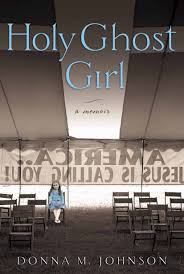
Holy Ghost Girl by Donna Johnson portrays the author's experience growing up on the trail of a revivalist preacher who would eventually be sentenced to prison time.

Holy Ghost Girl by Donna Johnson portrays the author’s experience growing up on the trail of revivalist preacher David Terrell.

I thought about the sermons I had heard Terrell preach from the time I was three until I was about sixteen, many of them a variation on a theme, and I chose the ones that seemed to best serve the story and to exemplify his peculiar worldview. I found his voice, his language, still very alive in me, and so I followed it. The phrases and lines quoted in the book are ones he used most often when making a point—and many of those points were made again and again in every sermon. Of course this makes sense only in retrospect. I didn’t have the sense I was choosing what to quote and what to summarize while writing. It felt like I was simply watching and listening to the character and trying to capture it in sentences.

I have no idea how many drafts I wrote of those sermons. I tend to rewrite as I go and move on only when I’m comfortable with a scene. It’s torturous.

Michael Noll

On the subject of that particular sermon, I love that line “In a fit of pique, he kills an Egyptian.” You go on to say, “Chapter three opens with Moses on the lam. God appears to him as a burning bush with a gift for gab and tells him to confront Pharaoh and lead the Israelites out of Egypt.” That is just terrific stuff–such a strong voice. I know that you teach a memoir class, and one of the things you focus on is voice. How conscious were you of trying to construct a voice when writing a passage like this?

Donna Johnson

I worked hard to find that voice. I couldn’t get past the prologue until it emerged—and I had the luxury of working a year on the prologue. The voice is a persona constructed from a multiplicity of selves. The scrappy kid I was when traveling with the tent, the irreverent girl I became who said things to shock people, the failed poet, the outcast who longs to return home; they are all there. Mixed in too is a white trash version of Scout Finch. It’s me, and it’s not me of course. I have to work against tossing off the quick, easy line, a habit from years of writing feature story leads and ad copy.

Michael Noll

There are moments in the narrative when you pull back to provide context. For example, in a story about three white men surrounding Terrell and telling him to kick the black people out of his tent, you step back to give a paragraph of context about the attitude toward black people on the sawdust trail, focusing in particular on the Azusa Street Revival in Los Angeles. Did the need for context like this jump out at you as you were writing? Or was it something you added in revision?

Donna Johnson

Once I finished the prologue, my agent sold the book on proposal. There was no time for revision, and I think the book suffers as a result. I always knew Holy Ghost Girl would include some of the history of Pentecostalism and the sawdust trail. It seemed necessary. Those three white men you mention above were with the KKK and they eventually beat Terrell over his insistence that blacks and whites sit together under his tents. If I had left the story there, Terrell might have seemed too heroic. Pentecostalism was born in Los Angeles on Azusa Street and the worshippers were black and white. The mixed race aspect of the revival ignited indignation among the press and the elites. The tents were one of the few places where blacks and whites gathered as equals in the pre civil rights south. That knowledge places Terrell in a tradition. It seemed important to let readers know he was not utterly unique.

October 2014

Michael Noll

Michael Noll is the Editor of Read to Write Stories.

How to Create Meaningful Spaces in Stories

30 Sep
Holy Ghost Girl by Donna Johnson portrays the author's experience growing up on the trail of a revivalist preacher who would eventually be sentenced to prison time.

Holy Ghost Girl by Donna Johnson portrays the author’s experience growing up as part of the inner circle of a revivalist preacher.

Every writer has heard this piece of advice: Don’t write a scene in a vacuum. Choose a setting that will impact the characters’ decisions. Not all settings are created equal. Force two characters to have an argument in the bathroom, and the result will be different than if they have it at the dinner table.

In theory, this advice should be easy to follow, but I can remember my days as a MFA student when I would spin my wheels for days puzzling out which setting would be best and worrying that I was choosing the wrong one. Like most writing “rules,” the theory is easier than the application. So, how can we create setting without driving ourselves crazy?

Donna Johnson’s memoir, Holy Ghost Girl, was published in 2011 to rave reviews. The New York Times called it “enthralling” and “a sure bet.” The book is about Johnson’s experience growing up in a family that followed a traveling tent revival led by the preacher David Terrell. The sense of place is vividly palpable in the book, as the first pages of the opening chapter make clear. You can read them here.

How the Story Works

One reason that setting often feels difficult to write is that the places we’re considering feel random, as though drawn from a hat of Places to Set a Scene. Sometimes, the solution is to find a place that the characters find meaningful. As real people, we travel through a variety of places every day, but all of us have a handful of places that feel like home, where we are our best or truest selves. Watch how Johnson sets up such a place in the first chapter of the memoir:

The tent waited for us, her canvas wings hovering over a field of stubble that sprouted rusty cans, A&P flyers, bits of glass bottles, and the rolling tatter of trash that migrated through town to settle in an empty lot just beyond the city limits. At dusk, the refuse receded, leaving only the tent, lighted from within, a long golden glow stretched out against a darkening sky. She gathered and sheltered us from a world that told us we were too poor, too white trash, too black, too uneducated, too much of everything that didn’t matter and not enough of anything that did. Society, or at least the respectable chunk of it, saw the tent and those of us who traveled with it as a freak show, a rolling asylum that hit town and stirred the local Holy Rollers, along with a few Baptists, Methodists, and even a Presbyterian or two, into a frenzy.

This passage establishes the tent as special in a couple of ways. First, it stresses how unremarkable the setting is: a field of trash at the edge of town. Yet that trash is appropriate because the people who gather there feel “too poor, too white trash, too black, too uneducated, too much of everything that didn’t matter and not enough of anything that did.” This is an example of characters finding meaning in the things that surround them. Real people do this all the time. They develop attachments to the places they live: small towns, big cities, flat plains, mountains, deserts, rainy places, blue states, and red states. In all likelihood, they didn’t consciously choose the place where they live. They were born there and stayed or arrived there out of some necessity. Yet they often appropriate aspects of the place as statements of personal character—the people who live here are good/hardworking/smart/real/whatever. This is exactly what Johnson is doing in this passage.

Secondly, the passage shows the people creating a space that demonstrates some quality about them: “At dusk, the refuse receded, leaving only the tent, lighted from within, a long golden glow stretched out against a darkening sky. She gathered and sheltered us…” It’s a cliche that you can learn a lot about people by stepping into their homes, and this passage reveals the truth in the cliche.

Once the memoir establishes the importance of the tent, it spends several paragraphs showing how the tent was put up, the effort and mechanics involved. Because the place matters, so does the upkeep of the place, and it’s in these passages that we learn crucial information about the people who gather there:

Local churches sent out volunteers, but most of the work was done by families who followed Brother Terrell from town to town, happy to do the Lord’s work for little more than a blessing and whatever Brother Terrell could afford to pass along to them. When he had extra money, they shared in it. He had a reputation as a generous man who “pinched the buffalo off every nickel” that passed through his hands. He employed only two to four “professional” tent men, a fraction of the number employed by organizations of a similar size. The number of employees remained the same over the years even as the size of the tents grew larger. “World’s largest tent. World smallest tent crew,” was the joke.

Because the tent is so central to the people’s identities, it’s also central to the story. One chapter begins with unwanted visitors to the tent (the Klan). Another chapter offers some children, including Johnson, the opportunity to escape from the tent for a while and swim in a local pool. In both scenes, the tension results from the changes to setting. The rules—the usual way of being—are upended, which produces a story to tell.

The Writing Exercise

Let’s create a meaningful space using Holy Ghost Girl by Donna Johnson as a model:

  1. Choose a character. It’s tempting to start with the setting itself, but unless you’re writing a story like Jack London’s “To Build a Fire” where setting is the entire point, the place is only as important as the character believes it to be. So, choose a character that you’ve already created, and let’s figure out what that character believes is important about the setting.
  2. Locate the character in his/her surroundings. Start with the general. Where does the character spend his/her time? Think about neighborhood, work, commute, church—the basic settings of our lives.
  3. Identify what is unremarkable about those surroundings. We tend to start with what is remarkable or unusual. But it’s often the case that people become inured to the peculiarities of where they live—they see them every day and take them for granted. Instead, try listing the things that the character sees or notices every day. What are the things that irritate the character about his/her setting?
  4. Let the character appropriate those aspects as personal qualities. Ironically, it’s the little, irritating things in our worlds that we often feel the most attachment to. Johnson writes about how the people who gathered in the tent identified with the trash strewn around them. Try writing a sentence that begins this way: “We were the kind of people” or “They were the kind of people” or “She was the kind of person who…” Can you connect that kind of people they are to those irritating, commonplace parts of their surroundings? Here’s an easy example of this: “We were the kind of people who didn’t need a lot of money.”
  5. Allow the character to create a personal space in those surroundings. In Johnson’s memoir, the worshippers construct a sacred place in the midst of the trash, and that place shines into the darkness. In other words, the place makes manifest the hidden, interior parts of the people who gather in it. People do this all the time. Sometimes we literally build shrines to the things that are closest to our hearts. Other times, we build dens or interior spaces that allow us to be our truest selves: they’re full of books or NFL gear or Precious Moments figurines. What shelter does your character build to protect against the elements—physical, emotional, and spiritual?

Good luck!

An Interview with Kalpana Narayanan

25 Sep
Kalpana Narayanan's story, "Aviator on the Prowl," won Boston Review's Aura Estrada Short Story Prize.

Kalpana Narayanan’s story, “Aviator on the Prowl,” won Boston Review’s Aura Estrada Short Story Prize.

Kalpana Narayanan was born in New Delhi and raised in Atlanta, and she now lives in Brooklyn. She has received writing fellowships from Yaddo, The Hambidge Center, and The New York Foundation for the Arts, and, in 2011, received Boston Review’s Aura Estrada Short Story Prize. The judge, novelist Francisco Goldman, called the story “a pretty dazzling mix of charm, humor, strong emotion, jump-off-the-page liveliness.” Narayanan teaches writing at Fordham University.

To read Narayanan’s story, “Aviator on the Prowl,” at Boston Review and an exercise on making creating character foils, click here.

Michael Noll

I love how so much of the dialogue shows the characters talking to themselves or talking to others and getting no response. When there is some extended back-and-forth, it gets summarized, as with the dialogue with the mom in the first paragraph. One effect of this is that it reinforces just how alone these characters are. Was the dialogue was always written this way or did it start out longer and then get pared back in revision?

Kalpana Narayanan

That’s a lovely read of the dialogue in the story. Thank you. The dialogue in the first draft of the story is the same as it was in the final draft—short.  Someone pointed out to me that the narrator only speaks once, which was so surprising to me, because in my head, she has this interior world that is constantly in dialogue with what she’s seeing, with the people around her.  But it’s true, we only hear her speak once at the end.  I think that was something I was interested in—a narrator who has a rich interior life, but the outside world can’t necessarily see that. I was interested in these characters who are in this house that feels at times as if it’s about to collapse in on them.  Their one way out is to communicate—but they can’t. There’s something really human about that problem to me—about not being able to communicate with the people who are closest to you.

It was also the first time I’d written in first-person, which I think unlocked something in me as I wrote it—I realized that I could just have her be in her head, imagining what she would say.  She’s this character who is enveloped by grief, and has all this emotion brimming in her, but she can’t vocalize it—she absorbs more and more, until she can’t one day—and I wanted for the reader to be in her head as this is happening, to be with her in this moment when she is finally able to connect, and act, and speak.

Michael Noll

Was the character of the narrator’s boss always such a significant part of the story? I ask because the story begin with the narrator struggling with her brother’s death, but very quickly the conflict with her boss becomes at least as pressing—and maybe more pressing—than this original conflict. The boss is such a great character—and a great opportunity for the story to direct the narrator’s grief into an unexpected direction.

Kalpana Narayanan

Thank you.  I think I started out wanting to bring the narrator out of her house.  I wanted her to try to move forward.  That couldn’t happen in her house, because her family is so consumed by the death of their son, and stuck in this holding pattern in a way.  So she begins to work at a restaurant.

The second the boss entered onto the page, he stuck. And I was interested in that—in the boss being someone who was unlikable, and abrasive, and in that way, someone who would push the narrator, and be really hard on her, because he has this lack of boundaries, and lack of reverence, for what has happened to the narrator’s family. And it would be that push that would allow the narrator to move forward. I don’t think I had any idea how the story would end, but by the time I got there, it seemed to make emotional sense. Her boss is this outsider who is in no way affected by this death that has happened.  And he’s so cruel, which makes the reader empathize with the narrator—but he’s also more complex than that, he’s also able to unlock this part of the narrator that no one else can—and in that way, push her. And that’s what I really wanted—for the narrator to be caught off guard, and for her to surprise herself, and to be suddenly able to move slightly forward.

Michael Noll

Kalpana Narayanan discussed death and the novel Skippy Dies, by Paul Murray, in this essay at The Millions.

Kalpana Narayanan discussed death and the novel Skippy Dies, by Paul Murray, in this essay at The Millions.

You recently published an essay about the novel Skippy Dies—“A Physics of the Heart: On Grief, M-Theory, and Skippy Dies—and wrote that the “descriptions of young love, and of grief, are so raw and vivid that they make for an alternate, enveloping universe, one created by the friction of words brushing up against each other in new ways.” I’m curious if you had something like this in mind with “Aviator on the Prowl.” Do the death of the narrator’s brother and her sexuality belong to different universes that have been momentarily brought together?

Kalpana Narayanan

Part of why Paul Murray’s Skippy Dies was and is so moving to me, is the language of his book.  It’s so energetic, and heated, and it mirrors the world and imaginations of these kids who are dealing with heartbreak, and loss, and other incredibly difficult things.  His language is so raw, and his descriptions are so fresh, that you feel like you’re in a different world, as you read—you have these sentences that explode like fireworks across the page. I think that’s part of what I was getting at in that description—this idea that you can create a universe through language, which I think is what any writer is trying to do.  I think when you’re writing about really difficult human experiences, death being the most difficult, you have to find a language that can do that work, a language that is raw and in that way perhaps mirrors the experience of your characters. I wrote Aviator years before I read Skippy Dies, but perhaps it’s part of why I was drawn to Murray’s book. In our real lives, our worlds are constantly overlapping—our work lives, our personal lives—they’re overlapping in messy ways—in fiction you can use language to make these worlds collide, and explore the friction that happens when they do.

Michael Noll

The story is full of cultural mash-ups. In one section alone, Japan is confused with Okinawa, a fat Korean man’s favorite word is “copacetic,” and the character mops up Sriracha stains by skating on sponges like Pippi Longstocking while her boss watches while drinking an Akitabare. On one hand, these juxtapositions seem like the natural result of the many cultures present in a place like this. But, on the other hand, they also seem to reinforce, in a way, the narrator’s confusion. Was this mashup intentional or just one of those happy accidents that sometimes occur in fiction?

Kalpana Narayanan

That’s an interesting question.  It wasn’t intentional, but I’m happy if it comes through as something that’s natural. I do think that those kinds of juxtapositions that you’re speaking to are just a really natural part of our lives. When you’re living in one place, but were raised in another, and born in yet another, as so many of us are, the connections you make when you are viewing the world are going to be unique, and beautiful, and surprising, and complex. I’ve always been interested in writing about what happens when different worlds, cultures collide. Ultimately that collision is an interior collision, or a collision between two people. The person who is standing in one place, but who has lived all of these other lives, is going to see the world through all of these lenses, and tell stories that are really layered, and in that way hopefully tell a story that feels real, and moving.

September 2014

Michael Noll

Michael Noll is the Editor of Read to Write Stories.

How to Create a Character Foil

23 Sep
Kalpana Narayanan won Boston Review's Aura Estrada Short Story Prize with her story, "Aviator on the Prowl."

Kalpana Narayanan won Boston Review‘s Aura Estrada Short Story Prize with her story, “Aviator on the Prowl.”

In high school literature classes, students are often taught about character foils—a yin-and-yang concept in which characters tend to be polar opposites of each other, as in the nursery rhyme, “Jack Sprat could eat no fat, his wife could eat no lean.” As a story device, an opposites-attract approach often works. But it isn’t the only way to develop character conflicts.

In her story, “Aviator on the Prowl,” Kalpana Narayanan creates two characters who are remarkably alike rather than different. The result is a story that won Boston Review‘s 2011 Aura Estrada Short Story Contest. The judge, Francisco Goldman, wrote that the story “makes you laugh a lot, makes you feel great affection, and breaks your heart. I have to admit, I finished it with tears in my eyes.” You can read “Aviator on the Prowl” here.

How the Story Works

There are many ways to establish a character (physical traits, social position, job), but one of the most memorable to the reader is through the character’s attitude toward the world around her. In this first paragraph of “Aviator on the Prowl,” notice how prominent the narrator’s voice is. It could have been made transparent, like a clear window for us to see the events of her past, but, instead, the voice colors our view:

That summer I broke it up and down and got a job because I was tired of thinking. Each night I came home I peeled off my shirt and pants that smelled of the juice of a thousand pigs, and I stood outside my room. My brother Aalap had hanged there the year before, the starched, yellow fold of his karate-class belt rounding his neck like a scarf. I’d been at college, and my mother had made it clear it was the belt and not her own strangle that had writhed small Aalap purple. You could still see the hole where the nail had been. It was just above my bedroom door and everyone had remembered everything but no one had remembered it.

This is a tough, jaded narrator. Her brother has committed suicide, and she’s developed a kind of emotional scab over her still-raw feelings about his death. This attitude becomes clear as she’s put into an interaction with her mother:

My mother said it wasn’t nice how I stripped outside my room like that, that my father might see my triangle bra and shriveled-up breasts and then what. (Buchu, put your breasts back in your buttons!) I said maybe you shouldn’t stick your sad face in my business like that or maybe I just said it in my head.

This clear attitude makes it easier to create a foil for the narrator; the usual way would produce a character who has an opposite attitude toward life, a sort of bleeding heart. But Narayanan does the complete opposite and creates a character who shares the narrator’s combative attitude—and shares it in an exaggerated way. The character is her boss at the restaurant where she works. The similarity of their attitudes becomes clear as soon as he’s introduced:

I told an Asian girl that came in the restaurant our beer was from Japan. My boss screamed I was a humiliation, that it was from Okinawa and if I didn’t get it straight he’d really do something bad. I told the girl it was from Okinawa and gave her the bottle for free. She mouthed an apology when my boss wasn’t looking, but I didn’t care.

The story wastes no time before the boss’s attitude is applied to the central event of the narrator’s life: her brother’s suicide. In this scene, the narrator has come into work even though it’s her off day. She likes working in the kitchen, and so she helps the sous-chef cut some garlic. But, she does it badly, and her boss notices and digs the cut ends out of the trash:

His hand opened to show the end of the bulb I’d just tossed. His fingers rolled the end like mucus then threw it at my face. I twitched.

I don’t fucking care who’s dead and who’s not, he continued, if you waste my money like this again you’re out.

In a way, the story has taken the narrator’s tough attitude toward her brother’s death and, through the character of her boss, exaggerated it into a grotesque version of itself. It becomes a kind of contest between the character’s: how desensitized can they become? As you read the rest of the story, you’ll see how Narayanan steers this contest in a surprising direction and how the final scene offers a release from this contest of wills.

By creating this particular character foil—two characters who are similar rather than opposites—Narayanan creates a framework in which the story’s emotional tension (how does she grieve her brother’s death) can play out.

The Writing Exercise

Let’s create a character foil using “Aviator on the Prowl” by Kalpana Narayanan as a model:

  1. Create a character and a problem that will not go away quickly. The character can be anyone, but the problem should be persistent, as opposed to one that can be solved with a decision (to leave or stay, to take this job or that one). A problem like this tends to be in the background of everything else in the character’s life. So, think about big issues: love, death, or existential dilemmas (what kind of person am I?).
  2. Clearly define the character’s attitude toward that problem. If you’ve ever listened to people talk about themselves in the midst of a significant difficulty (death of a loved one, career change, big move, or some other dramatic life transition), you’ve likely noticed that the stories they tell often change, depending on how they’re feeling about the situation. In other words, we tell ourselves stories that support our basic view of the world and ourselves. So, think about the character’s attitude as a thing he or she has created. How has the character chosen to approach the problem that won’t go away?
  3. Create a second character, one whom the first character cannot avoid. Our lives are full of such people: bosses, coworkers, spouses, children, parents, neighbors, and friends. Particular situations also bring unavoidable people into our lives. If the toilet is backed up, you’re stuck with a plumber. If a storm has blown a tree over onto your house, you’re stuck with a contractor and team of workers. Hospitals have doctors and nurses. Schools have teachers and administrators. In short, think about your character’s situation and choose a character who is an inevitable part of it.
  4. Give this new character the same attitude as the first character. You don’t need to know why the character has this attitude, only that it exists. So, if your first character is tough, make this new character tougher. If your first character is highly rational, make the new character even more logical. Once you know the attitude, you can find ways for it to be expressed. Be practical. If the new character is a nurse who copes with all difficulty with laughter, there will be plenty of difficulties in a nurse’s routine to prompt that laughter.
  5. Find opportunities for these attitudes to collide. You have already created characters who cannot avoid each other. Now, create scenes that force them onto different sides of a problem. Both characters will address the problem in the same way, and that similar approach may produce conflict.

Good luck!

An Interview with Ted Thompson

18 Sep
Ted Thompson's novel In the Land of Steady Habits was called XXX.

Ted Thompson’s novel In the Land of Steady Habits was described as a “elegiac yet bighearted take on adult disillusionment” by The Wall Street Journal.

Ted Thompson is the author of The Land of Steady Habits, a novel that has been called “the first great novel about post-crash American disillusionment, the flip side of The Wolf of Wall Street” by Salon editor David Daley. The novel has been optioned by director Nicole Holofcener. Thompson’s stories have appeared in Tin HouseAmerican Short Fiction, and Best New American Voices, and he was a Truman Capote fellow at the Iowa Writers’ Workshop. He lives in Brooklyn, NY with his wife.

In this interview, Thompson discusses how to structure multiple points of view, creating tension, and writing in the shadow of Yates, Cheever, and Updike.

To read the first chapter of In the Land of Steady Habits and an exercise on making characters uncomfortable, click here.

Michael Noll

I’ve read a lot of novels written from multiple points of view lately, and most develop a sequence for the different POVs—for example, every other chapter follows a different character. But you don’t do that in this novel. Part 1 is told entirely from Anders’ point of view, but then the chapters in Part 2 are told from not only Anders’ POV but also his wife Helene’s and his son Preston’s. The last section mixes the POV’s within a single chapter. When I first encountered the POV shift, some small part of me thought, “Hey, that’s not supposed to happen.” But then it worked. And the other shifts worked. I came to appreciate the way you handled them. Rather than latching onto a pattern, you shift POV only when necessary—at least that’s how it seemed to me. What went into your decisions about when to shift?

Ted Thompson

I’m so happy that you noticed that. It was something I came to rather late in the process of writing the novel. Originally it had been told entirely from Anders’ point of view, and draft after draft I was always chafing against that. It was too restrictive to tell the entire story through his consciousness, especially because he’s a character who often reacts before he understands his feelings, who doesn’t have the most awareness, and that made him a somewhat trying person to spend a lot of time with. But I had always believed that if you were going to change points of view in a novel you had to teach the reader that you were going to do that early on. As you say, it had to be established in the opening pages. But I didn’t want to do that, because to me the story begins with Anders and his crisis but then opens up from there to show how it affects the people and community around him. To me it was a little like a stone thrown in a pond. The opening is the splash and after that we can follow each of the waves that come off that impact.

So I looked at the novels I thought of as structurally perfect, or at least those that had influenced me, and discovered that not all of them had formal, logical ways of handling POV. Revolutionary Road in particular wanders all over the place. At first it seems like it’s going to be Frank’s story, but then we get his wife April, and then we jump to Mrs. Givings, the real estate agent, then their neighbor Shep Campbell. We even wander into Mrs. Givings’s deaf husband’s point of view at the very end. And it was then that I realized that so long as there is a narrative question (meaning a question that is in the reader’s mind) that’s being addressed, most of the time the reader will make the POV leap with you without too much resistance. Changes in point of view are always jarring, but they’re less so if it feels as though we’re following the narrative thrust of the story, if we’re where the action is.

So what I told myself was that I would go to the character who held the most interest to me in that moment, and figured (hoped) the reader would also share my curiosity. What I found was that these shifts could be fluid so long as the scene or moment or information we were getting deepened our understanding of what we’d already seen. The moment a POV shift dies is when the character reason for joining a character isn’t immediately clear. Then, for the reader, the move feels lateral rather than forward.

Michael Noll

On a similar note, I was also interested in the way you move around in time. Some chapters are in the present, some take place in various points in the past, and some move unexpectedly between the two. One of my favorite parts of the novel comes in the last paragraph of Chapter Two, when the past and present are collapsed together in a moment of regret. I can only imagine what this novel looked like in draft form—the many scenes spanning decades, waiting to be fitted into a single narrative. How did you go about finding the novel’s organization?

Ted Thompson

For me the simplest organizing principle for this novel was always the present events. Essentially once we know where we are in time, in the present story, and what matters there (once there’s conflict) then it opens all sorts of space to play. I say “play,” but really what I mean is an opportunity for contextual information, for a wider lens through which to understand the events. So since my novel has a character who has left a forty-year marriage and a long career, part of what that second chapter had to do was provide the context of that huge sweep of time, to help us place him more clearly in the present, and thus deepen the novel’s conflict. I’ve come to see conflict less and less as an aspect of present confrontation in fiction and more as an expression of character. In deepening the conflict, a literary novel is also deepening our understanding of character. They’re the same thing. So the present line of tension, for this book, was always the organizing principle, but once it was tacked down, I could go wherever I needed in time to make the most sense of the moment for myself and for the reader.

The writer Richard Bausch once told a workshop I was in that “drama in fiction is created by what is known, not by what is unknown,” and I agree with that wholeheartedly. For me with this book it was just a matter of finding the present events, then stepping away from them when it was necessary to give the reader enough context to understand precisely why they mattered.

Michael Noll

Someone described the novel’s main character, Anders Hill, as a one-percenter—it may have been a reviewer, or it may have been another character in the book. I can’t remember. But one of the interesting things about the novel is that Anders never feels like a one-percenter. His life has become such a mess that even though he spent much of his life riding the sweet spot of the economic wave (and also crashing, like many others), he doesn’t feel wealthy. Did you ever struggle to find the right tone for the wealth surrounding Anders and his community?

Ted Thompson

Ted Thompson's novel, The Land of Steady Habits, has been shortlisted for the Flaherty-Dunnan First Novel Prize.

Ted Thompson’s novel, The Land of Steady Habits, has been shortlisted for the Flaherty-Dunnan First Novel Prize.

I knew the tone of this book before I knew anything else. That was the one thing that I had from the first sentence—the sound of it—and it’s what I would come back to when I was lost. Sentence by sentence, I knew when it sounded right, when the angle of vision was correctly honed, and that more than anything else is what I was able to trust. I’m not sure where it came from, but I knew the book needed levity, I knew it needed a clear element of comedy to carry it, and all of that could be managed through the tone. The great thing about levity, for me, is that it creates space for genuine sentiment, for unexpected moments of regret or longing or generosity to come through.

As for the term “one-percenter” it was used by a reviewer (or more likely his headline editor). I didn’t actually know the term when I was writing the book since much of the public dialogue about income inequality that spawned it hadn’t yet begun. But I agree “one-percenter” isn’t quite right for Anders, even though he probably technically would qualify as one. And I think that’s because one of the things that I was interested in when I was writing it was the nature of work, in particular the way that it always seems to be at odds with personal freedom, even when we might believe it’s in the service of it. So it was important that Anders was a commuter, a guy who had to get up at five and get on the train to head into the office, a guy who was ham-strung by a huge mortgage and astronomical property taxes and tuition bills for his grown kids. A one-percenter, at least in the popular imagination, is someone who lives in a kind of frictionless world where he doesn’t have to do anything he doesn’t want. And that’s not this character. So for me, the novel has less to do with wealth than it does with responsibility, which is another way of looking at what’s expected of him, or more precisely what he feels is expected of him.

Michael Noll

Reviewers have compared you to Updike, Cheever, and Yates, and those comparisons seem inevitable given the novel’s subject matter. Still, what intimidating comparisons! They’re among the titans of 20th Century American fiction. Was working in their style was ever difficult, either because of their influence on your writing or because of their influence on the agents, editors, and other readers who might have been offering advice to you?

Ted Thompson

Yes and no. Mostly I took great comfort in their work. Particularly Yates. I think when you’re working on a novel, especially a first novel, you’re constantly worried if anyone could possibly care about the story you’re telling. This at least was a fear of mine, one of the greatest hits of my many doubts. So knowing that there was this huge swath of American fiction that had come before me, this grand beloved tradition, helped a lot. When it came to the writing, I didn’t worry much about imitating them, since the voice of the book always felt like my own and the world of the book was certainly my own, comprised of all the sense memories and settings of my childhood. Not to mention the fact that, you know, those writers are all masters (and, I would argue, very different). But I did use their work to help me find a form. And that was hugely important. It gave me permission to tell this story.

September 2014

Michael Noll

Michael Noll is the Editor of Read to Write Stories.

How to Make Characters Uncomfortable

16 Sep
Ted Thompson's novel, The Land of Steady habits, has earned comparisons to Richard Yates and John Updike.

Ted Thompson’s novel, The Land of Steady Habits, has earned comparisons to Richard Yates and John Updike.

Fiction should not be nice to its characters. As soon as a character reveals some preference (I like this but hate that), the story has an obligation to force the character into that hated thing. It’s a tried and true strategy that can produce some of the best moments in a story, regardless of genre (remember snake-fearing Indiana Jones facing a pit of snakes?). So, how do you set up a situation in which a character must face the thing he or she detests most?

Ted Thompson begins his novel The Land of Steady Habits with exactly this kind of moment. The novel was published by Hatchette Book Group, and you can read the opening chapter at Hatchette’s website.

How the Story Works

The first line of the novel establishes the hated thing:

One of the great advantages of Anders’s divorce—besides, of course, the end of the squabbling, and the sudden guiltless thrill of freedom—was that he no longer had to attend the Ashbys’ holiday party. The party, like all the parties he’d attended in his marriage, was his wife’s domain, and he was relieved to no longer have to show up only to be a disappointment to her friends.

The novel wastes no time forcing Anders to confront the thing he thought he’d left behind: “a card arrived from the Ashbys, as if with the season, inviting him once again to their holiday party.”

Of course, the invitation shouldn’t matter. Anders should simply toss it in the trash—the advantage of divorce. This seems to be his plan, and at first he treats it as curiosity—”the only invitation he’d received”—and tries “to decide if it was a peace offering of if they’d simply forgotten to take him off their list.”

But there’s a complication. As part of the divorce agreement, Anders agreed to give his wife the house (with its expensive mortgage), but he can’t afford to retire on what remains of their wealth and has, out of necessity and spite, quit paying the mortgage. The problem with this solution becomes clear with a second piece of mail: a note from his wife’s lawyers also comes in the mail that makes clear that he has “until the end of the year before the bank brought in a judge.”

To solve this problem, Anders must talk with his ex-wife—and that is why he decided to attend the party.

Thus, in the span of only a couple of pages, the novel creates a situation that Anders should absolutely avoid and a reason for him to necessarily confront it. As one might expect, his appearance begins uncomfortably and ends with disaster.

Side note: This novel was recently optioned by director Nicole Holofcener, whose films (Please GiveFriends with MoneyEnough Said) excel at putting characters into uncomfortable situations. When you read the opening chapter of Thompson’s novel, its appeal to a filmmaker will make a lot of sense.

The Writing Exercise

Let’s put a character into an uncomfortable situation using the excerpt from The Land of Steady Habits by Ted Thompson as a model:

  1. Create a character and a reasonable dislike/hatred. You might actually use Thompson’s first line as a model: “One of the great pleasures of _____ was that he/she no longer had to ______.” Life is full of situations like this. Parents look forward to no longer changing diapers, people in apartments look forward to no longer carrying groceries up flights of stairs, people who’ve changed jobs look forward to no longer commuting or sitting next to So-and-so. And, of course, most of us know what it’s like to expect that something is over—and then it isn’t. So, imagine what life change your character has recently gone through and the annoying things this change has left behind.
  2. Create an opportunity to encounter that dislike. Thompson uses an invitation in the mail, which is, in a larger sense, a visit from somebody he used to know but now no longer encounters. So, imagine all the ways that your character’s dislike could return in the form of an unexpected encounter: running into someone in the grocery store, an event (wedding, funeral, graduation) that forces them together, a merger at work. We like to believe that the world is large and that we can make our own place in it, but the truth is that our places overlap more than we often acknowledge. How can you make your character’s worlds overlap in order to bring him/her into an encounter with some unpleasant thing that has been left behind?
  3. Create a reason for the character to seek out that encounter. Thompson gives his character no choice, really, but to attend the party (Anders has quit paying the mortgage on the house that his wife won in the divorce, and he needs to explain himself). As Thompson demonstrates, a good way to force a character’s hand is to make him/her do something that will have negative consequences. So, imagine an act that your character could commit that would force him/her to face some unpleasantness that has been left behind. Or, imagine a circumstance that is beyond the character’s control (layoffs, illness) that could turn the character back to a place that’s been left behind. The result will likely be a scene that the character wants desperately to avoid but has no choice but to enter.

Have fun!

An Interview with Amy Leach

11 Sep
Amy Leach is the author of Things That Are, a collection of essays that Yiyun Li compared to "a descendent of Lewis Carroll and Emily Dickinson."

Amy Leach is the author of Things That Are, a collection of essays that the writer Yiyun Li compared to “a descendent of Lewis Carroll and Emily Dickinson.”

Amy Leach’s book, Things That Are, is a collection of essays that are equal parts nature writing in the tradition of Mary Austin and language play like that of Lewis Carroll. Her work has been published in A Public Space, Tin House, Orion, and the Los Angeles Review. She has been recognized with the Whiting Writers’ Award, Best American Essays selections, a Rona Jaffe Foundation Award, and a Pushcart Prize. She plays bluegrass, teaches English, and lives in Montana.

In this interview, Leach discusses using rare words, beavers as a proof of God’s existence, and why nature has captured her imagination.

To read Leach’s essay, “In Which the River Makes Off With Three Stationary Characters,” and an exercise on writing surprising descriptions, click here.

Michael Noll

One of the most striking things about your writing is your use of diction. In this essay alone, there are words that I knew but had to stare at for a moment before I recognized them in their new form (chatterboxy, sagitaries, heptangularly), words I’ve probably encountered before but couldn’t define with any certainty (glogg, yawing, gobbets, saltarellos),and words that I thought you’d invented until I looked them up (truckle, mouldywarp, bladderwort, mudpuppy), and words that I simply had never seen before (frumentary). I was reminded of the writer Alexander Theroux, who actively searches for forgotten words and has said that he believes it’s the duty of writers to keep such words alive. This keeping-alive philosophy extends to his work, which includes a book, Primary Colors, with three sections about everything that is red, green, or blue. I wonder if you feel this same way, especially given the last chapter of the book, “Glossary of Strange Beasts and Phenomena”. Are you trying to save wonderful things (and with words, the effort and thought and experience that went into creating them) from oblivion?

Amy Leach

I like the idea of rescuing words from extinction, of books being arks for drowning words; but I don’t know if my impulse is responsible enough for me to call what I’m doing a duty.  I just enjoy words so long out of use they are almost nonsense again, as they were before they were used.  English can be as fun as Jabberwocky.

Michael Noll

As I reread the essay, I was struck by how much of it is purely informational: here is what beavers do, here is what salmon do. It’s not until the final section, really, that you put that information to work in a kind of argument. This runs counter to the usual structure of essays, which almost always contain some rhetorical turn after the first paragraph or so, a move to transform an interesting detail or anecdote into a thesis. But you don’t do this. The first four pages contain more and more descriptions of beavers. The next three are about salmon and their parallels with beavers. And then, in the last two pages, you apply these parallels to human experience, where the essay’s meaning—if we want to use that word—becomes clear. Have you ever gotten pushback from editors or your first readers, anyone asking you to use a more traditional structure?

Amy Leach

 I did want for the beavers to be beavers, for salmon to mean salmon, rather than being proof of a point. I remember, in doing research on this essay, watching a little video of beavers in the wild. Down below, in the comments section, there was an excited dispute over whether beavers proved the existence of God or proved the nonexistence of God. Nobody was excited about the beavers–just about their own opinions, which beavers happened to support. The beavers could have been wolverines or worms: the conversation below would have been the same. This seems to illustrate the philosophical peril of starting out with a thesis (opinion) and using the rest of the essay (the world) to prove it. This is how I often think–in a thesis-driven way–but it’s not how I want to think, and I love how in writing you can work out the way you want to think.

Michael Noll

One of my favorite lines in the essay is this one: “The beavers’ reaction to the papal renaming highlights two of their especial qualities: their affability and their unyieldingness.” It’s so unexpected—even though the language is fresh and the opening situation (beavers being classified as fish) is almost fanciful, the descriptions of the beavers themselves are rooted in fact and observation. As a result, when I read the word qualities, I expected something about their physiology or behavior—anything but affability. It’s a word that seems to illustrate what you write at the end of the essay: that there is a kind of experience that “spills you into a place whose dimensions make nonsense of your heretofore extraordinary spatial intelligence.” Do you make choices (diction, sentence structure, details, metaphors) in your writing that aim for nonsense-making, or is this just an effect of your natural style?

Amy Leach

I suppose it is natural, my affinity for nonsense. If you’re naturally a sensible person and you try by conscious effort and choice to be nonsensical, it may just come off as quirky, effortfully quirky. It seems best to stay true to your own nature, whether that nature is sensible or not.

Michael Noll

Some of the essays in the book, like “Stairs,” are less about nature than human experience of nature and the world and experience itself. It makes me wonder if you can imagine a transition in which you begin to focus less on animals and plants and on something else (airplanes, societal structures). Or, do you think you’ll always focus on the natural world? After all, you live in Montana, where presence of the natural world is every bit the equal of the human presence.

Amy Leach

I wrote most of the book while I was living in Chicago, brimming with airplanes and societal structures–so these were the last things in the world I wanted to spend time thinking about. Where one’s real life is not swamped with airplanes and society, one could possibly afford to devote more imagination to them. Though I expect it will always be the green things and the creatures who have my heart, for they are real.

September 2014

Michael Noll

Michael Noll is the Editor of Read to Write Stories.

How to Write Surprising Descriptions

9 Sep
One reviewer said of the essays in Amy Leach's Things That Are, "If Donald Barthelme had made nature documentaries, the commentary might have sounded like this."

One reviewer said this about the essays in Amy Leach’s Things That Are: “If Donald Barthelme had made nature documentaries, the commentary might have sounded like this.”

At some point in your story or novel or essay, you’ll need to write a memorable description, something better than red or big or happy. So, you start free writing and brainstorming to find the right words, but they’re all variations on the usual and expected. You want to find something new and startling, but how?

For essayist Amy Leach, writing eye-opening descriptions seems almost as natural as breathing. Her essay, “In Which the River Makes Off With Three Stationary Characters,” is, in a way, one long description that develops and moves in surprising ways. It was published in The Iowa Review and included in her collection, Things That Are. You can read it here as a sample of the book or here at JSTOR.

How the Essay Works

As we grow older, we fall into patterns of seeing. We perceive not the thing itself but our expectation (built on years of seeing) of what the thing should look like and what it is. A good description, then, wipes away those years of seeing and allows us to see the world the way we saw it as babies and children: for the first time. Watch how Leach strips away the usual ways of perceiving in the first paragraph of “In Which the River Makes Off With Three Stationary Characters”:

In the seventeenth century, his Holiness the Pope adjudged beavers to be fish. In retrospect, that was a zoologically illogical decision, but beavers were not miffed at being changed into fish. They decided not to truckle to their new specification, not to be perfect fish, textbook fish; instead they became fanciful fish, the first to have furry babies, the first to breathe air and the first fish to build for themselves commodious conical fortresses in the water. If Prince Maximilian, traveling up the Missouri River, had taken it in mind to categorize them as Druids or flamingos, beavers would have become toothy Druids, or portly brown industrious flamingos.

The last phrase of the paragraph (“portly brown industrious flamingos”) would have been an inconceivable string of words without the rest of the paragraph. But, by introducing the idea that beavers might not actually be beavers, Leach removes the usual way of viewing the animal and gives herself the opportunity to see them as something totally new. The same thing is true of the description that ends this next two sentences:

The beavers’ reaction to their papal renaming highlights two of their especial qualities: their affability and their unyieldingness. They affably yield not. If they are deemed fishes, they respond by becoming lumberjack fishes.

How amazing is that phrase: lumberjack fishes? And how impossible it would be to pair those words in a passage that looks at beavers in the usual way.

Despite the inventiveness of the descriptions, Leach actually arrives at them in methodical ways:

  1. First, she introduces a wrong way of viewing something: the Pope says beavers are fish.
  2. Then, rather than correcting the wrong idea, she accepts it as a fact: okay, if beavers are fish, then these are the kind of fish they are.
  3. Finally, she introduces more wrong ways of viewing the beavers (if they’re already fish, why not make them flamingos?).
  4. This last, previously inconceivable way of viewing beavers creates the opportunity to describe them in new ways.

It might be tempting to think that these descriptions (lumberjack fishes, portly brown industrious flamingos) are simply cute, but Leach uses them to set up alternate ways to view not just beavers but nature as a whole and our place within it. In fact, the collection of essays as a whole repeatedly offers new ways of thinking about basic human experience—and these new ways are almost always tied to descriptions that scramble the usual order of things.

The Writing Exercise

Let’s write surprising descriptions using “In Which the River Makes Off With Three Stationary Characters” by Amy Leach as a model:

  1. Introduce a wrong way of viewing something. This happens in real life on a daily basis. Two people witness the same event and describe it in different ways. The resulting miscommunication can turn tragic or comic. But there are simpler ways to introduce an odd perspective. Take any common human interaction (lovers meeting or fighting, workers conferring, cashier checking out a customer) and label it as something that it clearly isn’t. In other words, write a scene in which two people kiss and then suggest that it’s a fight. Or, show two people shaking hands or passing money and suggest that they’re in love. This mashup challenges the ideas of loving and fighting and the typical way that we view these common scenes. You can actually do this with any interaction that you’ve already written in a story. Simply label it as something that it isn’t.
  2. Accept the error and write as if it applies. What if the people kissing really are fighting? What if the people shaking hands are in love? What would that mean? Are they pretending? Acting a certain way in public, for show? Fulfilling an obligation? Or, does love mean something different than we think it means? For instance, there are office wives and husbands—think about how odd that pairing and description is. Try to explain how the scene you’ve chosen can look one way but be called something that it doesn’t seem, at first glance, to be.
  3. Introduce more wrong ways of viewing the same thing. If we can have office wives or husbands, what other kinds of wives and husbands can we have? Bar spouses? Church spouses? Internet spouses? Or, if a coworker can be an office wife, what else can they be? An office sister? An office mother? An office lieutenant? An office gravedigger? If you’re going to break the bond between words and bind them to new, unusual words, don’t stop. Keep going to see how far you can push the idea.
  4. Describe the encounter or person or thing. What is a handshake between lovers? A pillow handshake? A spooning handshake? What is a kiss between people who are fighting? A blistering peck? A wolfish smooch? You can do better than these example. Play around. Try to surprise yourself. The immediate goal is to find an interesting description, but doing so may require creating an entirely new way to view an essential part of the story. 

Have fun!

An Interview with Sarah Frisch

4 Sep
Sarah Frisch won a Pushcart Prize for her story, "Housebreaking," which appeared in The Paris Review.

Sarah Frisch won a Pushcart Prize for her story, “Housebreaking,” which appeared in The Paris Review.

Sarah Frisch is a recent Wallace Stegner Fellow and current Jones Lecturer at Stanford University. She holds an MFA from Washington University in St. Louis. Her work has been published in The Paris Review and The New England Review, and she has won a Pushcart Prize and been a finalist for the National Magazine Award.

In this interview, Frisch discusses the challenges of finding the right beginning, doing research on the tribal areas of Pakistan, and avoiding one-dimensional political speech.

To read Frisch’s story, “Housebreaking,” at The Paris Review and an exercise on making unlikely scenarios more plausible, click here.

Michael Noll

The story begins with the main character, Seamus, doing things that are unlike him. He’s not a drinker, but he drinks several beers. He’s depressed, but he strikes up a conversation with a complete stranger and eventually asks her to stay the night. On the flip side, his house is a mess (and he’s a stranger as well), but Charity agrees to stay with him. I can imagine a lot of versions of this opening that don’t work–but this opening absolutely works. I heard Richard Ford once say that stories make the impossible possible, and that seems to be the case here. How did you approach this beginning? Did you ever find yourself thinking it wasn’t believable and needing to revise?

Sarah Frisch

I drafted the first version of this story over a decade ago, at a time when I was inclined to write chance encounters of this sort that I could almost never pull off. Nothing survives from that original version except the setting, Seamus and Charity’s names, and the opening scene where the two of them meet and immediately start a relationship. I decided to keep the premise of their instant connection because it seemed right for Seamus to get taken in by an illusion of intimacy. I thought it was a good way to start a story which is about, in part, the difference between thinking you know something and really knowing it in a way you can’t shake. I did have a lot of trouble making this section feel believable, and I was still struggling to revise it even after the rest of the story was done. It wasn’t until a very good reader recommended that I cut my random and utterly goofy first three pages (at one point they played a game of jacks) and start further into the encounter that I felt like I finally might be able to pull off the opening.

Michael Noll

It’s a long story, about 12,000 words. The opening scene alone is 1700 words, and as a result, I think, the story feels paced differently than shorter stories. More time is spent with dialogue. It’s still snappy, like this bit:

“You work in PR?”

“It’s an exclusive firm. We only take clients who can demonstrate a total absence of social conscience.”

“That’s not what I expected,” he said, suddenly awkward. “I imagined you were a teacher or an artist.”

“You’re looking at Weekend Charity. Wait till you see me in a suit.”

But a shorter story might end the scene with that line. But this one keeps going:

“He asked why she’d chosen to work with her company, and she shrugged and said that she’d mostly taken the job to piss off Greg.” 

I’m curious at what point you knew that this was going to be a long story—and if you ever had second thoughts about it. Did you ever try to revise to make it shorter (and more submittable to most journals)? Or did you always know that it needed to be long?

Sarah Frisch

The story was probably 7,000 words—about average for my stories—until I committed to setting part of it in Pakistan. Then it ballooned to almost 25,000 words, and I decided I was writing a novella. By the time I had finished revising and cutting out all the extraneous stuff, I was back down to forty-some pages. I might have tried to keep it shorter, but I was focused on finishing a collection and not thinking much about publishing in journals at the time. I knew how lucky I was when the Paris Review accepted the story, but it wasn’t until later that I realized that the Paris Review is one of only a few journals that publish stories this long.

Now that you mention it, I can see how the pacing is a bit more novelistic than in shorter stories. I think this is partially the result of having committed to a clock of an entire romantic relationship, from beginning to end. Also, at some point I scrapped the idea that I would summarize Seamus’s time in Pakistan using backstory and dialogue. That was when I really felt I had committed to telling two stories at once and showing how both the past and the present played out in full for Seamus. By then I had entirely lost sight of the pacing required for short stories and started taking my time.

Michael Noll

I love that the story takes on some sensitive political issues. Here are two characters talking about drone strikes:

Seamus made a point from one of the readings, that the civilian deaths and constant terror caused by hovering drones must be working against U. S. interests in the region.

“I hate that argument,” Melinda said. “People have a right to life outside our political agenda.”

What I love is that this moment has such clarity of moral vision, but that vision doesn’t take over the story, which is kind of a mess, morally speaking. The ending leaves us in a place of total uncertainty, not just in terms of what will happen but also how to feel about it all. How did you keep the politics from hijacking the story?

Sarah Frisch

You really hit on what I struggled with the most. When I started this version of the story, I had already been reading about the drone strikes for a couple of years in the New York Review of Books. This was back when there was barely any media coverage of drones, and I had just given birth to my youngest daughter. I couldn’t get over how the American government was killing families and kids and nobody was even talking about it. I was so angry about it, I felt as if it were my moral duty to write about it. This turns out to be a pretty difficult place to write fiction from. Throughout the drafting of this story, I felt as if I was fighting my own tendency toward one-dimensional political speech. I tried doling out my personal opinions to various characters, including the more problematic ones, and taking my beliefs to the extreme or mixing them up with opinions that I didn’t agree with. I also tried to have characters challenge each other’s opinions in scene.

A real turning point for me in drafting this story was when a friend put me in touch with a reporter and writer who had traveled in the tribal areas and was willing to read a draft of the section set in Pakistan. She was very generous and insightful and gave me notes on my scenes and access to the journals she wrote during her travels. She pointed out that things were actually a lot more complicated in the tribal areas than I was making them out to be and that it was difficult to know what was real and what was propaganda (and  who was a human rights worker and who was a fighter). She suggested that I play up the effects of not being able to tell right from wrong in the loss of Seamus’s faith. This change ended up working perfectly with the rest of the story and complicating everything in a way that helped keep a simplified moral vision from taking over.

The ending came to me all at once. I already knew that I wanted Seamus and Charity to break into a house together, but I was struggling with it until a sentence popped into my head while I was washing my hands. (I don’t mean to be romantic about it; this normally doesn’t happen to me.) The story had to “take a left turn through a window,” where it would hit up against some reality that Charity could not have communicated in her verbal account of herself. The arrival of the ending felt like magic at the time, but I think it actually grew out of a year’s worth of pushing against my own tendencies toward oversimplification and reductive political speech.

Michael Noll

What kind of research did you do for this story? I’m assuming you’ve never been to Islamabad (though I could be wrong, of course), and so you had the challenge of describing a place based entirely on research. To that end, I was struck by two things: the reference to the market, Jinnah Super, and the wound on Seamus’s foot. The first is specific and makes us believe that the story really does know the place, and the second seems to divert our attention so we’re not asking questions about the accuracy of the depiction of Islamabad. Was this intentional or just the work of your imagination?

Sarah Frisch

You’re right, I’ve never been to Islamabad. I watched a lot of YouTube videos. (Some guy drove around the city holding a video camera. There’s endless footage of avenues and intersections and cars.) I also read blogs and message boards where people discussed the city, and I asked a couple of people who had either grown up or lived in Islamabad to read over the Pakistan sections for accuracy. I ended up with a lot more information than I could use about Islamabad, but not nearly enough about the tribal areas, which I found very difficult to research. (Few news stories, no travel blogs, and only minimal video footage, some of which I would later learn was probably propaganda.)I lucked out when I was put in touch with the reporter. Her notes included a detailed account of the culture, customs, setting, and what it was like to travel as a woman in the tribal areas. She was incredibly generous about sharing her experience, making suggestions, and helping with the accuracy of those sections.

I hadn’t considered how the market and the athlete’s foot worked to make the Islamabad section more believable, but I can definitely see what you mean. I knew I wanted to set a scene in a market because markets are so different around the world, yet visiting them is a pretty common thing to do for travelers. I included the athletes foot because 1) There’s something disorienting about the way minor illnesses that would have been nothing back home take on weird ominous forms during travel. 2) I wanted Seamus to get sick in a way that he found difficult, uncomfortable, and slightly humiliating to share with Melinda. I think these are all emotions that in sickness women are made to feel more than men, and I got a rather sadistic pleasure out of having Seamus suffer an illness that he sensed made him appear unfit and ridiculous to Melinda. 3) Fungus cracks me up, at least in theory.

The information about the drone strikes was not that easy to find, and it took me a year to compile and confirm everything. I lucked out again when, a few weeks before the edits on the story were due, researchers from NYU and Stanford put out a report containing personal accounts of the devastation caused by drone strikes in northwest Pakistan. I was able to confirm a lot of my information and add details I didn’t know. The report is available online, and now there’s also a website with information and resources: http://www.livingunderdrones.org

September 2014

Michael Noll

Michael Noll is the Editor of Read to Write Stories.

How to Make the Impossible Possible in Stories

2 Sep
Sarah Frisch's story, "Housebreaking," appeared in The Paris Review.

Sarah Frisch’s story, “Housebreaking,” appeared in the Winter 2012 issue of The Paris Review.

If a story is to keep its readers from walking away, it must do something unexpected, something that makes the reader say, “I didn’t see that coming.” These moments of surprise are what almost all stories are about—if we know how it will play out, why keep reading? The writer Richard Ford once put it this way: The job of fiction is to make the impossible possible. That’s fine to say, of course, but how do we do that?

Sarah Frisch offers a kind of textbook model for how to put Ford’s maxim into practice in her story, “Housebreaking.” It was published in The Paris Review, where you can read it now.

How the Story Works

The story is about two strangers who move in together after a chance encounter. It’s the sort of story that would cause a listener in real life to say, “Wait—you did what?” Most people don’t move in with perfect strangers for a lot of good reasons. As a result, any story in which this happens must overcome a great deal of skepticism on the reader’s part. Frisch begins to do this in the first paragraph:

Seamus lived in Wheaton, Maryland, in the last house on a quiet street that dead-ended at a county park. He’d bought the entire property, including a rental unit out back, at a decent price. This was after the housing market crashed but before people knew how bad it would get—back when he was still a practicing Christian Scientist, still had a job and a girlfriend he’d assumed he would marry. Now, two years later, he was single, faithless, and unemployed. The money his mother had loaned him for a down payment was starting to look more like a gift, as were the checks she’d been sending for the last year to help him cover the mortgage. His life was in disrepair, but for the first time in months he wasn’t thinking about any of that: he was sitting out back on a warm spring day with a woman. Her name was Charity, and she was a stranger.

Notice how Frisch skips over their initial encounter. By the time we meet the woman, Charity, the story has already begun. The next paragraph fills in some of the details about the encounter but also continues to skip over a great deal:

Earlier that afternoon Seamus had been weeding by the driveway, and she’d stopped to ask him if the cottage in the backyard was available to rent. It was already rented, but soon they were on his deck, talking and sharing a six-pack Charity had been carrying and that she confessed she’d planned on drinking alone.

Both paragraphs use a similar technique, one that’s not unlike the famous yada-yada from Seinfeld: “His life was in disrepair” yada-yada “he was sitting out back on a warm spring day with a woman.” “It was already rented” yada-yada “they were on his deck, talking and sharing a six-pack.” In both cases, if the story had shown that first encounter in great detail, those details would have needed to explain the thought processes behind both characters’ decisions to continue the encounter. Imagine trying to write dialogue for such a scene. Even in real life, we tend to skip over such details; we sometimes don’t even know exactly how we get into situations. The being-there is more important than the how. Yet in fiction, in early drafts, we tend to write those scenes out, and then we get lost.

Even when Frisch uses dialogue, she works fast, making the scene happen quickly so that we don’t have time to object:

“My ex’s house has the gravitational pull of a black hole,” Charity said. “I can’t believe I’m still here.”

“Congratulations,” Seamus said. Then he asked her to stay for dinner.

Something big happens in that moment, internally for Seamus, but we don’t get any details about it. The story doesn’t show us his thoughts, though the next passage does explain how he was unprepared for this moment: his kitchen is a mess, and he has no food ready except “package of ground beef rotting in the crisper.”

A few lines later, the story gives Charity a similar moment:

“I don’t want to go back to that hellhole,” she said.

“Stay here till you find a place,” Seamus heard himself say.

“I didn’t mean it like that.” She looked embarrassed, as if he had accused her of something.

“Everybody needs help.”

“It seems like a bad idea,” she said, quietly.

Seamus said he was trying to be more open to bad ideas.

When she accepted, it was with such obvious relief that he wished he’d offered the instant they’d met.

Notice how matter-of-factly the story skips over the internal struggle: “Then he asked her to stay” and “When she accepted.” If the story had shown that struggle, it likely could have gotten bogged down, taking longer to get to the real story, which is what happens when these two people move in together.

The Writing Exercise

Let’s overcome unlikely plot scenarios using “Housebreaking” by Sarah Frisch as a model:

Before you can use this exercise, you need to Identify the problematic plot point. It could be the scenario itself (two strangers move in together). It could also be a decision that a character makes deeper into the story. The point is to know which points you’re having trouble defending or explaining. Where is the explanation of a character’s thoughts or psychology bogging down the narrative? Once you’ve identified the sticking point, you can figure out how to yada-yada over the parts that don’t matter—in other words, you can skip to the good stuff.

  1. Skip over an unlikely initial encounter. Frisch begins the story by explaining Seamus’ situation and then saying, essentially, “but all that went out the window because now he was doing something totally unlike what was just described.” This can serve as a good model for any opening: Here’s a description of a character that suggests he/she is a particular way, but one day he/she found him/herself doing something totally out of character. This opening not only skips over difficult details but also creates tension: how did this unlikely thing happen?
  2. Use a transition to glide across time. Sometimes the right word or phrase can help the story leap over a few minutes to a more interesting moment in a scene. Look at the word soon in this sentence: ” It was already rented, but soon they were on his deck, talking and sharing a six-pack.” That word skips over the conversation about the rental unit, which is not only less interesting but also tricky to write since it involves a conversation about doing things the characters wouldn’t normally do. So, try introducing something that would normally end a scene (“It was already rented”) and then use the word soon to keep the scene going (“but soon they were on his deck.”
  3. State a character’s action or decision outright, with no explanation. There are statements that we consider making or actions that we consider doing for days (or for a few tortured seconds) before we actually make or do them. That mental state is hard to describe and often not particularly interesting. But if you’ve set up a character and the way he/she tends to act, it can be jarring (in a good say) to state that he/she did something totally out of character (“Then he asked her to stay for dinner”). So, if you’ve tried to describe that mental state and crisis, cut it completely and just state the result as quickly as possible. Once you’ve surprised the reader, you can give details (as Frisch does) for how the character is totally unprepared for this decision.
  4. Use a dependent clause to make a decision seem inevitable. Another mental state that we often try to describe is a moment of waiting: I just said this, and now I’m waiting to see how she’ll respond. It’s a really hard thing to describe, and often it’s better to just skip the response entirely and get to the result. You can do this with two basic pieces of grammar: a subjective conjunction (when, after, although) and a dependent clause (the string of words that usually accompanies these words). Like the word soon, these words skip over time (“When she accepted”). You can do something almost identical with many scenes. Skip over the conversation or waiting period and use when or after to get to the thing being discussed or waited for.

Good luck and have fun!