An Interview with Matthew Gavin Frank

24 Jul
Matthew Gavin Frank's new book, Preparing the Ghost: An Essay Concerning the Giant Squid and Its First Photographer, contains "some stunning writing and perversely wonderful research," according to a New York Times review.

Matthew Gavin Frank’s new book, Preparing the Ghost: An Essay Concerning the Giant Squid and Its First Photographer, contains “stunning writing and perversely wonderful research,” according to a New York Times review.

Matthew Gavin Frank left home at age seventeen to travel and work in the restaurant industry. He ran a tiny breakfast joint in Juneau, Alaska, worked the Barolo wine harvest in Italy’s Piedmont, sautéed hog snapper hung-over in Key West, designed multiple degustation menus for Julia Roberts’s private parties in Taos, New Mexico, served as a sommelier for Chefs Rick Tramonto and Gale Gand in Chicago, and assisted Chef Charlie Trotter with his Green Kitchen cooking demonstration at the Slow Food Nation 2008 event in San Francisco. He received his MFA in Poetry and Creative Nonfiction from Arizona State University. He taught creative writing to undergraduates in Phoenix, Arizona, and poetry to soldiers and their families near Fort Drum in upstate New York on the Canadian border.

Frank is the author of two food memoirs: Barolo, a food memoir based on his illegal work in the Italian wine industry, and Pot Farm, about his time working on a medical marijuana farm in Northern California. He’s also written three poetry collections: “The Morrow Plots,” “Sagittarius Agitprop,” and “Warranty in Zulu.” His most recent book is Preparing the Ghost: An Essay Concerning the Giant Squid and Its First Photographer.

In this interview, Frank discusses the unpredictable rabbit holes of research, the line between fact and conjecture, and getting lost in sentences.

To read an excerpt from Preparing the Ghost and an exercise on creating space for digression, click here.

Michael Noll

I’m really taken with the line, “The fog that the early sailors believed to be the last remnants of Noah’s flood began to shroud the vessel.” Beyond the lovely effect of the imagery, I’m curious about the research involved in such a line. How does one come across a piece of information like this (that sailors once believed the fog to the last remnant of the Flood)? What is your research method like? It would seem to be pretty far-reaching and not necessarily specifically focused on giant squid.

Matthew Gavin Frank

My research process, like my writing process, was digressive. Squid led to ice cream which lead to cold weather which led to hot weather which led to ocean which led back to squid.  And so on.  I read plenty of late 19th century fisherman’s accounts and articles about the fishing industry in Newfoundland. The fishermen of that time would also trap auks—those fat unwieldy beautiful seabirds—driving them aboard the ships, caving in their skulls with clubs, salting and drying their breasts, feasting on their eggs, selling their bones to the superstitious and the spiritual, stuffing coats with their feathers, burning their bodies for fuel. Reverend Moses Harvey, who plays a great role in Preparing the Ghost (he was the one who first photographed the giant squid in 1874, rescuing it from the realm of mythology, and finally proving its existence) felt that, “It is not wonderful that, under such circumstances, the great auk has been completely exterminated.”

In scholar Weldon Thornton’s annotated Allusions in Ulysses, the author wonders if, in regards to the source text’s line, Auk’s egg, prize of their fray, the auk indeed “has any special mythological or symbolic meaning” or if its usage is “to represent something exceedingly rare.”  The 11th edition of the Encyclopedia Britannica provides a soft, wishy-washy answer of sorts, declaring, “A special interest attaches to the great auk (Alca impennis), owing to its recent extinction, and the value of its eggs to collectors.”

So, this is what I mean. Case in point. One thing leads to another, and it’s this lovely cascade down the rabbit hole of research. What fun! When I’m sifting through a roomful of research, I’m seeking out that “exceedingly rare” thing, and I’m interested in seeing what happens when we hold it up against a more known thing. I’m interested in seeing where such a collision will lead. Oftentimes, the most interesting thing we can do as essayists is draw a chalk outline around our main subject in order to suggest its shape; in order to evoke its essence. This ancillary engagement is often more powerful than a direct engagement, as it reveals to us (during the seemingly wayward research process) the specific and intricate blend of chalk necessary to evoke the body.

Yet again, I digress. Anyhow, these early accounts of fishermen [sailing into the St. John’s Narrows] were oddly rife with biblical allusions—I mean the giant squid was known as the Devil-fish before it was known as the giant squid. So the Noah’s flood reference seemed a natural extension of such documented accounts.

Michael Noll

I’m curious about your use of the first person point of view in this excerpt and in the book in general. The excerpt at The Nervous Breakdown is about Moses Harvey in a particular spot on the Newfoundland coast in 1874, and yet you include this line: 

I envision Harvey wiping his nose with his right hand, his left never leaving the squid’s body which had a “total number of suckers…estimated at eleven hundred,” and “a strong, horny beak, shaped precisely like that of a parrot, and in size larger than a man’s clenched fist.”

I can easily imagine an editor trying to cut that I—obviously, you weren’t there, and, and, in a way, it’s probably extraneous. And yet it also seems essential. Without it, the detail about Harvey wiping his nose would be out-of-place conjecture. Did you ever struggle with when and how to use the first person point of view?

Matthew Gavin Frank

Oh, yes. It’s always a struggle for me—a holy one—trying to determine to what degree I should signal to a reader that I’m speculating, that I’m imagining, that I’m caught up. Usually, my initial instincts are that I should not overtly signal at all. That context will do its job; that a reader will figure it out. And if it’s muddy in the book—this blurry line between fact and conjecture—that’s because it’s actually muddy. Supposedly factual historical research yields varying—and often conflicting—narratives. Once we impose narrative(s) onto a fact, it ceases to be a hard fact. It softens. It’s shapeable. Like boiling water into which we dissolve sugar teaspoonful-by-teaspoonful, it doesn’t become another thing completely. Until we add that ultimate spoonful which supersaturates the solution, it’s still water, still maintains the integrity of water. It’s still maintains the shape of the original fact. It’s just sweeter.

Throughout the book, there’s this overlap between the contemporary and the historical, our time and Harvey’s. The intrusion of the I sometimes forces this overlapping. It’s funny that you think an editor would be tempted to cut this I. In fact, my editor wanted me to add more of this kind of signaling to the draft I originally submitted, so that the reader felt a bit more tethered; could more easily distinguish between “fact” and speculation on said fact.

Michael Noll
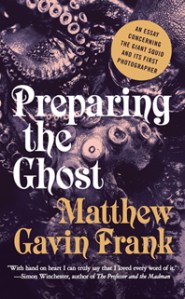
Preparing the Ghost: An Essay... tells the story of the obsession that led Moses to photograph the mysterious giant squid.

Preparing the Ghost is Matthew Gavin Frank’s third book of nonfiction and has been called, by Matt Bell, “a triumph of obsession.”

There are two sentences in this excerpt about Harvey sailing into the harbor at St. John’s that contain pretty noticeable digressions. The first sentence lists various sites around the harbor, beliefs about those places (“Deadman’s Pond, rumored to be bottomless), and some notable historical events that took place there. The other sentence zooms in on a girl cleaning fish. There’s definitely a more-is-more attitude in these sentences, both in terms of detail and grammar. You can’t really read them once through. I found myself stopping, rereading a phrase or word—but this was not an unpleasant experience, simply a different way of reading. How do you approach passages like these? Do you simply write them when so moved, or is there some underlying strategy at work?

Matthew Gavin Frank

Years ago, I took a class from the fiction writer, Paul Friedman, the gist of which was entirely devoted to the notion of the sentence—its parameters and pitfalls, its strong tightropes and its weak ones. The sentence, in this course, was something to navigate, traverse; something that required the strapping of the essential gear onto one’s body. Ropes. Cleats. Hooks. As my father-in-law would say: the whole toot. I love getting lost in the middle of a sentence— both as writer and as reader, and then having to bust my metaphorical flashlight out of my metaphorical fanny-pack in order to illuminate my way to its end. And then, of course, to re-write it a thousand times. I’d like to say that I wrote this passage in order to empathize with Moses Harvey’s assured ecstasy at approaching the port of St. John’s, Newfoundland in 1874, shell-shocked and bemused beneath the suspended and snotty chandelier of the first intact specimen of the giant squid. But the truth is probably that I was rendering my own ecstasy in the face of all of this wonderful research I uncovered. I fall in love with the objects of my research sometimes, and then all of the tightropes snap, and I’m falling, or rising, or just plain airborne, grabbing at all of the beautiful tinsel-y shrapnel floating past, trying to stitch it all into something that resembles a navigable sentence.

Michael Noll

You’re a writer of astoundingly varied experiences and interests, though they do seem to center on food and consumption. You’ve written books about working in the Italian wine industry and at a medical marijuana farm in northern California. So, a book about the man who first photographed the giant squid seems like a bit of a curveball. What drives your writing? I’d hazard to guess that you have no shortage of things to write about. What makes you choose one over another—and then spend the time necessary to write a book about it?

Matthew Gavin Frank

It’s funny. In trying to shun food writing for a while, I find myself working on a new project that’s attempting to interrogate not only our relationship with food (within regional context), but also our expectations of food writing. Food is complicated. The new book-in-progress is tentatively titled The Food You Require is Heavier: 50 States, 50 Essays, 50 Recipes. At the risk of sounding totally overblown, I’m trying to cobble together this spastic, lyrical anti-cookbook cookbook of sorts that also may be a fun and digressive revisionist take on U.S. history.  I’m trying to concentrate on the small events—incantatory and ponderous and horrific and mundane— that we glossed over when we originally (and then subsequently) attempted to set down regional definitions.  Each essay begins with this line of questioning: What does Illinois mean?  What does deep-dish pizza mean?  What ancillary subjects will I have to engage in order to stalk both food and state toward the blurry answers to these questions?  The Rhode Island essay, for example, is concerned with Clear Clam Chowder and the Cognitive Psychology of Transparency—how we think and react differently to things we can look through rather than look at. The Louisiana essay deals with the intersection of Crawfish Etouffee, bad weather, and autoerotic asphyxiation.

Being a little OCD helps to dictate my projects and focus for a while as well.  I mean, when, during my research process, I found out that squid ink is immortal—invulnerable to decay—and that in the South of England in the 19th century, the petrified remains of a 150-million-year-old squid were discovered entombed in solid rock, and that its own, perfectly intact ink was used to draw a picture of its remains, and that scientists called the resulting image, “the ultimate self-portrait,” how couldn’t I be seduced to catalogue the onrush on implications?  I’m easily seduced, is what I’m saying.  Immortal cephalopod melanin is all it takes, and I’m yours for a while.

July 2014

Michael Noll

Michael Noll is the Editor of Read to Write Stories.

How to Create Space for Digression

22 Jul
Preparing the Ghost: An Essay... tells the story of the obsession that led Moses to photograph the mysterious giant squid.

Preparing the Ghost: An Essay Concerning the Giant Squid and Its First Photographer has been called “a triumph of obsession” by Matt Bell.

For certain kinds of readers and writers, the best part of any book (often literary, though not always) is not a moment of supreme tension or complex gathering of plot strands. It’s an astute observation or unexpected description—some digressive phrase or passage that the writer seemed to pluck out of thin air. Yet when we sit down to write, we’re often overwhelmed with the practical necessities of motivation and plot and momentum and, as a result, find ourselves barreling down a straight line. The problem, we realize, is that we don’t know how to step off that line.

A writer who excels at digression is Matthew Frank. His latest book is Preparing the Ghost: An Essay Concerning the Giant Squid and Its First Photographer. While its subject is exactly what it seems—the mysterious giant squid—the book is a black hole, sucking into its center as many side stories and details as it can hold. You can read an excerpt here at The Nervous Breakdown.

How the Story Works

The trick to writing digressively is knowing when and how to digress. Your goal is to swerve from the main narrative without losing the reader, and to do this, you must prepare the reader for the swerves. One way to do this is to pry open a simple sentence and insert a small digression. Frank does exactly that. The excerpt from Preparing the Ghost focuses on the squid’s photographer as he rode a ship with the carcass of the squid aboard. The scene begins “at the 1874 port of St. John’s, Newfoundland”  as “the fishing boat entered The Narrows, the only entrance to the harbor.” Here is how Frank begins to digress:

The fog that the early sailors believed to be the last remnants of Noah’s flood began to shroud the vessel…

The sentence is simple in construction and subject. Without the digression, it reads this way: “The fog began to shroud the vessel.” To digress, all that Frank has done is add a description of the fog. He could have said it was thick or white, but he instead told us “that the early sailors believed [it] to be the last remnants of Noah’s flood.” On one hand, that tangential fact is simple, just a phrase. But it’s also a huge leap in time and logic. A passage that began in a specific time (1874) has now broadened its frame to include earlier sailors and even Old Testament times.

That digression made, Frank continues it after the sentence’s initial statement (the fog began to shroud the vessel) is finished. Here is the entire sentence:

The fog that the early sailors believed to be the last remnants of Noah’s flood began to shroud the vessel, the vapors pumped from the interior’s forests, commingling with the sea.

Frank has now expanded the geographic frame of the passage, from the port at St. John’s, Newfoundland to the forests that stretch far inland. Now that he’s expanded the frame, watch how he continues to digress. (Remember, he’s writing about a particular ship in 1874.) Here is the entire passage:

The fog that the early sailors believed to be the last remnants of Noah’s flood began to shroud the vessel, the vapors pumped from the interior’s forests, commingling with the sea. The early sailors believed that this fog housed ghosts of fishermen and fish, mermaids that they’d either have to love or decapitate, that the only way to eradicate this terrible fog would be to set a great fire to the forests. At the sea-bed beneath them, the skeletons of two-hundred ships lay unidentified in the soupy mass grave, lifeboats and their corpses embalmed in the deep freeze. The Labrador Current threw at them more and more ice.

Because he has created that initial space in a sentence about fog, Frank is able to make much larger digressions about ghosts, mermaids, and shipwrecks—the sort of details that give his writing energy and that we remember even after we’ve turned the page.

The Writing Exercise

Let’s digress using the passage from Matthew Frank’s Preparing the Ghost: An Essay Concerning the Giant Squid and Its First Photographer as a model:

  1. Choose any sentence that you’ve written to start a paragraph. Or, write a sentence that begins a new paragraph about a particular place and time. Ideally, the sentence will be focused on mechanics: who, when, where. Simplicity is best, even something as rudimentary as “The dog began to bark.”
  2. Find a place to pry the sentence open. A great place to start is after nouns, where we already tend to add descriptive phrases. Instead of a simple adjective, though, add a phrase that expands the dimensions of the sentence (space or time). Try using transition words like that or which or an en dash.  So, “The dog barked” can become “The dog that the neighbor brought home five years ago as a little barking puppy began to bark.” Or, it could become “The dog—which had appeared in the neighbor’s yard five years ago as a little, endlessly yapping puppy—began to bark.” Is it rough? Sure, but it has expanded the sentence’s sense of time.
  3. Continue the digression at the end of the sentence. If, after prying the sentence open, the beginning and end are still clear, it’s easy to simply keep the digression going by replacing the period with a comma. So, “The dog—which had appeared in the neighbor’s yard five years ago as a little, endlessly yapping puppy—began to bark” can become this: “The dog—which had appeared in the neighbor’s yard five years ago as a little, endlessly yapping puppy—began to bark, first at squirrels and then somebody taking out the garbage and then the rustling of leaves in Thailand and in France and finally at the Voyager space probe puttering along somewhere beyond the furthest reaches of the galaxy.” Now, we’ve expanded the sentence’s sense of geography.
  4. Keep digressing. Once you’ve set new boundaries for time and geography, there’s no reason to return to the limits of the original first sentence. Explore the space you’ve created for yourself. Frank picks up on the early sailors that he added and expands on some of their other beliefs. Then, he picks up on the geography of these beliefs (mermaids) and stays underwater, showing us shipwrecks. This kind of literary play is what makes writing fun and not simply the search for the next plot point.

If you read the entire excerpt from Preparing the Ghost, you’ll understand that I’ve simplified Frank’s work a bit. He begins to digress before the sentence about the fog and Noah’s flood. You may even get lost in some of his digressions. He’s a writer who pushes the usual boundaries of narrative—which means he’s a good writer to read because he’ll push your sense of what narrative is capable of. When reading someone like that, though, it’s useful to tease out a single passage for study. Otherwise, it’s like trying to puzzle out the structure of an entire symphony in one listening.

Good luck with your reading, and have fun with your writing!

An Interview with Domingo Martinez

17 Jul
Domingo Martinez's memoir, The Boy Kings of Texas, will soon become a HBO series.

Domingo Martinez’s memoir, The Boy Kings of Texas, is in works to become a HBO series.

Domingo Martinez is the author of the memoir The Boy Kings of Texas, which was a finalist for the 2013 National Book Award, the 2013 Pushcart Prize and was a Gold Medal Winner for The Independent Publisher Book Awards. It’s currently in development as a new series for HBO by Salma Hayek and Jerry Weintraub. Martinez’s work has appeared in Epiphany, The New Republic, This American Life, Huisache Literary Journal, All Things Considered, and Saveur Magazine.

In this interview, Martinez discusses building stories out of memories, his best-ever teaching moment, and taking the piss out of Rick Perry.

To read an excerpt from The Boy Kings of Texas, an essay Martinez wrote about the impact of the Affordable Care Act among immigrant communities in Texas, and exercises based on both, click here.

Michael Noll

The essay begins with a call you made to your grandmother, and that section ends with the lines: “Seeking medical advice is the last option, akin to giving up hope and faith. This is how poor people have learned to cope in South Texas.” Those sentences are addressing such big issues–the way that poverty and cultural barriers shape people’s lives. When you write about them, how do you begin? Do you start with sentences like those and work backwards, searching for anecdotes or details? Or do you start with a story (“I phoned my 84-year-old grandmother”) and wait for the right moment to open the story up to its larger implications?

Domingo Martinez

This was an issue I had when I first started in this business, in that my particular métier in writing is in anecdotes and storytelling; I’m not a journalistic/researcher-type writer. So when I begin on a topic, I scour my memory for something in my personal past that is at once relevant and, if I’m particularly lucky, unusual or comical in the cultural collision I’ve come to symbolize. Meaning that, I suppose I start from the project and let my imagination and experience wander, and hopefully where I end up, or the memories that surface, are still framed in the original intent. That’s why I usually bend the borders a bit. Which again, I suppose is my designation as an author. Ha.

Michael Noll

This is an essay about a Mexican immigrant living in South Texas published in a Washington D.C.-based journal. In other words, most of your readers almost certainly do not share your subject’s background or geography, and so you necessarily explain things that your grandmother’s community takes for granted. And yet, I’m guessing, you probably also wanted to write something that makes sense to readers in South Texas. So, there are sentences that seem aimed at less knowledgeable readers (“Many families there lived a dual life, on both sides of the border”) and details that are more intimate (“My brother, Dan, knew a kid whose grandmother made him eat Vicks VapoRub when he had a fever.”) How do you strike that balance? How do you know how much basic background information to explain?

Domingo Martinez

There’s a certain “sweet spot” you navigate when you’re writing about a culture that is at once so familiar and intimate to you, as the author, and unknown to your reader. First of all, you have to trust your reader, and trust that they’re capable of following insinuation or inflection, enough so that when you pause and explain something, they unconsciously register that this was important enough data to
 stop the story telling and define. If you stop and define every level of foreign information, it dulls the story, and comes off as condescension in a way. The best description I’ve ever come up with was at Breadloaf, this one fantastic woman in particular who was writing her own memoir, but was stuck very much in the “macro” telling of her origins, her family, their lives in Iran. The first part of her story read like the Old Testament, and I don’t mean the good parts. I sat with her and came up with the idea of the “dual
 perspective,” for her to write in the “micro” and have a constant awareness of the “macro.” Sort of like writing in a depth, with two
 points of view. That keeps your reader submerged in the particular of a story, and brings along the larger themes and intention of your
 work. It was a breakthrough, and she actually cried and hugged me. I think it was the best moment teaching I’ve ever had, and I really don’t like teaching.

Michael Noll

You write about the Republican presidential candidates in the last election promising to repeal the Affordable Care Act and, more specifically, about the cuts to medical services already made by Texas governor Rick Perry. And yet in South Texas, your grandmother is rubbing WD-40 on her arthritic joints. It would seem easy to become pretty angry while drafting this essay. How do you manage your emotions when writing about such a profound political disconnect?

Domingo Martinez

That was a depth I wasn’t really willing to tread in that piece, politically. Rick Perry is too easy a target to “take the piss out
 of” if you don’t mind the Britishism. So I wanted to stay away from him; he’s too cartoonish. (I do a great imitation of him, too, by the
 way.) It’s like when W was in the White House and every half-wit across the country felt he or she had the authority or superior
 to make fun of him, and that grew so tiresome so quickly. Anyhow, in this case, there is so much about Texas and its governance that I find absolutely appalling as a West Coaster from a nanny state, and probably in violation of several human rights. My younger brother lived in an apartment complex where, if he was two days late with rent, he’d be locked out of his apartment until he coughed up the full amount. I was astonished when this happened, while I was visiting. What if he was a diabetic? What if his kid lived with him? What if, like me, he had terrible asthma and his ventolin was in there? This would NEVER happen in Washington State. It just seemed so predatory. So I drove him to the Home Depot and figured out how to break in without the management knowing. That’s the sort of stuff that makes my blood boil, when it’s personal and immediate. Writing and witnessing the larger political objectives that are designed to cut support to impoverished (read: Mexican) communities in Texas, I’m overcome with more of a muted sense of defeat, especially because the Republicans in Texas are so good at getting Mexican American voters to vote for their pecuniary incentives as business owners because they hide their malicious political intentions behind a veil of religion and conservative “family values.” That disgusts me to no end, how easily Mexican Americans had been manipulated because “…Jesus wants it so. Jesus hates veterans and old people.” But that sense of defeat is as far as that goes, especially when it comes to Gramma and her weird choices in self-medication. I know her, and I know her people very well, and it wouldn’t really matter if she had access to healthcare at the Mayo Clinic: Gramma would augment her doctor’s prescriptions with WD-40 and anything else that would make sense to her, like chewing on rusty nails for the iron and sodium.

Michael Noll

Domingo Martinez's memoir, The Boy Kings of Texas, was a finalist for the National Book Award.

Domingo Martinez’s memoir, The Boy Kings of Texas, was a finalist for the National Book Award.

Your memoir, The Boy Kings of Texas, is being adapted into a series for HBO. HBO (and cable TV in general) has a good track record of offering shows that portray communities that are often hidden from national view (Baltimore in The Wire and Albuquerque in Breaking Bad come to mind). In the past, though, attempts at portraying Mexican-American communities near the border didn’t fare so well. The writer Dagoberto Gilb has written about his frustration in writing for a series set in Juarez/El Paso a decade or so ago. Do you worry about your story making the leap to television?

Domingo Martinez

I didn’t know that about Dago; I’ll have to ask him about his experiences. He briefly mentioned he’d taken a run at a script once but he didn’t expand on it. Truth be told, I’ve just developed momentum again on this project with Salma Hayek and her producer, so I’m not feeling like I can write about it here. It’s one thing I’ve learned in this business is that things are much better left untyped, as lawyers can’t sue you on insinuation alone. (Well, they can, but a good judge would throw it out.) However, I will say this: it’s certainly proving to be a challenge from the outset, and oddly, I’m really excited about it. Also, I’m incredibly naive and unsophisticated in the ways of Los Angeles, so I’m looking forward to being used, profoundly disappointed, and thrown aside as a spiritually desiccated husk, while the likes of George Clooney step over me on the sidewalk. It’s every author’s dream. (Not the success, but getting that close to success and failing, so that you can have something to write about.)

July 2014

Michael Noll

Michael Noll is the Editor of Read to Write Stories.

How to Describe a House

15 Jul
Domingo Martinez's memoir, The Boy Kings of Texas, was a finalist for the National Book Award.

Domingo Martinez’s memoir, The Boy Kings of Texas, was a finalist for the National Book Award.

Describing a house in a story ought to be easy. After all, real estate listings do it every day: 3 bedrooms, 2 baths. For poetic purposes, maybe throw in a window and chair. Of course, more is needed—but is that more simply more detail?

One of the best examples of a house description that I’ve read in a long time comes from the first chapter of The Boy Kings of Texas. Domingo Martinez’s memoir tells the story of his family and growing up in Brownsville, Texas. It was a bestseller and a finalist for the National Book Award. You can read the opening pages at the website of The Diane Rehm Show..

How the Story Works

As a thought experiment, try describing the house or apartment where you live. (Seriously, give it a try.)

What happened? Odds are, you started with the property listings and then got stumped. A good description requires some organizational principle, and until you find it, you’re just listing things.

The house that Martinez describes belonged his father’s stepuncle. The two families did not get along, as Martinez explains here:

Elogio and his four sons clearly felt that Dad and his family did not belong in the Rubio barrio, since Gramma had married into the barrio when Dad was already four years old, a child from another man. Elogio was our Grampa’s usurping younger brother, and he wanted control of the family trucking business that Grampa had built. As Grampa’s stepson, Dad challenged Elogio’s succession. It was a Mexican parody of Shakespeare, in the barrio, with sweat-soaked sombreros and antiquated dump trucks.

That tension is important because it informs the way Martinez describes the Rubios’ house, property, and near-feral dogs:

The Rubios had kept these dogs unfed, unloved, and hostile. Presumably it was to keep burglars away from their prototypical barrio home: a main house, built by farmhands many years before, with subsequent single-room constructions slapped together according to the needs of the coming-of-age males and their knocked-up wetback girlfriends. As such, the houses were consistently in varying stages of construction and deconstruction, because the boys never left home; they just brought their illegitimate children and unhappy wives along for the only ride they knew, the one that headed nowhere.

Notice the word choices: slappedknocked-upwetback, illegitimate, unhappy. They’re all negative.

Now, think about what other words Martinez could have described the house (or the words that a Realtor would use): big, hand-builtramblinghomeycomfortable. But those words would be totally out-of-place in this passage. Because Martinez has clearly defined his feelings toward the inhabitants of the house, the tone of the description is established. Once you’ve got the tone, the actual descriptions tend to present themselves automatically. The trick is to give your brain some guidelines. You’re not asking it to pull up every single detail about a place, just a few. The more clearly (and, usually, more emotionally) you define the guidelines, the easier it is to write the description.

It’s also worth noting that the description of the Rubios’ house is connected inextricably to the people who live in it. The main two sentences about the shape and construction of the house (beginning with Presumably… and As such…) end with the human rationale for the construction decisions (according to the needs… and because the boys never left home). The behavior and the needs of the family shape not only the house but the description of the house as well.

The Writing Exercise

Let’s describe a house or apartment (or wherever you or a character lives) using the passage from The Boy Kings of Texas by Domingo Martinez as a model:

  1. Choose your narrator or main character. If it’s you—good. If it’s a character in a story—also good. You need a primary perspective, a lens through which to view the house and everything else.
  2. Choose the house and its inhabitants. Who lives there? How are they connected to your narrator or main character?
  3. Identify the emotional angle on the house. How does the narrator or character feel about the house or the people living in it? Don’t think too hard; just brainstorm. Does the character have warm feelings? Is the character bitter, disappointed, angry, nostalgic, sad? Are the first memories or scenes that come to mind funny? Tragic? Tense?
  4. Write a quick scene/anecdote that illustrates that emotion. Focus the scene or story on a character or two and a particular moment in time. Remember, the goal is to tell a story that conveys how you or your character feels about the place.
  5. Generalize about the people who live in the house (or spend time there). This can be as simple as writing a sentence that begins, “They were the kind of people who…”
  6. Generalize how the people used the house. Did they use in a communal way (everyone eating, talking, hanging out together)? Did they isolate themselves into rooms? Did they come and go at odd hours? What sort of activities did they do there? Keep in mind the sort of people you are (previous step). If they’re the sort of people who ____, that means they spent a lot of time _____, which really made me/your character feel ______.
  7. Generalize how the house was a perfect/imperfect fit for these activities and these people. Did the house allow the people to do the activities? Were the people cramped? Did the people modify the house in order to do the things they wanted to do? In what ways did they modify their own behavior to fit the house?
  8. Describe the house. You’ve probably already written a few lines about the house. Now you’re summing them up. You might start with a sentence about the people: They were the kind of people who _____ or They spent a lot of time _____. Or, you can jump straight to the house with a sentence like this: It was the sort of house that _____ or It was a typical _____ house. Your goal is to write a description of the house that focuses on the ways it was used, the ways it fit a type of behavior, or the ways it shaped the inhabitants’ behavior. Keep in mind the cue words and phrases that Martinez uses (according to the needs… and because the boys). How can you describe the house in terms of causality?

As you likely know, people’s houses tend to become manifestations of their personality traits. The goal, then, is to write a description of a house that is as active as the people who live in it.

Good luck!

An Interview with Natalia Sylvester

10 Jul
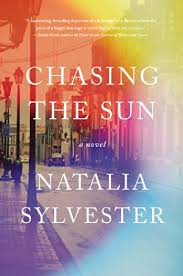
Natalia Sylvester's debut novel, Chasing the Sun, is set in Lima, Peru, during the terrifying years of the Shining Path. It tells the story of a marriage -in-crisis that is pushed to the brink by a kidnapping.

Natalia Sylvester’s debut novel, Chasing the Sun, is set in Lima, Peru, during the terrifying years of the Shining Path. It tells the story of a marriage-in-crisis that is pushed to the brink by a kidnapping.

Natalia Sylvester is a Peruvian-born Miamian now living in Austin, Texas. Her debut novel, Chasing the Sun, follows a frail marriage tested to the extreme by the wife’s kidnapping in 1990s Peru. Booklist called the novel’s ending “smart and unexpected.”

In this interview, Sylvester discusses restarting a novel after setting it aside for six years, the things that pull a marriage apart, and what happens when you pitch to American editors a novel set in Peru with an all-Peruvian cast of characters.

To read an exercise on moving the plot forward in a novel and an excerpt from Chasing the Sun, click here.

Michael Noll

I know the novel is based in part on the kidnapping of your grandfather in Lima in the 1990s. I’m sure that’s a story that you’ve been thinking about for a long time, not just what happened to your grandfather but the larger political situation in Peru at the time. What finally allowed you to turn that story into a novel? Was it a question of finding the right backstory for the kidnapping?

Natalia Sylvester

I think more than anything, it was time that allowed me to tell this story. I started writing it as part of my undergrad Creative Writing thesis back in 2005/2006, and back then (like I’d been most of my life) I was hesitant to talk to my family about my grandfather’s kidnapping. It’s something I’d known about and wondered about, but since we rarely spoke about it in much depth, I didn’t ask. I let all my questions pile up and even when I wrote the first drafts of Chasing the Sun, I wrote it quietly, keeping all my questions between me and the page.

Not surprisingly, the story didn’t come together the way I’d hoped. (Also, I was 21, newly engaged, and trying to write a story about a troubled marriage. I don’t really buy into the “write what you know” belief, but when I write I do need to find an access point into a story, and for me it can be almost anything, as long as it feels true.)

I set the book aside for nearly six years. I had no plans to ever revisit it, but my husband had read parts of it and would constantly insist, based on one scene he loved, that there was something there. This time I approached it with a heavy emphasis on research—not just on Peru and its political situation and the years of terrorism it experienced, but also the main thing I’d been avoiding all along, which was talking to my family about the kidnapping. Though none of the characters are based on my family, having their insights (and now I realize, their support) was so necessary because I wanted to restart this story from a place of truth and honesty.

Michael Noll

Speaking of the backstory, I loved the relationship between Andres and Marabela—it’s so complex. Even after Marabela is kidnapped, I found myself wondering not whether she’d survive but what would happen after she returned. This seems like a real accomplishment—to create a story that can rival kidnapping for suspense. How did you come up with it?

Natalia Sylvester

Natalia Sylvester's debut novel, Chasing the Sun, is a literary thriller that has drawn comparisons to Gillian Flynn's blockbuster Gone Girl.

Natalia Sylvester’s debut novel, Chasing the Sun, is a literary thriller that has drawn comparisons to Gillian Flynn’s blockbuster Gone Girl.

Thank you, I’m really touched by that. Their relationship took me by surprise from the very first draft. I’d originally written my thesis as a set of linked short stories, all told from different POVs, about Marabela’s kidnapping. I started with Cynthia’s POV, then Consuelo, then Ignacio, and then finally, Andres. When I got to his story, it was like they’d been keeping their troubled marriage secret from me all this time. And I thought that was pretty fascinating, because life never happens in a vacuum, even (or maybe especially) the kinds of things we most fear. I wondered if Andres would be able to compartmentalize, and not let his feelings about his failing marriage affect the decisions he makes as he tries to save Marabela. Their relationship became almost like an additional character I wanted to explore and dissect and understand.

Also, in the six years that I’d set the story aside, I’d gotten (happily!) married but seen a lot of marriages around me fall apart. So I became kind of obsessed with how that happens. How does something as huge as two lives, lived side by side for decades, fall apart to practically nothing? I thought it’d have to be something equally big and traumatizing, like a kidnapping, when really it’s the little things, the everyday, mundane gestures and regrets that can build up and pull us apart.

Michael Noll

I love the way the beginning of the novel sets up Andres’ value system (hard work pays, be assertive in business, honor your promises) and also the holes in that system (he doesn’t really pay attention or express concern for his family’s domestic employees). How important was it to establish those values early in the novel?

Natalia Sylvester

It’s interesting that you mention it because a huge chunk of that early scene, I didn’t end up writing until after the book had sold and I was working on my first round of revisions for my editor. Looking back, I feel very lucky the book sold like that, because I think it’s crucial to establish who a character is, what they stand for, and what world they’re living in, before you disrupt it all with something as earth-shattering as a kidnapping. What good is the “after” picture without the “before”? In fiction we’re often told, “Start with the inciting incident” but the false sense of security in the calm before the storm is equally rich in possibility.

Michael Noll

It’s not unusual to set novels in “exotic” locations, but it’s less common for American novels set in one of those places (in this case, Peru) to follow a cast of characters that doesn’t feature any Americans. I wonder if you encountered any resistance to the fact that it’s truly a Peruvian novel, about Peruvian characters. Did anyone, a reader or agent or editor, ever say, “Gee, couldn’t you make Andres an American?”

Natalia Sylvester

Not in exactly those words, but yes, several publishers that rejected the story expressed concern that it wasn’t tied at all to the U.S. Some wished there could be an American character, or maybe at some point, they go to the U.S. And you know, if there’s one thing I wish I could unlearn about publishing, or that I could make other aspiring authors unlearn, it’s this. Because I was blissfully unaware as I wrote Chasing the Sun that it being so Peruvian was unusual. I just thought, I’m writing a story, and of course I’m going to set it here, and these are the people who live in that world. It never occurred to me that they’d be seen as “difficult to relate to” because I’ve always believed we’re more alike than we are different, and that universal stories are just that—they can belong to any of us.

I’m very lucky that my publisher understood this; they actually loved that the book was so Peruvian. But my heart breaks when I realize what a struggle it was, and what a struggle it still is, for us to get our stories heard because they’re not perceived as part of the mainstream world.

July 2014

Michael Noll

Michael Noll is the Editor of Read to Write Stories.

How to Set Up the Second Half of Your Novel

8 Jul
Natalia Sylvester's debut novel, Chasing the Sun, is a literary thriller that has drawn comparisons to Gillian Flynn's blockbuster Gone Girl.

Natalia Sylvester’s debut novel, Chasing the Sun, is a literary thriller that has drawn comparisons to Gillian Flynn’s blockbuster Gone Girl.

Almost everyone who tries to write a novel hits a wall roughly a third to halfway through the book. They discover that the plot is played out and the characters have hit dead ends. Why is this?

Part of the problem is often found in the opening pages. One of the inescapable truths of storytelling is that you must get to the story quickly; it’s the reason readers won’t be able to put down your book. This is true for every kind of story, but it’s especially true for a novel that fits into the category thriller. Yet if the novel focuses solely on kicking off the plot, it won’t give itself enough material to keep going once the initial plot mechanism runs its course. This is why many early novel drafts tend to stall out after 70 to 100 pages.

The question is how to do two things at once: hook the reader and also plant seeds that will sprout later in the book.

An excellent example of planting seeds can be found in Natalia Sylvester’s novel Chasing the Sun. The hook is made clear in the front flap: “Andres suspects his wife has left him—again. Then he learns that the unthinkable has happened: she’s been kidnapped. Too much time and too many secrets have come between Andres and Marabela, but now that she’s gone, he’ll do anything to get her back. Or will he?” But you have to read the first chapter to find the seeds that will sprout into the second half of the novel.

How does Sylvester integrate early hints of those secrets into the kidnapping scene that must begin the story? Find out by reading the opening pages here.

How the Story Works

Anyone who’s read the jacket of Chasing the Sun knows that Marabela will be kidnapped. So, the novel has no choice but to begin there. Even if Sylvester had wanted to start earlier, the reader wouldn’t have stood for it. If readers know what happens next, they won’t keep reading for long. So, Marabela disappears in the first chapter. And yet what a difficult place to begin. Once the kidnapping occurs, there are certain steps that must quickly follow: calls from the kidnappers, requests for ransom, negotiations, and wrong steps by everyone involved. These events carry an incredible gravitational field. The reader’s eye will skip over everything else and move straight to the central question: then what? Good luck creating depth of character or culture or place when a woman’s life hangs in the balance. But character and culture and place are the best parts of the story and (from a practical standpoint) the triggers that will propel the plot forward after the initial burst of kidnapping energy has played itself out. As a result, the writer must imbed these things, this backstory, into the hook. Sylvester does this in a couple of ways.

First, she creates synchronous events. While Marabela is being kidnapped, her husband Andres is on a business call. Sylvester ties the events together in a few deft sentences, when Andres has to explain why his wife couldn’t come to the meeting:

He’d hoped Marabela would come with him today to help make a good impression.

“She’s so sorry she couldn’t make it. She was really looking forward to seeing you again,” he says.

“Tell her I said hello and that I hope she feels better,” Lara says.

We don’t yet know she’s been kidnapped, but we know something is going to happen (and if we’ve read the jacket, we know exactly what will happen), and so we’re aware of the irony of Lara’s statement. Sylvester doesn’t let it drop there. After the meeting, Andres’ son asks why his mom would come to a business meeting for something that doesn’t directly involve her. Watch how Sylvester uses Andres’ answer to do something crucial to the novel:

He sighs, unsure how to explain the less concrete aspects of his business. “Sometimes those kinds of things help the situation along. A man like Manuel wants to know the person he’s about to do business with shares his values. That he’s a good husband, a family guy. That he can be trusted.”

Again, the statement is ironic (“a good husband, a family guy. That he can be trusted”). Sylvester is making a clearcut statement about the man Andres wants to be, and, later in the novel, it will inevitably turn out that he’s not this kind of man. But Sylvester is doing something else as well. She’s beginning to tell the reader the values that Andres holds dear. Just one page later, when Andres and his son are being driven home, his son accidentally rolls down the window at a stoplight:

“Señor, tres paquetes de galletas por un sol.” A young boy, no older than thirteen, pokes his head through the window. Ignacio shakes his head and starts rolling up the window when his father leans forward to stop him.

“Not so fast. You already got his hopes up. Don’t toy with the kid.” He leans over and shouts, “¡Dos paquetes! Go ahead, pay him.” He nudges his son.

“But you’re the one who—” With a stern look from his father, Ignacio stops protesting and fishes two coins out of his pocket.

The scene might seem incidental, but it tells the reader that Andres lives by a particular ethical code. Just as the novel will inevitably challenge Andres’ definition of himself as a good husband, a family guy, and trustworthy, the novel will also inevitably challenge his ethical system, forcing him to act in ways he would have previously believed unacceptable. The scene has also introduced Andres’ relationship to the larger political situation in Lima. The novel is set during the days of the Shining Path, a guerrilla group whose battle against the government cost more than 100,000 lives. It’s not accident, then, that the scene just described involves two people with a hired driver and a poor boy selling cookies. The novel is hinting at the politics that will play a large role in the story.

These seeds will become increasingly important. The kidnapping will be resolved, as it must, and that is when the real story begins—a story that is impossible without these details about Andres that can be turned on their head, a turning that will drive the plot forward again.

The Writing Exercise

Let’s plant some seeds using Chasing the Sun by Natalia Sylvester as a model:

  1. Create a synchronous event. Your novel probably has a Big Event that kicks off the story. At its most basic, it’s likely some version of a stranger arriving in town or a character leaving on a trip. The story hinges on that event, and, as a result, it’s difficult to shoehorn any character development in those scenes. So, carve out a scene that takes place at the same time or within the Big Event. It can be anything. Sylvester’s Big Event is the kidnapping, and her synchronous event is the business meeting. In a way, this is true to life. We’re never doing one thing at a time, and when something big happens, we’re almost always engaged in some other activity. Create that activity. If your character is getting ready to leave on a trip, send her to the bank, the grocery store, the mechanic, to coffee with a friend, or to the person who will take care of the dog while she’s gone. If a stranger is arriving, find out what people are doing as the stranger gets into town; they’re probably not sitting around, waiting for him.
  2. Connect the events. The connection is essential because otherwise the reader may feel like you’ve added an extraneous scene. Obvious ways to connect the events are with glimpses of someone (I saw a figure walk past the window and didn’t think much of it) or with phone calls or text messages (Ready yet?). You can also connect the events with irony (I couldn’t wait for a relaxing evening, or, they seem like they’ll make the perfect married couple). Because any novel’s initial events are given away by the jacket flap, the reader is anticipating whatever Big Event you have in store. So, if you’re dropping hints that the characters have certain expectations that won’t be met, the reader gets a sense of anticipation. Therefore, the connection that you make between events doesn’t need to be direct; it can simply hint at expectations that the Big Event will disrupt.
  3. Use that connection as an opportunity for character definition. Remember, not all character development is created equal. It’s fine to know that a character is vegan, but if you write that a character refuses to sit in an establishment that doesn’t serve vegan options, then you’re creating a scene that the reader can anticipate. A great way to create expectations in the reader is to define the character’s value system (He’s the kind of person who…). Sylvester lets Andres define himself as a good, honest husband and family man. The reason that he defines himself is because he’s thinking about his wife’s absence at the meeting. So, how can you use the connection between events as an opportunity for your characters to define themselves? If your character is leaving on a trip, let her define the kind of traveler she is (I take books and a coffee grinder, but I refuse to answer my email). If it’s a stranger arriving in town, let the character define the kind of place he lives, which will be a reflection of how he sees himself (I thought about hitting the showers but decided to knock out another couple of sets. The guys nodded at me as I came back into the weight room.) You’re setting the stage for the Big Event. Notice that these definitions contain value systems. When you establish a value, it’s a good idea to try to pressure it, even break it, in the story. The reader will be expecting nothing less.

Good luck!

An Interview with Smith Henderson

3 Jul
Smith Henderson's novel Fourth of July Creek is already in the works to become a television series.

Smith Henderson’s novel Fourth of July Creek is already in the works to become a television series.

Smith Henderson’s novel, Fourth of July Creek, made news before it was even released, in part due to the bidding war it inspired among publishers. So far, the novel has been called “the best book I’ve read so far this year” by the book editor of The Washington Post and “a hell of a great book” by Esquire. The novel is set in Montana and follows a social worker whose life becomes entwined with the delusional and grandiose actions of a would-be prophet and revolutionary, Jeremiah Pearl.

Henderson was the recipient of the 2011 PEN Emerging Writers Award in fiction. He was a 2011 Philip Roth Resident in Creative Writing at Bucknell University, a 2011 Pushcart Prize winner, and a fellow at the Michener Center for Writers in Austin, Texas. He currently works at the Wieden+Kennedy advertising agency, where he wrote the Chrysler Super Bowl ad featuring Clint Eastwood. His fiction has appeared in American Short Fiction, One Story, New Orleans Review, Makeout Creek, and Witness. Born and raised in Montana, he now lives in Portland, Oregon.

In this interview, Henderson discusses the challenge of dramatizing a character who spends much of his time off the page and his method for capturing the voice of a man who believes the Antichrist is alive and well.

To read an exercise on using summary in dialogue and an excerpt from Fourth of July Creek, click here.

Michael Noll

I love the way that you make Jeremiah Pearl present in the novel, even when he’s not actually on the page. The biggest way you do this is with the coins that have had holes somehow cut into them. Pete finds one of the coins in his change, and then he runs across individuals who’ve encountered the coins and are collecting them, which leads him to someone who’s had a face-to-face encounter with Pearl. I’m curious if the coins were always present in the novel or if you introduced them to solve some issue you were having, perhaps the difficult of writing about a guy who would necessarily spend much of his time in hiding.

Smith Henderson

I’m sure the coins were a solution, as you suggest, but it was also just one of those things that felt right, and may have been something I was going to have him do all along. You have a character in mind and you start to think of things he or she does and what those things could mean for the plot.

But as you say, Pearl is in hiding quite a bit, so it began to be important that he do enough things that he wasn’t hiding from nobody. People—not just the protagonist, Pete—needed to want to find him. And so then you just start to look at things that a guy like that would do that would draw attention. The coins were definitely part of that.

If there’s a craft takeaway from all this, it’s probably that a character’s actions should both move the plot and be expressive of that character’s core identity.

Michael Noll

While Pearl makes his first appearance early on in the novel, he isn’t seen a second time until about halfway through. In that span of pages, you’ve created a tremendous amount of suspense about his activities and who, exactly, he is. Did you worry about how you’d satisfy the intrigue you’d built up? In other words, how did you approach the scene that you must have known that your readers would be dying for—Pete’s second encounter with Pearl?

Smith Henderson

I honestly don’t recall approaching that scene. I remember being more concerned with making Pearl off-stage as compelling as scenes with him in them. A scene with characters in the same time and place is technically easier to do than having a character relate a story to another character.

But of course, there was pressure to make Pearl-in-the-flesh as vibrant, interesting, and troubling as possible. To have earned that intrigue. But then, the intrigue itself gives the character a certain degree of power. Playing against the created image of the man was a large part of the fun in writing those scenes.

Michael Noll

Smith Henderson's highly anticipated debut novel, Fourth of July Creek, was called "the best book I've ready so far this year" by Washington Post fiction editor Ron Charles.

Smith Henderson’s highly anticipated debut novel, Fourth of July Creek, was called “the best book I’ve ready so far this year” by Washington Post fiction editor Ron Charles.

One last question about Pearl (he’s tremendously fascinating). How much research was required to write his rants? Did you try to research the kinds of things he would have read about? Or did you research people like him to see what they talked about?

Smith Henderson

Well I’ve been to churches where people spoke in tongues and where the religious intensity was hotter than say, at a Unitarian church or something. I was privy to conversations about who exactly was the antichrist. So a lot of Pearl’s basic worldview was familiar to me, as it is to millions of Americans.

Also, people in Montana are generally suspicious of “outside” authority…so I was steeped in that kind of thinking before I ever conceived of Pearl. But as it came time to bring him to life, I did research into separatist movements and militias and the different flash points of the past 30 years. The Unabomber’s capture, the Ruby Ridge standoff, the hunt for Eric Rudolph. But Pearl’s voice was drawn from more older sources. I read a lot of Thoreau, Emerson, and even Nietzsche to get his pronouncements to sound properly grand. He’s as much a product of the Jesus who threw the money-changers out of the temple as he is Timothy McVeigh.

Michael Noll

The novel is written from a few different points of view, and in the sections about Pete’s daughter Rachel, you use a Q&A format. Was this a way to break up the pace of the novel? Her story takes place pretty far from Pearl’s story, and so I’m wondering if you felt the need to give her sections some extra velocity, some snap, to keep the reader’s mind from wandering back to Pearl and Pete.

Smith Henderson

The Q&A format is basically a way for me to generate material. I will often write that way to figure out a character or write my way out of a problem. With the Rachel sections, I just found that I liked them in the Q&A style. For a couple reasons. First, the identities of the Q&A aren’t really identified and work like a Greek chorus, sort of commenting on the action as they disclose it. But also, there is an inherent anxiety to the questions, which I felt really gave the reader Pete’s perspective on his daughter’s fate, his worry, his fear, his imagination running away with the possibilities…it’s as if every question is some version of “Is she okay is she okay is she okay is she okay…?” I found that much more satisfying experience as a reader.

July 2014

Michael Noll

Michael Noll is the Editor of Read to Write Stories.
How to Create Energy in Dialogue with Summary

1 Jul
Smith Henderson's highly anticipated debut novel, Fourth of July Creek, was called "the best book I've ready so far this year" by Washington Post fiction editor Ron Charles.

Smith Henderson’s highly anticipated debut novel, Fourth of July Creek, was called “the best book I’ve ready so far this year” by Washington Post fiction editor Ron Charles.

Dialogue is not the same as real-life conversation. While this isn’t exactly news to anyone who’s tried to write a story or novel, it’s something we often forget. Most obviously, dialogue is brief, a few pages at most (and that’s some very extensive dialogue), whereas even short conversations, if transcribed, would last at least probably twice as long. There are some common ways to condense dialogue: skip the greetings and chit-chat. Get down to business. Jump ahead to the tense part of the dialogue—the bit where something is at stake. Leave out the filler that we often think is required to get to the good stuff but which can usually be cut.

But what if it’s all good stuff? What if, for instance, a character is telling another character a story, and it’s all tense and interesting, but it’s also going on and on? How do you keep the material but shorten the dialogue? One answer is to use summary.

A great example of using summary in dialogue can be found in the highly-praised debut novel Fourth of July Creek by Smith Henderson. It was published by Ecco, and you can read the opening pages here.

How the Story Works

In the novel’s opening scene, a social worker, Pete, has been called out to a dispute between a woman and her teenage son. A neighbor called the police, and after subduing both individuals, the cop called the social worker. In this piece of dialogue, the officer is telling Pete what happened. Notice what Henderson puts into dialogue and what he summarizes:

Pete nodded and wrote some more…

“And the situation when you got here? ”

The situation was a perfect fucking mess. The situation was the kid climbing up onto the slanted, dented aluminum carport and stomping on the rusted thing like an ape. Just making the whole unsound shelter boom and groan under his weight. The mother saying so help her if that thing falls on her Charger she’ll gut him, and the kid just swagging the carport back and forth so that it was popping and starting to bow under his weight. Now the cop was about ready to shoot the ornery shit off the goddamn thing.

Then the situation got interesting.

“The mother has the air rifle and—”

“No way,” Pete said.

“Yeah, fuckin way,” the cop said.

“She shoot him? ”

“Before I get to her, yeah, she shoots. You can see the big old welt on his forearm.”

Pete started to write.

“And then what?”

At this point, dialogue moves back into summary, describing what happened next between the boy and his mother. Take another look at the dialogue and imagine if the summarized part (the paragraph that begins with “The situation was a perfect fucking mess”) had been put into dialogue. In other words, what if the police officer had told the entire story in his words? It would have taken longer—perhaps only slightly longer, but if you’ve ever listened to someone tell a good story, anything that slows the pace is annoying.

So what does Henderson summarize? Notice where the summary ends and the dialogue picks back up again: “Now the cop was about ready to shoot the ornery shit off the goddamn thing.” The summary has given us the setup, the logistics of the story: who and where and what. But when the setup turns into a moment of action, of potential drama becoming actual drama, the scene is told through dialogue. We’re put immediately into the question of what happened:

“The mother has the air rifle and—”

“No way,” Pete said.

The dialogue is saved for the moment of greatest intensity and interest. Everything that is required to get to those moments is summarized.

The Writing Exercise

Let’s summarize within sections of dialogue, using the passage from Smith Henderson’s novel Fourth of July Creek as a model:

  1. Choose the scene. You’ll need two or more characters and a story for one of them to tell. While the story doesn’t need to be connected to the immediate situation (people just sitting around, telling stories), the dialogue will feel more pressing if it impacts the characters. Henderson makes his story impactful because the story dictates how the social worker will handle the situation. One way to handle the scene is to have a character enter in a hurry, or with great purpose, and begin telling a story that must be told. Think of a child running into a house to tell his mom that his brother is hurt. The story will answer the question, “What happened?” And what happened will dictate what the mom does next. So, how can you invent a scene where a character enters in a hurry and causes another character to ask, “What happened?”
  2. Write out the dialogue in full. Don’t worry about summarizing yet. In a way, you don’t know what to summarize because you don’t yet know the entire story or how it will unfold.
  3. Listen for the slow parts. As you reread the dialogue, or as you write it, attune yourself to the voice in your head telling the story and also the voice that’s listening to the story. When does that second voice begin to lose interest? When does its attention flag? When does it perk up?
  4. Summarize the slow parts. Slow doesn’t mean uninteresting, only less interesting than the most exciting parts. Usually, these parts are the interstitial moments, the parts of the story that connect the moments of true drama. Imagine telling the story at a bar or coffee shop. When the listener leans forward and says, “And then what?” that’s almost certainly a moment of high interest or suspense. Put that part in dialogue. The setup that was required to get there can be summarized.
  5. In the summary, use sentences that emphasize action. It’s almost like you’re blocking out a scene for a play, directing the actors where to stand and what to do. Henderson does this with -ing words: “the kid climbing up onto the slanted, dented aluminum carport and stomping on the rusted thing like an ape. Just making the whole unsound shelter boom and groan under his weight. The mother saying so help her if that thing falls on her Charger she’ll gut him, and the kid just swagging the carport back and forth so that it was popping and starting to bow under his weight.” These words give the scene a sense of immediacy because the make the action ongoing, rather than completed and over with. We do this naturally: “So I was standing there, minding my own business when…”
  6. In the summary, use sentence structures that emphasize latent energy. Latent energy is the energy required for a substance to undergo a transition (water: ice to liquid; a car: not moving to rolling down a hill). Latent energy is what makes an audience lean forward and ask, “Then what?” Notice the latent energy in this sentence from the scene in Henderson’s novel: “the kid just swagging the carport back and forth so that it was popping and starting to bow under his weight.” The kid is applying force to the carport, and at a certain point, that force may supply the necessary latent energy for the carport to fall apart. In story terms, the act of the boy jumping on the carport is also applying force to his mother. When the force is strong enough, she will act. So, in your scene, find a way for one character to apply a type of force against another character: you’re looking for the amount of force that will supply the necessary latent energy to make that character act. When the character is about to act, that’s when you quit summarizing and begin using dialogue again.

Good luck!

How to Build a Political Argument around a Personal Story

24 Jun
Domingo Martinez' memoir, The Boy Kings of Texas, will soon become a HBO series. His essay about the Affordable Care Act, "Quarantined," appeared in The New Republic.

Domingo Martinez’ memoir, The Boy Kings of Texas, will soon become a HBO series. His essay about the Affordable Care Act, “Quarantined,” appeared in The New Republic.

It’s no secret that personal stories can fuel political campaigns. The most successful example is the first campaign run by President Obama, but John Boehner does it as well (from a saloonkeeper’s son to the Senate) and so will/does Hillary Clinton. Watch the next presidential conventions, and you’ll notice that almost every single speaker crafts a political message from his or her life story. Some will be quite compelling, and others will come off as dull at best and crass at worst.

One of the better political/personal essays that I’ve read recently is by Domingo Martinez. His memoir, The Boy Kings of Texas, was a finalist for the National Book Award and will soon become a new TV series from HBO. But before the memoir, he wrote “Quarantined,” a short essay that you can read now at The New Republic.

How the Story Works

The essay is about the Affordable Care Act and was published in February, 2012, when the fate of the Act was still in doubt. So, Martinez had a clear goal for the piece: to explain why the ACA should be passed in its strongest possible version. He also knew that, to explain his argument, he wanted to talk about the people he grew up with in South Texas. The problem was how to connect the two without falling back on the usual talking points that every politically-engaged person in America had heard a thousand or more times. His solution is to find a third thing to spend most of the time discussing. Let’s look at how this works.

The essay begins with the author calling his grandmother in South Texas. Like many grandmothers everywhere, she ends up talking about her health. But, unlike most grandmothers, her medical treatment takes an unusual twist:

I tuned out her blessings and her current list of maladies until she told me about her terrible arthritis. I shouldn’t worry, she said, because, between the power of prayer and WD-40, her joints were working fine. I asked her, in my halting Spanish, to repeat what she had just said, especially that bit about the WD-40. “The spray stuff, that we used on the trucks, Gramma?” I asked. “El es-sprayo por los truckos?”

“Yes, that’s the stuff,” she said (en español). “I just say a prayer over it and spray my knees and my elbows, and, in the name of Jesus, the heat from the WD-40 loosens my arthritis.”

The interpretation begins at the end of the essay’s first section:

My grandmother’s not dumb or losing her mind. Like many immigrants faced with problems that demand solutions beyond their resources, she looks inward, and backward, for help—or at least delayed consequences—resorting to superstition, old wives’ tales, or illogical assumptions. Anything, so long as it does not cost money. Seeking medical advice is the last option, akin to giving up hope and faith. This is how poor people have learned to cope in South Texas.Seeking medical advice is the last option, akin to giving up hope and faith. This is how poor people have learned to cope in South Texas.

The essay, then, becomes about poverty and the methods a particular group of people have developed for living without some of the basic necessities that most Americans take for granted. He talks about his grandmother, who acts as a bank for her neighbors, who “hock pistols and rifles for small loans.” He explains the “cultural isolation and fundamental lack of understanding” that make delivery of government services a challenge. Because of those challenges, he explains the attitudes that develop around seeking out help, especially medical help: “If you’re not hemorrhaging or suffering from an embolism, then you don’t get to see a doctor.”

Eventually he zooms out from these fine-grain details:

Cameron County, where my grandmother lives, boasts one of the highest ratios of uninsured in the state; one in three people have no coverage. In Texas as a whole, one in four people live without health insurance, the worst percentage in the country.

He mentions the ACA briefly but then explains the cuts to medical services already made by Texas’ governor, Rick Perry. These cuts have affected his parents and grandmother, and they worry about what future cuts may mean for their health. By this point, Martinez is firmly within a political mode, explaining the necessity of the law. But this is not where he ends the essay. Instead, he returns to his point about the region’s poverty and challenges due to cultural barriers: even if the ACA is passed, will his grandmother take advantage of it? Or will she continue to treat her arthritis with WD-40?

Martinez writes, “Few people who speak their language have the time or inclination to try to persuade them—and even fewer are willing to pick up the phone and call.”

Rather than sticking to the well-worn arguments about expanding health care, he makes a larger argument about the political disenfranchisement of an entire group of people. In this way, by revealing the real issues faced by his family, he honors his personal story rather than simply making political hay with it.

The Writing Exercise

Let’s make a political argument with a personal story, using Domingo Martinez’s essay, “Quarantined,” as a model:

  1. Choose the general political argument that you want to make. It can be something that, when you hear pundits on TV talk about it, your blood starts to boil. Or it can be a more local issue that is usually ignored by national politicians. If possible, choose an issue that is personal to you. Doing so will help you avoid the typical arguments that everyone has begun to tune out.
  2. Choose the personal story you want to use. It doesn’t have to be a story, per se. A detail or series of details can work as well. Martinez uses the fact that his grandmother treats her arthritis with WD-40 and prayer. In short, you can use a detail or story that stands out to you or that you struggle to wrap your head around. Most of us have details about our childhood or the place where we’re from that we enjoy telling to people in order to get a reaction. Those are good details to use for a political essay because they’re usually rough-edged, whereas most political discourse tends to be polished and generic.
  3. Tell the story. Forget the political angle. Pretend it doesn’t exist. You want to tell your story in a true, authentic form, and that’s not possible if your point is already evident; the reader would become suspicious of your story. Use a basic structure: set the stage (when and where and who), what happened, and how this made you feel at the time and how it makes you feel now.
  4. Analyze the story. Why does this story stand out to you? Why do you still think about it? Martinez expresses disbelief at his mother’s use of WD-40: “The spray stuff, that we used on the trucks, Gramma?” I asked. “El es-sprayo por los trucks?” Then he offers an explanation for why she and others like her do such things: “Like many immigrants faced with problems that demand solutions beyond their resources, she looks inward, and backward, for help—or at least delayed consequences—resorting to superstition, old wives’ tales, or illogical assumptions.” While it’s true that there is an implicit political argument in this sentence (why does the U.S. not provide more assistance to immigrants?), it’s also true that Martinez is simply explaining the way things are. So, spend a few sentences explaining the behavior that you’ve just described.
  5. Analyze the story in greater depth. For Martinez, the paragraph mentioned in the previous step is just the beginning. Because he’s established the behavior and the reasons for it, he can elaborate on other types of the same behavior and other illustrations of the reasons. Try to do the same thing in your essay. Are there other things that people did/do that are like the story you told? Are there other ways to illustrate the reasons you’ve given?
  6. Zoom out from the story. Your story is almost certainly not an anomaly. But can you put numbers to it? Can you write a sentence like Martinez’s: “In Texas as a whole, one in four people live without health insurance, the worst percentage in the country.”
  7. Make your political point. Now that you’ve established the larger trend or picture as well as the personal element of the issue, you can make a suggestion for appropriate political action.
  8. If possible, move beyond the immediate politics. Martinez makes a point about the ACA, but then he makes a larger point about the reason his grandmother uses WD-40 for medical purposes, a point about political disenfranchisement. He’s explaining the deeper issue, the one that creates the need for the ACA law. So, if you can, think about what deeper political problem necessitates the law or action that you’re prescribing. You might not be able to do this, but it’s always worth a try.

Good luck!

How to Carve Out Space for Character Development in a Violent Setting

17 Jun
Benjamin Alire Sáenz won the PEN/Faulkner Prize for Fiction for his collection, Everything Begins and Ends at the Kentucky Club. The stories are set along the border between El Paso and Juarez and center on the Kentucky Club, two blocks south of the Rio Grande.

The stories in Benjamin Alire Sáenz’s collection, Everything Begins and Ends at the Kentucky Club, are set along the border between El Paso and Juarez and center on the Kentucky Club, two blocks south of the Rio Grande.

There are places in the world that dictate the type of stories that happen there. Violence exerts an overwhelming gravitational pull, and a story that at first has nothing to do with violence—a love story, or a story about family or business—will eventually get pulled into orbit around the violence that exists in the place. Set a story in Mosul, Iraq, and it will eventually run across militants and dead bodies. The key as the writer is not to avoid the violence at all costs but to resist it for as long as possible—in other words, to allow the story to develop dimensions beyond the inevitable.

An excellent example of this resistance can be found in Benjamin Alire Sáenz’s story, “He Has Gone to Be with the Women.” It was included in his collection, Everything Begins and Ends at the Kentucky Club, which won the 2013 PEN/Faulkner Award for Fiction. You can read it now at Narrative Magazine.

How the Story Works

If you hear a reference to Juarez, Mexico, you automatically prepare yourself to hear a story about violence. For a time, Juarez was one of the most dangerous cities in the world. Many of the residents on either side of the border knows real stories of people who have been murdered or kidnapped. From the safe distance of Washington D.C., it’s possible to believe that violence is the only thing happening there. And yet the people who live along the border go about their lives, and so, as a writer, it’s crucial to push back against the readers’ expectations of cartel executions. It’s necessary to find a way to create characters who have lives that exist outside of, or alongside, the violence.

This is exactly what Sáenz does in his story. In it, two men meet at a coffee shop in El Paso. One is American, and the other is Mexican. The border, and it’s associations, are present from the beginning but not at the center of the story, which instead follows the developing romance between the two men. It’s not until a third of the way through the story that violence forces itself onto the page:

Monday morning, I got this text from him: I thought about you when I woke up this morning. I read the text and then reread it. And then reread it again.

I felt like a schoolboy reading a note from a girl. No. A note from a boy.

I didn’t know how to answer his text. I only engaged in the practice because my nephews and nieces demanded it of me. We wrote silly and affectionate things to each other. But this was different. Finally around noon, I texted him back. Stay safe. That’s what I wrote. That’s when it occurred to me that I was afraid. I didn’t like to think of Javier walking the streets of Juárez, doing an errand, going to a store and getting killed, randomly, for no reason. What good does it do to be afraid? He was right. Of course he was right. But so many people had left already. Why couldn’t he leave too? I knew the answer to that question even before I asked it. He wasn’t the leaving kind. He loved his Juárez. I could see that in his eyes, in his unshaven face, in the way he moved and talked. I could almost taste his love for that poor and wretched city in his kisses. It enraged me that Juárez had become so chaotic and violent and capricious. A city hungry for the blood of its own people. How had this happened? I was sick to death of it, sick to death of the body count, sick to death that every killing went unprosecuted and unpunished. You could kill anybody. And what would happen? Nothing. The fucking city no longer cared who was killed. Soon, they would just be stepping over the bodies. Stay safe. Stay safe. Stay safe.

Because Sáenz has created characters with lives and concerns other than avoiding violence, he’s able to make their interactions with the violence personal, as opposed to the generic way that cable news viewers react against stories of border violence.

So, how does Sáenz create these characters without letting them be overwhelmed by the violence that surrounds them? First, he introduces us to them in a place that lies outside of the violence: a coffee shop in El Paso, the safer side of the border. Of course, a coffee shop doesn’t have to be safe. Think about the coffee shop scene in the film Children of Men. When the bomb explodes, the viewer understands that no place in the film is safe. Sáenz could have done that in his story, but if he had, we wouldn’t have gotten a chance to know the characters except as people caught in violence—which is how we know Clive Owen’s character in the film. But the point is to know these characters as more fully developed people. So, Sáenz puts them in a safe place and shows us nuances of their lives:

I always noticed what he was reading: Dostoyevsky, Kazantzakis, Faulkner. He was in love with serious literature. And tragedy. Well, he lived on the border. And on the border you could be in love with tragedy without being tragic.

He drank his coffee black. Not that I knew that.

Sometimes, I could see that he’d just come in from a run, his dark wavy hair wild and half wet with sweat.

He was thin and had to shave twice a day. But he only shaved once. There was always that shadow on his face. Even in the morning light he appeared to be half hidden.

Sáenz develops these details. The two men have conversations about their jobs and families, and when the violence is mentioned, it’s in the contexts of these things. For instance, here’s one of the men, Javier, talking about his uncle, who has cancer and whose care is being managed by Javier:

“He used to love to go out. He would laugh and tell me about how life used to be for him. Now, he won’t go out. He’s afraid. Before, the only thing he was afraid of was my aunt. Now, he’s like a boy. He cries. He reads the newspapers. He thinks he’s living in Juárez. I tell him that we’re in El Paso, that he’s safe. But he doesn’t believe me. He’s afraid to go out. Nos matan, he says. I try to tell him that no one’s going to hurt us. But it’s no use. Every time I go out he tells me to be careful.”

By the end of the story, when the violence cannot be avoided, its inevitable arrival is so much more personal than if it had been directly present all along.

The Writing Exercise

Let’s create characters in the midst of some overwhelming situation, using Benjamin Alire Sáenz’s story, “He Has Gone to Be with the Women,” as a model:

  1. Determine the overwhelming situation. As the writer Ron Carlson says, every story has two parts: the story and the world the story comes into. Almost every story, including blockbuster films whose sole purpose of existence is to blow stuff up, spends time developing the characters who will be consumed by the situation. In blockbuster films and many genre novels, though, the character development is as lean and minimal as possible (think of the description of Robert Langdon in The Da Vinci Code: “Harrison Ford in Harris tweed”). In those stories, the violence or destruction (or aliens, monsters) shows up almost immediately. But in Sáenz’s story, the violence doesn’t really appear until the end. So, decide what situation will eventually consume your characters: violence, family or marriage drama, economic distress, death, disease, or any inescapable deadline.
  2. Determine how that situation will affect the characters. You can be succinct. Someone will die, get sick, get divorced, get shipped off to prison or war or work in some far-off place, or get fired. Know where your story is headed.
  3. Put the characters in a place that is outside of the situation. You likely already know how the characters will behave or respond when the situation presents itself. There are, frankly, only so many ways that people can respond to inescapable deadlines or outcomes. Now, find out how your characters behave when the deadline is out of sight and (mostly) out of mind. Find a location where this is possible, some emotionally neutral or positive place. Put them there and see what they do. What other parts of their lives are revealed?
  4. Choose one of those parts and develop it. Sáenz gives Javier an ailing uncle, and that uncle’s health worsens. Think about the parts of your characters’ lives that you discovered: how can you make those parts dramatic? How can they change or develop (improve or worsen)? How can this change draw other characters into the person’s life? It is this dramatic arc that you’ll focus your story on. The inevitable deadline or outcome will arrive eventually, but if you make the reader forget that it’s there, its arrival will be all the more effective and impactful.

Good luck!