Archive | Genre-Fiction RSS feed for this section

How to Write Surprising Descriptions

9 Sep
One reviewer said of the essays in Amy Leach's Things That Are, "If Donald Barthelme had made nature documentaries, the commentary might have sounded like this."

One reviewer said this about the essays in Amy Leach’s Things That Are: “If Donald Barthelme had made nature documentaries, the commentary might have sounded like this.”

At some point in your story or novel or essay, you’ll need to write a memorable description, something better than red or big or happy. So, you start free writing and brainstorming to find the right words, but they’re all variations on the usual and expected. You want to find something new and startling, but how?

For essayist Amy Leach, writing eye-opening descriptions seems almost as natural as breathing. Her essay, “In Which the River Makes Off With Three Stationary Characters,” is, in a way, one long description that develops and moves in surprising ways. It was published in The Iowa Review and included in her collection, Things That Are. You can read it here as a sample of the book or here at JSTOR.

How the Essay Works

As we grow older, we fall into patterns of seeing. We perceive not the thing itself but our expectation (built on years of seeing) of what the thing should look like and what it is. A good description, then, wipes away those years of seeing and allows us to see the world the way we saw it as babies and children: for the first time. Watch how Leach strips away the usual ways of perceiving in the first paragraph of “In Which the River Makes Off With Three Stationary Characters”:

In the seventeenth century, his Holiness the Pope adjudged beavers to be fish. In retrospect, that was a zoologically illogical decision, but beavers were not miffed at being changed into fish. They decided not to truckle to their new specification, not to be perfect fish, textbook fish; instead they became fanciful fish, the first to have furry babies, the first to breathe air and the first fish to build for themselves commodious conical fortresses in the water. If Prince Maximilian, traveling up the Missouri River, had taken it in mind to categorize them as Druids or flamingos, beavers would have become toothy Druids, or portly brown industrious flamingos.

The last phrase of the paragraph (“portly brown industrious flamingos”) would have been an inconceivable string of words without the rest of the paragraph. But, by introducing the idea that beavers might not actually be beavers, Leach removes the usual way of viewing the animal and gives herself the opportunity to see them as something totally new. The same thing is true of the description that ends this next two sentences:

The beavers’ reaction to their papal renaming highlights two of their especial qualities: their affability and their unyieldingness. They affably yield not. If they are deemed fishes, they respond by becoming lumberjack fishes.

How amazing is that phrase: lumberjack fishes? And how impossible it would be to pair those words in a passage that looks at beavers in the usual way.

Despite the inventiveness of the descriptions, Leach actually arrives at them in methodical ways:

  1. First, she introduces a wrong way of viewing something: the Pope says beavers are fish.
  2. Then, rather than correcting the wrong idea, she accepts it as a fact: okay, if beavers are fish, then these are the kind of fish they are.
  3. Finally, she introduces more wrong ways of viewing the beavers (if they’re already fish, why not make them flamingos?).
  4. This last, previously inconceivable way of viewing beavers creates the opportunity to describe them in new ways.

It might be tempting to think that these descriptions (lumberjack fishes, portly brown industrious flamingos) are simply cute, but Leach uses them to set up alternate ways to view not just beavers but nature as a whole and our place within it. In fact, the collection of essays as a whole repeatedly offers new ways of thinking about basic human experience—and these new ways are almost always tied to descriptions that scramble the usual order of things.

The Writing Exercise

Let’s write surprising descriptions using “In Which the River Makes Off With Three Stationary Characters” by Amy Leach as a model:

  1. Introduce a wrong way of viewing something. This happens in real life on a daily basis. Two people witness the same event and describe it in different ways. The resulting miscommunication can turn tragic or comic. But there are simpler ways to introduce an odd perspective. Take any common human interaction (lovers meeting or fighting, workers conferring, cashier checking out a customer) and label it as something that it clearly isn’t. In other words, write a scene in which two people kiss and then suggest that it’s a fight. Or, show two people shaking hands or passing money and suggest that they’re in love. This mashup challenges the ideas of loving and fighting and the typical way that we view these common scenes. You can actually do this with any interaction that you’ve already written in a story. Simply label it as something that it isn’t.
  2. Accept the error and write as if it applies. What if the people kissing really are fighting? What if the people shaking hands are in love? What would that mean? Are they pretending? Acting a certain way in public, for show? Fulfilling an obligation? Or, does love mean something different than we think it means? For instance, there are office wives and husbands—think about how odd that pairing and description is. Try to explain how the scene you’ve chosen can look one way but be called something that it doesn’t seem, at first glance, to be.
  3. Introduce more wrong ways of viewing the same thing. If we can have office wives or husbands, what other kinds of wives and husbands can we have? Bar spouses? Church spouses? Internet spouses? Or, if a coworker can be an office wife, what else can they be? An office sister? An office mother? An office lieutenant? An office gravedigger? If you’re going to break the bond between words and bind them to new, unusual words, don’t stop. Keep going to see how far you can push the idea.
  4. Describe the encounter or person or thing. What is a handshake between lovers? A pillow handshake? A spooning handshake? What is a kiss between people who are fighting? A blistering peck? A wolfish smooch? You can do better than these example. Play around. Try to surprise yourself. The immediate goal is to find an interesting description, but doing so may require creating an entirely new way to view an essential part of the story. 

Have fun!
How to Make the Impossible Possible in Stories

2 Sep
Sarah Frisch's story, "Housebreaking," appeared in The Paris Review.

Sarah Frisch’s story, “Housebreaking,” appeared in the Winter 2012 issue of The Paris Review.

If a story is to keep its readers from walking away, it must do something unexpected, something that makes the reader say, “I didn’t see that coming.” These moments of surprise are what almost all stories are about—if we know how it will play out, why keep reading? The writer Richard Ford once put it this way: The job of fiction is to make the impossible possible. That’s fine to say, of course, but how do we do that?

Sarah Frisch offers a kind of textbook model for how to put Ford’s maxim into practice in her story, “Housebreaking.” It was published in The Paris Review, where you can read it now.

How the Story Works

The story is about two strangers who move in together after a chance encounter. It’s the sort of story that would cause a listener in real life to say, “Wait—you did what?” Most people don’t move in with perfect strangers for a lot of good reasons. As a result, any story in which this happens must overcome a great deal of skepticism on the reader’s part. Frisch begins to do this in the first paragraph:

Seamus lived in Wheaton, Maryland, in the last house on a quiet street that dead-ended at a county park. He’d bought the entire property, including a rental unit out back, at a decent price. This was after the housing market crashed but before people knew how bad it would get—back when he was still a practicing Christian Scientist, still had a job and a girlfriend he’d assumed he would marry. Now, two years later, he was single, faithless, and unemployed. The money his mother had loaned him for a down payment was starting to look more like a gift, as were the checks she’d been sending for the last year to help him cover the mortgage. His life was in disrepair, but for the first time in months he wasn’t thinking about any of that: he was sitting out back on a warm spring day with a woman. Her name was Charity, and she was a stranger.

Notice how Frisch skips over their initial encounter. By the time we meet the woman, Charity, the story has already begun. The next paragraph fills in some of the details about the encounter but also continues to skip over a great deal:

Earlier that afternoon Seamus had been weeding by the driveway, and she’d stopped to ask him if the cottage in the backyard was available to rent. It was already rented, but soon they were on his deck, talking and sharing a six-pack Charity had been carrying and that she confessed she’d planned on drinking alone.

Both paragraphs use a similar technique, one that’s not unlike the famous yada-yada from Seinfeld: “His life was in disrepair” yada-yada “he was sitting out back on a warm spring day with a woman.” “It was already rented” yada-yada “they were on his deck, talking and sharing a six-pack.” In both cases, if the story had shown that first encounter in great detail, those details would have needed to explain the thought processes behind both characters’ decisions to continue the encounter. Imagine trying to write dialogue for such a scene. Even in real life, we tend to skip over such details; we sometimes don’t even know exactly how we get into situations. The being-there is more important than the how. Yet in fiction, in early drafts, we tend to write those scenes out, and then we get lost.

Even when Frisch uses dialogue, she works fast, making the scene happen quickly so that we don’t have time to object:

“My ex’s house has the gravitational pull of a black hole,” Charity said. “I can’t believe I’m still here.”

“Congratulations,” Seamus said. Then he asked her to stay for dinner.

Something big happens in that moment, internally for Seamus, but we don’t get any details about it. The story doesn’t show us his thoughts, though the next passage does explain how he was unprepared for this moment: his kitchen is a mess, and he has no food ready except “package of ground beef rotting in the crisper.”

A few lines later, the story gives Charity a similar moment:

“I don’t want to go back to that hellhole,” she said.

“Stay here till you find a place,” Seamus heard himself say.

“I didn’t mean it like that.” She looked embarrassed, as if he had accused her of something.

“Everybody needs help.”

“It seems like a bad idea,” she said, quietly.

Seamus said he was trying to be more open to bad ideas.

When she accepted, it was with such obvious relief that he wished he’d offered the instant they’d met.

Notice how matter-of-factly the story skips over the internal struggle: “Then he asked her to stay” and “When she accepted.” If the story had shown that struggle, it likely could have gotten bogged down, taking longer to get to the real story, which is what happens when these two people move in together.

The Writing Exercise

Let’s overcome unlikely plot scenarios using “Housebreaking” by Sarah Frisch as a model:

Before you can use this exercise, you need to Identify the problematic plot point. It could be the scenario itself (two strangers move in together). It could also be a decision that a character makes deeper into the story. The point is to know which points you’re having trouble defending or explaining. Where is the explanation of a character’s thoughts or psychology bogging down the narrative? Once you’ve identified the sticking point, you can figure out how to yada-yada over the parts that don’t matter—in other words, you can skip to the good stuff.

  1. Skip over an unlikely initial encounter. Frisch begins the story by explaining Seamus’ situation and then saying, essentially, “but all that went out the window because now he was doing something totally unlike what was just described.” This can serve as a good model for any opening: Here’s a description of a character that suggests he/she is a particular way, but one day he/she found him/herself doing something totally out of character. This opening not only skips over difficult details but also creates tension: how did this unlikely thing happen?
  2. Use a transition to glide across time. Sometimes the right word or phrase can help the story leap over a few minutes to a more interesting moment in a scene. Look at the word soon in this sentence: ” It was already rented, but soon they were on his deck, talking and sharing a six-pack.” That word skips over the conversation about the rental unit, which is not only less interesting but also tricky to write since it involves a conversation about doing things the characters wouldn’t normally do. So, try introducing something that would normally end a scene (“It was already rented”) and then use the word soon to keep the scene going (“but soon they were on his deck.”
  3. State a character’s action or decision outright, with no explanation. There are statements that we consider making or actions that we consider doing for days (or for a few tortured seconds) before we actually make or do them. That mental state is hard to describe and often not particularly interesting. But if you’ve set up a character and the way he/she tends to act, it can be jarring (in a good say) to state that he/she did something totally out of character (“Then he asked her to stay for dinner”). So, if you’ve tried to describe that mental state and crisis, cut it completely and just state the result as quickly as possible. Once you’ve surprised the reader, you can give details (as Frisch does) for how the character is totally unprepared for this decision.
  4. Use a dependent clause to make a decision seem inevitable. Another mental state that we often try to describe is a moment of waiting: I just said this, and now I’m waiting to see how she’ll respond. It’s a really hard thing to describe, and often it’s better to just skip the response entirely and get to the result. You can do this with two basic pieces of grammar: a subjective conjunction (when, after, although) and a dependent clause (the string of words that usually accompanies these words). Like the word soon, these words skip over time (“When she accepted”). You can do something almost identical with many scenes. Skip over the conversation or waiting period and use when or after to get to the thing being discussed or waited for.

Good luck and have fun!

How to Use Plot Spoilers in a Story

26 Aug
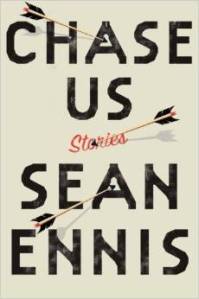
Sean Ennis' debut story collection, Chase Us, follows the lives of boys living on the outskirts of Philadelphia.

Sean Ennis’ debut story collection, Chase Us, follows the lives of boys living on the outskirts of Philadelphia.

Every writer will likely at some point begin a story with a spoiler—by giving away a major plot point. The novelist Paul Murray actually did this with the title of his book: Skippy Dies. It’s an effective strategy. The reader wants to know what happened—how did Skippy die? But it can also be a surprisingly difficult strategy to pull off. You can give away too much, or you can reveal an ending that the reader isn’t interested in. So, how do you make it work?

Sean Ennis does an excellent job of using this kind of opening in his story, “Saint Roger of Fox Chase.” It was included in his collection of linked stories Chase Us, and you can read it now at The Good Men Project.

How the Story Works

The first seven words of the story give away the ending: “The night Roger was beaten to death.” That’s the plot spoiler. A lesser story might depend on that spoiler alone to generate suspense. After all, it’s a powerful statement: Roger wasn’t killed but beaten to death. It’s natural for the reader to want to know what happened. Who was Roger? How did he arrive at such an awful ending?

But those seven words are just the beginning of passage that build suspense in a variety of ways. Here are the first two paragraphs in their entirety:

The night Roger was beaten to death, I was out there running, too. For weeks, he had been trying to convince Clip and me to hang out at the Fox Chase playground on Friday nights. The older kids were buying beer and selling cups for a buck. The girls that came were getting wild, dancing to the music blasting out of car stereos, and flashing their chests.

I was skeptical. The guys that hung around the playground at night were not my friends; they got in fights, smoked. I knew some of them from soccer, and we had a tenuous truce because I could play, but I didn’t want to tempt things and didn’t care much about drinking beer. Seventh grade is a tenuous time.

The initial pulse of suspense comes from “beaten to death,” but that suspense is heightened by the incongruity and mystery of what comes next: “I was out there running, too.” What does this mean? Running away? But what about that word too? He was running with Roger? The sentence makes perfect grammatical sense but leaves a great deal unclear in terms of the scene and what was happening. So, now the reader not only wants to know how and why Roger died but also what was going on in the background. Then, the next sentence introduces the word playground, which we don’t normally associate with beaten to death or beer and wild nudity. Again, it’s important to note that there is nothing literally  confusing about the paragraph. The sentences are not purposefully obscuring the facts. The confusion or mystery comes from not seeing only a glimpse of the entire picture. The narrator cannot explain everything in a few words, in part because it is first-person and therefore imperfect in the ways that all people are imperfect, rather than third-person and capable of omniscience.

The second paragraph continues the incongruity of playground/beaten to death by stringing together kids who “got in fights, smoked” with soccer and the idea that “Seventh grade is a tenuous time.” These are just kids, we realize. They’re playing at being adults but still stuck with the trappings of childhood—playgrounds and soccer.

So, even though the first sentence contains an enormous plot spoiler, the rest of the opening two paragraphs introduce a complexity and confusion that the reader wants to unravel and understand. If you read the entire story (which you most definitely should), you’ll likely find that the plot point of Roger’s death is less important than everything that was going on around it. In other words, the spoiler isn’t really a spoiler at all but a way of directing the reader’s attention toward what is truly important.

The Writing Exercise

Let’s introduce a plot spoiler into the beginning of a story using “Saint Roger of Fox Chase” by Sean Ennis as a model:

  1. Identify the most important thing that happens in your story. There are, of course, likely several important points, and the biggest of them might be internal—but internal plot points don’t really work as spoilers. Part of the problem is that even the deepest moments of realization for a character can sound, when distilled to a sentence, like the sentiments of a Hallmark card (“The Things They Carried”: Don’t let grief get you down.). To make a spoiler work, you need plot, which almost always means action and often means the external consequence of some internal turning point. So, identify the biggest plot point in the story.
  2. Write a sentence that states the spoiler plainly. You can’t get much plainer than “The night Roger was beaten to death.” But notice what else that sentence does: it suggest that other things are happening. It’s even a good idea to use Ennis’ first sentence as a template: On the _____ that ____ happened… You want to hint to the reader that though you’re revealing some parts of the story, there are others yet to be found out.
  3. Surround the plot spoiler with incongruities. Some spoilers aren’t really spoiler (A man went to war and died. A couple met in Vegas and got married and a year later they were divorced.) No one is going to wonder how those things happened because of course they happened. You want to provide details that make the spoiler not quite make sense. Ennis pairs “beaten to death” with a playground and wild parties and, eventually, seventh grade. These are things that don’t usually appear alongside a brutal murder. So, fill your first paragraph with details that one wouldn’t normally expect to find alongside the plot point that you’ve revealed. Keep in mind, though, that you’re not searching for opposites. Don’t be blatantly thematic (He died in a maternity ward). Be weird. Be unexpected. Here’s a sentence from the first paragraph of Stuart Dybek’s famous story “We Didn’t”: “We didn’t in your room on the canopy bed you slept in, the bed you’d slept in as a child, or in the backseat of my father’s rusted Rambler, which smelled of the smoked chubs and kielbasa he delivered on weekends from my uncle Vincent’s meat market.” Nobody expects to find smoked chubs in a sentence about sex. Allow your imagination to roam. What detail would make the reader sit up and say, “Huh?”
  4. Run with those details. Once you’ve got the plot spoiler in the story (and if it’s a good one), then there’s no doubt that you’ll return to it eventually. It’s also almost inevitable that it will press its face against the pane of your story over and over again. You won’t be able to get rid of it. So don’t feel the need to remind your readers that it’s there. Instead, elaborate on the incongruous details you’ve discovered. Ennis puts a playground and soccer in a paragraph with murder, and it’s the playground and the soccer that the story focuses on for a very long time—except that they’re not just soccer and a playground. They’re soccer and a playground that are accessories to murder. As a result, we pay attention. We want to know how the incongruous details will be brought together.

Good luck and have fun!

How to Bring Other Voices into Your Writing

19 Aug
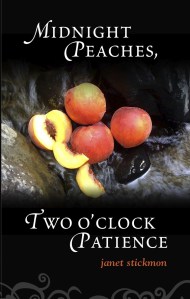
Janet Stickmon's book, Midnight Peaches, Two O'Clock Patience, is a collection of poems, stories, and essays about the creative power of women.

Janet Stickmon’s book, Midnight Peaches, Two O’Clock Patience, is a collection of poems, stories, and essays about the creative power of women.

When creating a narrator’s voice, either for a story or our own voice in an essay, we often struggle to find the right voice. Writers talk about this all the time—they struggled with their work until that moment when they finally discovered their voice. It’s tempting to believe that this voice is a single vein of consciousness and diction and that we’re just hacking away at the rock of our exteriors until we uncover it. But sometimes there is no single consciousness. Sometimes the best or most authentic voice contains different kinds of diction and syntax. If that’s the case, what do you do?

Janet Stickmon demonstrates how to handle multiple voices in her essay, “Blackapina,” about her multiethnic background as an African-American Filipina. The first part of the essay was published as ““Barack Obama: Embracing Multiplicity—Being a Catalyst for Change” in Race, Gender, and the Obama Phenomenon: Toward a More Perfect Union?, co-edited by G. Reginald Daniel and Hettie Williams. It was later incorporated into a larger essay, “Blackapina,” in Stickmon’s book Midnight Peaches, Two O’Clock Patience. You can read it here.

How the Essay Works

In her famous essay, “Mother Tongue,” Amy Tan writes about a lecture that she had given many times but never in front of her mother. Only then, with her immigrant mother in the audience, did she realize that it was “a speech filled with carefully wrought grammatical phrases, burdened, it suddenly seemed to me, with nominalized forms, past perfect tenses, conditional phrases, all the forms of standard English that I had learned in school and through books, the forms of English I did not use at home with my mother.”

That is the kind of English that Stickmon uses for this essay. An excerpt was published in a scholarly book. As anyone who’s written an academic, scholarly essay knows, there are expectations for the kind of language that will be used. Here is Stickmon’s first sentence:

People of multiethnic backgrounds are accustomed to existing at the intersections of multiple worlds and multiple identities, holding and juggling those spaces in tension.

This is Stickmon’s academic voice, and it would seem that it leaves no room for the diction and syntax that Stickmon might use outside the classroom or lecture hall—just as the voices we create for any piece of writing often seem narrow (purely serious with no room for humor or too smart or too naive or too whatever to leave room for sentences that contradict the dominant voice). Yet Stickmon manages to include other voices.

She starts by inserting other languages. The first is Filipino:

Momma was from the barangay of Labangon in Cebu and left a clerical job to come to the United States—the country she considered the “land of milk and honey.”

The second is a form of English:

Da’y (Daddy for short) was from Shreveport, LA and hopped freight trains to California—one of approximately six million African-Americans who fled the oppression of the South during what came to be known as the Great Migration.

With those proper names (barangay of Labangon in Cebu) and (Da’y (Daddy for short) was from Shreveport, LA) comes an entire dictionary of words that are rarely found in academic texts:

My biracial experience began with the very basic influences of food and language, eating Momma’s biko and bijon and Da’y’s hoe cakes and hot cakes, hearing Da’y sound “country” and Momma speak Cebuano.

The presence of these new voices has a marked impact on the dominant academic voice. Here’s the next paragraph:

It was 1989 when Momma died and Da’y was put in a convalescent hospital; I was 15 years old. Three years later, Da’y died, and I officially became an orphan, continuing to juggle my dual heritage along with the meaning of life in the absence of parental love. I was tossed around from one social worker to the next, telling my story over and over again, becoming attached to no one. Though the most immediate lifelines to my history were gone, my sense of self was informed by the memories my parents left behind, the Filipino relatives I moved in with, the holidays spent with my African-American relatives, and close high school and college friends.

The language is still addressing the “intersections of multiple worlds and multiple identities” from the essay’s first sentence, but it’s now doing so in language that isn’t necessarily more colloquial but certainly more understandable to non-academic readers (“tossed around from one social worker to the next”).

The essay even begins to gain a sense of humor (something that scholarly writing is not at all known for). Here is an example:

I had to “turn on” my Black side (whatever that meant) and leave behind or downplay my Filipino side; when I was in an all Filipino environment I felt that I had to “turn on” my Filipino-ness (whatever that meant) and downplay my Black side.

Those parenthetical asides—”(whatever that meant)”—almost seem like the commentary of another voice on a sentence that puts turn on in quotation marks. In short, because Stickmon has introduced these different voices in the essay, they begin to form a kind of dialogue with each other—that dialogue, as Chimamanda Adichie has explained in her popular TED talk, is far better than listening to a single, dominant voice.

The Writing Exercise

Let’s introduce and use different voices, using “Blackapina” by Janet Stickmon as a model:

  1. Choose a piece of writing whose voice feels too homogenized. It can be a story or essay sitting in a drawer or in a folder on your computer. Sometimes when we get stuck in a draft, the problem is that we haven’t given ourselves enough to work with. We had an idea that made us begin the story/essay in the first place, and we took it as far as we could. Introducing more voices can provide more grist for our imaginations.
  2. Introduce a piece of information that can’t be told in the dominant voice. This might be something from another culture or language, like the Filipino places and foods referenced by Stickmon. But that other culture/language doesn’t need to from some foreign land. In America, there are particular Englishes for different regions and professions, and with those Englishes come different vocabularies. You can’t talk about tort law or raising hogs or heart surgery or road construction without using the dictions of those fields.
  3. Expand the reference. Stickmon references her parents’ origins in the Phillipines and Louisiana and then builds on those references by talking about everyday experiences (like food) that are associated with them. In your writing, every reference to something outside the frame of the narration is an opportunity to let in other voices—if you’ll let them speak. So, stay with a reference for a paragraph. Give more details about it.
  4. Mesh the reference with the primary voice. We usually reference something because it carries some weight or importance. Use that importance to make the reference a crucial part of the primary narrative. For example, once Stickmon introduces Da’y, she’s able to tell a story about him that connects to the very academic idea of “intersections of multiple worlds and multiple identities.” Because Da’y is from a difference linguistic world that intersections, the language of that story and its analysis becomes a different language that previously existed—not less academic, as some people sometimes argue, but a hybrid of pure academic language (whatever that means) and something non-academic that is essential to the narrative. Another way of looking at this is as a lens. Very often we start a piece of writing by looking through a particular lens. If you change the lens slightly (by adding characters or changing setting), you also change the story and voice.

This can be a fun exercise. Like Amy Tan, you might realize that you’re speaking different languages or forms of a language without knowing it.

Good luck!

How to Set Up Illogical Character Choices

5 Aug
Laura Benedict's story "When I Make Love to the Bug Man" was published in PANK's Pulp Issue.

Laura Benedict’s story “When I Make Love to the Bug Man” was published in PANK’s Pulp Issue.

Almost every writer will have this experience: you’re sitting in workshop, listening to comments about your story, and someone says, “That part where ____? I just don’t get it. Why’d she do that? It makes no sense.” Maybe the workshopper will add, “I don’t know a single person who would do that.” Everyone will nod, some grudgingly. The worst part is that they’re right. Your character’s choice makes no sense. And yet that doesn’t you should revise that choice out of the story. Many great works of fiction are about characters doing things that are totally illogical—but they make sense in the story.

So how do you make an illogical choice make sense or at least keep the reader from thinking it doesn’t make sense? An almost-textbook example of this problem can be found in Laura Benedict’s story, “When I Make Love to the Bug Man.”  The story is creepy and unsettling and great—and it also features a character doing something that doesn’t make sense. Certainly, nobody you know would make the same choice. How does she pull it off? The story was published in PANK’s Pulp Issue, where you can read it now.

How the Story Works

The story is about a woman who has an affair—but not just any affair. She sleeps with the home exterminator, a man described this way:

You wouldn’t call the Bug Man handsome. Hair steely gray, push broom-mustache, mature belly straining confidently against the fifth button of his tidy uniform shirt.

But, of course, marital affairs are often the result of unhappiness in the marriage. In those situations, who knows who you’ll sleep with, right? But this narrator isn’t unhappy. Instead, she fled her “cheerful, shiny family for the Bug Man.” Her children are beautiful, and her husband is a good father and good in bed (“Even our sex was aggressively superior, like an Olympic relay event”). In other words, there is absolutely no reason for her to sleep with the Bug Man. Yet she does. It’s illogical. So why don’t we stop reading?

The reason that readers identify acts or choices as illogical is because they’re applying an agreed-upon logic. For instance, most of us would agree with this statement: Attractive, happy women with attractive children and an attractive, good husband do not sleep with unattractive random strangers. This logic may be problematic (judging people on appearances usually is), but it’s one that we believe on some level. As a result, in order to make the reader accept the illogical act, the story must introduce a new logic.

The most obvious way to introduce this logic would be to use a psychological disorder—if the narrator is a sex addict, for instance, then we change our expectations of her behavior. Another common way to change a story’s logic is to introduce an impactful event from the past. (This is what Aimee Bender did in her novel An Invisible Sign of My Own: after the character’s father becomes ill, she begins quitting things and compulsively knocking on wood.) But Benedict uses neither of these strategies in “When I Make Love to the Bug Man.”

Instead, she introduces an obsession. It begins logically. In fact, it’s not really an obsession at first, only a fact:

It didn’t seem fair that there should be so many spiders in one house. Wolf spiders, jumping spiders, daddy and granddaddy longlegs, cave cricket spiders (sure they’re a kind of cricket, but just take a look at one and tell me you don’t think, that’s the ugliest spider I’ve ever seen), orb spiders, brown recluse spiders. If I turned a lamp on in a dark room, I didn’t have to wait long to notice one fleeing for the threshold, or crouching motionless in the light, playing dead.

Any rationale person could become unnerved by a spider infestation (in Texas, we have cockroaches, and when they scuttle across the wall at night and drop onto your pillow, it’s hard to go back to sleep). Any rationale person might become a bit obsessed:

Oh, yes, I saw them. I heard them, too, as I lay in bed at night beside my husband, Robert. Robert pretended not to hear, but I’m not ashamed to say I heard them knocking softly, messaging each other.

“Are you there?”

“Yes, I am here.”

And when you become obsessed with something that deserves your undivided attention (like spiders), it’s perfectly logical to start focusing on it to an unhealthy degree:

Fact: you are never any farther than three feet from a spider. Fact: Wolf spiders–the females are the ones you’ll see–look furry, but that’s not fur on their backs. It’s their young. Hundreds of them. Mama carries them around with her as she explores her territory. Fact: You’ll rarely see a female brown recluse unless you rip into walls and crevices. They hide like reluctant royalty, hatching their young away from the light. Fact: Those are males crawling out of the guest bedroom pillow or the electric socket. There’s something about cardboard boxes that attracts them too, like perfect camouflage, their compact, angular bodies and bent legs gliding across the boxes’ bone-dry walls as though the walls were made of ice. Fact: Spiders have no capacity for vocal sound. Thus, the knocking. Not many spiders can communicate this way, but some do.

Look at what Benedict has done. She’s introduced a house with a common problem (spider infestation) and changed the logic of the story so that it makes sense to learn minutia about spiders. Once that new logic has been set, it makes sense (or at least seems less illogical) to make a statement like this:

I know these are Facts because the Bug Man whispers them to me when I’m in his embrace.

And this:

I am in love with the Bug Man. I cannot leave him.

It’s a purely illogical statement that the reader has been given freedom to believe. It’s not a case of temporarily setting aside logic (the fictive dream) so much as introducing a new kind of logic. If you read the story, you’ll find out that an even crazier, creepier twist lies in store.

The Writing Exercise

Let’s set up an illogical character choice using “When I Make Love to the Bug Man” by Laura Benedict as a model:

  1. Identify the illogical character choice. Odds are, you already know what this is. It’s probably the reason the story has screeched to a halt. Either someone read the draft and said, “Nope. Don’t believe it,” or you read your own story and could not figure out how to make it work. So, make sure you know what illogical thing is happening in your draft.
  2. Explain why it’s illogical. If you do want to make it work (rather than changing the choice the character makes), you need to not only write down the choice but also the reasons why it doesn’t make sense. In Benedict’s case, the narrator’s choice to sleep with an unattractive stranger doesn’t make sense because the narrator has it all: looks, youth, an attractive husband who is a good father, and beautiful kids. It’s possible that in the story you’ll need to come out and state these things outright. Benedict does this after she’s dropped the bomb about loving the Bug Man. The next four paragraphs describe the reasons her choice is crazy, which means that she’s not crazy, or at least it gives the reader permission to keep reading. The old saw about crazy people not knowing they’re crazy basically holds true for fictional characters as well.
  3. Find a way to introduce the choice. You can hint at the illogical choice from the beginning (as Benedict does, as Nabokov did in Lolita: “Lolita, light of my life, fire of my loins.”). But, to make it believable, you need to also introduce an alternative way of thinking that leads to the choice. Nabokov did this with the line, “You can always count on a murderer for a fancy prose style,” and the story of early love that follows. Benedict does this by introducing the spiders and the very rationale freaking out and obsessing that results. So, find something real and practical to hang your odd thoughts on: spiders, a lover, something that exists in every world. Then, give the character a reason to think about this thing a lot (infestation, love).
  4. Introduce an obsession. After you’ve got a character thinking about something a lot, it’s not hard to put those thoughts into full-blown obsession. You don’t really even need to explain the shift. It can just happen, as it does in Benedict’s story. The narrator moves from hearing spiders to listing a litany of facts about them. So, give your character a chance to demonstrate some specialized knowledge in the subject. We do this with love stories (and real-life love) all of the time; we know every last detail about the object of our affection or the object of our character’s affections. Love, of course, is not unlike obsession. So, treat the object at the center of your character’s obsession as if he/she loves it. Go into loving detail.
  5. Return to, or introduce, the illogical choice. People who are obsessed do not behave rationally. If you can convince the readers of the obsession, it’s only another short step to convince them of the choice. Or, to be more accurate, the choice will flash by them and they won’t notice; it will fit in with the obsession.

You may find that you need to arrange and rearrange these elements of introducing an illogical choice. The thing to remember is that you’re setting up the choice by creating a mindset—and the sneakiest way to create a mindset is to make it initially focused on something logical. Once it becomes obsession, then you push it into the bounds of what is normally illogical.

Good luck and have fun!

How to Write a Love Story

1 Apr
Seconds Before Sunrise is second book in the Timely Death series, a Young Adult paranormal series by recent University of Kansas graduate Shannon A. Thompson.

Seconds Before Sunrise is the second book in the Timely Death Young Adult paranormal series by Shannon A. Thompson.

I once heard a critic claim that love stories are more difficult to write today than they were for Shakespeare. The obstacles that Shakespeare depended upon—class, feuding families, the fate of stars—have mostly been removed as possibilities, at least in America.

So, if class isn’t an option, how do we put obstacles between lovers in a story other than “he’s just not that into you?” This is a problem that genre literature, especially genres that deal in fantasy elements, handles well. The new YA paranormal novel from Shannon A. Thompson, Seconds Before Sunrise, perfectly illustrates two great ways to complicate a relationship. You can read the opening chapters here.

How the Story Works

I don’t necessarily believe the critic is right, but the idea that class is no longer relevant is still an interesting one. It’s certainly true that when class conflicts appear in fiction, the battle is often quick and decisive. For example, in the film The Devil Wears Prada, Anne Hathaway’s character questions the importance of choosing between two identical belts (in other words, questioning the industry itself). In response, her boss not only says she’s wrong but also insults her clothes as lumpy and unfashionable, saying that they must come from “some tragic Casual Corner.” After that, the movie never questions the class divide again.

So what are other ways to complicate a relationship? This passage (the beginning of Eric’s chapter on page 10) from Thompson’s novel illustrates her approach to complicating a love story (and the approach of many novels that incorporate fantasy elements):

I shoved my head into my locker and breathed hoarsely. It was the first day of school and sitting next to Jessica was already killing me. I wanted to talk to her, hold her, be with her—anything really—but I couldn’t. If the Light realized who or what we were, she’d be killed, and there was nothing I could do except stay away.

“You okay?” Jonathon asked, his voice squeaking through the slits of my locker.

I leaned back to stare at the blind artist. I wouldn’t believe he was Pierce, a powerful shade, if I hadn’t known his identities myself.

“I’m dealing,” I grumbled, unable to keep eye contact as Jessica passed us.

She flipped her brunette curls as she playfully hit Robb McLain’s arm. Robb McLain, with his sparkling teeth, gelled hair, and playboy personality was the perfect jerk.

The narrator and Jessica are in love, but the powers that be are keeping them apart—in this case, the “powers that be” are actual forces with actual special powers. Jessica’s memory has been wiped (though not completely) and other characters are in disguise. In other words, Thompson has invented an obstacle that does not exist in the real world. But she has also added a more realistic obstacle. Though the plot depends on paranormal activities, it’s grounded with a staple of love stories: the beautiful and charismatic, yet so-wrong-for-her, rival.

The Writing Exercise

Let’s introduce complications to love story, using the passage from Shannon A. Thompson’s novel Seconds Before Sunrise as a model. In order to introduce those complications, we first must do the following:

Choose the relationship. It can be a relationship between lovers, of course, but that isn’t the only option. Every story has pairs of characters who develop a relationship with each other: brothers, siblings, parent/child, friends, co-workers, or teammates. All of these relationships work the same. The story is often driven forward by the forces that push these characters together and then pull them apart.

Choose the force of attraction. The most obvious is love. But characters can also be brought together in other ways: their shared history together, duty to a cause or each other, an event like a funeral, or some external force (boss/teacher forcing them to work together). In stories, this force is often clearly identified: “I could never leave her because _____.” Or, “Now, we had no choice but to work together.” Now, we can introduce the force that will disrupt the relationship. There are many ways to do this. Here are some of them:

Forces that can disrupt a relationship:

  • Forces of Class: These are forces whose power comes from differences in social standing: wealth, race and ethnicity, and position within a power structure. Wealth complications, though less common than in the past, still exist in fiction, especially historical fiction. So, The Notebook initially disrupts its characters’ relationship (just before World War II) by having Allie’s parents call Noah “trash.” Romance novels do this all the time: the tycoon’s son seducing the maid. Complications due to race/ethnicity might seem less common (or, again, confined to historical fiction), but they are still used (as in this beautiful story by Tiphanie Yanique). And, relationships in science fiction and fantasy stories (between different kinds of aliens) often mirror realistic stories of racial/ethnic differences. Complications due to power imbalance might be easier to use: bosses and employees, teacher and student, mentor and mentee, player and fan, soldier and civilian, or legal immigrant versus undocumented immigrant. In short, any policy or tradition that grants one person greater power than another is ripe for use in a story.
  • Forces of evil: It’s often useful to say, in a story, that if two characters get together, the bad guys will kill one of them. This is what Thompson does in Seconds Before Sunrise. It’s also the complication used in most adventure stories, like these two favorites from my childhood: Romancing the Stone and The Princess Bride.
  • Characters in disguise: Shakespeare used this a lot in his comedies. Characters—particularly female characters—would disguise themselves, often as men, and go unrecognized by their beloved. The question you must ask yourself is this: why must the character go into hiding? Are they in danger? Are they balancing multiple roles? Are there parts of their lives that cannot be revealed or discussed? The disguise can come in different forms. They don’t always make a beautiful person less beautiful. The story of Cyrano de Bergerac does the opposite by disguising looks with wit.
  • Irreconcilable differences and incompatible goals: This is used by romantic comedies a lot (she’s too serious, and he jokes all the time; she has a career, and he’s a Playboy). It’s also the basis of many domestic dramas. Answer the question: what would make it difficult for these characters to live together, to stand being around each other?
  • External Events: Many stories use external events that separate the characters (soldier shipped off to war, kid left at home over Christmas). The event can also be more intimate, such as the onset of a disease. The film Away from Her (based on Alice Munro’s story “The Bear Came Over the Mountain”) disrupts a relationship with Alzheimer’s, to devastating effect.

Now, you can choose a rival.

Three ways to choose a rival:

  • Pick someone poorly suited as a love interest: This kind of rival is often the complete opposite of the other love interest—beautiful and popular instead of ordinary-looking and nerdy or uncool in some way. Even though the rival’s qualities at first seem appealing, the character who falls in love with him/her eventually realizes the rival’s “true” qualities. This is what Thompson has done: “Robb McLain, with his sparkling teeth, gelled hair, and playboy personality was the perfect jerk.” This kind of rival often creates a plot whose focus is on revealing the rival’s true personality.
  • Pick someone similar to the other love interest: What if the rival isn’t easy to hate? What happens if I love So-and-so, but she falls in love with someone who is just like me, but not me? This kind of rival creates a plot whose focus is on the other person (me) finding ways to distinguish him/herself.
  • Pick a random person. The scary thing about finding your beloved in love with someone else is that it may mean your beloved is far different than you thought. A random rival (someone whose qualities are neither good nor bad, just unexpected) often creates a plot whose focus is revealing the beloved’s true personality. In other words, it shows that the other person (me) has been pursuing someone with whom he/she is poorly matched.

This may seem like a lot of information. In a nutshell, all you need for a love story is an attraction, a disrupting force, and a rival.

Good luck!

How to Create Your Narrator’s Voice

3 Sep
Joe Lansdale's new novel The Thicket is about X. You can read a free excerpt on Facebook.

Joe R. Lansdale’s new novel The Thicket follows a band of unlikely heroes on an adventure in turn-of-the-century East Texas. You can read a free excerpt on Facebook.

No aspect of writing fiction is more mysterious than creating a unique voice for the narrator. We often begin by imitating a voice that we love–Huck Finn, Holden Caulfield, or any of the voices dreamed up by Jonathan Safran Foer, Nicole Kraus, or Gary Shteyngart. Or we try to write the way that someone we know talks. As we fail, the elusive voice becomes like a magic trick that we should know how to perform but have forgotten. So what do we do?

One writer who consistently creates compelling narrators is Joe R. Lansdale. His new novel, The Thicket (to be released September 10) is set in East Texas at the turn of the century and narrated in a voice that catches your eye before the first sentence is over. The writer Ron Carlson said that The Thicket is “told in a voice so alluring and deadpan that it makes you smile and then look around to see who saw you smile.” You can read a preview of the first chapter here.

How the Story Works

First sentences are notoriously difficult to write. Stephen King recently claimed that he cannot write a novel until he’s gotten the first sentence right, and that sometimes doing so takes years. So it’s interesting to see how Lansdale approaches the first sentence of his novel. Notice how quickly he establishes the narrator’s voice:

“I didn’t suspect the day Grandfather came out and got me and my sister, Lula, and hauled us off toward the ferry that I’d soon end up with worse things happening than had already come upon us or that I’d take up with a gun-shooting dwarf, the son of a slave, and a big angry hog, let alone find true love and kill someone, but that’s exactly how it was.”

In that sentence, Lansdale falls back on a tried-and-true strategy. If you don’t know how to start a story, just tell the reader what will happen. It may sound simplistic, but this face-value approach is key to establishing the narrator’s voice for two reasons:

  1. We learn that the narrator is a tell-it-like-it-is kind of guy. He’s not going to play around with us. If you’re trying to develop a character, it’s useful to have a couple of hard-and-fast personality traits to rely upon.
  2. Because the statement is so factual, Lansdale has the luxury of playing with the words. He doesn’t have to worry about finding something interesting to say; he just needs to let the narrator find an interesting way to say a basic thing. This is exactly the strategy used here by Mark Twain in The Adventures of Huckleberry Finn (notice how it’s stating basic information):

“The Widow Douglas she took me for her son, and allowed she would sivilize me; but it was rough living in the house all the time, considering how dismal regular and decent the widow was in all her ways; and so when I couldn’t stand it no longer I lit out.”

A final point to consider: It’s easy to fall into the trap of believing that great voices are highly elaborate or deeply folksy, but the phrasings that make them memorable are often subtle. Lansdale’s three-part phrase “gun-shooting dwarf, the son of a slave, and a big angry hog” simply adds a few eye-catching adjectives. (This is another reason you shouldn’t abide by all “rules for writers.” Adjectives, when used well, can make a story sparkle.)

The Writing Exercise

Let’s create a voice, using Joe Lansdale’s The Thicket as a model:

  1. Using a story you’ve been working on, write a new first sentence(s). State outright, in the first person, what will happen. Use your plainest language. You’re giving yourself a frame to hang the narration on.
  2. Think about your narrator. Would he or she make such a up-front statement? If not, what parts would the narrator want to hide or soften? How would the simple statements be rephrased in order to make the narrator more comfortable? Make those changes.
  3. If the narrator had a captive audience, how would he/she change the remaining phrases in order to make them more interesting? In other words, what is the narrator’s storytelling voice? Because that is what narrators are doing: telling a story. Pick two or three words or phrases and make some simple changes: add adjectives, replace nouns with different nouns, or cut words to create surprising juxtapositions (“true love and kill someone”).

Play with your sentence(s) and see what you get. If you’re having fun, it’s a good sign.

Good luck.

How to Set the Rules Your Characters Must Live By

13 Aug
Shannon Thompson's novel "Minutes Before Sunset" was a Goodreads Book of the Month in July.

Shannon A. Thompson’s novel Minutes Before Sunset was a Goodreads Book of the Month in July and tells the story of two young adults trying to balance their supernatural gifts with a desire to live in the human world.

Every story has rules. In comic books, the superheroes have certain powers and not others. In horror stories, monsters can be killed only with silver bullets or certain chants. In romances, the heroine falls for certain kinds of men and not others. Pam Houston wrote a novel titled Cowboys are My Weakness. The rules of the novel are announced before you even open the book. Every story ever written or told must announce the rules it will play by.

The trick, as a writer, is to show those rules without disrupting the narrative. Shannon A. Thompson sets the rules clearly and quickly in her Young Adult/Paranormal novel Minutes Before Sunset. You can read the first chapter here. 

How the Story Works

Once you’re aware of how stories set the rules that their characters must live by, you can’t avoid seeing it’s done. Whether the fiction is genre or literary, the need to impose boundaries and limitations on characters is the same.

Here’s an example from the title story of Ethan Rutherford’s excellent new collection The Peripatetic Coffin. The story’s about the crew of a Confederate submarine trying to break the Union blockade of the port of Charleston:

“On deck, we had an unobstructed view of what Augustus had dubbed our Tableau of Lessening Odds. The Federal blockade was stupefyingly effective. Union canonships patrolled the mouth of the harbor, just out of range, and sank anything we tried to send through with the insouciance of a bull swatting blackflies. At night, they resumed the bombardment of the city. High, arching incendiaries, numbering in the thousands, painted the sky. You felt the concussion in your chest.”

The world is imposing clear boundaries on the characters: literally, a blockade with cannon balls and bombs. At no point in the story will the characters be able to act as if these impediments do not exist.

But the boundaries and rules can be mental as well as physical. To see how, read these two excerpts from Shannon A. Thompson’s novel, Minutes Before Sunset:

“It was Independence Day, and I stood with my family on Willow Tree Mountain. They called it Willow Tree Mountain, but, in reality, it was Willow Tree Hill, and the town denied that reality.”

Here’s the second excerpt:

“I moved my foot closer to the edge of the hill. I wanted to ride the wind down to the crowd. I wanted to dance and smile. I wanted to throw my arms in the air and listen to the exploding fireworks. I wanted to run around in endless circles until I fell down from exhaustion. I wanted to enjoy everything.

But that couldn’t happen. It was impossible.”

In these two passages, we learn the fundamentals of the story: the town has an Ignorance-is-bliss attitude. The narrator would like to join the smiling townspeople, but, for a reason that will be revealed later, he’s prevented from doing so. This mental and physical limitation defines his character and determines how the story will move forward.

The Writing Exercise

Let’s practice setting the rules, using Minutes Before Sunset as a model:

  1. Choose a character and a world for that character to inhabit.
  2. Define the world with a single adjective: happy, sad, fearful, proud, bored, etc.
  3. Free write about that adjective. Your goal is to find an image of the world or the people in it that demonstrates the adjective, if possible without actually stating it. The image will set the rules for the world. Future descriptions of the world should adhere to this early image in some way. So, in Minutes Before Sunset, the town’s denial of the supernatural elements in its midst is suggested by the fact that it calls a hill a mountain. In Gone in 60 Seconds, the stovetop burns out of control to suggest Kip’s lack of control.
  4. Now, free write about the character. How does he/she feel about the image you just created? Try to find an action that suggests the character’s attitude toward the world. For instance, in The Hunger Games, the fact that Katniss sneaks through the fence in order to hunt suggests that she’s willing to break the rules to protect her family. Thus, the big event at the end of the first chapter—volunteering for the Games in place of her sister—feels like a natural extension of her character, of the attitude that we’ve already witnessed.

Good luck and have fun.

How to Reinvent a Stock Character

11 Jun
M. John Harrison's Light is X.

M. John Harrison’s Light has been called “space opera for the intelligensia,” and Neil Gaiman said it was one of his favorite SF books of the last ten years. Light is the first in a trilogy that includes Nova Swing and Empty Space: A Haunting.

Almost every story begins with an idea that has been written about a thousand times. Detective stories can begin only so many ways. Stories about immigrants to America feature characters who, despite their far-flung origins, share a certain kind of experience. The problem is not to invent a story that’s never been written but to reinvent an age-old tale.

This is what M. John Harrison has done in his novel Light, the first of a science fiction trilogy. The book features space ships and aliens, but Harrison moves far beyond the typical versions of these things. You can read the opening of the novel here, or you can read the short passage below.

How the Story Works

For an example of how Harrison reinvents a stock character, read this passage about an alien invasion:

Drawn by the radio and TV ads of the twentieth century, which had reached them as faltering wisps and cobwebs of communication (yet still full of a mysterious, alien vitality), the New Men had invaded Earth in the middle 2100s. They were bipedal, humanoid—if you stretched a point—and uniformly tall and white-skinned, each with a shock of flaming red hair. They were indistinguishable from some kinds of Irish junkies. It was difficult to tell the sexes apart. They had a kind of pliable, etiolated feel about their limbs. To start with, they had great optimism and energy. Everything about Earth amazed them. They took over and, in an amiable, paternalistic way, misunderstood and mismanaged everything. It appeared to be an attempt to understand the human race in terms of a 1982 Coke ad. They produced food no one could eat, outlawed politics in favour of the kind of bureaucracy you find in the subsidised arts, and buried enormous machinery in the subcrust which eventually killed millions. After that, they seemed to fade away in embarrassment, taking to drugs, pop music and the twink-tank which was then an exciting if less than reliable new entertainment technology.

Thereafter, they spread with mankind, like a kind of wretched commentary on all that expansion and free trade. You often found them at the lower levels of organised crime. Their project was to fit in, but they were fatally retrospective. They were always saying:

“I really like this cornflakes thing you have, man. You know?”

Notice how the passage begins with an alien image we’ve seen before (humanoid, bipedal, white-skinned) but then quickly moves into unexpected territory (red hair, Irish junkies). But the genius of the passage is how Harrison describes the aliens’ attitude. He starts by making them the opposite of the creepy, emotionless creatures from TV and the movies. But then he develops the idea: what would it mean for an alien race to be attracted by Earth’s TV and radio ads? If human culture drew them to the planet, how would they behave? Rather than making the aliens sinister, the passage presents them as both curious and dopey enough to take that culture seriously but also technologically advanced enough to nearly destroy the world. By the passage’s end, Harrison has created an alien race that is entirely new to fiction.

The Writing Exercise

Let’s develop a stock fictional character the way that Harrison develops the alien invader.

  1. Pick a stock character: hard-boiled detective, crooked cop, bloodthirsty pirate, ambitious drug dealer, too-serious doctor, laconic cowboy, Medieval knight, bold dragon hunter.
  2. Describe the character. Feel free to include setting. Start with a cliche.
    1. A thin and weary private eye in a small, dirty office
    2. A single woman asleep in her cluttered apartment and awoken by a call from the hospital).
  3. Move the description in an unexpected direction. One way to do this is to include an unusual trait and then use that trait to make an unexpected comparison (red hair, Irish junkies).
    1. He had a mustache with the ends pulled to a thin point, like a villain who’d tie a woman to railroad tracks or a hipster with a custom-made bicycle.
    2. She was missing the pinky finger on her left hand. No one at the hospital had yet noticed the absence, but they inevitably would, just as a pickpocket’s victim inevitably pats his pocket to find his wallet gone.
  4. Answer the question of how someone in that character’s position would behave given that unusual trait.
    1. The mustache made it hard to blend in, but he wouldn’t give it up—the greased tips had taken him more than a year to grow out—and so as a result he only took business that involved the low-rent but becoming-gentrified part of town.
    2. The patient in which the finger resided would also discover it, which is why the doctor took a drink before going into work, a habit that was, in part, the reason she lost the finger in the first place.

The key to this exercise is to begin with a stock character and develop him/her by first adding a small, unexpected detail and then imagining how that detail would affect the character’s life.

Have fun.

Twist Endings

26 Mar
Brian Evenson's story "Windeye" was first published in PEN America 11: Make Believe. The story was later selected for the 2010 PEN/O'Henry Prize Stories.

Brian Evenson’s story “Windeye” was first published in PEN America 11: Make Believe. The story was later selected for The 2011 PEN/O’Henry Prize Stories.

Twist endings are one of the great pleasures of literature, yet in contemporary fiction, they’ve gone the way of the dodo and the epiphany. No one would dare write a modern version of O’Henry’s classic “Gift of the Magi,” and for good reason. That twist—and others like it—seem manipulative and implausible to modern readers. Perhaps it’s our attachment, as Americans, to realism, but we tend to relegate sudden reversals of fortune or circumstance to reality TV and schlocky movies. As a result, it’s tempting to ask whether a twist ending is even possible in literary fiction.

Brian Evenson would say yes, and he pulls of a doozy in “Windeye.” The story appeared in The 2011 Pen/O. Henry Prize Stories and was first published by PEN American Center. You can read it at PEN America’s site, here.

How the Story Works

Evenson uses an old trick: Introduce a character, weave her into the fabric of the story, and then—when our attention is focused elsewhere— make us question the character’s reality.  It’s not unlike the strategy used by Ron Howard in A Beautiful Mind; the brilliant mathematician’s friend is real, and when, suddenly, he’s not, we’re as dumbfounded as the mathematician. In “Windeye”, the reader doesn’t fully understand the truth until the mother says, “But you don’t have a sister.” And like the boy, we can’t quite believe it.

In a classic reversal, such as the one used by M. Night Shyamalon in The Sixth Sense, the viewer or reader’s sense of what is true is completely reversed. In other words, we realize that Bruce Willis is, in fact, not alive but dead. “Windeye” operates differently. The twist is incomplete. The sister likely never existed, but the boy can’t be certain of it – and more importantly, the boy will never be certain. Evenson creates this uncertainty with the fifth and final section, jumping forward in time, explaining the reversal’s emotional consequences. The boy can never shake the feeling that one day his sister will “simply reappear, young as ever, ready to continue with the games they had played.” This is similar to the strategy that Alfred Hitchock used in Vertigo, when Jimmy Stewart’s character discovers that he’s been fooled. Instead of ending with the revelation, the film continues, revealing the twist’s emotional consequences.

Once you’ve read the story, it’s easy to go back, section by section, to see how the twist (the fact that the sister isn’t real) is hinted at but not revealed. It’s worth checking out to learn how seeds planted at the beginning gradually sprout and reveal more of themselves.

The Writing Exercise:

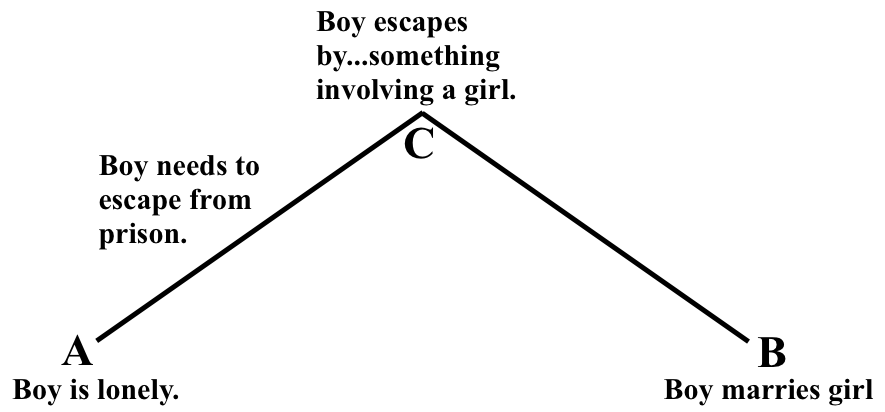
  1. Write down an ending (boy gets girl, woman discovers fortune, man finds happiness, woman is revealed to be a zombie). Don’t be afraid to go boldly where you normally wouldn’t dare.
  2. Now, write down a beginning that is the complete opposite of the ending (girl doesn’t know boy exists, woman is poor, man is miserable, woman is the leader of the free world).
  3. You may think that the trick will be getting from Point A to Point B, from leader of the free world to the realization that she’s a zombie. But a story with a twist—in truth, most stories—depends on a point between A and B. So, give the character a goal that has nothing to do with the Point B (boy needs to escape from prison, woman needs to hide from ex-husband, man wants to become the world’s greatest ventriloquist, woman must pass a national budget).
  4. Screen Shot 2013-03-25 at 8.45.45 PMOutline the events that must occur or the stages the character must go through to reach the destination he or she is aiming for. At the same time, outline backward from the Point B ending. The moment where the outlines meet will be a point of high tension (hopefully). If you can create the outline, all that is left is to flesh out the story, dropping hints of Point B in the beginning.

If you’re working on a story and don’t want to start a new one, try this exercise:

  1. Reread the ending of your story. Then fast forward in time (six months, sixty years, whatever). Summarize the emotional consequences of the ending you have already written. How do the characters live with the ending you’ve given them?
  2. You may discover that the story isn’t over. The story’s true conflict may still be unwritten. Or, you may realize that your original ending is the best one. That realization can be as valuable as any.

Have fun writing.