Archive | Plot RSS feed for this section

How to Carve Out Space for Character Development in a Violent Setting

17 Jun
Benjamin Alire Sáenz won the PEN/Faulkner Prize for Fiction for his collection, Everything Begins and Ends at the Kentucky Club. The stories are set along the border between El Paso and Juarez and center on the Kentucky Club, two blocks south of the Rio Grande.

The stories in Benjamin Alire Sáenz’s collection, Everything Begins and Ends at the Kentucky Club, are set along the border between El Paso and Juarez and center on the Kentucky Club, two blocks south of the Rio Grande.

There are places in the world that dictate the type of stories that happen there. Violence exerts an overwhelming gravitational pull, and a story that at first has nothing to do with violence—a love story, or a story about family or business—will eventually get pulled into orbit around the violence that exists in the place. Set a story in Mosul, Iraq, and it will eventually run across militants and dead bodies. The key as the writer is not to avoid the violence at all costs but to resist it for as long as possible—in other words, to allow the story to develop dimensions beyond the inevitable.

An excellent example of this resistance can be found in Benjamin Alire Sáenz’s story, “He Has Gone to Be with the Women.” It was included in his collection, Everything Begins and Ends at the Kentucky Club, which won the 2013 PEN/Faulkner Award for Fiction. You can read it now at Narrative Magazine.

How the Story Works

If you hear a reference to Juarez, Mexico, you automatically prepare yourself to hear a story about violence. For a time, Juarez was one of the most dangerous cities in the world. Many of the residents on either side of the border knows real stories of people who have been murdered or kidnapped. From the safe distance of Washington D.C., it’s possible to believe that violence is the only thing happening there. And yet the people who live along the border go about their lives, and so, as a writer, it’s crucial to push back against the readers’ expectations of cartel executions. It’s necessary to find a way to create characters who have lives that exist outside of, or alongside, the violence.

This is exactly what Sáenz does in his story. In it, two men meet at a coffee shop in El Paso. One is American, and the other is Mexican. The border, and it’s associations, are present from the beginning but not at the center of the story, which instead follows the developing romance between the two men. It’s not until a third of the way through the story that violence forces itself onto the page:

Monday morning, I got this text from him: I thought about you when I woke up this morning. I read the text and then reread it. And then reread it again.

I felt like a schoolboy reading a note from a girl. No. A note from a boy.

I didn’t know how to answer his text. I only engaged in the practice because my nephews and nieces demanded it of me. We wrote silly and affectionate things to each other. But this was different. Finally around noon, I texted him back. Stay safe. That’s what I wrote. That’s when it occurred to me that I was afraid. I didn’t like to think of Javier walking the streets of Juárez, doing an errand, going to a store and getting killed, randomly, for no reason. What good does it do to be afraid? He was right. Of course he was right. But so many people had left already. Why couldn’t he leave too? I knew the answer to that question even before I asked it. He wasn’t the leaving kind. He loved his Juárez. I could see that in his eyes, in his unshaven face, in the way he moved and talked. I could almost taste his love for that poor and wretched city in his kisses. It enraged me that Juárez had become so chaotic and violent and capricious. A city hungry for the blood of its own people. How had this happened? I was sick to death of it, sick to death of the body count, sick to death that every killing went unprosecuted and unpunished. You could kill anybody. And what would happen? Nothing. The fucking city no longer cared who was killed. Soon, they would just be stepping over the bodies. Stay safe. Stay safe. Stay safe.

Because Sáenz has created characters with lives and concerns other than avoiding violence, he’s able to make their interactions with the violence personal, as opposed to the generic way that cable news viewers react against stories of border violence.

So, how does Sáenz create these characters without letting them be overwhelmed by the violence that surrounds them? First, he introduces us to them in a place that lies outside of the violence: a coffee shop in El Paso, the safer side of the border. Of course, a coffee shop doesn’t have to be safe. Think about the coffee shop scene in the film Children of Men. When the bomb explodes, the viewer understands that no place in the film is safe. Sáenz could have done that in his story, but if he had, we wouldn’t have gotten a chance to know the characters except as people caught in violence—which is how we know Clive Owen’s character in the film. But the point is to know these characters as more fully developed people. So, Sáenz puts them in a safe place and shows us nuances of their lives:

I always noticed what he was reading: Dostoyevsky, Kazantzakis, Faulkner. He was in love with serious literature. And tragedy. Well, he lived on the border. And on the border you could be in love with tragedy without being tragic.

He drank his coffee black. Not that I knew that.

Sometimes, I could see that he’d just come in from a run, his dark wavy hair wild and half wet with sweat.

He was thin and had to shave twice a day. But he only shaved once. There was always that shadow on his face. Even in the morning light he appeared to be half hidden.

Sáenz develops these details. The two men have conversations about their jobs and families, and when the violence is mentioned, it’s in the contexts of these things. For instance, here’s one of the men, Javier, talking about his uncle, who has cancer and whose care is being managed by Javier:

“He used to love to go out. He would laugh and tell me about how life used to be for him. Now, he won’t go out. He’s afraid. Before, the only thing he was afraid of was my aunt. Now, he’s like a boy. He cries. He reads the newspapers. He thinks he’s living in Juárez. I tell him that we’re in El Paso, that he’s safe. But he doesn’t believe me. He’s afraid to go out. Nos matan, he says. I try to tell him that no one’s going to hurt us. But it’s no use. Every time I go out he tells me to be careful.”

By the end of the story, when the violence cannot be avoided, its inevitable arrival is so much more personal than if it had been directly present all along.

The Writing Exercise

Let’s create characters in the midst of some overwhelming situation, using Benjamin Alire Sáenz’s story, “He Has Gone to Be with the Women,” as a model:

  1. Determine the overwhelming situation. As the writer Ron Carlson says, every story has two parts: the story and the world the story comes into. Almost every story, including blockbuster films whose sole purpose of existence is to blow stuff up, spends time developing the characters who will be consumed by the situation. In blockbuster films and many genre novels, though, the character development is as lean and minimal as possible (think of the description of Robert Langdon in The Da Vinci Code: “Harrison Ford in Harris tweed”). In those stories, the violence or destruction (or aliens, monsters) shows up almost immediately. But in Sáenz’s story, the violence doesn’t really appear until the end. So, decide what situation will eventually consume your characters: violence, family or marriage drama, economic distress, death, disease, or any inescapable deadline.
  2. Determine how that situation will affect the characters. You can be succinct. Someone will die, get sick, get divorced, get shipped off to prison or war or work in some far-off place, or get fired. Know where your story is headed.
  3. Put the characters in a place that is outside of the situation. You likely already know how the characters will behave or respond when the situation presents itself. There are, frankly, only so many ways that people can respond to inescapable deadlines or outcomes. Now, find out how your characters behave when the deadline is out of sight and (mostly) out of mind. Find a location where this is possible, some emotionally neutral or positive place. Put them there and see what they do. What other parts of their lives are revealed?
  4. Choose one of those parts and develop it. Sáenz gives Javier an ailing uncle, and that uncle’s health worsens. Think about the parts of your characters’ lives that you discovered: how can you make those parts dramatic? How can they change or develop (improve or worsen)? How can this change draw other characters into the person’s life? It is this dramatic arc that you’ll focus your story on. The inevitable deadline or outcome will arrive eventually, but if you make the reader forget that it’s there, its arrival will be all the more effective and impactful.

Good luck!

How to Write a Story Ending

17 Apr
Óscar Martínez spent two years traveling with Central American migrants through Mexico on their way to the United States. His essays about the migrants were published in the Salvadoran online newspaper El Faro and collected in The Beast: Riding the Rails and Dodging Narcos on the Migrants Trail.

Óscar Martínez’s essays about traveling with Central American migrants were published in the Salvadoran online newspaper El Faro and collected in The Beast: Riding the Rails and Dodging Narcos on the Migrants Trail.

The easiest part of writing any story ought to be finding the beginning, middle, and end. So why is it often so hard? And why does so much ride on making the right choices?

The Salvadoran journalist Óscar Martínez has written one of the best story endings I’ve ever read in his nonfiction book The Beast: Riding the Rails and Dodging Narcos on the Migrant Trail. Martínez spent two years traveling with Central American migrants through Mexico on their way to the United States. The essays were originally published as dispatches in the Salvadoran online newspaper, El Faro, and translated in this collection from Verso Books. You can read the first chapter at Dazed.

How the Story Works

Martínez tells stories about many different migrants in the book, and one of them is about a teenager named Saúl, who was born in El Salvador but raised in Los Angeles, where he joined the M18 gang. He was deported after robbing a convenience store. The problem was that he didn’t know anything about El Salvador—hadn’t been there since he was four years old—and so he started walking and searching for the man who was supposed to be his father:

And what happened to him is what happens to any kid who doesn’t know what he’s doing in Central America, who thinks any neighborhood is just any neighborhood. A group of thugs turned out of an alleyway and beat him straight to hell.

So, the beginning of the story is pretty simple. The thugs, members of the Mara Salvatrucha gang, take Saúl to their leader, who, in turns out, is his father. Now, watch how Martínez sets up the story’s ending—and how he wraps it up:

“I’m Saúl,” Saúl said, breathless, “I just got deported. And, I swear it, I’m your son.”

The man, as Saúl recounted it to me on top of the hurtling train, opened his eyes as wide as possible. And then he exhaled, long and loud. And then a look of anger swept over his face. “I don’t have any kids, you punk,” his father said.

But in the days following, the man gave Saúl a gift. The only gift Saul would ever receive from his father. He publicly recognized him as his son, and so bestowed to him a single thread of life. “We’re not going to kill this punk,” Guerrero announced in front of Saúl and a few of his gang members. “We’re just going to give him the boot.” And then he turned to Saúl. “If I ever see you in this neighborhood again, you better believe me, I’m going to kill you myself.”

They left him in his underwear in another Mara Salvatrucha neighborhood. He only got out alive by covering himself (and the 18 tattooed on his back) in mud and pretending to be insane.

In short, a gang member has been captured by a rival gang in a foreign country, and it turns out the rival gang’s leader is his father. What incredible tension, right? And how does Martínez handle that tension? He could have given us a moment-by-moment account of arguments, beatings, and who stared down who. Instead he almost everything that happens: “But in the days following.” Why?

To answer that question, it’s useful to ask what those skipped moments could have added to the story. Saúl has already been beaten “straight to hell.” He’s already had a stunning encounter with his father (go back and look at how well the father’s shifting emotions are handled). Whatever comes next must advance this conflict. The problem is that you can’t advance severe beatings and familial rejection. More violence is just more of the same. So, when Martínez skips to the father’s pronouncement, he’s simply finding the moment where something new and different happens. The father changes his mind and doesn’t kill Saúl.

Sometimes condensing scenes—or a series of scenes—of high action actually increases the story’s tension. This is exactly what happens in that final paragraph, the story’s ending. It’d be tempting to describe what happens to Saúl in that other neighborhood minute-by-minute. But nothing Martínez could have written would have been better than the weird, surreal, stunning way that he summarizes the action: “He only got out alive by covering himself (and the 18 tattooed on his back) in mud and pretending to be insane.”

When closing out a story, sometimes one conflict-filled sentence is better than several less tense paragraphs.

The Writing Exercise

Let’s write a story ending by summarizing action and scenes, using the passage from Óscar Martínez’s The Beast as a model:

  1. Summarize the situation and how the character entered it. The point is to get into the story as quickly as possible. The summary should highlight factors that will appear later. If read the entire story from Martínez’s essay, you’ll see how he highlights Saúl’s gang membership and lack of knowledge about El Salvador. Then he skips past everything that happened to Saúl before he ran into the gang members who beat him up. So, you should focus on drawing the shape of the conflict: why your particular person/character is an especially bad match for the situation. (Bad matches in life make for good matches for stories.) Then, find the first significant action that results from that poor match.
  2. Make an outline of everything that happens next. Simply list all of the noteworthy moments from beginning to end. You don’t even need to use complete sentences. It’s an outline.
  3. Mark the moments of highest tension or action. They might be the most tense because of what information is revealed or because of the extremity of what happens.
  4. Are the remaining moments different or similar? Now that you know what your most tense moments are, you can begin carving away at the rest of the moments so that the best ones stand out. To do this, ask yourself if what is left is any different from those tense moments. If not, you can either cut them completely or group them together into a quick summary (a sentence or two) that sets up whatever tense moment comes next.
  5. Offer an escape valve in a sentence or two that restate the conflict. This strategy of summarizing and highlighting can be carried through until the very end. A great way to finish a story is by pivoting sharply. One way to do this is to restate or remind the reader of the conflict that you first presented at the beginning. You can do this with an actual reminder or by finding a moment that distills the conflict (“They left him in his underwear in another Mara Salvatrucha neighborhood.”) Then, offer an escape valve, a way to leave the conflict. Releases tend to be quick (think of a needle and a balloon). Once the reader knows an escape will occur, the writer’s work is mostly done. The tension has been broken. As a result, there’s no need to draw the release out. The quickest version is often the most interesting, as Martínez illustrates: “He only got out alive by covering himself (and the 18 tattooed on his back) in mud and pretending to be insane.”

Good luck!

How to Write Ideas into Fiction

25 Mar
Aliette de Bodard's story, "Immersion" appeared in Issue 69 of Clarksworld Magazine.

Aliette de Bodard’s story, “Immersion” appeared in Issue 69 of Clarkesworld and won the Nebula and Locus prizes for Best Short Story.

When I was in an undergraduate fiction workshop at Kansas State University, my teacher told us not to worry about what our stories were about. Focus on the characters and plot, he said, and the rest will sort itself out. This is often good advice—but not always. Some stories are about ideas, and the issue becomes not how to momentarily forget those ideas but, instead, how to attach them to the characters and plot so that they read as story rather than apart from it.

One genre that consistently tackles big ideas is science fiction. And one of the most interesting new science fiction writers is Aliette de Bodard, whose story, “Immersion,” appeared in Clarkesworld and won or was nominated for pretty much every award possible: Nebula, Locus, and Hugo Awards for Best Short Story. You can read “Immersion” at Clarkesworld‘s website.

How the Story Works

The story states its ideas outright. It’s about a piece of technology that allows its user to drop into a world and culture that isn’t their own and still communicate. In the story, de Bodard writes that certain people “believe that you can take a whole culture and reduce it to algorithms; that language and customs can be boiled to just a simple set of rules.” She also writes that the technology takes “existing cultural norms, and puts them into a cohesive, satisfying narrative.”

These are strong statements about culture and cultural appropriation, and it’s impossible to not read them as sharp critiques of very real technology in our very real world. The risk that any story runs when stating its ideas in this way is that can begin to feel more like an essay than a narrative. Essays are great, of course, but when readers begin a piece of fiction, they often have little patience for tangents that do not advance the forward momentum of plot and character. So how does de Bodard successfully include these statements in her story?

  1. She applies them directly to a single character. Here’s the story’s first sentence: “In the morning, you’re no longer quite sure who you are.” And why is the character not sure? Because she wears a device that produces an avatar that not only produces an external image but also delivers cultural and linguistic cues directly into the character’s brain. Imagine a Fodor’s guidebook mixed with Siri and the information delivery system in The Matrix. In short, de Bodard has created a machine that turns her ideas into tangible objects with consequences for the characters who encounter with them.
  2. She makes the plot hinge on the character’s decision. The story begins by asking the character who she is, and the plot follows an attempt to answer that question. Three of the characters (her husband, Quy, and Quy’s sister) are actively pushing or, at least, tangentially giving her space to answer that question, but the technology (the immerser) is pushing back. It wants to supply its own answer. In a way, the plot is similar to any story about powerful external influence (addiction, cults, relationships with manipulative partners). Because the technology is a character with (almost) a will that it exerts, it makes perfect sense for de Bodard to write that the immerser takes “existing cultural norms, and puts them into a cohesive, satisfying narrative.”

The Writing Exercise

Let’s write ideas into a story using Aliette de Bodard’s story, “Immersion,” as a model:

  1. State your ideas. What is your theory about _____? de Bodard is writing about cultural appropriation, and you can write about something equally large. Or, you can focus on something smaller. To get you started, how would you finish this sentence? The thing about (pick your group of people) is ______. For instance, you’ll sometimes hear people claim that certain men suffer from small-man syndrome; i.e. the guy is short and making up for it. Congressman Paul Ryan recently blamed poverty on inner-city people who don’t know how to work. President (at the time, candidate) Obama once said about Midwesterners that “”it’s not surprising then that they get bitter, they cling to guns or religion or antipathy to people who aren’t like them or anti-immigrant sentiment or anti-trade sentiment as a way to explain their frustrations.” (Interestingly, when my Midwestern, religious, gun-owning father heard this, he thought it seemed about right.) All of these statements are basically ideas or theories about human behavior. de Bodard’s ideas are more rigorously academic, but they are still about human behavior. So, what’s your theory about 1) why people act the way they do or 2) the systematic consequences of that behavior?
  2. Create a machine that turns those ideas into things. This can mean a literal machine like the one de Bodard has created. The point of the machine is to put your character into an existential dilemma that is tied to the theory you have developed. So, if you believe in short-man syndrome, you might create a machine that makes tall people short. If you’re a Paul Ryan acolyte, your machine would make people unwilling to work (a city full of unwilling scriveners). Or, if you agree with the president, your machine might make people bitter in order to see what they cling to. But your machine doesn’t need to be an actual machine. I’ve already mentioned that addiction or cult personalities can fulfill many of the same functions. But so can the circumstances you create: if you want to make a character bitter enough to hate foreigners and brandish guns, there are realistic ways to do that. Melville found a way to make Bartleby avoid work. Many stories are filled with characters who suffer illnesses or accidents that change their physical appearance. In short, you can use the world of your story to drive your character into a situation that forces them to act.
  3. Make the plot hinge on the character’s action. How will the physically altered character react, and how will that reaction the ones she loves? If the character refuses to work, even in the face of extreme poverty, will someone eventually step in to help or not? Will the bitter character use the gun you’ve given him against the people he blames for his misfortunes? Turn the plot into a question of the path your character will take? The story can end once the decision has been made. Or, it can proceed from there to show the effects. Either way, you’re turning your initial ideas into a story that may have room for the statement of those ideas.

Good luck!

How to Write a Scene that Can’t Be Avoided

25 Feb
Benjamin Reed's story, "King of the Apes," appeared in Arcadia Magazine.

Benjamin Reed’s story, “King of the Apes,” appeared in Arcadia Magazine.

Some stories have been told so often that, if you try to write one, certain scenes become inevitable. For instance, every sports movie will have its “Rocky Balboa at the steps of the Philadelphia Museum of Art” scene. Every teacher/student movie will contain a version of the scene in Dead Poets Society when Robin Williams’ literature students stand on their desks and recite poetry as he exits the room after being fired. If you’re writing these stories, the problem is not finding a way to avoid the scene but figuring out how to reinvent it.

Benjamin Reed has done exactly that in “King of the Jungle,” a story of unrequited love featuring Tarzan. The story was published in Arcadia Magazine, where you can read it now: King of the Apes

How the Story Works

Any story about unrequited love will include this scene: the frustrated lover crying out in anguish. The moment cannot be escaped, but because every reader will know it’s coming, the writer must find a way to reinvent it. Here is how Reed handles the moment with Tarzan:

Then I received a letter from Jane, at last. She’d read about me in the Times, the Saturday Evening Post, and of course, National Geographic. Although Jane was happy for my new success, she was not necessarily pleased that I had followed her to America. She would not be on the next train to New York. She hoped we could speak again, someday. She closed with a long apology and signed her name in bold, flowery script. In the postscript she stated that she’d married a real estate agent and moved to Des Moines.

Oh, naturally I was bitter. But I was too deeply incarcerated by my new lifestyle to let anyone know how I actually felt. I mean, I wasn’t about to go shouting on the steps of the school chapel, beating on my breast like a goddamn gorilla!

In short, Reed has his character say that he will not participate in such a scene. However, it’s one thing to do this and quite another to make it work. Reed pulls it off by doing two important things:

  1. He creates a character who has limitations. There are certain things that Tarzan will never do. The Book of Proverbs (King James Version) says, “Pride goeth before destruction, and a haughty spirit before a fall.” In a way, this pride and spirit define all great characters. They would rather suffer than negate some essential part of themselves. This is true of real people as well. People who do not draw personal, moral, or ethical lines tend to be viewed negatively. As Aaron Tippin once sang, “You’ve got to stand for something, or you’ll fall for anything.” (And that marks the first and only time I will juxtapose Aaron Tippin with King James.) In Reed’s story, Tarzan will never reveal his anguish by publicly beating his chest like a gorilla because it would betray the identity that he’s worked so hard to create (he’s a man, not a monkey). And why did he create that identity? Out of love for Jane.
  2. He writes the scene that his character promised to resist. Remember, the scene is inevitable. It’s been part of the unrequited love story for a very long time. So, you have no choice but to write it. The key is to make the scene the result of something that is only tangentially related to the love story. That way, the scene comes as a surprise. Reed writes his scene in summary, after one of many nights in which he’s ended up with “buxom Jewish girls from Brooklyn, secretaries and bookkeepers for lawyers.” He drunkenly goes to the top of the Empire State Building:

I’d take the elevator calmly, but once on the deck in the night sky, I’d tear open my shirt and howl my famous cry to the beasts and the birds, my chest heaving, the buttons of my shirts bouncing over the concrete deck like a broken string of pearls. I’ve been thrown out three times, but I can always go back. I’m no Mickey Mantle, but I’m still somebody.

In a story with an ages-old plot line, you likely won’t avoid the inevitable scenes. But you can make them seem fresh and unexpected by building them into the the character’s limitations.

The Writing Exercise

Let’s set up and write an inevitable scene using Ben Reed’s story, “King of the Apes,” as a model:

  1. Create a character who has limitations. What line does your character draw in the sand? When does he or she say, “I will never do that.” One way to explore those limits is by asking the character to define herself. Treat it like an interview or the Baltimore Catechism: Who are you? Where do you come from? Think categorically: witty, Catholic, Polish, free spirit. Then ask what it would take for those answers to be negated—for the character to no longer be that person, for the character to no longer claim his/her place of origin or be claimed by it.
  2. Find the act that would break those limits. The act should do two things. First, it should force the character into a situation that he doesn’t want to be in. Or, it should force the character to do something that goes against how she defines herself. Secondly, it should result from something tangential to the plot. So, if the plot is a love story, the act should result from something love related—but not the key relationship itself. Reed does this by letting Tarzan sleep with women who are not Jane. Rather than making him happy, though, these interactions heighten his anguish. As a result, he acts in a way that breaks the limits he’s set for himself.
  3. Write a scene with the forbidden act and the character’s justification for it. To make the act make sense to the reader, it’s necessary for it to make sense to the character. This is why Reed has Tarzan say about his howl atop the Empire State Building, “I’ve been thrown out three times, but I can always go back. I’m no Mickey Mantle, but I’m still somebody.” He justifies his self-effacing act with the justification of fame. He’s doing what is expected of him, and it’s his right. So, let your character excuse the act that he/she commits.

Good luck!

How to Find the Right Plot for Your Character

28 Jan
Long Division by Kiese Laymon has been compared to the novels of Haruki Murakami and called, by the Atlanta Journal-Constitution, "a little fantasy, a little mystery and a lot hilarious."

Long Division by Kiese Laymon has been compared to the novels of Haruki Murakami and called, by the Atlanta Journal-Constitution, “a little fantasy, a little mystery and a lot hilarious.”

I was talking to a writer the other day who said that, if it was up to her, she’d write nothing but character development. Her characters would talk to each other and occasionally wind up in interesting circumstances, but not much would happen. Her solution was to create a detailed outline—the kind that takes several weeks to create. This is a terrific idea, even if many writers are initially opposed to it. But what if you can’t find the right plot for the outline?

One of the best novels I’ve read lately also has a plot that perfectly fits its narrator. Long Division by Kiese Laymon is one of the competitors in the The Morning News Tournament of Books, and you can read an excerpt from the novel at Gawker.

How the Story Works

Long Division is about a teenager who gets the opportunity to compete in a national competition. Even from that vague description, it’s clear how the plot fits the character. Teenage kids all over America are dreaming about one day competing in the Super Bowl, World Series, or in March Madness. Almost all of our biggest celebrities are athletes; every two years at the Olympics, athletes from sports that exist on the fringe suddenly become the center of our national attention, setting themselves up for a brief moment of fame and corporate sponsorship. But this kind of competition isn’t confined to sports. It turns academic study into contests of knowledge like Jeopardy! and the Scripts National Spelling Bee. Every high school kid who takes the SAT or ACT is given a score and ranked against the other test takers, and those rankings help feed the competition for spots in select universities.

In short, any plot about a contest provides a good story for a teenage character. The trick is to find a contest that taps into the character’s hopes and fears.

In Long Division, Kiese Laymon has created a character named Citoyen (City) Coldson, a teenage African-American boy from Jackson, Mississippi. Keep that description in mind as you read this paragraph about the contest he faces:

“We’d like to welcome you to the fifth annual Can You Use That Word in a Sentence National Competition,” the voice behind the light said. “We’re so proud to be coming to you from historic Jackson, Mississippi. The state of Mississippi has loomed large in the history of civil rights and the English language. Maybe our next John Grisham, Richard Wright, Margaret Walker Alexander, William Faulkner, or Oprah Winfrey is in this contest. The rules of the contest are simple. I will give the contestant a word and he or she will have two minutes to use that word in a dynamic sentence. All three judges must agree upon the correct usage, appropriateness, and dynamism of the sentence. We guarantee you that this year’s contest will be must-see TV.

The passage immediately conflates “civil rights and the English language.” The competition is about word usage rather than spelling because (as stated earlier in the novel) the Scripts Spelling Bee was deemed racially and geographically biased. In this novel, and in this new competition, race is impossible to avoid. In fact, it’s put at the center of the story and televised to the world.

Watch how the first contestant, Coldson’s best friend, handles the word lascivious:

“If lascivious photographs of Amber Rose were found on Mr. White’s office computer,” LaVander began, “then the odds are higher than the poverty rate in the Mississippi Delta that Mr. Jay White would still keep his job at the college his great-great-grandfather founded.”

Coldson gets the next word:

“Your first word, Citoyen, is…‘niggardly.’”

Without uttering a syllable, I ran back to our dressing room and got my brush. “I just think better with this in my hand,” I told the voice when I got back.

“No problem. ‘Niggardly,’ Citoyen.”

“For real? It’s no problem?” I looked out into the white lights hoping somebody would demand they give me another word—not because I didn’t know how to use it, but because it just didn’t seem right that any kid like me should have to use a word like that, not in front of all those white folks.

“Etymology, please?” I asked him.

“From Old Norse nigla.”

Nigla? That’s funny. Am I pronouncing the word right? ‘Nigga’dly.’ Pronunciation, please.”

“Nig-gard-ly,” he said. “Citoyen, you have 30 more seconds.”

The beauty of this moment is that the contest has been made intensely personal for the character. Broadly speaking, its very existence is meant to serve kids like him. So, he’s already in the spotlight, simply because of who he is. The contest becomes acutely personal, though, when he’s given a word that he doesn’t know. He’s set up to look and feel inadequate. Finally, the broader issues of the contest meet the personal aspects because the word has racial overtones due to its similarity to another word. Given the nature of the contest and the character, it’s the perfect word to create tension and suspense and to force the character to act in ways that not only move the plot forward to reveal depth of character.

If you’re wondering what happens next, you can find out here.

The Writing Exercise

Let’s try finding the right plot for a character, using the excerpt from Long Divison by Kiese Laymon as a model:

  1. Choose a general plot vehicle that is appropriate for your character. Describe your character in the vaguest way possible (the way people are described in personal ads or by the police)—40-year-old white male, 16-year-old Hispanic female, middle class mother of three, retired widower living on a pension. What life events does that character typically (or stereotypically) encounter? Common examples that often find their way into stories include contests, marriage, divorce, coming-of-age, starting over, searching for someone (relative, someone to love), caring for elderly parent or child or dog, escaping something bad (war, old friends, neighborhood, family), making the grade, getting the promotion, etc.
  2. Summarize why the plot vehicle is particularly suited (generally speaking) to your character. This is where you begin to tie the plot to a few particulars of character: Getting laid off is particularly painful for a 50-year-old woman because she’s forced to compete for a job with younger people in an age-ist society. Tracking down your birth parents in rural Nevada is particularly difficult for someone who lives in New York and doesn’t have a driver’s license.
  3. Make the plot vehicle acutely personal. This can be done by accentuating the mechanics of the plot. In the excerpt from Long Division, the mechanics of the contest (contestants are given a word to use in a sentence) become accentuated when the character doesn’t know the word. That’s why the novel shows the mechanics of the contest: the back-and-forth between contestant and moderator, the question about etymological origin, the pushing against the rules when City runs to his dressing room to get his brush. Each of these mechanical details about the contest heightens the tension. In my examples, the 50-year-old woman interviewing for a job might be put into a group interview with a room full of recent college graduates. The person tracking down his birth parents in rural Nevada might arrange a ride from a friend-of-a-friend who doesn’t show up, leaving the character stranded.
  4. Connect the personal with the general. The key is to make the plot obstacles reflect or tap into the character’s hopes and fears. In Long Division, the plot taps into City’s complex feelings about race. When he’s given his word, he thinks that “it just didn’t seem right that any kid like me should have to use a word like that, not in front of all those white folks.” For him, it’s one thing to have the limits of his knowledge clearly defined, but it’s another thing entirely to have them defined in front of white people. In my examples, perhaps the 50-year-old job seeker has a college-grad child who wouldn’t fit in with the group interviewers, either. Or maybe the birth-parent seeker feels that he’s  been protected or insulated from certain harsher realities of the world.

As writers, we often resist thinking about character and plot at such a schematic level, but in any story—but especially a novel—this sort of clarity is often required to keep the plot from running out of steam. If you know the mechanics of the plot, you can manipulate them to keep the plot running.

Good luck!

How to Use Theme and Variation in a Story—Christmas Edition

24 Dec
images-2

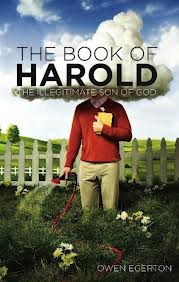
“The Book of Harold” by Owen Egerton is out in paperback from Soft Skull Press. You can read the first chapter here.

The success of a story is often determined by how well it goes off the tracks. In order for that to happen, though, the story must first lay those tracks. A great example of derailing a story can be found in the opening chapter of Owen Egerton’s novel, The Book of Harold: The Illegitimate Son of God. You can read that chapter, titled “Nativity,” on Amazon here. (Look inside and read the first pages.)

How the Chapter Works

One of the oldest ways to create suspense in a story is to create a repeating sequence of events. So, in “The Three Little Pigs,” we watch the wolf blow down two houses before going to the third—where his plan goes awry. In a more contemporary example, the film Oceans Eleven, plus every heist movie ever made, first shows the thieves planning the heist and then practicing the heist, and when they finally put their plan into action, something goes wrong. Both of those stories—the fairy tale and the blockbuster film—spend time establishing how events should go so that they can go wrong.

With that strategy in mind, count how many times Egerton shows us the Christmas pageant in “Nativity”:

  1. We’re told that the pageant “was a Christmas tradition for our church.”
  2. Next, we’re shown the casting and introduced to the doll that will play Baby Jesus.
  3. Then, we’re shown the children practicing the pageant, running through the entire show.
  4. Next, we’re given a quick description of the first two nights of the pageant.
  5. Finally, the last performance is upon us. We know the drill by heart, and so do the characters. Notice how they begin to alter the routine: the donkey drop “balls of dung every other step,” a Wise Man slips on the dung, and chaos ensues.

Notice how each telling involves a bit of irregularity: the introduction of the drummer boy, the casting of the narrator as Joseph, the drummer boy mis-delivering his line, angels crying, and finally donkeys pooping. Yet, even though the reader expects an unexpected turn of events, there is no way to foresee what actually happens. The thrill, for the reader, is in waiting for the predicted, yet unpredictable, twist. 

In addition to repeating the pageant, the passage contains words that clearly cue the reader into where things will go wrong. For instance, Egerton writes, “We practiced for two weeks. My part was simple enough.” The word simple is similar to Chekhov’s proverbial “gun on the wall.” If you show a gun in the first act, it must go off by the third. If you use the word simple in the beginning of a story, the story had better complicate that simplicity.

The Writing Exercise

Let’s create a sequence of events that will repeat itself, using Owen Egerton’s “Nativity” chapter as a model:

  1. Choose a scene that will repeat itself. The scene could be one that involves planning and practice (a wedding, shouting “Surprise!” at a birthday party). Or it could center around someone involved in a routine activity (door-to-door salesman).
  2. People the scene with characters. For instance, a wedding or party will have guests. A door-to-door salesman will visit homeowners.
  3. Tell the reader how the scene will play out. Be detailed. First, X will happen. Then X. Then X. Finally, X. The more detailed steps you provide, the more opportunities you have to make things go wrong.
  4. Show the scene once or twice. In each of the tellings, something should go slightly wrong but not so wrong that the characters can’t deal with it.
  5. Finally, show the scene a final time, adding big, unexpected challenges. Ideally, you’ll let the challenges build on one another. So, something goes wrong in the first step of the sequence, and that problem creates a slightly larger problem in the next step, and so on, until the final step, when the sequence has devolved into chaos.

It helps if you give the main character a sense that something might go wrong—or if you generally introduce the idea that all might not go according to plan. You can introduce the idea subtly or in an obvious way. The point is to show the sequence of events while hinting at a twist in the sequence.

Be inventive with this exercise. Remember, you want to surprise an expectant reader.

Good luck and have fun.

How to Put the Gun on the Wall

24 Sep
Ethan Rutherford's story "Dirwhals!" was published at FiveChapters and included in his debut collection The Peripatetic Coffin.

Ethan Rutherford’s story “Dirwhals!” was published at FiveChapters and included in his debut collection The Peripatetic Coffin.

By now, everyone knows the Russian story writer Anton Chekhov’s suggestion, “If you say in the first chapter that there is a rifle hanging on the wall, in the second or third chapter it absolutely must go off.” In workshop, if a story needs more tension, it’s not uncommon for someone to say, “Put a gun on the wall.” Students tend to take this advice literally and hang up not only guns but knives, axes, chain saws, and mean dogs.

So, what if you want to set up plot without literally hanging something on your story’s wall? The writer Ethan Rutherford demonstrates another method in his futuristic whaling story, “Dirwhals!” It’s included in his debut collection The Peripatetic Coffin, and you can read it now at FiveChapters.

How the Story Works

The story is about a whaling ship in the Gulf of Mexico–except that the Gulf has been drained of water, and the whales are large whale-like beasts that burrow through the sand. Most of the dirwhals have already been killed, and so the ships hunting them must travel into unknown areas. In this scene, a ship’s captain is speaking to his crew, and what he says will set up a plot point as neatly as putting a gun on the wall:

“But what he had come to tell us was now that we were moving further and further into the basin, those on watch were to be spotting for two things: dirwhals, and other shipper-tanks, which, given our current location, would most likely belong to the Firsties. A collective groan, followed by hissing, went up among the crew. Protection kooks, someone explained to me when I asked who the Firsties were. Bushard added: kamikaze environmentalists; degenerates; cultists; criminals. Capt. Tonker held up his hand for silence.

Their aim, he said, is to put us out of a job.”

The captain’s speech neatly lays out the stakes, not only the crew versus the Firsties but also the forces that are pushing them into a confrontation. Now watch how Rutherford uses these stakes to set the crew on a course that will determine the plot for the rest of the story:

“So, his order: spot the Firsties, and report them, but under no circumstances were we to engage, even if provoked. They had cameras, they wanted us to fire on them, and they would stop at nothing to manufacture an incident, even if it came at great cost to their organization. He asked us if we understood. We answered: yes, of course.”

As savvy readers, we know that the crew will run into the Firsties and things will not go according to plan. The certainty of that encounter is the gun on the wall. The decisions that lead the crew into that inevitable encounter is the story’s plot.

The Writing Exercise

Let’s use the captain’s speech in “Dirwhals!” as a model for how to set up plot:

  1. Choose a resource that can be exhausted. In “Dirwhals!” that resource is the whale-like creatures. But most things in the world exist in limited quantities: time, money, and jobs but also less tangible things like patience and endurance.
  2. For most resources, there is one side that wants to deplete the resource and another side that wants to conserve it. For the resource that you chose, what are those sides?
  3. Let a spokesperson for one of the sides explain the situation that will lead to an inevitable confrontation with the other side. So, if the story is about a woman who works 50 hours a week and in her off-hours takes care of her kids and maintains the integrity of the house and family, she will feel that her time is limited. If her brother calls and says that their mom can’t take care of herself and so should move in with the woman, the woman will obviously not feel that such an arrangement is possible. But, let’s say her brother is in the army and about to be deployed overseas. Now, you have two sides: one (the brother) pushing to deplete an already limited resource (the woman’s time), and another (the woman) trying to conserve what little time she has left to herself. Imagine the rant she might deliver to her husband or kids about the situation–imagine if that rant ends with “One of these days, my brother and I are going to have it out, and that will be the end of things.” What follows–the events that lead to that confrontation–is the story’s plot.
  4. If you want, you can outline those events.

Good luck with this exercise. You may find that a plot outline is not necessary. Knowing where the story is headed can sometimes guide you as much as any outline.

Why Paragraphs Matter in a Story

25 Jun
Roxane Gay's story "Contrapasso" first appeared in Artifice Magazine and then in Mixed Fruit.

Roxane Gay’s story “Contrapasso” first appeared in Artifice Magazine and then in Mixed Fruit. The unique structure highlights the importance of paragraph structure.

When talking about structure in fiction, we tend to focus on large-scale issues (story arc and delayed gratification of suspense) and the fine detail of sentence crafting. What often gets neglected in the conversation is a structural unit that is, in some ways, the skeleton of all fiction: the paragraph.

An excellent example of the beauty and importance of the paragraph is Roxane Gay’s story “Contrapasso.” It was first published in Artifice Magazine, and you can read it here at Mixed Fruit.

How the Story Works

In any story, a character begins with infinite possibilities, and the writer’s job is to narrow those possibilities down to a few that the character must choose from. Choosing a theme is one way to narrow the possibilities. In this story, the menu headings provide those themes. Of course, it’s not necessary to stick to the theme in a strict sense, and Gay doesn’t, but her headings do provide a direction for each paragraph.

In this paragraph (from the “Life Maine Lobster” entry on the “Meat and Seafood” page), the theme or idea of boiling lobsters provides an entry into the character and her story about bondage. The heading allows her to write a sentence like this: “Now, in the wake of her divorce, she envied the lobster and the privilege of such pain.” The entire character development proceeds from the heading.

Focusing on paragraph structure can also help you move through time. Look at this section from the “Sauteed Spinach” entry on the “Sides and Accompaniments” page. For many writers, it’s easy to fall into the trap of chronology. So, this section could have been written this way: I followed her, I saw this, I did that, she saw me, we exchanged looks, she got out her phone, I went home, and there was a knock on my door late and the words, “Open up. It’s the police.”

But Gay skips all that unnecessary connecting tissue. Here, the theme doesn’t matter as much. Instead, the paragraph headings force each paragraph to have a point: what the narrator saw, what the cops said, what the narrator did next. As a result, the narrative moves more quickly because the reader doesn’t need to slog through needless detail. But the structure also slows the narrative down. Because each paragraph focuses on a single action or event, you can’t rush on to the next event. Instead, you investigate the action more deeply, which can lead to further character development.

In this story, paragraph structure cannot be separated from story structure.

The Writing Exercise

We’ll write two paragraphs, the first concentrating on character development and the second focusing on moving through time.

Paragraph 1 (Character Development)

  1. Make a list of your characters’ interests: hobbies, food preferences, career influences, regional or cultural influences, etc. For example, if the character is an accountant, he might view the world through accounting concepts. Or, if the character is a high school student who loves to read, she might view the world through the titles of novels, like the narrator of Special Topics in Calamity Physics by Marisha Pessl. Choose one of these interests for your theme.
  2. Write the theme as a paragraph heading.
  3. Let the character apply the theme to his or her world. For example, if your accountant character was asked how the whole world can be explained by common mistakes in basic math on tax returns, what would the character say? What if you let the character give an example from his or her life, something like this: “You’ve got two kinds of taxpayers, X and Y. Just the other day, a guy came into the office, and he was type X…”
  4. Tell the character’s story in a single paragraph. Stick to the theme you’ve given yourself.

Paragraph 2 (Moving Through Time)

  1. Same as Step 1 above. Choose a theme.
  2. Tell a story in 3 sentences: X happened. Then Y. Then Z.
  3. Build a paragraph around each of the three sentences. In each paragraph, focus less on advancing the narrative and more on describing in depth some aspect of the action, for instance what the character sees or feels or thinks.

Good luck.

Setting Up the Inevitable

4 Jun
"Crossing" by Mark Slouka was first published in The Paris Review.

“Crossing” by Mark Slouka was first published in The Paris Review.

Any hack with the smallest facility for plot can walk a character into a situation that cannot be escaped. But it takes skill and craft to make the reader feel the character’s desperation. This is exactly what Mark Slouka does in his story, “Crossing.” By the last paragraph, the tension is nearly unbearable. The ending is powerful: “There was nowhere to go. It didn’t matter. They had to go.”

To find out how Mark Slouka builds the tension so subtly and yet to such an incredible pitch, read “Crossing” at here at The Paris Review.

How “Crossing” Works

Slouka does two things at once in the story.

First, he takes the father back and forth across the river: with the backpacks and then with his son on his back, and then an identical set of return trips the next day. The first set of trips allows the story to show us the river and the care required to cross it. The details are not particularly subtle. For instance, the father remembers when he was a boy crossing the river with his own father and asking, “what do you do if you fall?” His father answered, “Don’t fuckin’ fall.” It becomes clear where this story is headed.

Yet we forget this inevitable end because of the second thing Slouka does. While the river takes a central place in the story, the focus is actually on the father’s memories and thoughts. In fact, the river doesn’t even appear until the fifth paragraph. The story opens in the house of the man’s ex-wife, where the man is picking up his son:

“He went inside, wiping his shoes and ducking his head like a visitor, and when the boy came running into the living room he threw him over his shoulder, careful not to hit his head on the corner of the TV, and at some point he saw her watching them, leaning against the kitchen counter in her bathrobe, and when he looked at her she shook her head and looked away and at that moment he thought, maybe—maybe he could make this right.”

Slouka uses this opening to set the stakes: the man is going to use this camping trip to make things right with his family. His thoughts circle this idea throughout the story, even as he’s crossing the river. And so he does not see a second set of story stakes appear. While the story starts out being about making this right with his family, it will end with both two lives in the balance.

The Writing Exercise

  1. Pick a place to which you have a strong emotional connection.
  2. Ask yourself: What is dangerous about that place? Or, what danger could the place pose to someone who feels about it the same as you do? The danger could be literal (drowning) or emotional (the end of a relationship). For instance, if I choose my current back yard, where I’m landscaping, the danger might be that a character such as myself spends so much time thinking about what trees to plant that he misses something more important (kids, spouse, etc.). The danger could also be literal: cutting off a finger with a saw.
  3. Create a character who will face the danger.
  4. Finally outline how he or she will end up facing the dangerous situation. What details are crucial to establishing the danger? Why doesn’t the character avoid the situation? You must decide where the story begins. Doing so will give you a timeframe and help determine how quickly or slowly to dole out information.

Many writers will feel reluctant to plan out a story this way or will be unable to stick to the outline once they begin writing. That’s okay. The point of this exercise is to develop a feel for how to parcel out information in order to create suspense.

Narrating a Crime Scene Investigation

23 Apr
Steve by Marcus Pactor can be found online at this journal and also in his new collection of stories, vs. Death Noises.

“The Archived Steve” by Marcus Pactor can be read online at Timber and also in his new collection of stories, vs. Death Noises.

Literary fiction could learn a lot from the TV show CSI. If that claim sounds absurd, consider this: The show does not follow a traditional plot structure. No episode can be summed up with the old saws “Stranger Comes to Town” and “Character Goes on a Trip.” Those plot lines are present in the show, but they occur quickly—usually, within the first two minutes—and serve only to introduce the true story: the investigation, which consists almost exclusively of people standing around, talking to one another. Sounds pretty cerebral, right?

The problem with most detective shows is that their investigations have the same emotional impact as piecing together a jigsaw puzzle. The detectives remain untouched by their work. In a literary investigation, however, the characters are forever changed by the information they uncover.

A recent story that illustrates the dramatic potential of an investigation is “The Archived Steve” by Marcus Pactor. It appears in his new collection vs. Death Noises, and you can read it online at Timber.

How the Story Works

Here is the story: Steve is dead, and the narrator is searching through the items left in his apartment. With each discovered item, the narrator begins to piece together the story of Steve’s death. A show like CSI would maintain its focus on this search and puzzle solving. But the focus of “The Archived Steve” shifts away from the corpse and onto the man searching the apartment, a man who will learn that he is partly culpable in Steve’s death. The story, then, becomes about the emotional consequences of his investigation.

So how does the story work? While its premise may seem disconcerting at first—some readers may be thrown off by the matter-of-fact listing of evidence—the story does not plunge into the evidence without purpose. The first paragraph makes clear that the narrator’s goal is to “correct that fool doctor” and his autopsy report.

Aside: I’ve mentioned this idea several times on the blog, and it bears repeating. It’s important to give readers a sense of where the story is going. There are many ways to do this. For more examples, check out these exercise based on Manuel Gonzales’ story “Farewell, Africa,” Owen Egerton’s chapter “Nativity,” and Stacey Swann’s story “Pull.”

Once Marcus Pactor establishes the direction of the story’s investigation, he quickly sets it into motion, offering and explaining evidence. Notice how the type of evidence changes, moving from the concrete (“technological equipment and books”) to the more abstract (“Steve’s Inverted Pyramid of Suffering”). As this shift occurs, the reader requires more explanation from the narrator, which leads the narrator to insert himself more fully into the story. As a result, the pronouns begin to change halfway through the story. The words “we” and “I” appear more frequently as the story becomes the narrator’s, rather than the corpse’s.

What begins as the search through items left in an apartment becomes the story of a man’s growing sense of guilt and failure.

The Writing Exercise

Let’s use “The Archived Steve” as a model. Just as Marcus Pactor’s story focuses on items rather than the dead man who left them behind, let’s create a story from the things that our characters pull in their wakes.

  1. Choose a mysterious premise: someone has disappeared, someone has died from undetermined causes, something has been stolen, something has gone missing.
  2. Put yourself into a room where the person was last seen or where he/she spent a great deal of time—or the room where the item went missing from. What is in the room? Make a list. Be exhaustive.
  3. Now that you’ve created the items, give yourself an investigative goal: to sift through the items in order to find/figure out X.
  4. Begin explaining the relevance of each item to the missing person or the connection to the missing thing. Keep in mind your goal. What clue does each item offer you in your effort to reach the goal?
  5. If you find that explanations of certain items tend to veer unexpectedly or slide into unexpected tangents, that’s great. Follow those tangents. Just as a true crime investigator leaves no stone unturned and follows every tip, you should follow every trail that your subconscious provides. Keep in mind: you’re uncovering a story just as your narrator or character is uncovering a crime. Give yourself permission to explore.

Have fun and good luck.