


Brian Evenson’s story “Windeye” was first published in PEN America 11: Make Believe. The story was later selected for The 2011 PEN/O’Henry Prize Stories.
Twist endings are one of the great pleasures of literature, yet in contemporary fiction, they’ve gone the way of the dodo and the epiphany. No one would dare write a modern version of O’Henry’s classic “Gift of the Magi,” and for good reason. That twist—and others like it—seem manipulative and implausible to modern readers. Perhaps it’s our attachment, as Americans, to realism, but we tend to relegate sudden reversals of fortune or circumstance to reality TV and schlocky movies. As a result, it’s tempting to ask whether a twist ending is even possible in literary fiction.
Brian Evenson would say yes, and he pulls of a doozy in “Windeye.” The story appeared in The 2011 Pen/O. Henry Prize Stories and was first published by PEN American Center. You can read it at PEN America’s site, here.
How the Story Works
Evenson uses an old trick: Introduce a character, weave her into the fabric of the story, and then—when our attention is focused elsewhere— make us question the character’s reality. It’s not unlike the strategy used by Ron Howard in A Beautiful Mind; the brilliant mathematician’s friend is real, and when, suddenly, he’s not, we’re as dumbfounded as the mathematician. In “Windeye”, the reader doesn’t fully understand the truth until the mother says, “But you don’t have a sister.” And like the boy, we can’t quite believe it.
In a classic reversal, such as the one used by M. Night Shyamalon in The Sixth Sense, the viewer or reader’s sense of what is true is completely reversed. In other words, we realize that Bruce Willis is, in fact, not alive but dead. “Windeye” operates differently. The twist is incomplete. The sister likely never existed, but the boy can’t be certain of it – and more importantly, the boy will never be certain. Evenson creates this uncertainty with the fifth and final section, jumping forward in time, explaining the reversal’s emotional consequences. The boy can never shake the feeling that one day his sister will “simply reappear, young as ever, ready to continue with the games they had played.” This is similar to the strategy that Alfred Hitchock used in Vertigo, when Jimmy Stewart’s character discovers that he’s been fooled. Instead of ending with the revelation, the film continues, revealing the twist’s emotional consequences.
Once you’ve read the story, it’s easy to go back, section by section, to see how the twist (the fact that the sister isn’t real) is hinted at but not revealed. It’s worth checking out to learn how seeds planted at the beginning gradually sprout and reveal more of themselves.
The Writing Exercise:
- Write down an ending (boy gets girl, woman discovers fortune, man finds happiness, woman is revealed to be a zombie). Don’t be afraid to go boldly where you normally wouldn’t dare.
- Now, write down a beginning that is the complete opposite of the ending (girl doesn’t know boy exists, woman is poor, man is miserable, woman is the leader of the free world).
- You may think that the trick will be getting from Point A to Point B, from leader of the free world to the realization that she’s a zombie. But a story with a twist—in truth, most stories—depends on a point between A and B. So, give the character a goal that has nothing to do with the Point B (boy needs to escape from prison, woman needs to hide from ex-husband, man wants to become the world’s greatest ventriloquist, woman must pass a national budget).
 Outline the events that must occur or the stages the character must go through to reach the destination he or she is aiming for. At the same time, outline backward from the Point B ending. The moment where the outlines meet will be a point of high tension (hopefully). If you can create the outline, all that is left is to flesh out the story, dropping hints of Point B in the beginning.
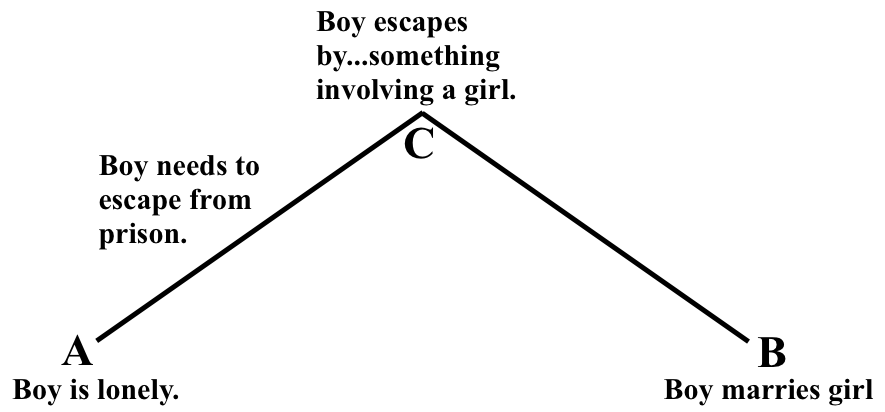
If you’re working on a story and don’t want to start a new one, try this exercise:
- Reread the ending of your story. Then fast forward in time (six months, sixty years, whatever). Summarize the emotional consequences of the ending you have already written. How do the characters live with the ending you’ve given them?
- You may discover that the story isn’t over. The story’s true conflict may still be unwritten. Or, you may realize that your original ending is the best one. That realization can be as valuable as any.
Have fun writing.


 Read to Write Stories