Archive | Writers on Writing RSS feed for this section

An Interview with Kalpana Narayanan

25 Sep
Kalpana Narayanan's story, "Aviator on the Prowl," won Boston Review's Aura Estrada Short Story Prize.

Kalpana Narayanan’s story, “Aviator on the Prowl,” won Boston Review’s Aura Estrada Short Story Prize.

Kalpana Narayanan was born in New Delhi and raised in Atlanta, and she now lives in Brooklyn. She has received writing fellowships from Yaddo, The Hambidge Center, and The New York Foundation for the Arts, and, in 2011, received Boston Review’s Aura Estrada Short Story Prize. The judge, novelist Francisco Goldman, called the story “a pretty dazzling mix of charm, humor, strong emotion, jump-off-the-page liveliness.” Narayanan teaches writing at Fordham University.

To read Narayanan’s story, “Aviator on the Prowl,” at Boston Review and an exercise on making creating character foils, click here.

Michael Noll

I love how so much of the dialogue shows the characters talking to themselves or talking to others and getting no response. When there is some extended back-and-forth, it gets summarized, as with the dialogue with the mom in the first paragraph. One effect of this is that it reinforces just how alone these characters are. Was the dialogue was always written this way or did it start out longer and then get pared back in revision?

Kalpana Narayanan

That’s a lovely read of the dialogue in the story. Thank you. The dialogue in the first draft of the story is the same as it was in the final draft—short.  Someone pointed out to me that the narrator only speaks once, which was so surprising to me, because in my head, she has this interior world that is constantly in dialogue with what she’s seeing, with the people around her.  But it’s true, we only hear her speak once at the end.  I think that was something I was interested in—a narrator who has a rich interior life, but the outside world can’t necessarily see that. I was interested in these characters who are in this house that feels at times as if it’s about to collapse in on them.  Their one way out is to communicate—but they can’t. There’s something really human about that problem to me—about not being able to communicate with the people who are closest to you.

It was also the first time I’d written in first-person, which I think unlocked something in me as I wrote it—I realized that I could just have her be in her head, imagining what she would say.  She’s this character who is enveloped by grief, and has all this emotion brimming in her, but she can’t vocalize it—she absorbs more and more, until she can’t one day—and I wanted for the reader to be in her head as this is happening, to be with her in this moment when she is finally able to connect, and act, and speak.

Michael Noll

Was the character of the narrator’s boss always such a significant part of the story? I ask because the story begin with the narrator struggling with her brother’s death, but very quickly the conflict with her boss becomes at least as pressing—and maybe more pressing—than this original conflict. The boss is such a great character—and a great opportunity for the story to direct the narrator’s grief into an unexpected direction.

Kalpana Narayanan

Thank you.  I think I started out wanting to bring the narrator out of her house.  I wanted her to try to move forward.  That couldn’t happen in her house, because her family is so consumed by the death of their son, and stuck in this holding pattern in a way.  So she begins to work at a restaurant.

The second the boss entered onto the page, he stuck. And I was interested in that—in the boss being someone who was unlikable, and abrasive, and in that way, someone who would push the narrator, and be really hard on her, because he has this lack of boundaries, and lack of reverence, for what has happened to the narrator’s family. And it would be that push that would allow the narrator to move forward. I don’t think I had any idea how the story would end, but by the time I got there, it seemed to make emotional sense. Her boss is this outsider who is in no way affected by this death that has happened.  And he’s so cruel, which makes the reader empathize with the narrator—but he’s also more complex than that, he’s also able to unlock this part of the narrator that no one else can—and in that way, push her. And that’s what I really wanted—for the narrator to be caught off guard, and for her to surprise herself, and to be suddenly able to move slightly forward.

Michael Noll

Kalpana Narayanan discussed death and the novel Skippy Dies, by Paul Murray, in this essay at The Millions.

Kalpana Narayanan discussed death and the novel Skippy Dies, by Paul Murray, in this essay at The Millions.

You recently published an essay about the novel Skippy Dies—“A Physics of the Heart: On Grief, M-Theory, and Skippy Dies—and wrote that the “descriptions of young love, and of grief, are so raw and vivid that they make for an alternate, enveloping universe, one created by the friction of words brushing up against each other in new ways.” I’m curious if you had something like this in mind with “Aviator on the Prowl.” Do the death of the narrator’s brother and her sexuality belong to different universes that have been momentarily brought together?

Kalpana Narayanan

Part of why Paul Murray’s Skippy Dies was and is so moving to me, is the language of his book.  It’s so energetic, and heated, and it mirrors the world and imaginations of these kids who are dealing with heartbreak, and loss, and other incredibly difficult things.  His language is so raw, and his descriptions are so fresh, that you feel like you’re in a different world, as you read—you have these sentences that explode like fireworks across the page. I think that’s part of what I was getting at in that description—this idea that you can create a universe through language, which I think is what any writer is trying to do.  I think when you’re writing about really difficult human experiences, death being the most difficult, you have to find a language that can do that work, a language that is raw and in that way perhaps mirrors the experience of your characters. I wrote Aviator years before I read Skippy Dies, but perhaps it’s part of why I was drawn to Murray’s book. In our real lives, our worlds are constantly overlapping—our work lives, our personal lives—they’re overlapping in messy ways—in fiction you can use language to make these worlds collide, and explore the friction that happens when they do.

Michael Noll

The story is full of cultural mash-ups. In one section alone, Japan is confused with Okinawa, a fat Korean man’s favorite word is “copacetic,” and the character mops up Sriracha stains by skating on sponges like Pippi Longstocking while her boss watches while drinking an Akitabare. On one hand, these juxtapositions seem like the natural result of the many cultures present in a place like this. But, on the other hand, they also seem to reinforce, in a way, the narrator’s confusion. Was this mashup intentional or just one of those happy accidents that sometimes occur in fiction?

Kalpana Narayanan

That’s an interesting question.  It wasn’t intentional, but I’m happy if it comes through as something that’s natural. I do think that those kinds of juxtapositions that you’re speaking to are just a really natural part of our lives. When you’re living in one place, but were raised in another, and born in yet another, as so many of us are, the connections you make when you are viewing the world are going to be unique, and beautiful, and surprising, and complex. I’ve always been interested in writing about what happens when different worlds, cultures collide. Ultimately that collision is an interior collision, or a collision between two people. The person who is standing in one place, but who has lived all of these other lives, is going to see the world through all of these lenses, and tell stories that are really layered, and in that way hopefully tell a story that feels real, and moving.

September 2014

Michael Noll

Michael Noll is the Editor of Read to Write Stories.

An Interview with Ted Thompson

18 Sep
Ted Thompson's novel In the Land of Steady Habits was called XXX.

Ted Thompson’s novel In the Land of Steady Habits was described as a “elegiac yet bighearted take on adult disillusionment” by The Wall Street Journal.

Ted Thompson is the author of The Land of Steady Habits, a novel that has been called “the first great novel about post-crash American disillusionment, the flip side of The Wolf of Wall Street” by Salon editor David Daley. The novel has been optioned by director Nicole Holofcener. Thompson’s stories have appeared in Tin HouseAmerican Short Fiction, and Best New American Voices, and he was a Truman Capote fellow at the Iowa Writers’ Workshop. He lives in Brooklyn, NY with his wife.

In this interview, Thompson discusses how to structure multiple points of view, creating tension, and writing in the shadow of Yates, Cheever, and Updike.

To read the first chapter of In the Land of Steady Habits and an exercise on making characters uncomfortable, click here.

Michael Noll

I’ve read a lot of novels written from multiple points of view lately, and most develop a sequence for the different POVs—for example, every other chapter follows a different character. But you don’t do that in this novel. Part 1 is told entirely from Anders’ point of view, but then the chapters in Part 2 are told from not only Anders’ POV but also his wife Helene’s and his son Preston’s. The last section mixes the POV’s within a single chapter. When I first encountered the POV shift, some small part of me thought, “Hey, that’s not supposed to happen.” But then it worked. And the other shifts worked. I came to appreciate the way you handled them. Rather than latching onto a pattern, you shift POV only when necessary—at least that’s how it seemed to me. What went into your decisions about when to shift?

Ted Thompson

I’m so happy that you noticed that. It was something I came to rather late in the process of writing the novel. Originally it had been told entirely from Anders’ point of view, and draft after draft I was always chafing against that. It was too restrictive to tell the entire story through his consciousness, especially because he’s a character who often reacts before he understands his feelings, who doesn’t have the most awareness, and that made him a somewhat trying person to spend a lot of time with. But I had always believed that if you were going to change points of view in a novel you had to teach the reader that you were going to do that early on. As you say, it had to be established in the opening pages. But I didn’t want to do that, because to me the story begins with Anders and his crisis but then opens up from there to show how it affects the people and community around him. To me it was a little like a stone thrown in a pond. The opening is the splash and after that we can follow each of the waves that come off that impact.

So I looked at the novels I thought of as structurally perfect, or at least those that had influenced me, and discovered that not all of them had formal, logical ways of handling POV. Revolutionary Road in particular wanders all over the place. At first it seems like it’s going to be Frank’s story, but then we get his wife April, and then we jump to Mrs. Givings, the real estate agent, then their neighbor Shep Campbell. We even wander into Mrs. Givings’s deaf husband’s point of view at the very end. And it was then that I realized that so long as there is a narrative question (meaning a question that is in the reader’s mind) that’s being addressed, most of the time the reader will make the POV leap with you without too much resistance. Changes in point of view are always jarring, but they’re less so if it feels as though we’re following the narrative thrust of the story, if we’re where the action is.

So what I told myself was that I would go to the character who held the most interest to me in that moment, and figured (hoped) the reader would also share my curiosity. What I found was that these shifts could be fluid so long as the scene or moment or information we were getting deepened our understanding of what we’d already seen. The moment a POV shift dies is when the character reason for joining a character isn’t immediately clear. Then, for the reader, the move feels lateral rather than forward.

Michael Noll

On a similar note, I was also interested in the way you move around in time. Some chapters are in the present, some take place in various points in the past, and some move unexpectedly between the two. One of my favorite parts of the novel comes in the last paragraph of Chapter Two, when the past and present are collapsed together in a moment of regret. I can only imagine what this novel looked like in draft form—the many scenes spanning decades, waiting to be fitted into a single narrative. How did you go about finding the novel’s organization?

Ted Thompson

For me the simplest organizing principle for this novel was always the present events. Essentially once we know where we are in time, in the present story, and what matters there (once there’s conflict) then it opens all sorts of space to play. I say “play,” but really what I mean is an opportunity for contextual information, for a wider lens through which to understand the events. So since my novel has a character who has left a forty-year marriage and a long career, part of what that second chapter had to do was provide the context of that huge sweep of time, to help us place him more clearly in the present, and thus deepen the novel’s conflict. I’ve come to see conflict less and less as an aspect of present confrontation in fiction and more as an expression of character. In deepening the conflict, a literary novel is also deepening our understanding of character. They’re the same thing. So the present line of tension, for this book, was always the organizing principle, but once it was tacked down, I could go wherever I needed in time to make the most sense of the moment for myself and for the reader.

The writer Richard Bausch once told a workshop I was in that “drama in fiction is created by what is known, not by what is unknown,” and I agree with that wholeheartedly. For me with this book it was just a matter of finding the present events, then stepping away from them when it was necessary to give the reader enough context to understand precisely why they mattered.

Michael Noll

Someone described the novel’s main character, Anders Hill, as a one-percenter—it may have been a reviewer, or it may have been another character in the book. I can’t remember. But one of the interesting things about the novel is that Anders never feels like a one-percenter. His life has become such a mess that even though he spent much of his life riding the sweet spot of the economic wave (and also crashing, like many others), he doesn’t feel wealthy. Did you ever struggle to find the right tone for the wealth surrounding Anders and his community?

Ted Thompson

Ted Thompson's novel, The Land of Steady Habits, has been shortlisted for the Flaherty-Dunnan First Novel Prize.

Ted Thompson’s novel, The Land of Steady Habits, has been shortlisted for the Flaherty-Dunnan First Novel Prize.

I knew the tone of this book before I knew anything else. That was the one thing that I had from the first sentence—the sound of it—and it’s what I would come back to when I was lost. Sentence by sentence, I knew when it sounded right, when the angle of vision was correctly honed, and that more than anything else is what I was able to trust. I’m not sure where it came from, but I knew the book needed levity, I knew it needed a clear element of comedy to carry it, and all of that could be managed through the tone. The great thing about levity, for me, is that it creates space for genuine sentiment, for unexpected moments of regret or longing or generosity to come through.

As for the term “one-percenter” it was used by a reviewer (or more likely his headline editor). I didn’t actually know the term when I was writing the book since much of the public dialogue about income inequality that spawned it hadn’t yet begun. But I agree “one-percenter” isn’t quite right for Anders, even though he probably technically would qualify as one. And I think that’s because one of the things that I was interested in when I was writing it was the nature of work, in particular the way that it always seems to be at odds with personal freedom, even when we might believe it’s in the service of it. So it was important that Anders was a commuter, a guy who had to get up at five and get on the train to head into the office, a guy who was ham-strung by a huge mortgage and astronomical property taxes and tuition bills for his grown kids. A one-percenter, at least in the popular imagination, is someone who lives in a kind of frictionless world where he doesn’t have to do anything he doesn’t want. And that’s not this character. So for me, the novel has less to do with wealth than it does with responsibility, which is another way of looking at what’s expected of him, or more precisely what he feels is expected of him.

Michael Noll

Reviewers have compared you to Updike, Cheever, and Yates, and those comparisons seem inevitable given the novel’s subject matter. Still, what intimidating comparisons! They’re among the titans of 20th Century American fiction. Was working in their style was ever difficult, either because of their influence on your writing or because of their influence on the agents, editors, and other readers who might have been offering advice to you?

Ted Thompson

Yes and no. Mostly I took great comfort in their work. Particularly Yates. I think when you’re working on a novel, especially a first novel, you’re constantly worried if anyone could possibly care about the story you’re telling. This at least was a fear of mine, one of the greatest hits of my many doubts. So knowing that there was this huge swath of American fiction that had come before me, this grand beloved tradition, helped a lot. When it came to the writing, I didn’t worry much about imitating them, since the voice of the book always felt like my own and the world of the book was certainly my own, comprised of all the sense memories and settings of my childhood. Not to mention the fact that, you know, those writers are all masters (and, I would argue, very different). But I did use their work to help me find a form. And that was hugely important. It gave me permission to tell this story.

September 2014

Michael Noll

Michael Noll is the Editor of Read to Write Stories.

An Interview with Amy Leach

11 Sep
Amy Leach is the author of Things That Are, a collection of essays that Yiyun Li compared to "a descendent of Lewis Carroll and Emily Dickinson."

Amy Leach is the author of Things That Are, a collection of essays that the writer Yiyun Li compared to “a descendent of Lewis Carroll and Emily Dickinson.”

Amy Leach’s book, Things That Are, is a collection of essays that are equal parts nature writing in the tradition of Mary Austin and language play like that of Lewis Carroll. Her work has been published in A Public Space, Tin House, Orion, and the Los Angeles Review. She has been recognized with the Whiting Writers’ Award, Best American Essays selections, a Rona Jaffe Foundation Award, and a Pushcart Prize. She plays bluegrass, teaches English, and lives in Montana.

In this interview, Leach discusses using rare words, beavers as a proof of God’s existence, and why nature has captured her imagination.

To read Leach’s essay, “In Which the River Makes Off With Three Stationary Characters,” and an exercise on writing surprising descriptions, click here.

Michael Noll

One of the most striking things about your writing is your use of diction. In this essay alone, there are words that I knew but had to stare at for a moment before I recognized them in their new form (chatterboxy, sagitaries, heptangularly), words I’ve probably encountered before but couldn’t define with any certainty (glogg, yawing, gobbets, saltarellos),and words that I thought you’d invented until I looked them up (truckle, mouldywarp, bladderwort, mudpuppy), and words that I simply had never seen before (frumentary). I was reminded of the writer Alexander Theroux, who actively searches for forgotten words and has said that he believes it’s the duty of writers to keep such words alive. This keeping-alive philosophy extends to his work, which includes a book, Primary Colors, with three sections about everything that is red, green, or blue. I wonder if you feel this same way, especially given the last chapter of the book, “Glossary of Strange Beasts and Phenomena”. Are you trying to save wonderful things (and with words, the effort and thought and experience that went into creating them) from oblivion?

Amy Leach

I like the idea of rescuing words from extinction, of books being arks for drowning words; but I don’t know if my impulse is responsible enough for me to call what I’m doing a duty.  I just enjoy words so long out of use they are almost nonsense again, as they were before they were used.  English can be as fun as Jabberwocky.

Michael Noll

As I reread the essay, I was struck by how much of it is purely informational: here is what beavers do, here is what salmon do. It’s not until the final section, really, that you put that information to work in a kind of argument. This runs counter to the usual structure of essays, which almost always contain some rhetorical turn after the first paragraph or so, a move to transform an interesting detail or anecdote into a thesis. But you don’t do this. The first four pages contain more and more descriptions of beavers. The next three are about salmon and their parallels with beavers. And then, in the last two pages, you apply these parallels to human experience, where the essay’s meaning—if we want to use that word—becomes clear. Have you ever gotten pushback from editors or your first readers, anyone asking you to use a more traditional structure?

Amy Leach

 I did want for the beavers to be beavers, for salmon to mean salmon, rather than being proof of a point. I remember, in doing research on this essay, watching a little video of beavers in the wild. Down below, in the comments section, there was an excited dispute over whether beavers proved the existence of God or proved the nonexistence of God. Nobody was excited about the beavers–just about their own opinions, which beavers happened to support. The beavers could have been wolverines or worms: the conversation below would have been the same. This seems to illustrate the philosophical peril of starting out with a thesis (opinion) and using the rest of the essay (the world) to prove it. This is how I often think–in a thesis-driven way–but it’s not how I want to think, and I love how in writing you can work out the way you want to think.

Michael Noll

One of my favorite lines in the essay is this one: “The beavers’ reaction to the papal renaming highlights two of their especial qualities: their affability and their unyieldingness.” It’s so unexpected—even though the language is fresh and the opening situation (beavers being classified as fish) is almost fanciful, the descriptions of the beavers themselves are rooted in fact and observation. As a result, when I read the word qualities, I expected something about their physiology or behavior—anything but affability. It’s a word that seems to illustrate what you write at the end of the essay: that there is a kind of experience that “spills you into a place whose dimensions make nonsense of your heretofore extraordinary spatial intelligence.” Do you make choices (diction, sentence structure, details, metaphors) in your writing that aim for nonsense-making, or is this just an effect of your natural style?

Amy Leach

I suppose it is natural, my affinity for nonsense. If you’re naturally a sensible person and you try by conscious effort and choice to be nonsensical, it may just come off as quirky, effortfully quirky. It seems best to stay true to your own nature, whether that nature is sensible or not.

Michael Noll

Some of the essays in the book, like “Stairs,” are less about nature than human experience of nature and the world and experience itself. It makes me wonder if you can imagine a transition in which you begin to focus less on animals and plants and on something else (airplanes, societal structures). Or, do you think you’ll always focus on the natural world? After all, you live in Montana, where presence of the natural world is every bit the equal of the human presence.

Amy Leach

I wrote most of the book while I was living in Chicago, brimming with airplanes and societal structures–so these were the last things in the world I wanted to spend time thinking about. Where one’s real life is not swamped with airplanes and society, one could possibly afford to devote more imagination to them. Though I expect it will always be the green things and the creatures who have my heart, for they are real.

September 2014

Michael Noll

Michael Noll is the Editor of Read to Write Stories.

An Interview with Sarah Frisch

4 Sep
Sarah Frisch won a Pushcart Prize for her story, "Housebreaking," which appeared in The Paris Review.

Sarah Frisch won a Pushcart Prize for her story, “Housebreaking,” which appeared in The Paris Review.

Sarah Frisch is a recent Wallace Stegner Fellow and current Jones Lecturer at Stanford University. She holds an MFA from Washington University in St. Louis. Her work has been published in The Paris Review and The New England Review, and she has won a Pushcart Prize and been a finalist for the National Magazine Award.

In this interview, Frisch discusses the challenges of finding the right beginning, doing research on the tribal areas of Pakistan, and avoiding one-dimensional political speech.

To read Frisch’s story, “Housebreaking,” at The Paris Review and an exercise on making unlikely scenarios more plausible, click here.

Michael Noll

The story begins with the main character, Seamus, doing things that are unlike him. He’s not a drinker, but he drinks several beers. He’s depressed, but he strikes up a conversation with a complete stranger and eventually asks her to stay the night. On the flip side, his house is a mess (and he’s a stranger as well), but Charity agrees to stay with him. I can imagine a lot of versions of this opening that don’t work–but this opening absolutely works. I heard Richard Ford once say that stories make the impossible possible, and that seems to be the case here. How did you approach this beginning? Did you ever find yourself thinking it wasn’t believable and needing to revise?

Sarah Frisch

I drafted the first version of this story over a decade ago, at a time when I was inclined to write chance encounters of this sort that I could almost never pull off. Nothing survives from that original version except the setting, Seamus and Charity’s names, and the opening scene where the two of them meet and immediately start a relationship. I decided to keep the premise of their instant connection because it seemed right for Seamus to get taken in by an illusion of intimacy. I thought it was a good way to start a story which is about, in part, the difference between thinking you know something and really knowing it in a way you can’t shake. I did have a lot of trouble making this section feel believable, and I was still struggling to revise it even after the rest of the story was done. It wasn’t until a very good reader recommended that I cut my random and utterly goofy first three pages (at one point they played a game of jacks) and start further into the encounter that I felt like I finally might be able to pull off the opening.

Michael Noll

It’s a long story, about 12,000 words. The opening scene alone is 1700 words, and as a result, I think, the story feels paced differently than shorter stories. More time is spent with dialogue. It’s still snappy, like this bit:

“You work in PR?”

“It’s an exclusive firm. We only take clients who can demonstrate a total absence of social conscience.”

“That’s not what I expected,” he said, suddenly awkward. “I imagined you were a teacher or an artist.”

“You’re looking at Weekend Charity. Wait till you see me in a suit.”

But a shorter story might end the scene with that line. But this one keeps going:

“He asked why she’d chosen to work with her company, and she shrugged and said that she’d mostly taken the job to piss off Greg.” 

I’m curious at what point you knew that this was going to be a long story—and if you ever had second thoughts about it. Did you ever try to revise to make it shorter (and more submittable to most journals)? Or did you always know that it needed to be long?

Sarah Frisch

The story was probably 7,000 words—about average for my stories—until I committed to setting part of it in Pakistan. Then it ballooned to almost 25,000 words, and I decided I was writing a novella. By the time I had finished revising and cutting out all the extraneous stuff, I was back down to forty-some pages. I might have tried to keep it shorter, but I was focused on finishing a collection and not thinking much about publishing in journals at the time. I knew how lucky I was when the Paris Review accepted the story, but it wasn’t until later that I realized that the Paris Review is one of only a few journals that publish stories this long.

Now that you mention it, I can see how the pacing is a bit more novelistic than in shorter stories. I think this is partially the result of having committed to a clock of an entire romantic relationship, from beginning to end. Also, at some point I scrapped the idea that I would summarize Seamus’s time in Pakistan using backstory and dialogue. That was when I really felt I had committed to telling two stories at once and showing how both the past and the present played out in full for Seamus. By then I had entirely lost sight of the pacing required for short stories and started taking my time.

Michael Noll

I love that the story takes on some sensitive political issues. Here are two characters talking about drone strikes:

Seamus made a point from one of the readings, that the civilian deaths and constant terror caused by hovering drones must be working against U. S. interests in the region.

“I hate that argument,” Melinda said. “People have a right to life outside our political agenda.”

What I love is that this moment has such clarity of moral vision, but that vision doesn’t take over the story, which is kind of a mess, morally speaking. The ending leaves us in a place of total uncertainty, not just in terms of what will happen but also how to feel about it all. How did you keep the politics from hijacking the story?

Sarah Frisch

You really hit on what I struggled with the most. When I started this version of the story, I had already been reading about the drone strikes for a couple of years in the New York Review of Books. This was back when there was barely any media coverage of drones, and I had just given birth to my youngest daughter. I couldn’t get over how the American government was killing families and kids and nobody was even talking about it. I was so angry about it, I felt as if it were my moral duty to write about it. This turns out to be a pretty difficult place to write fiction from. Throughout the drafting of this story, I felt as if I was fighting my own tendency toward one-dimensional political speech. I tried doling out my personal opinions to various characters, including the more problematic ones, and taking my beliefs to the extreme or mixing them up with opinions that I didn’t agree with. I also tried to have characters challenge each other’s opinions in scene.

A real turning point for me in drafting this story was when a friend put me in touch with a reporter and writer who had traveled in the tribal areas and was willing to read a draft of the section set in Pakistan. She was very generous and insightful and gave me notes on my scenes and access to the journals she wrote during her travels. She pointed out that things were actually a lot more complicated in the tribal areas than I was making them out to be and that it was difficult to know what was real and what was propaganda (and  who was a human rights worker and who was a fighter). She suggested that I play up the effects of not being able to tell right from wrong in the loss of Seamus’s faith. This change ended up working perfectly with the rest of the story and complicating everything in a way that helped keep a simplified moral vision from taking over.

The ending came to me all at once. I already knew that I wanted Seamus and Charity to break into a house together, but I was struggling with it until a sentence popped into my head while I was washing my hands. (I don’t mean to be romantic about it; this normally doesn’t happen to me.) The story had to “take a left turn through a window,” where it would hit up against some reality that Charity could not have communicated in her verbal account of herself. The arrival of the ending felt like magic at the time, but I think it actually grew out of a year’s worth of pushing against my own tendencies toward oversimplification and reductive political speech.

Michael Noll

What kind of research did you do for this story? I’m assuming you’ve never been to Islamabad (though I could be wrong, of course), and so you had the challenge of describing a place based entirely on research. To that end, I was struck by two things: the reference to the market, Jinnah Super, and the wound on Seamus’s foot. The first is specific and makes us believe that the story really does know the place, and the second seems to divert our attention so we’re not asking questions about the accuracy of the depiction of Islamabad. Was this intentional or just the work of your imagination?

Sarah Frisch

You’re right, I’ve never been to Islamabad. I watched a lot of YouTube videos. (Some guy drove around the city holding a video camera. There’s endless footage of avenues and intersections and cars.) I also read blogs and message boards where people discussed the city, and I asked a couple of people who had either grown up or lived in Islamabad to read over the Pakistan sections for accuracy. I ended up with a lot more information than I could use about Islamabad, but not nearly enough about the tribal areas, which I found very difficult to research. (Few news stories, no travel blogs, and only minimal video footage, some of which I would later learn was probably propaganda.)I lucked out when I was put in touch with the reporter. Her notes included a detailed account of the culture, customs, setting, and what it was like to travel as a woman in the tribal areas. She was incredibly generous about sharing her experience, making suggestions, and helping with the accuracy of those sections.

I hadn’t considered how the market and the athlete’s foot worked to make the Islamabad section more believable, but I can definitely see what you mean. I knew I wanted to set a scene in a market because markets are so different around the world, yet visiting them is a pretty common thing to do for travelers. I included the athletes foot because 1) There’s something disorienting about the way minor illnesses that would have been nothing back home take on weird ominous forms during travel. 2) I wanted Seamus to get sick in a way that he found difficult, uncomfortable, and slightly humiliating to share with Melinda. I think these are all emotions that in sickness women are made to feel more than men, and I got a rather sadistic pleasure out of having Seamus suffer an illness that he sensed made him appear unfit and ridiculous to Melinda. 3) Fungus cracks me up, at least in theory.

The information about the drone strikes was not that easy to find, and it took me a year to compile and confirm everything. I lucked out again when, a few weeks before the edits on the story were due, researchers from NYU and Stanford put out a report containing personal accounts of the devastation caused by drone strikes in northwest Pakistan. I was able to confirm a lot of my information and add details I didn’t know. The report is available online, and now there’s also a website with information and resources: http://www.livingunderdrones.org

September 2014

Michael Noll

Michael Noll is the Editor of Read to Write Stories.

An Interview with Sean Ennis

28 Aug
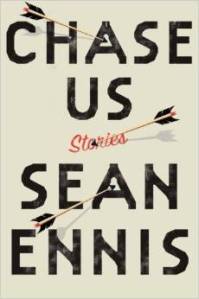
Sean Ennis is the author of Chase Us, which "expertly captures the tumultuous lives of youth on the streets of Philadelphia" according to a review by Largehearted Boy.

Sean Ennis is the author of Chase Us, which “expertly captures the tumultuous lives of youth on the streets of Philadelphia.”

Sean Ennis is the author of Chase Us, a collection of connected stories set on the outskirts of Philadelphia. Ennis is a Philadelphia native now living in Water Valley, Mississippi. He teaches writing and literature at the University of Mississippi and with the Gotham Writers Workshop. His work has appeared in Tin House, Crazyhorse, The Good Men Project, The Greensboro Review, The Mississippi Review, Hot Metal Bridge, LitNImage, Filter, and The Best New American Voices anthology.

In this interview, Ennis discusses staged and real violence, how the real story can be found in repercussions to dramatic events, and why game theory helps explain adolescence.

To read Ennis’ story, “Saint Roger of Fox Chase,” and an exercise on plot spoilers, click here.

Michael Noll

I’m really interested in the fact that the story puts the characters into two fights. The obvious thing to have done would be for the narrator to have learned a lesson from the first fight and responded differently in the second. But that’s not what happens. In fact, the second fight sort of sneaks up on him. He doesn’t even see it clearly. Did you always handle these fights in this way, or were there other versions of them in early drafts?

Sean Ennis

The structure for this story was a bit of a happy accident.  I had just finished reading a group of great, super-short novels (Ray by Barry Hannah, So Long, See You Tomorrow by William Maxwell, Death of a Beekeeper, by Lars Gustaffson), so I thought I might try my hand at something longer than my typical 15 page piece, and see what happens if I took my foot off the gas a bit.  My own experience playing soccer for ten years seemed like good enough fodder, and so I thought I’d tell every soccer story I had and see what fell out.  If I had originally approached the subject matter without thinking of it as a longer project, I probably just would have written the one long scene of the boy’s death.

A lot fell out though. Lengthy descriptions of indoor soccer, which is a bizarre game played with tiny goals and enormous tennis balls on basketball courts.  Errant coaches with hard drug problems who couldn’t keep their genitals from falling out of their shorts.  Feral sideline mothers who preyed on teenage referees.  The taste of yellow oranges in November at halftime.  All fine details, I guess, but eventually they felt irrelevant to the piece, and got cut. I didn’t want it to be turned into my lame soccer memoir.

The heart of the piece really seemed to be violence—the somewhat staged violence of the sport, and the real violence of the neighborhood.  On the field, there was, theoretically, some adult who would stop things from going too far.  Off the field there was not, even when their help was requested.

To the point of the narrator learning something, I guess my thought is that there is nothing to be learned.  He’s a coward in the best sense—he doesn’t believe that violence solves problems, or at least that he can use violence to solve problems—but might be surrounded by people who do.  I guess if he’s learned anything is that from now on, there is no one blowing a whistle to stop bad behavior.  He’ll have to manage it himself.

Michael Noll

I also really love the soccer field that you create in Fishtown. It’s not just a poor version of other fields—it’s not really even a field. What I love is how the absurdity of the field seems to change the tone of the story. We start out in familiar territory, familiar descriptions of poor neighborhoods, but then the field alters the scope of what is possible. It’s so beyond the bounds of what we think we know. I wonder if that second fight would have been believable in the story without that gravel soccer field. What do you think? Did any of this occur to you as you worked on the story?

Sean Ennis

This may diminish me as a story-teller, but that field was a real place. I played on it. This probably isn’t a shocker, but is it a bummer when writers say their best details are real?

Sean Ennis' debut story collection, Chase Us, follows the lives of boys living on the outskirts of Philadelphia.

Sean Ennis’ debut story collection, Chase Us, follows the lives of boys living on the outskirts of Philadelphia.

And in real life, I think the field was a metaphor. That neighborhood was very serious about soccer. They always kicked ass. They could have come up with money for grass. But it was a rite of passage in Philadelphia to play on that cinder field. We were shocked by it and had no idea how to negotiate it, so we complained and were totally intimidated and then lost. I distinctly remember my dad telling me it was a “cinder” field while we were driving there, and I had no idea what he meant. Had it been on fire?

Something that I think the whole collection is interested in is the idea of real objects out of place in a way that causes anxiety. Expanses of gravel and glass are not strange territory in an urban setting.  But when a hundred yards of them are contained by white lines and called a “field,” there’s something not right. To me, it’s the first clue for the narrator that something universal is off. The adults just shrug about the field.  Just say, sorry if you don’t like the rules, but you must play. For me, this is an idea running through most of the stories in the collection. For a while the whole manuscript was called “Deep Play,” an idea taken from Jeremy Bentham, a British political philosopher. He was talking about instances where players get involved in a game where it is impossible to win, but they play anyway. A lot of young adulthood feels like this, I think. I’m no expert in game theory, and “Deep Play” isn’t the sexiest of titles for a collection, but that superficial version of Bentham’s idea struck a chord with me in terms of the types of stories I was writing.

This relates to the second fight, I think. The natural progression of violence among these kids is that someone is going to be killed; it’s already in motion. Also, the narrator’s team’s manicured field is the place of real danger. Even the brutes from Fishtown understood when a fight was over and won. But the swarming idiots from the suburbs were less equipped to understand the repercussions of their actions.

Michael Noll

The story begins with a spoiler (“The night Roger was beaten to death…”). That’s a move that can really work and can also backfire (in this case, of course, it works really well). What went into your decision to start the story that way? And, how did foregrounding that line affect the way you structured the story?

Sean Ennis

My thought there was to just get that bit of drama out of the way. I think we all know stories about kids who died too early, and, of course, they are tragic, but I was interested in figuring out a way where that death wasn’t the climax of the piece. If the reader knows it first thing, then hopefully something else is going on to keep people reading. In general, I’m much more interested in the repercussions of dramatic events than the dramatic events themselves. Things that seem bad can have positive outcomes and vice versa. So, my hope is that what happens after the death is where the real heart of the story is.

Michael Noll

This is not the only story I’ve read that combines sex and death. First to mind is Stuart Dybek’s story, “We Didn’t.” But the novel Skippy Dies also came to mind. To that end, I guess even the movie Dead Poet’s Society fits the description. What is it, do you think, about sex and/or death that makes it natural to bring them together?

Sean Ennis

This question is probably above my pay grade, but I’ll speculate that there’s something evolutionary about an animal’s interest in these topics.  The ultimate conflict—have sex or die. The echoes of that impulse remain, right?  Freud?  Darwin? Help me out.

I also think for young people these are both concepts becoming real at about the same time.  By the age of twelve or so, most young boys are waging their virginity against their potential death in some stunt.  Before that age, neither sex nor death seem like possible outcomes, or even knowable outcomes. When they both come crashing in: chaos.

In terms of story-telling, a piece needs stake, and sex and death impart this pretty quickly. I’ll be the first to admit that maybe they do it cheaply.  Still, they’ve been staples in story-telling for thousands of years, which suggests readers are usually compelled by it.  All of which to say, I think this story, if it succeeds, is retreading very familiar thematic territory, if only because it is the story-telling I was trained in.

That said, I’m working to figure out how sex and death are no longer the backbone of my stories without becoming a bad version of Carver or Salinger (heroes of mine).  Surely there is a drama in between.

August 2014

Michael Noll

Michael Noll is the Editor of Read to Write Stories.

An Interview with Janet Stickmon

21 Aug
Janet Stickmon is the author of Midnight Peaches, Two O’Clock Patience and the memoir, Crushing Soft Rubies.

Janet Stickmon is the author of Midnight Peaches, Two O’Clock Patience and the memoir, Crushing Soft Rubies.

Janet Stickmon is the author of Midnight Peaches, Two O’Clock Patience and the memoir Crushing Soft Rubies, which has been used as a course textbook at U.C. Berkeley, San Francisco State University, Santa Rosa Junior College and Gavilan College. Stickmon is a professor of Humanities at Napa Valley College and a former high school teacher in Richmond, CA. She founded and facilitates Broken Shackle Developmental Training, a program that promotes the use of healing techniques to help reduce the effects of internalized racism.

In this interview, Stickmon discusses dangers of identifying people as “just human,” her unexpected love of the sci-fi novel Heirs of Prophecy, and hybridity in both writing and community.

To read Stickmon’s essay, “Blackapina,” and an exercise on narrative voice, click here.

Michael Noll

You write, “I longed to identify as ‘just human.’ This didn’t fully capture what I was about either, especially since being both Black and Filipina shaped my human experience.” When I teach an essay like Richard Rodriguez’s “‘Blaxicans’ and Other Reinvented Americans,” one of my students will inevitably say something like this: why can’t we just be people? It’s almost always a white student, and so I’ve come to think of this question as a white question. Yet here you were, with the same idea. Was there a particular experience that made you realize that being “just human” was an insufficient description of yourself?

Janet Stickmon

Actually I never really longed to identify as “just human.” In that line, I wrote, “Though such things were limiting, I never felt so frustrated by racial categories or questions reflecting binary thought that I longed to identify as ‘just human.’” Perhaps I could have phrased this sentence a bit differently. To clarify, I never longed to identify as “just human” even though I did find questions like, “What are you?” and “Are you more Black or Filipino?” to be frustrating and limiting.

However, I do remember when I was around 17 or 18 thinking that clubs organized around ethnic identity undermined integration. Attending my first National Society of Black Engineers (N.S.B.E.) conference during my sophomore year at U.C. Irvine completely changed my mind. There was something extremely powerful about being surrounded by hundreds of African Americans of every shade, every eye color, every hair texture.  For the first time in my life, I did not feel strange, unattractive, or undesirable. Instead of being the only Black person in the room, I was one among many; being Black was the norm; we were the majority. As diverse as the students at that conference were, we still shared a common ethnic heritage that we could detect in each other’s voices, gait, concerns, values, complexion, hair, and more. I felt a sense of relief that I could share certain aspects of my life experience and be understood without offering detailed explanations.

Gradually, with my involvement in N.S.B.E., and other groups, I began to understand that organizations centered around ethnic identity served as a home people of color could return to and have their/our existence validated and supported. In Crushing Soft Rubies—A Memoir, I go into more detail about how other college organizations/programs helped me understand that ethnicity is an integral part of our humanity.

When I talk about racism or multiracial identity in my classes, I also have at least a couple of students each semester who will ask, “Why can’t we just be human,” or make statements like, “People are just people,” or  “We are just one race:  the human race.” I’ve also found that usually these questions/statements are made by white students. Occasionally they come from students who pass for white and/or are multiracial students. Students who say these things are unaware of the implications of what they are saying. They don’t understand that such a mentality fuels color-blind racism. Some of these students believe that if we just stop talking about race or stop talking about our differences then racism (and other systems of oppression) will just go away. Instead, precisely the opposite happens. Ignoring the real differences between groups of people prevents us from seeing the real ways, for example, such differences are used as a basis for giving one group a set of privileges at the expense of another group. If we don’t see difference, we are incapable of seeing injustice clearly, and therefore are not in a good position to end the injustice. Though on the surface, the “just be human” mentality may look and sound appealing and innocuous, it’s actually a fear-based mentality that perceives difference as potentially divisive or something that “complicates” human interactions. Instead of being feared, our differences can be recognized and celebrated. Conversations about our different and similar ways of experiencing the world in terms of ethnicity, class, gender, and sexuality, disability, religion, and more have the potential to deepen relationships amongst human beings.

Michael Noll

Many people have probably experienced something like this:

“I felt pressured to believe I had to turn on and off each side of my ethnic identity depending on who was around. I thought that in order to be accepted as Black within an all Black social environment, I had to “turn on” my Black side (whatever that meant) and leave behind or downplay my Filipino side; when I was in an all Filipino environment I felt that I had to “turn on” my Filipino-ness (whatever that meant) and downplay my Black side.”

You write that you grew weary of these expectations, saying, “I wanted to bring all of me wherever I went,” but this seems easier said than done. Our communities exert a powerful influence on how we see ourselves—who they say, and we say, that we are. If you’re choosing to identify yourself in a different or new way, is it a constant battle with the community? Do your family and friends and acquaintances eventually come around to your way of seeing things? Or, do you find or form a new community?

Janet Stickmon

These are great questions! Yes, bringing all of me wherever I go is easier said than done. Indeed, people always have their opinions about how multiracial people should identify. Personally, I was tired of viewing myself as a fraction and feeling compartmentalized. Changes in how I chose to identify were informed by a substantial amount of self-reflection, research, and interaction with other multiracial people, particularly at conferences. In general, I never formally announced to all of my relatives or friends how I identified.   For some reason, I didn’t feel the need to do so.

With my closest friends and family members, how I identified ethnically was one of many things that inevitably came up in conversations since I shared a certain level of intimacy with them. In such cases, no matter how I identified, there was acceptance and understanding.

In more formal settings, like during a performance, presentation, or class introduction, I explicitly state how I identify. In such spaces, no one has ever confronted me or questioned why I identify the way I do. Perhaps, this was due to the clarity and conviction with which I publicly defined myself. Maybe identifying so strongly discourages people from openly questioning me. (Perhaps, some just prefer to criticize me in private.  Who knows?) It is also possible that some might think twice before questioning how I choose to identify (or before questioning my Black or Filipino authenticity) because I teach both Intro to Africana Studies and Filipina(o)-American Heritage. Though I don’t believe that teaching these histories makes me an “expert” in each culture, I do find it interesting that teaching both of these classes affords me the privilege of not having my authenticity routinely questioned—at least not in an academic setting anyway.

Today, when I share with my students why I identify as Blackapina, my students listen carefully and make a genuine attempt to understand a more nuanced approach to speaking about ethnic identity.  Judging from class discussions and one-on-one conversations, many students, especially multiracial people, transracial adoptees, and those involved in interracial romantic relationships, find it liberating to hear a professor articulate something that reflects some aspect of their own experience. Many of my students, including those who may identify as monoracial, welcome the possibility of embracing a both/and/and mentality to challenge binary thinking.

In response to your question about community, I actively seek out an unofficial circle of support that is made up of the people I confide and trust with various aspects of my personal and professional life. Some may share my way of thinking, while others may not. Those within my circle of support are generally compassionate and have a good sense of humor. This group consists of people of color and white allies with education in critical consciousness and intersectionality. This circle also consists of those of various backgrounds who may not have been exposed to an education in critical consciousness, but have a basic sense of justice and integrity and demonstrate a desire to learn from others and share of themselves. As I reflect upon this, my circle of support seems to mirror my own hybridity.

Michael Noll

I love that you found a model for your identity from a novel—and not some highbrow literary work but a fantasy novel, Heirs of Prophecy, with a main character who was half elf and half human. Was this just a happy accident of your reading, or do you think that genre fiction (especially science fiction, fantasy, and comic books) have something to teach us about how we identify ourselves?

Janet Stickmon

I must admit, my knowledge of science fiction, fantasy, graphic novels, and comic books is fairly limited.  My husband is far more well-versed in these worlds than I am. Years ago, we used to go to one of his favorite science fiction and fantasy bookstores called The Other Change of Hobbit. He usually knew exactly what he was looking for, while I would wander around the store trying to figure out what book seemed interesting enough to commit to. I happened to stumble across Heirs of Prophecy, part of the Forgotten Realms series. I read the back cover and the words “half elf” and “half human” caught my attention.  I bought it and began reading it right away. It turns out, yes, it was a happy accident.

Heirs of Prophecy is part of the Forgotten Realms Trilogy by best-selling science fiction author Lisa Smedman.

Heirs of Prophecy is part of the Forgotten Realms Trilogy by best-selling science fiction author Lisa Smedman.

I was pulled into this fantasy world set in the country of Sembia, and I wanted to stay. The characters were so believable.  The landscape of Sembia was breathtaking. The author, Lisa Smedman, didn’t just write a story, she painted a world, and I had the pleasure of sitting on the canvas. Witnessing the experiences of the main character, Larajin, gave meaning to my reality as a biracial woman. The extremes presented in this world inspired me to feel the realness of the spiritual force that I could invoke from both sides of my heritage and be able to benefit from both. In the past, I had attended a couple presentations where people talked about being biracial as having double the happiness. However, this book seem to speak to something deeper than possessing double the happiness; it seemed to say I had double the power.  No longer was I seeing myself as one condemned to a lifetime of confusion and rejection for being mixed.  Heirs of Prophecy seemed to create in me this audacity to believe I had special gifts that monoracial people did not have. Indeed, there are some issues with this idea, especially pertaining to exoticism and privileges given to light-skinned African Americans at the expense of dark-skinned African Americans; but I would need to expand on this in another essay. Nonetheless, I felt empowered as a biracial woman through this book.

I tried to recapture that same feeling and search for something just as meaningful in other books in the series but had little success. I enjoyed fantasy, but these latter experiences weren’t nearly as magical or as meaningful as the first time.

Shortly after reading Heirs of Prophecy and a couple other fantasy novels, I became exposed to the work of Octavia Butler and the His Dark Materials Trilogy. Around the same time, I became a fan of Star Trek (The Next Generation and Deep Space Nine) and Lord of the Rings. Although I am a fan, I consider myself a novice when it comes to science fiction and fantasy and gained appreciation for these genres through a combination of literary works and cinema.

I think the creation of fantastic worlds have the potential to push, destroy, or bend the boundaries of our reality to cause us to think we are bigger than ourselves and more capable of having a greater impact on the world than we ever imagined.  Science-fiction, fantasy, graphic novels, and comic books have the potential to shape our identity and influence our self-efficacy.

Michael Noll

This essay is, in a way, a kind of hybrid, employing scholarly language like “the more one critically examines racial hierarchy and essentialism and their impact on the dynamics between racial groups” and also more informal language and structures:”I had to “turn on” my Black side (whatever that meant).” How do you find the right balance between the formal and the colloquial in your writing?

Janet Stickmon

That’s funny that you noticed that. I don’t think I fully realized how much of a hybrid this essay was. The first part of the essay was originally written for a scholarly article on Obama. While writing it, I was on a flight to Chicago and one of my favorite movies, The Adjustment Bureau, came on. Perhaps it was a couple of scenes from the film or maybe its soundtrack that became my muse for that introduction.
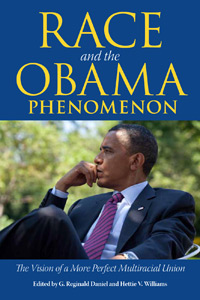
Race and the Obama Phenomenon The Vision of a More Perfect Multiracial Union, from the University Press of Mississippi, was edited by G. Reginald Daniel and Hettie V. Williams.

Race and the Obama Phenomenon:
The Vision of a More Perfect Multiracial Union, from the University Press of Mississippi, was edited by G. Reginald Daniel and Hettie V. Williams.

About a year later, I wrote “Blackapina.” I decided to reshape the introduction of the Obama article, use it in “Blackapina” and call it “First Movement: The Intersection” as if it were the first part of a musical composition. I wanted to use it for “Blackapina” because it accurately represented how I felt about the benefits that come from being born from and living within the intersections of life.  Throughout the writing process, I noticed most certainly my use of scholarly language, but there also seemed to be a flow and a pulse to that flow, that seemed to lack the rigidity that often characterizes scholarly writing.  It was as if the writing process itself became a bit of a dance that was magical and majestic at the same time.

I think the hybridity that exists throughout “Blackapina” is a reflection of my own hybridity as a professor.     I have teetered between valuing the language I’ve learned from graduate level education in theology and ethnic studies and valuing less formal ways of speaking. I never want to be too “academic” that everything out of my mouth is so jargon-laden that no one understands what I’m saying. I don’t want language to create a chasm between myself and another. I want it to create greater understanding and connection. I want my students to learn the “academic” language so it can serve as an additional tool they can use when a social context requires it. I discourage students from using it to alienate or impress people. I think if what has come to be accepted as “academic” language does not obscure the meaning that I want to communicate, then I use it. However, if a more colloquial voice expresses what I want to communicate in a way that is more meaningful to the target audience, then I use that. My objective is to use a combination of tools that create the greatest amount of understanding of and connection to the writing. Perhaps then with time, if enough of us continue to use this approach—another way of being bilingual—we can collectively change the face and sound of what is considered “academic” or “scholarly” language.

Another way I try to find balance between these voices is to pay attention to my heart and my intellect.  Lately, I have been toying around with telling stories to evoke a certain feeling. I enjoy sharing and listening to people share their personal stories and when they do so, there appears to be a difference between where they reach from: if they are reaching from their heart first or from their intellect first.  There seems to be greater honesty, rawness, vulnerability when an attempt is made to draw from the heart first. I have great admiration for those who allow their intellect to be informed by their heart—their emotional and spiritual selves. Consequently, I also make sure my intellect is guided by my heart’s needs and wants. I try my best to do this first in my personal life in order to be able to do it later in my writing.  The final product then becomes the hybrid that you see in pieces like “Blackapina” and other selections from Midnight Peaches, Two O’clock Patience.

August 2014

Michael Noll

Michael Noll is the Editor of Read to Write Stories.

An Interview with Kelly Davio

14 Aug
Kelly Davio is the poetry editor of Tahoma Literary Review and the author of the forthcoming novel-in-poems, Jacob Wrestling.

Kelly Davio is the poetry editor of Tahoma Literary Review and the author of the forthcoming novel-in-poems, Jacob Wrestling.

Kelly Davio is the poetry editor for Tahoma Literary Review and the author of the poetry collection, Burn This House, and the forthcoming novel-in-poems, Jacob Wrestling. She is also the associate poetry editor at Fifth Wednesday Journal and a former managing editor at Los Angeles Review. She lives in Seattle and works as an instructor of English as a Second Language. Her essay, “Strong Is The New Sexy,” was published recently at The Rumpus.

In this interview, Davio discusses the cultural criteria for womanhood, the corporate interests in empowerment, and the lessons of writing poetry for essay writers.

To read Davio’s essay, “Strong Is The New Sexy,” and an exercise on structure, click here.

Michael Noll

This is such a powerful essay, especially the line, “I was never a curvy woman to begin with, but with each of the more feminine attributes I’ve lost, I’ve become, I am given to understand, less and less of a real woman.” I’m curious how you worked up to this statement. Was it a realization that you’ve had for a while and so part of writing the essay was finding a way to say it? Or did this line only occur to you as you worked on the piece?

Kelly Davio

This idea, that I’m the antithesis of a “real woman,” is something I’ve been circling around for some time, often with amusement and other times with resignation or even bald aggravation. Our culture is strangely invested in telling women what makes them real: having curves, having health, having children, having beauty, having strength, having sexiness. I don’t feel that I meet any of the criteria for being a real woman, so it must stand to reason that I’m an unreal woman. I’ve been writing about this idea in my poetry for a little while, and have developed a character I call The Unreal Woman—she’s part comedic alter-ego and part antihero—whom I use to explore the idea of being left out and left over.

In writing “Strong is the New Sexy,” though, I wanted to take a more straightforward, serious approach to this topic. Cathartic as it is for me to write humorous or wry poems about The Unreal Woman, it was important to me to work up the courage to speak bluntly about body image and disability. I may be hyperaware of how few people write about the disabled body in the literary space, but it’s a topic that feels to me like one of the last literary taboos, and I wanted to, if not break it, at least chip artfully around its corners.

Michael Noll

In the first paragraph, you’re learning to swallow again and watching hang gliders through the window. This contrast between weakness and strength is carried through the entire essay. At one point in the essay, you juxtapose the statements, “Strong is the new sexy” and “grave weakness.” Did you start with this structure or discover it as you put images down on the page?

Kelly Davio

I did begin with the rough structure in mind. I find it amusing that we speak so much about strength as an essential attribute, especially with regard to living with illness, yet the name of the disease I live with–myasthenia gravis–quite literally means “grave weakness.” That seemed like a fruitful contrast to examine.

Beyond that fact, the form almost seemed to give itself to me on a platter with the unlikely scenario of daredevils hang gliding right in view of the hospital complex (I suppose they’re in the right place if anything goes amiss with their sport). I mean, you can’t make this stuff up! Here are these folks who presumably have health enough to spare, dangling themselves on nothing but air currents, and then you have this group of patients shuffling around in our sweatpants. The only things separating our groups were some large windows and a big gap in circumstance. I liked the idea that I could use this contrast between images of health and disability to work up to the view of acceptance that I put forth in the end of the essay.

Michael Noll

The essay is full of short paragraphs that make quick leaps of logic. For instance, you write this about the therapist: “The most important thing, she tells me, is that I don’t quit eating. Sometimes, people just give up, she says. She looks at my chart again, and asks how much weight I’ve lost in the past few months.” The leap from giving up to looking at your chart is striking. I think I actually paused after I read it the first time. The leap happens without any mechanics. You don’t say that she looked at you worriedly or that she advised you to eat more. There are so many ways that this moment could have been expanded, so many other pieces of seemingly pertinent information that could have been added. Such brevity is often difficult for fiction writers, but you’re a poet. What effect do you think your experience with the distillation and density that happens in poems has on your approach to writing an essay?

Kelly Davio

Most of us have probably experienced the phenomenon of trying to get the spirit of an incident on the page, and adding, elaborating, and decorating that incident for fear we haven’t gotten it quite right or communicated it fully. The problem with that impulse to keep renovating the image is that, the more you add, the more you dilute.

Poetry has a wonderful way of teaching the importance of getting the image right rather than piling on additions; when a poem begins to over-explain by even a word or two, the entire piece falls apart. Poetry has taught me to think through everything I put on the page before I put it there, and to approach everything I write slowly and attentively so that I can avoid the impulse to over-elaborate out of fear that the reader won’t grasp my meaning.

I should also note that I think the positions of the body are often more revealing than dialogue tags, and I tend to use body language in lieu of tagging whenever I can. What we say verbally is only a fragment of what we communicate, and when you excise the “he saids” from your writing, you give yourself room enough to suggest many of those subtleties in a small amount of space.

Michael Noll

In her essay, "Strong Is The New Sexy," Kelly Davio argues that shifting the idea image of female beauty from thin to strong still leaves some people feeling like they're not real women.

In her essay, “Strong Is The New Sexy,” Kelly Davio argues that shifting the idea image of female beauty from thin to strong still leaves some people feeling like they’re not real women.

The essay ends with you watching the gliders. Unlike at the beginning of the essay, you write, “I don’t look away. I have to admit that they are beautiful.” This is a pretty interesting statement given the connections you’ve drawn between the gliders and the ideas of strength and “real” women, which means women with curves. We tend to think in terms of empowerment, the belief that whoever you are, however you look, is good and beautiful. This is especially true with women’s health issues. Cancer survivors compete in triathlons. But that’s not really how this essay ends, and it’s certainly not the advice that you’re given by your doctor. In your case, your body attacks strength and effort. How do you reconcile this paradox: we don’t really have a philosophical place for an illness and a “real” body like yours?

Kelly Davio

Empowerment is a tricky business. Culturally, we have been making some tiny strides toward greater body acceptance for women, but it’s usually a corporate money-maker like Dove’s questionable “Real Beauty” campaign that features nothing but visibly able-bodied women who still fit highly conventional standards of attractiveness. We still have supposedly health-focused television shows that revolve around the entire premise that fat people need to be shamed and monitored into losing weight. And yes, we love to see cancer survivors compete in triathlons! But we sure don’t do much for cancer patients when they’re not “raising awareness”; do we cover our coughs on the bus so that the chemo patient doesn’t catch our germs and become seriously ill? No, unless somebody’s looking inspiring, we have little time for her. We like it when the arc of someone else’s story bends toward us. We like people to look like us, act like us. We have a low tolerance for those people and those bodies that don’t reflect us and underwrite our opinions about the world.

But let me tiptoe off my soapbox and get back to the question at hand. Part of what I wanted to say in this essay is that, over time, I’ve realized that body acceptance is a whole lot more than adopting a sassy attitude as though I’m in a Special K commercial—that’s a cheap imitation of actual acceptance. To me, body acceptance is the choice to allow my body to be as it is and others’ bodies to be as they are. It’s not just about my getting over the embarrassment of walking with a cane when I need to be on my feet for a long time, or coming to terms with all the visible side effects of my medications (though those have been big steps for me). It’s also about stopping the train of envy and judgment; body acceptance means refusing to look at someone else and say “I wish I had your…” or “you’d be so pretty if…”. It’s the radical idea that you and I are both good in and of ourselves, and that no one’s goodness diminishes another’s.

That’s what I mean when I say that I admit the hang gliders are beautiful—I’ve come to a place where I no longer feel envious of their beauty or their health. Just as I can live in this body and call it good, I acknowledge and enjoy their goodness, too.

August 2014

Michael Noll

Michael Noll is the Editor of Read to Write Stories.

An Interview with Laura Benedict

7 Aug
Laura Benedict's most recent suspense novel, Bliss House, tells a story of hauntings and murder. Her story, "When I Make Love to the Bug Man," was featured in PANK's Pulp Issue.

Laura Benedict’s most recent suspense novel, Bliss House, tells a story of hauntings and murder. Her story, “When I Make Love to the Bug Man,” was featured in PANK’s Pulp Issue.

Laura Benedict is a suspense writer whose latest novel, Bliss House, was called “eerie, seductive, and suspenseful.” Benedict is also the author of Devil’s Oven, a modern Frankenstein tale, and Calling Mr. Lonely Hearts and Isabella Moon. Her work has appeared in Ellery Queen Mystery MagazinePANK, and numerous anthologies like Thrillers: 100 Must-Reads and Slices of Flesh. She originated and edited the Surreal South Anthology of Short Fiction Series with her husband, Pinckney Benedict, and edited Feeding Kate, a charity anthology, for their press, Gallowstree Press. A native of Cincinnati, Ohio, Laura grew up in Louisville, Kentucky, and claims both as hometowns. She currently lives with her family in the southern wilds of a Midwestern state.

In this interview, Benedict discusses writing fiction that disrupts the social constructs we take for granted, not knowing her endings as she writes, and imagining everyday encounters as criminal acts.

To read Benedict’s story, “When I Make Love to the Bug Man,” and an exercise on writing seemingly illogical characters, click here.

Michael Noll

This story is amazingly creepy, even when it’s about very real things. For instance, this is my favorite passage in the story:

Fact: Wolf spiders–the females are the ones you’ll see–look furry, but that’s not fur on their backs. It’s their young. Hundreds of them. Mama carries them around with her as she explores her territory.

I love this passage because it shocks me into seeing something familiar for the first time. Or, to quote the essayist Amy Leach, the passage creates “a place whose dimensions make nonsense of your heretofore extraordinary spatial intelligence.” It takes a special eye to notice such details and transform them into lines of fiction. Many people look at spiders and are creeped out, but you’ve created an entirely new creepiness. Is this a skill that comes naturally to you, or have you trained your eye and imagination to see other dimensions of common things?

Laura Benedict

What a lovely thought. I’m so glad you like that passage. I find that fact about wolf spiders strangely—I don’t know—metaphorical. The passage may contain a lot of energy because I discovered a bizarre kind of empathy for female wolf spiders, even though I fear them with my whole being. What practical and efficient parents they are, yes? How odd it is to feel a connection with an arachnid. Of course I’m anthropomorphizing like mad.

A creepy story about spiders feels almost like cheating to me because I’m able to count heavily on the reader’s own sense of dread. From a craft standpoint, I liked the idea of having the woman recount facts in a straightforward manner, almost as if she’s educating both herself and the reader with useful details about her new world and interests.

Skill or training? That’s always a good question. Once I found my material I realized that I had to be able to immerse the reader in whatever world I wanted them to experience down to the last detail. That did take a lot of practice. Every sentence has to move the story forward in some way, or at least be integral to the scene. And if you break the mood, break the scene with something that doesn’t fit, you risk losing the reader for the rest of the story. I reached this place in my work by giving myself permission to not accept what I saw around me at face value, to pretend, to suppose—to stretch those confines beyond the point that was generally acceptable. It’s good to be a little off. You have to be willing to cross that line. Transgress. You have to walk on the other side just enough to be able to confidently tell your reader what another reality might be like.

Michael Noll

On a craft level, you actually tell the reader the irrational act that will occur in advance of it actually happening on the page. Early on, the narrator says, 

“I fled my cheerful, shiny family for the Bug Man. Fit, grinning children with summer tans, good teeth, and stunning green eyes the color of new grass. Relentlessly healthy children. Blonde, enviable children. They greet each day with terrifying vigor: water guns and war games, barefoot races and soccer tournaments.  Robert and I have raised them in the light. They attack the world, ready to rule it.”

On one hand, I can imagine someone arguing that you’ve given away the story. On the other hand, the passage raises as many questions as it answers: Why does she give up her family? Who is the Bug Man? Why does she describe nice things in such an ugly way? I’m curious how you approach a paragraph like this. How do you know when such a paragraph is necessary and when it actually will give away the story?

Laura Benedict

A horror story can be, but is not necessarily, a mystery story. To me, the most interesting part of “When I Make Love to the Bug Man” is not that she ends up leaving her family for a creepy exterminator. It’s how she gets there, the way she changes along the way, what she’s willing to accept and lose. If I hadn’t put that paragraph in the beginning, it would’ve felt too much like an “aha!” story. And I hope my fiction is more interesting than that. I want the stakes to be higher for the reader, and the journey to the end to be worth his time. If I’ve already told the reader that she leaves her family for the exterminator, then he should expect something even stranger by the end.

I confess that I didn’t know until I was writing the last few pages that the story was going to end the way it did. I had no idea what was in the box or what would show up to feed on its contents until she was in the Bug Man’s bedroom. It was a surprise I very much liked, and I hope the reader likes it, too.

Does the description of her family sound ugly? I have the sense that she sees her family and her daily life in bright, hyperchromatic colors. She’s passionate, but overwhelmed with the reality of it all. Life with the Bug Man is strange, but laconic and muted. It’s like an opposite universe. In his world, she’s fecund but passive. By engaging in the very bold action of abandoning her family, she sinks—finally, fatally—into a kind of inaction.

Michael Noll

You’ve written that you’re paranoid and tend to imagine every possible crime that might happen to you or others. Given that, I’m curious about the genesis of “When I Make Love to the Bug Man.” Yes, it’s sort of a Rosemary’s Baby tale about a woman sleeping with a monster. But it’s also a story about a woman who, for no good reason, gives up a happy marriage and family in order to have an affair with an unattractive stranger. I’ve heard other writers say that the key to fiction is letting your characters say yes when the real-life you would run the other direction. Given your paranoia, I’m curious if you are re-imagining all of your everyday encounters, not just the potentially criminal ones.

Laura Benedict

“I’ve heard other writers say that the key to fiction is letting your characters say yes when the real-life you would run the other direction.” What an interesting quote. Now that I think about it, it does ring rather true for me.

This story did grow out of an encounter with a real exterminator—a man I found a little smarmy and not at all attractive. Our house is surrounded by woods, and when we bought it eight years ago it was badly infested with both spiders and mice (we caught 24 mice in the first 6 weeks!). The battle may never be won with the spiders, but we’re down to a couple of mice per year. When the exterminator came out to give us a price on bombing the house for spiders, he terrified me with his horror stories about other houses. I already knew about the way wolf spiders carry their young on their backs, but he shared that he has a female wolf spider in his house that lives in a closet. His girlfriend doesn’t like it, but he said that the spider is allowed to stay because it has lived there longer then she has. That’s an un-inventable detail. Honestly, I couldn’t make that up.

I’m able to envision just about every adult encounter as a potentially criminal event. Some events—like the visit from the exterminator—feed almost immediately into the part of my brain that processes stories. Usually those events concern my or my family’s physical safety (or lack thereof), or are things I’m already worried about.

Michael Noll

One of the traits of horror/gothic fiction and weird tales is that characters often act on impulses that are monstrous—i.e. they cannot be explained rationally. This goes pretty far back, at least to Poe and Lovecraft. Why, after all, does Poe’s Montresor really bury Fortunato alive? And Lovecraft’s Chthulhu stories are almost entirely about normal people suddenly going insane. This is true of your story as well. There isn’t a rational reason for the narrator to sleep with the Bug Man. It’s an act that can have only bad consequences, yet she does it anyway. I’m curious what draws you to this kind of story. Is there something about irrational acts that particularly draws your imagination–and also is particularly suited to horror fiction?

Laura Benedict

Laura Benedict's most recent novel, Bliss House, is "a novel that works as a mystery, a ghost story, and a touching family drama," according to NY Times Bestseller Jeff Abbot.

Laura Benedict’s most recent novel, Bliss House, is “a novel that works as a mystery, a ghost story, and a touching family drama,” according to NY Times Bestseller Jeff Abbott.

We all live inside a fairly narrow social construct with many, many rules. And those rules don’t have a lot of room for obsessions or strange desires. Our contemporary culture has broken down a lot of the rules/walls, and the notions about what is strange or alien or unacceptable have changed quite a bit. But the constraints are still only a little bit wider and rely heavily on convention. With the exception of the clinically insane, we all crowd around a stable, identifiable center.

So we exist in a constant state of tension. The majority of people are able to handle the tension between their desires and their tribes’ demands for conformity with relative ease: Their desires are either easily satisfied, they’re too busy fulfilling their basic survival needs, or they have found some trade-off that makes the relative sublimation of those desires acceptable. But sometimes the tension is too great and they either suffocate or feel compelled—often quite suddenly it seems to them—to give themselves over fully to their desires, and damn the consequences.

Yes, there is a line that characters in horror and surreal fiction transgress that leads them into places that seem insane to other people. The woman in the story cannot help but sleep with the Bug Man and become his concubine. She no longer recognizes the validity of the choice in front of her: stay with her loving, charming family, or follow her desire for the bug man (no matter how bizarre it seems to us—or even to her) to its unknown consequence. She only understands that this is what she must do. Does she understand why? No, not really. There is, no doubt, something in her psyche that has led her to this place, but is it my responsibility as a writer to lay out the reasons behind her actions for the reader? I don’t think so. If I’ve done my job, the reader has enough information come to her own satisfactory conclusion about why the woman has acted as she has—but she’ll also realize that the reasons are completely irrelevant.  That’s part of the horror of the story.

As to my attraction to irrational acts—honestly, I’m rarely satisfied with reality as it’s presented to me every day. Perhaps that sounds strange or greedy or ungrateful. But irrationality and speculation make things a hell of a lot more interesting.

August 2014

Michael Noll

Michael Noll is the Editor of Read to Write Stories.

An Interview with Mathilde Walter Clark

31 Jul
Mathilde Walter Clark has written five books and starred in a Danish-language television show of her own creation.

Mathilde Walter Clark has written five books and starred in a Danish-language television show of her own creation. Her story, “The Disappearance of Things,” appeared in translation in The Chattahoochee Review.

Mathilde Walter Clark is the Danish-American author of three novels and two story collections. Her most recent book, Patron Wanted, is a work that doesn’t fit neatly into any literary category. The project started with Clark writing letters to rich men whom she thought might fund her writing—who would, essentially, play the role of patron of the artist. Every single person turned her down, and she turned their responses into a kind of literary performance art. Clark eventually won a grant from the National Arts Foundation, and the book was self-published with a foreword from a former Danish Minister of Culture and an afterword by yet another Danish Minister of Culture. Clark has also written the screenplay for and starred in the Danish-language television show, In Seven Minds. Clark lives in Copenhagen.

In this interview, Clark discusses crafting stories around a flaw in logic, her revision strategy (she sometimes doesn’t), and the challenge of translation when only six million people speak your language.

To read Clark’s story, “The Disappearance of Things,” and an exercise on writing plot, click here.

Michael Noll

One of the things I love about this story is that it’s entirely about the character’s mental state. Until the end, almost nothing really takes place. Instead, the focus of the story is on a consciousness in transition, and all of the paragraphs and the details in them are aimed at illustrating that transition from “orderly surroundings make an orderly mind” to the disintegration of both surroundings and mind. In a way, this is a conception of “story” that is different from how we often define the word, with its emphasis on plot and occurrence. Is this a coincidence–in other words, is this simply the way the story arrived on the page–or is it a purposeful choice on your part? Are you trying to write a different kind of story?

Mathilde Walter Clark

First of all: Thank you for asking me to answer these excellent questions and to be part of this great site. This is actually the first story I ever wrote, so I didn’t have much clue what I was doing. What got me started was a very real annoyance over how things sometime disappear, and it occurred to me that this annoyance comes from a belief that things don’t really disappear – they are somewhere, you just can’t find them. But what if they did in fact disappear, go on to non-existence from one moment to the next? It then becomes a matter of acceptance, a mental state. The character in the story is (like most of us) bound up in the logic of classical physics, but perhaps even more so. And so, to make the point of that stuckness, I imagined him a traditionalist, somebody working in a ministry as a public servant, an archiver of sorts, a ring-binder manager.

Michael Noll

The amount of detail in this fairly short story is staggering. For instance, there is an entire paragraph about the type of paper the character prefers. Again, this seems like a different conception of the role of detail. Very often as writers, we try to invent one detail that illustrates some quality of a character, and then we push that quality into a conflict: thus, plot is born. But in this story, you don’t seem satisfied with a few well-chosen details. This emphasis on exploring an exhaustive quantity of details reminds me in a way of the work of David Foster Wallace. He once wrote about his style, “The most obvious, ubiquitous, important realities are often the ones that are the hardest to see and talk about.” Is this something that you’re aiming for in your fiction? Trying to make the reader see obvious realities in a new light?

Mathilde Walter Clark

Absolutely. It is a trick I use in many of my stories: a world we know, but there is a missing piece somehow, or some logic or law of nature gone awry. Perhaps these disorders of things are what makes us see our world in a clearer light. This story has only one motor. You quickly get the drift: at some point all his stuff will be gone (some of my later stories have other story threads that complicate matters). As I wrote the story it very much became a story of lists and categories that was intended to reveal something about how we – or the character – make sense of the world. A matter of detailing as revelation.

Michael Noll

My favorite moment in the story is when the disappearances escalate from minor things like shoes to large items like a grandfather clock and then, very quickly, to people: his wife. How did you know when to make that escalation? Did you initially write many more mid-level disappearances (more large items like grandfather clocks), or was the escalation always that fast—shoes to wife?

Mathilde Walter Clark

Yes, it always went shoes to wife like that. No mid-level stuff. I thought of it as a reversal of the familiar scheme: a husband pops out to buy cigarettes never to return. In this case the wife disappears as he is out to get tobacco for his pipe. The suddenness of this disappearance. She’s gone, just like that, in one word. It also reveals something about the character, that his wife figures on his detailed lists of belongings alongside – one must suppose – less animated items.

Michael Noll

Nothing about the story should be funny–a man is growing old, losing his sense of self and the things and people around him. But it does have moments of sharp humor. After we learn about the disappearance of his wife, for instance, the very next sentence is this: “Yet it was the shoes that tormented him the most.” He also makes lists of everything that he owns, and then the lists disappear. This is kind of a dark humor, of course, but it’s definitely not the somber tone that one might expect given a story about someone in this situation. Was that humor always present in the story? Or did it arrive through revision?

Mathilde Walter Clark

I didn’t do any revision of this story. I wrote the beginning, and then nothing for a year or so. As I started writing some of the other stories for my first collection Disorder of Things, I finished it. The change of mental state, stretching that to absurdity, until finally the point where he accepts the loss and another state of mind takes over: now he wants to get rid of the last of his pitiful belongings. I saw something almost zen-like in this acceptance and riddance, that maybe, somehow, there is a strange sort of happiness, or at least calmness, involved in that loss. Many of the other stories in that collection center around the themes of language, matter, madness, loss, the possibility of serenity. How dependent we are on language to make sense of things, and what happens to our minds when language somehow fails? To me, the dark humor is inherent in these subjects, not something I can edit forth.

Michael Noll

Mathilde Walter Clark recently published, "Report From the Flatlands of Statistics," essay in the Los Angeles Review of Books on guns and the differences in "gun culture" between Denmark and Texas.

Mathilde Walter Clark recently published, “Report From the Flatlands of Statistics,” an essay in the Los Angeles Review of Books on guns and the differences in “gun culture” between Denmark and Texas.

A question about translation: Americans have been justly criticized for not reading much work in translation, and American authors themselves have been criticized for not translating other writers into English. But the opposite is very common: American works are translated into dozens of languages. I’m curious how this particular translation came about. Did the translator, Martin Aitken, contact you? Or did The Chattahoochee Review discover your story in its original Danish and find a translator for it?

Mathilde Walter Clark

Translation is a catch 22. Especially into English – the most exclusive market in the world, and also the most attractive. As the translator is initially paid quite a lot more than the author, it’s too big an investment for the home country’s publisher to have the manuscript translated for the sole purpose of trying to sell it to other markets. But how can foreign publishers judge a manuscript they can’t read? Well, in this case only numbers speak. Most of what gets sold to publication in foreign territory – especially America – are books with impressive sales. Besides bestsellers, Hans Christian Andersen, Kafka and other deceased writers from the literary canon account for most of the meager 2% of foreign literature that finds its way into the US market. That, unfortunately, leaves out a lot of the interesting contemporary literature. As a writer in a language with only six million speakers, it is hard not to feel a little locked up. So for foreign language writers, translators rule. It’s thanks to their interests and passions that literature finds its way into other languages. I’m lucky enough to have had a little more than a handful of my stories translated and published in various American journals. This particular story was translated some years back by one of our best translators, Martin Aitken out of his good heart. He also made the connection with Lydia Ship, the editor on The Chattahoochee Review, and I am extremely grateful for the work he has done.

July 2014

Michael Noll

Michael Noll is the Editor of Read to Write Stories.

An Interview with Matthew Gavin Frank

24 Jul
Matthew Gavin Frank's new book, Preparing the Ghost: An Essay Concerning the Giant Squid and Its First Photographer, contains "some stunning writing and perversely wonderful research," according to a New York Times review.

Matthew Gavin Frank’s new book, Preparing the Ghost: An Essay Concerning the Giant Squid and Its First Photographer, contains “stunning writing and perversely wonderful research,” according to a New York Times review.

Matthew Gavin Frank left home at age seventeen to travel and work in the restaurant industry. He ran a tiny breakfast joint in Juneau, Alaska, worked the Barolo wine harvest in Italy’s Piedmont, sautéed hog snapper hung-over in Key West, designed multiple degustation menus for Julia Roberts’s private parties in Taos, New Mexico, served as a sommelier for Chefs Rick Tramonto and Gale Gand in Chicago, and assisted Chef Charlie Trotter with his Green Kitchen cooking demonstration at the Slow Food Nation 2008 event in San Francisco. He received his MFA in Poetry and Creative Nonfiction from Arizona State University. He taught creative writing to undergraduates in Phoenix, Arizona, and poetry to soldiers and their families near Fort Drum in upstate New York on the Canadian border.

Frank is the author of two food memoirs: Barolo, a food memoir based on his illegal work in the Italian wine industry, and Pot Farm, about his time working on a medical marijuana farm in Northern California. He’s also written three poetry collections: “The Morrow Plots,” “Sagittarius Agitprop,” and “Warranty in Zulu.” His most recent book is Preparing the Ghost: An Essay Concerning the Giant Squid and Its First Photographer.

In this interview, Frank discusses the unpredictable rabbit holes of research, the line between fact and conjecture, and getting lost in sentences.

To read an excerpt from Preparing the Ghost and an exercise on creating space for digression, click here.

Michael Noll

I’m really taken with the line, “The fog that the early sailors believed to be the last remnants of Noah’s flood began to shroud the vessel.” Beyond the lovely effect of the imagery, I’m curious about the research involved in such a line. How does one come across a piece of information like this (that sailors once believed the fog to the last remnant of the Flood)? What is your research method like? It would seem to be pretty far-reaching and not necessarily specifically focused on giant squid.

Matthew Gavin Frank

My research process, like my writing process, was digressive. Squid led to ice cream which lead to cold weather which led to hot weather which led to ocean which led back to squid.  And so on.  I read plenty of late 19th century fisherman’s accounts and articles about the fishing industry in Newfoundland. The fishermen of that time would also trap auks—those fat unwieldy beautiful seabirds—driving them aboard the ships, caving in their skulls with clubs, salting and drying their breasts, feasting on their eggs, selling their bones to the superstitious and the spiritual, stuffing coats with their feathers, burning their bodies for fuel. Reverend Moses Harvey, who plays a great role in Preparing the Ghost (he was the one who first photographed the giant squid in 1874, rescuing it from the realm of mythology, and finally proving its existence) felt that, “It is not wonderful that, under such circumstances, the great auk has been completely exterminated.”

In scholar Weldon Thornton’s annotated Allusions in Ulysses, the author wonders if, in regards to the source text’s line, Auk’s egg, prize of their fray, the auk indeed “has any special mythological or symbolic meaning” or if its usage is “to represent something exceedingly rare.”  The 11th edition of the Encyclopedia Britannica provides a soft, wishy-washy answer of sorts, declaring, “A special interest attaches to the great auk (Alca impennis), owing to its recent extinction, and the value of its eggs to collectors.”

So, this is what I mean. Case in point. One thing leads to another, and it’s this lovely cascade down the rabbit hole of research. What fun! When I’m sifting through a roomful of research, I’m seeking out that “exceedingly rare” thing, and I’m interested in seeing what happens when we hold it up against a more known thing. I’m interested in seeing where such a collision will lead. Oftentimes, the most interesting thing we can do as essayists is draw a chalk outline around our main subject in order to suggest its shape; in order to evoke its essence. This ancillary engagement is often more powerful than a direct engagement, as it reveals to us (during the seemingly wayward research process) the specific and intricate blend of chalk necessary to evoke the body.

Yet again, I digress. Anyhow, these early accounts of fishermen [sailing into the St. John’s Narrows] were oddly rife with biblical allusions—I mean the giant squid was known as the Devil-fish before it was known as the giant squid. So the Noah’s flood reference seemed a natural extension of such documented accounts.

Michael Noll

I’m curious about your use of the first person point of view in this excerpt and in the book in general. The excerpt at The Nervous Breakdown is about Moses Harvey in a particular spot on the Newfoundland coast in 1874, and yet you include this line: 

I envision Harvey wiping his nose with his right hand, his left never leaving the squid’s body which had a “total number of suckers…estimated at eleven hundred,” and “a strong, horny beak, shaped precisely like that of a parrot, and in size larger than a man’s clenched fist.”

I can easily imagine an editor trying to cut that I—obviously, you weren’t there, and, and, in a way, it’s probably extraneous. And yet it also seems essential. Without it, the detail about Harvey wiping his nose would be out-of-place conjecture. Did you ever struggle with when and how to use the first person point of view?

Matthew Gavin Frank

Oh, yes. It’s always a struggle for me—a holy one—trying to determine to what degree I should signal to a reader that I’m speculating, that I’m imagining, that I’m caught up. Usually, my initial instincts are that I should not overtly signal at all. That context will do its job; that a reader will figure it out. And if it’s muddy in the book—this blurry line between fact and conjecture—that’s because it’s actually muddy. Supposedly factual historical research yields varying—and often conflicting—narratives. Once we impose narrative(s) onto a fact, it ceases to be a hard fact. It softens. It’s shapeable. Like boiling water into which we dissolve sugar teaspoonful-by-teaspoonful, it doesn’t become another thing completely. Until we add that ultimate spoonful which supersaturates the solution, it’s still water, still maintains the integrity of water. It’s still maintains the shape of the original fact. It’s just sweeter.

Throughout the book, there’s this overlap between the contemporary and the historical, our time and Harvey’s. The intrusion of the I sometimes forces this overlapping. It’s funny that you think an editor would be tempted to cut this I. In fact, my editor wanted me to add more of this kind of signaling to the draft I originally submitted, so that the reader felt a bit more tethered; could more easily distinguish between “fact” and speculation on said fact.

Michael Noll

Preparing the Ghost: An Essay... tells the story of the obsession that led Moses to photograph the mysterious giant squid.

Preparing the Ghost is Matthew Gavin Frank’s third book of nonfiction and has been called, by Matt Bell, “a triumph of obsession.”

There are two sentences in this excerpt about Harvey sailing into the harbor at St. John’s that contain pretty noticeable digressions. The first sentence lists various sites around the harbor, beliefs about those places (“Deadman’s Pond, rumored to be bottomless), and some notable historical events that took place there. The other sentence zooms in on a girl cleaning fish. There’s definitely a more-is-more attitude in these sentences, both in terms of detail and grammar. You can’t really read them once through. I found myself stopping, rereading a phrase or word—but this was not an unpleasant experience, simply a different way of reading. How do you approach passages like these? Do you simply write them when so moved, or is there some underlying strategy at work?

Matthew Gavin Frank

Years ago, I took a class from the fiction writer, Paul Friedman, the gist of which was entirely devoted to the notion of the sentence—its parameters and pitfalls, its strong tightropes and its weak ones. The sentence, in this course, was something to navigate, traverse; something that required the strapping of the essential gear onto one’s body. Ropes. Cleats. Hooks. As my father-in-law would say: the whole toot. I love getting lost in the middle of a sentence— both as writer and as reader, and then having to bust my metaphorical flashlight out of my metaphorical fanny-pack in order to illuminate my way to its end. And then, of course, to re-write it a thousand times. I’d like to say that I wrote this passage in order to empathize with Moses Harvey’s assured ecstasy at approaching the port of St. John’s, Newfoundland in 1874, shell-shocked and bemused beneath the suspended and snotty chandelier of the first intact specimen of the giant squid. But the truth is probably that I was rendering my own ecstasy in the face of all of this wonderful research I uncovered. I fall in love with the objects of my research sometimes, and then all of the tightropes snap, and I’m falling, or rising, or just plain airborne, grabbing at all of the beautiful tinsel-y shrapnel floating past, trying to stitch it all into something that resembles a navigable sentence.

Michael Noll

You’re a writer of astoundingly varied experiences and interests, though they do seem to center on food and consumption. You’ve written books about working in the Italian wine industry and at a medical marijuana farm in northern California. So, a book about the man who first photographed the giant squid seems like a bit of a curveball. What drives your writing? I’d hazard to guess that you have no shortage of things to write about. What makes you choose one over another—and then spend the time necessary to write a book about it?

Matthew Gavin Frank

It’s funny. In trying to shun food writing for a while, I find myself working on a new project that’s attempting to interrogate not only our relationship with food (within regional context), but also our expectations of food writing. Food is complicated. The new book-in-progress is tentatively titled The Food You Require is Heavier: 50 States, 50 Essays, 50 Recipes. At the risk of sounding totally overblown, I’m trying to cobble together this spastic, lyrical anti-cookbook cookbook of sorts that also may be a fun and digressive revisionist take on U.S. history.  I’m trying to concentrate on the small events—incantatory and ponderous and horrific and mundane— that we glossed over when we originally (and then subsequently) attempted to set down regional definitions.  Each essay begins with this line of questioning: What does Illinois mean?  What does deep-dish pizza mean?  What ancillary subjects will I have to engage in order to stalk both food and state toward the blurry answers to these questions?  The Rhode Island essay, for example, is concerned with Clear Clam Chowder and the Cognitive Psychology of Transparency—how we think and react differently to things we can look through rather than look at. The Louisiana essay deals with the intersection of Crawfish Etouffee, bad weather, and autoerotic asphyxiation.

Being a little OCD helps to dictate my projects and focus for a while as well.  I mean, when, during my research process, I found out that squid ink is immortal—invulnerable to decay—and that in the South of England in the 19th century, the petrified remains of a 150-million-year-old squid were discovered entombed in solid rock, and that its own, perfectly intact ink was used to draw a picture of its remains, and that scientists called the resulting image, “the ultimate self-portrait,” how couldn’t I be seduced to catalogue the onrush on implications?  I’m easily seduced, is what I’m saying.  Immortal cephalopod melanin is all it takes, and I’m yours for a while.

July 2014

Michael Noll

Michael Noll is the Editor of Read to Write Stories.