Archive | Writers on Writing RSS feed for this section

An Interview with Kelli Jo Ford

28 Apr
Kelli Jo Ford is a former Dobie Paisano fellow and recent winner of the Elizabeth George Foundation Emerging Artist Grant.

Kelli Jo Ford has held the prestigious Dobie Paisano fellowship and recently won an Elizabeth George Foundation Emerging Artist Grant.

Kelli Jo Ford’s fiction has appeared in Forty Stories: New Writing from Harper Perennial, New Delta ReviewDrunken Boat, and Virginia Quarterly Review. A Dobie Paisano Fellow and an Elizabeth George Foundation grant recipient, she holds an MFA from George Mason University. She is a member of the Cherokee Nation. She currently lives in Virginia and putting the finishing touches on Crooked Hallelujah, a collection of linked stories about a mixed-blood Cherokee mother and daughter who move from Eastern Oklahoma’s Indian Country to North Texas to start life anew amidst the oil bust of the 1980s.

To read an exercise on describing characters without relying on mirrors and Ford’s story, “You Will Miss Me When I Burn,” click here.

In this interview, Ford discusses the revision advice of Alan Cheuse, the challenge of portraying characters both as they are and as they’re viewed by others, and resolving (or not) plot threads in a story.

Michael Noll

Your character descriptions are so good. I love this passage: 

I called for him again, and he came out of the bedroom, pulling a long-handle shirt over his head and stomping his foot down into his boot.
“You’ll break the back of your boot like that,” I said, but you can’t tell that boy nothing. I tossed him a sausage biscuit I brought, and he grabbed a Dr Pepper from the fridge, opened it up, and took three long swallows without coming up for air. With his head tilted back like that, I could see where my boy was losing the hair on his head, and I felt proud to have a full head of my own, proud I didn’t work indoors under fake lighting on another man’s schedule. But it got me antsy.

I love how the passage has multiple things happening at once: the narrator telling his son what to do, the boy ignoring him, the action (throwing the food, drinking the Dr. Pepper), physical description (baldness), and emotion (the narrator’s various reasons for feeling proud). Do all these things land on the page as you write, or do you start with one or two and build the rest in gradually?

Kelli Jo Ford

Thank you, Michael! Sometimes a passage will come in a glorious chunk that sticks around in its God-given form. Usually though, it’s a matter of writing and rewriting. I retype my drafts a lot, something I think I picked up from Alan Cheuse back at George Mason, who felt rewriting (or retyping) a draft allows you let go of what’s there and truly revise instead of tweak. It’s slow work, especially for a plodder like me, but I find it so helpful. I’m constantly adding new stuff, layers or descriptions, which lately has created the problem of what to cull.

I couldn’t remember how that bit came to be until I found an old draft of the story. It looks like most of the descriptions were there but sort of spread out in the narrator’s rambling, which I condensed a good bit. In addition to Paul Reyes’s keen eye at VQR, I’m sure the final product came about with great help from my husband, Scott Weaver, who’s a poet and really helps me 1) see what a story is trying to be about (for lack of a better word) and 2) tighten my language and descriptions.

Michael Noll

I’m curious about the son’s wife—the Indian, as the narrator calls her. I don’t think we ever learn her actual name. She’s just, “the Indian” or “that Indian daughter-in-law.” What was your approach to this character—and to the narrator’s view of her?

Kelli Jo Ford

Kelli Jo Ford's story, "You Will Miss Me When I Burn," was published in Virginia Quarterly Review.

Kelli Jo Ford’s story, “You Will Miss Me When I Burn,” was published in Virginia Quarterly Review.

Justine is actually one of the main characters in the collection I’m working on. She and Ferrell have a sort of lovingly contentious relationship, though it doesn’t come through in this stand-alone piece. She’s a truth-teller and doesn’t let him get away with much. During the time period when this story takes place, they are going through a pretty contentious time, but of course, there’s more to it than that.

As we went through final edits, I began to feel a little uncomfortable with the narrator’s portrayal of Justine, to be honest. Justine’s the hero of the collection! In the end, I was comfortable enough, I guess, with what Ferrell’s portrayal of Justine says about him. “Lovingly contentious” is where I started, but doesn’t cover enough ground. Ferrell’s story grounds us in the culture Justine and Reney, the “little girl already in tow,” confront in North Texas. Through Ferrell we see the casual racism they face. The story is told from his perspective, so there’s no filter. I could go on more here, but that would probably be more relevant to the collection than this particular story.

At the same time, there is love and respect between the two. From Ferrell’s perspective, calling Justine “the Indian” is probably no different from the banter (or what he might call “good-natured ribbing”) that takes place at the D.Q., but that doesn’t make it any less racist or potentially hurtful. I’m out of my depth, but I’m thinking about micro-aggressions and the way that something Ferrell perceives as banter could quickly become straight-up aggressive, hurtful, and racist.

As for how his use of “the Indian” functions in the story, I think it allows readers to see Ferrell better than he sees himself. I hope readers pick up on some of Ferrell’s self-delusion and see that probably everything Justine tells him is spot-on—and that despite his hoo-hawing, he has heard every word.

In earlier drafts, the only female characters he called by name were Liza Blue and Elsie from the DQ, so the most important women in his life—his wife, the girl from Wyoming, and the Indian—didn’t get names. In the end, it got a little tedious and confusing to refer to his wife as “my wife” over and over. So having him name her was a technical decision that may make his usage of “the Indian” stand out a little more.

Michael Noll

In seems that a crucial question in this story is how we feel about the narrator’s actions with the Wyoming girl. But, frankly, I have no idea how I feel about it. What happens is, on one hand, part of the great tradition of “loving someone you’re not married to” stories. But it also cuts against the usual storyline in such unexpected ways that I’m don’t know wha to feel. When you finished the story, did you have a particular way you wanted the reader to react and feel?

Kelli Jo Ford

Good question! I don’t think I was going for a particular reaction or feeling. I think I only hoped to put readers right there with him and to, perhaps, help them see him better than he sees himself.

In some ways, the story for me started with that scene. Well, that scene and the magic horse. So the trick, if there was one, was to somehow get readers to want to keep reading and caring about the story, despite the character’s pretty despicable actions.

Michael Noll

The story starts with the threat of fire, and while we get the fire of passion, the actual fire never arrives. Was this always the case? It’s an interesting structure. You go back and forth between past and present, and I expected the present to be resolved one way or another. When it wasn’t, I felt relieved. If the fire had come through and burned everything–a kind of thematic burning–it would have felt cheap, I think. Were you ever tempted to do that?

Kelli Jo Ford

I don’t think I was ever tempted to resolve the question of whether the fire arrives, not in this story, at least. In “Bonita,” a companion piece of sorts, we learn that the fire does destroy Ferrell’s house, but that didn’t seem important to Ferrell’s story, somehow. Though he has some misgivings at the end, the house is the least important thing to him that day. Later, he may realize he was wrong to toss aside a life’s worth of memories, as well as a family that clearly cares for him. But as far as the confines of this story, (he thinks) he’s all forward motion

Maybe the past and present structure reflects how much the past is present for him. If he slowed down to think about it much, he might make a different decision.

April 2016

Michael Noll Michael Noll is the Editor of Read to Write Stories.

An Interview with Melissa Stephenson

21 Apr
Melissa Stephenson wrote about running and single-parenting in her Washington Post essay, "As a mom, I couldn’t afford to fall apart after my divorce. Then running saved me."

Melissa Stephenson wrote about running and single-parenting in her Washington Post essay, “As a mom, I couldn’t afford to fall apart after my divorce. Then running saved me.”

Melissa Stephenson lives, runs, parents, and writes in Missoula, Montana. Her fiction, non-fiction, and poetry have previously appeared in Cutbank, Other Voices, Thin Air, The Chattahoochee Review, New South, Memoir (and), The Mid American Review, and Passages North. She’s currently hard at work completing a collection of poems and revising her memoir.

To read an exercise about showing and telling, click here.

In this interview, Stephenson discusses finding the structure of her essay, why “less is more” can convey more emotion, and how her poetry informs her nonfiction.

Michael Noll

Structure is a problem for any personal essayist, I think, and so I’m interested in how you found the structure for this essay. It begins by laying out the conflict—you were going through a difficult period in your life but needed to keep it together for your kids—and the solution to the conflict, which was running. Then, you tell a story about your second marathon. Did you always use this structure–front loading context and finishing with the narrative? If not, what helped you find it?

Melissa Stephenson

Inspired by Ann Hood’s essay “Ten Things I Learned from Knitting,” I tried to write a piece about running and grief a couple of years ago. Hood writes about knitting her way through grief after her young daughter’s sudden death. After a attempting to use the Ten Things structure, I shelved the piece. It felt long, lofty, and unruly. A few months after running my second marathon, I came across a call for essay submissions about “badass moms.” I hadn’t written for any parenting publications, and I didn’t necessarily want to. But the prompt got me thinking about using the second marathon as the structure for the essay on running and grief. My goal in the first paragraph was to introduce the connection between grief and running in a concise and concrete way. Once I got that paragraph down, I simply had to write to and through the narrative of the marathon.

Michael Noll

This sentence really affected me:

“The next summer, I completed my first full marathon on my daughter’s fifth birthday, crossing the finish line to drive myself home.”

The emotion in it is clear, and so it makes sense to give the sentence its own paragraph—to make it stand out. But it’s also quite spare in terms of detail. We don’t learn anything else about the birthday, nothing about a party or a cake or celebration, nothing else about how you felt except your time. Were you ever tempted to write more? I ask because the question of how much detail to provide—and which details—is a difficult one. What was your guiding principle?

Melissa Stephenson

Haruki Murakami wrote about the connections between running and writing in What I Talk About When I Talk About Running.

Haruki Murakami wrote about the connections between running and writing in What I Talk About When I Talk About Running.

There are a couple of reasons why this moment is so sparse.

  1. Once I had a draft of this essay, I realized the length and content would work well for an online publication, so compression was key. Most of the bigger online personal narrative publishers, like Washington Post or New York Times, prefer 800-1200 word pieces. I made many cuts in favor of economy.
  2. I also wanted to capture the anti-climactic feeling I had with the half marathon and the first full marathon. In his book What I Talk About When I Talk About Running, Haruki Murakami describes his first marathon finish this way, “The finish line. I finally reached the end. Strangely, I have no feeling of accomplishment. The only thing I feel is utter relief that I don’t have to run anymore.” I felt this, too. I lived in a town without family, raising two kids with almost sole custody, and I woke up most days stunned by this new, isolated life. I’d imagined the finish line as a giant party, full of familiar faces, hugs, and cheers. Truth is most of my friends were home with children. One friend did show up to the finish line, but I was too nauseous to talk to her. And I wore a t-shirt with the words, Happy Birthday Hadley on the back, which is something my daughter still talks about. But I finished with this deep, hollow feeling, like walking around with the Grand Canyon inside you. That single line seemed the simplest way to capture that.

Michael Noll

The story of the second marathon fills a number of paragraphs, and, as someone who’s run a marathon (just one, though!), I understand how this is possible. The race is so long that it has many stages and points along a narrative arc. On the other hand, the action is sort of the same throughout: running, more running, suffering, a bit of ecstasy, and more suffering. How did you approach finding the narrative within the race?

Melissa Stephenson

This is the one section I’m surprised the Washington Post editor did not trim. Since I’d set out wanting to tell the story of that marathon, I naturally went into it in detail. I knew this decision meant narrowing my target audience to runners (a 4:12 marathon finish doesn’t mean much to those who haven’t run a race of some sort).  I did tweak this section many times to make it concise and also as non-runner-friendly as possible.

The second marathon was so important because it’s the event that finally captured the ups and downs of the past few years all in the span of four hours. I didn’t truly know why I was running (and kept running) until that marathon. The only thing that got me through was the gut-deep feeling that I had something to prove to myself, though I wouldn’t know exactly what that was until I finished the essay.

Michael Noll

I really like how the essay ends, both the line of dialogue and the final paragraph. Endings are difficult in personal essays. There’s a desire to wrap it up–to put a kind of emotional exclamation mark at the end. But there’s also the need to not overdo it. How did you know when you’d found the right end for this essay?

Melissa Stephenson

Writing this ending was a pretty divine experience in that I’d planted the seeds for it as I drafted but had no idea what the ending would be until I got there (aside from finishing the marathon). I never intended to include my brother’s death in this piece. I’ve been working on a memoir about that for a few years now, and I try to keep it from leaking into my other work. But once grief was on the plate, I realized why grieving as sole caretaker of two young children left no room for self-pity or solitude, and how running helped me deal with that.

I also didn’t include the words I’d whispered to my children on first mention of that moment because I thought they weren’t important to the essay. Once I made it to the end and wrote the line about the things I’m ashamed they might remember, I saw the opening for what I’d told them. As soon as I wrote, “This is what not quitting looks like,” I saw the connections I’d made without knowing it: My brother quit, my life hadn’t turned out the way I’d expected, and running helped me not quit. That’s when I truly understood the essay, myself, and the running.

On a nuts-and-bolts note, I’m a poet as well, and I love writing endings. Once the content is there, endings become a mix of cadence, imagery, and releasing just enough insight without (as you wisely note) overdoing it. I’ll write them, tweak them, and read them out loud until each word resonates. Then I’ll go back and tweak the whole essay to make sure the information is released in a way that makes the ending feel as surprising and inevitable as possible.

April 2016

Michael Noll Michael Noll is the Editor of Read to Write Stories.

An Interview with Kaitlyn Greenidge

18 Apr
Kaitlyn Greenidge is the author of We Love You, Charlie Freeman, has been called "auspicious," "complex," and "caustically funny."

Kaitlyn Greenidge is the author of We Love You, Charlie Freeman, which has been called “auspicious,” “complex,” and “caustically funny.”

Kaitlyn Greenidge was born in Boston and received her MFA from Hunter College. She’s the author of the novel We Love You, Charlie Freeman, and her wer work has appeared in The Believer, American Short Fiction, Guernica, Kweli Journal, The Feminist Wire, Afro Pop Magazine, Green Mountains Review and other places. She is the recipient of fellowships from Lower Manhattan Community Council’s Work-Space Program; Bread Loaf Writers’ Conference and other prizes. She currently lives in Brooklyn.

To read an exercise on introducing characters, click here.

In this interview, Greenidge discusses describing characters, acknowledging the role of power in race, and finding an agent who appreciated her novel.

Michael Noll

I love the way you introduce Charlie. A character says that “it’s best we all meet Charlie now,” but the introduction isn’t given to the reader in a direct way. First, we see the place where Charlie lives. Then, we’re told that he’s sitting beside a fern and that a man kneels beside him—and then we’re introduced to the man. Only after this do we get to see Charlie. I love this approach because it takes the weight off his character. It’s as if the novel is saying that Charlie is important, yes, but he’s less important the everything around him. Was this introduction to Charlie simply how it arrived on the page? Or did you write it with a particular goal in mind?

Kaitlyn Greenidge

I didn’t want this novel to be about chimpanzees. That isn’t, to me, what this novel is about or what it is concerned with. So, it was important to let the reader know this from the beginning. Part of it was just keeping the reader’s interest in that first chapter. Part of it was also me, as a writer, not being ready to engage with the character of Charlie yet. All of those things went into that first introduction to the character.

Michael Noll

I also love the description of Dr. Paulson, in particular this:

When she parted her lips to grin, behind her white, white teeth, I caught a glimpse of her tongue. It was the yellowest, craggiest, driest tongue I had ever seen. It surely did not belong in that mouth, in her, and I shot a look at my mother, who widened her eyes, who gave one quick shake of her head that told me to ignore it.

It’s a monstrous trait, that tongue. In an interview with Lambda Literary, you said that you love the grotesque and the mechanics of horror stories, and the tongue certainly seems to fit. It’s also a detail that turns Dr. Paulson into a kind of monster. In that same interview, you talked about writing fully-developed characters, and so I’m curious how a detail like this works in terms of character development. Did you worry that giving characters monstrous characteristics would make them more difficult to develop? Or is the monstrosity part of that complexity? It’s certainly part of what makes the book so compelling.

Kaitlyn Greenidge

That was more a private joke with myself, while I was writing. I had a teacher in school when I was a kid who used to eat chalk. He carried a stick of it in his back pocket and during class, he would bring it out and lick it. His tongue was pebbled and yellow. And, no one ever mentioned it! It was like, is no one else seeing this, how disgusting it is? So, when I was writing, I just wanted to include that detail as a reminder and a joke with some younger part of myself.

I love the grotesque but it’s very rare that I recognize it as initially repulsive. It takes a very specific visual to repulse me. But most things that people find grotesque, I just like to look at and think about.  I think human bodies are just endlessly fascinating and beautiful looking, even when they have yellow, craggy tongues and even when they are licking chalk.

Michael Noll

The characters are put into situations that highlight their blackness and make them objects of fascination and study. For example, Laurel likes to say of her childhood in Maine that she was the only black person in a one-hundred mile radius. The town of the novel is segregated, and the school that the girls attend is mostly white. At the Toneybee Institute, the family is made a literal object of study, and several reviewers have pointed out connections to the Tuskegee Institute. There’s a sense, then, that the Freemans’ weird situation isn’t, actually, so weird. When you began to sketch out the plot of the novel, did you have ideas or themes in mind? Did you, in other words, have something you wanted to say? Or did you invent the premise and plot first and discover what it had to say about the world?

Kaitlyn Greenidge

Kaitlyn Greenidge's highly anticipated debut novel, We Love You, Charlie Freeman, tells the story of an African-American family who moves to a research institute to live with a chimpanzee.

Kaitlyn Greenidge’s highly anticipated debut novel, We Love You, Charlie Freeman, tells the story of an African-American family who moves to a research institute to live with a chimpanzee.

I wanted to write about race in post-Civil Rights America. Which is a very big and wide topic. But I wanted to talk about the ways in which we don’t really have a way to describe living race right now, because we are so averse in America to talking about power.

I just read an editorial on Al Jazeera, about how “cultural appropriation” is a meaningless term. It’s an old argument, one that anyone familiar with that debate can recognize. Basically, culture is universal, all cultures borrow from each other, it was 19th century racists who popularized the idea of distinct, cultural productions in the first place so why do we cling to that idea?

All those historical facts are true, but they are missing that question of power. What does it mean that I probably won’t be hired at many places because my hair is in dreadlocks but an upper-middle class white man could wear the same hairstyle to work and be considered a wonderful iconoclast? That is a question of power, that those who go on and on about how it’s all the same never really have an answer for that.

I grew up in the 90s, when so much talk about race was about “diversity”, how everyone everywhere came from a different culture so let’s all flatten it out. The Irish potato famine is the same pain as the Holocaust is the same pain as American slavery so let’s just not talk about any of it. That is ludicrous, of course, and not how memory or history or culture or politics works. But it’s a convenient idea to cling to in order to avoid really talking about all the ways our wounds are different, and how they are serving, or not serving, us well.

It’s similar to that self-serving, smug, and ultimately meaningless phrase “Everyone is racist.” Usually, the unspoken follow-up to that sentence is “so don’t worry about it/don’t try to talk about it.” We have to get to a point where we have another way to talk about racism and white supremacy beyond just calling people out. Calling people and institutions out is a powerful tool, but we also have to get to a point where we can have conversations past naming someone or a practice or an institution as racist. What does it mean to work to change an institution? Knowing that we are all imperfect, that we will never live in a utopia, that there will always be bias, that over 500 years of racist thinking and oppression cannot simply be erased over night? How do we get to a point where we get real gains, and keep them for another generation to build on? One of the heartbreaking things about studying race post-the Civil Rights era is how many things have been lost, even in the last 8 years, how much we’ve lost. It’s terrifying. So how do we begin to keep what we’ve got and what’s working?

Michael Noll

I recently interviewed Daniel Jose Older about his essay, “Diversity Is Not Enough: Race, Power, Publishing.” He said that he loves books that multitask and that demand multiple things of the reader. So, for example, he’s written Half-Resurrection Blues, an urban fantasy novel about ghosts, monsters, and paranormal detectives, but it’s also a novel that has a lot to say about issues of race. Kiese Laymon’s Long Division does something similar: it contains time travel and an absurdist vocabulary contest, and it’s very much a book about race. In his case, he struggled to find an appreciative editor and publisher for that book. Your book also seems like it’s multi-tasking. Did you ever think, Uh oh, I’m taking on too much? Was it ever suggested to you that the novel contained too many different elements—or elements that seem too different to some readers?

Kaitlyn Greenidge

Never by my agent or my editor. When I sent it out to some agents, that was definitely a response. But Carrie read it and got it immediately. My editor Andra read it and got it as well. That was most important to me: that the people I worked with on it understood that it is a book that is “multi-tasking”, as you put it. That is a natural place for me to read from. My older sister was in college in the early to mid nineties, just in time to be hit with the full bloom of post-modern theory. She brought some of that stuff home to me and tried to talk to me about it. Like, I remember, she rented The Celluloid Closet and Paris is Burning for me when I was in elementary and middle school and we’d watch them together while she babysat me. And so, I grew up reading things for multiple meanings at a really early age—not because I was some genius, but because I was lucky enough to have an older sibling to say, “Hey, you can read things this way.” It was great: like discovering a secret code. It also meant that I could indulge in reading “low” culture books and avoid the classics, because I could always look for (and invent in my imagination) that subtext. I like books that do that and I always wanted to write one.

April 2016

Michael Noll Michael Noll is the Editor of Read to Write Stories.

An Interview with Manuel Gonzales

14 Apr
Manuel Gonzales is the author of The Regional Office Is Under Attack!, which the New York Times called "rollicking good fun on the surface, action-packed and shiny in all the right places" and also "thoughtful and well considered."

Manuel Gonzales is the author of The Regional Office Is Under Attack!, which the New York Times called “rollicking good fun on the surface, action-packed and shiny in all the right places” and also “thoughtful and well considered.”

Manuel Gonzales is the author of the novel The Regional Office is Under Attack! and the acclaimed story collection The Miniature Wife, winner of the American Academy of Arts and Letters Sue Kaufman Prize for First Fiction and the John Gardner Fiction Book Award. A graduate of the Columbia University Creative Writing Program, he teaches writing at the University of Kentucky and the Institute of American Indian Arts. He has published fiction and nonfiction in Open City, Fence, One Story, Esquire, McSweeney’s Quarterly Concern, and The Believer. Gonzales lives in Kentucky with his wife and two children.

To read an exercise on building character within action scenes based on Gonzales’ new novel The Regional Office Is Under Attack!, click here.

In this interview, Gonzales discusses moving from stories to a novel, writing novel sections out of order, and moving through time within a narrative.

Michael Noll

This novel contains so much of what you did in The Miniature Wife. There’s the wry, corporate in-house documentary tone that was in “Farewell, Africa,” the genre sensibility of stories like “All of Me” and “Wolf,” and the sense of tense waiting that was in “Pilot, Copilot, Writer.” This is one of the concerns that story writers have–how will my voice and style translate to the length and form of the novel? How did you approach that jump? Did you always know the sort of novel that you wanted to write? Or were there abandoned projects and starts before settling on The Regional Office Is Under Attack!?

Manuel Gonzales

I didn’t always know the kind of novel I wanted to write next. The stories—they came out over ten or eleven years, and for a long stretch the stories, as a book, had been abandoned and I was working on two different novels, neither of which came to light, for good reason. And to be honest, the in-house documentary tone didn’t arrive in this novel till the very end of rewriting it. What happened was I had an image in my head of a man trying to grab a woman out of a detention center—La Femme Nikita-style—to turn her into a trained assassin of sorts, and she stomps his foot and makes a break for it—but when I wrote that, I didn’t know what was going to happen, where this was headed. For a long time, the early drafts contained long-ish, self-contained sections that, in hindsight, read very much like their own short stories, and I think that’s what got me through early drafts—I wrote it as if it were nothing more than longish short stories that followed the same action but contained their own mini-arcs.

Michael Noll

The novel starts with the weirdness of the place and world—a description of the Regional Office. Then, we briefly meet Rose as she is preparing to attack the Office. And then we’re given some backstory about her, and that backstory seems to have a different voice than the previous two chapters: it’s still funny and sharp, but it also wouldn’t be out of place in a completely realistic novel. Is this simply the voice that arrived on the page when you wrote her character? Or were you consciously trying to ground the novel’s fantastic world with a recognizable voice?

Manuel Gonzales

That backstory might have a slightly different feel, especially early on, because it was written early in the process and part of the writing was exploration—who is Rose, what does she sound like, how does she move—and the moment of her waiting to start the attack was written at the end, after I decided the whole book needed an overhaul, a new kind of beginning. And by that time I had a clearer idea of Rose, of her sense of humor, of her bravado propped up by her foul mouth and disaffected youth. What’s nice, too, though, is that in that section of attack, she’s older and has a different sense of her self, even. She’s been through the recruitment and training and has more bravado because of it—even if most of it’s false bravado—and by happy accident, I feel the narrative tones match the different kinds of Rose in those different points in her life.

Michael Noll

In all of your work, I’ve admired how you’re able to create space within moments of action for—I don’t even know what to call it, not action, maybe, instead, moments for the character to talk about something else. You have one of those moments near the beginning of the novel. Rose is repelling down a ventilation shaft, and she’s not wearing gloves, which makes her think about the man who tells her to wear gloves, which makes her think about her job and the mission in general, and then she’s wondering about things and only barely paying attention to the task at hand—or, we’re barely paying attention to it as readers. Passages like this make me wonder if you ever find yourself writing, “This happened and this and this and this” and unable to break out of the immediate present and let a character think? Or is this simply some of the magic you’ve got as a writer?

Manuel Gonzales

I don’t know that I would call it some of the magic I’ve got as a writer—or that I have magic as a writer—but more that this is how I see action happening. I find myself easily distracted ALL THE TIME doing any number of simple or complicated tasks, and it drives my family totally bonkers because in getting distracted I forget the task I’m in and move to something else. In fact, I’ve been answering this question for the past twenty minutes, not these questions, this ONE question—and so it seems only natural to me, right?, that you find yourself in a situation where you’re supposed to be laser-focused but not everyone is good at laser-focus, and your mind wanders to the things it worries or cares about—a guy, a girl, that really pretty cardinal on the fence outside your kitchen window, whatever. And you have to bring yourself back to the task at hand, or the external world itself brings you back against your will.

Michael Noll

You’re able to get a lot of pages out of a relatively short period of time. So, for example, you’re able to get 50 pages or so out of the initial attack on the Regional Office. Another writer might have covered much more ground and time in that number of pages. What was your approach to the timeframe of the novel?

Manuel Gonzales

My original thought was to focus mostly just on the day of the attack, just that one day, and toy with the peripheral characters—though of course by default the ones I singled out as peripheral became central—but I wanted to slow down the time of the action mainly because that’s how time works, in my mind, anyway. Things happen really fast and then not at all, and then really fast again, but also I wanted to offer full storylines of characters. I wanted to play around with cutting away from the action to give the reader something different, to delay the gratification but also to create a rounder world, richer characters. But then inevitably, too, cutting away from one moment of action usually meant cutting away to another moment of action. And then I realized I couldn’t tell the whole story of what I wanted to tell—what happened to these people after the attack—unless I also jumped forward in time, and jumping forward meant I could also jump backward, and then time went all topsy-turvy, jingly-jangly, and I decided the topsy-turvy jingly-jangly approach was the best approach for me.

April 2016

Michael Noll Michael Noll is the Editor of Read to Write Stories.

An Interview with Keith Lee Morris

2 Apr
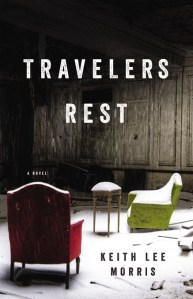
Keith Lee Morris' novel Travelers Rest culminates in "an operatic grand finale," according to a reviewer for England's The Independent.

Keith Lee Morris’ novel Travelers Rest culminates in “an operatic grand finale,” according to a reviewer for The Independent.

Keith Lee Morris is the author of three previous novels, The Greyhound God and The Dart League King, a Barnes & Noble Discover pick, and, most recently, Travelers Rest. His short stories have been published in New Stories from the South, Tin House, A Public Space, New England Review, and Southern Review, which awarded him its Eudora Welty Prize in Fiction. Morris lives in South Carolina, where he is a professor of creative writing at Clemson University.

To read an exercise on skipping over implausibility inspired by Travelers Rest, click here.

In this interview, Morris discusses pushing against conventional reality in stories, making predictions about characters, and the tonal difference between allowing characters to react to or ignore unusual details in a story.

Michael Noll

The novel’s first chapter is utterly realistic. The characters seem like “real” people, the situation (pulling off the highway due to snow) is plausible, and it’s certainly true that there are many small, beautiful, forgotten towns just off the Interstate. And yet there’s something about the last line of the chapter—”You’d never even know they were here”—that is full of foreboding. What was your approach to this chapter? It poses a certain challenge: you’re setting up the reader for a world that will gradually get stranger and stranger. Did you have a plan for how to plant the seeds for those changes?

Keith Lee Morris

The truth is, the first chapter wasn’t written until after the first draft of the novel was complete. The book originally began with what is now Chapter 3, Uncle Robbie waking up in the hotel in the middle of the night. But in talking to people who read the first draft, I got the idea that the opening was a little too abrupt and confusing. So the decision to include the first two introductory chapters was initially a practical move. But you’re right—Chapter 1 sets up a number of the elements that will be in play throughout the novel—the constant snowfall, the tensions between family members, the strange but oddly familiar small town. Nothing overtly strange happens, but things feel strange; that’s enough for the time being. In the next several chapters, the boundaries of conventional reality feel like they’re getting pushed up against a little bit, but nothing truly “otherworldly” happens for a while—and yet the reader senses that it’s coming.

Michael Noll

The novel is told from four different characters’ perspectives. It’s a structure that carries risks: you might lose the reader while changing POV, or the reader might feel more attached to one than the others, or the reader might feel that the shifts intrude upon the suspense that’s being built in each chapter. How did you balance the POV and the shifts to maintain a steady amount of suspense and interest in each character?

Keith Lee Morris

One of the key things to me is that readers have to get their hopes up for each character in a way that’s particular to that character. Very early on in a narrative we begin to make predictions, project outcomes—we do it unconsciously. If we like the characters, we begin to form an idea of what we hope will happen and also what we most deeply fear. Each character has to seem at least somewhat equal in that regard—if we don’t know what we want for a certain character, what we’re afraid might befall them, our interest is bound to lag behind in the chapters devoted to that character’s POV. So part of the battle is to make sure the reader can identify what would make each character happiest and what could potentially destroy him/her. And then I think it’s important to end the chapters on a strong note. I’ve always thought the most important sentence in any story or chapter or even entire novel is the last one. It’s what the reader’s left with. If you leave the character in an interesting place, the reader will be eager each time to pick him/her up again.

Michael Noll

When I was studying for a MFA, one of my writing professors said that the surest way to help readers buy into implausible parts of a story was to acknowledge them. So, if there’s a body on the street and everyone’s just carrying on as if nothing is wrong, a character ought to say, “That’s weird.” It seems like you’re doing something similar in the novel, particularly in one of Tonio’s early chapters, when he walks out of the hotel and thinks, “What the hell went on in this town, anyway? Who exactly lived here?” Of course, it’s natural for a character to wonder about things that seem a little off, but did you also feel that you needed to nod to the reader, to say, “Yeah, it’s kind of odd. You’re not crazy. Stick with me?”

Keith Lee Morris

Keith Lee Morris builds upon the long tradition of haunted hotels with his spooky, unsettling novel Travelers Rest.

Keith Lee Morris builds upon the long tradition of haunted hotels with his spooky, unsettling novel Travelers Rest.

To me it’s a tonal thing. Sure, if you want the reader to take the events of the story at face value, then those events have to seem plausible, and one way to make them seem plausible is to have the characters react in a way that seems to anticipate the way that we ourselves, or at least some other  reasonable person, might react. But maybe that’s not what you want. Authors like Barthelme and Delillo and even Flannery O’Connor get a lot of mileage out of having characters react (or fail to, as is often the case) in a way that we might not normally expect—they ignore the dead bodies in the street, so to speak. And in the case of those authors, the characters’ failure to respond in a “realistic” or predictable way lends the narrative the feeling of absurdity or irony that they’re after; the technique also produces a lot of the funniest passages—think of the Willie Mink scene in White Noise, for instance, in which one character fails to respond at all coherently or logically to the threat of being shot. Or an even better example– the “Misfit” scene in “A Good Man Is Hard to Find,” in which O’Connor uses the oddness of the characters’ responses to make the scene both unexpectedly horrifying and uncomfortably amusing—it’s the strangely implausible nature of both the action and the reactions that literally leaves us not knowing whether to laugh or cry. In Travelers Rest, yes, you’re right, it mostly served my purposes to try keep the reader and the characters on the same page in terms of their feelings about the strangeness of the situation—although there are occasions, as in the Julia sections, in which she seems to embrace the bizarre and rather dangerous situation she finds herself in, that it’s not working that way entirely.

Michael Noll

The novel is set in a kind of nowhere place, like the hotel in The Shining or the island in the television show Lost. The rules are different than in the regular world, but I wonder if they’re trying to reveal something about the regular world. For example, late in the novel Dewey thinks that “any time you imagined something, that imagined thing took its place in the world, in the mind of the person who imagined it, which was as real a place as Kalamazoo, Michigan, or Schenectady, New York, or maybe even more real, maybe the only real place.” This is undeniably true, as any artist or imaginative person can attest, but it’s also a bit dangerous, as your novel suggests. What drew you to this idea, the tension between dreaming and being swept away by the dream?

Keith Lee Morris

So much of our experience is internal and subjective. We pretend things that happen entirely in our own heads aren’t “real”—but they are real in the sense that they take their place in our memories and our thoughts in the same way that external events do, events that people other than ourselves can recognize as having taken place. If I dream that my wife is cheating on me with my best friend, it’s likely to change the way I feel about both of them when I wake up, at least until I get a cup of coffee and starting thinking more clearly. Most of us can sort out the differences between our own dreams or superstitions or initial misperceptions and the “facts” of the external world, but not always, and many people have trouble with it a lot of the time—it’s probably as good an explanation as any for why Donald Trump is currently the frontrunner for the nomination of one of our two major parties. We live with examples of mass delusion all the time. In the novel, I’m trying to point out how thin the line is between our perceptible fictions and fact, how susceptible we are to our own self-created illusions, and how the consequences can be very real.

April 2016

Michael Noll Michael Noll is the Editor of Read to Write Stories.

An Interview with Daniel José Older

31 Mar
Daniel José Older is the author of the Bone Street Rumba urban fantasy series, the Young Adult novel Shadowshaper. His essay, "Diversity Is Not Enough: Race, Power, and Publishing," addresses the institutional bias present in the publishing industry.

Daniel José Older is the author of the Bone Street Rumba urban fantasy series, the Young Adult novel Shadowshaper. His essay, “Diversity Is Not Enough: Race, Power, and Publishing,” addresses the institutional bias of the publishing industry.

Daniel José Older is the author of the Bone Street Rumba urban fantasy series and the Young Adult novel Shadowshaper, which was nominated for the Kirkus Prize in Young Readers’ Literature. His first collection of short stories, Salsa Nocturna, and the Locus and World Fantasy-nominated anthology Long Hidden: Speculative Fiction from the Margins of History, which he co-edited, are available from Crossed Genres Publications.

To read an exercise about becoming a better reader, click here.

In this interview, Older discusses the self-fulfilling prophecy of marketing, why categories in publishing matter, and what meaningful change in terms of diversity would look like.

Michael Noll

You write, “The publishing industry, people often say as if it’s a gigantic revelation, needs to make money and as such, it responds to The Market, and people don’t buy books about characters of color.” You add that this is marketing code for “you people don’t read” and an assumption that “white kids won’t buy a book with a black kid on the cover — or so The Market says, despite millions of music albums that are sold in just that way.”

This seems like the central crux of what you’re writing about: the belief that white people will only read about characters who are like them–or seem like them. And if they do read books about non-white characters, it’s often out of weird impulses of guilt and the need to be vindicated. For example, it seems not surprising that, at least here in Texas, To Kill a Mockingbird is required reading and, say, Invisible Man isn’t. How much of this—at least, thinking about the difference between books and music albums—is due to the age of the consumer? Would it make a difference if “adult” books were marketed to teens?

Daniel José Older

I’m honestly not sure. I’ll say this: Marketing is a self-fulfilling prophecy. There are certain assumptions in play until something comes along that ruptures them. And this applies to all genres. People tend to walk the line. That’s why courage comes into play, the courage to try new things. It’s wide-ranging, and industry-wide issue, not just editors and marketing people.

White writers have been writing to white audiences for decades but it was called being universal, which is a code word for white. Readers of color read white writers—even when they’re writing for write audiences—but the opposite isn’t always true. The industry isn’t representative of its readership. White writers can write for white audiences, and, at the same time, they can write to the industry.

Michael Noll

In the essay, you tell a story about attending a conference where an agent was asked about the industry’s diversity problem, and the agent said this: “I think the change is going to have to come from within those who are affected.” You write, “This is the language of privilege: it’s not the intangible Market that’s to blame, it’s the writers of color, who maybe don’t have what it takes and don’t submit enough anyway.”

What I find really interesting is what you write a bit later: “We’re not writing for editors and agents, we’re writing past them. We’re writing for us, for each other.” I immediately thought of Kiese Laymon, a writer who, as much as anyone I can think of, has said that he’s writing for black audiences and entering a discussion with black writers.

You write about what white people need to do in order to dismantle white supremacy, but is this the opposing response? How do you think about your own readership?

Daniel José Older

I’ve talked to entirely white audiences and audiences that were entirely people of color. The reaction in both has been positive, but it’s different, too. There are different laugh lines. I tell this story: I read once to an all-white audience, and they were into it. Mesmerized is the word. But they didn’t laugh once. It was a horror story, and when I’d written it on a bus in Brooklyn, I’d been cackling. When I read the same story to people of color, they were on the floor. Both audiences were into it. At one point, I was going to stop reading, and it was at a moment of tension, a cliffhanger, and the white audience said, “Don’t stop.” There’s a difference in how different audiences respond.

White people are hungry to talk about race. They don’t necessarily have the language to do it. But when I speak on race, the reception is warm and curious, even if they don’t have the language.

Michael Noll

Daniel José Older's urban fantasy novel Half-Resurrection Blues has been called "Noir for the Now."

Daniel José Older’s urban fantasy novel Half-Resurrection Blues has been called “Noir for the Now.”

You write, “Many of our gifts and challenges won’t be seen or recognized within a white cultural context. Nuances of codeswitching, racial microaggressions, the emotional reality of surviving white supremacy, self-translation – these are all layers of the non-white experience that rarely make it into mainstream literature, even when the characters look like us.”

I thought of this in connection with your urban fantasy novel Half-Resurrection Blues. It’s certainly working within the genre of ghost and paranormal thrillers. But there were moments when the fact that it was written by a writer who wasn’t white—and that it was about characters who weren’t white—was very clear. And those moments were great, at least to my mind, because they elevated the book above other similar books. Other books have cool monsters and cool worlds of the dead, but they don’t always comment on society. Did you set out to write a book about, as you say, “Nuances of codeswitching, racial microaggressions, the emotional reality of surviving white supremacy, self-translation”? Or is this simply an essential part of your work?

Daniel José Older

It feels natural to do it. It’s also what I know to be true. Write what’s true and then try to say something. Ultimately, it’s about asking books to multitask. You’ve got this entire book, and you can do a lot of things in it. When a book demands a lot from you, it asks you to step up to its level.

Michael Noll

Do you think the industry shares your enthusiasm for books that multitask? You sometimes hear about books that operate within multiple genres or are doing multiple things and that agents, editors, and booksellers don’t know how to categorize the book.

Daniel José Older

We have a flawed category system. I write urban fantasy, which is a weird term. Urban is code for characters who are black or brown. Then you throw in fantasy, which is almost entirely white. There are very few fantasy writers of color.

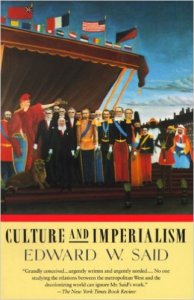
Edward W. Said's book Culture and Imperialism demonstrates that Western imperialism's most effective tools for dominating other cultures have been literary in nature as much as political and economic.

Edward W. Said’s Culture and Imperialism demonstrates that Western imperialism’s most effective tools for dominating other cultures have been literary as much as political and economic.

But there’s probably no way not to have a flawed system. Categories are inherently messy. I’m reading Culture and Imperialism by Edward Said, and he traces the need to categorize back to the nation-state—the idea of borders. And now, of course, we’re talking about walls. With nationalism, we’re talking about how we value life. In a micro way, this is the case in literature: which books are sci-fi, which are high literature even though they have robots in them. All of these are questions about power.

The categories matter. Slavery was invented by white people, but it’s become “black history.” We need to be clear who was doing the enslaving or it gets erased. It’s talked about as a black people problem and is written about in passive voice, without identifying who was doing the enslaving. In the same way, sexual assault is talked about as a woman’s problem. You won’t find it in the men’s section.

Michael Noll

You write, “The question industry professionals need to ask themselves is: How can I use my position to help create a literary world that is diverse, equitable, and doesn’t just represent the same segment of society it always has since its inception? What concrete actions can I take to make actual change and move beyond the tired conversation we’ve been having for decades?” That work, you add, “means taking courageous, real-world steps, not just changing mission statements or submissions guidelines.”

It’s been two years since you published this essay. Have any answers occurred to you? Have you seen this in action?

Daniel José Older

We need to go from a flash-in-the-pan to a sustained movement. The question is how to make even more sustained, not just a buzz word but an actual revolutionary change, not just a new face on the same old shit. A good example of this, in a positive way, is We Need Diverse Books.

All-American Boys tells the story of an act of police violence from the view of the victim and the police officer.

The novel All-American Boys tells the story of an act of police violence from the view of the victim and the police officer.

Because of how publishing works, how long it takes for books to come out, any changes won’t be apparent for a couple of years. One example is All-American Boys, which is about police brutality. That book was rushed—and rushed in a good way. There was a sense that it needed to get out there.

But we need to be on guard against white fatigue, the sense of, well, we’ve had enough diversity. If we’re not careful and precise in these changes, we’ll get something that isn’t good. Diversity doesn’t just mean diverse characters. It means diverse writers as well. If it just amounts to stories about characters of color being told by white authors, that’s not victory. That’s not the point of this movement. There’s a long history of co-option, and it’s especially dangerous. There are quotas in effect—literally. Publishers will say, we already have a black book. But it’s a book by a white person. A black writer is trying to get a book published and can’t because a white person already took that spot.

Michael Noll

So, does that mean creating new imprints and houses? Or changing the existing ones?

Daniel José Older

There’s a new Muslim imprint at Simon & Schuster that looks really interesting, but it can’t be the only answer. There’s no white imprint. It’s mainstream publishing, and that’s what we need to transform.

March 2016

Michael Noll Michael Noll is the Editor of Read to Write Stories.

An Interview with Karen Ranney

24 Mar
Karen Ranney is the bestselling author romance novels. Her most recent book is An American in Scotland.

Karen Ranney is the bestselling romance author whose most recent book, An American in Scotlandtakes place during the American Civil War.

Karen Ranney wanted to be a writer from the time she was five years old and filled her Big Chief tablet with stories. People in stories did amazing things and she was too shy to do anything amazing. Years spent in Japan, Paris, and Italy, however, not only fueled her imagination but proved she wasn’t that shy after all. Now a New York Times and USA Today bestseller, she lives in San Antonio, Texas.

To read an exercise on giving characters the opportunity to change and act dramatically and an excerpt from An American in Scotland, click here.

In this interview, Ranney discusses setting as character, the difference between love and sex scenes, and straddling the needs of historical narratives and contemporary readers.

Michael Noll

I want to say up front that Romance isn’t a genre I know very well, and so I was excited to read your novel because I wanted to learn how it works. To that end, I was surprised at how much the novel contained beyond what the cover might suggest: shirtless guy and beautiful woman. Or, to put it another way, the term romance is a lot bigger than I imagined. Setting is as important as love. For lack of a better word, there is something romantic about place, which I guess should make sense given that the title suggests more about place than anything else. What’s your approach to the setting and world of your novels? Are you trying to make readers fall in love with them as much as with the characters?

Karen Ranney

Place is very important to me. In some books it has a greater impact on me than on others. For example, A Scotsman in Love was set in a once deserted manor house that intrigued me. Another example is the MacIain trilogy that revolves around a house outside Edinburgh. In those books the setting was almost another character.

I enjoy placing my books in Victorian Scotland because, to me, it was the era of inventions and scientific achievement.

In An American in Scotland, I had to give readers a flavor of each locale, but I had three major settings, so I couldn’t linger too long in any one place. (Why make it easy on myself when I could visit Scotland, Nassau, and America all in one book?)

Michael Noll

The novel is quite chaste. The prelude to the kiss seems to be much more important than the kiss itself—and it takes up a great many pages. How do you maintain and gradually increase the tension between two characters who we know will eventually fall into each other’s arms?

Karen Ranney

I have always maintained that it’s easier to write a sex scene than it is a love scene. I always try to have the characters fall in love with each other before they actually consummate that love. It seems to me that emotions are more important than physical activity.

Also, putting sex in the context of 19th century mores, even kissing someone was a great moral leap. Each step toward the journey to bed is a form of commitment.

Michael Noll

Along those same lines, I admire the way that the novel draws out its sex scenes. For example, there’s a scene when Rose and Duncan bathe together, which leads toward what such baths tend to lead to, but then something interrupts them—Duncan sees something that distracts him. How do you know how much you can draw out such as scene before readers begin skimming to get to the stuff they know is coming and really want to read?

Karen Ranney

Again, it’s a love scene as opposed to a sex scene—or at least that’s how I hope the reader interprets it. Everything that goes on in that scene is both an act of revelation and one of commitment. The characters give of themselves not just physically but emotionally. Maybe even spiritually if I write it correctly. You can’t skip through the scene because it’s pivotal in the give and take between the characters. It shows why they’re falling in love and how.

Michael Noll

Karen Ranney's novel An American in Scotland follows an American woman who sails through the Union blockade of Charleston in order to pursue a sale and romance in Scotland.

Karen Ranney’s novel An American in Scotland follows an American woman who sails through the Union blockade of Charleston in order to pursue a sale and romance in Scotland.

The novel contains a fair bit of language about sin and virtue, and because it’s set in the mid-1800s, there are some time-appropriate ideas about gender. I bring this up because I heard a review the other day of the Downton Abbey finale, and the reviewer said that historical dramas are always more about the audience than the age and characters they’re portraying. Do you think this is true of your novel as well?

Karen Ranney

If I understand what you’re asking, let me answer this way: Robert Burns wrote poetry in the vernacular Scots. If I wrote a book like that today no one could understand it. Consequently, I interpret Scottish English with an ear/eye toward my readers. They’re 21st century women. Similarly, interpreting the mores of the 19th century means I have to straddle a line. I have to correctly depict the customs/manners/thinking of the day while interjecting some viewpoints that might be more acceptable to a 21st century reader.

For example, in An American in Scotland, Rose does a lot of things that would have horrified her neighbors in New York and scandalized her neighbors in South Carolina. She would probably have been ostracized in both communities for her abolitionist views. Yet we, being 21st century people, wish she went farther to oppose slavery.

A reviewer chided me for writing about mills in Scotland that were pro-slavery. No, they weren’t pro-slavery. It’s that American slavery was “just business”. They might have personally abhorred it, but they tolerated doing business with the American South because they needed their cotton. That review was a case of our 21st century values colliding with history.

March 2016

Michael Noll Michael Noll is the Editor of Read to Write Stories.
An Interview with Chinelo Okparanta

17 Mar
Chinelo Okparanta is the author of the novel Under the Udala Trees and the story collection Happiness, Like Water

Chinelo Okparanta is the author of the novel Under the Udala Trees and the story collection Happiness, Like Water.

Chinelo Okparanta is the author of the story collection Happiness, Like Water and the novel Under the Udala Trees. Her stories have appeared in The New Yorker, Granta, Tin House, The Kenyon Review, among others, and she was short-listed for the 2013 Caine Prize in African Writing. She won the 2014 O. Henry Award and the 2014 Lambda Literary Award for Lesbian Fiction. She has been awarded fellowships and residencies by Bread Loaf, the Jentel Foundation, the Hermitage Foundation, the Civitella Ranieri Foundation, and Hedgebrook. She was born and raised in Port Harcourt, Nigeria.

To read an exercise on manipulating chronology in order to create character, click here.

In this interview, Okparanta discusses finding the emotional heart of a story, writing within an omnipresent past, and whether a writer’s present location affects her writing.

Michael Noll

The novel has an interesting sentence in its first chapter: “So, the story begins even before the story, on June 23, 1968.” It comes after a quick overview of the war and is accompanied by this sentence: “There is no way to tell the story of what happened with Amina without first telling the story of Mama’s sending me off.” And this: “If I had not met Amina, who knows, there might be no story at all to tell.”

It seems that you’re directly addressing a problem that a lot of writers have with novel drafts: where to begin the story? Were these sentences the result of your own process of finding the story, or were they designed for readers, to help guide them from war in general to a particular story about particular individuals?

Chinelo Okparanta

I already knew where the story would begin, and those sentences were simply a natural aspect of the storytelling. Back in the day when my mother used to tell us folktales, sometimes she grounded the folktales in this sort of language, just a natural set up to the story, and perhaps also a signal for us children to know what we should be listening for (i.e. the emotional heart of the story). In the case of Under the Udala Trees, these sentences do signal to the readers where the emotional heart of the story lies.

Michael Noll

I’m curious about your sense of the novel’s audience and how it affects the story you tell. Obviously, the book was published in the United States, where you live, and in English. Some Igbo words and phrases appear, but they’re often translated, either directly, like this (Chineke bi n’eli! God in Heaven! How can this be?) or through context. How aware are you of audience, that it’s primarily American/Western? Can the novel be separated from this audience? In other words, how different would it be if you were writing for a Nigerian or Igbo audience?

Chinelo Okparanta

While writing the novel, I kept in mind various possible audiences, but my main audience was not American/Western. My main audience was my fellow Nigerians. In some ways it was just incidental that it got published in the West first. The truth is that current physical location is oftentimes irrelevant to the story that a writer tells. I have written about Nigeria from Nigeria. But I have also written about Nigeria from Greece, the Philippines, the USA, France, Italy, Uzbekistan and Turkmenistan. When I write many of my stories, regardless of where I am, my mind very often is back home in Nigeria.

Chinelo Okparanta's novel Under the Udala Trees tells the story of a young girl displaced by the Nigerian Civil War and the love affair that she begins.

Chinelo Okparanta’s novel Under the Udala Trees tells the story of a young girl displaced by the Nigerian Civil War and the love affair that she begins.

Which is all just to say that the book is exactly what it is—and exactly what it should be—for having been written primarily for a Nigerian audience. We Nigerians speak in a natural mélange/interspersing of our traditional languages and English. This is exactly what the book does. It’s important to keep in mind that Nigeria is a country in which hundreds of languages are spoken. The purpose of the book is to open conversation amongst all ethnic groups within the country, so it would have made no sense for me to write the entire thing in Igbo, with no context clues at all, thereby alienating quite a large segment of the nation’s population. There are also Hausa words in the book, and of course, there is Pidgin. But English is Nigeria’s lingua Franca. As such, it also the novel’s lingua Franca, and the language that best serves the purpose of the book: unity, rather than division.

By extension, because the purpose of the book is to be accessible to all of Nigeria, it also winds up being accessible to Western audiences, and hopefully to audiences all over the world. Sure, I wanted to write a book that invited Nigerians to have this LGBTQ conversation amongst themselves. But of course, it’s a good thing that the book is accessible to non-Nigerians. It’s always a good thing when literature speaks to universal human experiences, but it is an even better thing when the language of the literature facilitates a reader’s engagement with those human experiences.

Michael Noll

The chapters in the novel are fairly short, often a few pages long. It seems that some revolve around particular scenes, but there are many that move through time or move beyond scenes in various ways. What was your approach to chapter structure?

Chinelo Okparanta

I was going through a phase where I enjoyed reading books with shorter and more straightforward chapters. I decided to write the kind of book I enjoyed reading. Maybe for my next project I’ll be enjoying a different kind of book–the kinds with long, sprawling chapters, or those with no chapters at all. If that winds up being the case, I might also write that sort of book.

Michael Noll

The novel begins with the Biafran War, which ended 45 years ago, but now there are new protests in the region, to the point that, at least in the news outlets that I read and listen to, there’s some concern that they might lead to another civil war. Is this something that you thought about as you wrote the novel? Does the past of the novel seem truly past to you? Or were you trying to capture tensions that remain?

Chinelo Okparanta

Look at the United States and its history of slavery. That history haunts all Americans even today–at least, it haunts any socially aware American with an active conscience. Recently in the US, racial tensions have triggered worries of civil unrest. The past always leaves its stamp and oftentimes the stamp is waterproof. Maybe it fades a bit, but it is still there. So, yes, our past is the past, but it is also the present, and it will likely affect the decisions we make for the future. Which is why I’m always thinking about the nation and ways in which to flip our history of colonialism, and ways in which to better deal with the division caused by the British geo-political division of the country. We don’t have to be beholden to the past. We don’t forget—and perhaps we should not forget—but we certainly owe it to ourselves to rise above it. It seems to me that all of us have the power to flip unfortunate aspects of our pasts and use them positively, constructively, to make ourselves stronger. It’s just a matter of how. A united body people who are sincerely in it for the common good. Good leadership. A well thought out and thoroughly outlined plan. Expert organizational skills. These are some of what all healthy nations need.

March 2016

Michael Noll Michael Noll is the Editor of Read to Write Stories.
An Interview with Daniel Oppenheimer

3 Mar
Daniel Oppenheimer's book Exit Right has received glowing reviews, like this one from the Washington Post: "This book proves so satisfying precisely because it leaves you wanting much more."

Daniel Oppenheimer’s book Exit Right has received rapturous reviews, like this one from the Washington Post: “This book proves so satisfying precisely because it leaves you wanting much more.”

Daniel Oppenheimer’s articles and videos have been featured in The New York Times, The Atlantic, Tablet Magazine, and Salon.com. He earned a BA in religious studies from Yale and an MFA in nonfiction writing from Columbia. He lives in Austin with his wife, the historian and psychotherapist Jessica Grogan, and his kids Jolie and Asa. He is Director of Strategic Communications for the Division of Diversity and Community Engagement at the University of Texas at Austin. Exit Right: The People Who Left the Left and Reshaped the American Century is his first book.

To read an exercise about revealing tension indirectly, inspired by Exit Right, click here.

In this interview, Oppenheimer discusses quoting versus paraphrasing, the most under-recognized tool in the nonfiction writer’s trade, and the most insightful comparison of Donald Trump and Ted Cruz I’ve seen yet.

Michael Noll

I love the passage about Whittaker Chambers’ parents, the way they used everything in the world as a proxy battle for their mutual dislike of each other: the house that Chambers’ father allowed to go into disrepair, the way they treated their kids. You quote Chambers on this subject, but you also write about it in your own words. How did you know what to quote and what to summarize, what to footnote and what to pass by un-noted?

Daniel Oppenheimer

When it comes to quoting vs. paraphrasing or characterizing, I’m always trying to balance a few considerations. I like quoting, and particularly with someone like Whittaker Chambers, who was such an evocative writer, there’s great value in quoting him directly. He gives a good quote.

At the same time I think readers, for whatever reason, tend to zone out and begin to skim if you quote at too great length. I don’t usually love it, as a reader, when I encounter too many or too lengthy quotations. It feels like the writer fell too much in love with the material and lost sight of the reader—maybe also like they’re wanting the quotes to do their work for them. There are exceptions to that generalization. I think of someone like Janet Malcolm, who will quote from her interviews for pages, or of WG Sebald, who will also quote for pages. I’ll follow them anywhere, including into incredibly long quotations.

But they’re brilliant, and there’s also something about what they’re trying to do, as writers, that’s well served by their techniques. Malcolm is fascinated by the stories people tell about themselves, and so it makes sense that she shows that process at length. Sebald is trying to blur boundaries between himself and others, and the present and the past, so it serves that end for him, particularly since (if memory serves) he usually doesn’t even use quotation marks to signal that he’s begun quoting. It all kind of blends together.

I haven’t yet hit upon a method that feels organic that allows me to quote at great length, so I treat quotations in a more conventional way, and in general try to be somewhat sparing. In practice, I tend to include more quotes in the early drafts and then pare away as I revise, leaving only the ones that really work and seem really necessary in terms of giving a flavor of who the person was and how they saw the world.

I also like summarizing, paraphrasing, and distilling for their own sakes. Or at least I like having done it well. Some of my best writing happens, I think, when I’m trying to sum up what someone else thinks or has said. I’m trying to inhabit them, and at the same time to overlay in a subtle way the additional perspective that I bring to their story. In truth it can be a pretty sneaky thing to do, when I pull it off. I make it seem like I’m just paraphrasing or summarizing, but I’m actually inflecting the readers’ interpretation of what’s going on in a rather manipulative way.

In terms of footnoting, it’s less complex. I’m not an academic, so I don’t feel the need to footnote everything or list every source. I needed to do some of it for a few reasons: to legitimize myself, to serve that academic purpose at a basic level, and also to occasionally draw attention to other books or articles or writing that deserve to be read. I also, like a lot of writers, use the footnotes as a basin of last resort for passages that it made sense to cut from the main text, for reasons of flow and space, but that feel too good to just get rid of entirely.

Michael Noll

Many of the reviews (New Yorker, AtlanticNew Republic, Washington Post, Barnes & Noble) of the book have noted its terrific prose, and I agree. For example, you write this about the 1920s: “Any kind of sickness—an infected hangnail, a fever, a cough—might be the first domino in a short cascade that led to death. Epidemics and pandemics rolled across the populace like stampedes. Fires took out cities.” This is such vivid language, active and compelling for what is essentially a passage with a mechanical role: give the reader a sense for Chambers’ world. What was your process for writing the book? Did you research and take notes and then write? Or did you write as you researched? I guess I’m wondering at the head space that passages like this one came out of.

Daniel Oppenheimer

I’m glad you like that passage. I’m happy with myself every time I read it. My wife will laugh when she sees you quoting that, and will probably make an obscene joke about how happy it must have made me.

Daniel Oppenheimer's political biography, Exit Right, tells the story of six men who converted from the American left to American Conservatism—with an eye toward what the history and experience that set the stage for their conversions.

Daniel Oppenheimer’s political biography, Exit Right, tells the story of six men who converted from the American left to American Conservatism—with an eye toward what the history and experience that set the stage for their conversions.

I think I have a few other passages in the book that do that same kind of thing, distilling a lot of historical or social background into a few tight, evocative paragraphs, and I’m excessively proud of them. This kind of distillation has to be among the most under-recognized and under-theorized tools of the nonfiction writer’s trade. There should be entire craft classes on how to do this, because you need that background in a lot of historical and journalistic writing, and yet it’s so tempting to do it in a half-assed way, to knock it out in workman-like prose so you can get back to the sexy stuff. And I get it. It’s hard work, and when you do it well it’s pretty self-effacing. You’ll rarely be recognized for doing it well (unless you get interviewed by Michael Noll, apparently). But it’s so important. And if you do it poorly, it just slows the narrative down so much.

In answer to your specific questions, I started out the book doing a whole bunch of research before I began writing. That was a good way to go, in terms of writing passages like that one, but it was a bad way to go in terms of finishing the book in anywhere near a reasonable amount of time. So for Hitchens (which I wrote first even though it’s the last chapter chronologically), Chambers, and Burnham, I did it that way. Then I realized I needed to speed up if I was ever going to finish the book, so with Reagan, Podhoretz, and Horowitz it was more the latter strategy, researching and writing at the same time. I’d do a bit of reading in advance, usually the main biographies and autobiographies, and then I’d begin writing while also delving into the rest of the material (their writings from the time, what their colleagues had to say, other people’s memoirs, etc.). My guess is that these latter three chapters have fewer of the kinds of passages you quoted, which is too bad. At the same time I think they’re lighter and more fluid in some appealing ways. Research can sometimes weigh you down. So I honestly don’t know which strategy worked best for me, purely in terms of the quality of the book.

Michael Noll

You write this about Chambers: “There are different ways of reading the arc of Chambers.” This is probably true about all of the men you profile. About Christopher Hitchens, who abandoned the left several decades after Chambers, you summarize the view of his conversion from the left, from the right, and from his own eyes. These different ways of reading these men can make it difficult to see them with fresh eyes, but you can hardly avoid the filters and spin. How did you find your own way of seeing the men?

Daniel Oppenheimer

I was talking to my brother the other day about why it is that no one has written this book before, about people who’ve gone from the left to the right. In a way it seems like an obvious book to write. My theory, which he liked, and which touches on this question, is that I brought to the project a rare mix of humility and arrogance (or at least confidence).

What’s humble is that I’m just taking what everyone else has already written and said on the subject and synthesizing and summarizing and distilling it. I’m not venturing any great theses about history. I’m not uncovering any new material on these people. I’m not even offering radical new takes on them. Most writers who could pull off something like this have too much ego and ambition to be so self-effacing.

The arrogance is that I trusted that there was something about the way I write, and the way my brain works, that was going to produce writing that felt fresh even though I was going over territory that has been so thoroughly gone over before. A lot of writers, I suspect, would it find it daunting to have to say something new about folks like Whittaker Chambers and Ronald Reagan and Christopher Hitchens, who’ve been written about so many times over so many years. I didn’t worry about it so much. I trusted my voice.

Michael Noll

The book is remarkably understanding of its subjects, several of whom were often not viewed charitably by the people who knew them best. In the introduction, you write, “We can make judgments—we can’t not make judgements—but they should be made with an awareness of how hard it is to be a person in the world, period, and how much more confusing that task can become when you take on responsibility for repairing or redeeming it.” As you researched and thought about these men in this humanizing light, you must have found yourself identifying with them. That is the goal of humanizing people, right? If you did identify with them, could you begin to identify with their political conversions and beliefs? In the words, did the book affect your own political views at all?

Daniel Oppenheimer

I did find myself identifying with these men. In a sense that was the method of the book. Let’s see what it looks like when I try to see as deeply into their stories as possible, through their eyes, and then complement that with the perspective I can bring to their lives as someone who is not them, who can see certain things about them more clearly because I’m not them.

Daniel Oppenheimer's essay, "What Donald Trump Learned from Ronald Reagan's Flip-Flops," appeared in the Washington Post.

Daniel Oppenheimer’s essay, “What Donald Trump Learned from Ronald Reagan’s Flip-Flops,” appeared in the Washington Post.

I was writing an essay recently on Donald Trump, whose views I find truly awful, and the more I read about him the more sympathetic I became, to the point where there’s a part of me that kind of wants him to win the Republican nomination, simply because he’s the only one to whom I’ve cathected in that basic way. I watch him up on stage, at the debates, and I feel for him when he loses control. That’s just how my brain works. It would be interesting to do an experiment in which I spent a lot of time researching Ted Cruz just to see if the same thing would happen. I suspect not. I think Cruz is empathy-proof. I think he’s done such a good job of polishing off anything in him that’s vulnerable that there are no visible cracks left. I need the cracks to get access. Donald is almost all cracks.

So does this process of identification influence my politics? Well, yes I’m sure it does, but not in a very linear way, any more than a novelist is likely to be influenced in a linear way by writing with empathy about characters who are evil, or who do evil. The novelist doesn’t become more evil as a result of that, or more likely to do evil. What they become is more able to comprehend why someone might do evil. I’m sure that could lead to more evil, depending on the novelist’s character, but my guess is that it’s more likely to result in the opposite, in a deepening of the empathizer’s humanity and capacity for goodness. I haven’t become more conservative, but I like to think that I’ve become more understanding of why someone might leave the left, and why they might embrace conservatism.

If anything, I’ve probably gotten more ruthless as a leftist. It doesn’t feel as personal anymore. It’s about power, and who wields it, and how to change the balance of power to better achieve the ends I’d like to see achieved. I have empathy for the people on the other side. I don’t think they’re bad people just because they don’t share my political priorities. If I were super rich, for instance, I’d probably persuade myself that my wealth was a manifestation of my virtue, and that a healthy society is one that celebrates the wealthy and recognizes them as the natural leaders of their fellow men and women. I can imagine that. But I think it’s a toxic perspective when it acquires too much influence in the polity, and that that’s the best reason to do what we can to diminish the power and influence of the wealthy. It’s not personal. In fact, in that project making it too personal can obscure the best strategies. I don’t need them to be evil. I just need them to lose.

I read Saul Alinsky not too long ago, and what struck me about him was how pragmatic and non-moralizing he was about what he did. He wanted the world to be a certain way. The other side wanted it to be a different way. Both sides were going to do what they could to win, and he was going to be as clever and rude and tough and sneaky as he could be to increase the odds that his side won. Of course he cared deeply, and could get angry, but he had a real ability to see his political opponents with empathy and detachment, and to imagine the world through their eyes, and that helped him enormously in defeating them.

I’m no Saul Alinsky, but I think I have some of that in me. Honestly, someone should hire me to devise strategies to take down conservative politicians. I think I’d be a brilliant, ruthless, empathetic bastard.

March 2016

Michael Noll Michael Noll is the Editor of Read to Write Stories.
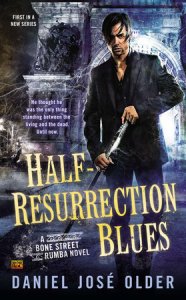
An Interview with Mo Daviau

25 Feb
Mo Daviau's novel Every Anxious Wave has been called a "bittersweet, century-hopping odyssey of love, laced with weird science, music geekery, and heart-wrenching laughs" by NPR.

Mo Daviau’s novel Every Anxious Wave has been called a “bittersweet, century-hopping odyssey of love, laced with weird science, music geekery, and heart-wrenching laughs” by NPR.

Mo Daviau has performed at storytelling shows such as Bedpost Confessions and The Soundtrack Series. She is a graduate of Smith College and the Helen Zell Writers’ Program at the University of Michigan, where she won a Hopwood Award. Daviau lives in Portland, Oregon. Every Anxious Wave is her first novel.

To read an exercise about explaining away implausibility, inspired by Every Anxious Wave, click here.

In this interview, Daviau discusses making implausible stories believable, the litmus test for whether personal tastes are shared by readers, and where plot twists come from.

Michael Noll

The novel presents you with a pretty significant problem. The characters need to travel through time. How do you they do it? And how do you explain it? You tackle those exact questions in a couple of paragraphs after the time travel device is discovered. What was your approach to those paragraphs? I love how fast they move, basically telling the reader, “Some stuff with computers happens and–boom. Time travel.” But a quick look at some online reviews reveals that sci-fi purists don’t agree. Of course, this isn’t a sci-fi novel. Was this an issue you faced writing it?

Mo Daviau

This is something I worried about, that I would be displeasing hardcore sci-fi fans by not going hard and deep into the science of the wormhole. There is actual science behind the mechanics of time travel as I’ve written it in the book—it’s based on the theory of the Einstein-Rosen Bridge, which was explained to me by a post-doc in physics at the University of Michigan who I met while I was there doing my MFA. But since the novel is told from the first person perspective of Karl, who has no knowledge or interest in physics, the burden of understanding the wormhole’s mechanics fully is on Wayne and Lena, whose voices we are not privy to. Was this a cheat-out? Maybe, but I never intended the novel to be sci-fi. To me, it’s magical realism. I did not build a new world—I only added one fantastical element to the existing one.

Michael Noll

The premise of the novel (time travel to great concerts) allows you to namedrop a lot of bands and a lot of particular concerts. In terms of reader appeal, this would seem to be on the level of Ready Player One, which was adored by pretty much anyone with a particular pop culture sensibility. Did you think about this (how readers might respond to the bands) as you wrote it? Or did you simply write what you liked?

Mo Daviau

I worried that since I chose to write towards my own musical tastes, and to pay tribute to, and in some cases, satirize, the indie scene of which I was a fan in the late ‘90s, that since the vast majority of readers wouldn’t have heard of those bands, they wouldn’t really connect with the work. No one up my chain of command—agent, editorial staff at St. Martin’s Press—is a fan of the bands I name in the book, or had much knowledge of that particular scene, yet they still connected with the themes in the novel. So that was my litmus test for being able to write a novel around obscure music that bore or alienate the non-indie-fan reader.

Michael Noll

You currently live in Portland, and, before that, you lived in Austin–so, two cities with strong live music sensibilities. Did these cities have any impact on the novel?

Mo Daviau

Mo Daviau's novel Every Anxious Wave follows a bar owner who time travels to historical indie rock concerts.

Mo Daviau’s novel Every Anxious Wave follows a bar owner who time travels to historical indie rock concerts.

The short answer is no. And I feel like a jerk saying that, but it’s true. Portland more than Austin-the novel was mostly finished when I moved to Portland in 2014, and although Portland gets a few mentions, and Austin gets no mentions (there were references to clubs in Austin but they ended up getting cut in the end) I’d say that there is no true sense of place. Every Anxious Wave takes place largely in Chicago, but only in Karl’s bar and in his head. It also takes place in Seattle, though not the Seattle we currently know and love. I was writing more about time than place.

Michael Noll

My favorite thing about this book is the fact that a character accidentally travels to 10th-century Manhattan. This is just so weird and wonderful, a bit like the section in The Amazing Adventures of Kavalier and Clay when a character spends an entire section in Antarctica. In both cases, the story is doing something totally outside the bounds of what the reader probably expects given the frame of the novel. Did you always know this would happen? Or was this the result of a moment of inspiration?

Mo Daviau

I don’t remember how or why I came up with the idea of Karl leaving the number 1 off his transmission entry sending him back to 980, but that was a pretty early idea that I had in my head, the first problem Karl would face. I’d just read the book Sex at Dawn when I started writing what would become Every Anxious Wave, and the idea that among early hunter/gatherers, there was no concept of personal property and that everything was shared communally was one that I found fascinating. I’ve always enjoyed communal living, something that our society frowns upon once college is over.  When I was trying to figure out under what circumstances Wayne would return to modern times, my personal inner impulse was “I wouldn’t. I would want to stay in hunter/gatherer society.” It’s a mild social commentary, I guess, and maybe one I didn’t punch very hard, looking back on it. But that’s where that idea came from.

February 2016

Michael Noll Michael Noll is the Editor of Read to Write Stories.