Tag Archives: creative writing exercises

How to Give Depth to Character Descriptions

23 May

Alexandria Marzano-Lesnevich’s The Fact of a Body: A Murder and a Memoir was named one of Entertainment Weekly‘s “Books You Have to Read in May.”

Beginning writers tend to approach character descriptions in a pretty straightforward way: what does he look like? Is she tall, short? What is a distinguishing characteristic? A nose? Teeth? The result often resembles a police or personal ad description—and that’s fine. It’s a place to begin. But as a writer’s craft grows, so does the ability to do more with character descriptions.

A great example of what is possible can be found at the beginning of Alexandria Marzano-Lesnevich’s book, The Fact of a Body: A Murder and a Memoir. You can read the opening pages here.

How the Book Works

The book tells two different kinds of stories. One is about a murder. The other is about the author’s realization that she has a personal connection with the people involved in the crime. To make this double narrative work, we need to pretty quickly feel connected to the crime—to see the murderer and the victim as people who exist independently of those identities. This means, of course, making them appear complex and sympathetic. But it’s more than that. They ought to feel apart of a world. Take any person you know, and I suspect that it’s difficult, if not impossible, to think of them outside of the world they inhabit (or the world they share with you). This is why we’re so often befuddled when we encounter someone outside of their normal context. We can’t place them. In life and in our minds, people exist in relation to everything around them. So, a good description will capture those myriad complex relationships. Marzano-Lesnevich does that in the book’s first chapter:

Louisiana, 1992

The boy wears sweatpants the color of a Louisiana lake. Later, the police report will note them as blue, though in every description his mother gives thereafter she will always insist on calling them aqua or teal. On his feet are the muddy hiking boots every boy wears in this part of the state, perfect for playing in the woods. In one small fist, he grips a BB gun half as tall as he is. The BB gun is the Daisy brand, with a long, brown plastic barrel the boy keeps as shiny as if it were real metal. The only child of a single mother, Jeremy Guillory is used to moving often, sleeping in bedrooms that aren’t his. His mother’s friends all rent houses along the same deadens street the landlord calls Watson Road whenever he wants to charge higher rent, though it doesn’t really have a name and even the town police department will need directions to find it.

The paragraph continues, but you can already see so many ways that Jeremy Guillory has been placed in relation to his world:

  • The particular blue of his sweatpants draws a local comparison (Louisiana lake) and also different names from different sets of characters. Even with a minor detail, we’ve glimpsed setting and many different characters.
  • The boots place him not just in muddy woods but in a community of people who interact with those woods in a particular way.
  • We see his size in relation to his gun.
  • We see his care for the gun.
  • We see his mother and their family unit in relation to his mother’s friends and the street where they all live. We see the landlord who charges them all too much.
  • We see the street in relation to the community that doesn’t even know where it is.

When writing teachers talk about synchronicity or simultaneity, this is what they’re talking about: the ability of a single passage to show readers multiple things at once. In this case, it’s a character description that holds all of those things together—and also brings the character to three-dimensional life in our imaginations.

The Writing Exercise

Let’s describe a character in relation to his or her surroundings, using The Fact of a Body: A Murder and a Memoir by Alexandria Marzano-Lesnevich as a model:

  1. Choose a detail that cannot be agreed upon. This is how Marzano-Lesnevich begins, though it’s not necessarily the way you must begin. But, we’ll go in the same order that she does. She picks a seemingly innocuous detail (the color of the boy’s sweatpants) and then gives a neutral description (her own) and then two different takes on it (the mother’s and the police’s). This gives the reader a clearer sense of the disputed issue, of course, but it also allows the writer to bring in other characters. In a purely mechanical way, it opens up the narrative to characters beyond the one being described.
  2.  Give the character a trait that many others like him/her possess. She uses his shoes. We do this constantly in narratives, and the way point of view often matters. When done from an outsider’s perspective, these kinds of details can potentially veer into stereotypes. (Think about the way that baggy pants and Carhartt jackets are used by politicians as shorthand for entire communities.) In a story, those stereotypes can reveal a lot about the character who holds them. But when done from an insider perspective, as Marzano-Lesnevich uses here, the detail can reveal a trait (societal, geographic) that is so strong that it bends the behavior of the people who encounter it.
  3. Show the character next to easily identifiable objects. We know how long a BB gun is (or at least readers with a certain background will). So, we don’t need to learn exactly how tall the boy is. Numbers are almost always less interesting and compelling than comparisons.
  4. Show the character interact with some object. Jeremy polishes the barrel of his BB gun. What does your character take great care with–or what does he neglect?
  5. Show the other people in the character’s world. Think about friends, family, coworkers—or just “their people.” What do they have in common?
  6. Investigate the power imbalances. The landlord has power over everyone who lives on the street or needs a house. The community has power over the street, or seems to based on its not caring enough to find out where it is. Or, to flip the perspective, the street has a kind of power over the community because it’s able to remain hidden—or, at least, certain individuals on the street will be able to take advantage of this hidden nature.

The goal is to explore a character in relation to everything around him. It creates a better description and the opportunity to advance the narrative beyond what the character looks like.

Good luck.

How to Turn Emotions into an Existential Threat

16 May

Joseph Scapellato’s debut collection, Big Lonesome, was called “gobsmackingly original prophecy” by Claire Vaye Watkins.

Writing teachers have a lot of ways of saying basically one important thing about story beginnings: set the stakes and break the routine and put a gun on the wall and show your character’s desire. All of these instructions are trying to get you to give your story the sense, from the first lines, that something big is about to happen—the literary equivalent of basketball players setting up for an inbounds play with the game on the line, or sprinters lowering into their stances as the starting gun is raised. The audience knows something is about to happen, something intense and worth pausing everything else to watch. That’s the kind of opening a story needs. You can find plot ways to do this—putting a gun on the wall or starting in medias res during an airplane crash—but there are other methods as well.

A great example of one of them can be found in Joseph Scapellato’s story “One of the Days I Nearly Died.” It appears in his new collection Big Lonesome, and was first published in Green Mountains Review, where you can read it now.

How the Story Works

As the title indicates, the story is using the same sort of plot hook as, say, the television show Lost. Something really is about to happen. But that’s not really what draws us in—or, it’s not the only thing. Here is how the story begin:

When it was happening I was alone. I didn’t think of my wife, of how her and I suspected she was pregnant (she wasn’t, but by the time the period came we’d both said a brace of big ugly honest things that had made the other think, These big ugly honest things you’ve said are who you Really Are, when really the big ugly honest things were only who we’d clubbed each other into becoming for a one-month spell inside a six-year spell that up until then had us living on Logan Boulevard in Logan Square thinking we’d be local, organic, and happy right up until we died blissful simultaneous deaths in the final scene of the epic film of our active old age, or at least that’s how I remember it out loud when I apologize, and when I see my ring on my finger in a mirror, and when I slam dishwasher drawers and shout, Listen! You aren’t listening!), and I didn’t think of…

What the story really begins with is an argument, a bad one full of “big ugly honest things” and the word clubbed and slamming drawers. It’s an argument that gives its participants the sense that “These big ugly honest things you’ve said are who you Really Are,” which suggests that this newly discovered reality isn’t desirable. Maybe they’d be better off somewhere else, with someone else. In short, it’s an existential argument. The way that it’s resolved will determine basic, essential details about the characters’ lives. These emotions matter. This isn’t to say that some emotions don’t matter; of course they do—in life. But in stories (in narratives, no matter the genre), everything, whether it’s setting or plot or character, must be geared toward wrenching the story forward. This is why we immediately suspect happy characters of being like chickens who don’t see the farmer walking up with is axe. It’s why Tolstoy wrote his famous line about happy and unhappy families. One makes for a better story.

If you read all of “One of the Days I Nearly Died,” you’ll find that the entire story isn’t about that opening argument, at least not directly. It’s about a series of potentially life-changing moments. The opening argument sets the stage for them, telling the reader, “This is the mental space this story will inhabit.” Once that space is created, the story moves forward.

The Writing Exercise

Let’s create existential emotions using “One of the Days I Nearly Died” by Joseph Scapellato as a model:

  1.  Set up a particular moment. Scapellato’s a sophisticated writer, and so he actually does this in multiple ways. There’s the literal moment of the story (the day the character nearly died) and also the general frame of the thing he remembers (the potential pregnancy) and then the immediate moment of the argument. If that seems overwhelming to attempt, don’t. Instead, shoot for one moment. Start with a basic phrase like “It was the day that…” Or start general and move to the specific, like this: “It was those days when…and it all came to a head when…”
  2. Give the moment a particular conflict. Scapellato gives his character a potential pregnancy. It’s the reason they’re arguing. But the pregnancy isn’t actually the key issue; it’s simply the key that unlocks the door where they’ve been keeping all their troubles. So, give your characters a conflict, but the resolution of this conflict shouldn’t necessarily resolve the troubles they’re having.
  3. Move from the conflict into the bigger issue. This is what the characters are actually feeling emotional about. Notice that we don’t actually know what the characters say in this story. We only know that they say terrible things. You can keep it vague, as Scapellato does, or you can dig into the details. Either way, you’re aiming for a moment when a character is so wound up that he or she slams a drawer and says, “You know what?” and what follows is the sort of statement that is very difficult to take back, a statement that can change the course of a life. Of course, we all make these sorts of statements at some point or another and manage to recover, but there’s always a split second where you think, maybe this is it. Find the emotion—the stress, the trouble, the inner conflict—that would push your character into saying something that might be a deal breaker, whatever the deal is.

The goal is to hook your readers by showing them something that might be broken by the characters holding it.

Good luck.

How to Defy Readers’ Expectations with Paragraph Structure

9 May

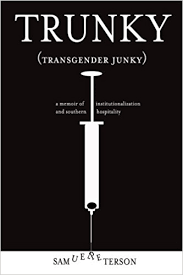
Samuel Peterson’s memoir, Trunky (Transgender Junky) tells the story of the author’s stay in an all-male drug and alcohol rehab facility in the South.

There are probably more personal essays published today than at any other point in history—in part because we’re hungry for authenticity, which we believe we find in “real” stories, as opposed to “reality” programming, but also because it’s easier than ever to publish them. Seneca and Montaigne, the great inventors of the personal essay, didn’t have the luxury of a thousand websites seeking essays or social media opportunities to simply publish whatever you want. It’s difficult to separate the modern personal essay from the medium where we most often find it: online. We read essays the way that we read anything online—with short attention spans and itchy mouse pointers poised over the back button. As always, writers are consciously or unconsciously shaping their essays for their readers, which means that successful essayists are building a kind of constant surprise into their form. Move in any one direction for too long, and readers are likely to get bored. This might seem frustrating (can’t people just pay attention longer?), but there is actually a way to seem to change subjects while also making a larger point.

Samuel Peterson does exactly that in his memoir Trunky (Transgender Junky).

How the Memoir Works

In a personal essay and memoir, there inevitably comes a moment when the writer is called to be smart—to say something wise, spot-on, and on point. You might think that readers would be hooked during these moments, that nothing could distract them. But I think we all understand that’s not true. (How many times have you been talking to someone you love and, while listening, felt your phone n and checked the text or email or notification? Distraction comes naturally to us, even when we ought to, or even want to, be paying attention.)

What’s needed is a way to avoid falling into any kind of rut—of moving in the same direction or making the same point—for too long, leaving readers susceptible to distraction. Of course, good narrative requires that we make larger points and tell longer stories. Something’s got to give, right?

In this passage from later in the book, Samuel Peterson manages to do both. (The book is about his time spent in an all-men’s wing of a drug and alcohol rehab facility. One of the workers is named Jordan.)

The institution was full of remarkable people; he couldn’t imagine himself in any one job maintaining any sort of cool. He had seen Jordan post-cry; if he worked here his eyes would be red all the time too from being a piñata for the men’s suffering, or he would be arrested for actually piñata-ing someone else. the men often were abusive, and it took a special personality (combined with rigorous training, he reflected) to be able to constantly deflect, and then use that moment to condition the men in socially appropriate response.

The masculine ego took poorly to discipline—which made him consider the number of institutions geared towards “breaking a man down to build him up.” He marveled at the way the world treated men, from his father, whose drunken flirtations and general boundary-pushing had been stonily sanctioned, and his brother, who had never been told his endless commentary was less than fascinating. He was both revolted and envious of the kind of clueless and simple confidence men carried because not enough people told them they were assholes and boring.

He understood men would resist this diagnosis, and he appreciated the intense scrutiny masculinity was subjected to, but he knew firsthand that men could never understand what it was like to always be a paler version of yourself because of the assumption of your opinion’s lesser value.

The passage uses topic sentences: “The institution was full of remarkable people…” and “The masculine ego took poorly to discipline…” But only one of the paragraphs actually follows its topic sentence in a straightforward way. “The institution was full of remarkable people” is followed by an example of one of those people—Jordan—and a reflection on his actions. This straightforwardness is important. If writing never moves in a straight line, readers will have a difficult time following it.

The second paragraph breaks this rule. Its first sentence (“The masculine ego took poorly to discipline…the number of institutions geared toward ‘breaking a man down to build him up'”) sets up the expectation that what will follow is examples of one of these points: the ego not responding to discipline or breaking a man down. But that’s not what happens. Instead, the rest of the paragraph gives examples of men’s ego not being disciplined or broken down. It ends with an observation that is both brilliant and obvious (and brilliant because it’s so obvious): “the kind of clueless and simple confidence men carried because not enough people told them they were assholes and boring.”

The paragraph is great because it’s smart but also because it doesn’t give us what we expect. It breaks the logical structure set up by the previous paragraph (point, illustration, explanation—the infamous PIE from college composition classes). As a result, readers are more apt to pay attention. We can’t fall into a lull as we read. We’re jolted into reading more carefully. Peterson’s observation about men’s confidence would is great no matter where it’s placed, but if we read over it without really seeing it, then we’ve missed his point.

The Writing Exercise

Let’s surprise a reader into paying attention, using Trunky (Transgender Junky) by Samuel Peterson as a model:

  1. Find a moment in your essay where you’re talking about something, not what happened. In other words, the narrative of the essay has paused momentarily for you to make a point. You often know this has happened when you start writing sentences that begin, “The thing is…” or “What’s really important…” or “What people don’t realize…”
  2. Give yourself a topic sentence. You might use any of these sentences that start with phrases like “The thing is…” Or you might start with a basic statement, as Peterson does: “The institution was full of remarkable people.” In short, write something that leads to examples.
  3. Give those examples—in a logical way. If you’ve ever written a five-paragraph essay, you know how to do this. If you write, “The food was terrible,” then you’re going to give examples of how terrible it was.
  4. Keep the flow going with another, related topic sentence. I use the word flow grudgingly here. When I taught college composition, my students used it all the time to describe their vague feeling that an essay had gotten off track. “You know,” they’d say, “it just doesn’t flow.” From a craft standpoint, this was not helpful to them. And yet we all know what flow means: a piece of writing continues moving in one direction. So, keep making the same point in the same way. Peterson does this with the sentence that begins “The masculine ego took poorly to discipline…” He just finished talking about people whose job it was to shape men’s responses, so this makes sense. He keeps the flow going.
  5. Break the structure. Instead of giving examples of men’s egos resisting discipline, he instead gives examples of the opposite—of egos unrestrained, subject to no discipline at all. A college comp instructor might advise changing the topic sentence. But that would be boring (and, thus, appropriate for a college comp essay; but this is a personal essay, meant to be interesting). Everything Peterson writes in this paragraph is smart and sharply observed; it just don’t quite flow in the way we expect. The paragraph isn’t completely scattered, though. The word discipline holds together. So, in your paragraph, pick one word from your topic sentence and riff on it in any way that comes to mind. Don’t worry about following logically—about flow. As long as you’re in the ballpark, readers will stay with you. But by moving away from the logical flow, you’ll hold their attention.

The goal is to create and break structure within paragraphs and passages in order to keep readers paying attention.

Good luck.

How to Create Desire with Opportunity

2 May

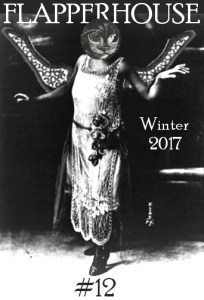
Maria Pinto’s story “Love Song of a Femme Fatale on Scholarship” appears in the Winter 2017 issue of Flapperhouse.

When I was a kid, my dad once claimed that if you left your car running while you ran into a store, it would be your fault if someone stole the car. It was an attractive nuisance, he said, a phrase that is usually applied to things that might prove both tempting and dangerous to children, like trampolines and pools. I’ve been skeptical of my dad’s claim for years, but sure enough, a Google search for “attractive nuisance laws” pulled up this stat: According to a study by the National Insurance Crime Bureau, from 2012-2014, 126,603 vehicles were reported stolen with the keys left in the vehicle. Did the people who owned those cars get blamed for their theft? I don’t know. But the principle is a great one for writers to keep in mind. Instead of asking why a character has a particular desire, it’s sometimes better to simply put a desirable thing in front of them.

Maria Pinto does exactly that in the first paragraph of her flash short story, “Love Song of a Femme Fatale on Scholarship.” It was published in the Winter 2017 issue of Flapperhouse, and you can read it online here.

How the Story Works

Here is the story’s first paragraph:

Something about seeing teacher on the bus, under the yellow light, the ridges of his brown corduroys flaccid, the finger upon which she’d always assumed she would find a gold band if she bothered to look, how the finger tapped at his bony knee, something about the way the finger had a gold band-shaped stripe on it, the stripe pale, a little indented, the way the knuckle hairs had a practiced wither there, how the stripe rendered him vulnerable as a midair-poised ass, hot, pink from slapping, something about all these things taken together made her want to push the moment, to fuck him. She did not interrogate why. She was a freshman; there was only the urgent press of do, do, do.

Notice how vague the rationale for the desire is: “Something about seeing teacher on the bus.” The character can’t really explain her attraction to her teacher; she just knows that she can’t take her eyes off of him. Nothing about the scene or the man is even particularly attractive: the yellow light, his flaccid pants, his bony knee and hairy knuckles. And yet the woman begins to fantasize about having sex with him. Why?

The answer is, mostly, because he’s there to fantasize about: “the finger upon which she’d always assumed she would find a gold band” turns out to have “a gold band-shaped stripe on it.” Her teacher was married, but now he isn’t. Which means he’s available. And that is all the woman needs to fire up her fantasies—and also basic human nature, “the urgent press of dododo.”

It’s almost identical to a moment in the most recent episode of Veep. A character walks into a hotel hallway, sees a half-eaten room-service sandwich on a tray in the hall, and takes a bite. Why? Because he’s hungry? Maybe. Or maybe he does it because that’s what you do with sandwiches. It’s an attractive nuisance, just like the college instructor with his empty ring finger. Further explanation is not required.

The Writing Exercise

Let’s create an attractive nuisance, using “Love Song of a Femme Fatale on Scholarship” by Maria Pinto as a model:

  1. Identify the aspect of human nature at work. Pinto uses sexuality—people want and need to have sex—but that’s not the only aspect available to writers. To find them, think about the advertisements we see on television, almost all of which appeal to basic human nature: fast food, big trucks, fast cars, cars that sense danger before you do, smiling families, partners who hold your hand as you walk toward a hand-carved wooden hot tub on a cliff overlooking a beach, pharmaceuticals that make you well again. We don’t want these things for logical reasons; we want them because of something deep and essential to our being. Pinto begins her story with “Something about…” Find that something for your character. It’s a broad exercise, but if you can narrow the essential desire down to, say, safety rather than sex, then you’ve got a start.
  2. Create the attractive nuisance. Put something in front of your desiring character. The thing doesn’t even need to be particularly great. Fast food is a good example. It’s disgusting and makes me feel sick afterward, but if I’m in riding in a car that goes through a drive-thru, you’d better believe I’m ordering a value meal. The man that Pinto puts in front of her character isn’t desirable, but he’s there, and so she desires him. In fact, the story is more interesting because he isn’t attractive. If we felt sure that an encounter between would go well, we wouldn’t want to know what happens next.
  3. Reaffirm human nature. If you’ve ever made a regrettable choice in life, someone (perhaps yourself) has asked you, “Why did you do it?” Pinto senses this question looming in the reader’s mind, and so she writes, “She was a freshman; there was only the urgent press of dododo.” In short, she’s made human nature a function of age. She’s created an excuse. Plenty of older people have sex with people they probably shouldn’t, too, but that’s not important. The excuse allows the story to move forward. So, give your character an excuse: she’s young, she hasn’t eaten in a few hours and her blood sugar is low, she just had a fight with her friend. The details of the excuse don’t really matter; what’s important is letting the character (and therefore the reader) off the hook.

The goal is to create story and plot by giving a character something that he or she cannot resist.

Good luck.

How to Warm Your Imagination Up for Metaphor

25 Apr

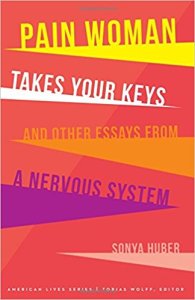
Sonya Huber’s essay, “The Lava Lamp of Pain” is included in her collection, Pain Woman Takes Your Keys and Other Essays from a Nervous System.

When I was starting out as a writer, I would sit at my computer and think, “Okay, now it’s time for a metaphor.” I didn’t know what the image would be, but I had the strong sense that some kind of cool language thing was needed in that moment on the page. So I’d start brainstorming, something like this: “He was so angry. He was a…gorilla…tornado…freight train.” And so on. Metaphor was not my strong suit. Later, in grad school, I would read poetry by the Surrealists and understand that I had, until then, chained my imagination too tightly to the thing I was trying to describe. My metaphors were either too predictable or not actually metaphors (He was so angry…he was a really angry guy). I needed a way of thinking about metaphoric language that could give me enough energy to break away from the most immediate connotations of an image in order to explore less obvious aspects of it.

Sonya Huber does exactly that in her essay, “The Lava Lamp of Pain.” It’s included in her collection, Pain Woman Takes Your Keys and Other Essays from a Nervous System. You can also read the essay online at The Rumpus.

How the Essay Works

The opening paragraph sets up the essays premise and the general direction that its metaphors will take:

Pain moved into my body five years ago. It wasn’t the whack of an anvil or the burn of a scraped knee. This pain sat warmly on the surface of my hands, and reached up to my elbows like evil pink evening gloves. It was a sort of swimming cap clenched on my head with blue plastic flowers at the base of the neck, and a nauseating blur in the eyes. At other times the pain was a cold ache at the knuckles, with a frazzle in the stomach and a steady and oblong ache from hip to hip across the pelvis. It was a rigid curled twang in the toes like the talons of a predatory bird.

This language is pretty straightforward, mixing similes (“like pink evening gloves”) with metaphor (pain in her head was “a sort of swimming cap” and pain made her toes “like the talons of a predatory bird”). The passage culminates in this image:

I didn’t know then that I had become a lava lamp of curling invisible storm clouds, filled with a surge of mute motion that might be its own kind of fierce beauty.

This image isn’t so literal. There isn’t the same kind of one-to-one connection between body of pain and lava lamp the way there is with rigid toes and bird talons. It’s the sort of great image that makes readers despair and think, “I could never write something that good.” But Huber didn’t write that image right off the bat. She worked up to it. In fact, the entire essay is filled with sentences that are continually working their way toward something, the way that a car stuck in snow will rock back and forth until it finally breaks free.

Here is another example:

I was the bitchy patient, crying after each doctor’s appointment, crying with fear when they told me they didn’t know what next. I was desperate to be the woman I’d been before. I wanted to claw my way back to the body I knew.

Instead, I was a slave to the sky. I noticed that an impending storm could knock me flat.

The first sentence (“I was the bitchy patient”) isn’t even a metaphor. But it takes the same syntactic form: I was… She uses that form again and again (“I was desperate” and “I wanted to”) until she hits up on “I was a slave to the sky,” an image that isn’t literal and that gets carried on for an entire beautiful paragraph.

She also uses a different syntax. Instead of “I was,” she uses a comma to create the opportunity to riff on an image, becoming less and less literal. Here’s an example:

In place of that quiet physical body, I would have to adapt to a noisy one, a body with the city-buzz of pain always in the background, a chatty zinging body with a thousand-signal radio-buzz jackhammer snatches-of-an-infomercial baby-crying Vincent-Price-ghoulish-laugh violin-cymbals.

When people (and you still hear this sometimes) say that writing can’t be taught, what they really mean is that raw imaginative power can’t be taught. Either your mind can come up with something as great as “lava lamp of pain” or it can’t (or it will come up with something in between can’t and great). But what can be taught is the creative process that creates the opportunity for an imagination to be as great as it can be. This is what Huber does again and again in this essay.

The Writing Exercise 

Let’s create the opportunity for imaginative language and metaphor, using “The Lava Lamp of Pain” by Sonya Huber as a model:

  1. Lay out the basic outlines of the subject. Huber does this at the start of her essay by describing what happened (“Pain moved into my body”) and what it felt like. Metaphor and simile only work if you know exactly what you’re talking about, whether it’s a particular person or place or event or state of being. Start with the practical.
  2. Take first steps into metaphor and simile. Don’t swing for the fences right away. Take a few practice cuts at easy pitches. Huber does this when she compares her pain to a swim cap. Try using this sentence starter: “It was sort of like…” We do this in conversation all of the time. Don’t worry about being literary. Just use whatever image comes naturally.
  3. Attempt a bigger image. Huber writes the lava lamp image. But notice that she approaches it from a place of uncertainty: “I didn’t know then that I had become…” Sometimes, when you try to write, “It was exactly this way,” it sets the stakes so high that your imagination shuts down. Use the “It was sort of like” phrase for as long as seems necessary.
  4. Get into a rhythm. Huber writes some version of “I was…” over and over. Yes, in workshop this sort of repetition is often discouraged, but that’s why it’s important to remember that workshop isn’t the real world. Real readers don’t care about workshop rules. She repeats that syntax until something brilliant pops out.
  5. Riff on an image. Huber gives herself the image of a noisy body and then runs with it. You can do this with any metaphor or simile that you write. Simply add a comma at the end and play a kind of game with yourself, like you do with kids (everyone name a fruit that starts with the letter A). How much stuff can you associate with the image you’ve written?

The goal is to warm up your imagination and let it run for a while.

Good luck.

Create Tension by Using Character Stand-ins

18 Apr
Man and Wife is the debut story collection by Katie Chase. The title story appeared in Missouri Review and Best American Short Stories 2008.

Man and Wife is the debut story collection by Katie Chase. The title story appeared in Missouri Review and Best American Short Stories 2008.

For my money, one of the most intense scenes in any film is the moment in Ridley Scott’s Alien when a character goes into an air duct with the goal of pushing the Alien toward an air lock so it can be sucked out into space. (If you’ve seen the film, you know the scene; it’s everybody’s favorite.) We barely see the Alien. Instead, we track it with a motion sensor which registers both the man in the air duct and the Alien as dots on a grid. One dot draws closer to the other. It’s terrifying—as suspenseful or more than if we saw the actual Alien racing toward the man.

A lot has been written about the scene, in particular how it resulted from Ridley’s small budget. He couldn’t afford crazy special effects. In prose, writers often work under similar restrictions. Every word costs the same, but they aren’t always equally available. So, it’s useful to keep the dots from Alien in mind. A stand-in for the real thing is often as effective or more than the thing itself.

A great example of this approach can be found in Katie Chase’s story “Man and Wife.” It’s included in her collection, Man and Wife, and was originally published in Missouri Review and Best American Short Stories 2008. You can read it online here.

How the Story Works

The story begins with a bold sentence: “They say every girl remembers that special day when everything starts to change.” You don’t have to read very long before realizing that the change isn’t the one we expect. (If you don’t want details of the story spoiled for you, stop and read it now. You’ll be glad you did.)

We learn that the narrator, Mary Ellen, is remembering the day when she was nine years old and was told that her parents had promised her in marriage to a much, much older man, Mr. Middleton. From this point, we meet the husband-to-be and follow Mary Ellen through the elaborate process that will culminate in their wedding. At all times, we’re aware of the looming prospect of sex. It’s mostly addressed obliquely, as in the wry first line, but there are moments when it’s brought to the forefront of the story. For example, Mary Ellen’s mother hands her a book titled Your Womanly Body and says, “This will tell you some of what you need to know about being a wife. I imagine Mr. Middleton won’t expect much from you at first. After all, you’re still very young.”

Yet the prospect of sex presents a problem for Chase. If shown in detail, such a scene would push away many, if not most, readers. So, we never see any sex. But there is a scene like the one from Alien, and it conveys all of the creepiness and horror that is suggested by the premise.

Chase uses Barbie dolls. Mary Ellen loves to play with them, and one day Mr. Middleton comes over to her house unannounced and asks her to take him to the basement to show him her dolls. We’re shown the dolls in close detail:

Mr. Middleton dropped my hand and approached the Barbies’ houses slowly, as if in awe. The toys sprawled from one corner of the room to the other, threatening to take over even the laundry area; the foldout couch, which I maintained took up valuable space, sometimes served as a mountain to which the Barbies took the camper. There was one real Barbie house, pink and plastic; it had come with an elevator that would stick in the shaft, so I had converted the elevator to a bed. The other Barbie home was made of boxes and old bathroom rugs meant to designate rooms and divisions; this was the one Stacie used for her family. The objects in the houses were a mixture of real Barbie toys and other adapted items: small beads served as food, my mother’s discarded tampon applicators were the legs of a cardboard table. On a Kleenex box my Barbie slept sideways, facing Ken’s back; both were shirtless, her plastic breasts against him.

In Alien, there’s a pause when the Alien’s dot disappears and we’re left to wait breathlessly for it to appear again. The same thing happens here. Mr. Middleton chats with Mary Ellen about the materials used in the construction of the dollhouse—the threat has disappeared. And then, this happens:

Then he leaned down and stroked Barbie’s back with his index finger. “Do they always sleep this way?” he asked.

In Alien, when the Alien’s dot reappears, a character screams at the man in the vent to leave, to get out of there. But he’s not sure what to do or where to go. The same is true of what follows in this scene, except that we’re the ones who are freaked out, even as Mary Ellen stays put. We never see the thing itself, unlike in Alien, but the sight of the dolls standing in for that thing is just as unsettling.

The Writing Exercise

Let’s write a pivotal scene with character stand-ins, using “Man and Wife” by Katie Chase as a model:

  1. Know what is implied or promised by the premise. A good test for your story is to finish this sentence: “We know the characters are going to ____.” Or finish this one: “I hope that ___ doesn’t/does happen.” As a side note, if these sentences are impossible to finish, it may suggest that your story isn’t building suspense. After all, dread and hope can only exist if it’s possible to imagine what will happen next.
  2. Search for possible stand-ins. In Alien, the stand-in is an element of technology, which makes sense in a film about space ships in the future. In “Man and Wife,” the stand-ins are Barbies, which, again, makes sense for a 9-year-old character. Perhaps both were planned from the beginning, but it’s just as likely that both Ridley Scott and Katie Chase made use of the objects at hand. So, figure out what sort of objects/items/materials are important to your characters. What would they feel attached to or compelled to keep close?
  3. Incorporate the stand-ins into a scene. Both scenes start with the threat of something and then introduce the stand-ins. Mr. Middleton shows up unannounced (creepy!), and then they go into the basement to see the dolls. This order may be important. If he’d shown up while Mary Ellen was playing with her dolls, it might have felt too heavy-handed. Because he arrives first, creating the tension, the introduction of the dolls is unexpected, which further ratchets the tension because we’re not sure what’s coming. In your story, start writing a scene that feels as though it could be important. Then, introduce your stand-ins. You may not be sure which ones you’ll choose. Try several until one feels right.
  4. Focus on the stand-ins, not the rest of the scene. The scene from “Man and Wife” works so well because everything is channeled through the dolls. In Alien, we can’t see the Alien and so we’re forced to look at the dots. Force your characters to use the stand-ins. Give yourself and them constraints. If they must use the stand-ins (if we’re forced to pay attention to the stand-ins), what happens?

The goal is to create tension by showing an expected scene in an unexpected way. You may eventually reveal the thing itself, as in Alien, or you might not, as in “Man and Wife.” Either way, you’re using stand-ins to build suspense.

Good luck.

How to Create “People Like You”

28 Mar

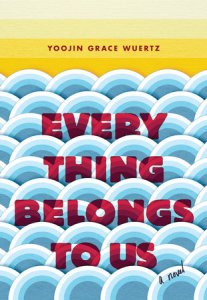
Yoojin Grace Wuertz’s debut novel, Everything Belongs to Us, was called “a Gatsby-esque takedown, full of memorable characters” by the New York Times Book Review.

In real life, we often fall into an “us and them” mentality and then struggle to break free from the restrictive stereotypes that inevitably result. Some of these “us and them” traps are so clear that we have names for them: racism, sexism, classism, homophobia, transphobia, xenophobia. But just because we avoid these (or try to) doesn’t mean that we don’t succumb to others, even in small ways. As the great writer Barry Hannah once told a class of students, “There are two types of people in the world: Those who like the movie Rocky and those who do not.” While this is, on its surface, a far less serious “us and them” binary than, say, racism, anyone who’s gotten involved in a heated argument about aesthetics knows that they can quickly escalate. In life, that’s bad. In fiction, though, it’s good.

A great example of using an “us and them” binary to create character and story can be found in Yoojin Grace Wuertz’s novel Everything Belongs to Us. You can read an excerpt here.

How the Novel Works

The novel follows childhood friends who are now college students in South Kora in 1978.  Jisun’s father is a wealthy businessman, and Namin’s family runs a food cart. They both want to resist the dominant political system, which reinforces their inequality, but they take different approaches. Namin studies hard in order to get a good job, and Jisun pretends to be a factory worker in order to organize the workers in protests. In one of these protests, she gets arrested, but then the police realize who her father is and publicly pull her out of the jail cell and away from her fellow protesters. In this scene, she goes to visit Namin at home, and they get into an argument about how they spend their time:

“So go ahead, spend your life marching and shouting slogans,” Namin had said. “But I can’t. I need this. People rely on me, you know.”

“And you think no one relies on me?”

“Who, Jisun?” she’d said. “Who relies on you? You have no responsibilities! Everything’s always been given to you.”

Jisun had actually stamped her foot like a child throwing a tantrum, raising a low cloud of dust over the courtyard. “No responsibilities?” she’d shouted. “Who do you think I’m doing this for? Why should I work so hard when people like you don’t even appreciate it?”

“‘People like me’?” Namin had shouted, too, forgetting to keep her voice down. The neighbors could repeat this argument word for word in the market for all she cared. “‘People like me,’ you mean, who are helpless, who need big, powerful champions like you to fight their battles? Is that what you think you’re doing? Let me get this straight. Do you actually expect me to be grateful?”

The passage starts with Namin describing how Jisun spends her time, but it’s not simply a factual statement. It’s charged: “So go ahead, spend your life marching and shouting slogans.” Then they get to the heart of the matter: why they do what they do. Who they do it for. And that’s when Jisun breaks out the phrase that changes everything: “people like you.” Notice that it only appears when she’s been challenged—when her motives for something she cares about deeply enough to go to jail get challenged. The relationship has been transformed in ways that will drive the story forward.

The Writing Exercise 

Let’s create an “us and them” binary, using Everything Belongs to Us by Yoojin Grace Wuertz as a model:

  1. Start with an unlikely relationship. Almost every sitcom starts with one: two or more people who are friends/family/coworkers despite seemingly unresolvable differences. In Everything Belongs to Us, the differences revolve around class. They could be anything, but in this novel, in South Korea in 1978, class is a major point of conflict. So, if you don’t yet have your characters in mind, look around the world you want to inhabit. What issues are people fighting over? What are the sides of the argument? Give each of your characters a different side.
  2. Put one of the characters in trouble. The scene starts after Jisun has been 1) arrested and 2) revealed as wealthy in the midst of working-class protesters. Things are not going great for her, which means it’s a great time to put her in scene. Characters (and people) who are stressed tend to act out or without thinking, which is almost requisite to create plot and tension. What sort of trouble has your character gotten into?
  3. Let the other character belittle that trouble. Namin’s response to the arrest is to suggest that protesting isn’t a good idea in the first place. Even worse, she does it in a condescending tone: “So go ahead, spend your life marching and shooting slogans.” It doesn’t matter if she’s right. What matters is that it makes a stressed character want to act out, which she does. So, how can you use tone and dialogue to allow one character to diminish another character’s situation?
  4. Break out the binary. Jisun says, “People like you.” She could have added, “The trouble with…” and it would have fit perfectly. So, try this. Let the character whose trouble has been belittled respond with a statement that begins with “The trouble with people like you…” What does “people like you” mean in the particular circumstances of your story? It’s a statement that automatically leads to conflict. No one ever gets confronted with “people like you” and shrugs it off. Those are fighting words, so let them fight and reveal the tensions that inherently exist between the characters.

The goal is to create tension and story by putting one character in trouble and having another character challenge and belittle that trouble.

Good luck.

How to Create Suspense in Any Story

21 Mar
John Pipkin's second novel, The Blind Astronomer's Daughter, "captures our own awe and sense of puniness as we look at the skies," according to a New York Times review.

John Pipkin’s second novel, The Blind Astronomer’s Daughter, “captures our own awe and sense of puniness as we look at the skies,” according to a New York Times review.

One of those hoary claims about writing that won’t go away is that genre fiction focuses on plot and literary fiction focuses on character and language. I suppose there are bits of truth in that statement, but all you need to do is read John Pipkin’s new novel The Blind Astronomer’s Daughter to realize that the distinction is mostly nonsense.

The novel is the sort of book that shouldn’t be as easy to read as it is. It’s big and ambitious, rich with metaphor and complex characters, and written in the language of its setting: late eighteenth-century Ireland. It’s a book about science and the ways that our understandings of the latest discoveries shape how we understand the people and world all around us. And, in the midst of all that high-literary business, it manages to leap nimbly from page to page because it uses some of the basic elements of creating suspense.

You can read the opening pages here.

How the Novel Works

The novel is, as you might expect, about a blind astronomer’s daughter. Pretty much every word of that title is complicated, though, since she’s not exactly his daughter, he’s not exactly blind, and not exactly an astronomer since astronomy in Ireland two hundred years ago wasn’t the academic science we know today. So, there’s plenty of intrigue in the book. But much of the page-to-page suspense comes from the sort of mechanical strategies we’re familiar with in genre fiction. For example, early in the book, there’s a scene in which the daughter, Caroline, has finally convinced her father, Arthur, to take her to his rooftop observatory. The scene begins like this:

He insists that she tie herself to him.

The short length of thick-braided hemp is already knotted at his waist when he holds the fretted end toward her in the cramped attic. She words her refusal in terms he will appreciate.

“While there is comfort in having you anchor my steps, if you were to falter, the fall would carry us both.” She considers adding that a larger object will ever hold a small in its sway, but decides that this would overstate the point.

He warns her that even now, in the light of midday, there are still shadows ready to deceive, and that she must heed the sharp angle of the roof and hold fast to the railing with her strong hand.

“And there will be wind,” he says.

Caroline has imagine this moment often—her first visit to the observatory—but it seems odd that her father has chosen to bring her here during the day when there is nothing to be seen but blue sky and white clouds. As usual he wears the patch over his left eye, and when she asks him if it is a hindrance in getting to the roof, he explains that he has grown accustomed to climbing the stairs half-blind, that he has learned to translate two dimensions into three, that preserving the eye for the telescope is worth incurring some unsteadiness in his step.

In this short passage, Pipkin has made something as basic as going onto the roof of a house into a riveting question of “What will happen?” First, he starts with a statement that demands explanation (“He insists that she tie herself to him.”) We don’t yet know what’s happening in the scene, and so we naturally think, “Huh?” Then, she refuses to do it. As a rule, refusal is good for tension (unless acceptance means going along with something we understand to be dangerous). Pipkin introduces several elements of danger: shadows, the sharp angle of the roof, and wind. He also writes the scene into a moment we don’t expect it. Astronomer’s work at night, but this is the middle of the day. Finally, Pipkin gives Arthur an eyepatch (as a rule, eyepatches=awesome) and uses the patch to further throw everything a bit off-kilter. It’s one thing to navigate a dangerous place, but it’s quite another to do it without the full faculty of your senses. It’s a trick that every magician understands: they’ll escape an underwater box or stand in front of knives, but first they’ll tie this blindfold over their eyes.

Each one of these is a strategy used every day by genre writers. The only difference is that Pipkin is using them on a rooftop observatory rather than, say, an intergalactic war.

The Writing Exercise 

Let’s create suspense, using The Blind Astronomer’s Daughter by John Pipkin as a model:

  1. Choose the scene you want to write. It doesn’t really matter what scene you choose. It can be one with obvious plot elements or one without. It should contain a kind of set piece: a particular thing happening in a particular place.
  2. Introduce the scene with an unexpected detail. Don’t “set the scene.” Don’t lay out the basic parameters of place and stakes. Instead, focus on one element that, stripped of its context, strikes the reader as unusual. Pipkin ties his characters together with a rope. You want to avoid cheap thrills, of course, and false innuendos. And you can’t do this in every scene. But it’s a great strategy now and then: state something about the characters or place or situation without context, a statement that demands explanation.
  3. Let a character refuse or or accept the premise of the situation. Refusal works because it leads to disagreement, which leads to tension. Acceptance works if the thing being accepted ought to be refused (jumping off that cliff your parents talked about, walking into Mordor). Again, this will require explanation.
  4. Use the explanation as an opportunity to introduce danger. Every scene should contain elements of danger. If there are none, what’s the point of the scene? In this case, the danger is falling off the roof. But the danger might also be saying the wrong word, doing the wrong thing, doing the right thing but getting the wrong reaction, etc. In your scene, what poses a risk to the characters. Let one of the characters enumerate those risks.
  5. Give the scene an element of the unexpected. Pipkin knows we’ll expect the scene to take place at night, so he sets it during the day. There are other ways to play with the basic elements of the scene: something expected that is subtracted or something unexpected that is added. Or, some element is changed: day for night, bedroom for kitchen, outside for inside, work for church, etc.
  6. Impair or heighten one of your characters’ senses. Pipkin makes Arthur wear an eyepatch. He’s used to it, but it’s clear that is increases the risk in the scene. Superhero and comic book movies do this all the time (special powers). War movies and action movies do this in the negative: the hero is always fighting without his weapon or with some grievous wound. How can you impair or heighten your own character’s senses or abilities?

The goal is use these basic strategies for increasing tension in any scene, no matter if the story is literary or genre.

Good luck.

How to Add Interiority in the Midst of Suspense

7 Mar

Alexandra Burt’s novel The Good Daughter tells the story of a woman uncovering secrets from her childhood that some people don’t want her to answer.

The death note for any work of fiction is just that—a single note. When a novel or story is doing just one thing at a time, readers will get bored and walk away. Good fiction, then, juggles multiple elements at once. There are large-scale ways of doing this (multiple points of view, multiple timeframes), but it’s also possible to juggle elements on a sentence and paragraph level. Even when writers are moving between the big building blocks of POV and time, they’re also doing the same thing in small ways because those small shifts are what keep a reader engaged. After all, readers read pages and chapters one sentence at a time, and so writers must hold their attention on that level.

A good example of juggling elements on this small-scale be found in Alexandra Burt’s new novel The Good Daughter. You can read the opening pages here.

How the Novel Works

The novel is a thriller with a slow-burning fuse, driven as much by mood and eeriness as some of the flashier mystery writing tools. The prologue makes this clear. Instead of, say, a murder, it shows us actions that we seem urgent and weird but that we don’t entirely understand: an unexplained and hurried trip, an encounter with the police that ends in a robbery (and not the other way around), a robbery that doesn’t quite make sense, and identities that are tossed aside and replaced with ease. All of this happens in four pages. But the multiple elements aren’t the things that happen. They’re laid out in chronological order, one thing after the other. Instead, the multiple elements are what is happening and what the main character is thinking: exterior action and interior thought.

Here is an example of how Burt shifts between the two. All we know is that a girl and her mom are driving across the country. Here’s the girl:

She opened a bag of Red Vines, sucked on them and then gently rubbed them over her lips until they turned crimson.

Running her fingers across the cracked spine of her encyclopedia—the first pages were missing and she’d never know what words came before accordion; a box-shaped bellows-driven musical instrument, colloquially referred to as a squeezebox—she concentrated on the sound of the pages rustling like old parchment as she flipped through the tattered book.

Her mother called her Pet. The girl didn’t like the name, especially when her mother introduced her. This is pet, she’d say with a smile. She’s very shy. Then her mother moved on quickly, as if she had told too much already.

Pet, the encyclopedia said, a domestic or tamed animal kept for companionship. Treated with care and affection.

The girl opened the encyclopedia to a random page. She remembered when it was new, how the pages and the spine had not yielded as readily, and she wondered if the pages would eventually shed. She attempted to focus on a word but the movement of the car made her nauseous. Eventually she just left the book cracked open in her lap.

“My feet are cold. Can I get a pair of socks from the trunk?” she asked somewhere after the New Mexico/Texas border.

The passage begins with action (“She opened a bag of red vines”) and continues with more action (“Running her fingers across the cracked spine of her encyclopedia”) but then shifts into the character’s head and what she notices about the encyclopedia (“the first pages were missing and she’d never know what words came before accordion” and “the sound of the pages rustling”).

Then, it moves into background information (“Her mother called her Pet”) that turns into the character’s feelings about the name (“The girl didn’t like the name”) and a memory of her mother saying it.

Next, the passage returns to the encyclopedia’s definition of Pet.

The next paragraph starts with more action (“The girl opened the encyclopedia to a random page”) and moves again into memory (“She remembered when it was new”).

Finally she puts the book down and speaks—back to action.

Of course, one might argue that there isn’t much action in this passage, and it’s true. The action consists of reading a book. But it’s just a small passage situated in a prologue about a mysterious cross-country drive and some inexplicable things that happen along the way. Without this moment of interiority, the novel might have a couple of problems. First, the drive would happen too fast, in two pages instead of four. Second, readers might not care what happens because the characters would be simply pieces moved around by the author. Third, readers might not have a sense of the world and how it feels. Sense (or mood) is often, though not always, built with interiority.

So, to create mood, pacing, character, and a sense of the world, Burt must move back and forth between intriguing action and interiority.

The Writing Exercise 

Let’s move back and forth between exterior action and interiority, using The Good Daughter by Alexandra Burt as a model:

  1. Know what is happening—generallyThink in terms of the larger unit (prologue, chapter, section). What is the overall arc? If someone asked your reader, what happened in that part, what would they say? In Burt’s case, the characters seem to be on the run from something. They’re driving. That’s the general happening of the prologue. What is the general happening in the part of your story/book that you’re focusing on?
  2. Zoom in on a smaller piece of action. Within the larger arc, what is happening on the smaller scale. Try phrasing it this way: While they were ____, So-and-so _____. What action fills the second blank? In Burt’s case, it’s the character eating Red Vines and reading the encyclopedia. Notice that she gives her character two things to do. The first action serves as a kind of transition to the second action, taking some of the weight off of it so readers don’t initially read too much into it.
  3. Give the character something to notice while doing this small action. Burt’s character notices something about the page of the book? What does your character notice?
  4. Add information. At a certain point, Burt needs to tell us the character’s name. It’s one of those pieces of information that must be included early in a story/book. Burt chooses one that seems particularly important to the story and drops it in, seemingly out of the blue, but then lets the character react to the information, remember something about the information, and then act based on that information (she looks up Pet in the encyclopedia). So, don’t just add the information. Let it lead back into interiority and then back out again into action.
  5. Zoom back out. Burt moves us out of the character’s head and into less specific action (“The girl opened the encyclopedia to a random page”). Finally she sets the book aside and speaks, and then we’re back into the general action of the drive again.

The goal is adjust narrative pace by creating layers of action and the opportunity to portray a character’s interior state (and also to drop in some basic, unavoidable information).

Good luck.

How to Set Up a Story’s Hook

28 Feb
"The Key Bearer's Parents" by Siân Griffiths appeared online at American Short Fiction.

“The Key Bearer’s Parents” by Siân Griffiths appeared online at American Short Fiction.

A story must hook its readers. Everyone knows this. The problem is that a hook can sometimes feel as if it’s trying too hard. I remember once, when I was a reader for a literary journal, coming across a first line that was something like “He was walking down the freeway with a turd in a bucket.” It caught my eye, sure, but it also felt like something that wanted to be noticed—and that is fine as long as the writer is able to place the hook within a world and story. In this case, it was just a turd in a bucket. Nothing that followed was as interesting or compelling, which means the opening line was a failure.

A great example of a story that places its hook firmly in a story and world is “The Key Bearer’s Parents” by Siân Griffiths. It was published online at American Short Fiction, where you can read it now.

How the Story Works

Here is how Griffiths’ story opens:

We were good parents. We know people assume otherwise when they see our wide ties and honking red noses, but we were. We took that job seriously. We told our son that he could be anything he wanted to be, just like you’re supposed to. Yes, we could see his embarrassment when we showed up for Career Day, how he threw the basketball into the field as our tiny car pulled in so that his friends would look away. And though we were happy clowns, smiles broader and wider than any lips, the disappointment underneath our makeup was easy to read. “It’s fine,” we said, fitting on our over-sized shoes and adjusting the flowers in our hats. We told ourselves that he would get over it.

The hook is obvious: the shock of encountering “honking red noses” in a story that starts off seeming like a realistic story about two parents. It’s sometimes useful to imagine how else a story could have been written, and so here is another version of these opening lines:

When people saw our honking red noses, they thought we weren’t good parents, but we were.

The basic elements haven’t changed: parenting, red noses, and the expectations people have based on those noses. But the effect isn’t the same. This new version is trying too hard, in my view, like a teacher who tries to be cool and uses five-year-old slang. It’s focused entirely on how people will see it and, as a result, doesn’t come off as natural. Griffiths’ actual opening, on the other hand, starts inside the narrators’ heads, focusing on what they believe about themselves: We were good parents. This grounds us. No matter how many unexpected details the story throws at us, we know who these characters are because we know what they worry about.

As the paragraph continues, we get more clown stuff: makeup, over-sized shoes, flowers. These details are humorous and interesting, but we see through them to what matters: the parents’ conflicted feelings as they watch their kid be embarrassed of them.

As with all “rules” for writing, this one won’t hold true all of the time. Sometimes a story will need to start, from the first word, with how a character is viewed. That said, it’s probably a good idea to start a draft inside a character’s head, feelings, and desires. Establish the kernel of humanity—the conflict or desire that readers will intuitively recognize—and then add a honking red nose or turd in a bucket.

The Writing Exercise

Let’s set up a story’s hook using “The Key Bearer’s Parents” by Siân Griffiths as a model:

  1.  Start with the hook. Know what it is. If you’re not sure, tell the first part of the story to someone—anyone, someone you trust or a complete stranger. What detail makes their eyes open wider? If you can’t bring yourself to do this, do it in your head. Which detail surprises? To quote the wisdom of Sesame Street, which of your details is not like the other?
  2. Figure out your character’s self-affirmation. If you’re old enough to remember Al Franken’s Saturday Night Live character Stuart Smalley, you know what I’m talking about. Smalley would repeat to himself, “I’m good enough, I’m smart enough, and, doggone it, people like me!” It didn’t matter if this was true or not. What mattered was that Smalley needed it to be true, the same as Griffiths’ narrators need to feel that they’re good parents. So, what does your character need to be true? How does your character need to be viewed?
  3. Place the self-affirmation before the hook. It doesn’t need to be as over the top as Stuart Smaller’s. Griffith’s first line seems like a basic statement of fact—but, of course, it’s not. It’s a matter of opinion, but it’s stated to plainly that it doesn’t jump out at us—until we read “honking red noses.” Ordering the sentence in this way can make the hook stand out more and also make the essential human need of the character stand out.
  4. Add action. When I was in college, I’d go to the rec center’s weight room, and there’d be enormous guys who’d grunt when they lifted and then drop the weights to the rack or the floor with a bang. They wanted to make sure that everyone saw them because they needed to be seen as strong. Desire always leads to action. Either the character acts, like the guys in the weight room, or the character becomes intensely aware of other people’s actions, like the narrators in “The Key Bearer’s Parents,” who notice every small thing their kid does when they show up. What action (acted or noticed) follows naturally from your character’s desire and self-affirmation?
  5. Don’t forget the hook. Keep it present in the reader’s mind. If you don’t, then it’s a gimmick. But if you commit to it, referencing it whenever possible, in the context of the action and desire, then you’ll create something readers haven’t seen before and they’ll keep reading.

The goal is to hook readers with something surprising and with an essential element of every story: character desire.

Good luck.