
Tag Archives: creative writing prompts

How to Describe a Character’s Mental State

20 May
Nami Mun's novel Miles From Nowhere was a Booklist Top Ten Novel in 2009.

Nami Mun’s novel Miles from Nowhere was a Booklist Top Ten First Novel.

Our tendency as writers is to focus on describing the emotions of the characters closest to us: our narrators or, in the case of third person POV, the character we’re following. We become a Henry James-in-training, trying to capture the minute shifts of perception and feeling that occur inside the characters’ heads. But what happens when we need to describe those shifts of emotion inside a character whose head is closed to us? How do you describe an internal thought process when all you have available is the character’s exterior appearance?

A good example for how to approach this problem can be found in Nami Mun’s story, “Club Orchid.” It was a chapter in her novel Miles from Nowhere, a startling book about a homeless teenager that seemed to come out of nowhere in 2009 and appeared on many best-of lists. “Club Orchid” was originally published in Evergreen Review, where you can read it now.

How the Story Works

The story is about a homeless teenage girl in New York City in the 1980s. She rents a blood-stained mattress at night and has found a job in a brothel. Here is a passage that demonstrates the narrator describing her own thoughts and feelings about the club:

But the club was all right for what it was and I was just glad to come in from the rain. After a whole day of walking around downtown looking for work at grocery stores, gas stations, and donut shops, it was nice to hear someone say you’re hired, just by looking at you. Like I was a model or something. Miss T. didn’t give me any forms to fill out, didn’t ask how old I was or where I went to school. She did ask if I was over eighteen, and I felt bad about lying, but I really needed the money. And to be honest, she didn’t seem to care all that much about my answer. Rajeev the night manager at Bombay Palace Hotel had asked me the same question before renting me a room, and I’d lied to him, too. But I didn’t feel guilty about fibbing to him because he charged too much money.

Notice the indicator phrases: “I was just glad,” “it was nice,” “I felt bad,” and “But I didn’t feel guilty.” These types of phrases are available to a narrator talking about herself. But, they’re not available if she’s describing the interior mind of someone else. Here is a passage that shows how the description changes. The narrator is talking to a man who has hired her services, and she’s failed to follow the act he expected:

I turned back and caught the old man wiping his face up and down with both hands, like he was washing it or something, then he rattled his head to shake off the invisible water. He took a deep breath, held it, then let it out, sending me a wave of garlic and more garlic. His face squeezed out a big clown smile that looked more painful than anything, and he pulled up his chair closer to the table, sitting upright and tall. He was a new man. He was gonna take it from the top.

One key to this passage is that the narrator not only describes the man but mentally engages with the things she is describing. In other words, the thoughts and intentions behind the man’s actions are important to the narrator. She’s in a dangerous and unfamiliar situation, and so it’s necessary for her to figure out what is happening around her. As a result, the narrator provides specific descriptions of the man’s appearance and behavior and experiences these descriptions in different ways: she compares them to actions she’s familiar with (“like he was washing it”) and smells them (“sending me a wave of garlic and more garlic”). She also imagines the physical sensations that he feels (“a big clown smile that looked more painful than anything”). Finally, she interprets his intentions (“He was a new man. He was going to take it from the top.”)

If you go back and look at the first passage, you’ll see the difference. In the paragraph about the man, Mun uses none of the indicator phrases that appeared in the paragraph about herself. This may seem fairly obvious, but in early drafts of stories, it’s not unusual to find writers forcing narrators to convey their own emotions by describing their physical appearance (the most common way is to have a narrator look into a mirror). Or, the writer will force a narrator to describe another character’s emotion without describing that character physically; the result becomes speculation that can make the reader wonder about the narrator’s reliability.

The Writing Exercise

Let’s describe the thought processes and emotions of a character whose head is closed to us, using Nami Mun’s story “Club Orchid” as a model:

  1. Choose the characters. You’ll need a narrator and another character. Give them a relationship (friends, spouses, lovers, siblings, parent-child, customer-service provider, etc).
  2. Determine the situation. You don’t want to choose a scene in which nothing is at stake. Think of the situation as a transaction: the narrator is trying to get something from or give something to the other character (or vice versa). The thing being transacted could be information (where were you last night?), a word (yes or no), an agreement (what do you want to do?), or even engagement itself (talk to me, look at me, don’t ignore me). The thing could also be money or some object or action. I read a lot of Matt Christopher’s baseball novels when I was a kid, and the transactions in them were often between pitchers and batters. The thing being transacted was a baseball, but it was also cues that might give away the character’s intention for that ball (curveball, fastball, changeup). Be specific about what the narrator is trying to get out of the situation.
  3. Let the narrator describe the character using a comparison. So, you’ll need a description of the character (“the old man wiping his face up and down with both hands”) and the narrator’s sense of what that description is like (“like he was washing it or something”). The key is to give the character something to do. Try to avoid gazes (he looked at me like he was a jackal).
  4. Let the narrator engage physically with the description. Again, you’ll need a description of the character (“He took a deep breath, held it, then let it out”) and a way for the character to engage physically with it (“sending me a wave of garlic and more garlic”). The physical engagement can be through any of the four senses other than sight. Your goal is to make your narrator more than a distant observer. It’s one thing to watch somebody have a breakdown through a window, but it’s another to watch it from across the table. Make whatever the narrator is observing difficult to evade or hide from.
  5. Let the narrator imagine the character’s physical experience. In other words, let your character notice something (“a big clown smile”) and then imagine what it feels like (“more painful than anything”). This might be the easiest of the descriptions. One way to approach it is to watch for act and reaction: for instance, a character slamming the table with her fist and then the grimace that immediately follows. Allow your narrator to comment on what he sees.
  6. Let the narrator interpret the character’s intentions. Think of everything that the narrator has described (all of the character’s actions) as a transition from one mental state to another. So, is the character transitioning from joy to anger, from confusion to clarity, from grief to frustration? What is the outcome after these actions take place? Because the narrator cannot escape what is happening (Step 4), this outcome matters a great deal. So, let the narrator try to understand what that outcome might be (“He was a new man. He was going to take it from the top.”)

This exercise may yield a lot of writing. The next stage will be paring it back to a passage that propels the story forward. This likely means simply picking the descriptions that work best.

Good luck!
How to Set the Mood

13 May
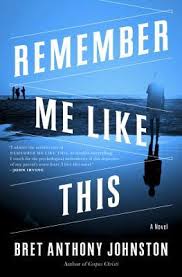
Bret Anthony Johnston's debut novel, Remember Me Like This, has, according to Esquire, a "driving plot but fully realized characters as well"

Bret Anthony Johnston’s debut novel, Remember Me Like This, features, according to Esquire, a “driving plot but fully realized characters as well.”

Every story tries to reveal the kind of story it is from the opening page or opening shot, in the case of film and TV. The opening shots of any given episode of Breaking Bad, for instance, are pretty different from the opening of any episode of Parks and Recreation. One is almost always foreboding and dark, and the other is light, fast, and witty. Even if you were to encounter these shows with no knowledge of them, you’d understand after about five seconds what kind of world and narrative sensibility you’d entered.

Novels and stories must set the mood as quickly as any TV show, and a great example is the beginning (or pretty much any chapter) of Bret Anthony Johnston’s debut novel Remember Me Like This. The book is set on the Texas coast, in and around Mustang Island, a place that can inspire many emotions. But the novel quickly focuses on a specific mixture of them that hints at the story to come. You can read an excerpt at the Random House website.

How the Story Works

Most writers are probably familiar with John Gardner’s famous exercise for emotion in description: “Describe a barn as seen by a man whose son has just been killed in a war. Do not mention the son, or war, or death.” This is a brilliant exercise—unless you can’t do it. I’ve seen very good writers in workshops tackle this exercise and come up with nothing. Yet, Gardner’s goal of establishing emotion and mood through description is still a valid one; the thing that might be tripping up some writers is the exercise’s focus on an emotion stemming from a specific event: the son’s death. Emotion and mood can also be general, as seen in this paragraph from the first chapter of Remember Me Like This. Pay attention to the word choices Johnston makes, the way they seem to have been pulled from a stream with a pan that lets all but a certain kind of word sift out the bottom:

Months earlier, the June heat on Mustang Island was gauzy and glomming. The sky hung close, pale as caliche, and the small played-out waves were dragging in the briny, pungent scent of seaweed. On the beach, people tried holding out for a breeze from the Gulf, but when the gusts blew ashore, they were humid and harsh, kicking up sand that stung like wasps. By midday, everyone surrendered. Fishermen cut bait, surfers packed in their boards. Even the notoriously dogged sunbathers shook out their long towels and draped them over the seats in their cars, the leather and vinyl scalding. Lines for the ferry stretched for half an hour, though it could seem days before the dashboard vents were pushing in cool air. Porpoises wheeled in the boats’ wakes, their bellies pink and glistening.

You may have paused at these words and phrases: gauzy, glomming, close, pale as caliche, played-out, dragging, holding out, humid and harsh, stung like wasps, surrendered, cut bait, dogged, scalding. And, of course, there’s the static image of the cars lined up, waiting for the ferry. Taken together, the words don’t describe a particular emotion so much as a general sense of an end of things. If this was a film, it might be called a tone poem: the mood is unmistakable. As readers, we’re made uneasy.

And then there’s that last line: “Porpoises wheeled in the boats’ wakes, their bellies pink and glistening.” Its tone is markedly different, even the opposite of everything that came before it. It might be tempting, if reading this in a workshop, to suggest cutting the sentence. But, in fact, it might be the most important line in the paragraph. It’s the postcard from Hawaii taped to the bathroom mirror in a Chicago apartment in February—the reminder, good or bad, that there are other ways of being and other perspectives on the world. Placing this bright line in a dreary description makes the dreariness even harder to bear. It also suggests that there are entities in the world that relish conditions that the rest of us find unbearable.

The Writing Exercise

Let’s set the mood in a story, using the passage from Bret Anthony Johnston’s novel Remember Me Like This as a model:

  1. Choose the place to describe. Be specific. Johnston shows us a particular spot on the beach. In the prologue, he focuses on the Harbor Bridge in Corpus Christi.
  2. Choose the moment to describe it. Descriptions tend to focus on moments of transition. So, Johnston shows us the beach as the weather is driving the surfers, fishermen, and sunbathers away. The bridge in the prologue is shown at its beginning and then in the moments before and after a group of people walking over discover something terrible. So, think about what often happens in the place you’ve chosen. Or think about an incident that occurs there in your story. Describe the place just before or after that moment has occurred.
  3. Choose the emotion or mood. Unlike your choice of place, specificity is less important here. It might even be easier to think in terms that are tangential to emotions: positive, negative, bright, dark, still, frenetic. Emotions like joy, sorrow, anger, or jealousy can be too pointed and produce obvious personifications: skies shedding tears, happy breezes, etc. Leave room for the language to surprise you. Sometimes you’ll discover lines like this one from Denis Johnson’s Tree of Smoke: “a child up on its knees on the mattress howled out of a face like a fist.”
  4. Choose a narrative arc. Think of the description as a story, with a beginning, middle, and end. For instance, Johnston begins with the weather conditions, which drive the people away, who then sit in line for the ferry while the porpoises swim. In other words, the end of the description should be different from the beginning: a narrative arc, no matter how small, is a way to ensure this.
  5. Write the description. Keep all of the above in mind: the moment of transition, the arc, the mood. After each phrase or sentence, take a look back at the nouns, verbs, and adjectives in it and ask yourself if they can be changed to fit the mood. Play around with the diction. In Johnston’s paragraph, the difference between “small waves” and “small played-out waves” is small but significant. That difference is the source of much of the pleasure in writing. Challenge yourself to lean toward the mood at every opportunity. If you lean too far, you can always pull back.

It’s possible that these steps may seem overwhelming. You might wonder if Johnston approached the paragraph in this way or if he simply wrote it. The odds are, he just wrote it, and perhaps you will, too. But one drawback to modeling your work after published writing is that you’re trying to achieve the same effect as someone who’s been working for many years. As beginners, we must sometimes parse out the processes that more experienced artists seem to manage naturally, without thinking. So, give yourself permission to scramble these steps, to forget some or focus more heavily on others. Let yourself experiment. You’re giving your imagination room to work.

Good luck!

How to Take Your Characters for a Drive

6 May
Sarah Bird is the best-selling author of The Yokota Officers Club and, now, the much anticipated Above the East China Sea.

Sarah Bird is the best-selling author of The Yokota Officers Club and, now, the much anticipated Above the East China Sea.

At some point in almost every story, characters will move from one place to another. This change in scene ought to be simple, but it can be one of the most aggravating problems writers face. Too often, we try to mimic the actual experience of driving or walking, the way our minds wander across subject and time. Not infrequently, we use a car ride as an opportunity to insert backstory. Maybe this works—and if it does, that’s great. But if it doesn’t—if the reader begins to skim—then perhaps a more succinct strategy is required.

Sarah Bird’s new novel Above the East China Sea demonstrates perfectly how to quickly and effectively move a character through space. You can read an excerpt (and an interview with another great writer, Mary Helen Specht) at Necessary Fiction. You can also find a free sample at iBooks and Amazon.

How the Story Works

Moving from one place to another in fiction is an opportunity for something to happen, for something to change. If a character drives or walks somewhere, and the place she ends up is identical to the place she left and if the things that happen there are the same as the things that happened in the last place, then the move was not important. Unimportant moves should probably be cut from the story. Or, they should be made more impactful.

In this scene from Bird’s novel, notice how much changes along over the course of the drive. You don’t even need to know the plot to understand that something is about to happen:

He flips the photo back onto my lap and pulls into traffic. “I know exactly where and what that is.”

The rain has stopped by the time we leave the broad boulevards lined with royal palms and shops spilling out their glittering merchandise and turn onto narrower and narrower streets until we’re creeping along a nearly deserted back street. On either side are abandoned businesses with boarded-up windows and weeds growing through the concrete steps sporting signs so faded by the sun that I can barely make out the names: Club Kentucky. High Time Bar. The Manhattan. Girls Girls Girls. GI Welcome.

Suddenly, amidst all the gray buildings, we encounter one painted a vivid crimson. The shocking color frames a painting two stories high that depicts a beautiful woman in a red-and-lilac kimono sniffing a flower. A few blocks later there is another painted a shocking pink. A two-story poster depicts a pair of animé girls in French maid costumes, breasts overflowing laced bodices. An invisible fishing line hoists up the backs of ruffled skirts to reveal the clefts of their butts. With a weirdly sarcastic tone, Jake translates the caption beneath the girls: “‘Welcome home, Mr. Married Man. Your wife is out shopping for the day. Is there anything we can do for you before she gets back?’”

Two important things happen in this passage:

  1. The change in place corresponds to a change in something else. Obviously, the characters have driven to a different part of town. The streets look different, and this difference is an indicator that the people who live and work on those streets are different as well. They have less money and less opportunity. In short, this is the economic hinterland of the city. The things that happen here are not the same things that happen on the “broad boulevards lined with royal palms and shops spilling out their glittering merchandise.”
  2. The characters discover something unexpected. Yes, one of them is driving and knows what they’re going to find, but, for the narrator, the brightly painted buildings are new. At a very basic level, this discovery sets up suspense: What are these buildings? What happens inside them? Why has this person brought me here? This suspense is important because it forces the readers to recalibrate their expectations. We were led methodically down gradually narrowing streets, to a poorer, forgotten part of town, and then suddenly things have changed. The expectations we had for “abandoned businesses with boarded-up windows” are no longer useful.

In almost every kind of fiction, a trip usually indicates that something is about to happen. If you find yourself writing scenes that change locations aimlessly, it can be a sign that something deeper is wrong with the story. Those kind of “smart bombs” as one of my former teachers once called them can be immensely helpful; recognizing them helps you begin revising sooner.

The Writing Exercise

Let’s change locations in a story, using the passage from Sarah Bird’s novel Above the East China Sea as a model:

  1. Choose the point of origin. What kind of place is it? Is it a neighborhood, a business, a park? Is it private or public? What kind of area is it? Rural, urban, or suburban? Wealthy, poor, working class, or white collar? Are its fortunes rising or falling? Once you’ve got the place set in your mind, write a few descriptions of it that convey this information to the reader. Keep in mind Bird’s description of her point of origin: “broad boulevards lined with royal palms and shops spilling out their glittering merchandise.”
  2. Choose the new location. The same questions as before still apply. What kind of place is it? Once you’ve got it set in your mind, pick some descriptors that tell the readers what they need to know.
  3. Transition between locations. The easiest way to do this is to find a description from the point of origin that can be continued into the new location. Bird uses streets: their width and appearance and the buildings along them. This trailing description allows the reader to do what we all do in real life. As we drive somewhere, we mentally chart what is happening around us and make educated guesses about what those changes mean. So, look back at the descriptions you’ve written so far. Are any of them parallels? Can you easily connect a description from the point of origin to a description of the new location?
  4. Introduce something unexpected. The discovery can be totally unexpected (“Nobody expects the Spanish Inquisition”), or it can fit within the world you’ve brought your character into. Bird introduces brothels after taking us to an economically disadvantaged side of town. It’s not shocking that they’re there. Instead, the surprise is that any number of things are likely on that side of town, and this is the thing we’ve found. In other words, treat your new location like the backdrop on a stage. The scenery gives the audience a clue about what will come, but the actual scene must still surprise us. You’re creating expectations with the transition, and now you must both fulfill and scramble those expectations. One way to do this is with an abrupt shift in landscape. Interrupt the smooth transition with a quick change. Regardless of what you introduce with the change, the fact that things have shifted so quickly gets the reader’s attention.

You’ll notice that I haven’t talked about plot or story at all. Of course, you’ll need a story to go along with your change of location. But sometimes a change in location can inspire or prompt a story. Play around with different locations and see what happens.

Good luck!

How to Set Up a Power Imbalance

29 Apr
NoViolet Bulawayo's debut novel, We Need New Names, was shortlisted for the Man Booker prize.

NoViolet Bulawayo’s debut novel, We Need New Names, was shortlisted for the Man Booker prize.

A common writing tip is to create a power imbalance between characters. There are obvious ways to do this: give one character a gun. Or, create a structural imbalance (teacher/student, coach/player, rich family/servants). But what if these approaches don’t fit comfortably in your story, and you don’t want to shoehorn them in? You need something more nuanced.

NoViolet Bulawayo’s novel We Need New Names contains many rich, complex portraits of her native Zimbabwe, and one of the many things she does well is reveal imbalances of power. A terrific example can be found in this excerpt, “Blak Power,” published at Guernica, where you can read it now.

How the Story Works

The novel takes place in Zimbabwe during the land redistribution of the 1980s, after the transition to a government led by black, not white, leaders. The excerpt opens with an encounter between some kids, who are picking guavas from a rich neighborhood, and the guard, who has been hired to watch over the gate to one of the houses. The dialogue is funny and menacing. If you haven’t read the excerpt yet—or the novel—these pages of dialogue are worth the time by themselves.

That great dialogue, though, depends on a power imbalance between the guard and kids. Here is how Bulawayo describes the kids seeing the guard for the first time:

“We can tell from his uniform that he is a guard. We haven’t seen any guards in Budapest before so at first we are not so sure what to do with him. He beckons us with his black baton stick, and because we are too close to turn around and run we just walk towards him.”

Already, even though we know very little about the guard or even the kids, we sense the tone of the encounter. A guard ought to convey a sense of authority and power, but the kids are curious more than anything else. They approach him in the spirit of play (“we’re not sure what to do with him”), almost like he’s a caterpillar or some other amusement they’ve happened upon.

Now, watch how Bulawayo describes the guard through the kids’ eyes:

We’re right there with him but he is busy shouting like we are on Mount Everest. He looks us over with his dirty eyes, and we look him back, not answering, just watching him to see what he is all about.

I can’t figure out if he is frowning or it’s his general ugliness. He is tall and his navy uniform looks like it’s just been slapped on him. On his left arm is a discolored white patch with a picture of a gun and the word Security embossed in red letters, and on his breast is a ZCC church badge.

The trousers barely reach the ankles, and his boots are unpolished. He is wearing a black woolen hat and matching gloves, never mind the heat. Everything about him looks like a joke and we know he is a waste of time—if we weren’t this close we’d probably call him names and laugh and throw stones.

Imagine how differently the guard might have been described by someone impressed by or intimidated by his power. For instance, the badge with the picture of a gun might have seemed frightening rather than shabby. But because the kids are not afraid of the guard—because the power imbalance actually runs the other direction, with the kids possessing more than the guard—details that, from the guard’s point of view, are supposed to seem intimidating, are, instead, comical. By the time the narrator says that they’d “probably call him names and laugh and throw stones,” we already understand the power dynamic.

The great dialogue (“Where is your roger-over, can I see it?”) depends on this description to set the stage. (Incidentally, if you read the entire excerpt, you’ll see how the power imbalance plays an important role later on. The kids merely tease the guard, but others will take a more heavy-handed approach.)

The Writing Exercise

Let’s create a power imbalance with description, using the passage from NoViolet Bulawayo’s “Blak Power” as a model:

  1. Choose two characters from any story or vignette you’ve written (or are writing). It doesn’t matter which characters so long as they have an opportunity to interact with each other.
  2. Figure out the power balance. There isn’t an interaction that happens anywhere on Earth that doesn’t have some sort of power balance. Even conversations between friends are charged: who gets the last word? Who picks up the tab? Who determines where to meet, when to leave, or what to talk about? When a disagreement is broached, who politely keeps their mouth shut? Who doesn’t? If a character says something stupid, does the other one call him/her on it? The important thing is to think of power in terms of agency, not force. It’s not a question of one character forcing another to act but, rather, one character being more able to fully inhabit his or her agency. The character with less power censors him/herself or waits for permission or instructions before acting.
  3. Choose one character as a lens to view the other. It doesn’t matter if you choose the more or less powerful character. The key is to pick one. You’re trying to write a description that is conscious of the power imbalance.
  4. Describe the other character, charging each detail. The easiest way to do this is to use the phrase “looks like.” Bulawayo uses the phrase when she writes that the guard’s “navy uniform looks like it’s just been slapped on him.” The charge can also be more subtle. In the next sentence, Bulawayo writes, “On his left arm is a discolored white patch with a picture of a gun and the word Security embossed in red letters.” She could have focused on the gun, but she leads with the word “discolored.” As a result, everything that follows is less impressive. We make judgments like this every day. Someone will say, “Isn’t he great?” And we’ll respond, “Yes, but did you notice…” You might even look back at descriptions you’ve already written. What adjective (like “discolored”) could you add to convey the attitude of the character doing the describing?

The power imbalance doesn’t need to be gaping. Even the slightest imbalance can cause an otherwise uncharged scene to become much more interesting.

Good luck!

How to Write a One-Sentence Paragraph

22 Apr
Adrian Van Young's story, "The Skin Thing," was featured on Electric Literature's Recommended Reading blog and will appear in the forthcoming anthology Gigantic Worlds.

Adrian Van Young’s story, “The Skin Thing,” was featured on Electric Literature‘s Recommended Reading blog and will appear in the science flash fiction anthology Gigantic Worlds.

In composition writing classes, we’re usually taught (or we teach students) not to write one-sentence paragraphs. But, in fiction and nonfiction alike, these short paragraphs can pack a tremendous punch if done well.

Adrian Van Young demonstrates this punch in his story, “The Skin Thing,” which will appear in the forthcoming science fiction anthology Gigantic Worlds. You can read it now at Electric Literature‘s Recommended Reading blog.

How the Story Works

Most writers will, at some point, use a one-sentence paragraph to emphasize some point or moment. Van Young’s story is interesting, then, because he uses so many of these constructions, sometimes to conclude a longer paragraph and sometimes as a series of short paragraphs. The sentences can be long, short, and even fragments.

They tend to be used in one of three ways:

Accentuate a change in tone:

This short paragraph concludes a description of the monster’s actions. In terms of subject and style, it’s really part of the paragraph that precedes it, but it’s given its own line because its tone is different (funnier, sort of):

Just one of us, McSorls, held ground. He was seeking, we think, to protect his allotments. It plucked him up inside its mouth, like the mouth of a puppet, and gobbled him down. Or gummed him down. It had no teeth. The leg of his pants dangled out, disappearing.

The Skin Thing ate his onions, too.

Summarize time and events:

These fragments deliver an accounting of the colonists’ battle with the monster:

McSorls came first. McGaff. McShea. McVanderslice. McGuin. McGreaves…

Colonists total: two-hundred and forty.

Colonists fed to the thing: thirty-six.

Colonists saved on account of this practice (not to mention the onions): one hundred, at least.

Illuminate important images

This paragraph is actually a series of short, connected sentences that focus on a different part of the monster’s body:

It was the height of foursome men, and its body behind was a languishing tube, and its head, although eyeless, was snouted, with nostrils that sucked and blew as it grew near.

Here, the sentences adopt a style of repetition common to speeches. The fragments illuminate a character in a moment of time:

There was:

McGondric in the mess, picking over his onions in no special hurry, a relaxed, dewy look to his under-eye skin.

McGondric going through the camp with his harvest of onions arrayed under cheesecloth, and heavens, his basket, the way that he bore it: offertory, slimly poised.

McGondric alongside his daughter, McGale, as they raked up the sands that comprised their allotment, the pink and the clean-muscled arms of them pushing, and pulling back toward them, and pushing once more.

Instead of moments from a long period of time, though, these two paragraphs break a very short amount of time into even shorter flashes of perception:

And there, behind the sandy glass, we saw a crown of human head.

And under it: a hand. A knee.

All of these one-sentence paragraphs are designed to manipulate the reader’s perception of the events and characters in the story. They speed up or slow down time and direct the reader’s eye.

The Writing Exercise

Let’s write some one-sentence paragraphs, using the passages from Adrian Van Young’s “The Skin Thing” as a model:

  1. Write a sentence that accentuates a change in tone. One way to do this is to create a series: actions, personality traits, qualities, requirements, events, or whatever appears in your story multiple times or has its differences parsed out. The problem with lists is that they can be boring—just a bunch of stuff. In workshops, the writer Tim O’Brien discourages lists for this reason, but of course his famous story, “The Things They Carried,” contains lists in almost every paragraph. So, after a list of ____, he writes, ______. Van Young uses a shift in tone in his story as well, but rather than interpreting the list, the tonal shift adds to the list: literally, one more thing the monster did, but this thing tells us something about the monster’s intentions that the other things did not. So, in your series, search for entries that sound different. Ask yourself, “What does that difference indicate?” Does it make you uncomfortable? Does it seem to cast the other items in a different light? Try putting it at the end and in a separate paragraph.
  2. Write a sentence that summarizes time and events. People who write press releases do this all the time. They use fragments to highlight the impact or actions of a group over time: X number of units sold, X number of services rendered. Fiction writers can do this as well, as Van Young illustrates. In truth, many of us do this naturally, especially when pressed into an argument. We tally up our actions over time: X meals cooked, X hours worked, X kindness delivered or sacrifices made. To do this in a story, figure out what actions your character takes pride in; then, challenge it. How would the character defend him/herself? Try listing the tally in separate lines.
  3. Write a sentence that illuminates important images. There are a few ways to do this. 1) In a static description of a person, thing, or place, instead of using commas to set off attributes (tall, dark, and handsome), develop each adjective into a sentence or phrase of its own (so handsome that I had to look away). Then, connect the sentences with commas or semicolons. 2) In a description of a person, thing, or place in motion, break the motion down into snapshots (as opposed to a running strip of film). What is happening in each snapshot? 3) In a description of an act of perception (I saw…), do not show the entire thing being perceived. Instead, reveal one part at a time. In each of these three methods, you’re focusing on images that writers and readers alike often zoom past. Devoting an entire sentence or phrase to the image can slow readers down, and then you can slow them down further by placing each sentence into a paragraph of its own.

Good luck!

How to Write a Story Ending

17 Apr
Óscar Martínez spent two years traveling with Central American migrants through Mexico on their way to the United States. His essays about the migrants were published in the Salvadoran online newspaper El Faro and collected in The Beast: Riding the Rails and Dodging Narcos on the Migrants Trail.

Óscar Martínez’s essays about traveling with Central American migrants were published in the Salvadoran online newspaper El Faro and collected in The Beast: Riding the Rails and Dodging Narcos on the Migrants Trail.

The easiest part of writing any story ought to be finding the beginning, middle, and end. So why is it often so hard? And why does so much ride on making the right choices?

The Salvadoran journalist Óscar Martínez has written one of the best story endings I’ve ever read in his nonfiction book The Beast: Riding the Rails and Dodging Narcos on the Migrant Trail. Martínez spent two years traveling with Central American migrants through Mexico on their way to the United States. The essays were originally published as dispatches in the Salvadoran online newspaper, El Faro, and translated in this collection from Verso Books. You can read the first chapter at Dazed.

How the Story Works

Martínez tells stories about many different migrants in the book, and one of them is about a teenager named Saúl, who was born in El Salvador but raised in Los Angeles, where he joined the M18 gang. He was deported after robbing a convenience store. The problem was that he didn’t know anything about El Salvador—hadn’t been there since he was four years old—and so he started walking and searching for the man who was supposed to be his father:

And what happened to him is what happens to any kid who doesn’t know what he’s doing in Central America, who thinks any neighborhood is just any neighborhood. A group of thugs turned out of an alleyway and beat him straight to hell.

So, the beginning of the story is pretty simple. The thugs, members of the Mara Salvatrucha gang, take Saúl to their leader, who, in turns out, is his father. Now, watch how Martínez sets up the story’s ending—and how he wraps it up:

“I’m Saúl,” Saúl said, breathless, “I just got deported. And, I swear it, I’m your son.”

The man, as Saúl recounted it to me on top of the hurtling train, opened his eyes as wide as possible. And then he exhaled, long and loud. And then a look of anger swept over his face. “I don’t have any kids, you punk,” his father said.

But in the days following, the man gave Saúl a gift. The only gift Saul would ever receive from his father. He publicly recognized him as his son, and so bestowed to him a single thread of life. “We’re not going to kill this punk,” Guerrero announced in front of Saúl and a few of his gang members. “We’re just going to give him the boot.” And then he turned to Saúl. “If I ever see you in this neighborhood again, you better believe me, I’m going to kill you myself.”

They left him in his underwear in another Mara Salvatrucha neighborhood. He only got out alive by covering himself (and the 18 tattooed on his back) in mud and pretending to be insane.

In short, a gang member has been captured by a rival gang in a foreign country, and it turns out the rival gang’s leader is his father. What incredible tension, right? And how does Martínez handle that tension? He could have given us a moment-by-moment account of arguments, beatings, and who stared down who. Instead he almost everything that happens: “But in the days following.” Why?

To answer that question, it’s useful to ask what those skipped moments could have added to the story. Saúl has already been beaten “straight to hell.” He’s already had a stunning encounter with his father (go back and look at how well the father’s shifting emotions are handled). Whatever comes next must advance this conflict. The problem is that you can’t advance severe beatings and familial rejection. More violence is just more of the same. So, when Martínez skips to the father’s pronouncement, he’s simply finding the moment where something new and different happens. The father changes his mind and doesn’t kill Saúl.

Sometimes condensing scenes—or a series of scenes—of high action actually increases the story’s tension. This is exactly what happens in that final paragraph, the story’s ending. It’d be tempting to describe what happens to Saúl in that other neighborhood minute-by-minute. But nothing Martínez could have written would have been better than the weird, surreal, stunning way that he summarizes the action: “He only got out alive by covering himself (and the 18 tattooed on his back) in mud and pretending to be insane.”

When closing out a story, sometimes one conflict-filled sentence is better than several less tense paragraphs.

The Writing Exercise

Let’s write a story ending by summarizing action and scenes, using the passage from Óscar Martínez’s The Beast as a model:

  1. Summarize the situation and how the character entered it. The point is to get into the story as quickly as possible. The summary should highlight factors that will appear later. If read the entire story from Martínez’s essay, you’ll see how he highlights Saúl’s gang membership and lack of knowledge about El Salvador. Then he skips past everything that happened to Saúl before he ran into the gang members who beat him up. So, you should focus on drawing the shape of the conflict: why your particular person/character is an especially bad match for the situation. (Bad matches in life make for good matches for stories.) Then, find the first significant action that results from that poor match.
  2. Make an outline of everything that happens next. Simply list all of the noteworthy moments from beginning to end. You don’t even need to use complete sentences. It’s an outline.
  3. Mark the moments of highest tension or action. They might be the most tense because of what information is revealed or because of the extremity of what happens.
  4. Are the remaining moments different or similar? Now that you know what your most tense moments are, you can begin carving away at the rest of the moments so that the best ones stand out. To do this, ask yourself if what is left is any different from those tense moments. If not, you can either cut them completely or group them together into a quick summary (a sentence or two) that sets up whatever tense moment comes next.
  5. Offer an escape valve in a sentence or two that restate the conflict. This strategy of summarizing and highlighting can be carried through until the very end. A great way to finish a story is by pivoting sharply. One way to do this is to restate or remind the reader of the conflict that you first presented at the beginning. You can do this with an actual reminder or by finding a moment that distills the conflict (“They left him in his underwear in another Mara Salvatrucha neighborhood.”) Then, offer an escape valve, a way to leave the conflict. Releases tend to be quick (think of a needle and a balloon). Once the reader knows an escape will occur, the writer’s work is mostly done. The tension has been broken. As a result, there’s no need to draw the release out. The quickest version is often the most interesting, as Martínez illustrates: “He only got out alive by covering himself (and the 18 tattooed on his back) in mud and pretending to be insane.”

Good luck!

How to Distinguish Fact from Fiction in an Essay

15 Apr
Óscar Martínez's book of essays about migrants, The Beast, was published in English by Verso books and in Spanish by Icaria Editorial.

Photo Credit: Edu Ponces & Toni Toni Arnau                                 Óscar Martínez’s book of essays about migrants, The Beast, was published in English by Verso Books and in Spanish by Icaria Editorial.

Some stories have been told so many times that they become a genre with rules: when a particular thing happens, the character reacts a particular way. But what if those rules are wrong? For some stories, it’s not enough to tell the truth. You must also consciously distinguish the facts from the fiction that your readers expect. What hangs in the balance is often the humanity of the people you’re writing about.

The Salvadoran journalist Óscar Martínez is telling this kind of story in his book The Beast: Riding the Rails and Dodging Narcos on the Migrant Trail. The essays were originally published as dispatches in the Salvadoran online newspaper, El Faro, and collected in an edition published first in Mexico and now, in English, by Verso Books. The original title in Spanish—Los migrantes que no importan (The Migrants Who Don’t Matter)—gives a sense for what is as stake in the essays. You can read the first chapter at Dazed.

How the Story Works

Martínez tells stories about many migrants, and, taken as a summary with only names and basic events, some of these stories begin to sound like a certain kind of fiction. For instance, Martínez interviews three Salvadoran brothers traveling to the U.S. to escape gang violence. The youngest brother is Pitbull, a 17-year-old who watched his friend Juan Carlos get shot in broad daylight. The next day, he found and put on a police uniform and “went to downtown Chalchuapa looking for the murderer’s accomplice who had gotten away. All day he searched through alleyways and makeshift street shops.” He eventually identified the killers to the police, but the killers recognized him, too, and soon threats were made against his life. If you’ve watched any gang movies, you may have an expectation for what comes next, but this is the point where fact and fiction part ways, as Martínez explains:

If he were a character in a movie, of course, Pitbull would have snooped around, hit up his barrio contacts, tried to put a name to the assassins, maybe put on the police uniform again.

But Pitbull lives in the real world. He ’s just an eighteen-year-old kid steeped in the violence of one of the most dangerous countries on the continent.

Once Martínez establishes that this story will depart from the usual story line, he explains why this departure matters:

What’s more, not even the police reports contain many details. When they killed Juan Carlos—January or February, he doesn’t exactly remember – nine other men between the ages of eighteen and twenty-five were killed, just in Chalchuapa. And Pitbull doesn’t even know if Juan Carlos was his friend’s real name.

“That’s what he called himself,” Pitbull says. “But he was in a gang and he had problems in some of the other barrios. I heard people call him a lot of different names.”

William, José, Miguel, Carlos, Ronal, Unidentified, any of these could have been Juan Carlos. All of these young men were murdered in Chalchuapa in the same month. And even if one were to know the facts of the murder, I have a hunch that, like the facts of so many other migrant murder cases, the details would be so scarce they’d simply disappear. Evaporate. It’d be as if nothing had ever happened.

The risk of turning “true” stories into a fictional genre is that the real people involved are turned into stock characters. When Martínez distinguishes fact from fiction, then, he is, in a way, giving life to the people in his stories.

The Writing Exercise

Let’s try to distinguish fact from fiction, using the passage from Óscar Martínez’s The Beast as a model. This exercise may be most useful as a tool for revision:

  1. Boil a character and story down to a tagline. To do this, choose a character and story (or person and essay) you’ve created and simplify everything about them. What is the quickest version you could tell someone. For help, think of movie posters. They use simple images that show you the essence of the main character and a phrase or short sentence to state the stakes. For instance, the new movie Draft Day has a poster that shows Kevin Costner in a suit and holding a football in front of signs for the NFL draft. The tagline is “The Greatest Victories Don’t Always Happen on the Field.”
  2. State the movie version. Imagine if your character and tagline were put in the hands of a movie producer hoping for a blockbuster—in other words, someone who will likely hew to convention. How would that person pitch your story, especially the conflict? Try to write the pitch as a series of actions in a single sentence. Here’s how Martínez does it: “If he were a character in a movie, of course, Pitbull would have snooped around, hit up his barrio contacts, tried to put a name to the assassins, maybe put on the police uniform again.”
  3. Explain how your character lives in the real world. Keep the explanation short and focused on the nature of the world and how it’s different from the world of movies. You’re basically tweaking the tagline you wrote earlier. Martínez started with barrio contacts and turned them into this: “He ’s just an eighteen-year-old kid steeped in the violence of one of the most dangerous countries on the continent.” How can you sum up your tagline so that it’s not about a character’s individual action but, instead, about the larger forces that operate around that character.
  4. Show how the world impacts the character(s). What choices do the characters make in reaction to the world you’ve just described? In Martínez’s essay, Juan Carlos created aliases to avoid the pockets of violence all around him. These aliases have the effect of making him hard to officially identify by the authorities—or even by the people closest to him. As a result, when he’s found murdered, no one can say for certain who he is. His identify has been spread so thin that he’s rendered almost invisible. Think about the choices your characters make. What are the consequences of these simple, necessary decisions? What impact do they have later on? Or, how do these choices affect the character’s actions once he/she is dropped into the plot or story you’re writing about?

This exercise should work for both fiction and nonfiction. In both, you’re keeping in mind the readers’ expectations about your story due to the previous way it’s been told.

Good luck!

How to Create Speed in Flash Fiction

8 Apr
Juliana Goodman's story, "Hot N' Spicy" appeared as an online feature in Blackberry Magazine, a literary magazine featuring black women writers and artists.

Juliana Goodman’s story, “Hot N’ Spicy” appeared as an online feature in BLACKBERRY, a literary magazine featuring black women writers and artists.

Anyone who’s tried to write flash fiction knows how fast it must move. There’s no time for context or explanation. You’re illuminating a few minutes or seconds of a character’s story, and, if it works, the readers feel as though they’ve peered into Borges’ aleph and seen a much larger world.

But how do you create that dizzying sense of speed? Juliana Goodman’s story, “Hot N’ Spicy” does exactly that. It clocks in at just over 250 words yet reveals an intimate portrait of a relationship. “Hot N’ Spicy” was published at BLACKBERRY, where you can read it now.

How the Story Works

The story captures an intimate portrait of a relationship by showing, not telling. If that sounds suspiciously like the workshop cliché, you’re not crazy. But it’s the key to Goodman’s storytelling. She introduces objects without explanation, allowing the reader to figure out why they’re important. Here is a good example:

He pulls on his dark gray jeans, then a black V-neck. Will he take the hoodie? That’s what I want to know.

Notice the difference in the articles: his jeans, a V-neck, the hoodie. In other words, the hoodie is important. There’s obviously an entire history behind that piece of clothing, but it’s never given to us. Instead, Goodman skips directly to the emotional importance of the object:

I watch him grab it off the sofa and drape it over his shoulder. That’s how I know he’s not coming back. Not tonight.

What matters is not so much the object but what it means: he’s not coming back. Part of the reason this story can be complete with so few words is that it continually skips over context and right to meaning. Here’s another example:

“You’re leaving over tacos?” I ask, and then feel stupid because I sound aggressive and he hates that.

Again, the narrator alludes to past arguments and conflicts but does not tell us anything about them. All that matters is the weight of that history and what it means right now, in this moment: if she acts a certain way, he’ll react in a particular way. Sentences like this provide the flash for this piece of fiction.

The Writing Exercise

Let’s write sentences that move fast, using Juliana Goodman’s story, “Hot N’ Spicy,” as a model. This exercise will work as a brainstorming exercise, but it may be most helpful as a tool for revision:

  1.  Refer to, but do not explain, the history of an object. Goodman does this when she writes, “Will he take the hoodie? That’s what I want to know.” One way to do something similar is by finding an object that either contains meaning. The most obvious example is a wedding ring, but it’d be better to find something more personal to the characters. Put yourself in the room with the characters; what objects are with you? Do the characters have sentimental or personal attachments to them? Another way to approach this is with routine. Does a character always sit in a particular chair? Watch a particular show or read a particular magazine? What you’re looking for is an object that indicates some change in emotion or intention. In a few sentences, explain the importance or role of the object. Then, write a sentence in which the change in emotion or intention or action is happening. How much of the previous explanation can you cut? Can you simply use the sentence with the change?
  2. Make a claim about the future. If characters have spent a lot of together, then they’ve been through certain arguments or interactions enough to anticipate each other’s actions or words. An easy way to show this (and, thus, to skip showing all of those previous interactions) is to make a quick prediction. Goodman writes, “That’s how I know he’s not coming back. Not tonight.” You could also write something like this: “Now, he was going to get defensive.” And, then, he gets defensive. Or, “She was going to fill up her water bottle,” and then she does it.
  3. State a change/modification of behavior with little explanation. Your goal is to portray a shift in thinking or action without being forced to spend time explaining why that shift has occurred. Goodman does this by having her narrator state, after some strongly worded dialogue, “I sound aggressive and he hates that.” The key is often to state what a character likes or dislikes (or, to frame in terms of personality, what a character does or does not do), and move on. What matters is not so much why a preference exists as the effect that the preference (like/dislike, do/don’t do) has on another character.

These exercises are designed for flash fiction, but, in truth, all writers are often trying to condense explanation.

Good luck!

How to Write a Love Story

1 Apr
Seconds Before Sunrise is second book in the Timely Death series, a Young Adult paranormal series by recent University of Kansas graduate Shannon A. Thompson.

Seconds Before Sunrise is the second book in the Timely Death Young Adult paranormal series by Shannon A. Thompson.

I once heard a critic claim that love stories are more difficult to write today than they were for Shakespeare. The obstacles that Shakespeare depended upon—class, feuding families, the fate of stars—have mostly been removed as possibilities, at least in America.

So, if class isn’t an option, how do we put obstacles between lovers in a story other than “he’s just not that into you?” This is a problem that genre literature, especially genres that deal in fantasy elements, handles well. The new YA paranormal novel from Shannon A. Thompson, Seconds Before Sunrise, perfectly illustrates two great ways to complicate a relationship. You can read the opening chapters here.

How the Story Works

I don’t necessarily believe the critic is right, but the idea that class is no longer relevant is still an interesting one. It’s certainly true that when class conflicts appear in fiction, the battle is often quick and decisive. For example, in the film The Devil Wears Prada, Anne Hathaway’s character questions the importance of choosing between two identical belts (in other words, questioning the industry itself). In response, her boss not only says she’s wrong but also insults her clothes as lumpy and unfashionable, saying that they must come from “some tragic Casual Corner.” After that, the movie never questions the class divide again.

So what are other ways to complicate a relationship? This passage (the beginning of Eric’s chapter on page 10) from Thompson’s novel illustrates her approach to complicating a love story (and the approach of many novels that incorporate fantasy elements):

I shoved my head into my locker and breathed hoarsely. It was the first day of school and sitting next to Jessica was already killing me. I wanted to talk to her, hold her, be with her—anything really—but I couldn’t. If the Light realized who or what we were, she’d be killed, and there was nothing I could do except stay away.

“You okay?” Jonathon asked, his voice squeaking through the slits of my locker.

I leaned back to stare at the blind artist. I wouldn’t believe he was Pierce, a powerful shade, if I hadn’t known his identities myself.

“I’m dealing,” I grumbled, unable to keep eye contact as Jessica passed us.

She flipped her brunette curls as she playfully hit Robb McLain’s arm. Robb McLain, with his sparkling teeth, gelled hair, and playboy personality was the perfect jerk.

The narrator and Jessica are in love, but the powers that be are keeping them apart—in this case, the “powers that be” are actual forces with actual special powers. Jessica’s memory has been wiped (though not completely) and other characters are in disguise. In other words, Thompson has invented an obstacle that does not exist in the real world. But she has also added a more realistic obstacle. Though the plot depends on paranormal activities, it’s grounded with a staple of love stories: the beautiful and charismatic, yet so-wrong-for-her, rival.

The Writing Exercise

Let’s introduce complications to love story, using the passage from Shannon A. Thompson’s novel Seconds Before Sunrise as a model. In order to introduce those complications, we first must do the following:

Choose the relationship. It can be a relationship between lovers, of course, but that isn’t the only option. Every story has pairs of characters who develop a relationship with each other: brothers, siblings, parent/child, friends, co-workers, or teammates. All of these relationships work the same. The story is often driven forward by the forces that push these characters together and then pull them apart.

Choose the force of attraction. The most obvious is love. But characters can also be brought together in other ways: their shared history together, duty to a cause or each other, an event like a funeral, or some external force (boss/teacher forcing them to work together). In stories, this force is often clearly identified: “I could never leave her because _____.” Or, “Now, we had no choice but to work together.” Now, we can introduce the force that will disrupt the relationship. There are many ways to do this. Here are some of them:

Forces that can disrupt a relationship:

  • Forces of Class: These are forces whose power comes from differences in social standing: wealth, race and ethnicity, and position within a power structure. Wealth complications, though less common than in the past, still exist in fiction, especially historical fiction. So, The Notebook initially disrupts its characters’ relationship (just before World War II) by having Allie’s parents call Noah “trash.” Romance novels do this all the time: the tycoon’s son seducing the maid. Complications due to race/ethnicity might seem less common (or, again, confined to historical fiction), but they are still used (as in this beautiful story by Tiphanie Yanique). And, relationships in science fiction and fantasy stories (between different kinds of aliens) often mirror realistic stories of racial/ethnic differences. Complications due to power imbalance might be easier to use: bosses and employees, teacher and student, mentor and mentee, player and fan, soldier and civilian, or legal immigrant versus undocumented immigrant. In short, any policy or tradition that grants one person greater power than another is ripe for use in a story.
  • Forces of evil: It’s often useful to say, in a story, that if two characters get together, the bad guys will kill one of them. This is what Thompson does in Seconds Before Sunrise. It’s also the complication used in most adventure stories, like these two favorites from my childhood: Romancing the Stone and The Princess Bride.
  • Characters in disguise: Shakespeare used this a lot in his comedies. Characters—particularly female characters—would disguise themselves, often as men, and go unrecognized by their beloved. The question you must ask yourself is this: why must the character go into hiding? Are they in danger? Are they balancing multiple roles? Are there parts of their lives that cannot be revealed or discussed? The disguise can come in different forms. They don’t always make a beautiful person less beautiful. The story of Cyrano de Bergerac does the opposite by disguising looks with wit.
  • Irreconcilable differences and incompatible goals: This is used by romantic comedies a lot (she’s too serious, and he jokes all the time; she has a career, and he’s a Playboy). It’s also the basis of many domestic dramas. Answer the question: what would make it difficult for these characters to live together, to stand being around each other?
  • External Events: Many stories use external events that separate the characters (soldier shipped off to war, kid left at home over Christmas). The event can also be more intimate, such as the onset of a disease. The film Away from Her (based on Alice Munro’s story “The Bear Came Over the Mountain”) disrupts a relationship with Alzheimer’s, to devastating effect.

Now, you can choose a rival.

Three ways to choose a rival:

  • Pick someone poorly suited as a love interest: This kind of rival is often the complete opposite of the other love interest—beautiful and popular instead of ordinary-looking and nerdy or uncool in some way. Even though the rival’s qualities at first seem appealing, the character who falls in love with him/her eventually realizes the rival’s “true” qualities. This is what Thompson has done: “Robb McLain, with his sparkling teeth, gelled hair, and playboy personality was the perfect jerk.” This kind of rival often creates a plot whose focus is on revealing the rival’s true personality.
  • Pick someone similar to the other love interest: What if the rival isn’t easy to hate? What happens if I love So-and-so, but she falls in love with someone who is just like me, but not me? This kind of rival creates a plot whose focus is on the other person (me) finding ways to distinguish him/herself.
  • Pick a random person. The scary thing about finding your beloved in love with someone else is that it may mean your beloved is far different than you thought. A random rival (someone whose qualities are neither good nor bad, just unexpected) often creates a plot whose focus is revealing the beloved’s true personality. In other words, it shows that the other person (me) has been pursuing someone with whom he/she is poorly matched.

This may seem like a lot of information. In a nutshell, all you need for a love story is an attraction, a disrupting force, and a rival.

Good luck!

How to Write Ideas into Fiction

25 Mar
Aliette de Bodard's story, "Immersion" appeared in Issue 69 of Clarksworld Magazine.

Aliette de Bodard’s story, “Immersion” appeared in Issue 69 of Clarkesworld and won the Nebula and Locus prizes for Best Short Story.

When I was in an undergraduate fiction workshop at Kansas State University, my teacher told us not to worry about what our stories were about. Focus on the characters and plot, he said, and the rest will sort itself out. This is often good advice—but not always. Some stories are about ideas, and the issue becomes not how to momentarily forget those ideas but, instead, how to attach them to the characters and plot so that they read as story rather than apart from it.

One genre that consistently tackles big ideas is science fiction. And one of the most interesting new science fiction writers is Aliette de Bodard, whose story, “Immersion,” appeared in Clarkesworld and won or was nominated for pretty much every award possible: Nebula, Locus, and Hugo Awards for Best Short Story. You can read “Immersion” at Clarkesworld‘s website.

How the Story Works

The story states its ideas outright. It’s about a piece of technology that allows its user to drop into a world and culture that isn’t their own and still communicate. In the story, de Bodard writes that certain people “believe that you can take a whole culture and reduce it to algorithms; that language and customs can be boiled to just a simple set of rules.” She also writes that the technology takes “existing cultural norms, and puts them into a cohesive, satisfying narrative.”

These are strong statements about culture and cultural appropriation, and it’s impossible to not read them as sharp critiques of very real technology in our very real world. The risk that any story runs when stating its ideas in this way is that can begin to feel more like an essay than a narrative. Essays are great, of course, but when readers begin a piece of fiction, they often have little patience for tangents that do not advance the forward momentum of plot and character. So how does de Bodard successfully include these statements in her story?

  1. She applies them directly to a single character. Here’s the story’s first sentence: “In the morning, you’re no longer quite sure who you are.” And why is the character not sure? Because she wears a device that produces an avatar that not only produces an external image but also delivers cultural and linguistic cues directly into the character’s brain. Imagine a Fodor’s guidebook mixed with Siri and the information delivery system in The Matrix. In short, de Bodard has created a machine that turns her ideas into tangible objects with consequences for the characters who encounter with them.
  2. She makes the plot hinge on the character’s decision. The story begins by asking the character who she is, and the plot follows an attempt to answer that question. Three of the characters (her husband, Quy, and Quy’s sister) are actively pushing or, at least, tangentially giving her space to answer that question, but the technology (the immerser) is pushing back. It wants to supply its own answer. In a way, the plot is similar to any story about powerful external influence (addiction, cults, relationships with manipulative partners). Because the technology is a character with (almost) a will that it exerts, it makes perfect sense for de Bodard to write that the immerser takes “existing cultural norms, and puts them into a cohesive, satisfying narrative.”

The Writing Exercise

Let’s write ideas into a story using Aliette de Bodard’s story, “Immersion,” as a model:

  1. State your ideas. What is your theory about _____? de Bodard is writing about cultural appropriation, and you can write about something equally large. Or, you can focus on something smaller. To get you started, how would you finish this sentence? The thing about (pick your group of people) is ______. For instance, you’ll sometimes hear people claim that certain men suffer from small-man syndrome; i.e. the guy is short and making up for it. Congressman Paul Ryan recently blamed poverty on inner-city people who don’t know how to work. President (at the time, candidate) Obama once said about Midwesterners that “”it’s not surprising then that they get bitter, they cling to guns or religion or antipathy to people who aren’t like them or anti-immigrant sentiment or anti-trade sentiment as a way to explain their frustrations.” (Interestingly, when my Midwestern, religious, gun-owning father heard this, he thought it seemed about right.) All of these statements are basically ideas or theories about human behavior. de Bodard’s ideas are more rigorously academic, but they are still about human behavior. So, what’s your theory about 1) why people act the way they do or 2) the systematic consequences of that behavior?
  2. Create a machine that turns those ideas into things. This can mean a literal machine like the one de Bodard has created. The point of the machine is to put your character into an existential dilemma that is tied to the theory you have developed. So, if you believe in short-man syndrome, you might create a machine that makes tall people short. If you’re a Paul Ryan acolyte, your machine would make people unwilling to work (a city full of unwilling scriveners). Or, if you agree with the president, your machine might make people bitter in order to see what they cling to. But your machine doesn’t need to be an actual machine. I’ve already mentioned that addiction or cult personalities can fulfill many of the same functions. But so can the circumstances you create: if you want to make a character bitter enough to hate foreigners and brandish guns, there are realistic ways to do that. Melville found a way to make Bartleby avoid work. Many stories are filled with characters who suffer illnesses or accidents that change their physical appearance. In short, you can use the world of your story to drive your character into a situation that forces them to act.
  3. Make the plot hinge on the character’s action. How will the physically altered character react, and how will that reaction the ones she loves? If the character refuses to work, even in the face of extreme poverty, will someone eventually step in to help or not? Will the bitter character use the gun you’ve given him against the people he blames for his misfortunes? Turn the plot into a question of the path your character will take? The story can end once the decision has been made. Or, it can proceed from there to show the effects. Either way, you’re turning your initial ideas into a story that may have room for the statement of those ideas.

Good luck!