Tag Archives: how to write a novel

An Interview with Bret Anthony Johnston

15 May
Bret Anthony Johnston's story collection, Corpus Christi, was named Best Book of the Year by The Independent and the Irish Times. He has just published his first novel, Remember Me Like This.

Bret Anthony Johnston’s first book, Corpus Christi: Stories, was named Best Book of the Year by The Independent and the Irish Times. His new novel, Remember Me Like This, tells the story of a boy who disappears in Corpus Christi and then mysteriously turns up.

Bret Anthony Johnston new novel Remember Me Like This, tells the story of a Corpus Christi family whose young son disappeared for years and then mysteriously reappeared. A review in the Washington Post says that the book asks, “But what happens after the cable news hysteria fades away, and the mayor issues a proclamation and the tearful grandparents fly back home? Are these rare families like lottery winners who celebrate in public and then, in the months that follow, squander their good fortune?”

Johnston is the author of Corpus Christi: Stories, which was named a Best Book of the Year by The Independent (London) and The Irish Times, and the editor of Naming the World and Other Exercises for the Creative Writer. He currently serves as Director of Creative Writing at Harvard University.

In this interview, Johnston discusses suspenseful imagery, the challenge of finding the right tone, and his approach to place in fiction.

To read an excerpt from Remember Me Like This and an exercise on setting the mood in fiction, click here.

Michael Noll

The novel begins with a body facedown in the water. This image doesn’t return until almost the end of the novel. In fact, it’s almost possible to forget about it since it’s not long before the drama of the novel takes over. What went into your decision to open the novel with that image? Did you worry that the reader would become impatient with wanting to return to it?

Bret Anthony Johnston

My hope was that the image would embed itself in the reader’s subconscious memory, that it would be something of a shadow that followed them through the story. I wanted them to wonder about the body; I wanted it to keep them from getting too comfortable in the story, to preclude them from taking survival for granted. That is, I wanted them to share the experience that the family endures. Starting the book that way seemed to invite a necessary kind of empathy. Of course you’re right, though, in that it’s almost possible to forget about the image. That’s the gamble I had to take so that when the body returns, the reader is jolted and yanked back toward a kind of raw vulnerability. I hope it works. If it didn’t, don’t tell me.

Michael Noll

The scene where Justin appears for the first time is really well done and uses a deft trick of misdirection. I can imagine that scene was difficult to write. The readers been waiting for it intently, and so there’s a need to both meet and confound their expectations. How did you approach that scene?

Bret Anthony Johnston

Your reading of the scene, the craft behind it, is incredibly accurate and I really appreciate such close reading, Michael. Thank you. What you’re pointing out, though, actually came with relative ease—meaning, it was stunningly difficult and time-consuming, but still not as difficult or time-consuming as other scenes—because it was the result of empathizing with the characters. I only had to understand what the characters would be feeling in that moment, and because I knew them well by that point in the book, their reactions were readily available. Once I understood that she would fixate on her memory him being afraid of snakes, I felt really at home in her reaction.

What took an enormous amount of time was striking the right balance in what might be called tone. I revised and revised and revised to get the scene to move evenly toward the revelation. I struggled with the pace for many drafts. I struggled with the cop’s reaction and the district attorney’s entrance. As you say, it was a scene that we were all waiting to see—not least the writer and the characters—and I took care not to speed through it or linger in an indulgent, self-defeating way. One of the pieces of advice that I regularly dole out to my students is to engage the opposite emotion of what the reader would expect, and I relied on that here. The expectation, I thought, would be hopefulness, but I didn’t think these characters had much hope left in them. I saw that as an opportunity, a way in.

Michael Noll
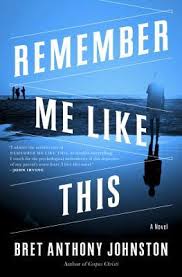
Bret Anthony Johnston's debut novel, Remember Me Like This, has, according to Esquire, a "driving plot but fully realized characters as well"

Bret Anthony Johnston’s debut novel, Remember Me Like This, has, according to Esquire, a “driving plot but fully realized characters as well.”

The novel returns to certain places (the empty pool at the “half-razed TeePee Motel” and the Marine Lab). The places begin just as places where the characters go, but over the course of the novel, several of the most important events occur there. Did you have certain dramatic scenes in mind when you first introduced those places into the novel? Or, did you explore the places and return to them until the drama presented itself?

Bret Anthony Johnston

The latter. When I start writing anything, I have no intentions of any kind, and the novel was no different. I approach every piece of fiction the same way, which is to pay attention to the details, images, and artifacts of the story and take nothing for granted. My impulse is to reach backwards in a story rather to stretch forward, so I’m always asking myself what’s already in play that I can use again, that I can recycle in a manner that will reward the reader’s attention. It’s a mechanism of repetition and evolution. In this case, I returned to various places until those places evolved to mean something other than what they had. I think a lot of new writers are excited by the prospect of constantly bringing in new material, new imagery or settings or objects, but I think the more satisfying move is often to juggle what you already have so that the reader sees something familiar in a new, more revelatory light.

Michael Noll

It’s been ten years since Corpus Christi: Stories was published. Since then you’ve continued to write stories, and you’ve also published a book of creative writing exercises and written a film documentary about skateboarder Danny Way. Plus, you direct the writing program at Harvard. In other words, you’ve been pretty busy. And yet, I can imagine there was pressure to produce a novel, especially since your first book was so well received. How were you able to resist that pressure, to discover the novel you wanted to write and then write it at a pace that would allow it to become the book you had in mind?

Bret Anthony Johnston

You’re absolutely right about the pressure, but I regard any kind of pressure as a privilege. I’m incredibly fortunate to have editors and readers who want to read my work, and I refuse to take that as a given. Honestly, it still surprises me. It really does. It surprises me to the degree that I don’t fully believe anyone when they ask to read something I’ve written; I think they’re just being nice.

And yet it’s always been clear to me that I’m a slow writer and there will be years between the books that I’m lucky enough to publish. Meaning, I don’t want to publish something until I think it’s ready, until I’ve written the book I want to read, because it will be a long, long time before I have the opportunity to redeem myself. What this means is that I’ve missed many deadlines. I know I missed at least three for the novel, though maybe I missed more. The book just wasn’t ready, and publishing it would have seemed a kind of malpractice. I always gave the publisher the opportunity to cancel my contract, and I apologized profusely, but I also wouldn’t show them the book until it was ready. I worked with an amazing editor named Kendra Harpster, and she was beyond supportive. Not only would the book not have been published without her, the published book wouldn’t be nearly as successful without her guidance. It’s another way that I got lucky. I’ve been lucky my whole career. Lucky and slow, that’s my life as a writer. I wouldn’t change it for the world.

May 2014

Michael Noll

Michael Noll is the Editor of Read to Write Stories.
How to Set the Mood

13 May
Bret Anthony Johnston's debut novel, Remember Me Like This, has, according to Esquire, a "driving plot but fully realized characters as well"

Bret Anthony Johnston’s debut novel, Remember Me Like This, features, according to Esquire, a “driving plot but fully realized characters as well.”

Every story tries to reveal the kind of story it is from the opening page or opening shot, in the case of film and TV. The opening shots of any given episode of Breaking Bad, for instance, are pretty different from the opening of any episode of Parks and Recreation. One is almost always foreboding and dark, and the other is light, fast, and witty. Even if you were to encounter these shows with no knowledge of them, you’d understand after about five seconds what kind of world and narrative sensibility you’d entered.

Novels and stories must set the mood as quickly as any TV show, and a great example is the beginning (or pretty much any chapter) of Bret Anthony Johnston’s debut novel Remember Me Like This. The book is set on the Texas coast, in and around Mustang Island, a place that can inspire many emotions. But the novel quickly focuses on a specific mixture of them that hints at the story to come. You can read an excerpt at the Random House website.

How the Story Works

Most writers are probably familiar with John Gardner’s famous exercise for emotion in description: “Describe a barn as seen by a man whose son has just been killed in a war. Do not mention the son, or war, or death.” This is a brilliant exercise—unless you can’t do it. I’ve seen very good writers in workshops tackle this exercise and come up with nothing. Yet, Gardner’s goal of establishing emotion and mood through description is still a valid one; the thing that might be tripping up some writers is the exercise’s focus on an emotion stemming from a specific event: the son’s death. Emotion and mood can also be general, as seen in this paragraph from the first chapter of Remember Me Like This. Pay attention to the word choices Johnston makes, the way they seem to have been pulled from a stream with a pan that lets all but a certain kind of word sift out the bottom:

Months earlier, the June heat on Mustang Island was gauzy and glomming. The sky hung close, pale as caliche, and the small played-out waves were dragging in the briny, pungent scent of seaweed. On the beach, people tried holding out for a breeze from the Gulf, but when the gusts blew ashore, they were humid and harsh, kicking up sand that stung like wasps. By midday, everyone surrendered. Fishermen cut bait, surfers packed in their boards. Even the notoriously dogged sunbathers shook out their long towels and draped them over the seats in their cars, the leather and vinyl scalding. Lines for the ferry stretched for half an hour, though it could seem days before the dashboard vents were pushing in cool air. Porpoises wheeled in the boats’ wakes, their bellies pink and glistening.

You may have paused at these words and phrases: gauzy, glomming, close, pale as caliche, played-out, dragging, holding out, humid and harsh, stung like wasps, surrendered, cut bait, dogged, scalding. And, of course, there’s the static image of the cars lined up, waiting for the ferry. Taken together, the words don’t describe a particular emotion so much as a general sense of an end of things. If this was a film, it might be called a tone poem: the mood is unmistakable. As readers, we’re made uneasy.

And then there’s that last line: “Porpoises wheeled in the boats’ wakes, their bellies pink and glistening.” Its tone is markedly different, even the opposite of everything that came before it. It might be tempting, if reading this in a workshop, to suggest cutting the sentence. But, in fact, it might be the most important line in the paragraph. It’s the postcard from Hawaii taped to the bathroom mirror in a Chicago apartment in February—the reminder, good or bad, that there are other ways of being and other perspectives on the world. Placing this bright line in a dreary description makes the dreariness even harder to bear. It also suggests that there are entities in the world that relish conditions that the rest of us find unbearable.

The Writing Exercise

Let’s set the mood in a story, using the passage from Bret Anthony Johnston’s novel Remember Me Like This as a model:

  1. Choose the place to describe. Be specific. Johnston shows us a particular spot on the beach. In the prologue, he focuses on the Harbor Bridge in Corpus Christi.
  2. Choose the moment to describe it. Descriptions tend to focus on moments of transition. So, Johnston shows us the beach as the weather is driving the surfers, fishermen, and sunbathers away. The bridge in the prologue is shown at its beginning and then in the moments before and after a group of people walking over discover something terrible. So, think about what often happens in the place you’ve chosen. Or think about an incident that occurs there in your story. Describe the place just before or after that moment has occurred.
  3. Choose the emotion or mood. Unlike your choice of place, specificity is less important here. It might even be easier to think in terms that are tangential to emotions: positive, negative, bright, dark, still, frenetic. Emotions like joy, sorrow, anger, or jealousy can be too pointed and produce obvious personifications: skies shedding tears, happy breezes, etc. Leave room for the language to surprise you. Sometimes you’ll discover lines like this one from Denis Johnson’s Tree of Smoke: “a child up on its knees on the mattress howled out of a face like a fist.”
  4. Choose a narrative arc. Think of the description as a story, with a beginning, middle, and end. For instance, Johnston begins with the weather conditions, which drive the people away, who then sit in line for the ferry while the porpoises swim. In other words, the end of the description should be different from the beginning: a narrative arc, no matter how small, is a way to ensure this.
  5. Write the description. Keep all of the above in mind: the moment of transition, the arc, the mood. After each phrase or sentence, take a look back at the nouns, verbs, and adjectives in it and ask yourself if they can be changed to fit the mood. Play around with the diction. In Johnston’s paragraph, the difference between “small waves” and “small played-out waves” is small but significant. That difference is the source of much of the pleasure in writing. Challenge yourself to lean toward the mood at every opportunity. If you lean too far, you can always pull back.

It’s possible that these steps may seem overwhelming. You might wonder if Johnston approached the paragraph in this way or if he simply wrote it. The odds are, he just wrote it, and perhaps you will, too. But one drawback to modeling your work after published writing is that you’re trying to achieve the same effect as someone who’s been working for many years. As beginners, we must sometimes parse out the processes that more experienced artists seem to manage naturally, without thinking. So, give yourself permission to scramble these steps, to forget some or focus more heavily on others. Let yourself experiment. You’re giving your imagination room to work.

Good luck!

An Interview with Sarah Bird

8 May
Sarah Bird's eighth novel, Above the East China Sea, has been called her most powerful book yet.

Sarah Bird’s ninth novel, Above the East China Sea, has been called her most powerful book yet.

Sarah Bird is the author of eight novels that have been honored by the New York Public Library’s 25 Books to Remember list, Elle Magazine Reader’s Prize, People Magazine’s Page Turners, and Library Journal’s Best Novels. Her latest novel, Above the East China Sea, tells the entwined stories of two teenaged girls, an American and an Okinawan, whose lives are connected across seventy years by the shared experience of profound loss, the enduring strength of an ancient culture, and the redeeming power of family love. Bird has written screenplays for many studios and independent producers and has contributed articles to The New York Times, Salon, O Magazine, and Texas Monthly. As a kid, she moved all over the world with her air force family, and now she lives in Austin, Texas.

In this interview, Bird discusses composting research into story, writing in bed, and why some surprises aren’t good for readers.

To read excerpts of Above the East China Sea and an exercise on moving characters around in fiction, click here.

Michael Noll

You’re an American writing about a place—Okinawa—that has a long, difficult relationship with Americans and the United States. You spent part of your childhood in Okinawa, and so you’re familiar with the island from the American perspective. In this excellent interview with Mary Helen Specht, you said that you tried to imagine yourself “outside of the fence and ask questions like, How would an American would feel if, say, the entire eastern seaboard, were occupied by foreigners?” That seems like a necessary but difficult imaginative leap. How did you approach the problem of crossing that fence, so to speak, and trying to see things from the Okinawan view with as little of the inherently residual American view clouding your perspective? 

Sarah Bird

The major question I wanted to look at in this novel is how the price of imperial ambition is always borne most heavily by the young. That was true when Japanese industrialists seized control of the government around the turn of the century and began militarizing that country. And it’s been tragically true for our country.

History is a kaleidoscope that can be twisted in an infinite number of directions. Settling on the correct lens through which to view both the contemporary and historical stories in this novel required years of education. Like most writers, I was a born observer, outsider, and almost burdened by a high degree of imaginative empathy. So shifting perspective wasn’t hard, but getting the factual context right did require lots of research.

Michael Noll

At one point in the novel, the characters visit a strip of Sōpus, or bath houses. The passage approaches these places a couple of ways. There’s direct description (“The two-story building is covered in bathroom tile and features giant posters of young Japanese girls in sexy nurse uniforms and pink scrubs.”) and also historical summary (“Whorehouse? Technically, no, since prostitution has been illegal in Japan since the mid-fifties.”). The latter seems easier than the former to write: in theory, you’re relaying your research to the reader. But in the direct description, you’re bringing that research to life. How did you approach these kinds of scenes and descriptions? Or, in other words, how did you convert the facts of research into the breath of story?

Sarah Bird

Michael, I love the entire process of converting research into fiction and think of it as composting. I try to toss rich, nutritious items onto the pile, horse manure, food scraps, along with grass clippings and dead leaves. I let it steep for months in a spot that receives ample sunshine. And I trust that a dark, buried world of microbial beings will convert the whole mass into a medium capable of sustaining a character, a story.

For this novel in particular, I spent many happy months researching in libraries, online, and doing personal interviews. Most useful, probably, of all these avenues in creating a character are diaries, personal narratives, and fiction set in the time and place of interest. Then, when it comes time, after this mulch pile has stewed in my brain long enough, I put all my books and notes aside and channel the character. If I’d absorbed enough of the right ingredients, something good usually sprouts.

Michael Noll

Sarah Bird is the best-selling author of The Yokota Officers Club and, now, the much anticipated Above the East China Sea.

Sarah Bird is the best-selling author of The Yokota Officers Club and, now, the much anticipated Above the East China Sea. Signed, personalized copies of the novel can be pre-ordered from BookPeople, the Austin independent bookstore.

The novel takes place in two different time periods (1945 and present day). An inherent risk in this structure is that every time you switch between time periods and stories, you break, at least momentarily, the narrative momentum. Did you find that this was something you had to think about in structuring the chapters and novel as a whole? 

Sarah Bird

Without intending to, I seem to gravitate toward telling stories from two points of view. It was essential for this novel since I wanted to show how we are all formed by our national narratives. This was a right-brain, left-brain process so distinct that worked in two entirely different spots. When I was in full fiction mode, the dreaming, empathy, channeling part, I wrote in bed, in longhand on a yellow pad. That was where the characters spoke to me and I took dictation. For the shaping part I sat at my desk edited the material and made the two girls’ stories cohere.

In the end, I was astonished at how well the two narratives braided together. How, guided by their deepest yearnings, they told stories that wove together and amplified each other.

Michael Noll

The promotional copy for Above the East China Sea describes the novel as a “stunning departure.” I’m curious what this phrase means to you. It’s not like you’ve been writing zombie erotica. At a recent panel sponsored by The Writer’s League of Texas, you described your books as midlist literary fiction. What makes this novel different?

Sarah Bird

Okay, the “stunning departure” thing is a way to signal to readers that this one is not funny. I’ve written both intensely serious books and others that are regarded as comic novels. And, whoa doggies, judging by reviews on Amazon, if a reader comes to you expecting larfs aplenty and they get, oh say, the invasion of Okinawa when more people died than at Hiroshima and Nagasaki combined, well, that is not a happy reader. And that reader departs. Stunned.

May 2014

Michael Noll

Michael Noll is the Editor of Read to Write Stories.

How to Take Your Characters for a Drive

6 May
Sarah Bird is the best-selling author of The Yokota Officers Club and, now, the much anticipated Above the East China Sea.

Sarah Bird is the best-selling author of The Yokota Officers Club and, now, the much anticipated Above the East China Sea.

At some point in almost every story, characters will move from one place to another. This change in scene ought to be simple, but it can be one of the most aggravating problems writers face. Too often, we try to mimic the actual experience of driving or walking, the way our minds wander across subject and time. Not infrequently, we use a car ride as an opportunity to insert backstory. Maybe this works—and if it does, that’s great. But if it doesn’t—if the reader begins to skim—then perhaps a more succinct strategy is required.

Sarah Bird’s new novel Above the East China Sea demonstrates perfectly how to quickly and effectively move a character through space. You can read an excerpt (and an interview with another great writer, Mary Helen Specht) at Necessary Fiction. You can also find a free sample at iBooks and Amazon.

How the Story Works

Moving from one place to another in fiction is an opportunity for something to happen, for something to change. If a character drives or walks somewhere, and the place she ends up is identical to the place she left and if the things that happen there are the same as the things that happened in the last place, then the move was not important. Unimportant moves should probably be cut from the story. Or, they should be made more impactful.

In this scene from Bird’s novel, notice how much changes along over the course of the drive. You don’t even need to know the plot to understand that something is about to happen:

He flips the photo back onto my lap and pulls into traffic. “I know exactly where and what that is.”

The rain has stopped by the time we leave the broad boulevards lined with royal palms and shops spilling out their glittering merchandise and turn onto narrower and narrower streets until we’re creeping along a nearly deserted back street. On either side are abandoned businesses with boarded-up windows and weeds growing through the concrete steps sporting signs so faded by the sun that I can barely make out the names: Club Kentucky. High Time Bar. The Manhattan. Girls Girls Girls. GI Welcome.

Suddenly, amidst all the gray buildings, we encounter one painted a vivid crimson. The shocking color frames a painting two stories high that depicts a beautiful woman in a red-and-lilac kimono sniffing a flower. A few blocks later there is another painted a shocking pink. A two-story poster depicts a pair of animé girls in French maid costumes, breasts overflowing laced bodices. An invisible fishing line hoists up the backs of ruffled skirts to reveal the clefts of their butts. With a weirdly sarcastic tone, Jake translates the caption beneath the girls: “‘Welcome home, Mr. Married Man. Your wife is out shopping for the day. Is there anything we can do for you before she gets back?’”

Two important things happen in this passage:

  1. The change in place corresponds to a change in something else. Obviously, the characters have driven to a different part of town. The streets look different, and this difference is an indicator that the people who live and work on those streets are different as well. They have less money and less opportunity. In short, this is the economic hinterland of the city. The things that happen here are not the same things that happen on the “broad boulevards lined with royal palms and shops spilling out their glittering merchandise.”
  2. The characters discover something unexpected. Yes, one of them is driving and knows what they’re going to find, but, for the narrator, the brightly painted buildings are new. At a very basic level, this discovery sets up suspense: What are these buildings? What happens inside them? Why has this person brought me here? This suspense is important because it forces the readers to recalibrate their expectations. We were led methodically down gradually narrowing streets, to a poorer, forgotten part of town, and then suddenly things have changed. The expectations we had for “abandoned businesses with boarded-up windows” are no longer useful.

In almost every kind of fiction, a trip usually indicates that something is about to happen. If you find yourself writing scenes that change locations aimlessly, it can be a sign that something deeper is wrong with the story. Those kind of “smart bombs” as one of my former teachers once called them can be immensely helpful; recognizing them helps you begin revising sooner.

The Writing Exercise

Let’s change locations in a story, using the passage from Sarah Bird’s novel Above the East China Sea as a model:

  1. Choose the point of origin. What kind of place is it? Is it a neighborhood, a business, a park? Is it private or public? What kind of area is it? Rural, urban, or suburban? Wealthy, poor, working class, or white collar? Are its fortunes rising or falling? Once you’ve got the place set in your mind, write a few descriptions of it that convey this information to the reader. Keep in mind Bird’s description of her point of origin: “broad boulevards lined with royal palms and shops spilling out their glittering merchandise.”
  2. Choose the new location. The same questions as before still apply. What kind of place is it? Once you’ve got it set in your mind, pick some descriptors that tell the readers what they need to know.
  3. Transition between locations. The easiest way to do this is to find a description from the point of origin that can be continued into the new location. Bird uses streets: their width and appearance and the buildings along them. This trailing description allows the reader to do what we all do in real life. As we drive somewhere, we mentally chart what is happening around us and make educated guesses about what those changes mean. So, look back at the descriptions you’ve written so far. Are any of them parallels? Can you easily connect a description from the point of origin to a description of the new location?
  4. Introduce something unexpected. The discovery can be totally unexpected (“Nobody expects the Spanish Inquisition”), or it can fit within the world you’ve brought your character into. Bird introduces brothels after taking us to an economically disadvantaged side of town. It’s not shocking that they’re there. Instead, the surprise is that any number of things are likely on that side of town, and this is the thing we’ve found. In other words, treat your new location like the backdrop on a stage. The scenery gives the audience a clue about what will come, but the actual scene must still surprise us. You’re creating expectations with the transition, and now you must both fulfill and scramble those expectations. One way to do this is with an abrupt shift in landscape. Interrupt the smooth transition with a quick change. Regardless of what you introduce with the change, the fact that things have shifted so quickly gets the reader’s attention.

You’ll notice that I haven’t talked about plot or story at all. Of course, you’ll need a story to go along with your change of location. But sometimes a change in location can inspire or prompt a story. Play around with different locations and see what happens.

Good luck!

An Interview with Shannon A. Thompson

3 Apr
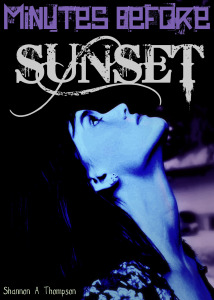
Shannon A. Thompson's novel Minutes Before Sunset was a Goodreads Book of the Month for July. You can read the first chapter here.

Shannon A. Thompson’s novel Seconds Before Sunrise is the latest in the Timely Death series. You can read the opening chapters here.

Shannon A. Thompson is a recent graduate of the University of Kansas and the author of Timely Death Trilogy, a YA paranormal romance series. The latest novel in the series is Seconds Before Sunrise. The first novel, Minutes Before Sunset, was a Goodreads Book of the Month selection.

In this interview, Thompson discusses choosing Kansas over New York for her novel’s setting, when to write multiple points of view, and how to create a community of readers and writers.

(To read the opening chapters of Seconds Before Sunrise and an exercise based on how Thompson sets up the novel’s love story, click here.)

Michael Noll

I’m curious about the importance of place in the trilogy. It’s set in Hayworth, Kansas, which you’ve said is an amalgam of Hays and Ellsworth. This seems, on the surface, like an unusually specific choice for a paranormal romance. The genre states its interests in its name (paranormal and romance), and so the focus of your novels is obviously on the experience of being a shade and the love story between Eric and Jessica. The genre doesn’t really allow for long, lyric passages about place. But does that mean the trilogy could have been set anywhere, or does place matter? To take other examples, place definitely matters in True Blood and Harry Potter, but the American South and England also have much stronger literary histories than central Kansas. In other words, if you set any novel in the South, the reader will have certain expectations. Kansas is more of a blank page, so to speak. How does it impact or color the novel?

Shannon A. Thompson

Understandable question! In the first draft, The Timely Death Trilogy purposely did not have a set place where everything happened. This was because I wanted it to feel like it could happen anywhere, especially right outside your window. Then, in rewrites, I realized I wanted a place, but I didn’t want the stereotypical cities that many novels take place in right now (New York City, Chicago, etc.) I desire more of a “home” feel, something more people can relate to, so I knew I wanted a smaller town, and then I realized I hadn’t read many YA novels in the Midwest, especially fantasy or paranormal based, so I picked Kansas—more or less—as a tribute to the state I lived in during the time of writing the novel.

Michael Noll

The novel is told from two perspectives: Eric and Jessica. How do you know when to switch between them? Sometimes the chapters switch back and forth between points of view, one after the other, but there are also times when Eric gets a couple of chapters in a row. I’m especially curious about the chapters where they are together. How did you decide who got to narrate those chapters?

Shannon A. Thompson

Shannon Thompson's novel "Minutes Before Sunset" was a Goodreads Book of the Month in July.

Shannon A. Thompson’s novel Minutes Before Sunset was a Goodreads Book of the Month. Thompson discusses her approach to POV in the novel at her website.

I actually wrote about how I choose who was speaking on my blog here: Dual Perspectives: Should Characters Have Equal Time to Speak?

To summarize it, I let the characters dictate when they will speak. Since the first novel revolves around the Dark (shades), Eric spoke more, but the second book is focused on what it is like to be a human. Jessica speaks more because of her human background, but it’s a lot more even than the first novel. The third novel, Death Before Daylight, will expose the Light, but I won’t spoil it by saying who speaks more yet. 😀 

Michael Noll

On your website, you give writing tips, and one of them is to avoid inserting technology into fiction—no cell phones, Facebook, Twitter—because it will quickly become obsolete, as flip phones and MySpace have proven. But you also write that excluding technology is a moral choice. You write, “I want young adults to spend more time outside (or reading) and putting an emphasis on social media didn’t sit well with me any longer.” I’m curious how you balance this choice with the fact that social media and technology are becoming integral parts of our lives. Many people (especially teens) cannot use maps, for instance, but instead rely on the GPS apps in their phones. We check our phones constantly (Facebook, Twitter, Snapchat) and even sleep with them. We almost certainly do not plan social gatherings or meetings as far ahead as we did when it was possible to go a day or more without talking to someone. Is it possible that at some point in the future, it will be impossible to write about human life without incorporating phones and social media? Will they become like cars–essential parts of a story?

Shannon A. Thompson

You have a very great point! Yes, technology is part of our everyday lives. However, I still think people will eventually turn away from certain aspects—like how the popularity of MySpace eventually went to Facebook—so I see technology as an unknown expiration date when included in novels. That being said, I see nothing wrong with including social media websites—I loved TTYL when I was younger—but it’s not something I will use in this particular trilogy. I might incorporate it into my future works, but I avoid it for now.

Michael Noll

Many writers (new and old, self-published and those working with publishers) tend to focus on their work but not on the business of publishing. What advice would you give about networking? You’ve been quite successful at building a following. Your author website has more than 14,000 followers. How do you find or attract your readers?

Shannon A. Thompson

I think it’s really important to have a website they can go to. Participate on social media, connect all of your sites, and be willing to understand how the social media changes overtime. Blogging has been my most successful platform. If you’re going to blog, I would suggest keeping a regular schedule with a focused topic range, but it’s more important to connect with fellow bloggers by reading and commenting on writers’ blogs like yourself. Networking is the key to finding fun and entertaining relationships with your readers. Overall, be engaging, entertaining, fun, and informative.

For my website, I began it in September of 2012 under the advice of Robin Hoffman, the Get Published Coach. I started reviewing books and movies, but then I slowly began sharing my story—how I got published and what I was planning on doing in the future. This was before I had my contract for my trilogy. I made sure to begin using a lot of SEO terms in my tags, and through the tags, I found blogs that spoke about similar topics. That’s how I found more writers and readers. Once I did that, I followed trends. For instance, I noticed my book reviews weren’t nearly as popular as my writing tips, so I dropped book reviews and did a long series of writing tips. I also started incorporating my contacts into my blog, which I still do today. On my author Facebook, I will ask questions that followers can answer. If I use their answer, I link to their blog. It’s a way to give back while encouraging a communicating and fun environment. It’s win-win. I honestly believe my every other day schedule is a huge factor, because trends slip majorly on the days I do not blog. Keeping everyone up-to-date is really vital to guarantee return. Having my blog connected with all social facets, so it automatically shares across numerous streams helps. My blog automatically posts on Facebook, Twitter, Google+, LinkedIn, Wattpad, and more.

April 2014


Michael NollMichael Noll is the editor of Read to Write.

How to Write a Love Story

1 Apr
Seconds Before Sunrise is second book in the Timely Death series, a Young Adult paranormal series by recent University of Kansas graduate Shannon A. Thompson.

Seconds Before Sunrise is the second book in the Timely Death Young Adult paranormal series by Shannon A. Thompson.

I once heard a critic claim that love stories are more difficult to write today than they were for Shakespeare. The obstacles that Shakespeare depended upon—class, feuding families, the fate of stars—have mostly been removed as possibilities, at least in America.

So, if class isn’t an option, how do we put obstacles between lovers in a story other than “he’s just not that into you?” This is a problem that genre literature, especially genres that deal in fantasy elements, handles well. The new YA paranormal novel from Shannon A. Thompson, Seconds Before Sunrise, perfectly illustrates two great ways to complicate a relationship. You can read the opening chapters here.

How the Story Works

I don’t necessarily believe the critic is right, but the idea that class is no longer relevant is still an interesting one. It’s certainly true that when class conflicts appear in fiction, the battle is often quick and decisive. For example, in the film The Devil Wears Prada, Anne Hathaway’s character questions the importance of choosing between two identical belts (in other words, questioning the industry itself). In response, her boss not only says she’s wrong but also insults her clothes as lumpy and unfashionable, saying that they must come from “some tragic Casual Corner.” After that, the movie never questions the class divide again.

So what are other ways to complicate a relationship? This passage (the beginning of Eric’s chapter on page 10) from Thompson’s novel illustrates her approach to complicating a love story (and the approach of many novels that incorporate fantasy elements):

I shoved my head into my locker and breathed hoarsely. It was the first day of school and sitting next to Jessica was already killing me. I wanted to talk to her, hold her, be with her—anything really—but I couldn’t. If the Light realized who or what we were, she’d be killed, and there was nothing I could do except stay away.

“You okay?” Jonathon asked, his voice squeaking through the slits of my locker.

I leaned back to stare at the blind artist. I wouldn’t believe he was Pierce, a powerful shade, if I hadn’t known his identities myself.

“I’m dealing,” I grumbled, unable to keep eye contact as Jessica passed us.

She flipped her brunette curls as she playfully hit Robb McLain’s arm. Robb McLain, with his sparkling teeth, gelled hair, and playboy personality was the perfect jerk.

The narrator and Jessica are in love, but the powers that be are keeping them apart—in this case, the “powers that be” are actual forces with actual special powers. Jessica’s memory has been wiped (though not completely) and other characters are in disguise. In other words, Thompson has invented an obstacle that does not exist in the real world. But she has also added a more realistic obstacle. Though the plot depends on paranormal activities, it’s grounded with a staple of love stories: the beautiful and charismatic, yet so-wrong-for-her, rival.

The Writing Exercise

Let’s introduce complications to love story, using the passage from Shannon A. Thompson’s novel Seconds Before Sunrise as a model. In order to introduce those complications, we first must do the following:

Choose the relationship. It can be a relationship between lovers, of course, but that isn’t the only option. Every story has pairs of characters who develop a relationship with each other: brothers, siblings, parent/child, friends, co-workers, or teammates. All of these relationships work the same. The story is often driven forward by the forces that push these characters together and then pull them apart.

Choose the force of attraction. The most obvious is love. But characters can also be brought together in other ways: their shared history together, duty to a cause or each other, an event like a funeral, or some external force (boss/teacher forcing them to work together). In stories, this force is often clearly identified: “I could never leave her because _____.” Or, “Now, we had no choice but to work together.” Now, we can introduce the force that will disrupt the relationship. There are many ways to do this. Here are some of them:

Forces that can disrupt a relationship:

  • Forces of Class: These are forces whose power comes from differences in social standing: wealth, race and ethnicity, and position within a power structure. Wealth complications, though less common than in the past, still exist in fiction, especially historical fiction. So, The Notebook initially disrupts its characters’ relationship (just before World War II) by having Allie’s parents call Noah “trash.” Romance novels do this all the time: the tycoon’s son seducing the maid. Complications due to race/ethnicity might seem less common (or, again, confined to historical fiction), but they are still used (as in this beautiful story by Tiphanie Yanique). And, relationships in science fiction and fantasy stories (between different kinds of aliens) often mirror realistic stories of racial/ethnic differences. Complications due to power imbalance might be easier to use: bosses and employees, teacher and student, mentor and mentee, player and fan, soldier and civilian, or legal immigrant versus undocumented immigrant. In short, any policy or tradition that grants one person greater power than another is ripe for use in a story.
  • Forces of evil: It’s often useful to say, in a story, that if two characters get together, the bad guys will kill one of them. This is what Thompson does in Seconds Before Sunrise. It’s also the complication used in most adventure stories, like these two favorites from my childhood: Romancing the Stone and The Princess Bride.
  • Characters in disguise: Shakespeare used this a lot in his comedies. Characters—particularly female characters—would disguise themselves, often as men, and go unrecognized by their beloved. The question you must ask yourself is this: why must the character go into hiding? Are they in danger? Are they balancing multiple roles? Are there parts of their lives that cannot be revealed or discussed? The disguise can come in different forms. They don’t always make a beautiful person less beautiful. The story of Cyrano de Bergerac does the opposite by disguising looks with wit.
  • Irreconcilable differences and incompatible goals: This is used by romantic comedies a lot (she’s too serious, and he jokes all the time; she has a career, and he’s a Playboy). It’s also the basis of many domestic dramas. Answer the question: what would make it difficult for these characters to live together, to stand being around each other?
  • External Events: Many stories use external events that separate the characters (soldier shipped off to war, kid left at home over Christmas). The event can also be more intimate, such as the onset of a disease. The film Away from Her (based on Alice Munro’s story “The Bear Came Over the Mountain”) disrupts a relationship with Alzheimer’s, to devastating effect.

Now, you can choose a rival.

Three ways to choose a rival:

  • Pick someone poorly suited as a love interest: This kind of rival is often the complete opposite of the other love interest—beautiful and popular instead of ordinary-looking and nerdy or uncool in some way. Even though the rival’s qualities at first seem appealing, the character who falls in love with him/her eventually realizes the rival’s “true” qualities. This is what Thompson has done: “Robb McLain, with his sparkling teeth, gelled hair, and playboy personality was the perfect jerk.” This kind of rival often creates a plot whose focus is on revealing the rival’s true personality.
  • Pick someone similar to the other love interest: What if the rival isn’t easy to hate? What happens if I love So-and-so, but she falls in love with someone who is just like me, but not me? This kind of rival creates a plot whose focus is on the other person (me) finding ways to distinguish him/herself.
  • Pick a random person. The scary thing about finding your beloved in love with someone else is that it may mean your beloved is far different than you thought. A random rival (someone whose qualities are neither good nor bad, just unexpected) often creates a plot whose focus is revealing the beloved’s true personality. In other words, it shows that the other person (me) has been pursuing someone with whom he/she is poorly matched.

This may seem like a lot of information. In a nutshell, all you need for a love story is an attraction, a disrupting force, and a rival.

Good luck!

An Interview with Diana Lopez

6 Mar
Diana Lopez is the author of the YA novel Ask My Mood Ring How I Feel, two middle grade novels, and an adult novella. She won the 2012 William Allen White Award.

Diana Lopez is the author of the YA novel Ask My Mood Ring How I Feel, two middle grade novels, and an adult novella. She won the 2012 William Allen White Award.

Diana López is the author of the adult novella, Sofia’s Saints; the middle grade novels, Confetti Girl and Ask My Mood Ring How I Feel; and the young adult novel, Choke. She was featured in the anthologies Hecho en Tejas and You Don’t Have a Clue and appeared as a guest on NPR’s Latino USA. She won the 2004 Alfredo Cisneros del Moral Award and the 2012 William Allen White Award. Lopez teaches English and works with the organization, CentroVictoria, at the University of Houston Victoria.

In this interview, Lopez discusses the importance of strong imagery, how to find a contemporary teen voice, and when to explain cultural/regional details to a broader audience.

To read the opening chapters of Ask My Mood Ring How I Feel and an exercise on creating conflict with subtext, click here. For those in Austin, Lopez will be reading at the Westbank Library on March 12.

Michael Noll

One of the more challenging technical aspects of fiction writing is getting characters onto the page for the first time. Your novel does this really effectively. The opening pages use a simple object (bikinis) to introduce four of the major characters (the narrator, her mother, her sister, and her little brother) and also the major conflict (the mother’s breast cancer). All of that happens in about three pages. How did you approach this introduction to character and story? Did the book always begin with the bikinis?

Diana Lopez

Yes. The original title of the novel was “9 Bikinis, 500 Names,” which are now the first and last chapters. I have no idea where the number nine came from, but I knew that I wanted to tackle breast cancer from a daughter’s perspective, a girl who is maturing and who has a lot questions about the body. I wanted her mother to be a strong character with a positive attitude, someone who was going to celebrate her days before the mastectomy by showing off. What better way than to wear bikini tops?

I can’t overstate the importance of strong imagery. The best way to make an okay story into a memorable one is specific imagery. My students often struggle with this. They miss so many opportunities. But consider all the power an image holds. First, it gives the reader a chance to experience via the senses—the bikini colors and patterns, the texture of the fabric, even the hot sun that we associate with them. Second, images hold connotative powers. I don’t have to say that Chia’s mom is fun loving, daring, and sexy. What kind of conclusion would the reader draw if the mother bought oversized T-shirts instead or if she threw away her bras the minute she came home from the doctor? In other words, a good image lets the readers co-create as they arrive at their own conclusions about the characters. Imagine all the assumptions we make about a forty year old woman driving a minivan versus a sixteen-year-old boy.

Michael Noll

There’s a really tender moment in the first chapter between the narrator’s dad and mom:

He pulled out her chair. He could be a real gentleman, but since he pulled out Mom’s chair only at fancy dinners or weddings, this was weird. Mom must have thought so, too, because she hesitated before sitting down.

When the narrator’s little brother demands juice, her dad gets it instead of her mom, which causes her mom to say, “Your father’s treating me like an invalid.” What I love about this moment is its complexity: the father is trying to be kind and considerate—and in most situations, his actions would be seen that way—but because of the situation, the mother interprets these actions as insulting and painful. As a result, the reader is shown something deep and powerful about the characters. Did you try to find scenes that would result in this kind of awkward collision of intention and effect? Or was a scene like this a happy accident? Did it just pop onto the page one day?

Diana Lopez

I am always looking for opportunities to heighten the conflict. It’s what drives a novel just as it drives a good conversation. Imagine how bored you are when your friend is relating the non-eventful details of her day, and then imagine how attentive you are when your friend is talking about someone in trouble. We love conflict.

I spent a lot of time figuring out my characters. I write a lot about each before I put them in scenes. What’s the mom like? Where does she come from and how does she spend her days? How about the dad? Where did they meet? Of course, this doesn’t make it into the final book but it definitely informs the scenes.

So to answer your question about that dinner, I imagined the family at the table and the parents having to deal with the mother’s breast cancer. It made sense for the father to be overprotective, and by then, we already know the mother has an independent streak. So the way she takes offense is natural and logical, given who she is. You could put two different people at the same table with the same looming news and get a completely different scene. In fact, that would be a good writing exercise, wouldn’t it?

Michael Noll

You don’t shy away from featuring technology in the novel. In the first chapter alone, the narrator texts her friend, searches through Google Images, and uses her iPod as a point of comparison for something as important as boys. Was it difficult to write about these things from an 8th grader’s perspective? I ask because my students at Texas State have a far different relationship to cell phones and technology than I do—and certainly different than I had at their age. These same students, however, tend to view their younger siblings as getting far more privileges than even they got. They sometimes sound like old geezers complaining about the kids these days. As a writer, how are you able to bridge the generational gap between you and your characters, especially with technology?

Diana Lopez

Good question and one that brings up a very important aspect of writing for young adults. You have to know your audience. I like writing contemporary books, so they have to take place in the here and now, not decades ago when I was a teen. This can be a challenge, but here’s where research comes in. The best way to bridge that generational gap is spend time with teens. Talk to them. Observe them. “Friend” them on Facebook or follow them on Twitter. Soon you’ll start hearing that contemporary teen voice and you’ll get a good sense of how they relate to each other and to technology. I teach too, and I’m still writing on the board. Instead of copying the notes, half the class takes a pic with cell phones. Many public schools are doing away with books and distributing iPads to their students. I only know these things because I’m out there paying attention. A good tool for writers is observation and engagement with the people you hope will read your book.

Michael Noll

I’m curious about the audience for this book. It’s about a Latino family living in San Antonio. They use corn tortillas for tacos—not flour—and take a trip to a cuarto de milagros. In other words, they have an intimate relationship with a particular culture and place. As a result, I was interested in this passage about migas:

Migas was our favorite Tex-Mex dish—a mix of corn tortillas, eggs, tomatoes, onions, and cheese. We loved the recipe. Thing was, migas were for breakfast, not dinner.

The description of migas is clearly meant for readers who do not have the same cultural knowledge as the narrator and her family. This seems to point to a tension that is inherent in a novel about characters who do not often appear in national fiction (though this is changing). How do you balance the need to clue in an audience not familiar with things like Tex-Mex food with the equal need for an honest depiction of a narrator who wouldn’t walk around explaining the basic elements of her life? How do you decide what to explain and what to leave to the reader to figure out?

Diana Lopez

Diana Lopez's middle grade novel Confetti Girl won the William Allen White Award and, according to ALA Booklist, "puts at its center a likable girl facing realistic problems on her own terms."

Diana Lopez’s middle grade novel Confetti Girl is featured the week at Latin@’s in Kid Lit.

Excellent question and one I have struggled with. I want my book to be accessible to many readers. That said, I don’t intentionally highlight these details. Seriously, they are part of my world so it doesn’t occur to me to give the recipe for things like migas or to explain the process of making cascarones like I do in Confetti Girl. This is where an editor who lives in New York comes in. We’ll get to this point in the revision process where she has highlighted places with unfamiliar images or words. I remember the first time this happened. I wrote a book set in Corpus and mentioned T-heads, never realizing how unique that term was. The editor had no idea what I was talking about, so I added an appositive phrase for clarification. Ultimately, that’s what I have to determine. Are there enough context clues or should I be little more explicit? The last thing I want is a reader to stop because she’s confused. In that sense, I am very grateful to have an editor who is not from my world and can point out these places—then lets me decide whether or not I should add that recipe or definition.

March 2014

Michael Noll

Michael Noll is the Editor of Read to Write Stories.
How to Create Conflict with Subtext

4 Mar
Diana Lopez's YA novel Ask My Mood Ring How I Feel

Diana Lopez’s middle grade novel Ask My Mood Ring How I Feel has been called an “honest, sometimes uncomfortable, but always hopeful look at how cancer affects family.”

Conflict is essential to fiction, and, of course, the easiest way to create conflict is by pushing characters into a fight or argument. But how do you set the stage for the big confrontation? One way is to establish competing needs or desires (I want my neighbor to cut his grass, and he wants me to keep my opinions to myself). Relying on this strategy too often, though, can lead to predictable scenes. A story needs unexpected arguments. One way to set those up is with good intentions. In fiction, as in real life, we’re often stunned to find out that our good deeds are not always appreciated.

Diana Lopez uses this strategy perfectly in her middle grade novel Ask My Mood Ring How I Feel. You can read the opening chapters at Hachette’s website. (Look for the maroon tab that says “OpenBook-READ AN EXCERPT.”)

How the Story Works

When setting up scenes, we often choose the most obvious paths toward conflict. One character is upset about something and says so. Another character doesn’t like what’s said and so reacts. Thus, conflict. While this method can work, it also limits the characters to thinking about and acting on whatever is happening directly in front of their faces. In other words, there’s no subtext.

In a conflict that arises out of subtext, the characters are thinking about something that is not happening in front of their faces, and the conflict arises because those thoughts begin to manifest themselves through the character’s actions. As a result, a character’s internal conflict becomes external.

Here’s the scene from Lopez’s novel that illustrates this idea perfectly. The subtext isn’t stated in the scene, but it’s clearly present:

As soon as she saw the table, Mom said, “What’s this?”

“I made dinner,” Dad announced.

“But I could have made dinner,” Mom said. “I was planning to. I always make it, don’t I?”

“Just wanted you to have a day off,” Dad said, all cheery.

He pulled out her chair. He could be a real gentleman, but since he pulled out Mom’s chair only at fancy dinners or weddings, this was weird. Mom must have thought so too, because she hesitated before sitting down. Then Dad went to his seat and told us to dig in. We did. Quietly. For once, Carmen wasn’t acting like a know-it-all and Jimmy wasn’t begging for something to hold. It was a perfectly quiet dinner like Dad had wanted, but it sure wasn’t peaceful.

After some typical dinner-with-kids chaos, this happens:

“So let the rest of us help,” Dad said. “There’s no need for you to do everything.”

“And there’s no need for me to do nothing at all.”

I felt totally confused. Dad was acting super nice, but Mom was acting mad. “What’s going on?” I had to ask.

It’s at this point that the subtext is revealed: the mom has breast cancer. With that knowledge, you can go back through the scene and see how the dad’s and mom’s actions all stem from this subtext. What makes the scene work is that not everyone is acting on the subtext in the same way: The dad has approached the cancer diagnosis differently than the mom, and the kids don’t yet know what’s going on. As a result, the scene involves three different characters (mom, dad, kids) reacting to subtext (conflict that is happening off page) in three different ways.

What’s interesting is that all of the characters have good intentions. No one is the bad guy or antagonist in the scene. Keep this in mind. A good subtext can pit good people against one another simply because they have different, incompatible reactions to the subtext.

The Writing Exercise

Let’s write a scene whose conflict stems from subtext, using the scene from Diana Lopez’s novel Ask My Mood Ring How I Feel as a model:

  1. Choose a subtext. Or, decide what the character(s) are thinking about while they’re doing other things. What often works best is a subtext that is shared by more than one character. So, you could consider news or revelations about health, career, relationships, school, or finances. These are big areas, the sort of things that stories are “about.”
  2. Choose characters. Who are they, and what is their relationship to one another? Remember, you’ll be putting these people together in a scene, so you need a reason for them to be together.
  3. Give each character a different approach to the subtext. How does each character feel about the subtext? In Lopez’s example, cancer makes the mom determined to enjoy life and the dad determined to care for the mom, and the kids don’t know about it yet. In your writing, each character should have his/her own personal reaction to the news/revelation and also a need to act on that reaction. In life, some good advice is to never act rashly or in haste—to let news sink in before acting. But in fiction, this is bad advice. People and characters alike have a gut reaction upon learning news, but with people, this reaction is sometimes tempered with time. In fiction, time should actually heighten the reaction. In other words, by the time your characters find themselves in scene with one another, they should be so disturbed or bothered by the subtext that they’re chomping at the bit to act. It might also be helpful to have at least one character who doesn’t know the subtext.
  4. Put the characters into a room together. Lopez uses the occasion of a meal. Many stories use wedding, funerals, and graduations. Jane Smiley, in her brilliant novel A Thousand Acres, has her characters play Monopoly. The point is to put the characters into a confined space that they cannot leave: a car, around a table, a space station (Gravity).
  5. Make one of the characters act first. Lopez has the dad act on his reaction to the subtext first (making dinner, pulling out the chair), and the sequence of events dominoes from those initial acts. The act should stand out in some way. The easiest way is for the character to act out of character, and, often, this kind of act will cause the character to be embarrassed or behave awkwardly. Remember, the character is doing something out of the ordinary, and so he/she likely won’t be very good at it. The small failures in the act can provide openings for other characters to react.
  6. Keep the subtext just beneath the surface. Don’t let it be stated outright. As Lopez makes clear in the first chapter of the novel, once the subtext is revealed, the scene ends. So, the longer you can keep it under the surface, the longer you can keep the scene going.

Good luck!

An Interview with Caeli Widger

20 Feb
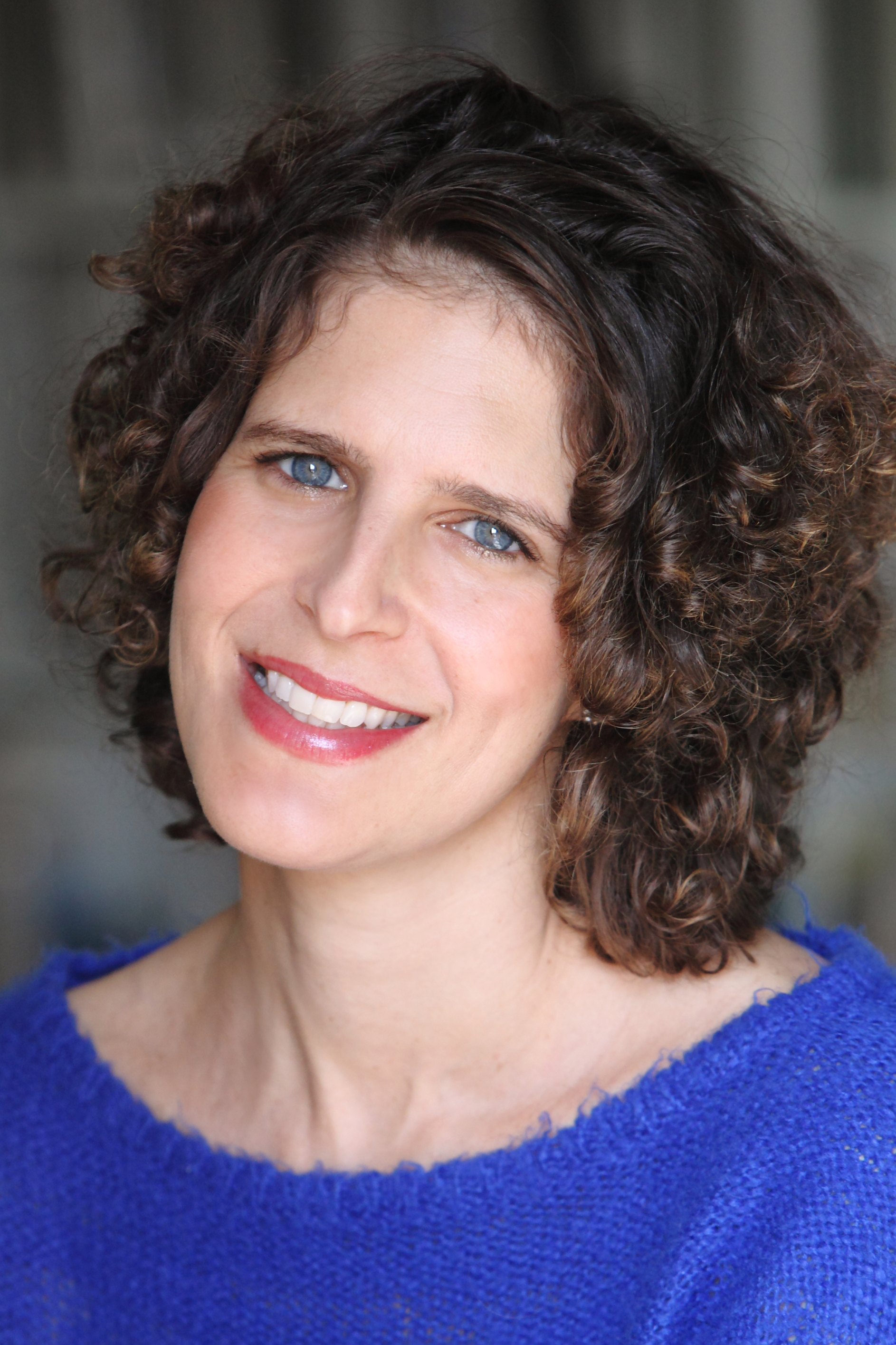
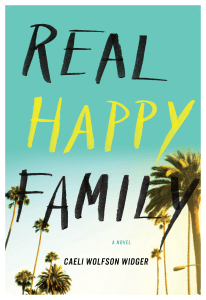
Caeli Widger's essay, "X" appeared in the "Lives" section of The New York Times Magazine. Her first novel, Real Happy Family, will be released by Amazon in March.

Caeli Widger’s essay, “Why I Silence Your Call, Even When I’m Free,” appeared in the “Lives” section of The New York Times Magazine. Her first novel, Real Happy Family, will be released by Amazon in March.

Caeli Widger’s debut novel, Real Happy Family, will be released by Amazon in March. Her work has appeared in The New York Times Magazine, Another Chicago Magazine, and the Madison Review, as well as on NPR and CBS Radio. She currently teaches for Writing Workshops Los Angeles, and has taught in the past for Brooklyn’s Sackett Street Workshop and at University College London.

In this interview, Widger discusses rage against digital culture, what The New York Times will fact check (text messages!), and moving from novel writing to working within an 800-word limit.

To read “Why I Silence Your Call, Even When I’m Free” and an exercise on using context to discover what a story or essay is about, click here.

Michael Noll

A lot has been written about the way social media and technology are impacting our lives, and I suspect that most of us feel as though our own behavior has been changed—I know mine has. However, I’m not sure that I could pinpoint a moment that illustrates that impact. But that’s precisely what you do in this essay. The simple act of not answering your phone becomes an opportunity to discuss the emotional consequences of how you use technology. How did you choose that moment to use as the basis of your essay? Was it immediately after the missed-call and subsequent follow-up occurred—a lightning strike of understanding? Or did you start with a general feeling about technology and then search for a moment to illustrate it?

Caeli Widger

The call with Stacey actually was not the trigger for the original essay. Her voicemail and our follow-up exchanges occurred a full month before I sat down to write the first draft. My initial motivation came from anger and resentment over how digital culture works against all the elements required to sustain a writing life: silence, contemplation, solitude. Unimpeded focus, minimal distraction, etc. As a writer with young children and a day job, I must stay vigilantly protective of my writing time. I was revising my first novel at the time, and had maybe an hour a day to work on it. And I found that unless I wrote at the crack of dawn, it was nearly impossible to “unplug” mentally and fully inhabit my writing mind in a short amount of time. As soon as I began to engage with the digital world, I always felt it breathing on me. I’d run Freedom (internet-crippling software) on my laptop and then cheat and check my phone for messages five minutes later. Or, even if I didn’t check, some little portion of my brain would still be attuned to the possibility of something happening on some technology platform. And every time I caved to the possibility and turned away from my work, I ended up feeling gross and disingenuous. Disgusted with myself. It felt like a low-grade addiction—and I’m a total social media lightweight compared to most people! I don’t use Facebook or Instagram. But the infringement of texting and email and Twitter on my writing life finally sent me into something of a rage one afternoon (after a lame revision session) and I wrote a spontaneous 2000+-word essay on how technology is anti-art and anti-relationship. The relationship part is where the Stacey situation worked itself into that first draft, but it was a minor part. The original essay was a high-level, “our culture’s going to hell” sort of rant-piece. Really, it was an act of catharsis and I didn’t have submitting to The New York Times or any particular publication in mind. I was just feeling disgusted and emotional about everyone being glued to their stupid smart phones, myself included, and needed to blow off steam.

I revised it over the next few days and decided to submit it to the NYT Mag’s “Riff” page. I hit send and forgot about it. A few weeks later Adam Sternbergh, the mag’s culture editor, wrote and said he liked the piece, but that it wasn’t right as a “Riff”. He asked if he could send it over to Jillian Dunham who ran the “Lives” page. Jillian liked it, but said I would need to 1) cut it down by two-thirds (Yikes!) 2) make the piece a personal essay instead of a cultural-criticism piece. She suggested starting over with the Stacey anecdote at the core, so that’s what I did. And I ended up getting to a deeper truth than I originally had in the long rant. It just took me a long time to get there.

Michael Noll

The essay begins with the story and then, in the fourth paragraph, provides context for that story by explaining your phone habits. This is a common structure in magazine essays (begin in scene or with an anecdote, then provide context), but it can also be difficult to get right. There are usually several ways to talk about the same incident, and so providing context means choosing one and, perhaps, disregarding the others. How did you approach this paragraph? Was it difficult to distill your phone/social media habits down to five sentences?

Caeli Widger

Some iteration of that graph was always in the piece. I don’t think I consciously chose to explain my phone habits that way, but one of my original inspirations for writing it—part of what fueled that first burst of culture-rage—was the viscera of digitial communciation. The swooshes and pings and tinkling glass and other nine million noises that can come from a little machine had become way too present—and desired—in my daily life. Even the way my fingers feel on the glass of iPhone, tapping out a text, or the particular swiping motion I make with my thumb to enter my home screen—these are noises and actions that never existed until recently, and here they were, the gateways to NOT writing my book and NOT talking to people I love! So those sensory details organically worked themselves into the “example” paragraph supporting the opening graph, and then in revision I distilled the language into a succinct portrait of my phone habits.

 Michael Noll

The essay moves through time with incredible efficiency. These lines are a perfect example:

“I’ll call you at 2!” I replied.

“You didn’t listen to my voice mail last week, did you?” she asked when we finally spoke.

Was that transition between conversations always so quick, or did you need to revise out some mechanical explanation?

Caeli Widger

The 800-word limit is incredibly restricting. No room whatsover for mechanical explanation! This felt totally unnatural to me. I’m longwinded by nature. Novel-writing suits me—no parameters! But I simply had no choice with this essay. The original graph you cite was originally MUCH longer. I had to pare down every single inessential word. The NYT’s incredibly diligent fact-checking system also helped impose limits. I had to supply screen shots of my text conversations with Stacey and use them verbatim in the essay—no paraphrasing allowed!

Michael Noll

In her debut novel, family drama leads to a public intervention on a TV reality show and in a seedy Reno motel room.

In Caeli Widger’s debut novel, Real Happy Family, family drama leads to a public intervention on a TV reality show and in a seedy Reno motel room.

Your first novel, Real Happy Family, will be released next month. Outside of poetry or highly academic work, there’s probably not a form that is more different than a novel than a personal essay. One is long, digressive, and invented, and the other is short, narrowly-focused, and true. Was it difficult to move from novel-writing to essay-writing?

Caeli Widger

In ways yes, but in others, writing this essay felt like a reprieve from the open-endedness of my usual genre. I’d never really written a personal essay before, outside of one workshop back in grad school. I’d spent years writing short fiction, and when my stories began to creep beyond 10k words, I decided it was time to take the plunge and commit to a novel. And it was totally liberating. But also overwhelmingly free, if that makes sense. You can go anywhere in a novel: into any character’s head, anywhere in time. You can indulge in descriptive language, you can digress for chapters at a time. Of course, in the end, you must impose control and revise endlessly, but there is a Wild West feeling to the early drafts that was pleasantly minimal in the crafting of my essay. Even in that very first “rant draft,” I was fueled by specific subject matter and knew I couldn’t go on too long. This is not to say that I found the form easier—certainly not! Not only did the prose require strict discipline, but it took a long time to tease what I truly wanted to stay out of the piece while staying within 800 words. The piece must have had 30 different endings. Jillian kept sending it back to me saying, Try again. I kept trying to force a transformation on the end. I was avoiding (subconsciously) being honest and facing the fact that what I learned from the experience is that probably won’t change. And that was an uncomfortable, if painful, realization. In this respect, the two forms (novel and short essay) are similar: both require a great amount of patience and openness on the part of the author in order for the true subject to “reveal” itself.

February 2014

Michael NollMichael Noll is the Editor of Read to Write Stories.
An Interview with Jennifer duBois

6 Feb
Jennifer Dubois' latest novel, Cartwheel, was included on multiple best-of-the-year lists in 2013. Photo credit: Ilana Panich-Linsman

Jennifer Dubois’ latest novel, Cartwheel, was included on multiple best-of-the-year lists in 2013. Photo credit: Ilana Panich-Linsman

Jennifer duBois’ latest novel, Cartwheel, was included in at least eight best-of-the-year lists in 2013. Her debut novel, A Partial History of Lost Causes, was the winner of the California Book Award for First Fiction and the Northern California Book Award for Fiction and a finalist for the PEN/Hemingway Prize for Debut Fiction. Dubois attended the Iowa Writer’s Workshop and completed a Stegnor Fellowship at Stanford University. Her writing has appeared in The New York Times, The Wall Street Journal, Playboy, The Missouri Review, Salon, The Kenyon Review, Cosmopolitan, Narrative, ZYZZYVA, and others. She was the recipient of a 2013 Whiting Writer’s Award and a 2012 National Book Foundation 5 Under 35 award, and she currently teaches in the MFA program at Texas State University.

In this interview, duBois discusses sentence structure and style, her reason for telling a story from multiple points of view, and how she chose Buenos Aires as the setting for Cartwheel.

To read the opening pages of Cartwheel and an exercise on controlling narrative pace with sentence structure, click here.

Michael Noll

The book is a whodunit thriller, and yet the sentences move at a deliberative, almost stately pace. The sentences rarely move in a smooth, straight line. In the first paragraph, for instance, four out of the five sentences contain a phrase that is literally offset by punctuation: commas, dashes, or hyphens. The same thing happens throughout the novel, and, as a result, I was forced to slow down instead of racing ahead to see what happened on the next page–which was a pleasurable relief. Anxious page flipping always causes me to feel as though I’m blindly devouring a jumbo bag of Doritos. I’m curious how aware you were of this sentence style. Was the pace purposeful or simply the way your voice appears on the page? Or was it something that began naturally but fine-tuned through revision?

Jennifer duBois

I never thought of the book as a whodunit, or even really as a thriller. To me Cartwheel is more of a whoisit than a whodunit, I guess you could say: I wanted readers to experience a sense of suspense regarding the question of who Lily Hayes really was, and what they thought she was capable of; I wanted the plot’s twists and turns to stem not only from events, but from readers’ shifting interpretations of those events. And so the sentence structure wasn’t really a conscious effort to slow down the pace; I think I probably do tend to write long sentences anyway—and I definitely get a lot of mileage out of the em dash (case in point). And that tendency was probably amplified by the fact that each chapter is embedded so deeply in each character’s perspective. I really hoped that readers would be persuaded by the logic of each character’s thinking while they were with them, so I tried to capture that thinking in as much detail as I could—there’s a lot of time spent in each of their heads.

Michael Noll

The novel is told from four different points of view: the accused murderer, her father, her boyfriend, and the prosecuting attorney. As a finished product, the novel seems whole and complete, but I imagine that in the early stage of writing it, you were unsure of basic things such as whose point of view to follow. There are other important characters in the novel, but their actions take place mostly off the page. Was it difficult to decide on these four viewpoints? Did you ever try writing from the POV of any other characters?

Jennifer duBois

I knew from the beginning that I would include the prosecutor’s and Lily’s father’s point of view, since it seemed natural to hear from a character totally convinced of Lily’s guilt and a character totally convinced of her innocence. I also knew I’d include Lily’s point of view, but that her sections would end the night of the murder—I wanted her chapters to offer psychological revelations about her character, but not factual revelations about the crime itself. The fourth point of view, Sebastien’s, was the last addition. I liked the idea of hearing from a character whose sympathies weren’t necessarily so pre-ordained as the prosecutor’s or Lily’s father’s were. I also liked the idea of introducing another character whose behavior inspires wildly different reactions, and whose interiority doesn’t always match the way he’s externally perceived. I didn’t think Lily should be the only character in the book who is at the mercy of other people’s interpretations—because in real life, we all are. To misquote St. Francis, I wanted Lily not only to be misunderstood, but to misunderstand.

 Michael Noll

The novel has an interesting sense of place. It’s set in Buenos Aires, but most of the action takes place in a series of closed spaces, not just houses but rooms in houses: Lily’s bedroom, the parlor in her boyfriend’s house, the prosecutor’s bedroom, the rooms in the jail cell where Lily is allowed to talk to her family and lawyers, and the inside of a restaurant where Lily worked. The rest of Buenos Aires appears only briefly, through Lily’s photographs (or as she tours the city, photographing it) or the travels of the other characters to and from the prison. I can imagine beginning this novel and feeling the need to capture the city, to do a kind of travel-show introduction. But this never happens. Were those passages cut, or did you know from the beginning how to approach descriptions of the city?

Jennifer duBois

In her debut novel, Dubois matches a former Russian chess champion intent on challenging Vladimir Putin's political power with a young American college lecturer who, fearing that she has inherited the genes for Huntington's Disease, travels to Russia to find out answers about her dead father.

In her debut novel, Dubois matches a former Russian chess champion intent on challenging Vladimir Putin’s political power with a young American college lecturer who, fearing that she has inherited the genes for Huntington’s Disease, travels to Russia to find out answers about her dead father.

That’s such an interesting observation and question—I never really thought about the number of closed spaces in the book, but you’re totally right. I think it relates to my sense of the book as being “set” in a hazy sphere of personal perception much more than in an objective external reality. There were a few reasons I selected Buenos Aires—I needed a city an American study abroad student might fall in love with, in a country with a judicial system similar enough to our own that said student might not be aware of some key differences. I wanted a country with a language that an American college student might have mastered sufficiently to feel overly confident in. I thought that setting the book in a Catholic country could provide an interesting dimension to its exploration of misogyny/ideas about female sexuality, and that setting the book in a country with such a fraught history with the U.S. could add an interesting angle to the questions about American entitlement/anti-American resentment. But ultimately I didn’t see Cartwheel as trying to depict a particular place as much as trying to depict four different characters’ minds. In a very fundamental way I think Cartwheel is a story that could have been set anywhere—this was very different from my first book, A Partial History of Lost Causes, in which the Russian setting is, in many ways, the book’s soul. And so that’s probably partly why Cartwheel doesn’t linger in the Argentinean setting very much; I hope that readers believe Buenos Aires as the book’s backdrop, but I think its real setting is in the characters’ heads (talk about enclosed spaces).

Michael Noll

 A lot of young writers tend to stick close to home with their work, but this isn’t the case for you. So far, your novels have been about characters who seem, at least on the surface, pretty different than yourself: an American exchange student charged with murder, a father, an Argentinean prosecutor, a Russian chess champion and political dissident. Plus, your novels have mostly been set in countries other than the United States. What draws your imagination to these characters and places? Are you drawing on the books that you read as a child? Were you a news and Time magazine junky as a kid?

Jennifer duBois

I don’t think my own life has really been interesting enough to generate a ton of material for fiction—but even if it had been, I’m not sure writing about it would appeal to me very much. I’m in my own life and memories every day anyway, and there is a real limit to my curiosity about myself. For me, the fun of fiction writing is in imagining lives and experiences that are very different from my own, and in getting to explore ideas or situations that I think are interesting. And because I’ve always been interested in other countries–and in international politics in particular (I was a political science major in college)—that interest winds up showing up in my fiction, along with assorted other preoccupations and hobbies and fun facts and jokes and pet conspiracy theories, etc. If I’m curious about it, it’s going in.

February 2014

Michael NollMichael Noll is the Editor of Read to Write Stories.