Tag Archives: how to write a short story

An Interview with Matthew Gavin Frank

24 Jul
Matthew Gavin Frank's new book, Preparing the Ghost: An Essay Concerning the Giant Squid and Its First Photographer, contains "some stunning writing and perversely wonderful research," according to a New York Times review.

Matthew Gavin Frank’s new book, Preparing the Ghost: An Essay Concerning the Giant Squid and Its First Photographer, contains “stunning writing and perversely wonderful research,” according to a New York Times review.

Matthew Gavin Frank left home at age seventeen to travel and work in the restaurant industry. He ran a tiny breakfast joint in Juneau, Alaska, worked the Barolo wine harvest in Italy’s Piedmont, sautéed hog snapper hung-over in Key West, designed multiple degustation menus for Julia Roberts’s private parties in Taos, New Mexico, served as a sommelier for Chefs Rick Tramonto and Gale Gand in Chicago, and assisted Chef Charlie Trotter with his Green Kitchen cooking demonstration at the Slow Food Nation 2008 event in San Francisco. He received his MFA in Poetry and Creative Nonfiction from Arizona State University. He taught creative writing to undergraduates in Phoenix, Arizona, and poetry to soldiers and their families near Fort Drum in upstate New York on the Canadian border.

Frank is the author of two food memoirs: Barolo, a food memoir based on his illegal work in the Italian wine industry, and Pot Farm, about his time working on a medical marijuana farm in Northern California. He’s also written three poetry collections: “The Morrow Plots,” “Sagittarius Agitprop,” and “Warranty in Zulu.” His most recent book is Preparing the Ghost: An Essay Concerning the Giant Squid and Its First Photographer.

In this interview, Frank discusses the unpredictable rabbit holes of research, the line between fact and conjecture, and getting lost in sentences.

To read an excerpt from Preparing the Ghost and an exercise on creating space for digression, click here.

Michael Noll

I’m really taken with the line, “The fog that the early sailors believed to be the last remnants of Noah’s flood began to shroud the vessel.” Beyond the lovely effect of the imagery, I’m curious about the research involved in such a line. How does one come across a piece of information like this (that sailors once believed the fog to the last remnant of the Flood)? What is your research method like? It would seem to be pretty far-reaching and not necessarily specifically focused on giant squid.

Matthew Gavin Frank

My research process, like my writing process, was digressive. Squid led to ice cream which lead to cold weather which led to hot weather which led to ocean which led back to squid.  And so on.  I read plenty of late 19th century fisherman’s accounts and articles about the fishing industry in Newfoundland. The fishermen of that time would also trap auks—those fat unwieldy beautiful seabirds—driving them aboard the ships, caving in their skulls with clubs, salting and drying their breasts, feasting on their eggs, selling their bones to the superstitious and the spiritual, stuffing coats with their feathers, burning their bodies for fuel. Reverend Moses Harvey, who plays a great role in Preparing the Ghost (he was the one who first photographed the giant squid in 1874, rescuing it from the realm of mythology, and finally proving its existence) felt that, “It is not wonderful that, under such circumstances, the great auk has been completely exterminated.”

In scholar Weldon Thornton’s annotated Allusions in Ulysses, the author wonders if, in regards to the source text’s line, Auk’s egg, prize of their fray, the auk indeed “has any special mythological or symbolic meaning” or if its usage is “to represent something exceedingly rare.”  The 11th edition of the Encyclopedia Britannica provides a soft, wishy-washy answer of sorts, declaring, “A special interest attaches to the great auk (Alca impennis), owing to its recent extinction, and the value of its eggs to collectors.”

So, this is what I mean. Case in point. One thing leads to another, and it’s this lovely cascade down the rabbit hole of research. What fun! When I’m sifting through a roomful of research, I’m seeking out that “exceedingly rare” thing, and I’m interested in seeing what happens when we hold it up against a more known thing. I’m interested in seeing where such a collision will lead. Oftentimes, the most interesting thing we can do as essayists is draw a chalk outline around our main subject in order to suggest its shape; in order to evoke its essence. This ancillary engagement is often more powerful than a direct engagement, as it reveals to us (during the seemingly wayward research process) the specific and intricate blend of chalk necessary to evoke the body.

Yet again, I digress. Anyhow, these early accounts of fishermen [sailing into the St. John’s Narrows] were oddly rife with biblical allusions—I mean the giant squid was known as the Devil-fish before it was known as the giant squid. So the Noah’s flood reference seemed a natural extension of such documented accounts.

Michael Noll

I’m curious about your use of the first person point of view in this excerpt and in the book in general. The excerpt at The Nervous Breakdown is about Moses Harvey in a particular spot on the Newfoundland coast in 1874, and yet you include this line: 

I envision Harvey wiping his nose with his right hand, his left never leaving the squid’s body which had a “total number of suckers…estimated at eleven hundred,” and “a strong, horny beak, shaped precisely like that of a parrot, and in size larger than a man’s clenched fist.”

I can easily imagine an editor trying to cut that I—obviously, you weren’t there, and, and, in a way, it’s probably extraneous. And yet it also seems essential. Without it, the detail about Harvey wiping his nose would be out-of-place conjecture. Did you ever struggle with when and how to use the first person point of view?

Matthew Gavin Frank

Oh, yes. It’s always a struggle for me—a holy one—trying to determine to what degree I should signal to a reader that I’m speculating, that I’m imagining, that I’m caught up. Usually, my initial instincts are that I should not overtly signal at all. That context will do its job; that a reader will figure it out. And if it’s muddy in the book—this blurry line between fact and conjecture—that’s because it’s actually muddy. Supposedly factual historical research yields varying—and often conflicting—narratives. Once we impose narrative(s) onto a fact, it ceases to be a hard fact. It softens. It’s shapeable. Like boiling water into which we dissolve sugar teaspoonful-by-teaspoonful, it doesn’t become another thing completely. Until we add that ultimate spoonful which supersaturates the solution, it’s still water, still maintains the integrity of water. It’s still maintains the shape of the original fact. It’s just sweeter.

Throughout the book, there’s this overlap between the contemporary and the historical, our time and Harvey’s. The intrusion of the I sometimes forces this overlapping. It’s funny that you think an editor would be tempted to cut this I. In fact, my editor wanted me to add more of this kind of signaling to the draft I originally submitted, so that the reader felt a bit more tethered; could more easily distinguish between “fact” and speculation on said fact.

Michael Noll
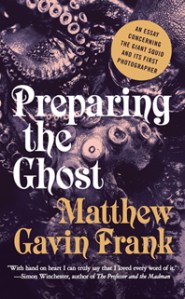
Preparing the Ghost: An Essay... tells the story of the obsession that led Moses to photograph the mysterious giant squid.

Preparing the Ghost is Matthew Gavin Frank’s third book of nonfiction and has been called, by Matt Bell, “a triumph of obsession.”

There are two sentences in this excerpt about Harvey sailing into the harbor at St. John’s that contain pretty noticeable digressions. The first sentence lists various sites around the harbor, beliefs about those places (“Deadman’s Pond, rumored to be bottomless), and some notable historical events that took place there. The other sentence zooms in on a girl cleaning fish. There’s definitely a more-is-more attitude in these sentences, both in terms of detail and grammar. You can’t really read them once through. I found myself stopping, rereading a phrase or word—but this was not an unpleasant experience, simply a different way of reading. How do you approach passages like these? Do you simply write them when so moved, or is there some underlying strategy at work?

Matthew Gavin Frank

Years ago, I took a class from the fiction writer, Paul Friedman, the gist of which was entirely devoted to the notion of the sentence—its parameters and pitfalls, its strong tightropes and its weak ones. The sentence, in this course, was something to navigate, traverse; something that required the strapping of the essential gear onto one’s body. Ropes. Cleats. Hooks. As my father-in-law would say: the whole toot. I love getting lost in the middle of a sentence— both as writer and as reader, and then having to bust my metaphorical flashlight out of my metaphorical fanny-pack in order to illuminate my way to its end. And then, of course, to re-write it a thousand times. I’d like to say that I wrote this passage in order to empathize with Moses Harvey’s assured ecstasy at approaching the port of St. John’s, Newfoundland in 1874, shell-shocked and bemused beneath the suspended and snotty chandelier of the first intact specimen of the giant squid. But the truth is probably that I was rendering my own ecstasy in the face of all of this wonderful research I uncovered. I fall in love with the objects of my research sometimes, and then all of the tightropes snap, and I’m falling, or rising, or just plain airborne, grabbing at all of the beautiful tinsel-y shrapnel floating past, trying to stitch it all into something that resembles a navigable sentence.

Michael Noll

You’re a writer of astoundingly varied experiences and interests, though they do seem to center on food and consumption. You’ve written books about working in the Italian wine industry and at a medical marijuana farm in northern California. So, a book about the man who first photographed the giant squid seems like a bit of a curveball. What drives your writing? I’d hazard to guess that you have no shortage of things to write about. What makes you choose one over another—and then spend the time necessary to write a book about it?

Matthew Gavin Frank

It’s funny. In trying to shun food writing for a while, I find myself working on a new project that’s attempting to interrogate not only our relationship with food (within regional context), but also our expectations of food writing. Food is complicated. The new book-in-progress is tentatively titled The Food You Require is Heavier: 50 States, 50 Essays, 50 Recipes. At the risk of sounding totally overblown, I’m trying to cobble together this spastic, lyrical anti-cookbook cookbook of sorts that also may be a fun and digressive revisionist take on U.S. history.  I’m trying to concentrate on the small events—incantatory and ponderous and horrific and mundane— that we glossed over when we originally (and then subsequently) attempted to set down regional definitions.  Each essay begins with this line of questioning: What does Illinois mean?  What does deep-dish pizza mean?  What ancillary subjects will I have to engage in order to stalk both food and state toward the blurry answers to these questions?  The Rhode Island essay, for example, is concerned with Clear Clam Chowder and the Cognitive Psychology of Transparency—how we think and react differently to things we can look through rather than look at. The Louisiana essay deals with the intersection of Crawfish Etouffee, bad weather, and autoerotic asphyxiation.

Being a little OCD helps to dictate my projects and focus for a while as well.  I mean, when, during my research process, I found out that squid ink is immortal—invulnerable to decay—and that in the South of England in the 19th century, the petrified remains of a 150-million-year-old squid were discovered entombed in solid rock, and that its own, perfectly intact ink was used to draw a picture of its remains, and that scientists called the resulting image, “the ultimate self-portrait,” how couldn’t I be seduced to catalogue the onrush on implications?  I’m easily seduced, is what I’m saying.  Immortal cephalopod melanin is all it takes, and I’m yours for a while.

July 2014

Michael Noll

Michael Noll is the Editor of Read to Write Stories.

How to Create Space for Digression

22 Jul
Preparing the Ghost: An Essay... tells the story of the obsession that led Moses to photograph the mysterious giant squid.

Preparing the Ghost: An Essay Concerning the Giant Squid and Its First Photographer has been called “a triumph of obsession” by Matt Bell.

For certain kinds of readers and writers, the best part of any book (often literary, though not always) is not a moment of supreme tension or complex gathering of plot strands. It’s an astute observation or unexpected description—some digressive phrase or passage that the writer seemed to pluck out of thin air. Yet when we sit down to write, we’re often overwhelmed with the practical necessities of motivation and plot and momentum and, as a result, find ourselves barreling down a straight line. The problem, we realize, is that we don’t know how to step off that line.

A writer who excels at digression is Matthew Frank. His latest book is Preparing the Ghost: An Essay Concerning the Giant Squid and Its First Photographer. While its subject is exactly what it seems—the mysterious giant squid—the book is a black hole, sucking into its center as many side stories and details as it can hold. You can read an excerpt here at The Nervous Breakdown.

How the Story Works

The trick to writing digressively is knowing when and how to digress. Your goal is to swerve from the main narrative without losing the reader, and to do this, you must prepare the reader for the swerves. One way to do this is to pry open a simple sentence and insert a small digression. Frank does exactly that. The excerpt from Preparing the Ghost focuses on the squid’s photographer as he rode a ship with the carcass of the squid aboard. The scene begins “at the 1874 port of St. John’s, Newfoundland”  as “the fishing boat entered The Narrows, the only entrance to the harbor.” Here is how Frank begins to digress:

The fog that the early sailors believed to be the last remnants of Noah’s flood began to shroud the vessel…

The sentence is simple in construction and subject. Without the digression, it reads this way: “The fog began to shroud the vessel.” To digress, all that Frank has done is add a description of the fog. He could have said it was thick or white, but he instead told us “that the early sailors believed [it] to be the last remnants of Noah’s flood.” On one hand, that tangential fact is simple, just a phrase. But it’s also a huge leap in time and logic. A passage that began in a specific time (1874) has now broadened its frame to include earlier sailors and even Old Testament times.

That digression made, Frank continues it after the sentence’s initial statement (the fog began to shroud the vessel) is finished. Here is the entire sentence:

The fog that the early sailors believed to be the last remnants of Noah’s flood began to shroud the vessel, the vapors pumped from the interior’s forests, commingling with the sea.

Frank has now expanded the geographic frame of the passage, from the port at St. John’s, Newfoundland to the forests that stretch far inland. Now that he’s expanded the frame, watch how he continues to digress. (Remember, he’s writing about a particular ship in 1874.) Here is the entire passage:

The fog that the early sailors believed to be the last remnants of Noah’s flood began to shroud the vessel, the vapors pumped from the interior’s forests, commingling with the sea. The early sailors believed that this fog housed ghosts of fishermen and fish, mermaids that they’d either have to love or decapitate, that the only way to eradicate this terrible fog would be to set a great fire to the forests. At the sea-bed beneath them, the skeletons of two-hundred ships lay unidentified in the soupy mass grave, lifeboats and their corpses embalmed in the deep freeze. The Labrador Current threw at them more and more ice.

Because he has created that initial space in a sentence about fog, Frank is able to make much larger digressions about ghosts, mermaids, and shipwrecks—the sort of details that give his writing energy and that we remember even after we’ve turned the page.

The Writing Exercise

Let’s digress using the passage from Matthew Frank’s Preparing the Ghost: An Essay Concerning the Giant Squid and Its First Photographer as a model:

  1. Choose any sentence that you’ve written to start a paragraph. Or, write a sentence that begins a new paragraph about a particular place and time. Ideally, the sentence will be focused on mechanics: who, when, where. Simplicity is best, even something as rudimentary as “The dog began to bark.”
  2. Find a place to pry the sentence open. A great place to start is after nouns, where we already tend to add descriptive phrases. Instead of a simple adjective, though, add a phrase that expands the dimensions of the sentence (space or time). Try using transition words like that or which or an en dash.  So, “The dog barked” can become “The dog that the neighbor brought home five years ago as a little barking puppy began to bark.” Or, it could become “The dog—which had appeared in the neighbor’s yard five years ago as a little, endlessly yapping puppy—began to bark.” Is it rough? Sure, but it has expanded the sentence’s sense of time.
  3. Continue the digression at the end of the sentence. If, after prying the sentence open, the beginning and end are still clear, it’s easy to simply keep the digression going by replacing the period with a comma. So, “The dog—which had appeared in the neighbor’s yard five years ago as a little, endlessly yapping puppy—began to bark” can become this: “The dog—which had appeared in the neighbor’s yard five years ago as a little, endlessly yapping puppy—began to bark, first at squirrels and then somebody taking out the garbage and then the rustling of leaves in Thailand and in France and finally at the Voyager space probe puttering along somewhere beyond the furthest reaches of the galaxy.” Now, we’ve expanded the sentence’s sense of geography.
  4. Keep digressing. Once you’ve set new boundaries for time and geography, there’s no reason to return to the limits of the original first sentence. Explore the space you’ve created for yourself. Frank picks up on the early sailors that he added and expands on some of their other beliefs. Then, he picks up on the geography of these beliefs (mermaids) and stays underwater, showing us shipwrecks. This kind of literary play is what makes writing fun and not simply the search for the next plot point.

If you read the entire excerpt from Preparing the Ghost, you’ll understand that I’ve simplified Frank’s work a bit. He begins to digress before the sentence about the fog and Noah’s flood. You may even get lost in some of his digressions. He’s a writer who pushes the usual boundaries of narrative—which means he’s a good writer to read because he’ll push your sense of what narrative is capable of. When reading someone like that, though, it’s useful to tease out a single passage for study. Otherwise, it’s like trying to puzzle out the structure of an entire symphony in one listening.

Good luck with your reading, and have fun with your writing!

How to Carve Out Space for Character Development in a Violent Setting

17 Jun
Benjamin Alire Sáenz won the PEN/Faulkner Prize for Fiction for his collection, Everything Begins and Ends at the Kentucky Club. The stories are set along the border between El Paso and Juarez and center on the Kentucky Club, two blocks south of the Rio Grande.

The stories in Benjamin Alire Sáenz’s collection, Everything Begins and Ends at the Kentucky Club, are set along the border between El Paso and Juarez and center on the Kentucky Club, two blocks south of the Rio Grande.

There are places in the world that dictate the type of stories that happen there. Violence exerts an overwhelming gravitational pull, and a story that at first has nothing to do with violence—a love story, or a story about family or business—will eventually get pulled into orbit around the violence that exists in the place. Set a story in Mosul, Iraq, and it will eventually run across militants and dead bodies. The key as the writer is not to avoid the violence at all costs but to resist it for as long as possible—in other words, to allow the story to develop dimensions beyond the inevitable.

An excellent example of this resistance can be found in Benjamin Alire Sáenz’s story, “He Has Gone to Be with the Women.” It was included in his collection, Everything Begins and Ends at the Kentucky Club, which won the 2013 PEN/Faulkner Award for Fiction. You can read it now at Narrative Magazine.

How the Story Works

If you hear a reference to Juarez, Mexico, you automatically prepare yourself to hear a story about violence. For a time, Juarez was one of the most dangerous cities in the world. Many of the residents on either side of the border knows real stories of people who have been murdered or kidnapped. From the safe distance of Washington D.C., it’s possible to believe that violence is the only thing happening there. And yet the people who live along the border go about their lives, and so, as a writer, it’s crucial to push back against the readers’ expectations of cartel executions. It’s necessary to find a way to create characters who have lives that exist outside of, or alongside, the violence.

This is exactly what Sáenz does in his story. In it, two men meet at a coffee shop in El Paso. One is American, and the other is Mexican. The border, and it’s associations, are present from the beginning but not at the center of the story, which instead follows the developing romance between the two men. It’s not until a third of the way through the story that violence forces itself onto the page:

Monday morning, I got this text from him: I thought about you when I woke up this morning. I read the text and then reread it. And then reread it again.

I felt like a schoolboy reading a note from a girl. No. A note from a boy.

I didn’t know how to answer his text. I only engaged in the practice because my nephews and nieces demanded it of me. We wrote silly and affectionate things to each other. But this was different. Finally around noon, I texted him back. Stay safe. That’s what I wrote. That’s when it occurred to me that I was afraid. I didn’t like to think of Javier walking the streets of Juárez, doing an errand, going to a store and getting killed, randomly, for no reason. What good does it do to be afraid? He was right. Of course he was right. But so many people had left already. Why couldn’t he leave too? I knew the answer to that question even before I asked it. He wasn’t the leaving kind. He loved his Juárez. I could see that in his eyes, in his unshaven face, in the way he moved and talked. I could almost taste his love for that poor and wretched city in his kisses. It enraged me that Juárez had become so chaotic and violent and capricious. A city hungry for the blood of its own people. How had this happened? I was sick to death of it, sick to death of the body count, sick to death that every killing went unprosecuted and unpunished. You could kill anybody. And what would happen? Nothing. The fucking city no longer cared who was killed. Soon, they would just be stepping over the bodies. Stay safe. Stay safe. Stay safe.

Because Sáenz has created characters with lives and concerns other than avoiding violence, he’s able to make their interactions with the violence personal, as opposed to the generic way that cable news viewers react against stories of border violence.

So, how does Sáenz create these characters without letting them be overwhelmed by the violence that surrounds them? First, he introduces us to them in a place that lies outside of the violence: a coffee shop in El Paso, the safer side of the border. Of course, a coffee shop doesn’t have to be safe. Think about the coffee shop scene in the film Children of Men. When the bomb explodes, the viewer understands that no place in the film is safe. Sáenz could have done that in his story, but if he had, we wouldn’t have gotten a chance to know the characters except as people caught in violence—which is how we know Clive Owen’s character in the film. But the point is to know these characters as more fully developed people. So, Sáenz puts them in a safe place and shows us nuances of their lives:

I always noticed what he was reading: Dostoyevsky, Kazantzakis, Faulkner. He was in love with serious literature. And tragedy. Well, he lived on the border. And on the border you could be in love with tragedy without being tragic.

He drank his coffee black. Not that I knew that.

Sometimes, I could see that he’d just come in from a run, his dark wavy hair wild and half wet with sweat.

He was thin and had to shave twice a day. But he only shaved once. There was always that shadow on his face. Even in the morning light he appeared to be half hidden.

Sáenz develops these details. The two men have conversations about their jobs and families, and when the violence is mentioned, it’s in the contexts of these things. For instance, here’s one of the men, Javier, talking about his uncle, who has cancer and whose care is being managed by Javier:

“He used to love to go out. He would laugh and tell me about how life used to be for him. Now, he won’t go out. He’s afraid. Before, the only thing he was afraid of was my aunt. Now, he’s like a boy. He cries. He reads the newspapers. He thinks he’s living in Juárez. I tell him that we’re in El Paso, that he’s safe. But he doesn’t believe me. He’s afraid to go out. Nos matan, he says. I try to tell him that no one’s going to hurt us. But it’s no use. Every time I go out he tells me to be careful.”

By the end of the story, when the violence cannot be avoided, its inevitable arrival is so much more personal than if it had been directly present all along.

The Writing Exercise

Let’s create characters in the midst of some overwhelming situation, using Benjamin Alire Sáenz’s story, “He Has Gone to Be with the Women,” as a model:

  1. Determine the overwhelming situation. As the writer Ron Carlson says, every story has two parts: the story and the world the story comes into. Almost every story, including blockbuster films whose sole purpose of existence is to blow stuff up, spends time developing the characters who will be consumed by the situation. In blockbuster films and many genre novels, though, the character development is as lean and minimal as possible (think of the description of Robert Langdon in The Da Vinci Code: “Harrison Ford in Harris tweed”). In those stories, the violence or destruction (or aliens, monsters) shows up almost immediately. But in Sáenz’s story, the violence doesn’t really appear until the end. So, decide what situation will eventually consume your characters: violence, family or marriage drama, economic distress, death, disease, or any inescapable deadline.
  2. Determine how that situation will affect the characters. You can be succinct. Someone will die, get sick, get divorced, get shipped off to prison or war or work in some far-off place, or get fired. Know where your story is headed.
  3. Put the characters in a place that is outside of the situation. You likely already know how the characters will behave or respond when the situation presents itself. There are, frankly, only so many ways that people can respond to inescapable deadlines or outcomes. Now, find out how your characters behave when the deadline is out of sight and (mostly) out of mind. Find a location where this is possible, some emotionally neutral or positive place. Put them there and see what they do. What other parts of their lives are revealed?
  4. Choose one of those parts and develop it. Sáenz gives Javier an ailing uncle, and that uncle’s health worsens. Think about the parts of your characters’ lives that you discovered: how can you make those parts dramatic? How can they change or develop (improve or worsen)? How can this change draw other characters into the person’s life? It is this dramatic arc that you’ll focus your story on. The inevitable deadline or outcome will arrive eventually, but if you make the reader forget that it’s there, its arrival will be all the more effective and impactful.

Good luck!

An Interview with Murray Farish

12 Jun
Murray Farish

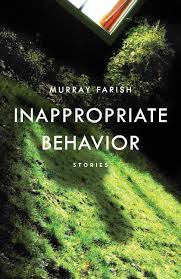
Murray Farish’s story collection, Inappropriate Behavior, includes stories about Lee Harvey Oswald and John Hinckley, Jr.

Murray Farish’s debut story collection, Inappropriate Behavior, was called “the best first collection I have read in years” by Elizabeth McCracken. Farish’s short stories have appeared in The Missouri Review, Epoch, Roanoke Review, FiveChapters, and Black Warrior Review, among other publications. His work has been awarded the William Peden Prize, the Phoebe Fiction Prize, and the Donald Barthelme Memorial Fellowship Prize. Farish lives with his wife and two sons in St. Louis, Missouri, where he teaches writing and literature at Webster University.

In this interview, Farish discusses the accretion of American pain, the despair of not finding the right ending, and writing stories in a world in which CEOs make 350 times the salary of their workers.

To read the collection’s title story, “Inappropriate Behavior,” and exercises on breaking narrative rules, click here.

Michael Noll

Early in the story, George and Miranda are discussing their son’s behavior and the problems he’s causing at school, and George says, “I just thank God that he’s healthy.” The conversation that followed really struck me for a couple of reasons. One, I have kids, and I think that I’ve probably said something similar to this. Two, the conversation seems to announce that this story is going to run counter to some basic ideas about propriety. Generally, thanking God for a child’s health wouldn’t be considered morally bankrupt, but that’s exactly what Miranda suggests, and both the reader and George come to realize that she’s right. Did the story always begin this way, or did you write the dialogue to perform a particular function within the story?

Murray Farish

The first thing I wrote that made the cut in the final draft of “Inappropriate Behavior” was a version of a much later scene where Archie is lying on the couch trying to figure out which of his toys he’s taking to heaven when he dies. I have to write a lot of pages and take a lot of false paths before I figure out what a story is about and what I want to do with it. Once I figure that out, I try to orchestrate everything—scene, setting, dialogue, situation, character—around that realization. That orchestration became even more important in this story, which I think of as nearly plotless and almost totally free of character development.

Michael Noll

In several places, you create catalogues of George’s thoughts and snippets of news that he hears. I’ve seen stories make similar moves before but never to the extent that you make them. The catalogues are very long–and so there’s the inevitable risk of losing the narrative thread. But that’s not what happens. The juxtapositions in the catalogues are savage, and the paragraphs contain some of the most gut wrenching lines in the story. This is generally true of the story as a whole. There’s another section about paying bills that isn’t a catalogue but works in a similar way. I can imagine a lot of writers drafting a couple of lines about bills and then moving forward into the story, but you stay with the bills for ten paragraphs. I kept expecting the narrative to stall, but it never did. How did you keep the momentum moving?

Murray Farish

Especially in a story that is plotless and free of character development? I worried about it a lot, until I decided to trust in the orchestration—or if that’s too grand a term to keep repeating—to trust the design of the story. Once I figured out that the story I wanted to write was about the Great Recession and how it was the natural result of four decades of political, legislative, and cultural malpractice and neglect of the commonwealth—of the failure to live up to ideals that we the people are obligated, by ink and by blood, to try to live up to . . . well, you can see the problem, for a fiction writer. But if that’s the story you’ve got to write, that’s the story you’ve got to write, so you’ve got to figure out how to write it. I decided to create this little family and inflict upon them a steady accretion of American pain, and hope to build narrative momentum out of that accretion.

Michael Noll

I have to admit that I felt a thrill at the story’s description of St. Louis: “It feels like exactly what it is: a static, lifeless, dead-water burg, a place that lacked enough imagination to remake itself when people stopped using beaver pelts as currency, and that runs, after a fashion, on the inertia of old money.” And that’s just one sentence in a long paragraph that ends with a line of bitter sarcasm: “Here’s something people say about St. Louis: It’s a great place to raise kids.” I can’t remember the last time I read such a brutal takedown of a place. I’m not sure I’d have the courage to write something like that. Given that you live in St. Louis, do you worry that someone you know will read this story and get upset?

Murray Farish

Well, of course that’s George’s description of St. Louis, and St. Louis is a place he feels victimized by, in a way. All this bad stuff is happening to him and there’s no one around to try to help him out. But however St. Louisans would feel about the description, to the extent that they would find it accurate, we also have to realize how places like St. Louis have themselves been victimized by that same neglect I talked about before. One of the most troubling things I’ve seen in my forty-some years as an American is precisely that lack of imagination, a fearful inability to conceive of how things might be different, might be better. That lack of common vision hits places like St. Louis particularly hard. To the extent that a St. Louisan might find the description inaccurate or unfair, I guess I’d have to plead artistic license.

Michael Noll

By the story’s end, you’ve put the characters in such an intensely difficult situation that it’s natural as a reader to want to look away, to avert our eyes from what we suspect will happen. And that’s exactly what you do–you shift the point of view in a way that’s bound to bother some readers who will expect a neat conclusion. But I actually loved the ending. In a way, it reminded me of what Richard Ford does in Independence Day: His narrator, Frank Bascombe, fails repeatedly to connect and successfully parent his son, and when it seems as if nothing good can happen, Ford knocks the kid out of the novel–literally. The kid gets hit in the head with a baseball and is knocked unconscious. I found that particular move frustrating—a cheat on Ford’s part—because then everything starts going Bascombe’s way again. But in your story, the shift in POV (the looking away) doesn’t change the characters’ fortunes. But it makes them easier to read—not less disturbing or emotional but readable, as if there’s only so much misery readers can take before they walk away. Your ending kept me with the story. That’s a lot of words to ask, how did you approach the ending?

Murray Farish

Finding the ending was as close to real despair as I’ve ever had as a writer. I had worked for months to winnow hundreds of pages down to the final version, up to the scene where George goes for the last meeting at Archie’s school. I knew I loved this story, but the steady accretion of pain had left the Putnams, and me, in a corner where there was no way to write a narratively satisfying and honest ending that would change their fortunes in any way. Do some sort of Horatio Alger bit? Launch an alien invasion or some other cataclysm that renders the economy irrelevant? Have George blow his brains out? I wrote versions of all of these, and many others, including one ending replete with learned footnotes and pie-charts and bar-graphs, which I think you’ll agree with everyone else who read that version that it was a bad idea. Somewhere in the midst of that despair I looked at the school principal’s statement at the end of the last “realistic” scene: “I’m sure you have questions.” So I put the story away and just started making this long list of questions—some from George, some from Miranda, some from American lit and American history, recent and ancient. My notion was not that this catalog of questions would become the ending, but I hoped that some question in there would trigger an ending. Then I saw that those questions could be orchestrated in a way that felt to me very honest and risky and perhaps even resonant, and if I couldn’t do narratively satisfying, I could at least do those things. Jumping out of the third-person, realistic mode also allowed me to return to the Putnams in the voice of Archie and the style of the fairy tale. Archie may be in a lot of trouble, anchored to this sinking family of his, but at least he still has imagination, and he’s not afraid. That’s about the only note of hope I could stand to build into this story, the notion that the future might be better if we don’t lose our courage and our imaginations. But realistically, Archie’s probably screwed.

Michael Noll

A. O. Scott of The New York Times didn't like the way the film Away We Go portrayed red America. You can read his review here.

A. O. Scott of The New York Times didn’t like the way the film Away We Go portrayed “regular” Americans. You can read his review here.

Many stories create unlikable side characters and then reveal some redeeming part of them. But not this story. George thinks this: “The greater part of what my neighbors call good I believe in my soul to be bad, and if I repent of anything it is very likely to be my good behavior: what demon possessed me that I behaved so well?” Because I think we’re supposed to empathize with George and his point of view, this is a pretty damning indictment of a great swath of the population of St. Louis. It reminds me of the Dave Eggers film, Away We Go, about a couple on the verge of parenthood who travel America trying to find a good place to raise their kids. But everywhere they go, they find people they don’t like. The New York Times critic A. O. Scott angrily criticized the film’s “smug self-regard” and its portrayal of “red state grotesques” and said, “This movie does not like you.” Do you feel any obligation to find the good in every character? Or, to put it in the negative, do you think fiction suffers when it’s too nice and open-minded?

Murray Farish

The quoted question about good behavior is from American lit, one that Thoreau asks in Walden, but of course it applies to George as well, as well as to the overall point that this section and this story is trying to make—what is “inappropriate behavior?” Is it the stuff this goofy kid does to get in trouble at school, or is it unnecessary wars and drone strikes and cutting off people’s unemployment benefits? Is it one little kid hugging some other little kid or is it the Trail of Tears? Is it hyperactivity or the abjuration of our responsibilities to one another? If the fact that CEOs make 350 times the salary of their workers isn’t at the very least inappropriate, I don’t know what is. I think the only obligations fiction writers have are to write the best story they possibly can, and to give the reader something they can’t get from anyone else.

June 2014

Michael Noll

Michael Noll is the Editor of Read to Write Stories.

How to Write Break the Contract with Your Reader

11 Jun
Murray Farish's story collection, Inappropriate Behavior, includes stories about X, X, and X.

Murray Farish’s story collection, Inappropriate Behavior, was called “the best first collection I have read in years” by Elizabeth McCracken.

In stories and novels, we occasionally write ourselves into corners of inevitability. The story dictates that a particular thing must come next, but we can’t or don’t want to write that ending. Often this is because the ending is going to be unpleasant for everyone involved: characters, readers, and writer. So what do we do? We can scrap or rewrite the story, or we can find a way to write the inevitable ending in a way that honors the narrative momentum that has been built but also changes the way we think about that narrative. Sometimes, this means breaking the contract with the reader—a big no-no in workshop but sometimes a necessary risk to take.

In his story, “Inappropriate Behavior,” Murray Farish writes an ending that radically shifts point of view and tone. You can read it now at FiveChapters. Tomorrow, Farish will talk about the risks of writing this kind of ending.

How the Story Works

Every story makes a contract with the reader—or, as various quotable writers have said, works of fiction teach their readers how to read them. This means that the first paragraph of stories and novels teaches the reader how the narrative will proceed in terms of point of view, style, and tone. Here is the first paragraph of “Inappropriate Behavior”:

George and Miranda Putnam have been called to another meeting at their son’s school. It’s hard for Miranda to get off work, but she’s going to be there. For George, it’s no problem, and there’s a part of him that’s glad for something to do. There’s a part of him that’s glad to have another grievance to nurse deep into the night. For Miranda, in this economy, this is all a real inconvenience.

The terms of the contract have been set. The story will be told in third person, switching between George and Miranda’s points of view, closer to George’s than Miranda’s. The tone is pretty straightforward—some version of realism. Of course, there is room to move within these terms, but if, for instance, the story shifts into extended first-person narration or if Godzilla rumbles onto the page, the reader might drop the story and walk away. Broken contracts don’t normally bode well for a work of fictions’ relationship with its readers.

Now watch how Farish begins the final section of this story:

Once upon a time, there was a man. He lived with his wife and his son in what he’d always been told was the greatest country in the world. God-loved and manifest. A city upon a hill. Commensurate to his capacity for wonder. The last, best hope of Earth. Then when the man reached what should have been his happiest and safest and most productive years, everything went wrong.

Farish has switched from close third person to a much more distant point of view. George is now “a man.” This change is straining against the bounds of the contract, but nothing has been broken yet. Then, Farish switches the focus of the point of view, from George to his son, Archie:

Their son watched all of this, and he was a smart boy. Everyone thought he was stupid, but he wasn’t. He didn’t understand why everyone thought he was stupid, but it didn’t matter, because he knew he wasn’t. The boy watched his parents. He knew they were scared. But the boy was not scared.

Again, this change is pushing against everything the reader has accepted and known thus far, but it’s a discomfort the reader will likely adapt to. It’s not like Godzilla has appeared on the page:

As soon as the father got in his car, a monster picked up his car and threw it all the way to where the boy couldn’t see. The boy got his sword and Mr. Carrots got his laser, and the boy said the spell to go through the door so they could rescue the apartment complex. Then they killed the monster.

Okay, now the contract is broken. How does Farish pull it off? Some readers will say that he doesn’t. Any narrative risk that a writer takes is bound to alienate some readers, and it’s not because those readers lack sophistication. At a certain point, liking a book isn’t about the book’s quality but about the readers’ taste. Some readers will give a story more leeway to break against expectations. That said, this story tries to set up the reader for the extreme change it has in store. First, as I wrote yesterday, the story continually breaks the frame of its own narration, which makes the reader comfortable with a story that will reach beyond its immediate setting. Second, the story eases into the ending, first tweaking the distance in the third-person POV and then changing the person that the POV follows. When the POV shifts from George to Archie, the tone necessarily changes as well, and it’s not unexpected. We’ve gotten to know Archie pretty well over the course of the story. So, Farish has set up the ending as much as possible.

But why make these changes at all? Why not stick with the terms of the contract? (Spoiler Alert) The story begins with Archie causing trouble at school, George out of work, and the stress taking a toll on George’s relationship with his wife Miranda. By the end, Archie has been removed from the school and placed in an alternative school for children with behavioral problems. George is still unemployed, his relationship with his wife has deteriorated, and they’ve lost their home. They’ve living in a small apartment in a dangerous part of town. Things are bad. Here is the scene that ends the story: George gets a call for an immediate job interview, but he has nowhere to go with Archie, who is at home. So George puts on Mario and tells the boy not to open the door; then he leaves for the interview. In this scene, nothing good can happen. Given the Job-like string of misfortune that has befallen the family, only a misfortune of the very worst kind can happen now. The way that the story must end is clear. And yet, as a reader, I don’t think I could bear it; it’s possible I might not finish the story. I’m not sure Farish, as the writer, could stand the ending, either.

So what is to be done with the story? Farish’s solution is to keep the scene but tell it from a POV that permits the reader to finish the story. It gives the reader enough emotional distance to keep going. In a way, by breaking the contract with the reader, the story works in partnership with the reader to create the ending.

The Writing Exercise

Let’s write an ending that breaks the contract with the reader, using the ending from Murray Farish’s story “Inappropriate Behavior” as a model:

  1. Choose a story that you can’t finish. Every writer has unfinished stories stashed in a folder. Read through the story again and ask yourself this question: Given what has occurred in the story, what must happen at the end? Now, ask yourself a second question: Do you want to write that ending? If the answer is yes, then go ahead and write it. Sometimes you just need to look at the ending logically. But if the answer is no, then you need to figure out why. Does the ending feel wrong? In other words, does it not fit your sense of the characters and place and tone? If so, you’ll need to adjust the way you’ve handled the characters, place, and tone (and what happens to them) so that you can get to the ending that is right for the story. You likely took a wrong turn somewhere; you’ll need to go back and find it. But perhaps the ending is right, and the problem is you don’t want to do that to your characters. In that case, you need to find a way to do what needs to be done.
  2. Try out different ways to break the contract with the reader. The most likely way to break the contract is to change the POV. Can you change the amount of distance in the point of view (close to distant third person)? You probably can’t switch from third to first. You might be able to switch from first to third. You can also switch the character at the focus of the POV. If you do this, you will also likely change the tone of the story since the character will have a different sense of the world. Another way to break the contract is to jump forward in time. Or go back in time. This type of break is more common but carries the same level of risk. Whatever type of break you choose, you should choose it intentionally. You can’t sneak a change past the reader.
  3. Ease into the break. What smaller changes can you make to prepare the reader for the big change? Farish first changes the distance of the point of view. Then he changes the focus (man to boy). Finally, he drastically changes the tone. Think about the break that you’ve chosen. What are small ways that you can begin to push against the limits of the contract before finally breaking it? Doing so can prepare the reader for what you’ve got in store.

One final thing to keep in mind. Farish breaks the contract at the very end of a long story. If he had broken it halfway through, all readers probably would have quit. Keep in mind the readers’ psychology. If they see that there is only paragraph or so left in the story, they’re likely to keep reading. Every workshop teacher in the world will preach not breaking contracts with readers, but if you must do so (and sometimes you must), then try to do it in a way that makes it easier on the reader.

Good luck!

How to Break the Narrative Frame

10 Jun
Murray Farish's story collection, Inappropriate Behavior, includes stories about X, X, and X.

Murray Farish’s story collection, Inappropriate Behavior, was called “the best first collection I have read in years” by Elizabeth McCracken.

As writers, we often find ourselves frustrated at the difference between the story in our heads and what appears on the page. As we often imagine it, the story and its many parts exist all at once, smashed together in our minds. Connections between ideas are immediate. But on the page, these parts are broken into discrete paragraphs that put space and distance between the ideas and images. The best writers are able to eliminate that distance. We recognize such writing when we see it, but how can we create such prose ourselves?

Murray Farish’s story, “Inappropriate Behavior,” contains entire worlds in single paragraphs. The story is the part of the new collection, Inappropriate Behavior, from Milkweed Editions. Read it now at FiveChapters.

How the Story Works

Great narration often breaks the frame that is has set for itself. A paragraph that begins in a particular room, in a particular moment of time, will slide out of that room and moment of time. In this paragraph from “Inappropriate Behavior,” watch how Farish breaks out of the frame that he sets in the first sentence:

Once they finally get Archie to sleep, Miranda goes to bed because she has to work in the morning, and she’s liable to be up with Archie’s nightmares in an hour or two. George checks the ads on Monster, even though LaShonda at the outplacement agency says no one ever gets a job off of Monster. The only way to get a job in this economy is to meet people, LaShonda says. Network, network, network. George looks at Monster. He looks at hockey scores. He jerks off to porn. He e-mails résumés. The Internet costs $24.99 a month. He nurses his grievances. He reads the news. In Washington, Congress has averted a government shutdown. The deal includes another six months of unemployment benefits. Six more months? He can’t imagine what will happen if it’s six more months. Don’t let feelings of worthlessness ever enter your mind, LaShonda says. You are not worthless because you’ve been laid off. There is no stigma attached to losing a job in this economy.

The paragraph begins in George and Miranda’s house in St. Louis, in the moment after their son has fallen asleep. Yet very quickly it starts quoting someone, LaShonda, who is not present. It also reports political news from Washington D.C. When reading this paragraph, it’s possible that you don’t notice these shifts out of the initial frame. They seem like a natural part of the narrative voice. But almost every writer has experienced the frustration of feeling trapped in place and time, as their story’s narration is yoked to whatever is happening immediately in front of its gaze. So, how does Farish move away from the present moment?

He connects the present moment with another moment. Perhaps the most important phrase in the paragraph is “even though LaShonda at the outplacement agency says.” The phrase creates a bridge from the present moment to something that happened earlier and in another place. The next two sentences take place on the other side of that bridge, in the outplacement agency. This bridge is essential to the shifts that take place in the rest of the paragraph. Because the readers have been shown one bridge, they won’t be surprised when others are built—and built more quickly. For instance, the next bridge out of the initial frame contains no transition such as “even though.” Instead, the paragraph leaps from “He reads the news” to “In Washington, Congress has averted a government shutdown.” The shift happens much faster than the first one.

He shifts between moments again and again. A bridge is no good unless you use it. So, Farish stays in the political news for another sentence and then shifts back into George’s head in the present moment and then immediately into LaShonda’s advice from the outplacement agency.

Once the bridge out of the narrative frame has been built, you can jump out of the frame again and again, as many times as you want. It’s this kind of dynamic sense of place and time that makes great narration so wonderful to read. As readers, we’re constantly surprised (pleasantly) by where the prose takes us, by what unexpected bridges have been built.

The Writing Exercise

Let’s shift out of the narrative frame of a paragraph, using the passage from Murray Farish’s story “Inappropriate Behavior” as a model:

  1. Create a frame. Take any paragraph you’ve already written. Or write a new one. It can be about anything. The important thing is to give yourself a defined place and time: your characters are in this place at this moment. Farish’s paragraph is about what two parents do after their son falls asleep. The place is a house, and the time, we know from an earlier paragraph, is about eleven at night.
  2. Create a bridge out of the frame. The easiest way to do this is to connect something about the present place and time with something that is not within that frame. Farish uses a simple transitional phrase: “even though.” It works like this: Character does _____, even though So-and-So says not to. So, to create a bridge, you can make a character do something and then explain what someone else says about that particular behavior. That said, the bridge doesn’t require an action. You can do the same thing with an object: Character picks up a coffee cup, which So-and-So always hated/loved.
  3. Cross the bridge. Once you’ve got the bridge, go over it. Farish leaves George’s house at 11 p.m. and shifts into a placement agency on some previous day. Readers are savvy enough that if you directly mention someone or someone in a paragraph (and I’ve that something or someone an attitude or weight of being), then if you, in the next sentence, write from a POV that is close to that person or thing, the readers will figure out what’s going on. That said, the weight of being is important. It’s more difficult to build a bridge out of a weightless reference. Here’s an example: She listens to Bon Jovi and wonders what she’s going to do about Carl. If the writer suddenly crossed a bridge into Bon Jovi world, the reader would likely figure it out but might also wonder why Bon Jovi matters. The reference is weightless. So, give your reference weight by providing it with an attitude about what is happening or by letting it reflect, like a mirror, the attitudes of others (she always hated the coffee cup).
  4. Cross back to the other side. Very little transitional work is required. If you clearly set up the two sides of the bridge, the reader will understand what side they’re on.

Once you’ve built one bridge and crossed over it and crossed back, you can easily build more bridges. In his short paragraph, Farish creates and crosses over two. The story as a whole has dozens of bridges. As a result, it has set up the reader to perhaps accept an even greater break at the end, which I’ll look at tomorrow.

Good luck!

How to Describe a Character’s Mental State

20 May
Nami Mun's novel Miles From Nowhere was a Booklist Top Ten Novel in 2009.

Nami Mun’s novel Miles from Nowhere was a Booklist Top Ten First Novel.

Our tendency as writers is to focus on describing the emotions of the characters closest to us: our narrators or, in the case of third person POV, the character we’re following. We become a Henry James-in-training, trying to capture the minute shifts of perception and feeling that occur inside the characters’ heads. But what happens when we need to describe those shifts of emotion inside a character whose head is closed to us? How do you describe an internal thought process when all you have available is the character’s exterior appearance?

A good example for how to approach this problem can be found in Nami Mun’s story, “Club Orchid.” It was a chapter in her novel Miles from Nowhere, a startling book about a homeless teenager that seemed to come out of nowhere in 2009 and appeared on many best-of lists. “Club Orchid” was originally published in Evergreen Review, where you can read it now.

How the Story Works

The story is about a homeless teenage girl in New York City in the 1980s. She rents a blood-stained mattress at night and has found a job in a brothel. Here is a passage that demonstrates the narrator describing her own thoughts and feelings about the club:

But the club was all right for what it was and I was just glad to come in from the rain. After a whole day of walking around downtown looking for work at grocery stores, gas stations, and donut shops, it was nice to hear someone say you’re hired, just by looking at you. Like I was a model or something. Miss T. didn’t give me any forms to fill out, didn’t ask how old I was or where I went to school. She did ask if I was over eighteen, and I felt bad about lying, but I really needed the money. And to be honest, she didn’t seem to care all that much about my answer. Rajeev the night manager at Bombay Palace Hotel had asked me the same question before renting me a room, and I’d lied to him, too. But I didn’t feel guilty about fibbing to him because he charged too much money.

Notice the indicator phrases: “I was just glad,” “it was nice,” “I felt bad,” and “But I didn’t feel guilty.” These types of phrases are available to a narrator talking about herself. But, they’re not available if she’s describing the interior mind of someone else. Here is a passage that shows how the description changes. The narrator is talking to a man who has hired her services, and she’s failed to follow the act he expected:

I turned back and caught the old man wiping his face up and down with both hands, like he was washing it or something, then he rattled his head to shake off the invisible water. He took a deep breath, held it, then let it out, sending me a wave of garlic and more garlic. His face squeezed out a big clown smile that looked more painful than anything, and he pulled up his chair closer to the table, sitting upright and tall. He was a new man. He was gonna take it from the top.

One key to this passage is that the narrator not only describes the man but mentally engages with the things she is describing. In other words, the thoughts and intentions behind the man’s actions are important to the narrator. She’s in a dangerous and unfamiliar situation, and so it’s necessary for her to figure out what is happening around her. As a result, the narrator provides specific descriptions of the man’s appearance and behavior and experiences these descriptions in different ways: she compares them to actions she’s familiar with (“like he was washing it”) and smells them (“sending me a wave of garlic and more garlic”). She also imagines the physical sensations that he feels (“a big clown smile that looked more painful than anything”). Finally, she interprets his intentions (“He was a new man. He was going to take it from the top.”)

If you go back and look at the first passage, you’ll see the difference. In the paragraph about the man, Mun uses none of the indicator phrases that appeared in the paragraph about herself. This may seem fairly obvious, but in early drafts of stories, it’s not unusual to find writers forcing narrators to convey their own emotions by describing their physical appearance (the most common way is to have a narrator look into a mirror). Or, the writer will force a narrator to describe another character’s emotion without describing that character physically; the result becomes speculation that can make the reader wonder about the narrator’s reliability.

The Writing Exercise

Let’s describe the thought processes and emotions of a character whose head is closed to us, using Nami Mun’s story “Club Orchid” as a model:

  1. Choose the characters. You’ll need a narrator and another character. Give them a relationship (friends, spouses, lovers, siblings, parent-child, customer-service provider, etc).
  2. Determine the situation. You don’t want to choose a scene in which nothing is at stake. Think of the situation as a transaction: the narrator is trying to get something from or give something to the other character (or vice versa). The thing being transacted could be information (where were you last night?), a word (yes or no), an agreement (what do you want to do?), or even engagement itself (talk to me, look at me, don’t ignore me). The thing could also be money or some object or action. I read a lot of Matt Christopher’s baseball novels when I was a kid, and the transactions in them were often between pitchers and batters. The thing being transacted was a baseball, but it was also cues that might give away the character’s intention for that ball (curveball, fastball, changeup). Be specific about what the narrator is trying to get out of the situation.
  3. Let the narrator describe the character using a comparison. So, you’ll need a description of the character (“the old man wiping his face up and down with both hands”) and the narrator’s sense of what that description is like (“like he was washing it or something”). The key is to give the character something to do. Try to avoid gazes (he looked at me like he was a jackal).
  4. Let the narrator engage physically with the description. Again, you’ll need a description of the character (“He took a deep breath, held it, then let it out”) and a way for the character to engage physically with it (“sending me a wave of garlic and more garlic”). The physical engagement can be through any of the four senses other than sight. Your goal is to make your narrator more than a distant observer. It’s one thing to watch somebody have a breakdown through a window, but it’s another to watch it from across the table. Make whatever the narrator is observing difficult to evade or hide from.
  5. Let the narrator imagine the character’s physical experience. In other words, let your character notice something (“a big clown smile”) and then imagine what it feels like (“more painful than anything”). This might be the easiest of the descriptions. One way to approach it is to watch for act and reaction: for instance, a character slamming the table with her fist and then the grimace that immediately follows. Allow your narrator to comment on what he sees.
  6. Let the narrator interpret the character’s intentions. Think of everything that the narrator has described (all of the character’s actions) as a transition from one mental state to another. So, is the character transitioning from joy to anger, from confusion to clarity, from grief to frustration? What is the outcome after these actions take place? Because the narrator cannot escape what is happening (Step 4), this outcome matters a great deal. So, let the narrator try to understand what that outcome might be (“He was a new man. He was going to take it from the top.”)

This exercise may yield a lot of writing. The next stage will be paring it back to a passage that propels the story forward. This likely means simply picking the descriptions that work best.

Good luck!

How to Set Up a Power Imbalance

29 Apr
NoViolet Bulawayo's debut novel, We Need New Names, was shortlisted for the Man Booker prize.

NoViolet Bulawayo’s debut novel, We Need New Names, was shortlisted for the Man Booker prize.

A common writing tip is to create a power imbalance between characters. There are obvious ways to do this: give one character a gun. Or, create a structural imbalance (teacher/student, coach/player, rich family/servants). But what if these approaches don’t fit comfortably in your story, and you don’t want to shoehorn them in? You need something more nuanced.

NoViolet Bulawayo’s novel We Need New Names contains many rich, complex portraits of her native Zimbabwe, and one of the many things she does well is reveal imbalances of power. A terrific example can be found in this excerpt, “Blak Power,” published at Guernica, where you can read it now.

How the Story Works

The novel takes place in Zimbabwe during the land redistribution of the 1980s, after the transition to a government led by black, not white, leaders. The excerpt opens with an encounter between some kids, who are picking guavas from a rich neighborhood, and the guard, who has been hired to watch over the gate to one of the houses. The dialogue is funny and menacing. If you haven’t read the excerpt yet—or the novel—these pages of dialogue are worth the time by themselves.

That great dialogue, though, depends on a power imbalance between the guard and kids. Here is how Bulawayo describes the kids seeing the guard for the first time:

“We can tell from his uniform that he is a guard. We haven’t seen any guards in Budapest before so at first we are not so sure what to do with him. He beckons us with his black baton stick, and because we are too close to turn around and run we just walk towards him.”

Already, even though we know very little about the guard or even the kids, we sense the tone of the encounter. A guard ought to convey a sense of authority and power, but the kids are curious more than anything else. They approach him in the spirit of play (“we’re not sure what to do with him”), almost like he’s a caterpillar or some other amusement they’ve happened upon.

Now, watch how Bulawayo describes the guard through the kids’ eyes:

We’re right there with him but he is busy shouting like we are on Mount Everest. He looks us over with his dirty eyes, and we look him back, not answering, just watching him to see what he is all about.

I can’t figure out if he is frowning or it’s his general ugliness. He is tall and his navy uniform looks like it’s just been slapped on him. On his left arm is a discolored white patch with a picture of a gun and the word Security embossed in red letters, and on his breast is a ZCC church badge.

The trousers barely reach the ankles, and his boots are unpolished. He is wearing a black woolen hat and matching gloves, never mind the heat. Everything about him looks like a joke and we know he is a waste of time—if we weren’t this close we’d probably call him names and laugh and throw stones.

Imagine how differently the guard might have been described by someone impressed by or intimidated by his power. For instance, the badge with the picture of a gun might have seemed frightening rather than shabby. But because the kids are not afraid of the guard—because the power imbalance actually runs the other direction, with the kids possessing more than the guard—details that, from the guard’s point of view, are supposed to seem intimidating, are, instead, comical. By the time the narrator says that they’d “probably call him names and laugh and throw stones,” we already understand the power dynamic.

The great dialogue (“Where is your roger-over, can I see it?”) depends on this description to set the stage. (Incidentally, if you read the entire excerpt, you’ll see how the power imbalance plays an important role later on. The kids merely tease the guard, but others will take a more heavy-handed approach.)

The Writing Exercise

Let’s create a power imbalance with description, using the passage from NoViolet Bulawayo’s “Blak Power” as a model:

  1. Choose two characters from any story or vignette you’ve written (or are writing). It doesn’t matter which characters so long as they have an opportunity to interact with each other.
  2. Figure out the power balance. There isn’t an interaction that happens anywhere on Earth that doesn’t have some sort of power balance. Even conversations between friends are charged: who gets the last word? Who picks up the tab? Who determines where to meet, when to leave, or what to talk about? When a disagreement is broached, who politely keeps their mouth shut? Who doesn’t? If a character says something stupid, does the other one call him/her on it? The important thing is to think of power in terms of agency, not force. It’s not a question of one character forcing another to act but, rather, one character being more able to fully inhabit his or her agency. The character with less power censors him/herself or waits for permission or instructions before acting.
  3. Choose one character as a lens to view the other. It doesn’t matter if you choose the more or less powerful character. The key is to pick one. You’re trying to write a description that is conscious of the power imbalance.
  4. Describe the other character, charging each detail. The easiest way to do this is to use the phrase “looks like.” Bulawayo uses the phrase when she writes that the guard’s “navy uniform looks like it’s just been slapped on him.” The charge can also be more subtle. In the next sentence, Bulawayo writes, “On his left arm is a discolored white patch with a picture of a gun and the word Security embossed in red letters.” She could have focused on the gun, but she leads with the word “discolored.” As a result, everything that follows is less impressive. We make judgments like this every day. Someone will say, “Isn’t he great?” And we’ll respond, “Yes, but did you notice…” You might even look back at descriptions you’ve already written. What adjective (like “discolored”) could you add to convey the attitude of the character doing the describing?

The power imbalance doesn’t need to be gaping. Even the slightest imbalance can cause an otherwise uncharged scene to become much more interesting.

Good luck!

An Interview with Adrian Van Young

24 Apr
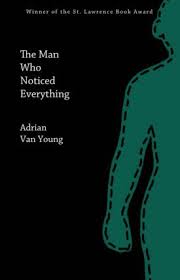
Adrian Van Young is the author of the story collection The Man Who Noticed Everything.

Adrian Van Young’s story collection, The Man Who Noticed Everything, has been called “seedy, even unnatural” and full of “Cthulian horror.”

Adrian Van Young’s story collection, The Man Who Noticed Everything, won the 2011 St. Lawrence Book Award from Black Lawrence Press. His fiction and nonfiction have been published or are forthcoming in LuminaGiganticElectric Literature, The American Reader, Black Warrior ReviewThe Believer and Slate, among other publications. Van Young has taught writing at Boston College, Boston University and Grub Street Writers, in Boston, and writing and literature at the Calhoun School, 826 NYC and the Buckingham, Browne and Nichols School. Currently, he teaches writing at Tulane University in New Orleans, LA, and lives in New Orleans, LA with his wife.

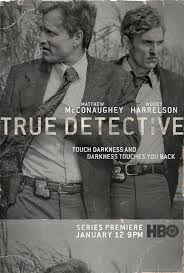
In this interview, Van Young discusses monster creation, mall gothic, and genre-benders like True Detective.

To read “The Skin Thing” and an exercise on writing one-sentence paragraphs, click here.

Michael Noll

I love the monster in the story, the actual The Skin Thing. It’s such a simple concept. There’s no origin story, no technical explanation of its mechanics or motives. It’s just a blob that sometimes eats people and sometimes doesn’t. How did you come up with the monster? Did you start with The Skin Thing and write the story around it? Or did you have a sense for the kind of story you wanted to tell and create a monster to fit?

Adrian Van Young

Thanks! I was happy with the way it turned out. To begin to answer the first part of your question, the story was solicited by Gigantic Worlds, a terrific anthology of flash science fiction forthcoming from Gigantic Books and featuring a great many writers who I slaverously admire such as Brian Evenson, Laird Barron, Meg McCarron, Alissa Nutting and Adam Wilson, to name just a few. So the genre was somewhat decided in advance.

But I knew from the get-go that I wanted to write an alien story and that moreover I wanted the alien itself to be Lovecraftian—a creature that presides terribly over human destiny but from a point beyond human knowing. Of course, when you’re going the Lovecraftian route, you don’t always want to hew to what’s been done, you want to make it new, so I started thinking, as well, about the scariest element of successful horror-inflected science fiction, which in my mind is always the human element. It’s a simple but effective principle. Take the Alien trilogy, for example. In the second film—which also takes place in a ruined space colony on a planet not unlike Oblivia—sure, H.R. Giger’s Xenomorph creature is responsible for a lot of the bloodshed, yet were it not for The Company’s decision to send the colonists and then the space Marines into a potentially dangerous situation or The Company’s decision, via Burke the corporate shill, to harvest a human host for military research, then a lot of what transpires over the course of the story would be moot. Which is a roundabout way of saying that I wanted the true horror in “The Skin Thing” to be not the creature itself but rather—not to belabor the obvious—what the colonists put on the creature and how they react to it in a setting of isolation and privation. Thus came my decision to call the creature The Skin Thing and to have it share with humans the largest and most superficially recognizable human organ: skin. So while the creature is “The Skin Thing” by name, the colonists themselves, whether they want to admit it or not, are doing “the skin thing,” i.e. the human thing— segregation, violence, cruelty, oppression, what have you, which humans have done with remarkable skill since they first crawled out of the ocean, notwithstanding hideous creatures to expedite the process.

So I guess you could say that, yes, I tailored the monster to fit the story, more or less. On another level, though, the look of the monster emerged partly from my obsession with Jim Henson Puppet Factory creatures and the like—the painstaking craft that at one point in time went into fashioning grotesque bodies. Guillermo Del Toro, god bless him, carries on the tradition today in film, Laird Barron and Caitlin R. Kiernan in literature. And somewhere in there must’ve been the sandworms from Dune, combined with a sort of eyeless sloth, combined with a terrestrial bat.  I was—and am!—a super nerdy and monster-obsessed little kid. After watching Star Wars and Dune, or reading The Tommyknockers and At the Mountains of Madness, all I could think of for days were the monsters.

Michael Noll

You write a lot of one-sentence paragraphs in the story. For example, this passage about the people who were sacrificed as a series of one-sentence paragraphs:

McSorls came first. McGaff. McShea. McVanderslice. McGuin. McGreaves…

Colonists total: two-hundred and forty. Colonists fed to the thing: thirty-six. Colonists saved on account of this practice (not to mention the onions): one hundred, at least.

Life was, for an instant, as right as it could be. 

Until the matter of McGrondic.

Is this style simply the way you find yourself writing? Or did you discover this style in an attempt to achieve a certain voice or tone or effect?

Adrian Van Young

The Man Who Noticed Everything has been called, by John Wray, "the secret love-child of so many authors I admire, from Ambrose Bierce to H.P. Lovecraft to Sherwood Anderson to Tobias Wolff."

The Man Who Noticed Everything has been called, by John Wray, “the secret love-child of so many authors I admire, from Ambrose Bierce to H.P. Lovecraft to Sherwood Anderson to Tobias Wolff.”

That’s an interesting question; I’m glad that you asked. Before a couple years ago though, I think you would’ve found that my fiction trafficked in lengthy, solid blocks of text that scrolled endlessly down the page. And unless you’re Thomas Bernhard—who I sometimes wish I was!— that’s not always going to work, especially with the modern reader. I learned from writers like Denis Johnson and Lydia Davis and Peter Carey, to name only a few, the indelible power of a well-placed one-sentence paragraph. It can just slam you, if you do it right. I also think it strengthens the bridge between fiction and poetry—namely, treating fiction as a kind of long-form, narrative poetry that demands equal if not more attention to rhythm, word combination and line-breaks, as it were. When I myself am writing a piece of fiction I always have a rhythm in my head that I want the words to conform to—so much so that at first I end up choosing words irrespective of precision, allusion or inflection and solely based on whether or not they fit rhythmically into the musical scheme of the sentence. That rhythm can be imprisoning. In drafting, of course, I go back and end up recalibrating the music of the sentence to fit the aims of the words but in the first draft, at least, rhythm is everything to me. One-sentence paragraphs further this sense of rhythm because they each signify a clean break from and a full stop after the sentence before. They also speak with a lovely straightforwardness to the writer’s intent—take note of this sentence!—and serve to move the story along in accord with how a reader’s eye moves down the page and how that eye, in turn, translates those words into brain matter, i.e. image, image, scene, image, scene, scene, image, etc. As you can see, my writing is heavily influenced by film, but at this point I’ve seen so many, how could it not be!

 Michael Noll

This story reminds me a lot of “The Ones Who Walk Away from Omelas” by Ursula K. Le Guin. (It’s also set in a place not unlike the colony in her novel The Dispossessed.) Both stories are science fiction, of course, and they’re both written in first person plural and formal in tone. Both read like myths, though your story has more narrative (I suppose, in that sense, it’s not unlike Shirley Jackson’s “The Lottery”). I’m curious what draws you to this style and form. Are you after that mythic sensibility, and science fiction/speculative fiction is a form that allows for it?

Adrian Van Young

Funny you should mention that Le Guin story, because in spite of the fact that several other people had noted a similarity, I’d never actually read it until yesterday when I started answering these questions. It’s a good one—though I think I like other Le Guin better. “Vaster Than Empires and More Slow,” also from The Wind’s Twelve Quarters, is a marvelous space opera that does volumes with characterization and world building in less than 50 pages. Of course, I can see the resemblance between “Omelas” and “The Skin Thing,” though I’d argue that “The Skin Thing” is bleaker. “The Lottery” you’re dead-on with, though. That story was at the forefront of my mind when writing this one. I have always been a tremendous Shirley Jackson fan—We Have Always Lived in the Castle and The Haunting of Hill House rank among my favorite novels—and “The Lottery” is no exception.

But the “mythic sensibility” that you cite in Le Guin is something I’m absolutely drawn to as a writer. That sort of epic, indelible quality to the prose, the themes. The writer’s way of saying: this happened. It was terrible, terrible, and it cannot un-happen. Near as I can recall I first encountered that quality in Edgar Allan Poe in stories like “The Fall of the House of the Usher” and “The Masque of the Red Death”—even though he was very much writing out of the 19th century. And then subsequently people like Angela Carter, Cormac McCarthy, William Gay and Annie Proulx, who all riff on 19th-century-inflected modes of speech and storytelling to manufacture their own modern-day myths. Granted this technique can seem hackneyed and super-imposed, especially if you go about it half-assedly, and so I would argue that the more wholly you give yourself over to the high, operatic quality of this kind of storytelling, the more a reader will be inclined to believe you, to go where you’re taking them. You really have to go full ham, I think. Carter does this extraordinarily well in her stories—“The Lady of the House of Love” from The Bloody Chamber, for instance, which is a feminist retelling of “Sleeping Beauty” with vampires in it, and goes so utterly over-the-top that it works. Which is all by way of saying, yes, I think this tone can be well suited to speculative fiction.

On the other hand though, you have people like Kelly Link, Victor LaValle and George Saunders who strive to incorporate more banal elements alongside more fantastic ones in their fiction, giving rise to something newer and subtler probably than anything I’m capable of producing. Shirley Jackson excelled in this, too, especially in “The Lottery,” which begins: “The morning of June 27th was clear and sunny, with the fresh warmth of a full summer day…” Or to touch again on Saunders, there is no better descriptor in criticism than the term that’s been used to characterize his early work (CivilWarLand in Bad Decline and Pastoralia): mall gothic.

Michael Noll

Your story collection, The Man Who Noticed Everything, was published by Black Lawrence Press, an imprint of Dzanc. For a long time, the attitude toward small, independent presses like Black Lawrence has been that they publish the writers whose work is too weird or experimental or nontraditional (whatever these terms mean) for the big publishing houses. But I wouldn’t say that’s entirely true anymore. Your work–and the work of writers like Kelly Luce (published by A Strange Object) and Daniel Jose Older (published by Crossed Genres)–is firmly within some very popular genres, most obviously the speculative fiction of Le Guin and horror of Lovecraft but also what’s sometimes called the New Fabulism of George Saunders, Aimee Bender and, now, Karen Russell and Manuel Gonzales. In short, the big houses are publishing some of the same kinds of fiction as the independent presses–“literary” fiction that is incorporating various genre elements. Do think this is a case of the big houses finally catching on to a style that was discovered and promoted by small presses? Or, are presses like Black Lawrence and Dzanc growing large enough that they now exist in the same sphere as the big houses?

Adrian Van Young

Well, given that Black Lawrence recently separated from Dzanc, I guess the last part of that question’s up for debate. Certainly both presses (Dzanc and Black Lawrence) are expanding every day, putting out top-quality fiction, poetry and non-fiction, genre-inflected and not. But I mean, yes, I definitely feel like New Fabulism, as it’s been called, has been inching its way into the mainstream for a couple years now to the point where genre-barriers are breaking down. In my opinion, this is ideal for literature in general. These distinctions between genre fiction and literary fiction, which have been picked over ad infinitum, are essentially meaningless when it comes to quality—and yet they’re incredibly meaningful, too, when it comes to form and tradition insofar as understanding the ways in which various genres work can help one into a greater appreciation for fiction that blurs the lines between them. Ultimately, I think that a more useful distinction exists between commercial and non-commercial, i.e. 50 Shades of Gray vs. The Piano Teacher. But then again, there are some jaw-droppingly adept novels out there that are superficially “commercial”—Gone Girl by Gillian Flynn, for instance—and some jaw-droppingly absorbing novels out there that are superficially “non-commercial”—say, Never Let me Go by Kazuo Ishiguro. I suppose in the end that all of these distinctions are silly, that a really excellent piece of fiction will decimate them forwards and backwards. Yet in the end they’re very human, and they’re useful to us as writers and readers. Distinguishing and discerning between types, after all, is its own form of doing “the skin thing”—it’s just what people do.

In his recent essay at Slate, Van Young argues about the TV series True Detective that "the cosmic-horror genre—rooted, as it is, in humankind’s subprime position in the pecking order of the universe—is deeply entwined with the character of Louisiana’s physical and cultural landscape."

In his recent essay at Slate, Van Young argues about the TV series True Detective that “the cosmic-horror genre—rooted, as it is, in humankind’s subprime position in the pecking order of the universe—is deeply entwined with the character of Louisiana’s physical and cultural landscape.”

And while I wouldn’t group myself in with the so-called New Fabulism school of Aimee Bender and George Saunders—as much as I admire those writers—I do think it’s catching on and I’m glad of that. It was wonderful, for instance, to see Saunders receive so much attention for The 10th of the December, which although accessible in some ways is objectively a very bizarre, eclectic collection of stories. As bizarre and eclectic as any of Saunders.

All the same, though, I don’t think you could realistically say that Black Lawrence and Dzanc, along with Coffee House, Two Dollar Radio and others, are in the same sphere as the big houses—and this is purely from a standpoint of promotional resources, distribution reach, market clout. The sheer ability that the bigger houses have when it comes exposing their authors, getting their books reviewed, getting their books in bookstores. What is interesting to me recently are the larger houses who’ve embraced the indie model as a sideline—say, FSG Originals, who has been publishing work by ostensibly experimental or genre-bending writers like Laura Van Den Berg, Jeff VanderMeer, Amelia Gray. That goes for Riverhead too (a division of Penguin), who published Manuel Gonzales’ collection.

That said, no, I don’t think it’s a case of bigger houses co-opting what was originally promoted by smaller presses. In many ways, I think it just marks a shift in the cultural sensibility at large. Which is to say a shift toward genre-bending, a gleeful sort of category crisis. You see it in TV (True Detective), in film (Let the Right One In, District 9), and now in literature. If the 80’s and 90’s were a time for largely embracing the conventions of genre when it comes to narrative art forms, then maybe the 2000’s have been a time for exploding them. You could chalk this up to post-modernism, blah, blah, blah, but in the end I think it just comes down to the fact that people as artists and consumers of art crave ingenuity, and the surest path to achieving that is through hybridization. Everyone loves a good mash-up.

April 2014

Michael Noll

Michael Noll is the Editor of Read to Write Stories.

How to Write a One-Sentence Paragraph

22 Apr
Adrian Van Young's story, "The Skin Thing," was featured on Electric Literature's Recommended Reading blog and will appear in the forthcoming anthology Gigantic Worlds.

Adrian Van Young’s story, “The Skin Thing,” was featured on Electric Literature‘s Recommended Reading blog and will appear in the science flash fiction anthology Gigantic Worlds.

In composition writing classes, we’re usually taught (or we teach students) not to write one-sentence paragraphs. But, in fiction and nonfiction alike, these short paragraphs can pack a tremendous punch if done well.

Adrian Van Young demonstrates this punch in his story, “The Skin Thing,” which will appear in the forthcoming science fiction anthology Gigantic Worlds. You can read it now at Electric Literature‘s Recommended Reading blog.

How the Story Works

Most writers will, at some point, use a one-sentence paragraph to emphasize some point or moment. Van Young’s story is interesting, then, because he uses so many of these constructions, sometimes to conclude a longer paragraph and sometimes as a series of short paragraphs. The sentences can be long, short, and even fragments.

They tend to be used in one of three ways:

Accentuate a change in tone:

This short paragraph concludes a description of the monster’s actions. In terms of subject and style, it’s really part of the paragraph that precedes it, but it’s given its own line because its tone is different (funnier, sort of):

Just one of us, McSorls, held ground. He was seeking, we think, to protect his allotments. It plucked him up inside its mouth, like the mouth of a puppet, and gobbled him down. Or gummed him down. It had no teeth. The leg of his pants dangled out, disappearing.

The Skin Thing ate his onions, too.

Summarize time and events:

These fragments deliver an accounting of the colonists’ battle with the monster:

McSorls came first. McGaff. McShea. McVanderslice. McGuin. McGreaves…

Colonists total: two-hundred and forty.

Colonists fed to the thing: thirty-six.

Colonists saved on account of this practice (not to mention the onions): one hundred, at least.

Illuminate important images

This paragraph is actually a series of short, connected sentences that focus on a different part of the monster’s body:

It was the height of foursome men, and its body behind was a languishing tube, and its head, although eyeless, was snouted, with nostrils that sucked and blew as it grew near.

Here, the sentences adopt a style of repetition common to speeches. The fragments illuminate a character in a moment of time:

There was:

McGondric in the mess, picking over his onions in no special hurry, a relaxed, dewy look to his under-eye skin.

McGondric going through the camp with his harvest of onions arrayed under cheesecloth, and heavens, his basket, the way that he bore it: offertory, slimly poised.

McGondric alongside his daughter, McGale, as they raked up the sands that comprised their allotment, the pink and the clean-muscled arms of them pushing, and pulling back toward them, and pushing once more.

Instead of moments from a long period of time, though, these two paragraphs break a very short amount of time into even shorter flashes of perception:

And there, behind the sandy glass, we saw a crown of human head.

And under it: a hand. A knee.

All of these one-sentence paragraphs are designed to manipulate the reader’s perception of the events and characters in the story. They speed up or slow down time and direct the reader’s eye.

The Writing Exercise

Let’s write some one-sentence paragraphs, using the passages from Adrian Van Young’s “The Skin Thing” as a model:

  1. Write a sentence that accentuates a change in tone. One way to do this is to create a series: actions, personality traits, qualities, requirements, events, or whatever appears in your story multiple times or has its differences parsed out. The problem with lists is that they can be boring—just a bunch of stuff. In workshops, the writer Tim O’Brien discourages lists for this reason, but of course his famous story, “The Things They Carried,” contains lists in almost every paragraph. So, after a list of ____, he writes, ______. Van Young uses a shift in tone in his story as well, but rather than interpreting the list, the tonal shift adds to the list: literally, one more thing the monster did, but this thing tells us something about the monster’s intentions that the other things did not. So, in your series, search for entries that sound different. Ask yourself, “What does that difference indicate?” Does it make you uncomfortable? Does it seem to cast the other items in a different light? Try putting it at the end and in a separate paragraph.
  2. Write a sentence that summarizes time and events. People who write press releases do this all the time. They use fragments to highlight the impact or actions of a group over time: X number of units sold, X number of services rendered. Fiction writers can do this as well, as Van Young illustrates. In truth, many of us do this naturally, especially when pressed into an argument. We tally up our actions over time: X meals cooked, X hours worked, X kindness delivered or sacrifices made. To do this in a story, figure out what actions your character takes pride in; then, challenge it. How would the character defend him/herself? Try listing the tally in separate lines.
  3. Write a sentence that illuminates important images. There are a few ways to do this. 1) In a static description of a person, thing, or place, instead of using commas to set off attributes (tall, dark, and handsome), develop each adjective into a sentence or phrase of its own (so handsome that I had to look away). Then, connect the sentences with commas or semicolons. 2) In a description of a person, thing, or place in motion, break the motion down into snapshots (as opposed to a running strip of film). What is happening in each snapshot? 3) In a description of an act of perception (I saw…), do not show the entire thing being perceived. Instead, reveal one part at a time. In each of these three methods, you’re focusing on images that writers and readers alike often zoom past. Devoting an entire sentence or phrase to the image can slow readers down, and then you can slow them down further by placing each sentence into a paragraph of its own.

Good luck!