
For the past six years, I’ve used this blog to explore the nuts and bolts of writing craft. The posts were an extension of what I was doing with students in the classroom, but it was also a form of close study to improve my own writing. I had written a novel, as good a book as I was able to produce at the time. An agent agreed to represent it, and the book received a lot of really flattering passes from editors. I sometimes tell people that the book didn’t sell because it went out at the height of the economic meltdown, when editors were fearful, especially of a genre-bending Kansas novel by an unproven author like myself. That may be true. But it was also true that I needed to become a better writer.
“An indispensable book that belongs on every serious writer’s desk.” (Thanks Amanda Eyre Ward for the awesome blurb!)
The blog led to a book: The Writer’s Field Guide to the Craft of Fiction. It’s a collection of all-new exercises (and short memoir pieces about honing my craft as a reader and writer) based on 40 one-page excerpts from recent amazing books. I’m quite proud of the result, and since its publication in late February, I’ve posted less often at this blog. I wasn’t sure what to write about. After around 200 exercises posted here (and 40 more in the book), I began to sense that I had exhausted what I wanted to say about craft. It’s true that, in some ways, craft discussions are inexhaustible. Every writer approaches the eternal problems of story (introducing and developing characters and setting, raising the stakes, advancing the plot, and structuring it all so that it makes sense) in slightly different ways. Yet as I’ve often told my students, once you identify strategies used by a writer, you’ll see them over and over in other books. We are all part of a grand tradition of storytelling that goes back as far as humans have walked the planet.
I’m also much more confident in my own writing. I’ve published stories in journals that, as a MFA student, I read with awe. I had a story included in a big national anthology. I’ve got enough stories for a collection, have written a draft of a middle grade novel, and am halfway through an adult novel that I’m really excited about. I’m still learning my craft, and (no kidding) I use the exercises I’ve posted here. Yet I’m also restless, ready to do something a little different at this blog.
Which brings me to my day job. I’m the Program Director at the Writers’ League of Texas, and one of my responsibilities is talking to writers about the entire writing and publishing process. I help organize an annual Agents & Editors Conference, and in the past three years, I’ve met and talked with more than sixty agents and editors. I work closely with Becka Oliver, the Writers’ League’s Executive Director and a former literary agent. From Becka and the pros who’ve come to Austin from New York and LA and elsewhere, I’ve learned a great deal about how the publishing industry talks about books. I’ve listened to pitches from hundreds of aspiring authors and seen many of them acquire agents and, eventually, book deals.
I never pitched a book as a MFA student, and I can’t remember ever having a single conversation with anyone who had. Learn to write first, we were told—which isn’t bad advice. But one side effect is that pitches and query letters remain a mystery or simply a hoop to jump through. But what I’ve begun to recognize at the conference is how exciting it is to tell someone about your book—and to hear about someone else’s. As readers, we occasionally stumble upon books, but more often, we pick up a book because someone told us about it, and something about their description captured our imagination.
When we tell people about our books, that is the reaction we are hoping for: awe, excitement, and a curiosity that absolutely must be sated.
Just as with books and stories, there is a craft to a good pitch. That is what I want to explore next as this blog. I will be taking jacket copy from recent and new books and teasing out what makes them effective: not just what catches our attention but also how they distill often complex stories into a short paragraph or two.
Studying pitches is not only important to selling a book (and for answering that inevitable question, “So what do you write?”). I’ve also found that problems with pitches often point to problems with the manuscript as a whole.
I’m excited about this, and I hope you will find it helpful and interesting as well.

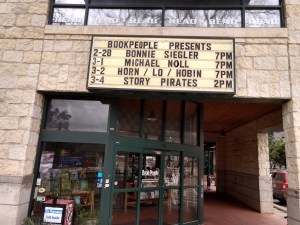
 If you’re in Tampa for AWP this week, this is where you’ll find me and The Writer’s Field Guide to the Craft of Fiction.
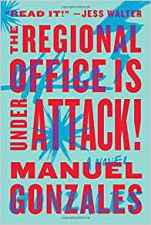
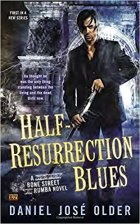
 One of the regular questions writers and teachers are asked is about the difference between literary and genre fiction. There are differences, but one of the things I found while putting together The Writer’s Field Guide to the Craft of Fiction was that both literary and genre writers were doing a lot of same things. This shouldn’t be surprising. A story is a story, and any distinctions almost certainly fall into what an author wants to focus on as opposed to any difference in quality.
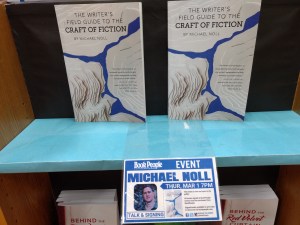 (If you’re in Austin, Johnston will be a special guest at the book launch for The Writer’s Field Guide this Thursday, March 1, 7 pm, at BookPeople.)
 Everyone who has taken a writing workshop has, at some point, heard the advice, “Kill your darlings.” A lot of very confident writers have said or supposedly said it: Hemingway, Faulkner and Welty are just a few. Through repetition, the maxim has acquired the solidity of one thing that young writers often desire most: a rule to follow. Sometimes it’s even true. But even more often, you pick up a book you love and see example after example of lines that must have been precious to the author.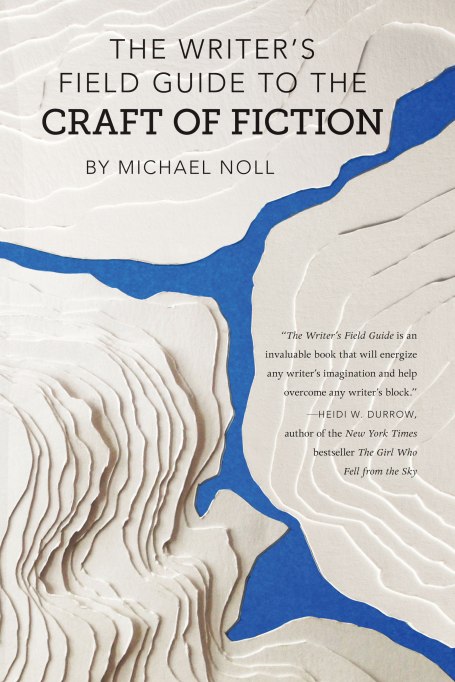


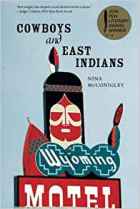 IDENTIFY THE MOTIVE FOR THE TOUR. The character leading the tour may have a destination in mind. Or the tour might be a way to kill time until some scheduled or expected moment. In McConigley’s case, the tour leads to both: a destination where Larson will make his request. This intention, or motive, is crucial. Without it, the characters are simply wandering around.
 GIVE YOUR CHARACTER A NEIGHBORHOOD TO INHABIT. To start, choose a common term (downtown, suburbs, etc.) that broadly applies to the neighborhood where your character lives, works, or spends time. Imagine that the character (or someone else) is explaining the location of this neighborhood. What phrase or term would be used? Not every character will necessarily use the same term. People who live downtown often view anything beyond their borders as the suburban hinterland, but people living outside of downtown will say things like, “I’m only 10 minutes from downtown,” suggesting that the suburbs are farther out. What does your character (and others) call your character’s neighborhood?
 GIVE YOUR CHARACTER BEHAVIOR TO OBSERVE. Just as people who buy cars or have babies tend to pay close attention to other cars and other parents with babies, all people/characters tend to notice certain behaviors more than others. The question is this: What concerns are on your character’s mind? Someone who just bought a car, for example, is worried about buying the best/cheapest/safest one. What decision has your character made or what decisions must the character make on a daily basis? The rationale for those decisions will likely cause the character to notice people with the same rationale or, perhaps, who make different choices.
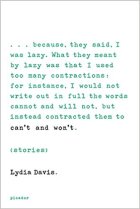 START WITH A PRONOUN. Davis’ story begins with we. It’s impersonal; we could be anyone. By the end of the sentence, it’s clear that the identity of we is wholly contingent on the setting. We are the people on the airplane. Nothing else about them matters. So, give yourself a pronoun: we, he, she, us, they, it. Don’t use a name. Avoid nailing down details for now. The point is to give your story a warm body, nothing more.


 Read to Write Stories