Tag Archives: writing exercises

An Interview with Jaime Netzer

10 Apr
Jaime Netzer's journalism has appeared widely, and her story,

Jaime Netzer’s journalism has appeared widely, and her story, “How to Die” was published in Black Warrior Review and reprinted at Litragger.

Jaime Netzer is a fiction writer and journalist living in Austin. She served as the L.D. and LaVerne Harrell Clark Writer-in-Residence in Smithville, TX, and the nonfiction editor for the literary journal Front Porch. Her fiction has appeared in Black Warrior Review, Parcel, and Twelve Stories; her journalism has appeared all over, including (most recently) Variety, USA Today Special Publications, Cowboys and Indians, and Austin Monthly.

To read an exercise on writing self-aware prose and Netzer’s story, “How to Die,” click here.

Michael Noll

The story starts really fast: right to the reality show and its irresistible hook. Did the story always start this way? Or was this a conscious decision that you made, to start in a way that would immediately grab the reader?

Jaime Netzer

I started this story in the thick of work on my thesis project at Texas State, back in the spring of 2012. I had been plodding away at this truly terrible attempt at a novel while also enrolled in a workshop with Tom Grimes, who asked me to turn in something other than part of the thesis, for everyone’s sake, I think. My memory is usually awful but I do remember the idea coming to me sort of whole, or something close to it. I wanted to write about a girl competing on a reality show to earn her own suicide. The published version is not that different from the version I sat down and wrote in one fell swoop—which is wholly unusual for me. Small things changed, but this story always felt more like play than work. Her voice was there from the start, which I think helped a lot.

Michael Noll

The story is set in Kansas City, which caught my eye, not just because I’m from Kansas, but because I so rarely read stories set in KC. In fact, I can’t think of another short story set there. Did you ever consider setting the story in a generic location, or did you always want to put it in Kansas City, at Arrowhead?

Jaime Netzer

I’m from Kansas too, just west of Kansas City. So I’ve sat in that weird concrete stadium and seen its shadows and felt the height and bowl-feeling of it—it’s an amazing place to watch a game, and it’s weird and cold and huge, and somehow that felt like the right place to start. The other part of this answer, honestly, is that I’m a chicken, and I don’t usually set stories places I haven’t had some serious experience with. The story is obviously a bit speculative, a bit not-here, not-now, but I wanted it very, very close to now and here. So I wanted to set it somewhere, and Kansas City felt right. Lawrence, the narrator’s name, is actually the name of my hometown.

Michael Noll

The thing I love most about this story is the demented sexuality of the narrator, the way she tries to seduce the guy who will interview her for the TV show. Her sexuality, and the way she wields it, is so unexpected. The story could have easily been about how the character lacks power and so wants to die, but the story gives her incredible power and control. Is this one of those characterizations that just appears in your head one day, or did you have to write toward a point of discovery, when you realized who the character was?

Jaime Netzer

She came to me fully formed, but I wouldn’t say her sexuality is demented at all, actually. And maybe it’s because she was always the voice in my head, but it doesn’t seem unexpected to me, either. Don’t we all wield our sexuality in an attempt to get what we want? I never saw her as lacking power, so in my head, the story hasn’t given power to her. She is the story, her power and control (and desires) are the story.

Michael Noll

A lot of readers will probably think of The Hunger Games when reading this story. I’m curious how much you thought about it. Did you read the books or watch the movies and feel compelled to write your own (different, weirder, better) version? Or is the connection coincidental or the result of reality TV’s prevalence in our lives?

Jaime Netzer

To be honest, I didn’t give The Hunger Games a moment’s thought when writing it—I saw one of the movies (now I’m curious about the timing) at some point, but it’s the opposite story, right? Those people are not fighting of their own accord, and they’re fighting to live. I have, however, long admired Shirley Jackson’s “The Lottery,” and The Hunger Games‘ premise is fantastic. I actually had three people ask me if I’d seen Black Mirror after reading the story. I haven’t, but apparently it’s similar in tone and there may have even been an episode with a reality show of some kind.

April 2015

Michael Noll Michael Noll is the Editor of Read to Write Stories.

An Interview with Nicole Haroutunian

2 Apr
Nicole Haroutunian's debut collection, Speed Dreaming, has been called

The Paris Review blog compared Nicole Haroutunian’s debut collection, Speed Dreaming, to the HBO hit Girls: “Her protagonists, all women, admit to melodrama, but they go one step further than the characters in Girls in that they question what’s behind their woe-is-me antics.

Nicole Haroutunian’s short fiction has appeared in the LiterarianTin House Flash Fridays, Vol. 1 BrooklynTwo Serious Ladies, and other publications. Her short story “Youse” was the winner of the Center for Fiction’s 2013 Short Story Contest. She is coeditor of the digital arts journal Underwater New York, works as a museum educator, and lives with her husband in Woodside, Queens. Her first story collection, Speed Dreaming, was recently published by Little A.

To read an exercise on showing dramatic elements twice and her story, “Youse,” click here.

In this interview, Haroutunian discusses the inspiration for her story, “Youse,” the process of revising a published story for inclusion in a collection, and one possible difference between literary and young adult fiction.

Michael Noll

“Youse” is a story that could have gone in a very different direction. We could have seen Margaret the way other people see her, as an object of pity, but the story doesn’t allow that view. Was it difficult to avoid sliding into that perspective, or did the story always see the world so firmly through Margaret’s eyes that pity wasn’t a possibility?

Nicole Haroutunian

As is often the case, I had to trick myself into starting this story with a self-devised writing exercise. I work as a museum educator at, among other places, the American Folk Art Museum. One of my favorite branches of the collection is schoolgirl art—amazing samplers, embroideries and watercolors done by 18th-19th century schoolgirls. Some of this work takes the shape of mourning drawings—ritualized drawings made to commemorate a death. I chose a selection of schoolgirl art, wrote descriptions of each work, and then tried to weave a contemporary story around those descriptions, with each new scene sparked by another artwork. One of the first paragraphs I wrote was about a mourning drawing created for the artist’s father, hence Margaret’s father’s death. Eventually, Margaret’s story took shape and the framework could be excised; there’s no explicit trace of the art in the story now. My residual positive associations with schoolgirl art still come through, though; these girls exhibited such strength, personal vision and insightfulness—I transferred those feelings onto, or into, Margaret. Of course it’s possible to feel pity for the schoolgirl artists—they dealt with a lot of death and had to live within the parameters of a pretty circumscribed life—but they also had a lot of privilege. The same is true of Margaret. At least half of the adversity she faces is of her own making and comes from a place of privilege, so although I have empathy for her, it’s hard to feel too sorry for her.

Michael Noll

The story contains a lot of heavy material: a dead father, catcalling from some pretty sketchy guys, and a trade of sexual favors for exam answers. How did you manage to keep all those balls in the air, so to speak? Did you ever wonder if you’d included too much for a single story?

Nicole Haroutunian

I see this story as being about the relationships between a pair of teen girls and their mothers. All the material you mention is there to serve the tension in and development of these relationships. So it didn’t feel like too much to me because the central concerns of the story seemed fairly straightforward in the midst of all the drama.

Michael Noll

The ending is lovely, a very small and intimate moment. Did you always have it in mind? Or did it occur to you as the story came together?

Nicole Haroutunian

Following from my last answer, it took me many, many drafts to decide which relationship was truly at the center of the story—Margaret and Joanna or Margaret and her mother. When I finally decided it was Margaret and her mother, I knew I wanted the last moment of the story to be between the two of them. When the story was originally published in the Literarian, a few things were different—the major one is that it was set in the 2010s rather than the 1990s (I knocked it back fifteen years so that it was plausible, in the context of my collection, that Margaret could grow up to become Meg, the protagonist of a few other stories). The last few lines, though, are in a slightly different order. It’s really subtle, but I think it does change the ending for the better.

Michael Noll

Since the story is about teenagers, I’m curious about how you would categorize your fiction. I’ve heard of writers who write a book that they imagine is literary fiction and then an agent says, no, this should sell as a young adult novel. (This happened with Margo Rabb’s forthcoming Kissing in America.) Do you think about these distinctions at all? Do you think there’s a difference?

Nicole Haroutunian

Before last summer, when I worked as a teaching artist for a book club summer camp for 9-13 year olds, I hadn’t read much, if any, young adult literature since I was a teenager. I’ve still read very little, so I don’t say this with a lot of confidence, but what I thought I noticed is that often the reader has to do less work when reading young adult literature and more work when reading literary fiction. YA books are forthcoming in a way that my stories aren’t. There’s more overt emotion, plot and resolution; there’s less ambiguity. In literary fiction, there’s often a lot of room for readers to make their own meaning. To me, it’s not about how old the characters in the story are, but how the fiction is written. I don’t think this is true in every case, of course, and it’s also not a value judgment. Some of my literary touchstones for this story were Lorrie Moore’s Who Will Run the Frog Hospital? and Jo Ann Beard’s In Zanesville, both of which I think are sometimes categorized as YA, but don’t read that way for me despite being about teenagers. I think a young reader would probably find “Youse” a little, or a lot, boring. It ends with the implication that someone is about to take a sip from a glass; a teenager would probably expect a little more in the way of payoff.

April 2015

Michael Noll Michael Noll is the Editor of Read to Write Stories.
How to Add Historical Context to a Short Story

10 Sep
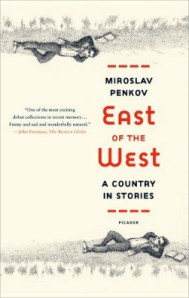
East of the West, the story collection from Bulgarian-born writer Miroslav Penkov, was called, by the Boston Glove, one of the most exciting debut collections in recent memory.

East of the West, the story collection from Bulgarian-born writer Miroslav Penkov, was called, by the Boston Globe, one of the most exciting debut collections in recent memory. The storoy “Makedonija” is included in the collection, and you can read it here at FiveChapters.

Stories are different than novels–obviously. They’re shorter, generally with fewer characters who face fewer complications within a more narrow scope. Novels that take place over the course of a day and stories that encompass decades are the anomaly, not the rule. And yet there are writers whose stories seem more like novels. Alice Munro is one.  Her recent story, “Axis,” (published in The New Yorker and The Best American Short Stories 2012), plays out over roughly half a century.

Another writer who accomplishes the same feat is Miroslav Penkov. The title story from his debut collection, East of the West, recently won the BBC International Short Story Award. It uses a love story to give a fierce portrayal of the geography of war. Another story from the collection, “Makedonija,” traces the effects of war over a person’s lifetime, a novel’s work in a single story. “Makedonija” was published at FiveChapters, where you can read it now.

How the Story Works

A man discovers the love letters sent to his wife by her old lover and reads them in a nursing home while offering advice to his daughter, whose husband is cheating on her. The story flips back and forth between the present and the past—the stories in the letters and the stories he remembers. As a result, he sees the present events against the backdrop of both personal and world history. The results are powerful.

For instance, here is a passage from the end of “Makedonija.” The old man is talking to his wife after sitting on a bench with his daughter’s husband. This is what he tells her:

“I’ve never told you this,” I say. “We never buried Brother. That was a lie. We never took him off the rope. I’d heard rumors, stories from people in our mountain, of how when mothers recognized their gunned-down children the tsarists pulled them aside and shot them on the spot. And so I told Mother, ‘I beseech you in your daughters’ blood, keep walking. Don’t say a word.’ And Mother was so shocked then she stood before my brother and didn’t even reach to touch his feet. We walked right past.”

In any work of fiction, it’s useful to ask what experience most haunts a character or narrator. That experience will likely shape, in subtle or obvious ways, the character’s decisions and reactions for the rest of his or her life. Here is a paragraph from Penkov’s story that does exactly that:

My brother came back from the war without a scratch. We never spoke of what he’d seen or done. I was ashamed to ask, and he was ashamed to say. We’d lost the war, of course, like all other recent wars, which was regrettable, since we never really lost our battles; we just picked the wrong allies. Or rather, our soldiers never lost their battles. Because what did I know? I herded sheep. So Brother joined me, up on the hills.

Of course, what happens next in the paragraph is that the war comes back for the brother.

The Writing Exercise

Let’s explore our characters’ pasts, using Penkov’s paragraph about his brother as a model:

  1. People often have multiple ways of thinking about their past: a view for when they’re feeling upbeat and a view for when they’re feeling down. How does your main character or narrator think about the past when he/she is feeling happy? What is the best version of the character’s personal history? The answer could relate to family or place, something small and intimate or large and cultural.
  2. What is the sad or pessimistic version of your character’s personal history? How does the character think about his/her personal past when he/she is feeling low?
  3. What is the main conflict from both versions of this past? What obstacle was overcome (or not overcome)?
  4. Fast forward to some point in the future. What sort of conflict would force the character to think about either version of this past? Possibilities include conflicts over love, children, property, money, and work. Ideally, the conflict should correspond in some way (though often unexpectedly) to the past conflict.

The past can affect the present in surprising ways. For instance, a happy version of the past could haunt a character who feels that she cannot live up to the standard set by previous generations. A dark version of the past could feel like an anchor on an otherwise buoyantly happy person. The point is to explore the ways that, as Faulkner famously wrote, “The past is never dead. It’s not even past.”

Good luck.

How to Create Your Narrator’s Voice

3 Sep
Joe Lansdale's new novel The Thicket is about X. You can read a free excerpt on Facebook.

Joe R. Lansdale’s new novel The Thicket follows a band of unlikely heroes on an adventure in turn-of-the-century East Texas. You can read a free excerpt on Facebook.

No aspect of writing fiction is more mysterious than creating a unique voice for the narrator. We often begin by imitating a voice that we love–Huck Finn, Holden Caulfield, or any of the voices dreamed up by Jonathan Safran Foer, Nicole Kraus, or Gary Shteyngart. Or we try to write the way that someone we know talks. As we fail, the elusive voice becomes like a magic trick that we should know how to perform but have forgotten. So what do we do?

One writer who consistently creates compelling narrators is Joe R. Lansdale. His new novel, The Thicket (to be released September 10) is set in East Texas at the turn of the century and narrated in a voice that catches your eye before the first sentence is over. The writer Ron Carlson said that The Thicket is “told in a voice so alluring and deadpan that it makes you smile and then look around to see who saw you smile.” You can read a preview of the first chapter here.

How the Story Works

First sentences are notoriously difficult to write. Stephen King recently claimed that he cannot write a novel until he’s gotten the first sentence right, and that sometimes doing so takes years. So it’s interesting to see how Lansdale approaches the first sentence of his novel. Notice how quickly he establishes the narrator’s voice:

“I didn’t suspect the day Grandfather came out and got me and my sister, Lula, and hauled us off toward the ferry that I’d soon end up with worse things happening than had already come upon us or that I’d take up with a gun-shooting dwarf, the son of a slave, and a big angry hog, let alone find true love and kill someone, but that’s exactly how it was.”

In that sentence, Lansdale falls back on a tried-and-true strategy. If you don’t know how to start a story, just tell the reader what will happen. It may sound simplistic, but this face-value approach is key to establishing the narrator’s voice for two reasons:

  1. We learn that the narrator is a tell-it-like-it-is kind of guy. He’s not going to play around with us. If you’re trying to develop a character, it’s useful to have a couple of hard-and-fast personality traits to rely upon.
  2. Because the statement is so factual, Lansdale has the luxury of playing with the words. He doesn’t have to worry about finding something interesting to say; he just needs to let the narrator find an interesting way to say a basic thing. This is exactly the strategy used here by Mark Twain in The Adventures of Huckleberry Finn (notice how it’s stating basic information):

“The Widow Douglas she took me for her son, and allowed she would sivilize me; but it was rough living in the house all the time, considering how dismal regular and decent the widow was in all her ways; and so when I couldn’t stand it no longer I lit out.”

A final point to consider: It’s easy to fall into the trap of believing that great voices are highly elaborate or deeply folksy, but the phrasings that make them memorable are often subtle. Lansdale’s three-part phrase “gun-shooting dwarf, the son of a slave, and a big angry hog” simply adds a few eye-catching adjectives. (This is another reason you shouldn’t abide by all “rules for writers.” Adjectives, when used well, can make a story sparkle.)

The Writing Exercise

Let’s create a voice, using Joe Lansdale’s The Thicket as a model:

  1. Using a story you’ve been working on, write a new first sentence(s). State outright, in the first person, what will happen. Use your plainest language. You’re giving yourself a frame to hang the narration on.
  2. Think about your narrator. Would he or she make such a up-front statement? If not, what parts would the narrator want to hide or soften? How would the simple statements be rephrased in order to make the narrator more comfortable? Make those changes.
  3. If the narrator had a captive audience, how would he/she change the remaining phrases in order to make them more interesting? In other words, what is the narrator’s storytelling voice? Because that is what narrators are doing: telling a story. Pick two or three words or phrases and make some simple changes: add adjectives, replace nouns with different nouns, or cut words to create surprising juxtapositions (“true love and kill someone”).

Play with your sentence(s) and see what you get. If you’re having fun, it’s a good sign.

Good luck.

How to Introduce Characters to Each Other

27 Aug
Mary Helen Specht was the writer-in-residence at Necessary Fiction, where the prologue to her novel Migratory Animals was published.

Mary Helen Specht was the writer-in-residence at Necessary Fiction, where the prologue to her novel Migratory Animals was published.

Sometimes the simplest things are the most difficult. For instance, how do you introduce two characters for the first time? A lot rides on the encounter. It’s not so different than dreaming about that guy or girl in middle school and worrying about how you’d ask him or her to the dance. The problem vexed F. Scott Fitzgerald—how to introduce Gatsby to Nick— so much that he slipped the great man in the back door. We meet him without knowing it.

If you want an easier way to introduce two characters, check out Mary Helen Specht’s great novel-in-progress Migratory Animals. The prologue was published at Necessary Fiction, where you can read it now.

How the Story Works

Here’s how Specht introduces the novel’s main characters: Flannery, a white American woman in her 20s visiting Nigeria, and Kunle, a Nigerian man in graduate school:

“She met Kunle at an outdoor canteen at the Nigerian university where she had been posted on what was supposed to be a brief data-collecting trip. Sitting at an adjacent table with a soda and a worn textbook, he leaned over and said, “You should try the palm wine.” Kunle wore slacks and a blue button-down Oxford, both ironed within an inch of their lives. Trim and preppy, he looked like one of those idealized husbands in films, usually too straight-laced to be Flannery’s type, the kind of man who kissed a beautiful wife before leaving for the office.”

Notice what Specht does not do: she doesn’t let the characters say, “Hi.” They don’t shake hands or make chit-chat. They don’t eye each other from across the room. The introduction just happens. Here’s a breakdown of how it works:

  1. When and where she met the man
  2. The initial encounter boiled down to a single spoken phrase and action
  3. What the man was wearing
  4. What his appearance reminder her of

If you used this template for every introduction in every story and novel, you’d be set for life. It’s an easy, efficient way to get two characters together.

The Writing Exercise

Let’s introduce two characters using Mary Helen Specht’s novel as a model:

  1. Pick a setting: Why is the character/narrator there? In what specific place did the characters meet? Be explicit when starting the passage: He/She/I met So-and-so in this place.
  2. Pick a moment: Boil the initial encounter down to a single spoken phrase and action. When the main character/narrator leaves the encounter, what words of the other person will he/she remember and dream about?
  3. PIck the clothes: What is the person wearing? Be specific.
  4. Describe the clothes/style/appearance more generally: From one character’s perspective, describe the other character. What does he/she reminder her/him of? What feeling does he/she get when meeting the person?

That’s it. The encounter is over, and you can transition next to the next encounter. Mechanically speaking, all you need to do is get the characters onto the page together. The scene doesn’t need to be long, like the initial encounter in Henry James’ The Beast in the Jungle. Be brief and efficient and move on.

Good luck and have fun.

How to Write a Dream Sequence

20 Aug
Paul Yoon's novel, Snow Hunters, was published by Simon and Schuster. It follows the travels of Yohan, a Korean who leaves his country after the Korean War to start over in Brazil.

Paul Yoon’s novel, Snow Hunters, follows the travels of Yohan, a man who leaves his country after the Korean War to start over in Brazil. The novel prompted a New York Times reviewer to write, “One of the gratifications of literature is to know a character in a book more completely than we can know people in real life.”

Some writing teachers make a rule for stories submitted in workshop: No dreams. No dream sequences. They make this rule because badly written dreams are all the same. They “show” a character’s inner torments/thoughts rather than artfully imbedding them into the narrative. But if fiction is, in any way, supposed to imitate life, then dreams are fair game. The question is how to write them well.

Paul Yoon has written one of the best dream sequences I’ve ever read in his new novel Snow Hunters. You can read the first chapter here. The dream begins at the bottom of page 16.

How the Story Works

The passage begin with Yohan falling asleep and hearing sounds through the open window:

“the tapping of the rain and voices and a car and then a ship’s horn. A single chime of a church bell. a door opening. A song on the radio. The steady punches of a sewing machine. He heard aircraft and the dust spraying from trucks and the wind against the tents”

We get a short reflection on this noise from Yohan (“it was faint and calm and he did not mind”), and then the dream begins.

“He was riding a bicycle. He felt a hand on the small of his back. Someone familiar spoke to him and he said, —I can go a little longer, and he lifted a shovel and sank it into the earth. A group of children whistled and clapped. And then he was running his hands through a girl’s hair and she took his wrist and they moved through a corridor where rows of dresses hung from the ceiling. Those dresses turned into the sea.”

Then the dream ends. So why does this dream work? First, it has no clear message. It’s not telegraphing crucial information about Yohan’s interior life. At best, the message is mixed: the desire and need to push himself and the desire for friendship and love. The images are not accidental. They reflect encounters and experiences from waking life. Second, the dream does not predict the future. It doesn’t attempt to move the plot forward.  Though dreams sometimes cause us to act (dreaming that someone has an accident and then, upon waking, contacting that person), we tend to be skeptical of someone who claims that valuable information was gained in a dream.

So why does the dream work? Here are four reasons (and lessons to keep in mind):

  1. It’s so beautifully and simply written.
  2. It glides from image to image, never dwelling too long in one place.
  3. It’s short.
  4. The images reflect things we’ve already seen in the novel. The dream feels to us, the readers, the same as it does to Yohan. In other words, the dream feels like a real dream. And that is rare in fiction.

The Writing Exercise

Let’s practice writing a dream sequence, using Paul Yoon’s Snow Hunters as a model:

  1. Choose a character whom you’ve already created and written about.
  2. Bring the character home, to bed, after a long day—not after a life-changing event but simply a day in which things seem to be on the cusp of happening.
  3. When the characters’ eyes are closed, let the sounds of the world drift in. Be specific and precise. You’re describing that odd state in which the mind is both idle and resting and also alert and aware of its surroundings.
  4. Ease into the dream. If you’ve ever heard the voice/sound from the waking world in your dream (a spouse or child talking to you, a professor speaking, the alarm clock), then you know how permeable dreams can be.
  5. Make the dream a reflection of the images of the waking world. Treat the dream’s reflective power like that of an almost-still lake. Remember, the mind is not directing traffic any longer but instead letting images trickle through unfiltered. Move from image to image. End on one that best seems to fit the mood of the day.

Now you have a dream sequence. If it seems inconsequential, that’s good. Beware dreams of great import—unless you’re writing about the Virgin Mary. Let the dream become part of the character’s fabric and, thus, the fabric of the novel.

Good luck and have fun.

How to Set the Rules Your Characters Must Live By

13 Aug
Shannon Thompson's novel "Minutes Before Sunset" was a Goodreads Book of the Month in July.

Shannon A. Thompson’s novel Minutes Before Sunset was a Goodreads Book of the Month in July and tells the story of two young adults trying to balance their supernatural gifts with a desire to live in the human world.

Every story has rules. In comic books, the superheroes have certain powers and not others. In horror stories, monsters can be killed only with silver bullets or certain chants. In romances, the heroine falls for certain kinds of men and not others. Pam Houston wrote a novel titled Cowboys are My Weakness. The rules of the novel are announced before you even open the book. Every story ever written or told must announce the rules it will play by.

The trick, as a writer, is to show those rules without disrupting the narrative. Shannon A. Thompson sets the rules clearly and quickly in her Young Adult/Paranormal novel Minutes Before Sunset. You can read the first chapter here. 

How the Story Works

Once you’re aware of how stories set the rules that their characters must live by, you can’t avoid seeing it’s done. Whether the fiction is genre or literary, the need to impose boundaries and limitations on characters is the same.

Here’s an example from the title story of Ethan Rutherford’s excellent new collection The Peripatetic Coffin. The story’s about the crew of a Confederate submarine trying to break the Union blockade of the port of Charleston:

“On deck, we had an unobstructed view of what Augustus had dubbed our Tableau of Lessening Odds. The Federal blockade was stupefyingly effective. Union canonships patrolled the mouth of the harbor, just out of range, and sank anything we tried to send through with the insouciance of a bull swatting blackflies. At night, they resumed the bombardment of the city. High, arching incendiaries, numbering in the thousands, painted the sky. You felt the concussion in your chest.”

The world is imposing clear boundaries on the characters: literally, a blockade with cannon balls and bombs. At no point in the story will the characters be able to act as if these impediments do not exist.

But the boundaries and rules can be mental as well as physical. To see how, read these two excerpts from Shannon A. Thompson’s novel, Minutes Before Sunset:

“It was Independence Day, and I stood with my family on Willow Tree Mountain. They called it Willow Tree Mountain, but, in reality, it was Willow Tree Hill, and the town denied that reality.”

Here’s the second excerpt:

“I moved my foot closer to the edge of the hill. I wanted to ride the wind down to the crowd. I wanted to dance and smile. I wanted to throw my arms in the air and listen to the exploding fireworks. I wanted to run around in endless circles until I fell down from exhaustion. I wanted to enjoy everything.

But that couldn’t happen. It was impossible.”

In these two passages, we learn the fundamentals of the story: the town has an Ignorance-is-bliss attitude. The narrator would like to join the smiling townspeople, but, for a reason that will be revealed later, he’s prevented from doing so. This mental and physical limitation defines his character and determines how the story will move forward.

The Writing Exercise

Let’s practice setting the rules, using Minutes Before Sunset as a model:

  1. Choose a character and a world for that character to inhabit.
  2. Define the world with a single adjective: happy, sad, fearful, proud, bored, etc.
  3. Free write about that adjective. Your goal is to find an image of the world or the people in it that demonstrates the adjective, if possible without actually stating it. The image will set the rules for the world. Future descriptions of the world should adhere to this early image in some way. So, in Minutes Before Sunset, the town’s denial of the supernatural elements in its midst is suggested by the fact that it calls a hill a mountain. In Gone in 60 Seconds, the stovetop burns out of control to suggest Kip’s lack of control.
  4. Now, free write about the character. How does he/she feel about the image you just created? Try to find an action that suggests the character’s attitude toward the world. For instance, in The Hunger Games, the fact that Katniss sneaks through the fence in order to hunt suggests that she’s willing to break the rules to protect her family. Thus, the big event at the end of the first chapter—volunteering for the Games in place of her sister—feels like a natural extension of her character, of the attitude that we’ve already witnessed.

Good luck and have fun.

How to Use Unusual Words

31 Jul
Matt Bell's novel

Matt Bell’s novel, In the House Upon the Dirt Between the Lake and the Woods, has been called “fiercely original” and “a gut punch.” It’s also the only novel you’ll read this year where one of the conflicts is Man vs. Bear.

Ernest Hemingway didn’t mince words about style. About William Faulkner’s, he wrote, ““Poor Faulkner. Does he really think big emotions come from big words? He thinks I don’t know the ten-dollar words. I know them all right. But there are older and simpler and better words, and those are the ones I use.” But what if the two sides are not exclusive? What if you can use ten-dollar words that are also old and simple?

Matt Bell offers a lesson in using unusual vocabulary in his new novel In the House Upon the Dirt Between the Lake and the Woods. You can read a few of those words in this excerpt published at Guernica.

How the Story Works

Here are a few of the words used in the excerpt:

kith, kin, circumscribing, exhalations, remove (used as a noun), rankled (used as an adjective), sequestered.

Some of these words belong to languages other than fiction’s: sequestered is now a political word. Exhalations belongs to biology, physiology, and yoga. Circumscribing comes from geometry, mapmaking, and travel. Kith and kin belong to another age. To see just how specific our ideas can be about when certain words are appropriate, try this simple experiment: Use any of these words in casual conversation. Example: What were you doing this weekend? Oh, just hanging with my kith and kin. You’ll get some odd looks. Someone might ask, “Why are you talking that way?” But you would have accomplished a sometimes-difficult feat. That person would paying attention to you, trying to figure out, “Why is he talking that way?” or “Who is she that she uses words like that?” Part of the battle of fiction is just to get the reader to wake up and pay attention. Using unusual words can do that.

The Writing Exercise

Let’s practice using unusual words:

  1. Find your source. Words seem unusual only when they’re used outside of their usual contexts. So, pick up a trade magazine or one that caters to a hobby or special interest. Or visit a website that serves the same purpose. Write down all the words that you understand but would never use in conversation.
  2. Create a character who would use those words. The easiest way is to write a character who is part of the words’ trade or special interest; obviously, doctors don’t talk like studio engineers. But you can also shoot for idiosyncrasy. Ask yourself, what kind of person would use these words casually in a sentence outside of their usual context? Try to hear the person’s voice as he or she speaks.
  3. Write a passage in which the character discusses something mundane: eating dinner, walking the dog, going on a date, putting the kids to bed. If it’s a character with a specific job or interest, make him/her discuss the topic with someone else from that job/interest. If it’s an idiosyncratic character, just let him/her talk. Try to use as many of the unusual words from your list as possible. Some won’t make any sense, or they’ll feel forced. But others will surprise you. They’ll become part of the fabric of the character’s speech, and when that happens, you may discover that you’ve created a character with a voice you’ve never heard before.

Good luck and have fun.

How to Write an Action Sequence

18 Jun
Five Chapters is an online literary journal that publishes stories serially in five installments over the course of a week.

“Bullies” by Kevin Grauke first appeared FiveChapters, an online literary journal that publishes stories serially in five installments over the course of a week.

One of the hardest things to write is a fight scene. The blow-by-blow description often ends up sounding like a choreographer’s notes: hit here, kick there. The most commonly proposed solution to this problem is to condense the action into a line or two (He hit me, and I kicked him, and then we fell to the ground, fighting.)

But a terse summary is not the only way to write an action sequence. An example of the alternative can be found in the excellent fight scene in Kevin Grauke‘s story, “Bullies.” You can read it at FiveChapters. (The fight is at the end of Part Four.)

How the Story Works

The key to this passage is that it never becomes a list of actions. Lists are almost always boring. They’re too much like recipes, and so readers tend to skim them. Grauke solves this problem in two ways. First, he offers an interpretation of the action:

“He grabbed Mr. Shelley’s tie and gave it a quick yank. He meant this only to be a sign, a signal that this was over for now—a period, not an exclamation point—but he pulled harder than he’d meant to, and Mr. Shelley, caught off-guard, stumbled forward, knocking into him.”

Notice how the commentary (“He meant this only to be a sign…but he pulled harder than he’d meant to”) sets up the action that follows (“stumbled forward”). Imagine if the commentary were left out. The action would be stripped of cause and effect, and thus of story and meaning.

Second, Grauke repeatedly moves from a particular action to the character’s thoughts. Here’s the first half of a sentence that illustrates this move nicely:

“When their bodies came to a stop in the darkness beyond the glow of the porch light, Mr. Shelley was on top of him, and thinking of everything that he’d ever talked himself out of, all the stands he hadn’t taken, Dennis threw the first punch of his life…”

Again, imagine if the character’s thoughts were left out. The action would suddenly exist in a void. Why does a college professor throw a punch? Why does he throw that punch now, in this moment? We wouldn’t know.

But the phrase containing the thought doesn’t only cue the reader into motivation. It also breaks up the rhythm of the sentence. The twin phrases, set off by commas (and thinking of…; all the stands…) slows the reader down and suggests the ways that time itself seems to slow to the character whose head we’re inside.

The Writing Exercise

This is a simple exercise. We’re going to make two characters fight. Here’s how:

  1. Pick the two characters. You can choose two that you’ve been working with. Or you can make them up. Either way, it will be tempting to make them complete opposites. But the best fights are between characters who share something in common. In “Bullies,” the fighters are both fathers of young children. In Rocky IV (as a magnificent montage makes clear) both Rocky and the Russian, Ivan Drago, are willing to push their bodies against human limits. The difference between the men is less in their personalities than in their motivation.
  2. Pick the ring. Give the characters a place to fight: the flagpole in front of school, a parking lot, a house, a swimming pool. Think about how the place would affect the fight. For instance, water in a pool would reduce the fighters’ mobility but also raise the stakes (drowning).
  3. Write the fight. List the actions that will occur. What would an objective camera capture if filming the scene?
  4. Go back and insert commentary. Grauke uses a version of this: He meant to do X, but Y happened instead.
  5. Insert the character’s thoughts. Use Grauke’s sentence as a guide: X happened, and he thought Y, and so he Z. Give some thought to the character’s motivation. A fight demands that the participants make choices: to fight or not to fight, how hard to fight, how bad to hurt the other fighter, and when to stop. Keep in mind the great line from David Sedaris’ essay “Can’t Kill the Rooster.” Sedaris’ brother gets beat up in the parking lot of a bar, and someone asks when the other quy stopped hitting him. The brother says, “When he was fucking finished.” A good fight scene allows you to write a line like that.

Good luck.

How to Reinvent a Stock Character

11 Jun
M. John Harrison's Light is X.

M. John Harrison’s Light has been called “space opera for the intelligensia,” and Neil Gaiman said it was one of his favorite SF books of the last ten years. Light is the first in a trilogy that includes Nova Swing and Empty Space: A Haunting.

Almost every story begins with an idea that has been written about a thousand times. Detective stories can begin only so many ways. Stories about immigrants to America feature characters who, despite their far-flung origins, share a certain kind of experience. The problem is not to invent a story that’s never been written but to reinvent an age-old tale.

This is what M. John Harrison has done in his novel Light, the first of a science fiction trilogy. The book features space ships and aliens, but Harrison moves far beyond the typical versions of these things. You can read the opening of the novel here, or you can read the short passage below.

How the Story Works

For an example of how Harrison reinvents a stock character, read this passage about an alien invasion:

Drawn by the radio and TV ads of the twentieth century, which had reached them as faltering wisps and cobwebs of communication (yet still full of a mysterious, alien vitality), the New Men had invaded Earth in the middle 2100s. They were bipedal, humanoid—if you stretched a point—and uniformly tall and white-skinned, each with a shock of flaming red hair. They were indistinguishable from some kinds of Irish junkies. It was difficult to tell the sexes apart. They had a kind of pliable, etiolated feel about their limbs. To start with, they had great optimism and energy. Everything about Earth amazed them. They took over and, in an amiable, paternalistic way, misunderstood and mismanaged everything. It appeared to be an attempt to understand the human race in terms of a 1982 Coke ad. They produced food no one could eat, outlawed politics in favour of the kind of bureaucracy you find in the subsidised arts, and buried enormous machinery in the subcrust which eventually killed millions. After that, they seemed to fade away in embarrassment, taking to drugs, pop music and the twink-tank which was then an exciting if less than reliable new entertainment technology.

Thereafter, they spread with mankind, like a kind of wretched commentary on all that expansion and free trade. You often found them at the lower levels of organised crime. Their project was to fit in, but they were fatally retrospective. They were always saying:

“I really like this cornflakes thing you have, man. You know?”

Notice how the passage begins with an alien image we’ve seen before (humanoid, bipedal, white-skinned) but then quickly moves into unexpected territory (red hair, Irish junkies). But the genius of the passage is how Harrison describes the aliens’ attitude. He starts by making them the opposite of the creepy, emotionless creatures from TV and the movies. But then he develops the idea: what would it mean for an alien race to be attracted by Earth’s TV and radio ads? If human culture drew them to the planet, how would they behave? Rather than making the aliens sinister, the passage presents them as both curious and dopey enough to take that culture seriously but also technologically advanced enough to nearly destroy the world. By the passage’s end, Harrison has created an alien race that is entirely new to fiction.

The Writing Exercise

Let’s develop a stock fictional character the way that Harrison develops the alien invader.

  1. Pick a stock character: hard-boiled detective, crooked cop, bloodthirsty pirate, ambitious drug dealer, too-serious doctor, laconic cowboy, Medieval knight, bold dragon hunter.
  2. Describe the character. Feel free to include setting. Start with a cliche.
    1. A thin and weary private eye in a small, dirty office
    2. A single woman asleep in her cluttered apartment and awoken by a call from the hospital).
  3. Move the description in an unexpected direction. One way to do this is to include an unusual trait and then use that trait to make an unexpected comparison (red hair, Irish junkies).
    1. He had a mustache with the ends pulled to a thin point, like a villain who’d tie a woman to railroad tracks or a hipster with a custom-made bicycle.
    2. She was missing the pinky finger on her left hand. No one at the hospital had yet noticed the absence, but they inevitably would, just as a pickpocket’s victim inevitably pats his pocket to find his wallet gone.
  4. Answer the question of how someone in that character’s position would behave given that unusual trait.
    1. The mustache made it hard to blend in, but he wouldn’t give it up—the greased tips had taken him more than a year to grow out—and so as a result he only took business that involved the low-rent but becoming-gentrified part of town.
    2. The patient in which the finger resided would also discover it, which is why the doctor took a drink before going into work, a habit that was, in part, the reason she lost the finger in the first place.

The key to this exercise is to begin with a stock character and develop him/her by first adding a small, unexpected detail and then imagining how that detail would affect the character’s life.

Have fun.