Tag Archives: writing exercises

An Interview with Karan Bajaj

26 May
Karan Bajaj is a bestselling novelist in India. The Yoga of Max's Discontent is his most recent book.

Karan Bajaj is a bestselling novelist in India. The Yoga of Max’s Discontent is his most recent book.

Karan Bajaj is a bestselling novelist and striving yogi. Born and raised in India, he has trained as a Hatha Yoga teacher in the Sivananda ashram in South India and learned meditation in the Himalayas. He is the author of the novels Johnny Gone Down and Keep off the Grass, both of which were No. 1 bestsellers in India. His most recent book is The Yoga of Max’s Discontent. He’s been named one of India Today’s Top 35 Under 35. He lives in New York City.

To read an exercise on hooking the reader based on The Yoga of Max’s Discontent, click here.

In this interview, Bajaj discusses why he chose a white American character for a novel based on his own experience, the necessity of an author’s “message” staying out of a story, and the importance of taking a sabbatical.

Michael Noll

You’ve written that parts of The Yoga of Max’s Discontent are based on your own experience studying yoga and Buddhism and hiking in the Himalayas, and so I’m interested in your choice to tell this story from the point of view of a white American. On one hand, I can imagine some publishers preferring a white main character because it fits their idea of what sells. On the other hand, I’ve also had the experience in my own work of not being able to write about something until I distanced myself from it somehow. What went into the creation of Max?

Karan Bajaj

Thanks Michael. I made the choice of an American main character, less due to publishing practicalities, more to approach Max’s experiences in India from the perspective of an outsider. His “otherness”, be it an American in India or a white guy in the Bronx housing projects, is crucial to the core idea in the book of a man stripping off layers of external identity, first, physical, then, spiritual, to come closer to a more permanent reality. If I had an Indian protagonist, he’d have too many pre-conceived notions about concepts like karma, re-birth, yogic powers etc. that he uncovers in his journey.

In terms of creating Max, here’s a small anecdote: I read more than one hundred books and as many articles and papers to research the 1st 30 pages of the book that are set in the Bronx housing projects. Almost none of my research appears in the book but I had to truly understand each day in Max’s childhood to understand why someone would make the extreme decision to quit his job in Wall Street to become a yogi in the Himalayas. The next 270 pages set in India required almost no research at all. I’ve lived Max’s life myself and spent a lot of time in hidden Indian ashrams and remote Himalayan villages.

Michael Noll

Part of Max’s attraction to yoga and meditation is the possibility, learned from a street food vendor, that some yogis can sit in mountain caves in the winter in nothing but loin cloths and walk barefoot in deep snow. As a fictive device, this works well, creating intrigue and suspense in both the main character and the reader. But I also found myself wondering how it connects with the physical and spiritual practices that you’ve studied and that are important to you. Did you feel any conflict between the need to tell a good story and the desire to introduce readers to the very real practice of yoga? (Of course, perhaps some yogis really can walk barefoot in snow and across water!)

Karan Bajaj

The Yoga of Max's Discontent is the latest novel by Karan Bajaj.

The Yoga of Max’s Discontent is the latest novel by Karan Bajaj.

Excellent question, Michael. My idea for this novel was to break the paradigm of spiritual/personal transformation novels as fables thick and heavy with messages. I wanted to write a page-turning adventure through contemporary India in which the reader melts into the story and doesn’t feel the presence of an author communicating any message. However, I didn’t exaggerate or falsely exoticize India for the sake of a good story. Yogis and their physical prowess are well researched and in the novel, I’ve treated it as a spontaneous by-product of a yogis’ journey from the finite to infinite rather than the goal of the practice. Yoga, as I’ve presented in the book, is chitta vritti nirodah, the complete cessation of the thought waves of the mind so that the individual dissolves as it were. Every practice referenced in the book is in service of that idea.

Michael Noll

One of the sources of Max’s discontent is his attachment to material things, and one of the realizations he has during his quest is that he actually requires very little in order to survive and be at peace. I think it’s natural for readers to wonder how the book connects with your own life. You’ve studied yoga, gone on a sabbatical, and meditated in silence for a year, but you also work with large corporations in New York and your personal website is no slouch as a marketing device. Do these roles ever feel like competing forces?

Karan Bajaj

As you get deeper into the book, I think the concept that emerges is one of dharma. The tree grows and bears fruit, the water quenches thirst, in the same way every living being has a dharma, a certain innate tendency. Purifying your actions in accordance with your dharma rather than taking someone else’s dharma serves you best. Max’s dharma was to live in the mountains and serve. My own dharma, I think, is to be in business since I feel a very natural inclination for it. So what I’m trying to do is to purify my life in that context by working without attachment to the results of the work. I slip and fall often but that’s the general idea I try to live by. Right now, for example, I’m focused on marketing the book and getting hundreds of people to read a story I think is pure and transforming, but if that doesn’t happen, I know a large part of me will remain untouched.

That’s why perhaps my 4,1,4 model of working for four years, then taking a year-long sabbatical, then working again for four years works for me. Being in the world starts to take its toll so stepping out of it regularly and doing deep meditation helps me return a little more grounded to it. Yet I do always return because I think my dharma is to be in the world of commerce rather than in teaching yoga and meditation in the Himalayas.

Michael Noll

I know that the idea of sabbatical is important to you and that your own sabbatical fueled your growth as a writer and in yoga. What advice would you give to people interested in taking a sabbatical but who also find it difficult for a variety of reasons: limited income, children, or parents or other family members who depend on them for care? I think a lot of people look at their lives and don’t see how they can extricate themselves from them for any long period of time. Is a sabbatical a possibility for everyone?

Karan Bajaj

It’s never easy for anyone, I think. It was difficult for me to step out of life for a year when I was alone, harder when both my wife and I had to plan it together, and will be harder still now that we have a toddler and an infant! But each time I’ve come back, I’ve transformed in so many dimensions from becoming more spontaneous and creative to a greater stillness in my thoughts that I make it a point to keep taking them. If someone is interested in the idea but struggling to make the time, I’d say start by taking deeper, more meaningful vacations. Rather than going to a beach resort or a comfortable destination like Florida, take vacations that dissolve your sense of self. I highly recommend the 10-day silent Vipassana meditation retreat, for example or a tough hike like Kilimanjaro or the Grand Canyon where for a period of time, you just take one step, then another, and no other idea exists. Once you take a few such vacations, you start seeing the impact on your life and make the space to take longer and longer sabbaticals. In some ways, this is much easier than the dramatic re-inventions I see in American life. People are always becoming in the U.S.—from lawyer to yoga teacher; from marketing director to life-purpose coach etc. It’s perhaps simpler and more effective to go from point A to nothing at all rather than point A to point B.

May 2016

Michael Noll Michael Noll is the Editor of Read to Write Stories.

An Interview with Alexander Chee

20 May
Alexander Chee has been called "incomparable" by Junot Diaz and is the author of the much-anticipated novel, The Queen of the Night.

Alexander Chee has been called “incomparable” by Junot Diaz and is the author of the much-anticipated novel, The Queen of the Night.

Alexander Chee is the author of the novels Edinburgh and The Queen of the Night. He is a contributing editor at The New Republic and an editor at large at VQR. His essays and stories have appeared in The New York Times Book Review, Tin House, Slate, Guernica, NPR and Out, among others. He has received a 2003 Whiting Award, a 2004 NEA Fellowship in prose and a 2010 MCCA Fellowship, and residency fellowships from the MacDowell Colony, the VCCA, Civitella Ranieri and Amtrak. He has taught writing at Wesleyan University, Amherst College, the University of Iowa Writers’ Workshop, Columbia University, Sarah Lawrence College and the University of Texas – Austin. He lives in New York City, where he curates the Dear Reader series at Ace Hotel New York.

To read an exercise on creating character with plot based on The Queen of the Night, click here.

In this interview, Chee discusses growing as a writer to meet the needs of your novel, building character in order to develop plot, and the process of writing a novel with a complex plot and many characters.

Michael Noll

I think a lot of people who read your first novel Edinburgh may have been surprised by this book. The Queen of the Night is big and sweeping, with plot twists galore. As an opening line states, “When it began, it began as an opera would begin…” You and I talked on a panel at Austin’s New Fiction Confab, and I compared this novel to Victor Hugo’s work. But Hugo probably isn’t a writer that many contemporary writers strive to emulate (despite the success of the musical Les Misérables). What drew you to the novel’s operatic style? Is there something that it allowed you to do that a so-called “quieter” style wouldn’t? Or is the novel simply the result of your maturation as a writer? Did your craft advance to the point that you could attempt something big, with a complex plot, without it falling apart?

Alexander Chee

When I began thinking about the things that resulted in the writing of the novel, I was fascinated by opera plots and how seemingly ridiculous they were but also how pleasing. And so I began looking into why opera even existed as an art form and found the poems Orlando Furioso and Orlando Innamorato, poems which are commonly believed to have been the inspiration for most of the classic Italian opera plots. The idea that there was some common source for seemingly disparate works of art fascinated me and then made me wonder, what would it be like to try to make something that could mirror that on the far side? A life composed of opera plots? Or what if, after believing opera plots were inherently unbelievable, your life came to resemble one? Would you believe they were real then? And of course I was fascinated by the idea of people living out a lesson from the Gods, dictated by them, which of course resembles or prefigures authorship.

And then the idea of doing anything like this seemed implausible. But of course that made it all very tantalizing. As did working with the tools of melodrama and the old romans: coincidence, mistaken identity, cliffhanger plot twists, and adventure.

Once I knew I would be writing a novel based on all of this, I decided it had to be very bold. I set out wanting to do something utterly different from both anything I had ever done much less anything anyone would expect me to do. I decided it would be a picaresque, with a woman as the main character and narrator, and initially believed it would be a very small novel, maybe 250 pages. I would work with the tools of escapism but to give the reader a deeper relationship to this question of why we do what we do when we are confronted with a coincidence. What is it in us that makes us believe it is the work of a higher power? What do we do to our lives when we believe that? And: what if it really is a higher power, what then?

I don’t know that the novel was the result of my maturation—I think it’s more that it caused it. I had to grow in order to do this. What you see here, these are all gambles. Finalizing the novel’s plot structure nearly drove me insane. And at every point before it worked, I believed I was closer to failure than success.

Michael Noll

When we talk about plot (and plot-driven novels) as writers, it’s perhaps tempting to think of it as separate from character. This is why we so often quote Chandler’s line about novels that are stuck: the solution is to have a guy with a gun walk in the door. Or we quote Chekhov and his advice that if a gun’s present in the first act, then it had better go off in the third. It’s possible to read both as arguments for deus ex machina plot devices in which characters are tossed about without much control over events. But this isn’t how your novel works. For example, early on, the main character—who will later become a famous opera singer—offends her mother, and so her mother punishes her by covering the girl’s mouth so that she can’t sing in church. It’s a moment that drives the plot forward (readers wonder, what will happen?), but it’s also a moment that reveals character. Something good has been taken from the girl; how will she respond? This is all to ask this: Was it difficult to balance building character with driving the story forward? Or are those challenges one and the same?

Alexander Chee

Alexander Chee's novel THE QUEEN OF THE NIGHT is a national bestseller a review in Vogue called "brilliantly extravagant in its twists and turns and its wide-ranging cast of characters."

Alexander Chee’s novel The Queen of the Night is a national bestseller a review in Vogue called “brilliantly extravagant in its twists and turns and its wide-ranging cast of characters.”

Thank you. Yes. This is a common mistake, I think, a fatal separation. Plots have to grow out of your character for them to really succeed. If a gun is present in the first act, I wouldn’t think about how it has to go off in the third. I would think about how the character is the reason the gun is there to begin with. And from there: under what circumstances would that character pick up the gun and fire it?

Building character is building plot, to me. If you don’t know where your story is going, you don’t know your character well enough yet and need to do more to know them.

At each moment you’re asking, as you draft, what is the most likely action for this person with these limitations and these desires in this place at this time, and you just keep asking that, at each moment going forward.

Michael Noll

In the course of the novel, the main character moves from a destitute servant girl to famous opera singer who runs in the most elite circles of Parisian society. As a result, we get to see many different worlds: the American frontier, hippodromes, brothels, secret passages in castles, salons featuring the most famous artists of the time, the opera stage, the French royal court, and scenes of war. On one hand, this variety means that every few chapters or so, the readers gets the thrill of being transported to a new setting. On the other hand, it also means that you had to create not just one world but many. How did you approach the challenge of getting the reader to buy into each new world? Was it difficult to maintain a consistent voice and sensibility throughout the novel?

Alexander Chee

They are one world and they are many, both. Part of my approach was inspired by a Sherlock Holmes story, “A Study in Scarlet”, which begins as a mystery in London and then becomes a Western (I won’t otherwise spoil it). I loved this sense of the two worlds connected by a single fugitive.

But also: I wrote this because I was fascinated by these kinds of women, the orphan who becomes a prostitute who becomes a courtesan who becomes a singer, women who existed in a sort of special social class that was slippier than the others. If you were a courtesan back then, you knew the powerful and the powerless. And you had your own power because of that. You moved between those worlds. So I simply read and researched and followed my imagination. I don’t know that I did anything more special than that. But yes, it meant so many research books. It was a little like preparing to write several novels rather than one. But it was often quite fun, to be honest.

As for her voice, well, I kept favorite sections of the draft printed out to read from before working, so her voice was in my head. Sections where I thought, “Yes, that is her, that is how she sounds.” And I used them to grow more.

Michael Noll

The novel contains so many reversals that I’ve wondered how you were able to keep track of them and hold a single narrative line in your head while writing. Perhaps part of the answer is in the way you tell the reader that certain plot points are bound to happen. For example, the singer learns that her voice is particularly gifted but that it will also inevitably fail her one day–and so we know that moment is coming, but I can also see how it gave you a destination to aim for. How did you keep track of where the novel was going?

Alexander Chee

In some ways, I wrote it without quite knowing where it was going. Or even that the story was building the way it was. It was as if I had to write each of the sections without knowing I was doing that.

I kept a journal devoted to the novel. I wrote in it at the end of every work session, included any questions I had, any frustrations. I read that at the beginning of work the next day. This diary idea came from keeping a blog. I decided to keep one but just for myself—which may sound funny, but which is to say that instead of keeping the diary in a traditional format, I wrote it so the newest entry was always at the top, and the oldest all the way at the end. This way whenever I opened the document the newest entry was the first thing I saw.

I also kept a list of characters and places for the novel where I could see it, and I looked at it whenever I had a question or was stuck. I would say to myself, “What next, what people in what places?” And that helped a great deal. I got the idea for the lists from Janet Frame, who describes it in her autobiography, along with many of her writing habits.

Lastly I kept a file of rejected pages, pages I cut from the novel. I noticed one day that the thing I was calling the novel was about 70 pages and the rejected file had about 300 pages. I had discarded what I thought of as false starts, yet this file was so big, it was like I’d thrown the whole novel away. So I went through it and understood the seemingly random different pieces were all one novel. That all of it was her life. And the twists and turns, I had to invent those as credible connections between the sections.

I always knew the novel was going to be something with false names and secrets and sudden reversals—that it would be a picaresque composed of opera plots, the life of someone overtaken by a curse that was turning her life into a series of operas she had once sung in. And the resulting twists did fit the conventions of the picaresque and of opera. The whole point of the novel was always, “What if opera plots were realism?” What if your life, when described, sounded like an opera? And yet I had to sneak up on myself to write it.

May 2016

Michael Noll Michael Noll is the Editor of Read to Write Stories.

An Interview with Katie Chase

12 May
Katie Chase is the author of Man and Wife, a story collection that Edan Lepucki calls "comic and horrific."

Katie Chase is the author of Man and Wife, a story collection that Edan Lepucki calls “comic and horrific.”

Katie Chase is the author of the story collection, Man and Wife. Her fiction has appeared in Missouri Review, Narrative, ZYZZYVA, Prairie Schooner, Mississippi Review, and the Best American Short Stories and Pushcart Prize anthologies. A graduate of the Iowa Writers’ Workshop, she was the recipient of a Teaching-Writing Fellowship, a Provost’s Postgraduate Writing Fellowship, and a Michener-Copernicus Award. She has also been a fellow of the MacDowell Colony and the Center for Steinbeck Studies at San José State University. Born and raised outside Detroit, Michigan, she lives currently in Portland, Oregon.

To read an exercise about creating suspense with stand-ins for characters, inspired by Chase’s story “Man and Wife,” click here.

In this interview, Chase discusses the “authority” wielded by a writer in a story, flashback, and differences between stories and novels.

Michael Noll

A word that often gets thrown around by writing students is “authority,” as in “the writer shows such authority; where does it come from?” I thought of this when I read your first line: “They say every girl remembers that special day when everything starts to change.” It’s so in-your-face in its irony—because, of course, we know the narrator isn’t talking about the change that immediately comes to mind  As soon as I read that line, I was hooked. Did the story always begin with this line? Or did you write it in some later draft?

Katie Chase

It’s funny, the first draft of this story is nearly eleven years old, and I couldn’t have told you the answer to this without digging it up. No, the story did not always begin this way. It went through two different openings before landing on this one: the second was similar, but still did not contain that first line, and the first was a version of a paragraph I later moved deeper in, one that gave away what “the change” really was. So, clearly, I realized (or perhaps was told in workshop) that it was better to build up to that revelation. As for “authority,” that too I had to work up to. From conception, I knew this would be an audacious story, but that I didn’t want it to read as audacious or, I suppose, “gimmicky,” and so a level, evenhanded tone would be key to pulling it off. I believe that by the time I was shaping up the story in revision, I had recognized that the point of connection in the story for me was the change that immediately comes to mind, or more generally, the process of having to grow up from a girl into a woman and all the expectations that attend that process. That point of connection was an even bigger key, and perhaps what lent me whatever authority the story may seem to have.

Michael Noll

At the beginning of the story, you use a bit of slick sleight-of-hand. You flash back to a really important scene (the party when the narrator met Mr. Middleton), and you make the leap with a single line of dialogue: “Well, do you remember Mr. Middleton? From Mommy and Daddy’s New Year’s party?” Did that scene always take place in flashback, or did the story ever start earlier so that the party scene appeared in the present moment?

Katie Chase

It did always take place in flashback. I wrote this story just before beginning graduate school, which taught me (among other things) the habit of more fully scrutinizing all of a story’s choices, and I don’t believe that I considered this one very consciously at the time, particularly during early drafting. What I would say now is that the reason for keeping it in flashback is to promote the sense that Mary Ellen, just a child, had not yet faced the inevitable. Her world is the water she swims in, etc., and she takes its qualities for granted, yet it still comes as a surprise when her turn to take part in it comes. She’s in denial, I suppose, if a child even has anything like the psychology an adult has. It feels to me that the story really begins with her opening her eyes to her fate, and as they say, a story that opens too early will feel slow, too late will feel disorienting or, again, gimmicky. Also, if I had added it as a present scene there would be two quite similar party scenes—and the strange bachelorette get-together that occurs in the present and is really for the parents, exists in part as a way to allow that first party onto the page.

Michael Noll

Man and Wife is the debut story collection by Katie Chase. The title story appeared in Missouri Review and Best American Short Stories 2008.

Man and Wife is the debut story collection by Katie Chase.

Perhaps the creepiest scene in the story—and maybe the entire book—is when Mr. Middleton stops by the house unannounced and asks to see the narrator’s Barbies. What I find remarkable is how much foreboding the scene contains and, yet, how little actually happens. He simply asks her to do certain things with her Barbies—and it’s so intensely creepy. What was your approach to this scene? 

Katie Chase

Mr. Middleton and Mary Ellen needed, I thought, to have some time alone, to share a scene that could explore what the dynamics would be like between them in a marriage and show more specifically not only why Mr. Middleton has chosen Mary Ellen, but how she is compelled to go along with him, beyond that she is a child without much choice. As you suggest, the set-up itself is inherently discomforting for the reader: the sheer fact of them being alone, along with the persisting question of whether such an encounter is aboveboard or not. The Barbies, too, as sexualized, anatomically idealized dolls, as vehicles for playing house, are already laden with import. In the scene, I wanted to push the potentialities of those elements, without going what I saw as too far. That inherent tension and anticipation for all that could happen can have more impact than showing any of it actually happen. And although this story presents a society with norms the reader will in all likelihood find repellent, it still has its rules for what is proper, and to even write this story, let alone in a way that was provocative and not merely lurid or sensational, which is what I wanted to do, drawing such lines was necessary. My intention, I won’t deny, was to disturb, but I wanted much of that disruption to be happening in the reader’s mind, and less so on the page.

Michael Noll

So many of your stories feel like they could be the first chapters of novels. This isn’t to say that they don’t feel finished. Instead, I mean that they end with a clear sense of conflicts yet to come. I think a lot of writers struggle with knowing what they’re writing–something short or something longer. How did you know these were stories? Or, to put it another way, what does the story form offer in these narratives that the novel form doesn’t?

Katie Chase

I have never sat down to write something and experienced the phenomenon of it growing, as if of its own will, much beyond the length I thought it was. I have tried to write novels, or turn stories into novels or novellas. Perhaps it is simply that I exercise too much control. But the stories I write, especially those in the book, are often based on certain premises, with certain potentialities, that seem to me to have a limited life span on the page. Any longer, and the premise would start to lose its impact and feel watered down. Often a first line suggests an entire arc to me—not that I already know all of what will happen, but I do know that the narrative will hinge on a shift and that this can be achieved in, say, twenty to thirty pages. For me, stories work by containing all of the fun stuff and none of the belabored. The creation of a world, its borders and its tone, the culling of a situation into a conflict, the “channeling” of a voice and culmination of a character’s potential for growth or revelation—the brick building in a story is faster, sentence by sentence, not chapter by chapter, and it holds together less with mortar than with magic. I suppose I like to end with an opening up, a sense of conflicts to come, in order to achieve that sense that a story is ostensibly just one part of a whole life, and to enlarge that sense a story already has, that in existing only in its pared-down essentials, a lot has been left off the page. Perhaps, again, it is temperament, but more often than not, a story doesn’t continue into its new conflicts because I don’t have the patience or interest in following them step by step. The very point is that shift that initiates a new momentum. I’d rather let those next steps stand as stars do in a constellation, as suggestions, and move on to a new set of constraints. If a writer isn’t into those things, they might be more of a novelist!

May 2016

Michael Noll Michael Noll is the Editor of Read to Write Stories.
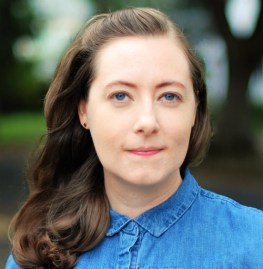
An Interview with Phaedra Patrick

5 May
Phaedra Patrick is the author of the novel The Curious Charms of Arthur Pepper.

Phaedra Patrick is the author of the novel The Curious Charms of Arthur Pepper.

Phaedra Patrick studied art and marketing and has worked as a stained glass artist, film festival organizer and communications manager. She is a prize-winning short story writer and now writes full time. She lives in the UK with her husband and son. The Curious Charms of Arthur Pepper is her debut novel.

To read an exercise on setting up happy endings, inspired by The Curious Charms of Arthur Pepper, click here.

In this interview, Patrick discusses how to set a character off on a quest, happy endings, and using coincidence in a novel.

Michael Noll

The novel begins with the main character, Arthur, deciding to go on a quest. It’s a decision that is part of a long tradition of quest stories that is alive and well as shown by The Unlikely Pilgrimage of Harold Fry; Eat, Pray, Love, and Wild. The difficulty, I would imagine, in writing such a story is that you need a reason to push the character out the door. Did you always know that Arthur would find the charm bracelet? Or did he begin as a character in search of a reason to go searching?

Phaedra Patrick

The charm bracelet idea came to me first, as I showed my young son my own bracelet. I write short stories too, so I liked the idea that each charm would be like a short story in its own right, then there would be a thread linking them all together, like a bracelet. I then had to find the right character to discover the bracelet and to set off on the journey to find out more about it. I thought it would be interesting if it was an older gentleman, who was rather set in his ways, and who I could take out of his comfort zone to go on this search. One of my favourite exercises is to write down the ten worst things that could happen to your character, then to explore how they’d react if these happened. And that’s what I did with Arthur.

Michael Noll

One question that often comes up in my writing classes—especially with college undergraduates—is “Why must stories be so sad?” The “literary” novels and stories that they’re reading tend to end unhappily. (One caveat: this isn’t really true of the fantasy and science fiction novels they read.) So, I was struck as I read this novel how its emotional arc is pretty much always oriented toward a happy ending—and it’s to the book’s strength. The book jacket even says that it’s a “joyous celebration of life’s infinite possibilities.” What was required—in dreaming up the novel, in its early chapters—to get it moving in a happy, satisfying direction?

Phaedra Patrick

I believe in happy endings! And in order for the story to be happy at the end, it kind of needs to be the opposite (at least in places) at the beginning, so the character can go on his/her transformative journey. The Curious Charms of Arthur Pepper has been described as a kind of fable and even compared to a fairy story. A lot of fables or fairy tales traditionally start with the character in an unhappy place—Bambi’s mother dies, Cinderella is ill-treated by her step-sisters, etc. So I had to put Arthur in a bad place to make things right for him in the end. It was a fine balance not to make him too self-pitying, but as soon as I introduced his neighbour, Bernadette, then this brought along humour to lift the first couple of chapters.

Michael Noll

I had the pleasure of moderating a recent panel on writing that included Alexander Chee, and he talked about how coincidence is often frowned upon by writers, and so he wanted to write a book with a lot of it (and did, in The Queen of the Night). Your novel is full of coincidence; I suppose these moments (such as the ease with which Arthur finds the people he’s looking for) might be unrealistic, but they’re also hugely entertaining. How do you approach coincidence in your writing? How do you manage to explain a plot point enough for the reader to buy it but not overexploit it until the reader is suspicious?

Phaedra Patrick

The Curious Charms of Arthur Pepper is Phaedra Patrick's first novel, and it's been called "tender, insightful, and surprising."

The Curious Charms of Arthur Pepper is Phaedra Patrick’s first novel, and it’s been called “tender, insightful, and surprising.”

I think because the book had to link up eight charms then there had to be a rather strong element of coincidence, or else Arthur would just discover the first charm and then get stuck! It’s also a story rather than a real-life account, so it does invite readers to suspend disbelief a little and get swept along with it. For quite a while I pondered on whether readers would believe there was a phone number engraved on the elephant charm, but then I decided that Arthur had to get his first lead from somewhere, and that this was the story I wanted to tell. I also ensured that Arthur found out about the charms in a variety of ways—word of mouth, letter, photo, a receipt, family, etc., and at one point he even gets stuck in his search. I think this helps to make the coincidences more believable. It is a difficult balance though.

Michael Noll

Near the end of the book, Arthur has a conversation with a woman named Sonny Yardley. I don’t want to give anything away to readers, but Sonny’s response to Arthur’s questions is strikingly different from what he’s encountered before. Did you always know the scene would play out like this? Or did you sense that the novel needed a kind of unexpected hard turn to shake the reader a bit?

Phaedra Patrick

We know that Miriam led a secret life before she and Arthur married, so there had to be a rather big reason she kept this from him during 40 years of marriage. And it was unlikely to be a happy reason! So when Arthur finally speaks to Sonny, the conversation is serious and upsetting, as it needs to be considering the subject. I actually didn’t know what Miriam’s secret was until this part of the book, and I found out at the same time as Arthur. I had to have faith in my writing and plough on with the storyline in the hope that Miriam’s secret would reveal itself to me, and thankfully it did.

May 2016

Michael Noll Michael Noll is the Editor of Read to Write Stories.
An Interview with Kelli Jo Ford

28 Apr
Kelli Jo Ford is a former Dobie Paisano fellow and recent winner of the Elizabeth George Foundation Emerging Artist Grant.

Kelli Jo Ford has held the prestigious Dobie Paisano fellowship and recently won an Elizabeth George Foundation Emerging Artist Grant.

Kelli Jo Ford’s fiction has appeared in Forty Stories: New Writing from Harper Perennial, New Delta ReviewDrunken Boat, and Virginia Quarterly Review. A Dobie Paisano Fellow and an Elizabeth George Foundation grant recipient, she holds an MFA from George Mason University. She is a member of the Cherokee Nation. She currently lives in Virginia and putting the finishing touches on Crooked Hallelujah, a collection of linked stories about a mixed-blood Cherokee mother and daughter who move from Eastern Oklahoma’s Indian Country to North Texas to start life anew amidst the oil bust of the 1980s.

To read an exercise on describing characters without relying on mirrors and Ford’s story, “You Will Miss Me When I Burn,” click here.

In this interview, Ford discusses the revision advice of Alan Cheuse, the challenge of portraying characters both as they are and as they’re viewed by others, and resolving (or not) plot threads in a story.

Michael Noll

Your character descriptions are so good. I love this passage: 

I called for him again, and he came out of the bedroom, pulling a long-handle shirt over his head and stomping his foot down into his boot.
“You’ll break the back of your boot like that,” I said, but you can’t tell that boy nothing. I tossed him a sausage biscuit I brought, and he grabbed a Dr Pepper from the fridge, opened it up, and took three long swallows without coming up for air. With his head tilted back like that, I could see where my boy was losing the hair on his head, and I felt proud to have a full head of my own, proud I didn’t work indoors under fake lighting on another man’s schedule. But it got me antsy.

I love how the passage has multiple things happening at once: the narrator telling his son what to do, the boy ignoring him, the action (throwing the food, drinking the Dr. Pepper), physical description (baldness), and emotion (the narrator’s various reasons for feeling proud). Do all these things land on the page as you write, or do you start with one or two and build the rest in gradually?

Kelli Jo Ford

Thank you, Michael! Sometimes a passage will come in a glorious chunk that sticks around in its God-given form. Usually though, it’s a matter of writing and rewriting. I retype my drafts a lot, something I think I picked up from Alan Cheuse back at George Mason, who felt rewriting (or retyping) a draft allows you let go of what’s there and truly revise instead of tweak. It’s slow work, especially for a plodder like me, but I find it so helpful. I’m constantly adding new stuff, layers or descriptions, which lately has created the problem of what to cull.

I couldn’t remember how that bit came to be until I found an old draft of the story. It looks like most of the descriptions were there but sort of spread out in the narrator’s rambling, which I condensed a good bit. In addition to Paul Reyes’s keen eye at VQR, I’m sure the final product came about with great help from my husband, Scott Weaver, who’s a poet and really helps me 1) see what a story is trying to be about (for lack of a better word) and 2) tighten my language and descriptions.

Michael Noll

I’m curious about the son’s wife—the Indian, as the narrator calls her. I don’t think we ever learn her actual name. She’s just, “the Indian” or “that Indian daughter-in-law.” What was your approach to this character—and to the narrator’s view of her?

Kelli Jo Ford

Kelli Jo Ford's story, "You Will Miss Me When I Burn," was published in Virginia Quarterly Review.

Kelli Jo Ford’s story, “You Will Miss Me When I Burn,” was published in Virginia Quarterly Review.

Justine is actually one of the main characters in the collection I’m working on. She and Ferrell have a sort of lovingly contentious relationship, though it doesn’t come through in this stand-alone piece. She’s a truth-teller and doesn’t let him get away with much. During the time period when this story takes place, they are going through a pretty contentious time, but of course, there’s more to it than that.

As we went through final edits, I began to feel a little uncomfortable with the narrator’s portrayal of Justine, to be honest. Justine’s the hero of the collection! In the end, I was comfortable enough, I guess, with what Ferrell’s portrayal of Justine says about him. “Lovingly contentious” is where I started, but doesn’t cover enough ground. Ferrell’s story grounds us in the culture Justine and Reney, the “little girl already in tow,” confront in North Texas. Through Ferrell we see the casual racism they face. The story is told from his perspective, so there’s no filter. I could go on more here, but that would probably be more relevant to the collection than this particular story.

At the same time, there is love and respect between the two. From Ferrell’s perspective, calling Justine “the Indian” is probably no different from the banter (or what he might call “good-natured ribbing”) that takes place at the D.Q., but that doesn’t make it any less racist or potentially hurtful. I’m out of my depth, but I’m thinking about micro-aggressions and the way that something Ferrell perceives as banter could quickly become straight-up aggressive, hurtful, and racist.

As for how his use of “the Indian” functions in the story, I think it allows readers to see Ferrell better than he sees himself. I hope readers pick up on some of Ferrell’s self-delusion and see that probably everything Justine tells him is spot-on—and that despite his hoo-hawing, he has heard every word.

In earlier drafts, the only female characters he called by name were Liza Blue and Elsie from the DQ, so the most important women in his life—his wife, the girl from Wyoming, and the Indian—didn’t get names. In the end, it got a little tedious and confusing to refer to his wife as “my wife” over and over. So having him name her was a technical decision that may make his usage of “the Indian” stand out a little more.

Michael Noll

In seems that a crucial question in this story is how we feel about the narrator’s actions with the Wyoming girl. But, frankly, I have no idea how I feel about it. What happens is, on one hand, part of the great tradition of “loving someone you’re not married to” stories. But it also cuts against the usual storyline in such unexpected ways that I’m don’t know wha to feel. When you finished the story, did you have a particular way you wanted the reader to react and feel?

Kelli Jo Ford

Good question! I don’t think I was going for a particular reaction or feeling. I think I only hoped to put readers right there with him and to, perhaps, help them see him better than he sees himself.

In some ways, the story for me started with that scene. Well, that scene and the magic horse. So the trick, if there was one, was to somehow get readers to want to keep reading and caring about the story, despite the character’s pretty despicable actions.

Michael Noll

The story starts with the threat of fire, and while we get the fire of passion, the actual fire never arrives. Was this always the case? It’s an interesting structure. You go back and forth between past and present, and I expected the present to be resolved one way or another. When it wasn’t, I felt relieved. If the fire had come through and burned everything–a kind of thematic burning–it would have felt cheap, I think. Were you ever tempted to do that?

Kelli Jo Ford

I don’t think I was ever tempted to resolve the question of whether the fire arrives, not in this story, at least. In “Bonita,” a companion piece of sorts, we learn that the fire does destroy Ferrell’s house, but that didn’t seem important to Ferrell’s story, somehow. Though he has some misgivings at the end, the house is the least important thing to him that day. Later, he may realize he was wrong to toss aside a life’s worth of memories, as well as a family that clearly cares for him. But as far as the confines of this story, (he thinks) he’s all forward motion

Maybe the past and present structure reflects how much the past is present for him. If he slowed down to think about it much, he might make a different decision.

April 2016

Michael Noll Michael Noll is the Editor of Read to Write Stories.

An Interview with Melissa Stephenson

21 Apr
Melissa Stephenson wrote about running and single-parenting in her Washington Post essay, "As a mom, I couldn’t afford to fall apart after my divorce. Then running saved me."

Melissa Stephenson wrote about running and single-parenting in her Washington Post essay, “As a mom, I couldn’t afford to fall apart after my divorce. Then running saved me.”

Melissa Stephenson lives, runs, parents, and writes in Missoula, Montana. Her fiction, non-fiction, and poetry have previously appeared in Cutbank, Other Voices, Thin Air, The Chattahoochee Review, New South, Memoir (and), The Mid American Review, and Passages North. She’s currently hard at work completing a collection of poems and revising her memoir.

To read an exercise about showing and telling, click here.

In this interview, Stephenson discusses finding the structure of her essay, why “less is more” can convey more emotion, and how her poetry informs her nonfiction.

Michael Noll

Structure is a problem for any personal essayist, I think, and so I’m interested in how you found the structure for this essay. It begins by laying out the conflict—you were going through a difficult period in your life but needed to keep it together for your kids—and the solution to the conflict, which was running. Then, you tell a story about your second marathon. Did you always use this structure–front loading context and finishing with the narrative? If not, what helped you find it?

Melissa Stephenson

Inspired by Ann Hood’s essay “Ten Things I Learned from Knitting,” I tried to write a piece about running and grief a couple of years ago. Hood writes about knitting her way through grief after her young daughter’s sudden death. After a attempting to use the Ten Things structure, I shelved the piece. It felt long, lofty, and unruly. A few months after running my second marathon, I came across a call for essay submissions about “badass moms.” I hadn’t written for any parenting publications, and I didn’t necessarily want to. But the prompt got me thinking about using the second marathon as the structure for the essay on running and grief. My goal in the first paragraph was to introduce the connection between grief and running in a concise and concrete way. Once I got that paragraph down, I simply had to write to and through the narrative of the marathon.

Michael Noll

This sentence really affected me:

“The next summer, I completed my first full marathon on my daughter’s fifth birthday, crossing the finish line to drive myself home.”

The emotion in it is clear, and so it makes sense to give the sentence its own paragraph—to make it stand out. But it’s also quite spare in terms of detail. We don’t learn anything else about the birthday, nothing about a party or a cake or celebration, nothing else about how you felt except your time. Were you ever tempted to write more? I ask because the question of how much detail to provide—and which details—is a difficult one. What was your guiding principle?

Melissa Stephenson

Haruki Murakami wrote about the connections between running and writing in What I Talk About When I Talk About Running.

Haruki Murakami wrote about the connections between running and writing in What I Talk About When I Talk About Running.

There are a couple of reasons why this moment is so sparse.

  1. Once I had a draft of this essay, I realized the length and content would work well for an online publication, so compression was key. Most of the bigger online personal narrative publishers, like Washington Post or New York Times, prefer 800-1200 word pieces. I made many cuts in favor of economy.
  2. I also wanted to capture the anti-climactic feeling I had with the half marathon and the first full marathon. In his book What I Talk About When I Talk About Running, Haruki Murakami describes his first marathon finish this way, “The finish line. I finally reached the end. Strangely, I have no feeling of accomplishment. The only thing I feel is utter relief that I don’t have to run anymore.” I felt this, too. I lived in a town without family, raising two kids with almost sole custody, and I woke up most days stunned by this new, isolated life. I’d imagined the finish line as a giant party, full of familiar faces, hugs, and cheers. Truth is most of my friends were home with children. One friend did show up to the finish line, but I was too nauseous to talk to her. And I wore a t-shirt with the words, Happy Birthday Hadley on the back, which is something my daughter still talks about. But I finished with this deep, hollow feeling, like walking around with the Grand Canyon inside you. That single line seemed the simplest way to capture that.

Michael Noll

The story of the second marathon fills a number of paragraphs, and, as someone who’s run a marathon (just one, though!), I understand how this is possible. The race is so long that it has many stages and points along a narrative arc. On the other hand, the action is sort of the same throughout: running, more running, suffering, a bit of ecstasy, and more suffering. How did you approach finding the narrative within the race?

Melissa Stephenson

This is the one section I’m surprised the Washington Post editor did not trim. Since I’d set out wanting to tell the story of that marathon, I naturally went into it in detail. I knew this decision meant narrowing my target audience to runners (a 4:12 marathon finish doesn’t mean much to those who haven’t run a race of some sort).  I did tweak this section many times to make it concise and also as non-runner-friendly as possible.

The second marathon was so important because it’s the event that finally captured the ups and downs of the past few years all in the span of four hours. I didn’t truly know why I was running (and kept running) until that marathon. The only thing that got me through was the gut-deep feeling that I had something to prove to myself, though I wouldn’t know exactly what that was until I finished the essay.

Michael Noll

I really like how the essay ends, both the line of dialogue and the final paragraph. Endings are difficult in personal essays. There’s a desire to wrap it up–to put a kind of emotional exclamation mark at the end. But there’s also the need to not overdo it. How did you know when you’d found the right end for this essay?

Melissa Stephenson

Writing this ending was a pretty divine experience in that I’d planted the seeds for it as I drafted but had no idea what the ending would be until I got there (aside from finishing the marathon). I never intended to include my brother’s death in this piece. I’ve been working on a memoir about that for a few years now, and I try to keep it from leaking into my other work. But once grief was on the plate, I realized why grieving as sole caretaker of two young children left no room for self-pity or solitude, and how running helped me deal with that.

I also didn’t include the words I’d whispered to my children on first mention of that moment because I thought they weren’t important to the essay. Once I made it to the end and wrote the line about the things I’m ashamed they might remember, I saw the opening for what I’d told them. As soon as I wrote, “This is what not quitting looks like,” I saw the connections I’d made without knowing it: My brother quit, my life hadn’t turned out the way I’d expected, and running helped me not quit. That’s when I truly understood the essay, myself, and the running.

On a nuts-and-bolts note, I’m a poet as well, and I love writing endings. Once the content is there, endings become a mix of cadence, imagery, and releasing just enough insight without (as you wisely note) overdoing it. I’ll write them, tweak them, and read them out loud until each word resonates. Then I’ll go back and tweak the whole essay to make sure the information is released in a way that makes the ending feel as surprising and inevitable as possible.

April 2016

Michael Noll Michael Noll is the Editor of Read to Write Stories.

An Interview with Kaitlyn Greenidge

18 Apr
Kaitlyn Greenidge is the author of We Love You, Charlie Freeman, has been called "auspicious," "complex," and "caustically funny."

Kaitlyn Greenidge is the author of We Love You, Charlie Freeman, which has been called “auspicious,” “complex,” and “caustically funny.”

Kaitlyn Greenidge was born in Boston and received her MFA from Hunter College. She’s the author of the novel We Love You, Charlie Freeman, and her wer work has appeared in The Believer, American Short Fiction, Guernica, Kweli Journal, The Feminist Wire, Afro Pop Magazine, Green Mountains Review and other places. She is the recipient of fellowships from Lower Manhattan Community Council’s Work-Space Program; Bread Loaf Writers’ Conference and other prizes. She currently lives in Brooklyn.

To read an exercise on introducing characters, click here.

In this interview, Greenidge discusses describing characters, acknowledging the role of power in race, and finding an agent who appreciated her novel.

Michael Noll

I love the way you introduce Charlie. A character says that “it’s best we all meet Charlie now,” but the introduction isn’t given to the reader in a direct way. First, we see the place where Charlie lives. Then, we’re told that he’s sitting beside a fern and that a man kneels beside him—and then we’re introduced to the man. Only after this do we get to see Charlie. I love this approach because it takes the weight off his character. It’s as if the novel is saying that Charlie is important, yes, but he’s less important the everything around him. Was this introduction to Charlie simply how it arrived on the page? Or did you write it with a particular goal in mind?

Kaitlyn Greenidge

I didn’t want this novel to be about chimpanzees. That isn’t, to me, what this novel is about or what it is concerned with. So, it was important to let the reader know this from the beginning. Part of it was just keeping the reader’s interest in that first chapter. Part of it was also me, as a writer, not being ready to engage with the character of Charlie yet. All of those things went into that first introduction to the character.

Michael Noll

I also love the description of Dr. Paulson, in particular this:

When she parted her lips to grin, behind her white, white teeth, I caught a glimpse of her tongue. It was the yellowest, craggiest, driest tongue I had ever seen. It surely did not belong in that mouth, in her, and I shot a look at my mother, who widened her eyes, who gave one quick shake of her head that told me to ignore it.

It’s a monstrous trait, that tongue. In an interview with Lambda Literary, you said that you love the grotesque and the mechanics of horror stories, and the tongue certainly seems to fit. It’s also a detail that turns Dr. Paulson into a kind of monster. In that same interview, you talked about writing fully-developed characters, and so I’m curious how a detail like this works in terms of character development. Did you worry that giving characters monstrous characteristics would make them more difficult to develop? Or is the monstrosity part of that complexity? It’s certainly part of what makes the book so compelling.

Kaitlyn Greenidge

That was more a private joke with myself, while I was writing. I had a teacher in school when I was a kid who used to eat chalk. He carried a stick of it in his back pocket and during class, he would bring it out and lick it. His tongue was pebbled and yellow. And, no one ever mentioned it! It was like, is no one else seeing this, how disgusting it is? So, when I was writing, I just wanted to include that detail as a reminder and a joke with some younger part of myself.

I love the grotesque but it’s very rare that I recognize it as initially repulsive. It takes a very specific visual to repulse me. But most things that people find grotesque, I just like to look at and think about.  I think human bodies are just endlessly fascinating and beautiful looking, even when they have yellow, craggy tongues and even when they are licking chalk.

Michael Noll

The characters are put into situations that highlight their blackness and make them objects of fascination and study. For example, Laurel likes to say of her childhood in Maine that she was the only black person in a one-hundred mile radius. The town of the novel is segregated, and the school that the girls attend is mostly white. At the Toneybee Institute, the family is made a literal object of study, and several reviewers have pointed out connections to the Tuskegee Institute. There’s a sense, then, that the Freemans’ weird situation isn’t, actually, so weird. When you began to sketch out the plot of the novel, did you have ideas or themes in mind? Did you, in other words, have something you wanted to say? Or did you invent the premise and plot first and discover what it had to say about the world?

Kaitlyn Greenidge

Kaitlyn Greenidge's highly anticipated debut novel, We Love You, Charlie Freeman, tells the story of an African-American family who moves to a research institute to live with a chimpanzee.

Kaitlyn Greenidge’s highly anticipated debut novel, We Love You, Charlie Freeman, tells the story of an African-American family who moves to a research institute to live with a chimpanzee.

I wanted to write about race in post-Civil Rights America. Which is a very big and wide topic. But I wanted to talk about the ways in which we don’t really have a way to describe living race right now, because we are so averse in America to talking about power.

I just read an editorial on Al Jazeera, about how “cultural appropriation” is a meaningless term. It’s an old argument, one that anyone familiar with that debate can recognize. Basically, culture is universal, all cultures borrow from each other, it was 19th century racists who popularized the idea of distinct, cultural productions in the first place so why do we cling to that idea?

All those historical facts are true, but they are missing that question of power. What does it mean that I probably won’t be hired at many places because my hair is in dreadlocks but an upper-middle class white man could wear the same hairstyle to work and be considered a wonderful iconoclast? That is a question of power, that those who go on and on about how it’s all the same never really have an answer for that.

I grew up in the 90s, when so much talk about race was about “diversity”, how everyone everywhere came from a different culture so let’s all flatten it out. The Irish potato famine is the same pain as the Holocaust is the same pain as American slavery so let’s just not talk about any of it. That is ludicrous, of course, and not how memory or history or culture or politics works. But it’s a convenient idea to cling to in order to avoid really talking about all the ways our wounds are different, and how they are serving, or not serving, us well.

It’s similar to that self-serving, smug, and ultimately meaningless phrase “Everyone is racist.” Usually, the unspoken follow-up to that sentence is “so don’t worry about it/don’t try to talk about it.” We have to get to a point where we have another way to talk about racism and white supremacy beyond just calling people out. Calling people and institutions out is a powerful tool, but we also have to get to a point where we can have conversations past naming someone or a practice or an institution as racist. What does it mean to work to change an institution? Knowing that we are all imperfect, that we will never live in a utopia, that there will always be bias, that over 500 years of racist thinking and oppression cannot simply be erased over night? How do we get to a point where we get real gains, and keep them for another generation to build on? One of the heartbreaking things about studying race post-the Civil Rights era is how many things have been lost, even in the last 8 years, how much we’ve lost. It’s terrifying. So how do we begin to keep what we’ve got and what’s working?

Michael Noll

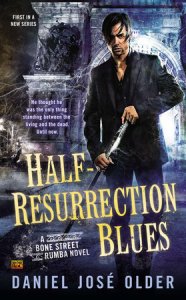
I recently interviewed Daniel Jose Older about his essay, “Diversity Is Not Enough: Race, Power, Publishing.” He said that he loves books that multitask and that demand multiple things of the reader. So, for example, he’s written Half-Resurrection Blues, an urban fantasy novel about ghosts, monsters, and paranormal detectives, but it’s also a novel that has a lot to say about issues of race. Kiese Laymon’s Long Division does something similar: it contains time travel and an absurdist vocabulary contest, and it’s very much a book about race. In his case, he struggled to find an appreciative editor and publisher for that book. Your book also seems like it’s multi-tasking. Did you ever think, Uh oh, I’m taking on too much? Was it ever suggested to you that the novel contained too many different elements—or elements that seem too different to some readers?

Kaitlyn Greenidge

Never by my agent or my editor. When I sent it out to some agents, that was definitely a response. But Carrie read it and got it immediately. My editor Andra read it and got it as well. That was most important to me: that the people I worked with on it understood that it is a book that is “multi-tasking”, as you put it. That is a natural place for me to read from. My older sister was in college in the early to mid nineties, just in time to be hit with the full bloom of post-modern theory. She brought some of that stuff home to me and tried to talk to me about it. Like, I remember, she rented The Celluloid Closet and Paris is Burning for me when I was in elementary and middle school and we’d watch them together while she babysat me. And so, I grew up reading things for multiple meanings at a really early age—not because I was some genius, but because I was lucky enough to have an older sibling to say, “Hey, you can read things this way.” It was great: like discovering a secret code. It also meant that I could indulge in reading “low” culture books and avoid the classics, because I could always look for (and invent in my imagination) that subtext. I like books that do that and I always wanted to write one.

April 2016

Michael Noll Michael Noll is the Editor of Read to Write Stories.

An Interview with Manuel Gonzales

14 Apr
Manuel Gonzales is the author of The Regional Office Is Under Attack!, which the New York Times called "rollicking good fun on the surface, action-packed and shiny in all the right places" and also "thoughtful and well considered."

Manuel Gonzales is the author of The Regional Office Is Under Attack!, which the New York Times called “rollicking good fun on the surface, action-packed and shiny in all the right places” and also “thoughtful and well considered.”

Manuel Gonzales is the author of the novel The Regional Office is Under Attack! and the acclaimed story collection The Miniature Wife, winner of the American Academy of Arts and Letters Sue Kaufman Prize for First Fiction and the John Gardner Fiction Book Award. A graduate of the Columbia University Creative Writing Program, he teaches writing at the University of Kentucky and the Institute of American Indian Arts. He has published fiction and nonfiction in Open City, Fence, One Story, Esquire, McSweeney’s Quarterly Concern, and The Believer. Gonzales lives in Kentucky with his wife and two children.

To read an exercise on building character within action scenes based on Gonzales’ new novel The Regional Office Is Under Attack!, click here.

In this interview, Gonzales discusses moving from stories to a novel, writing novel sections out of order, and moving through time within a narrative.

Michael Noll

This novel contains so much of what you did in The Miniature Wife. There’s the wry, corporate in-house documentary tone that was in “Farewell, Africa,” the genre sensibility of stories like “All of Me” and “Wolf,” and the sense of tense waiting that was in “Pilot, Copilot, Writer.” This is one of the concerns that story writers have–how will my voice and style translate to the length and form of the novel? How did you approach that jump? Did you always know the sort of novel that you wanted to write? Or were there abandoned projects and starts before settling on The Regional Office Is Under Attack!?

Manuel Gonzales

I didn’t always know the kind of novel I wanted to write next. The stories—they came out over ten or eleven years, and for a long stretch the stories, as a book, had been abandoned and I was working on two different novels, neither of which came to light, for good reason. And to be honest, the in-house documentary tone didn’t arrive in this novel till the very end of rewriting it. What happened was I had an image in my head of a man trying to grab a woman out of a detention center—La Femme Nikita-style—to turn her into a trained assassin of sorts, and she stomps his foot and makes a break for it—but when I wrote that, I didn’t know what was going to happen, where this was headed. For a long time, the early drafts contained long-ish, self-contained sections that, in hindsight, read very much like their own short stories, and I think that’s what got me through early drafts—I wrote it as if it were nothing more than longish short stories that followed the same action but contained their own mini-arcs.

Michael Noll

The novel starts with the weirdness of the place and world—a description of the Regional Office. Then, we briefly meet Rose as she is preparing to attack the Office. And then we’re given some backstory about her, and that backstory seems to have a different voice than the previous two chapters: it’s still funny and sharp, but it also wouldn’t be out of place in a completely realistic novel. Is this simply the voice that arrived on the page when you wrote her character? Or were you consciously trying to ground the novel’s fantastic world with a recognizable voice?

Manuel Gonzales

That backstory might have a slightly different feel, especially early on, because it was written early in the process and part of the writing was exploration—who is Rose, what does she sound like, how does she move—and the moment of her waiting to start the attack was written at the end, after I decided the whole book needed an overhaul, a new kind of beginning. And by that time I had a clearer idea of Rose, of her sense of humor, of her bravado propped up by her foul mouth and disaffected youth. What’s nice, too, though, is that in that section of attack, she’s older and has a different sense of her self, even. She’s been through the recruitment and training and has more bravado because of it—even if most of it’s false bravado—and by happy accident, I feel the narrative tones match the different kinds of Rose in those different points in her life.

Michael Noll

In all of your work, I’ve admired how you’re able to create space within moments of action for—I don’t even know what to call it, not action, maybe, instead, moments for the character to talk about something else. You have one of those moments near the beginning of the novel. Rose is repelling down a ventilation shaft, and she’s not wearing gloves, which makes her think about the man who tells her to wear gloves, which makes her think about her job and the mission in general, and then she’s wondering about things and only barely paying attention to the task at hand—or, we’re barely paying attention to it as readers. Passages like this make me wonder if you ever find yourself writing, “This happened and this and this and this” and unable to break out of the immediate present and let a character think? Or is this simply some of the magic you’ve got as a writer?

Manuel Gonzales

I don’t know that I would call it some of the magic I’ve got as a writer—or that I have magic as a writer—but more that this is how I see action happening. I find myself easily distracted ALL THE TIME doing any number of simple or complicated tasks, and it drives my family totally bonkers because in getting distracted I forget the task I’m in and move to something else. In fact, I’ve been answering this question for the past twenty minutes, not these questions, this ONE question—and so it seems only natural to me, right?, that you find yourself in a situation where you’re supposed to be laser-focused but not everyone is good at laser-focus, and your mind wanders to the things it worries or cares about—a guy, a girl, that really pretty cardinal on the fence outside your kitchen window, whatever. And you have to bring yourself back to the task at hand, or the external world itself brings you back against your will.

Michael Noll

You’re able to get a lot of pages out of a relatively short period of time. So, for example, you’re able to get 50 pages or so out of the initial attack on the Regional Office. Another writer might have covered much more ground and time in that number of pages. What was your approach to the timeframe of the novel?

Manuel Gonzales

My original thought was to focus mostly just on the day of the attack, just that one day, and toy with the peripheral characters—though of course by default the ones I singled out as peripheral became central—but I wanted to slow down the time of the action mainly because that’s how time works, in my mind, anyway. Things happen really fast and then not at all, and then really fast again, but also I wanted to offer full storylines of characters. I wanted to play around with cutting away from the action to give the reader something different, to delay the gratification but also to create a rounder world, richer characters. But then inevitably, too, cutting away from one moment of action usually meant cutting away to another moment of action. And then I realized I couldn’t tell the whole story of what I wanted to tell—what happened to these people after the attack—unless I also jumped forward in time, and jumping forward meant I could also jump backward, and then time went all topsy-turvy, jingly-jangly, and I decided the topsy-turvy jingly-jangly approach was the best approach for me.

April 2016

Michael Noll Michael Noll is the Editor of Read to Write Stories.

An Interview with Keith Lee Morris

2 Apr
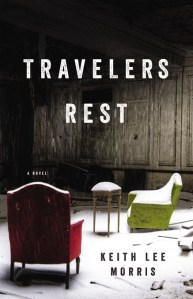
Keith Lee Morris' novel Travelers Rest culminates in "an operatic grand finale," according to a reviewer for England's The Independent.

Keith Lee Morris’ novel Travelers Rest culminates in “an operatic grand finale,” according to a reviewer for The Independent.

Keith Lee Morris is the author of three previous novels, The Greyhound God and The Dart League King, a Barnes & Noble Discover pick, and, most recently, Travelers Rest. His short stories have been published in New Stories from the South, Tin House, A Public Space, New England Review, and Southern Review, which awarded him its Eudora Welty Prize in Fiction. Morris lives in South Carolina, where he is a professor of creative writing at Clemson University.

To read an exercise on skipping over implausibility inspired by Travelers Rest, click here.

In this interview, Morris discusses pushing against conventional reality in stories, making predictions about characters, and the tonal difference between allowing characters to react to or ignore unusual details in a story.

Michael Noll

The novel’s first chapter is utterly realistic. The characters seem like “real” people, the situation (pulling off the highway due to snow) is plausible, and it’s certainly true that there are many small, beautiful, forgotten towns just off the Interstate. And yet there’s something about the last line of the chapter—”You’d never even know they were here”—that is full of foreboding. What was your approach to this chapter? It poses a certain challenge: you’re setting up the reader for a world that will gradually get stranger and stranger. Did you have a plan for how to plant the seeds for those changes?

Keith Lee Morris

The truth is, the first chapter wasn’t written until after the first draft of the novel was complete. The book originally began with what is now Chapter 3, Uncle Robbie waking up in the hotel in the middle of the night. But in talking to people who read the first draft, I got the idea that the opening was a little too abrupt and confusing. So the decision to include the first two introductory chapters was initially a practical move. But you’re right—Chapter 1 sets up a number of the elements that will be in play throughout the novel—the constant snowfall, the tensions between family members, the strange but oddly familiar small town. Nothing overtly strange happens, but things feel strange; that’s enough for the time being. In the next several chapters, the boundaries of conventional reality feel like they’re getting pushed up against a little bit, but nothing truly “otherworldly” happens for a while—and yet the reader senses that it’s coming.

Michael Noll

The novel is told from four different characters’ perspectives. It’s a structure that carries risks: you might lose the reader while changing POV, or the reader might feel more attached to one than the others, or the reader might feel that the shifts intrude upon the suspense that’s being built in each chapter. How did you balance the POV and the shifts to maintain a steady amount of suspense and interest in each character?

Keith Lee Morris

One of the key things to me is that readers have to get their hopes up for each character in a way that’s particular to that character. Very early on in a narrative we begin to make predictions, project outcomes—we do it unconsciously. If we like the characters, we begin to form an idea of what we hope will happen and also what we most deeply fear. Each character has to seem at least somewhat equal in that regard—if we don’t know what we want for a certain character, what we’re afraid might befall them, our interest is bound to lag behind in the chapters devoted to that character’s POV. So part of the battle is to make sure the reader can identify what would make each character happiest and what could potentially destroy him/her. And then I think it’s important to end the chapters on a strong note. I’ve always thought the most important sentence in any story or chapter or even entire novel is the last one. It’s what the reader’s left with. If you leave the character in an interesting place, the reader will be eager each time to pick him/her up again.

Michael Noll

When I was studying for a MFA, one of my writing professors said that the surest way to help readers buy into implausible parts of a story was to acknowledge them. So, if there’s a body on the street and everyone’s just carrying on as if nothing is wrong, a character ought to say, “That’s weird.” It seems like you’re doing something similar in the novel, particularly in one of Tonio’s early chapters, when he walks out of the hotel and thinks, “What the hell went on in this town, anyway? Who exactly lived here?” Of course, it’s natural for a character to wonder about things that seem a little off, but did you also feel that you needed to nod to the reader, to say, “Yeah, it’s kind of odd. You’re not crazy. Stick with me?”

Keith Lee Morris

Keith Lee Morris builds upon the long tradition of haunted hotels with his spooky, unsettling novel Travelers Rest.

Keith Lee Morris builds upon the long tradition of haunted hotels with his spooky, unsettling novel Travelers Rest.

To me it’s a tonal thing. Sure, if you want the reader to take the events of the story at face value, then those events have to seem plausible, and one way to make them seem plausible is to have the characters react in a way that seems to anticipate the way that we ourselves, or at least some other  reasonable person, might react. But maybe that’s not what you want. Authors like Barthelme and Delillo and even Flannery O’Connor get a lot of mileage out of having characters react (or fail to, as is often the case) in a way that we might not normally expect—they ignore the dead bodies in the street, so to speak. And in the case of those authors, the characters’ failure to respond in a “realistic” or predictable way lends the narrative the feeling of absurdity or irony that they’re after; the technique also produces a lot of the funniest passages—think of the Willie Mink scene in White Noise, for instance, in which one character fails to respond at all coherently or logically to the threat of being shot. Or an even better example– the “Misfit” scene in “A Good Man Is Hard to Find,” in which O’Connor uses the oddness of the characters’ responses to make the scene both unexpectedly horrifying and uncomfortably amusing—it’s the strangely implausible nature of both the action and the reactions that literally leaves us not knowing whether to laugh or cry. In Travelers Rest, yes, you’re right, it mostly served my purposes to try keep the reader and the characters on the same page in terms of their feelings about the strangeness of the situation—although there are occasions, as in the Julia sections, in which she seems to embrace the bizarre and rather dangerous situation she finds herself in, that it’s not working that way entirely.

Michael Noll

The novel is set in a kind of nowhere place, like the hotel in The Shining or the island in the television show Lost. The rules are different than in the regular world, but I wonder if they’re trying to reveal something about the regular world. For example, late in the novel Dewey thinks that “any time you imagined something, that imagined thing took its place in the world, in the mind of the person who imagined it, which was as real a place as Kalamazoo, Michigan, or Schenectady, New York, or maybe even more real, maybe the only real place.” This is undeniably true, as any artist or imaginative person can attest, but it’s also a bit dangerous, as your novel suggests. What drew you to this idea, the tension between dreaming and being swept away by the dream?

Keith Lee Morris

So much of our experience is internal and subjective. We pretend things that happen entirely in our own heads aren’t “real”—but they are real in the sense that they take their place in our memories and our thoughts in the same way that external events do, events that people other than ourselves can recognize as having taken place. If I dream that my wife is cheating on me with my best friend, it’s likely to change the way I feel about both of them when I wake up, at least until I get a cup of coffee and starting thinking more clearly. Most of us can sort out the differences between our own dreams or superstitions or initial misperceptions and the “facts” of the external world, but not always, and many people have trouble with it a lot of the time—it’s probably as good an explanation as any for why Donald Trump is currently the frontrunner for the nomination of one of our two major parties. We live with examples of mass delusion all the time. In the novel, I’m trying to point out how thin the line is between our perceptible fictions and fact, how susceptible we are to our own self-created illusions, and how the consequences can be very real.

April 2016

Michael Noll Michael Noll is the Editor of Read to Write Stories.

An Interview with Daniel José Older

31 Mar
Daniel José Older is the author of the Bone Street Rumba urban fantasy series, the Young Adult novel Shadowshaper. His essay, "Diversity Is Not Enough: Race, Power, and Publishing," addresses the institutional bias present in the publishing industry.

Daniel José Older is the author of the Bone Street Rumba urban fantasy series, the Young Adult novel Shadowshaper. His essay, “Diversity Is Not Enough: Race, Power, and Publishing,” addresses the institutional bias of the publishing industry.

Daniel José Older is the author of the Bone Street Rumba urban fantasy series and the Young Adult novel Shadowshaper, which was nominated for the Kirkus Prize in Young Readers’ Literature. His first collection of short stories, Salsa Nocturna, and the Locus and World Fantasy-nominated anthology Long Hidden: Speculative Fiction from the Margins of History, which he co-edited, are available from Crossed Genres Publications.

To read an exercise about becoming a better reader, click here.

In this interview, Older discusses the self-fulfilling prophecy of marketing, why categories in publishing matter, and what meaningful change in terms of diversity would look like.

Michael Noll

You write, “The publishing industry, people often say as if it’s a gigantic revelation, needs to make money and as such, it responds to The Market, and people don’t buy books about characters of color.” You add that this is marketing code for “you people don’t read” and an assumption that “white kids won’t buy a book with a black kid on the cover — or so The Market says, despite millions of music albums that are sold in just that way.”

This seems like the central crux of what you’re writing about: the belief that white people will only read about characters who are like them–or seem like them. And if they do read books about non-white characters, it’s often out of weird impulses of guilt and the need to be vindicated. For example, it seems not surprising that, at least here in Texas, To Kill a Mockingbird is required reading and, say, Invisible Man isn’t. How much of this—at least, thinking about the difference between books and music albums—is due to the age of the consumer? Would it make a difference if “adult” books were marketed to teens?

Daniel José Older

I’m honestly not sure. I’ll say this: Marketing is a self-fulfilling prophecy. There are certain assumptions in play until something comes along that ruptures them. And this applies to all genres. People tend to walk the line. That’s why courage comes into play, the courage to try new things. It’s wide-ranging, and industry-wide issue, not just editors and marketing people.

White writers have been writing to white audiences for decades but it was called being universal, which is a code word for white. Readers of color read white writers—even when they’re writing for write audiences—but the opposite isn’t always true. The industry isn’t representative of its readership. White writers can write for white audiences, and, at the same time, they can write to the industry.

Michael Noll

In the essay, you tell a story about attending a conference where an agent was asked about the industry’s diversity problem, and the agent said this: “I think the change is going to have to come from within those who are affected.” You write, “This is the language of privilege: it’s not the intangible Market that’s to blame, it’s the writers of color, who maybe don’t have what it takes and don’t submit enough anyway.”

What I find really interesting is what you write a bit later: “We’re not writing for editors and agents, we’re writing past them. We’re writing for us, for each other.” I immediately thought of Kiese Laymon, a writer who, as much as anyone I can think of, has said that he’s writing for black audiences and entering a discussion with black writers.

You write about what white people need to do in order to dismantle white supremacy, but is this the opposing response? How do you think about your own readership?

Daniel José Older

I’ve talked to entirely white audiences and audiences that were entirely people of color. The reaction in both has been positive, but it’s different, too. There are different laugh lines. I tell this story: I read once to an all-white audience, and they were into it. Mesmerized is the word. But they didn’t laugh once. It was a horror story, and when I’d written it on a bus in Brooklyn, I’d been cackling. When I read the same story to people of color, they were on the floor. Both audiences were into it. At one point, I was going to stop reading, and it was at a moment of tension, a cliffhanger, and the white audience said, “Don’t stop.” There’s a difference in how different audiences respond.

White people are hungry to talk about race. They don’t necessarily have the language to do it. But when I speak on race, the reception is warm and curious, even if they don’t have the language.

Michael Noll

Daniel José Older's urban fantasy novel Half-Resurrection Blues has been called "Noir for the Now."

Daniel José Older’s urban fantasy novel Half-Resurrection Blues has been called “Noir for the Now.”

You write, “Many of our gifts and challenges won’t be seen or recognized within a white cultural context. Nuances of codeswitching, racial microaggressions, the emotional reality of surviving white supremacy, self-translation – these are all layers of the non-white experience that rarely make it into mainstream literature, even when the characters look like us.”

I thought of this in connection with your urban fantasy novel Half-Resurrection Blues. It’s certainly working within the genre of ghost and paranormal thrillers. But there were moments when the fact that it was written by a writer who wasn’t white—and that it was about characters who weren’t white—was very clear. And those moments were great, at least to my mind, because they elevated the book above other similar books. Other books have cool monsters and cool worlds of the dead, but they don’t always comment on society. Did you set out to write a book about, as you say, “Nuances of codeswitching, racial microaggressions, the emotional reality of surviving white supremacy, self-translation”? Or is this simply an essential part of your work?

Daniel José Older

It feels natural to do it. It’s also what I know to be true. Write what’s true and then try to say something. Ultimately, it’s about asking books to multitask. You’ve got this entire book, and you can do a lot of things in it. When a book demands a lot from you, it asks you to step up to its level.

Michael Noll

Do you think the industry shares your enthusiasm for books that multitask? You sometimes hear about books that operate within multiple genres or are doing multiple things and that agents, editors, and booksellers don’t know how to categorize the book.

Daniel José Older

We have a flawed category system. I write urban fantasy, which is a weird term. Urban is code for characters who are black or brown. Then you throw in fantasy, which is almost entirely white. There are very few fantasy writers of color.

Edward W. Said's book Culture and Imperialism demonstrates that Western imperialism's most effective tools for dominating other cultures have been literary in nature as much as political and economic.

Edward W. Said’s Culture and Imperialism demonstrates that Western imperialism’s most effective tools for dominating other cultures have been literary as much as political and economic.

But there’s probably no way not to have a flawed system. Categories are inherently messy. I’m reading Culture and Imperialism by Edward Said, and he traces the need to categorize back to the nation-state—the idea of borders. And now, of course, we’re talking about walls. With nationalism, we’re talking about how we value life. In a micro way, this is the case in literature: which books are sci-fi, which are high literature even though they have robots in them. All of these are questions about power.

The categories matter. Slavery was invented by white people, but it’s become “black history.” We need to be clear who was doing the enslaving or it gets erased. It’s talked about as a black people problem and is written about in passive voice, without identifying who was doing the enslaving. In the same way, sexual assault is talked about as a woman’s problem. You won’t find it in the men’s section.

Michael Noll

You write, “The question industry professionals need to ask themselves is: How can I use my position to help create a literary world that is diverse, equitable, and doesn’t just represent the same segment of society it always has since its inception? What concrete actions can I take to make actual change and move beyond the tired conversation we’ve been having for decades?” That work, you add, “means taking courageous, real-world steps, not just changing mission statements or submissions guidelines.”

It’s been two years since you published this essay. Have any answers occurred to you? Have you seen this in action?

Daniel José Older

We need to go from a flash-in-the-pan to a sustained movement. The question is how to make even more sustained, not just a buzz word but an actual revolutionary change, not just a new face on the same old shit. A good example of this, in a positive way, is We Need Diverse Books.

All-American Boys tells the story of an act of police violence from the view of the victim and the police officer.

The novel All-American Boys tells the story of an act of police violence from the view of the victim and the police officer.

Because of how publishing works, how long it takes for books to come out, any changes won’t be apparent for a couple of years. One example is All-American Boys, which is about police brutality. That book was rushed—and rushed in a good way. There was a sense that it needed to get out there.

But we need to be on guard against white fatigue, the sense of, well, we’ve had enough diversity. If we’re not careful and precise in these changes, we’ll get something that isn’t good. Diversity doesn’t just mean diverse characters. It means diverse writers as well. If it just amounts to stories about characters of color being told by white authors, that’s not victory. That’s not the point of this movement. There’s a long history of co-option, and it’s especially dangerous. There are quotas in effect—literally. Publishers will say, we already have a black book. But it’s a book by a white person. A black writer is trying to get a book published and can’t because a white person already took that spot.

Michael Noll

So, does that mean creating new imprints and houses? Or changing the existing ones?

Daniel José Older

There’s a new Muslim imprint at Simon & Schuster that looks really interesting, but it can’t be the only answer. There’s no white imprint. It’s mainstream publishing, and that’s what we need to transform.

March 2016

Michael Noll Michael Noll is the Editor of Read to Write Stories.