An Interview with Rahul Kanakia

11 Dec
Rahul Kanakia is the author of the forthcoming YA novel Enter Title Here and this weird ghost story in Clarkesworld.

Rahul Kanakia is the author of the forthcoming YA novel Enter Title Here and this cool, weird ghost story in Clarkesworld.

Rahul Kanakia’s young adult novel, Enter Title Here (its actual title, not a typo) will be published by Disney-Hyperion in Fall 2015. His stories have appeared in Clarkesworld, The Indiana Review, Apex, and Nature. He holds an MFA in Creative Writing from Johns Hopkins, and a B.A. in Economics from Stanford, and used to work in the field of international development. Currently, he lives in Oakland, CA, working a freelance writer and content creation consultant.

To read “Seeking boarder for rm w/ attached bathroom, must be willing to live with ghosts ($500 / Berkeley)” and an exercise on playing with the logistics of genre stories, click here.

In this interview, Kanakia discusses early reactions to his story in a MFA workshop, the source of some of the imagery in the story, and what (if any) connection this supernatural story has on his forthcoming Young Adult novel.

Michael Noll

I love how this story flips some famous tropes from ghost stories. For instance, one of the most darkest sentences is this one: “You know how many times I’ve gone down to the Kaiser Hospital over on Howe Street and sucked the ghost of a crying baby out of one of their incubators?” Capturing ghosts was so funny and great in Ghostbusters, but here it’s horribly sad and a sign of something wrong emotionally with the person who does it. Did you set out to subvert this image, or did you simply happen upon it in writing the story?

Rahul Kanakia

Interesting that you bring this up. I actually only thought of the movie Ghostbusters after the story was completed, but it’s obvious that it had some subconscious influence on the imagery of the story. For instance, the vacuum device that I’ve imagined in this story is definitely reminiscent of the apparatus they used in the movie. Regarding this particular image, I can’t say what I was doing. In its first draft, the story was entitled “Seven Things That Really Don’t Bother Me,” and each section was about one thing that annoyed other people but didn’t annoy the narrator. In this case, I think the idea was that the narrator wasn’t bothered by the sound of crying babies (which is said to be one of the most distressing sounds that a human being can hear). The idea with the story was, I think, that the narrator came off as emotionally disturbed because he didn’t have these basic human responses, but, after a lifetime of grappling with these problems, the narrator had started to rationalize these deficiencies as being a sign of a greater and more inclusive heart (i.e. other people are disturbed by babies, so they refuse to have anything to do with them, whereas, in his eyes, he is so great-hearted that he’s willing to go out and extract them from the incubators so that the hospital’s operations can continue).

Michael Noll

Those babies are also part of the real horror of this horror story. For instance, there is a ghost of a baby whose intestines developed on the outside of its body—and what’s horrifying is that this is something that actually happens. But unless it happens to us—to our baby—we rarely give such possibilities any thought. You do something similar with the ghosts of the men who died of AIDS. Is that one of the goals of horror stories? To remind readers of the very real horror that exists in the world?

Rahul Kanakia

I don’t know. This is probably one of the only horror stories I’ve ever read. In the case of the baby w/ the intestines, that’s a result of a documentary on harlequin babies that I once saw late at night. Horrifying images. The men with AIDS was something I tossed in at the last minute. I realized that a 60+ year old gay man will have some experience with the epidemic, and I wanted to be true to that. The imagery of the AIDS patients was drawn from the descriptions in Randy Shilt’s history of the early years of the epidemic: And The Band Played On.

Michael Noll
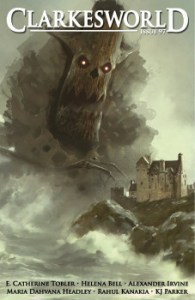
Rahul Kanakia's story, "Seeking boarder for rm w/ attached bathroom, must be willing to live with ghosts ($500 / Berkeley)" was published in Clarkesworld, which recently won a Hugo Award for best Science Fiction and Fantasy Magazine.

Rahul Kanakia’s story, “Seeking boarder for rm w/ attached bathroom, must be willing to live with ghosts ($500 / Berkeley)” was published in Clarkesworld, which recently won a Hugo Award for best Science Fiction and Fantasy Magazine.

The title is great—as soon as I saw it, I wanted to read the story. Did you start with this title, which really only begins to introduce the direction the story will go, or did you write the story first and then choose the title?

Rahul Kanakia

As I mentioned above, the original title of the story was “Seven Things That Really Don’t Bother Me,” and it was originally told as a list of seven things. The basic underlying story (a ghostbuster’s roommate has moved out and he’s filled with angst about it) was the same, but the format was very different. However, when I ran it through my MFA workshop, they said the format felt too scattershot, so I decided to tell it as a series of Craigslist house posts. The title is, I think, based on an actual post I saw while looking for housing once. Although, in that case, I believe, the landlord wanted a roommate who wouldn’t drink alcohol.

Michael Noll

You have a young adult novel being published in the next year, so I’m curious how you see this story fitting in with the rest of your writing. Would you give this story to fans of your YA novel? Or are that novel and this story products of separate writing lives that you inhabit?

Rahul Kanakia

My YA novel is very different. Firstly, it doesn’t have any fantastic or science fictional elements. It’s about a high school senior—the valedictorian of her school—who’s very angry with those who she sees as having gotten more recognition than her and who embarks upon all kinds of schemes in order to bring down her enemies. But I do see both this story and that novel as sharing lots of themes. They’re both about people who feel like they’re damaged and outside the mainstream; people who are secretly worried that no one will ever, or could ever, love them. I think the horrifying thing about this story is that in this case, the protagonist is right. He is unloveable. For whatever reason, he’s rendered himself unloveable. My book, though, is not quite as bleak.

December 2014

Michael Noll Michael Noll is the Editor of Read to Write Stories.

How to Build a Story with Logistics

9 Dec
Rahul Kanakia's story, "Seeking boarder for rm w/ attached bathroom, must be willing to live with ghosts ($500 / Berkeley)" was published in Clarkesworld, which recently won a Hugo Award for best Science Fiction and Fantasy Magazine.

Rahul Kanakia’s story, “Seeking boarder for rm w/ attached bathroom, must be willing to live with ghosts ($500 / Berkeley)” was published in Clarkesworld, which recently won a Hugo Award for best Science Fiction and Fantasy Magazine.

Some university creative writing teachers don’t allow their students to write genre fiction: no ghosts, aliens, spaceships, vampires, or zombies unless they’re handled in a literary fashion (whatever that means). This isn’t my policy, but I understand it. Bad genre stories tend to skim the surface of an idea (stun guns, cosmic annihilation) in a cursory way that can be tedious and dull. And yet I’ve found that good genre stories are as much fun to read as any purely literary creation. So what makes a good genre story?

The answer is, in part, how imaginatively the story digs into the practical details of its idea. Ghosts are ghosts, for instance; we’ve seen them countless times in books and movies, and, as a result, we tend to grow accustomed to the rules and conventions of the ghost-story genre. A good ghost story, then, will play with the practical logistics of those conventions in order to make us see them with fresh eyes.

This is precisely what Rahul Kanakia does in his story, “Seeking boarder for rm w/ attached bathroom, must be willing to live with ghosts ($500 / Berkeley).” He takes the idea of a ghost catcher (a la Ghostbusters) and focuses on the logistics of the profession in order to produce a story that is horrifying, funny, and complex. It was published at Clarkesworld, where you can read it now.

How the Story Works

Anyone who’s seen Ghostbusters will understand the basic concept of the story. A man captures and stores ghosts for a living. But what does that mean, logistically-speaking? Where are the ghosts found? How are they captured? Where are they stored? These are basic questions, but the answers are crucial to developing the story. Kanakia begins to provide these answers in a single paragraph:

Chris once told me that human beings are hard-wired to feel an “urgent sense of distress” at the crying of a baby. Well, that’s not true. You know how many times I’ve gone down to the Kaiser Hospital over on Howe Street and sucked the ghost of a crying baby out of one of their incubators? Just maybe like two hundred times. Crying babies? That’s a Wednesday for me.

Where are the ghosts found? The usual places (people’s homes, as we learn elsewhere) but also in places that make logical sense and yet are unexpected. Of course you’d find ghosts in hospitals. Of course some of those ghosts would be babies. And, of course, some of those babies would have died in incubators. It makes perfect sense, but I’m willing to bet you’ve never read a story with these kinds of ghosts in it.

How are they captured? The same way they’re captured in Ghostbusters. But, note the verb that Kanakia uses: sucked. It’s not the tone typically used when talking about dead babies, and so it’s shocking.

Where are they stored? We know that from the story’s title: in the narrator’s house.

These answers flesh out the story by creating the world, but they also create the character. The most important question is one that many readers might not think to ask: What kind of person captures and stores ghosts? The answer is someone so callous or emotionally closed that the ghosts of dead babies in incubators doesn’t faze him (“That’s a Wednesday for me”).

By digging into the logistics of how the idea works (capturing ghosts), the story creates a character who must live with those logistics. The rest of the story explores what happens to such a character when he is faced with a problem that connects his supernatural profession to a mundane problem (finding a boarder). That story is impossible without the depth of character revealed in that paragraph about ghost babies.

The Writing Exercise

Let’s create a character by digging into the logistics of an idea, using Rahul Kanakia’s ghost story as a model:

  1. Identify the idea. If you’re writing a genre story, this should be fairly easy. Which genre element are you using? Ghosts, zombies, werewolves, aliens, etc? But it also applies to literary stories. Is your literary story a love story, revenge story, coming-of-age story, marital affair story, death of a loved one story, or dating (mis)adventure story? There are probably others; the point is that most stories fall into a genre of some kind, which is why my 11th-grade English teacher always claimed that no one had written an original plot since Shakespeare (who also borrowed his plots). Once you know the kind of story you’re writing, you can begin to identify the conventions of that story.
  2. Where does the idea exist? Setting matters. Try to get away from the default, bland world that is often associated with an idea (haunted houses for ghosts, nighttime underworlds for zombies, middle class suburbs for love stories). Where can you put the story that would make it seem original? What setting would make you unsure how the story would proceed? This doesn’t require you to do something extreme (zombies on Mars), only to explore the logical possibilities of the idea. Kanakia realized that ghosts could be babies, and so he took the story, at least for one paragraph, to a place where those ghosts could be found. How can you do this for your idea?
  3. How does the idea occur? What is the basic mechanism of the idea. Kanakia’s character sucks ghosts into bottles which he stores in his small house. On one hand, this is very similar to the most famous version of the idea (Ghostbusters), but, on the other hand, it’s also pretty different. Ghostbusters put the ghosts, which tended to be monstrous-looking, into an opaque vault. But what if you couldn’t afford a vault? And what if the ghosts didn’t look like monsters? By figuring out the mechanical logistics (where and how) of the idea, the story creates a space for a character to inhabit. How can you create a detailed space in your story? What is the where and how?
  4. How does the character feel about the idea? The key is to force the character to interact not with the idea in general but with the idea in its mechanical logistics. Do the logistics tax the character emotionally or physically? Is the character forced to develop a coping mechanism in order to interact with the logistics? Are there certain kinds of character traits that lend themselves to these particular logistics. In Kanakia’s story, an emotionally-open and empathetic character would struggle capture and store the ghosts of dead babies (and also of gay men who’d died of AIDS, as also occurs in the story). But if a character is emotionally closed enough to do this type of work, how does he function in other parts of his life? If you can create a character who learns to function within the idea (whatever your idea is), what happens when the character is taken outside or beyond that idea? Are his or her character traits helpful? Not helpful? Problematic?

Have fun playing around with the logistics of the idea. It’s possible that you’ll begin to see entirely new pathways for the story to travel. Good luck!

An Interview with Steph Post

4 Dec
Steph Post's crime novel, A Tree Born Crooked, is set in the Florida panhandle made infamous by Harry Crews.

Steph Post’s crime novel, A Tree Born Crooked, is set in the Florida panhandle made infamous by Harry Crews.

Steph Post grew up in North Florida, lives in St. Petersburg with her husband and six dogs, and teaches writing at a performing arts high school in Tampa. Her essay, “Blue Diamond,” on the early work of Stephen King was included in the recent anthology, Stephen King’s Contemporary Classics: Reflections on the Modern Master of Horror. Her latest book is the crime novel, A Tree Born Crooked.

To read an excerpt from A Tree Born Crooked and an exercise on writing active character descriptions, click here.

In this interview, Post discusses writing about making the Florida panhandle feel authentic, creating intimate spaces within plot, and working under the influence of Cormac McCarthy.

Michael Noll

This book seems to be as much about its setting in the Florida panhandle as the actual story. On one hand, this seems like a good move as a storyteller since it’s a place full of colorful characters. On the other hand, I’d imagine it could be hard to create characters in this place without running into stereotypes. How did you create this place in a way included drugs, alligators, and poor, uneducated white people without falling into the caricatures so often connected with popular images of those things?

Steph Post

I honestly didn’t even think about the stereotype issue until I was deep into the revision process. I just created a place and a set of characters that were real and true to the people of this area of Florida. Although Crystal Springs is a fictional town, I wanted it to feel authentic for the reader. I didn’t want readers to feel like they were watching a movie or television show with a caricature of a rural Florida town, populated with rednecks and white trash. I mean, how many times has this been done? I wanted readers to feel like they could imagine walking around the town as if it were an actual place. I wanted them to feel all of the hopes, dreams, despairs and complexities of these characters. Just as all people are complex, so to are all characters. It’s the job of the writer not to be lazy when bringing the characters to light.

Michael Noll

A Tree Born Crooked, a crime novel by Steph Post, is set in the Florida panhandle and follows the disaster of a theft gone wrong.

A Tree Born Crooked, a crime novel by Steph Post, is set in the Florida panhandle and follows the disaster of a theft gone wrong.

I’m interested in how you approached plot in the novel. The book starts with James getting a postcard telling him to come home because his father has died. But the plot doesn’t really begin until his brother and cousin commit a crime. How did you bridge the gap between James showing up in town and his getting drawn into the crime? It would seem tempting to make that gap quite large, with James meeting various characters and visiting old haunts. Was it difficult to get the next part of the plot moving?

Steph Post

I won’t lie—developing the plot was the hardest part of writing A Tree Born Crooked. I’m on my third novel now and crafting plot has become a much more fluid process, but it was a bit difficult for me with A Tree Born Crooked. It was tempting to let James play in Crystal Springs a while and to bring out new characters and places, but I wanted to keep the pace accelerated throughout the novel. There’s a definite balance between pushing the action forward and then allowing for pauses where readers can become more intimate with the setting and characters. I had to establish James and his inner conflict before I could focus on the external conflicts of the plot, and from there I had to make sure there were enough peaks and valleys between the two.

Michael Noll

Crime novels tend to have a particular kind of main character, one who has, as your book jacket puts it, “a tough-as-nails exterior and an aching emptiness inside.” But, of course, book jackets are not novels. How did you create a character who fulfills the description in the jacket (and the readers’ expectations for a crime novel) but is also a nuanced character with depth?

Steph Post

I was much more concerned with creating a character with depth. It wasn’t until after the novel was finished that I realized James fit into the role of anti-hero in a crime novel. And, of course, that came from the subliminal effects of researching and writing in this genre. As I was writing, I was focused on developing James as a character who is having to come to terms with events outside of his control. He’s thrust back into a world that he wants no part of and he must decide how he wants to navigate the situation. James’ story is really one of a character peeling, or a times ripping, back layers in a difficult process of self-discovery. He just also happens to be dodging bullets in the process.

Michael Noll

In the blurbs for the novel, you’re compared to Daniel Woodrell and Harry Crews. I’d add another writer: Joe Lansdale, the crime and horror writer from East Texas. I’m curious which writers were in your head as your wrote this novel. Was there a book that you looked to for help? What did you learn or borrow?

Steph Post

A lot of books were influential in getting A Tree Born Crooked started. Novels such as Jim Harrison’s A Good Day to Die, Daniel Woodrell’s Winter’s Bone and David Eddings’ High Hunt definitely inspired me to write about underdog characters in an underbelly world. I fully fall prey to Bloom’s “anxiety of influence,” though, and so try to avoid reading fiction when I’m writing the first draft of a novel. However, Cormac McCarthy’s No Country for Old Men was crucial in helping me to craft dialogue. There’s a scene in the beginning of the novel with Llewellyn sitting in his trailer—what the character doesn’t say is almost more important than what he puts into words. I definitely relied on McCarthy when working to create “negative dialogue” and to utilize the spaces in a scene to their fullest.

December 2014

Michael Noll Michael Noll is the Editor of Read to Write Stories.

How to Write Active Character Descriptions

2 Dec
A Tree Born Crooked, a crime novel by Steph Post, is set in the Florida panhandle and follows the disaster of a theft gone wrong.

A Tree Born Crooked by Steph Post is set in the Florida panhandle and follows a man who tries to save his brother from the consequences of a theft-gone-wrong.

When we first start describing characters, there’s often a tendency to aim for a perfect representation, the equivalent of a photographic portrait. So we state the character’s body type, hair color and style, and clothes. But does even the most exact detail add up to something interesting? It’s often the case that a good character description, rather than being a snapshot, is more like the magical moving photographs that hang on the walls of Hogwarts. They’re active and dramatic.

A great example of this kind of description can be found early in Steph Post’s new crime novel A Tree Born Crooked. You can read the opening pages of the novel here.

How the Novel Works

The novel is set on the Florida panhandle and follows a man who is living in a trailer park when he receives a note that his father has died. So he returns home to the small town where he was born. There, we meet his mother:

Birdie Mae was a fat woman. She wasn’t big enough to be called “obese” or any other such ridiculous medical term. But she wasn’t small enough to be just “large” or “big-boned” either. “I’m fat, dammit. What the hell’s wrong with that?” she would yell at the doctors who tried to use polite euphemisms. She had big hands, with small fingernails that made them look bigger. Her eyes were a pretty blue, but always framed with gunky mascara, and when she worked at the store she wore peach eye shadow up to her eyebrows. Her thin lips usually carried the outline of sticky, pink lipstick. She had to constantly reapply it, as it always ended up smeared on her Virginia Slims. Her hair was long and dishwater blond, but James couldn’t remember ever seeing it down. Birdie wore her hair twisted and piled up on top of her head, sprayed into a motionless nest that didn’t even look good back when she first started doing it in the seventies. Birdie Mae had some delusion that she resembled Farrah Fawcett and running out of Aqua Net was cause for a family crisis. On more than one occasion, Birdie had refused to leave the bathroom until someone went out to the drugstore and brought back a can. She wore the clothes from the Citrus Shop that had defects and couldn’t be sold, so she usually stuffed herself into gaudy T-shirts and culottes. The shirt she was wearing today was hot pink with a silhouette of three palm trees. Above all, Birdie Mae thought she looked good, and that’s how she carried herself.

This description gives a pretty thorough portrait of Birdie Mae: her size and shape, her makeup, her hair, her clothes, and her attitude. What makes them interesting is the way Post makes them active, which she manages in four ways:

  1. The character is allowed to comment about the details. The description doesn’t just say that Birdie Mae is overweight; it lets her talk about being overweight (“I’m fat, dammit”). Without that snippet of dialogue, the character’s weight is static, something the reader sees and forms an opinion about. With the dialogue, though, the weight becomes active, something the character is thinking about. A a result, the reader is forced to deal with Birdie Mae’s opinion about herself. It’s the difference between judging people from a distance and sitting at a table, talking to them. The dialogue puts us at the table with Birdie Mae.
  2. A detail is given and then used to created drama. Post tells us that Birdie Mae uses Aqua Net on her hair. Then, she tells us what happens when the hair product isn’t available (“Birdie had refused to leave the bathroom until someone went to out to the drugstore and brought back a can”). Again, a simple detail is put into action.
  3. A general behavior or tendency is stated and then shown as it happens. We’re told that the character only wears gaudy clothes that she can’t sell at her store, and then we’re given this sentence: “The shirt she was wearing today was hot pink with a silhouette of three palm trees.” The tendency becomes active because it is happening as we speak.
  4. The details are summed up as an attitude. The problem with listing details about a character is that the items on the list often don’t cohere into something that resembles a living, breathing character. Instead, the details seem like the accessories of a Mr. Potato Head, something that can be changed or added at will. One way to make the details cohere is to end with a generalization, from the point of view of the narrator, another character, or the character being described. In this case, Birdie Mae’s point of view is privileged. After this long description, we’re told that “Birdie Mae thought she looked good, and that’s how she carried herself.” In short, we’re given a lens through which to view the details.

The Writing Exercise

Let’s describe a character using A Tree Born Crooked by Steph Post as a model:

  1. Identify the character and make a list of details. You can also use a description that you’ve already written but aren’t happy with. It’s often the case that a description becomes active in revision, not in the first draft, when we’re trying to visualize the most basic aspects of the character.
  2. Let the character comment on a detail. It’s one thing to tell us that a character always wears a Chicago Bulls hat or goes back for a second helping at meals. It’s quite another to learn that and then hear what the character says about it. Is the character ashamed? Proud? Does the character make light of it? Direct our attention elsewhere? Rationalize it? Does the character have good reasons for the detail? State the detail and then let your character talk about it.
  3. Use a detail to create drama. If a character always does something or wears something, what happens when that something isn’t available? Anyone with kids immediately will understand this idea: try to put your kid to bed without their favorite stuffed animal or security blanket, and there’s going to be trouble. What happens when your character’s tendency or routine is thrown out of whack?
  4. Introduce a tendency and then show it in real time. Your character tends to do something, and they’re doing it right now. This is a good way to move the description from a place of timelessness to the immediacy of a scene.
  5. Sum up the details. Make them cohere into a whole that is larger than the pieces. Post does this by stating the character’s attitude about herself. You can also use metaphor and simile. The basic structure (which, once you realize it exists, you’ll see in books and stories everywhere) is this: detail, detail, detail, comparison. The character was this and this and this. She was like/a this. Here’s a bad example: He was always smiling, always laughing, always telling jokes. He was like a circus clown who’d wandered out of the tent and into someone’s home. You can do better than that, but it gives you the idea.

Good luck!

An Interview with Syed Ali Haider

29 Nov
Syed Ali Haider

Syed Ali Haider’s essay about food and religion, “Porkistan,” was published at The Butter.

Syed Ali Haider was born in Pakistan, grew up in Florida, went to college in Minnesota, and finished his degree in Texas. He lives in the Texas Hill Country, where he writes, teaches, and cheers for the Detroit Lions. His work has appeared in Glimmer Train, vandal, and Mary: A Journal of New Writing. His essay about bacon and Islam, “Porkistan,” was published at The Butter.

To read “Porkistan” and an exercise on using sensory details, click here. In this interview, Haider discusses the challenges of describing religious confusion and writing about family and the way that telling a story to a live audience can help shape its written form.

Michael Noll

The descriptions of food in this essay are really great. You capture the essence of bacon. the sound of it cooking in its own fat, the look of it. You write that after you tried it for the first time, you “wanted to lick the greasy paper towel.” You also capture the weird grossness of turkey bacon (“salted rubber tires”). Finally, you make a really interesting statement when talking about the food of South and Central Texas, comparing it to the food of Pakistan: “Carne Guisada Con Papas is Aloo Gosht. Aloo Qeema is Picadillo Mexicano.” Food can sometimes be a difficult thing to describe: our sense of taste doesn’t correspond neatly to adjectives. Was it difficult to put your love of bacon, disgust at turkey bacon, and appreciation for Tex-Mex into words?

Syed Ali Haider

I think it’s difficult for me to put nearly anything into words because I’m such a stickler about precise language. But when it comes to writing about food, I think I have an easier time than with anything else because I think about it so damn much. Seriously, I am nearly always thinking about food, reading about food, talking about food. And when I was growing up, bacon was such a constant obsession of mine, that it was so much fun to write about at length. Earlier drafts of the essay were much more focused on bacon that it read like a cheap David Foster Wallace knockoff. But, yeah, because food occupies so much of my time and thought, it was the easiest part of the essay to write. Everything surrounding food was much more difficult because I had to explain how religious confusion feels. I had to somehow put into words the moment your family is ready to disown you and everything that is going on in your head and your body. Bacon tastes smoky and salty. It has texture. It’s crunchy and chewy and fatty. But how does it feel when your mom tells you she won’t see or speak to you? What does that feel like? That’s much more difficult.

Michael Noll

This essay started out as a story told to a live audience. I’m curious how much you had to change the story to adapt it to a written form. Was there a significant difference between telling and writing this essay?

Syed Ali Haider

I think that because of the way Story Department was framed to me—tell us stories about your mom!—the stakes were lower than when I’m writing. I’m much more comfortable with oral storytelling. Because I can talk for days, and I don’t nitpick and stress about sentence structure and the precision of language and all that. I gave myself permission to just talk. Because I wanted it to sound like a conversation, I wrote a loose outline and allowed room to just freestyle and flesh it out on the spot. This might make some people really nervous, but it removed the possibility of me forgetting lines or anything like that. I rehearsed it four times, and each iteration was drastically different. And when I got up and told it to the audience, it was a whole new beast. Sort of stand-up routine/storytelling. Mike Birbiglia-esque. Telling the story to a live audience sort of activates all these devices we have as natural storytellers. You very quickly get a feel for the room and what sort of things are and aren’t working. When a joke bombs, you feel it. The silence of the room is so awful. You’re standing up there thinking, “I thought that was going to be hilarious.” So you get this instant feedback that you don’t get when you’re writing. When you’re telling somebody a story, you’re forced to cut out all the uninteresting parts that don’t really pertain or aren’t important to what you’re trying to say. Unless you’re just completely ignoring the look on the other person’s face in which case you’re going to miss most of that and tell a really long and boring story and completely lose the person’s attention. I think that’s what live storytelling did for me. Forced me to think about the audience and their attention. How can I tell this story in the best way so that they’ll keep listening to me. And the feedback I got that night was so positive that I wanted to keep that voice and sound in the essay. I wanted it to more or less be as direct an adaptation as I could get. There’re pieces that I culled from an older essay of mine and fit it in, but for the most part I wrote down what I remembered telling at Story Department.

Michael Noll

Syed Ali Haider's essay about food and religion, "Porkistan," appeared at The Butter, the new online journal edited by Roxane Gay.

Syed Ali Haider’s essay about food and religion, “Porkistan,” appeared at The Butter, the new online journal edited by Roxane Gay.

This is a wide-ranging essay. It’s about your relationship with your parents, especially your mother. But it’s also about religious belief, persecution based on religious and ethnic stereotypes, food, and creating a mixed identity—one that is part one thing and part another. I’m curious how long it took for this essay to find its structure. How often did you wade into this material before finding the right way to begin?

Syed Ali Haider

When I wrote the essay two years ago, it was more about me and my love of food. But when I told the story at Story Department, I opened with a story about my mom that is essential to understanding who she is. She’s at JFK and accosts a Delta Airlines lady and is nearly arrested for climbing over the counter. It’s such a bizarre story that all these years later, I’m still baffled that she did that and I wonder if I made it all up. I love telling this story about my mom because she’s so whackadoodle but also equal parts graceful and wonderful. The story comes back toward the end of the essay because I understand her and the story in a whole new way. She’s this totally fierce protector of her kids and is willing to look silly and risk arrest if her kid isn’t allowed on an airplane. In telling this story and focusing on my mom, I realized that her story and my story are so similar, which is why sometimes there’s so much tension between us. She grew up with the same religious confusion that I did except mine was so entirely food-centric. So everything just clicked and I realized that she was the missing piece to the whole thing.

Michael Noll

This is an essay about your religious beliefs, practice and identity, but it’s also about your mother’s conversion to Islam. That conversion is essential to understanding your own, not least because it led to your being born. But, it’s also someone else’s experience, not your own. Relationships with parents can be a touchy subject, especially for writers. Was it difficult to write about this part of your mother’s life? How did you approach telling the story of her conversion?

Syed Ali Haider

Yeah, this was an extremely difficult piece to write. When I told the story, it was a one-off thing, so I didn’t have to worry about my mom reading it, but when I sent it to The Butter, and they published it, it was suddenly out there for anyone to read. The strange thing about this essay is that it pivots on this secret—that I’m not a Muslim or at least that I don’t really know what I am—and the necessity to continue lying to her to maintain our relationship. But I still have this responsibility to tell her story in a way that honors her experience. So in trying to honor her, I asked her a lot about growing up and what that was like, and she was really open about it with me. I’m not sure what her reaction to the essay would be, but I tried very hard to write a piece that respects her and shows her how much I love her because I don’t want people to read it and think she’s a horrible person who disowns her kids. Like yes, that threat was there, but it’s like a fucked up love thing.

November 2014

Michael Noll Michael Noll is the Editor of Read to Write Stories.

How to Use Sensory Details

26 Nov
Syed Ali Haider's essay about food and religion, "Porkistan," appeared at The Butter, the new online journal edited by Roxane Gay.

Syed Ali Haider’s essay about food and religion, “Porkistan,” appeared at The Butter, the new online journal edited by Roxane Gay.

Beginning in elementary school, we’re taught to use the five senses in descriptive writing. By the time we’re writing as adults, it ought to seem like second nature, right? Too often, though, when we try to use all five senses, the sentences feel forced and unnatural. Some smells are difficult to explain. Or, the smell is easy, but to describe the other senses takes too much room on the page. So, how do we move beyond the descriptions that are easiest, that first come to mind? How do we move to descriptions that are more imaginative and interesting?

A really good example of using sensory details can be found in Syed Ali Haider’s essay, “Porkistan.” The essay combines those essential aspects of the first Thanksgiving: food and religion. It was published at Roxane Gay’s new online magazine, The Butter, where you can read it now.

How the Story Works

Haider writes about bacon, a food that is impossible to ignore, even if you don’t eat it. Here is how he describes it:

I ate bacon for the first time when I was eleven years old. My best friend Jorge lived a block from my house, and I practically lived at his house during the summer. Bacon was a fixture at breakfast, sizzling in a pan and drying on paper towels. Before I even knew what it was, I wanted it. Bacon is intoxicating. The sound of bacon cooking in its own grease is seductive. Fat popping in a hot pan. It even looks beautiful. Ribbons of red and yellow, tips charred and crispy. The word “bacon” is plump and satisfying.

Haider doesn’t use all five senses, but he does return to one particular sense over and over. He describes the sound of bacon cooking three different ways:

  1. “sizzling in a pan”
  2. “The sound of bacon cooking in its own grease”
  3. “Fat popping in a hot pan.”

Two of those lines (sizzling, popping) are onomatopoeia: words whose sound imitates the thing they are describing. The other line simply states the actual sound (bacon cooking in its own grease). Haider also describes the sight of the bacon: “drying on paper towels” and “Ribbons of red and yellow, tips charred and crispy.” Next, he describes the smell:

Jorge’s mom, doling out servings of bacon, asked me every morning if I wanted some. On one particular morning, I gave in and held out my plate. I wanted to lick the greasy paper towel. That afternoon I went home and ran past my parents, straight to the bathroom, where I brushed my teeth over and over, but the smell was still on my fingers.

I thought I would be found out. It was in my hair, my nails, and sweating through my pores.

Notice that Haider doesn’t try to describe what the smell is like. The smell of bacon is not comparable to anything else. Instead, he describes the way it sticks to everything (which is not helpful if you’re a Muslim, as Haider was, and trying to conceal your bacon consumption).

In two paragraphs, Haider has not only described bacon but attached those descriptions to story: the things he describes make life difficult for him.

The Writing Exercise

Let’s write a description with sensory details using “Porkistan” by Syed Ali Haider as a model:

  1. Identify the thing to describe. Keep it simple. It’s difficult to describe something that is diffuse or abstract. If possible, name the thing you want to describe.
  2. State what the thing does. Sometimes it’s not necessary to compare the smell or taste to something else. A clear statement of what the thing does (cooking in its own grease) can clearly evoke the thing—and sometimes it can suggest sensory details. So, explain in close detail what the thing does. When and where do you find it? How do you know it’s there? What is it doing? How do people react?
  3. Describe the thing with a few senses. Perhaps you can use more, or even all; if so, great. But, very often, it’s effective to choose one or two senses and explore the different ways to use them. Haider uses two different onomatopoeic words. He twice describes how the smell sticks to different parts of his body. He finds two different visual descriptions of bacon: color and texture. Try choosing a sense and finding different ways that the thing looks, sounds, feels, smells, or tastes.
  4. Connect the senses to story. You’re really just connecting the thing to story, which should be easy; why else would you be describing it in the first place? Think about the effect the thing has on you. How does it affect your behavior? As you consider this, remember the sensory details. The smell of bacon made it difficult for Haider to hide the fact that he’d eaten it. How does one of the sensory details you wrote make the thing difficult to ignore?

Good luck and have fun!

An Interview with Judy Chicurel

20 Nov
Judy Chicurel novel, If I Knew You Were Going to Be This Beautiful, I Never Would Have Let You Go, tells the story of a young woman in Long Island during the 70s.

Judy Chicurel novel, If I Knew You Were Going to Be This Beautiful, I Never Would Have Let You Go, tells the story of a young woman coming of age in Long Island during the 70s.

Judy Chicurel’s writing has appeared The New York Times, Newsday and Granta, and her plays have been performed in NYC theaters and at festivals, including the NYC International Fringe Festival, New Perspectives Theatre, and Metropolitan Playhouse. She is a member of the New York Writers Coalition and was a 2011 Fellow in the CUNY Graduate Center Writers Institute Fiction Writing Program. She recently published her first novel, If I Knew You Were Going to be This Beautiful, I Never Would Have Let You Go.

To read an excerpt from If I Knew You Were Going to Be This Beautiful, I Never Would Have Let You Go and an exercise on creating a narrative clock, click here.

In the following interview, Chicurel discusses endings that aren’t neat, staying true to a character’s voice, and the writer as outsider.

Michael Noll

I’m really interested in your conception of the book as a collection of linked stories. On one hand, the book doesn’t quite build and develop its story lines the way a novel would. On the other hand, many of the stories do seem like chapters, with narrative arcs of their own and endings that seem incomplete, like the prelude to another story or chapter. Also, some of the chapters are almost character sketches, which is probably insufficient to drive a stand-alone story, but which, in the context of the book as a whole, are really probing and thoughtful. How did you decide on the structure of the book?

Judy Chicurel

The content and structure of If I Knew… almost had a life of its own. I wrote the last story first and knew it was going to be the last story, but really had no idea what would come before. I just started writing the stories pretty much out of sequence and I would send them to my agent as they were completed; I was simultaneously working on another novel at the same time, and at one point she said about If I Knew…, “I think this is your book.” I still didn’t know if it was going to be a novel or a story collection until the manuscript was finished, and then the linked stories made the most sense, particularly within the contextual setting of Elephant Beach. I liked the idea of stories about these connected lives that didn’t necessarily have neat, tied-in-a-bow conclusions and might haunt readers a little after they finished reading. This seems to have been accomplished, according to some of the reviews.

Michael Noll

I once heard Robert Stone talk about the drug experimentation of the Beats. They’d expected to create a cultural revolution, he said, but, in the end, many of the changes wrought by drug use were bad, both in the effects of addiction and the conservative societal and governmental response that followed. This book seems set after the glow has worn off. There’s not a lot of sense of promise and positive excitement to the drug use. For instance, the narrator talks about “boys I’d gone to school with, known forever, groping, sniffing, sliding around me, everyone high on acid or THC, thinking I was just as stoned as they were and it would be easy.” The drug use seems more predatory than hopefully experimental here. Is this a depiction you were aiming for?

Judy Chicurel

No. The sniffing and sliding around were more a result of hormones, not drug use, which, like alcohol, has been known to lower inhibitions when it comes to sexual activity. And don’t forget the sexual revolution was in full swing, which heightened expectations. But there’s a scene in the same chapter that you’re referring to where Katie considers having sex with one of her friends on a lifeguard chair, but it never happens because he passes out from too many Quaaludes, so I don’t think you can really call that predatory behavior.

I think we tend to delude ourselves with the notion that excessive behavior is always excusable if you’re some kind of artist because then drugs or alcohol have a creative purpose, when in reality people at all ends of the spectrum fare just as badly from resulting addictions. Whether we’re talking about the Beats or working class kids in the 1970s or young people today, a lot of experimentation with heavier drugs promised mind-expanding possibilities that yielded mind-diminishing consequences. Keep in mind not all the Beats enjoyed William Burroughs’ productivity and longevity.

Michael Noll

If I Knew You Were Going to Be This Beautiful

The Guardian called If I Knew...”a beautifully evocative portrait of one tight-knit working-class community on Long Island during the summer of 1972.”

You occasionally let your characters talk for long, uninterrupted stretches—especially Mitch. He has one piece of dialogue where he’s talking about the flowers in Vietnam, and he talks for at least a page. I don’t often read dialogue—or monologues—that last that long? Is that the effect of your experience as a playwright? How did you know when to let a character keep talking and when to shut him down?

Judy Chicurel

I think whether writing dialogue for plays or narrative fiction, you have to pay attention to your characters, more so than to the rules of whatever medium in which you’re writing. Mitch loves to drink and the drunker he gets, the more he likes to talk; in that particularly monologue, he’s finally found someone in Luke who can empathize with his experiences in Viet Nam and he’s sharing what for him was a critical memory. Luke, the other Viet Nam vet, is more taciturn; his war experiences have made him more of a brooder. I like to picture my characters and imagine their speech patterns, the sound of their voices, conversations they might have; sometimes I’ll write snippets of dialogue and think, “That’s a nice couple of lines, but would this character really say that?” So for me it’s more about respecting the characters, trying to stay true to their voices.

Michael Noll

At one point Katie is walking through her neighborhood, watching kids play and their parents hanging out on the stoops, and the description of the place is chaotic and messy, and Katie’s heart begins to beat faster and she thinks to herself, “These are my people.” That sense of belonging is really strong in the book, and I’m curious about how much you felt—and still feel—the same way. This stretch of Long Island is not a place you’d expect to find a published writer living. How has your sense of belonging to that community changed as you’ve grown as a person and an artist?

Judy Chicurel

I think I’ve almost always felt like something of an outsider no matter how much I appear to belong to a particular group. I’ve spoken to other writers who’ve experienced this kind of psychic detachment, where externally you’re part of the scene, but internally you might as well be on an island, alone, and on some level, you’re always observing. It’s an interesting paradox because most of the time, unless you tell them, nobody else knows how you’re really feeling.

I no longer live on Long Island and haven’t for over twenty years, though I still have friends who live there. But I’m often struck by the expectations of where published writers live and don’t live, and the typecasting of people who live on Long Island by folks both familiar and unfamiliar with the geographical terrain. When I did live there, I was a journalist who contributed to The New York Times and Newsday, as well as national magazines, and I knew many other writers doing the same thing who still enjoy living there or have moved there because they want to live five minutes from the beach. So I do think these types of assumptions tend to put limitations on people that probably shouldn’t be there. Readers might also keep in mind that If I Knew…takes place over forty years ago and that the demographics of Long Island, like practically every place else in America, have changed quite a bit.

November 2014

Michael Noll

Michael Noll is the Editor of Read to Write Stories.

How to Create a Narrative Clock

18 Nov
If I Knew You Were Going to Be This Beautiful

If I Knew You Were Going to Be This Beautiful, I Never Would Have Let You Go, the new collection of linked stories by Judy Chicurel, tells the coming-of-age-story of a young woman on Long Island in 1972 in the midst of drugs and Vietnam.

If you had to boil my MFA experience down to one lesson about craft, it would be this: give every story a clock. That piece of advice came from the program’s director, Tom Grimes, who had been a close friend of the infamous director of the Iowa Writer’s Workshop, Frank Conroy, and so the advice had the feeling of something inescapably essential and true. The problem was that I had no idea how to do it. As a result, like many writers, I struggled to know when to end a story. So, it’s useful to pay attention to writers who know how to set the timer for their own work.

A great clock can be found in Judy Chicurel’s collection of linked stories, If I Knew You Were Going to Be This Beautiful, I Never Would Have Let You GoYou can read a sample chapter from the book here.

How the Novel Works

In this interview with Tom Grimes’ in The Austin Chronicle, he explains how the clock works: “it starts ticking when dramatic action happens” and the clock stops “when the dramatic action ends, regardless of what it is. The clock’s out of time, so you can’t add overtime.” So, the clock is connected to dramatic action, which seems obvious and easy until you try it.

Sometimes, what is needed is an artificial clock, one that you consciously set at the beginning of a story or chapter. Judy Chicurel does this at the very beginning of her chapter, “My Country Right or Wrong,” in the description of Mitch:

I had to talk quickly, though, because once Mitch reached a certain point in his drinking it would be useless to try and get his opinion on anything. The good thing was, the drunker he got, he wouldn’t remember most of what we’d talked about so he wouldn’t be able to repeat it to anyone else we knew. The trick was to get his wisdom on the subject before he reached “the click,” “that place between the last drink you should have had and the last drink you actually drank. You know, the one you’re still tasting the next morning, while your head’s exploding and you’re sitting around waiting for the room to blow up,” he once explained to me.

This is the type of clock that George Saunders has said he uses: “there is a clock ticking during internal monologue, and so you can’t just yap it up.” In this case, Chicurel’s narrator must finish her yapping—say what she needs to say—before Mitch becomes too drunk. The clock has started ticking.

We know the clock will stop ticking when Mitch is too drunk to talk or remember anything. The question is how do we get there? If Mitch simply sits and drinks until he becomes incoherent and then the narrator leaves, we’re likely to feel disappointed in the way that we’re often disappointed when expected things play out in expected ways.

So, it’s interesting to see how Chicurel interrupts an expected chain of events. About halfway through the chapter, her narrator is watching Mitch carefully: “He raised his glass and drained it. I stared into Mitch’s face. His eyes still looked okay.” Then Mitch “licked the dregs of his glass and signaled to Len for another.” He’s getting drunker and talking about awful things that happened to Vietnam vets, and that’s when Chicurel introduces something unexpected: a bunch of construction workers who tell Mitch they don’t appreciate the way he’s running down America. An argument ensues, which Mitch wins, but winning it involves getting off his bar stool in order to fight and rolling up his pant leg to reveal his wooden leg. The scene ends with the bartender settling everyone down and pouring a round of drinks:

When he began making Mitch’s boilermaker, Mitch put up his hand and shook his head, “no.” He threw some bills on the bar and picked up his jacket with the bottle of Gordon’s in the pocket and began walking toward the door that led to the rooms in the hotel.

The clock has stopped ticking. Mitch is about to drink himself beyond “the click,” as promised at the beginning of the chapter. What is unexpected is how he got to that point: leaving the bar after an argument and finishing his drinking alone, rather than yapping it up at the bar.

In short, Chicurel has not only set a clock, but she found a way to make it stop ticking in a surprising way.

The Writing Exercise

Let’s create a ticking clock using If I Knew You Were Going to Be This Beautiful, I Never Would Have Let You Go by Judy Chicurel as a model:

  1. Identify the ongoing action. A clock often involves something anticipated by the characters. This could be someone who walks in the door (or doesn’t, as in Waiting for Godot). It can also be a significant event (which is how every sporting event in the world works, with the audience waiting for the last great play). In both cases, the ongoing action is what happens in the meantime, what the characters are doing while waiting for the anticipated thing. This ongoing action could be purposeful and active, like someone trying to defuse a bomb before the timer runs out. The ongoing action can also be less purposeful and less active, like characters sitting around, talking.
  2. Set the clock. The clock is whatever will put an end to the ongoing action: someone arrives, an event occurs, a timer runs out. Inexperienced writers often use the timer that is most readily available: the course of a day. Their chapters and stories begin in the morning and end when the character goes to bed. The key is to find some other way of ending the action. Chicurel uses the effects of alcohol. In other words, the ongoing action ends when her character has had enough (or more than enough). How can you use that criteria for a clock: when will your character have had enough of whatever is happening?
  3. Notice the clock ticking. Chicurel does this by showing Mitch finishing his drink and ordering a new one. In a sporting event, we check the game clock to see how much time is left. If we’re waiting for someone, we watch the door. Make your characters aware that the clock is ticking, and give them an opportunity to check the time in whatever way is appropriate for your ongoing action.
  4. Introduce something unexpected. If your characters are watching the clock, find a way to make them forget it. We’ve all had the real-life experience of saying, “Oh, look at the time!” (and not in an ironic way). The key is to use the elements available to you given your ongoing action. Chicurel’s characters are drinking in a bar, and so she uses other patrons of the bar as interrupters. How can you identify some element of the ongoing action, some detail that exists in the background, and bring it to the foreground? When this happens, you may be able to distract your characters from the ticking clock.
  5. Stop the clock. No matter the distraction, the clock should still stop ticking. The alarm should ring. This moment becomes especially interesting when it interrupts something: the ongoing action or the unexpected interrupter of that action. Just because the characters have forgotten the clock doesn’t mean you, the writer, have. Experiment with ways to bring the clock back into the story.

Good luck!

An Interview with Kerry Howley

13 Nov
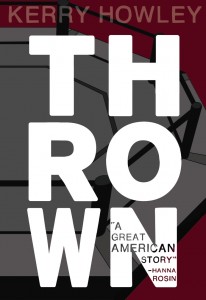
Kerry Howley traveled with MMA fighters for three years and wrote about the experience in her book-length essay THROWN.

Kerry Howley spent three years traveling and visiting with MMA fighters and wrote about the experience in her book-length essay Thrown.

Kerry Howley’s essays, reviews, and reportage have appeared in Harper’sThe New York Times MagazineSlateThe AtlanticThe Wall Street JournalGulf CoastVice.com, and frequently in Bookforum. Her short story “Pretty Citadel” was published in The Paris Review. Thrown, her book-length essay, is an account of three years spent in the company of mixed martial artists, narrated from the perspective of an excitable, semi-fictionalized graduate student named Kit. Howley teaches creative writing at the University of Tennessee at Chattanooga.

To read Howley’s essay “Cold Water in Texas” and an exercise on writing dialogue, click here.

In the following interview, Howley discusses framing essays around comic dialogue, the challenge of describing fight scenes, and the kind of person who is attracted to mixed martial arts.

Michael Noll

I’m really interested in the role and POV you assume in the piece (I’d call it an essay, but it’s partly fictionalized, yes?). There’s an interesting moment once you move out of the locker room and into the crowd. You write this:

In the way of any traveler, I ascribe every aberration to the jurisdiction. I have been to fights at bars and strip clubs and flyover state fairgrounds but never have I seen a barefoot ring girl — this one’s Vietnamese, in a bikini — and I’ve never seen an announcer cat-call a ring girl on his descent from the cage. “Texas,” I think.

It’s such an unexpected detail, and it suggests quite a bit of familiarity with the world of Mixed Martial Arts. How long did it take you to feel comfortable writing about a world that I’m assuming is pretty far outside your natural habitat?

Kerry Howley

It’s an essay, and semi-fictionalized in that the narrative voice is that of an imagined narrator named Kit. I probably felt comfortable well before comfort was justified. It took years for me to really understand the rhythms of those small fights, and longer to be able to write competently about them. That cat-calling of the ring girl is still surprising to me.

Michael Noll

In Thrown, Howley portrays the lives, battles, and worlds of two MMA fighters.

In Thrown, Howley portrays the lives, battles, and worlds of two MMA fighters from the perspective of a semi-fictionalized female graduate student.

It would seem tempting to draw conclusions about certain parts of society based on their love and enjoyment of MMA fighting. Yet you seem to resist this. At the beginning of the essay, you mention that fight takes place in Cleveland, Texas, where 19 men were charged with sexually abusing an 11-year-old girl, a fact that seems important, yet you refrain from drawing the connection, writing, “I don’t know what to do with this information.” Was it difficult to avoid that kind of societal analysis? Or did you find that the complexity of the people involved precluded easy conclusions.

Kerry Howley

It was never tempting to conflate the kind of brutality on display among Cleveland’s rapists with the kind of artful, consensual violence I was witnessing at the fights. I think my book-length essay, Thrown, does have something to say about the kind of person who is drawn to MMA. The men I follow tend to be proud nonconformists given to the kind of cosmopolitan worldview you’d expect from a sport closely identified with Japan and Brazil.

Michael Noll

I love the dialogue between the fighters as they’re trying to distract Charlie before the fight. It’s one of those rare moments when people are trying to be funny and succeeding and you seem to make a choice to get out of the way as a writer and let them talk. What was your approach to dialogue like this? Did you simply write it down as fast as possible and put it on the page? Or did you need to craft and revise the essay so that the dialogue would sound right?

Kerry Howley

Thank you. That was all recorded on my iPhone; I just transcribed what I took to be the best back-and-forth. I take such joy in bringing a funny voice to the page that I naturally frame essays around those moments. Part of editing the book involved purging a bunch of scenes I’d included—scenes much like the one you identify—that weren’t serving any purpose beyond amusement. I just felt like the reader had to know this hilarious thing the protagonist said about lawnmowers.

Michael Noll

You have a natural ease in writing about the actual fight—the punches and kicks, the action of it. This is actually quite difficult to do. It’s easy to get lost in a choreography of fists and feet, as in those films where the camera is zoomed in so close to the person fighting that we can’t get a sense for the action as a whole. But you really manage to convey both the immediate sense of what is happening and the arc of the fight. How did you approach writing these scenes?

Kerry Howley

Great question. The reader is only going to tolerate so much description of bodies in motion, so you end up molding a fight into the simplest version of itself—a few key moments and a mood. There are going to be a lot of small movements lost between point A and point B, and in that way perhaps writing about fighting (or dancing, which presents the same challenges) is emblematic of essay writing as a whole. So much of the struggle is subtraction.

November 2014

Michael Noll

Michael Noll is the Editor of Read to Write Stories.

How to Attribute and Describe Dialogue

11 Nov
Kerry Howley's "Cold Water in Texas" portrays the MMA fighter Charlie Ontiveros' attempt to fight in spite of a broken hand.

Kerry Howley’s “Cold Water in Texas” portrays the MMA fighter Charlie Ontiveros’ decision to enter a bout despite having a broken hand.

Here is my claim for the most difficult thing to do in writing: attribute and describe dialogue. The problem of who said what can seem impossible to solve. How often do you attribute a line of dialogue? Every line? Every other line? What words do you use? Only said? Screamed? How do the characters speak their lines? With dancing eyes? (Definitely not.) While looking intently or patiently at someone? (Preferably not.) And, what if the dialogue includes more than two people? What do you do then?

A great model for how to handle these problems can be found in Kerry Howley’s essay, “Cold Water in Texas.” The essay is an extension of her new book Thrown, about the three years she spent with a series of mixed martial arts fighters. The essay was published at Vice Magazine‘s Fightland, where you can read it now.

How the Story Works

The essay begins in the locker room with MMA fighter Charlie Ontiveros and a roomful of others:

a reticent black 260-pound heavyweight champion wearing a hat that says “Jesus Didn’t Tap,” his extremely gregarious black 275-pound friend Chris in the same, a chubby Hispanic coach named Mando currently absorbed in the wrapping of Charlie’s hands, and lithe, lily-white 170-pound Charlie himself.

All of these men are trying to keep the mood light before the fight begins. Imagine the challenges of writing such a scene: at least three speakers, two with the same build and clothing, plus some cornermen and officials who haven’t even been named. If you’re writing this scene, how do you keep everyone straight? Watch how Howley does it:

The joke in the room is that when Derrick, the slow-to-speak 275-pound heavyweight who will tonight successfully defend his belt, has mounted you, the best way to get out of the situation is to come onto him.

“I just pinch his butt,” says Chris. “He jump right up and say, ‘Stop with that gay shit.’”

“I lick his ear,” someone offers.

“He talk so low you can’t hear him,” someone says of Derrick.

“He don’t talk low,” says Chris. “He talk sexy.”

“That’s some Barry White shit.”

“Some of us grew up eating animal crackers. Derrick grew up eating animals with crackers.”

Chris glides about the room as he speaks. “Do a split,” someone demands, and the 275-pound superheavyweight does a to-the-ground straddle worthy of a Texas cheerleader.

“I ain’t acting too colored,” he says, apropos of nothing in particular. “I just watched Django before I came here is all.”

Charlie is laughing so hard he is crying, wiping tears from his cheeks.

So, how does Howley handle multiple speakers? Only one of them is named: Chris. Why? Because he’s more or less directing the banter. The other speakers are lumped into the tag someone, which puts the emphasis not on the speaker but on the subject of the dialogue: Derrick.

In other words, Chris is leading a rapid-fire conversation about Derrick, and so the focus is on Chris and Derrick. Notice how Howley, as the writer, stays out of the dialogue except to clarify things. The first sentence explains what the men are talking about. There is no other description until Chris does the splits—so, the action accompanying the dialogue has been stripped down to the most interesting moment. Howley steps in again in the next line—”I ain’t acting too colored”—in order to clarify since the conversation has jumped topics. Finally, she directs our gaze to the purpose of all this banter: Charlie and his reaction.

The Writing Exercise

Let’s write dialogue with more than two characters using “Cold Water in Texas” by Kerry Howley as a model:

  1. Summarize the dialogue. Think about the purpose and direction of the conversation as a whole. (If it’s an extended, even story-length piece of dialogue like Raymond Carver’s “What We Talk About When We Talk About Love,” summarize a section of dialogue.) Howley’s dialogue could be summarized this way: Chris tries to distract Charlie by leading a series of rapid-fire jokes about Derrick. Notice how the summary identifies a leader, a subject, a tone, and a purpose.
  2. Set up the subject of the dialogue with summary. A general rule for writing dialogue is to get to the good stuff as quickly as possible. One way to do that is to identify the good stuff and summarize what the reader needs to know in order to follow the dialogue. This is exactly what Howley does when she begins the dialogue by explaining the joke in the room—the thing that everyone is laughing about. So, tell the reader who is present and what they’re talking about. Then, write the dialogue.
  3. Identify only the character leading the dialogue. It’s almost never important to identify every speaker. If the readers understand the direction of the dialogue and who’s leading it, you can simply identify the leader’s words and use they or everyone for everything else that gets said. If you’re writing an argument, you can also divide the group into factions (men and women, kids and adults, etc) and identify the statements by faction rather than by individual.
  4. Describe only the most important or interesting action. If the only thing that a speaker does is look at the other speaker, then you probably don’t need any description; most people look at the person they’re talking to. If they’re not looking (if they’re driving, on the phone), then it can be useful to describe their actions more often. Usually, though, you can use one good description to describe the action in the scene as a whole. Howley does this by describing Chris generally (“glides about the room”) and then specifically (“does a to-the-ground straddle”). Compared to that moment, what else could be worth mentioning? The answer can be found in the final line: the reaction that the speaker is trying to get. In this case, Chris is trying to get Charlie to laugh, and the essay shows us that he succeeded. In your scene, what reaction is the speaker trying to get? Does he or she succeed? Give an answer with description.
  5. Clarify to help orient the reader. Dialogue doesn’t always move in a straight line; in fact, good dialogue often doesn’t move directly from Point A to Point B. When it switches subject or tone, it’s often necessary to cue the reader to the change by giving a brief description of what has changed. Howley does this when she writes that Chris has changed subject “apropos of nothing in particular.”

Once you summarize the dialogue and understand who is driving it forward and what their aim is, you may find it easier to identify who said what and how they said it.

Good luck!