
An Interview with Shannon A. Thompson

3 Apr
Shannon A. Thompson's novel Minutes Before Sunset was a Goodreads Book of the Month for July. You can read the first chapter here.

Shannon A. Thompson’s novel Seconds Before Sunrise is the latest in the Timely Death series. You can read the opening chapters here.

Shannon A. Thompson is a recent graduate of the University of Kansas and the author of Timely Death Trilogy, a YA paranormal romance series. The latest novel in the series is Seconds Before Sunrise. The first novel, Minutes Before Sunset, was a Goodreads Book of the Month selection.

In this interview, Thompson discusses choosing Kansas over New York for her novel’s setting, when to write multiple points of view, and how to create a community of readers and writers.

(To read the opening chapters of Seconds Before Sunrise and an exercise based on how Thompson sets up the novel’s love story, click here.)

Michael Noll

I’m curious about the importance of place in the trilogy. It’s set in Hayworth, Kansas, which you’ve said is an amalgam of Hays and Ellsworth. This seems, on the surface, like an unusually specific choice for a paranormal romance. The genre states its interests in its name (paranormal and romance), and so the focus of your novels is obviously on the experience of being a shade and the love story between Eric and Jessica. The genre doesn’t really allow for long, lyric passages about place. But does that mean the trilogy could have been set anywhere, or does place matter? To take other examples, place definitely matters in True Blood and Harry Potter, but the American South and England also have much stronger literary histories than central Kansas. In other words, if you set any novel in the South, the reader will have certain expectations. Kansas is more of a blank page, so to speak. How does it impact or color the novel?

Shannon A. Thompson

Understandable question! In the first draft, The Timely Death Trilogy purposely did not have a set place where everything happened. This was because I wanted it to feel like it could happen anywhere, especially right outside your window. Then, in rewrites, I realized I wanted a place, but I didn’t want the stereotypical cities that many novels take place in right now (New York City, Chicago, etc.) I desire more of a “home” feel, something more people can relate to, so I knew I wanted a smaller town, and then I realized I hadn’t read many YA novels in the Midwest, especially fantasy or paranormal based, so I picked Kansas—more or less—as a tribute to the state I lived in during the time of writing the novel.

Michael Noll

The novel is told from two perspectives: Eric and Jessica. How do you know when to switch between them? Sometimes the chapters switch back and forth between points of view, one after the other, but there are also times when Eric gets a couple of chapters in a row. I’m especially curious about the chapters where they are together. How did you decide who got to narrate those chapters?

Shannon A. Thompson
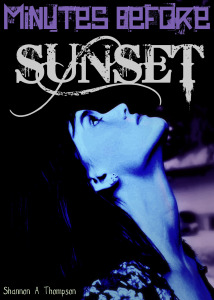
Shannon Thompson's novel "Minutes Before Sunset" was a Goodreads Book of the Month in July.

Shannon A. Thompson’s novel Minutes Before Sunset was a Goodreads Book of the Month. Thompson discusses her approach to POV in the novel at her website.

I actually wrote about how I choose who was speaking on my blog here: Dual Perspectives: Should Characters Have Equal Time to Speak?

To summarize it, I let the characters dictate when they will speak. Since the first novel revolves around the Dark (shades), Eric spoke more, but the second book is focused on what it is like to be a human. Jessica speaks more because of her human background, but it’s a lot more even than the first novel. The third novel, Death Before Daylight, will expose the Light, but I won’t spoil it by saying who speaks more yet. 😀 

Michael Noll

On your website, you give writing tips, and one of them is to avoid inserting technology into fiction—no cell phones, Facebook, Twitter—because it will quickly become obsolete, as flip phones and MySpace have proven. But you also write that excluding technology is a moral choice. You write, “I want young adults to spend more time outside (or reading) and putting an emphasis on social media didn’t sit well with me any longer.” I’m curious how you balance this choice with the fact that social media and technology are becoming integral parts of our lives. Many people (especially teens) cannot use maps, for instance, but instead rely on the GPS apps in their phones. We check our phones constantly (Facebook, Twitter, Snapchat) and even sleep with them. We almost certainly do not plan social gatherings or meetings as far ahead as we did when it was possible to go a day or more without talking to someone. Is it possible that at some point in the future, it will be impossible to write about human life without incorporating phones and social media? Will they become like cars–essential parts of a story?

Shannon A. Thompson

You have a very great point! Yes, technology is part of our everyday lives. However, I still think people will eventually turn away from certain aspects—like how the popularity of MySpace eventually went to Facebook—so I see technology as an unknown expiration date when included in novels. That being said, I see nothing wrong with including social media websites—I loved TTYL when I was younger—but it’s not something I will use in this particular trilogy. I might incorporate it into my future works, but I avoid it for now.

Michael Noll

Many writers (new and old, self-published and those working with publishers) tend to focus on their work but not on the business of publishing. What advice would you give about networking? You’ve been quite successful at building a following. Your author website has more than 14,000 followers. How do you find or attract your readers?

Shannon A. Thompson

I think it’s really important to have a website they can go to. Participate on social media, connect all of your sites, and be willing to understand how the social media changes overtime. Blogging has been my most successful platform. If you’re going to blog, I would suggest keeping a regular schedule with a focused topic range, but it’s more important to connect with fellow bloggers by reading and commenting on writers’ blogs like yourself. Networking is the key to finding fun and entertaining relationships with your readers. Overall, be engaging, entertaining, fun, and informative.

For my website, I began it in September of 2012 under the advice of Robin Hoffman, the Get Published Coach. I started reviewing books and movies, but then I slowly began sharing my story—how I got published and what I was planning on doing in the future. This was before I had my contract for my trilogy. I made sure to begin using a lot of SEO terms in my tags, and through the tags, I found blogs that spoke about similar topics. That’s how I found more writers and readers. Once I did that, I followed trends. For instance, I noticed my book reviews weren’t nearly as popular as my writing tips, so I dropped book reviews and did a long series of writing tips. I also started incorporating my contacts into my blog, which I still do today. On my author Facebook, I will ask questions that followers can answer. If I use their answer, I link to their blog. It’s a way to give back while encouraging a communicating and fun environment. It’s win-win. I honestly believe my every other day schedule is a huge factor, because trends slip majorly on the days I do not blog. Keeping everyone up-to-date is really vital to guarantee return. Having my blog connected with all social facets, so it automatically shares across numerous streams helps. My blog automatically posts on Facebook, Twitter, Google+, LinkedIn, Wattpad, and more.

April 2014

 

Michael NollMichael Noll is the editor of Read to Write.

How to Write a Love Story

1 Apr
Seconds Before Sunrise is second book in the Timely Death series, a Young Adult paranormal series by recent University of Kansas graduate Shannon A. Thompson.

Seconds Before Sunrise is the second book in the Timely Death Young Adult paranormal series by Shannon A. Thompson.

I once heard a critic claim that love stories are more difficult to write today than they were for Shakespeare. The obstacles that Shakespeare depended upon—class, feuding families, the fate of stars—have mostly been removed as possibilities, at least in America.

So, if class isn’t an option, how do we put obstacles between lovers in a story other than “he’s just not that into you?” This is a problem that genre literature, especially genres that deal in fantasy elements, handles well. The new YA paranormal novel from Shannon A. Thompson, Seconds Before Sunrise, perfectly illustrates two great ways to complicate a relationship. You can read the opening chapters here.

How the Story Works

I don’t necessarily believe the critic is right, but the idea that class is no longer relevant is still an interesting one. It’s certainly true that when class conflicts appear in fiction, the battle is often quick and decisive. For example, in the film The Devil Wears Prada, Anne Hathaway’s character questions the importance of choosing between two identical belts (in other words, questioning the industry itself). In response, her boss not only says she’s wrong but also insults her clothes as lumpy and unfashionable, saying that they must come from “some tragic Casual Corner.” After that, the movie never questions the class divide again.

So what are other ways to complicate a relationship? This passage (the beginning of Eric’s chapter on page 10) from Thompson’s novel illustrates her approach to complicating a love story (and the approach of many novels that incorporate fantasy elements):

I shoved my head into my locker and breathed hoarsely. It was the first day of school and sitting next to Jessica was already killing me. I wanted to talk to her, hold her, be with her—anything really—but I couldn’t. If the Light realized who or what we were, she’d be killed, and there was nothing I could do except stay away.

“You okay?” Jonathon asked, his voice squeaking through the slits of my locker.

I leaned back to stare at the blind artist. I wouldn’t believe he was Pierce, a powerful shade, if I hadn’t known his identities myself.

“I’m dealing,” I grumbled, unable to keep eye contact as Jessica passed us.

She flipped her brunette curls as she playfully hit Robb McLain’s arm. Robb McLain, with his sparkling teeth, gelled hair, and playboy personality was the perfect jerk.

The narrator and Jessica are in love, but the powers that be are keeping them apart—in this case, the “powers that be” are actual forces with actual special powers. Jessica’s memory has been wiped (though not completely) and other characters are in disguise. In other words, Thompson has invented an obstacle that does not exist in the real world. But she has also added a more realistic obstacle. Though the plot depends on paranormal activities, it’s grounded with a staple of love stories: the beautiful and charismatic, yet so-wrong-for-her, rival.

The Writing Exercise

Let’s introduce complications to love story, using the passage from Shannon A. Thompson’s novel Seconds Before Sunrise as a model. In order to introduce those complications, we first must do the following:

Choose the relationship. It can be a relationship between lovers, of course, but that isn’t the only option. Every story has pairs of characters who develop a relationship with each other: brothers, siblings, parent/child, friends, co-workers, or teammates. All of these relationships work the same. The story is often driven forward by the forces that push these characters together and then pull them apart.

Choose the force of attraction. The most obvious is love. But characters can also be brought together in other ways: their shared history together, duty to a cause or each other, an event like a funeral, or some external force (boss/teacher forcing them to work together). In stories, this force is often clearly identified: “I could never leave her because _____.” Or, “Now, we had no choice but to work together.” Now, we can introduce the force that will disrupt the relationship. There are many ways to do this. Here are some of them:

Forces that can disrupt a relationship:

  • Forces of Class: These are forces whose power comes from differences in social standing: wealth, race and ethnicity, and position within a power structure. Wealth complications, though less common than in the past, still exist in fiction, especially historical fiction. So, The Notebook initially disrupts its characters’ relationship (just before World War II) by having Allie’s parents call Noah “trash.” Romance novels do this all the time: the tycoon’s son seducing the maid. Complications due to race/ethnicity might seem less common (or, again, confined to historical fiction), but they are still used (as in this beautiful story by Tiphanie Yanique). And, relationships in science fiction and fantasy stories (between different kinds of aliens) often mirror realistic stories of racial/ethnic differences. Complications due to power imbalance might be easier to use: bosses and employees, teacher and student, mentor and mentee, player and fan, soldier and civilian, or legal immigrant versus undocumented immigrant. In short, any policy or tradition that grants one person greater power than another is ripe for use in a story.
  • Forces of evil: It’s often useful to say, in a story, that if two characters get together, the bad guys will kill one of them. This is what Thompson does in Seconds Before Sunrise. It’s also the complication used in most adventure stories, like these two favorites from my childhood: Romancing the Stone and The Princess Bride.
  • Characters in disguise: Shakespeare used this a lot in his comedies. Characters—particularly female characters—would disguise themselves, often as men, and go unrecognized by their beloved. The question you must ask yourself is this: why must the character go into hiding? Are they in danger? Are they balancing multiple roles? Are there parts of their lives that cannot be revealed or discussed? The disguise can come in different forms. They don’t always make a beautiful person less beautiful. The story of Cyrano de Bergerac does the opposite by disguising looks with wit.
  • Irreconcilable differences and incompatible goals: This is used by romantic comedies a lot (she’s too serious, and he jokes all the time; she has a career, and he’s a Playboy). It’s also the basis of many domestic dramas. Answer the question: what would make it difficult for these characters to live together, to stand being around each other?
  • External Events: Many stories use external events that separate the characters (soldier shipped off to war, kid left at home over Christmas). The event can also be more intimate, such as the onset of a disease. The film Away from Her (based on Alice Munro’s story “The Bear Came Over the Mountain”) disrupts a relationship with Alzheimer’s, to devastating effect.

Now, you can choose a rival.

Three ways to choose a rival:

  • Pick someone poorly suited as a love interest: This kind of rival is often the complete opposite of the other love interest—beautiful and popular instead of ordinary-looking and nerdy or uncool in some way. Even though the rival’s qualities at first seem appealing, the character who falls in love with him/her eventually realizes the rival’s “true” qualities. This is what Thompson has done: “Robb McLain, with his sparkling teeth, gelled hair, and playboy personality was the perfect jerk.” This kind of rival often creates a plot whose focus is on revealing the rival’s true personality.
  • Pick someone similar to the other love interest: What if the rival isn’t easy to hate? What happens if I love So-and-so, but she falls in love with someone who is just like me, but not me? This kind of rival creates a plot whose focus is on the other person (me) finding ways to distinguish him/herself.
  • Pick a random person. The scary thing about finding your beloved in love with someone else is that it may mean your beloved is far different than you thought. A random rival (someone whose qualities are neither good nor bad, just unexpected) often creates a plot whose focus is revealing the beloved’s true personality. In other words, it shows that the other person (me) has been pursuing someone with whom he/she is poorly matched.

This may seem like a lot of information. In a nutshell, all you need for a love story is an attraction, a disrupting force, and a rival.

Good luck!

An Interview with Aliette de Bodard

27 Mar
Aliette de Bodard is the author of the Aztec mystery-fantasy series, Obsidian and Blood, and the science fiction novel On a Red Station, Drifting.

Aliette de Bodard is the author of the Aztec mystery-fantasy series, Obsidian and Blood, and the science fiction novel On a Red Station, Drifting.

Aliette de Bodard has won almost every science fiction and fantasy award possible: a Nebula Award, a Locus Award, a BSFA Award, as well as Writers of the Future. She has also been a finalist for the Hugo, Sturgeon, and Tiptree Awards. She is the author of the Aztec mystery-fantasy series, Obsidian and Blood; the science fiction novel On a Red Station, Drifting; and many short stories and essays. She lives in Paris.

In this interview, de Bodard discusses mixed points of view, stories as social commentary, and the myth that technology and science are value neutral.

To read “Immersion” and an exercise on writing ideas into fiction, click here.

Michael Noll

Your story, “Immersion” is told from a mixed point of view: second person for the woman who cannot remove her immerser and third person for the woman who scorns the technology. The mix works: second person seems to really fit the dilemma faced by Agnes, and the third-person POV helps avoid confusion between the two narratives. But the mix also probably breaks one of those “rules” that occasionally pop up in writing workshops, something along the lines of “pick a point of view and stick with it.” How did you decide upon this mix? Was Agnes’ POV always told from second-person?

Aliette de Bodard

I’ve never been much of a person for following rules, actually–my motto is more “know why the rules exist so you can break them”. Seriously though, I think rules are very useful when you’re a beginner, mostly in order to leave you time to work on more “simple” things. I think of it as juggling. If you start out learning to juggle with six balls, you’re probably going to get discouraged; an easier way to go about it is to start with one ball, then add another one, etc. until you get to six. Rules are meant to “box” you in a bit, to make stories a little easier to write. But they can become strictures if you keep applying them without thinking on why they exist.

In this particular case, sticking with one POV makes sense in a short story, because you have little space, and shifting POVs too often risks making your story difficult to follow. It’s always been one of the more frustrating rules for me, though, because what you gain in clarify, you lose in subtlety: I think it makes for better, more balanced stories if you combine several points of view–it gives you several different views on the action or on things that characters might not be aware of. In the case of “Immersion”, it makes you understand the plight of Agnes better to see her both from within and from without. The story didn’t start out that way: I originally only had Quy’s point of view, but it wouldn’t gel until I found Agnes’s voice in second person.

Michael Noll

I recently read M. John Harrison’s Light trilogy, which features a character who is addicted to a chemically-induced dream reality. This same idea is present in “Immersion.” Agnes used the immerser to fit in with her husband’s social group but soon began to rely on it until she reached the point that removing it will kill her. Unlike in Harrison’s novels, though, the addiction in your story isn’t complete. The characters, even Agnes, are aware—if dimly—of their altered states. You capture this by showing Agnes half remembering phrases or caught between instincts that are truly remembered and those that are technology-induced. It’s a fine line that you must walk in almost every sentence—capturing warring impulses in a single mind. Did this voice simply come to you one day, or did you have to experiment to find a way to portray this dual state?

Aliette de Bodard

Agnes’s voice was pretty straightforward to write—though I’m not sure if I could sustain it for a full novel, since it’s a bit draining and a bit difficult to write a character like her, who’s not exactly sure which world she inhabits. I’ve always found it easier to write characters with a very large internal life, and she certainly fits the bill.

 Michael Noll

You’ve written some high-powered social commentary in the story. This is probably my favorite line: “It takes a Galactic to believe that you can take a whole culture and reduce it to algorithms; that language and customs can be boiled to just a simple set of rules.” What I found impressive was how you integrated this commentary into the story. It doesn’t come out of nowhere or feel like the author intruding to tell the reader the moral. Instead, you attach it to the technology that is warping the characters’ lives. The technology, you write, “Takes existing cultural norms, and puts them into a cohesive, satisfying narrative…Just like immersers take a given culture and parcel it out to you in a form you can relate to: language, gestures, customs, the whole package.” I wonder what came first: the commentary or the story it’s embedded within. How do you strike the balance between story and the things you want to say?

Aliette de Bodard

It really depends on the story! “Immersion” started out as mostly commentary: I wrote it after we came back from visiting my maternal family in Vietnam, and I saw firsthand the damages the Western mindset was still doing there. I always knew what I wanted to say with the story; and what took time was working out a setting and characters that would help me do this without seeming overly preachy (though every one has a different idea of what “preachy” means. I felt the story was very direct about postcolonial issues, perhaps too overtly so, but there are a lot of people who didn’t even see that aspect of it!).

Michael Noll

When I read about the immersers, I couldn’t help but think of our current technology, especially smart phones. Just as the immersers “take a whole culture and reduce it to algorithms,” so do smart phones take complex processes like navigating space or killing time and flatten them into simple interactions with a screen. I’ve read enough Jaron Lanier to know how much of what we take for granted as “the way we interact with technology” is founded on particular assumptions made by a handful of early programmers and developers, who may or may not have had problematic assumptions about culture. What do you think? Does technology force people and cultures to interact within the paradigm of the technologically dominant culture?

Aliette de Bodard

Aliette de Bodard has composed eight "rules" for writing fiction about cultures other than your own. The rules, along with a lot of other great essays and links, are available here at her website.

Aliette de Bodard has composed eight “rules” for writing fiction about cultures other than your own. The rules, along with a lot of other great essays and links, are available here at her website.

I think there is a persistent myth that technology, like science, is value neutral because it simply reflects the way the universe works. The thing is, they’re both tools, and they’re both created in a cultural matrix that makes them what they are (the pursuit of science, and the way science revolutionised the world at the end of the 19th Century, for instance, is inextricably bound up with the rise of massive colonial empires and the plundering of resources from said empires). Perhaps even more so than science, technology is dependent on who created it and how they thought people would interact with it: a very simple example is that, on a lot of webpages and forms, the encoding is ASCII or some variant that doesn’t handle diacritics. That’s because the people who coded it were Anglophones, and didn’t think anyone would have a need for letters like “é”, “è”, etc. So when you have to type in something, you strip it of diacritics rather than have it come out as garbage text. And that’s a very simple example: now imagine this kind of mindset in, say, the use of a GPS, the use of a personal assistant, the coding of an AI. You see that there is something at work there that goes beyond lines of codes and electronics and whatnot; a set of assumptions that remain unquestioned and perpetuate a status quo. So, yes, definitely, there’s a paradigm that gets enforced when dealing with technology; and it’s a self-reinforcing one because people will then reject, say, any smart phone that doesn’t behave “sort of like an iPhone”–unless there’s some massive shift.

I’m not saying we’re locked in this; there are game changers, and there are people providing technology beyond the dominant paradigm and being very successful at it–but just that we have to be aware of this.

March 2014

Michael Noll

Michael Noll is the Editor of Read to Write Stories.

How to Write Ideas into Fiction

25 Mar
Aliette de Bodard's story, "Immersion" appeared in Issue 69 of Clarksworld Magazine.

Aliette de Bodard’s story, “Immersion” appeared in Issue 69 of Clarkesworld and won the Nebula and Locus prizes for Best Short Story.

When I was in an undergraduate fiction workshop at Kansas State University, my teacher told us not to worry about what our stories were about. Focus on the characters and plot, he said, and the rest will sort itself out. This is often good advice—but not always. Some stories are about ideas, and the issue becomes not how to momentarily forget those ideas but, instead, how to attach them to the characters and plot so that they read as story rather than apart from it.

One genre that consistently tackles big ideas is science fiction. And one of the most interesting new science fiction writers is Aliette de Bodard, whose story, “Immersion,” appeared in Clarkesworld and won or was nominated for pretty much every award possible: Nebula, Locus, and Hugo Awards for Best Short Story. You can read “Immersion” at Clarkesworld‘s website.

How the Story Works

The story states its ideas outright. It’s about a piece of technology that allows its user to drop into a world and culture that isn’t their own and still communicate. In the story, de Bodard writes that certain people “believe that you can take a whole culture and reduce it to algorithms; that language and customs can be boiled to just a simple set of rules.” She also writes that the technology takes “existing cultural norms, and puts them into a cohesive, satisfying narrative.”

These are strong statements about culture and cultural appropriation, and it’s impossible to not read them as sharp critiques of very real technology in our very real world. The risk that any story runs when stating its ideas in this way is that can begin to feel more like an essay than a narrative. Essays are great, of course, but when readers begin a piece of fiction, they often have little patience for tangents that do not advance the forward momentum of plot and character. So how does de Bodard successfully include these statements in her story?

  1. She applies them directly to a single character. Here’s the story’s first sentence: “In the morning, you’re no longer quite sure who you are.” And why is the character not sure? Because she wears a device that produces an avatar that not only produces an external image but also delivers cultural and linguistic cues directly into the character’s brain. Imagine a Fodor’s guidebook mixed with Siri and the information delivery system in The Matrix. In short, de Bodard has created a machine that turns her ideas into tangible objects with consequences for the characters who encounter with them.
  2. She makes the plot hinge on the character’s decision. The story begins by asking the character who she is, and the plot follows an attempt to answer that question. Three of the characters (her husband, Quy, and Quy’s sister) are actively pushing or, at least, tangentially giving her space to answer that question, but the technology (the immerser) is pushing back. It wants to supply its own answer. In a way, the plot is similar to any story about powerful external influence (addiction, cults, relationships with manipulative partners). Because the technology is a character with (almost) a will that it exerts, it makes perfect sense for de Bodard to write that the immerser takes “existing cultural norms, and puts them into a cohesive, satisfying narrative.”

The Writing Exercise

Let’s write ideas into a story using Aliette de Bodard’s story, “Immersion,” as a model:

  1. State your ideas. What is your theory about _____? de Bodard is writing about cultural appropriation, and you can write about something equally large. Or, you can focus on something smaller. To get you started, how would you finish this sentence? The thing about (pick your group of people) is ______. For instance, you’ll sometimes hear people claim that certain men suffer from small-man syndrome; i.e. the guy is short and making up for it. Congressman Paul Ryan recently blamed poverty on inner-city people who don’t know how to work. President (at the time, candidate) Obama once said about Midwesterners that “”it’s not surprising then that they get bitter, they cling to guns or religion or antipathy to people who aren’t like them or anti-immigrant sentiment or anti-trade sentiment as a way to explain their frustrations.” (Interestingly, when my Midwestern, religious, gun-owning father heard this, he thought it seemed about right.) All of these statements are basically ideas or theories about human behavior. de Bodard’s ideas are more rigorously academic, but they are still about human behavior. So, what’s your theory about 1) why people act the way they do or 2) the systematic consequences of that behavior?
  2. Create a machine that turns those ideas into things. This can mean a literal machine like the one de Bodard has created. The point of the machine is to put your character into an existential dilemma that is tied to the theory you have developed. So, if you believe in short-man syndrome, you might create a machine that makes tall people short. If you’re a Paul Ryan acolyte, your machine would make people unwilling to work (a city full of unwilling scriveners). Or, if you agree with the president, your machine might make people bitter in order to see what they cling to. But your machine doesn’t need to be an actual machine. I’ve already mentioned that addiction or cult personalities can fulfill many of the same functions. But so can the circumstances you create: if you want to make a character bitter enough to hate foreigners and brandish guns, there are realistic ways to do that. Melville found a way to make Bartleby avoid work. Many stories are filled with characters who suffer illnesses or accidents that change their physical appearance. In short, you can use the world of your story to drive your character into a situation that forces them to act.
  3. Make the plot hinge on the character’s action. How will the physically altered character react, and how will that reaction the ones she loves? If the character refuses to work, even in the face of extreme poverty, will someone eventually step in to help or not? Will the bitter character use the gun you’ve given him against the people he blames for his misfortunes? Turn the plot into a question of the path your character will take? The story can end once the decision has been made. Or, it can proceed from there to show the effects. Either way, you’re turning your initial ideas into a story that may have room for the statement of those ideas.

Good luck!

How to Write a Murder Scene

18 Mar
Claire Vaye Watkins won the prestigious Story Prize for her debut collection of stories, Battleborn. Her story, "The Last Thing We Need," appeared in Granta 111.

Claire Vaye Watkins won the prestigious Story Prize for her debut collection of stories, Battleborn. Her story, “The Last Thing We Need,” appeared in Granta.

American films are full of violence; in fact, the anticipation of death is probably one of the reasons that people go to the movies. There’s a visceral, perverse thrill in seeing someone killed in front of your eyes, and that feeling is harder to create in writing than it is on the screen. It’s difficult to replicate the speed of a gunshot or the blind, chaotic feeling of participating in a fight. Some writers try to copy the techniques of film: a lot of choreography (punches, kicks, and ricocheting bullets). But the best writers use techniques that are only available in written fiction to create powerful scenes of violence.

Claire Vaye Watkins has written such a scene in her story, “The Last Thing We Need.” It was published in Granta, where you can read it now.

How the Story Works

The scene takes place at a gas station in the Nevada desert. The narrator is a high school kid working the night shift for the station owner, a man who keeps a shotgun under the counter. He’s doing his homework and doesn’t see a car pull up. As you read the scene, pay attention to two things: the choreography (who did what) and the delay (what details are given to slow down the action):

I looked up and the guy was already coming through the door at me. I looked outside and saw the ’66 Chevelle, gleaming under the lights, grasshoppers falling all around it like rain.

I tried to stop him but he muscled back behind the counter. He had a gun, held it like it was his own hand. He said, You see this?

There was a bandanna over his face. But Beatty is a small town and it was even smaller then. I knew who he was. I knew his mother worked as a waitress at the Stagecoach and that his sister had graduated the year before me. The money, he was saying. His name was Frankie. The fucking money, Frankie said.

I’d barely touched a gun before that night. I don’t know how I did it. I only felt my breath go out of me and reached under the counter to where the shotgun was and tried. I shot him in the head.

Afterwards, I called the cops. I did the right thing, they told me, the cops and Bill Hadley in his pyjamas, even my father. They said it over and over again. I sat on the kerb outside the store listening to them inside, their boots squeaking on the tile.

Every time I read this passage, I’m struck by the line, “I shot him in the head.” It’s blunt and direct. The language does not try to convey anything other than the barest of facts. This is important because badly written violence tends to be overwritten. The language tends to tell the readers not only what happened but also how they should feel about it (anxious! afraid! sickened!) and how it occurs (in a flash! suddenly! out of the blue!). So, how does Watkins avoid those mistakes and write a powerful scene? She does two things:

  1.  She uses simple sentence constructions to convey the choreography. By simple, I don’t mean in the grammatical sense—one subject/verb pair—though there are several of those types. For instance, this is a simple sentence: “I only felt my breath go out of me and reached under the counter to where the shotgun was and tried.” The beauty of a simple sentence (in the grammatical sense) is that it’s usually crystal clear. While you never want your readers confused about basic elements in a story, you especially don’t want them confused during the moment of greatest importance. That said, by simple construction, I mean sentences that use as few words as possible, like this one: “I tried to stop him but he muscled back behind the counter.” Imagine how else that sentence could have been written. Stop is a vague word, right? Another writer might have described the exact physical movements used in the attempt to stop the man. It might have worked. Who knows? But it might also have lost the sense of purpose. In all the arm-grabbing and shuffling, the reader might have forgotten the elemental goal of stopping the man with the gun. Who really cares how motions were involved? The same is true of the word muscled. Again, Watkins eschews detailed description and again boils the movement down to its essence: stop and muscled back. She’s conveyed the physical dynamics of the scene (one person is stronger than the other) and also the basic action in only twelve words. Written stories can never approach the speed of film, but they can still move quickly, as Watkins has shown.
  2. She interrupts the action with plain information. Beginning writers tend to try to make each sentence in an action sequence more intense than the previous one. But this is almost always unsustainable. Another strategy is to switch back and forth between intense action and something that isn’t intense. Watkins interjects the actions in the gas station with basic info: “But Beatty is a small town and it was even smaller then. I knew who he was. I knew his mother worked as a waitress at the Stagecoach and that his sister had graduated the year before me.” Imagine if, in advance of reading this scene, someone told you that the best way to write a murder scene is to tell the reader, just before a man is shot and killed, how big the town is. You’d likely think it was terrible advice. But what it does in this scene is heighten the tension. A man with a gun is one thing, but a guy you know with a gun is entirely different. Watkins keeps switching back and forth between action and info: “The money, he was saying. His name was Frankie. The fucking money, Frankie said.” She does the same thing with the narrator, telling the reader that he’d never touched a gun before. These interjections slow the action down but also make us lean into the page in anticipation. What started as “stop and muscled back” becomes “The fucking money, Frankie said and I’d barely touched a gun before.” In other words, the information makes the scene more personal, which, of course, makes it more tense.

The Writing Exercise

Let’s write a violent scene, using the scene from Claire Vaye Watkins’ story “The Last Thing We Need” as a model:

  1. State what will occur. Know what your destination is. In Watkins’ story, a teenage gas station attendant shoots an armed robber. Don’t worry about crafting a great sentence. You’re just reminding yourself what the endpoint of the action is.
  2. Describe the choreography in simple sentence constructions. Your goal is a sentence like this one: “I tried to stop him but he muscled back behind the counter.” Boil the action down to quick descriptions of purpose. What are the characters trying to do? When the purposes are clear, it becomes easier to introduce complications. So, for instance, you might write, “He grabbed at the money, and I tried to pull it away. The bills  ripped down the middle.” Try to choose words that accomplish two things at once: statement of action and description of how that action occurs. Consider the difference in the scene if muscled was replaced with slipped. It might make the man harder to shoot in the head. He might be too quick, and so the scene would play out in another direction.
  3. Interrupt the action with plain (uncharged) information. By uncharged, I mean that if you read the information out of context, you wouldn’t think twice about it. But you can’t insert just any old info. You need a goal in mind. Are you trying to make the scene more personal for one of the characters, as Watkins does? Are you trying to make the characters more hesitant or eager? Do you want more or less urgency?  Do you want them thinking of ways to safely extricate themselves from the scene, or do you want them escalating the tension? How do you want the characters to feel after the scene is over? Regardless of your goal, the information should be simple. Characters who are about to engage in violence probably don’t have a lot of mental space for abstractions or reflection. The information should be the sort that they would likely be instantly aware of during the moment.
  4. Switch back and forth between action and information. The idea is not so much to keep applying pressure on the reader but to take short breaks from the tension so that the reader wants to know what will happen. One way to do this is to repeat one of the pieces of information that you’ve introduced. Watkins does this by revealing and repeating the identity of the man with the gun: who his mother was, who his sister was, his name, and his name again. The result is that the scene becomes increasingly personal for both characters because they know each other. You can do something similar by taking one piece of information and showing it to the reader in slightly different ways. (Genre writers, especially mystery/detective/crime writers, often do this. At a moment of high tension, the character will notice a refrigerator humming too loudly or a scratch on the floor. Sometimes this fact will get incorporated into the scene somehow, either directly or by causing the character to remember/realize something.)

The key to a scene like this is twofold: use short, clear language that reveals multiple things at once and add moments that step away from the tension to reveal information that is initially uncharged but that becomes important as the scene progresses.

Good luck!

How to Find a Plot (and Humor) with Repetition

11 Mar
Teddy Wayne's humor piece, "On the Internet, Nobody Knows You're a Human Who's Turned Into a Dog," appeared in the Shouts and Murmers Section of the New Yorker. Wayne is the author of two novels and many fictions like this one.

Teddy Wayne’s story, “On the Internet, Nobody Knows You’re a Human Who’s Turned Into a Dog,” appeared in “Shouts and Murmurs” in The New Yorker. Wayne is the author of two novels, most recently The Love Song of Jonny Valentine.

When working with plot, we tend to think forward: what happens next? But sometimes that’s the wrong question. Occasionally, we should think of plot as if we’re telling knock-knock jokes to a 4-year-old. You finish one, the kid shouts, “Again, again,” and you ask yourself, “How can I possibly tell another?”

Comedy writers understand this question perhaps better than anyone. Repetition is part of the genre. The challenge often becomes about how long the writer can stay with an idea.

Teddy Wayne uses this kind of repetition in his story, “On the Internet, Nobody Knows You’re a Human Who’s Turned Into a Dog.” It appeared in The New Yorker‘s “Shouts and Murmurs” section, where you can read it now.

How the Story Works

When we break the story down by its sections, it’s clear how Wayne is repeating and modifying the same idea. Here is each section, summarized:

  1. States the premise (transformed into a dog) and the medium (Facebook).
  2. Introduces a problem with the medium: People “like” things without reading them, forcing the narrator to restate the fact that he’s turned into a dog.
  3. Introduces another problem with the medium (People expect to laugh at Facebook posts), which causes a problem for the narrator because they be laughing while he starves to death.
  4. Introduces another problem with the medium: Facebook moves on without you.
  5. Introduces another problem with the medium: Facebook attachments are weak, and so people will unfriend you if you ask too much of them.
  6. Begins to accept the limitations of the premise: The narrator’s a dog, and he won’t try to fight it.
  7. Accepts the medium: The narrator posts about non-dog topics.
  8. Fully accepts the premise: The narrator becomes a dog in mind as well as body.
  9. The payoff: The narrator finds a way to make dog life work for him and deactivates his Facebook account.

This summary reveals the clothesline that the funny stuff has been hung from. Without this structure, the writer doesn’t have the space to riff.

So, how does this structure work?

While Wayne seems to be writing about a single idea (dog transformation), he’s actually writing about two ideas: dog transformation and Facebook. It’s the latter that turns out to be the most important. If you reread the piece, you’ll see that the narrator repeats the dog premise over and over without many changes. The dog stays in the house. What changes, then, is his reaction to the limitations and problems posed by Facebook. (This is similar to what Will Ferrell does in his famous Saturday Night Live skit about the man grilling at a backyard party and yelling at his kids to get off the shed. The premise doesn’t change: the kids stay on the shed. What changes is Ferrell’s reaction to the medium: his inability to shout loudly or angrily enough to get his kids’ attention.)

As a result, the story is less about a guy turning into a dog than it is about trying—and failing—to communicate something important via Facebook. The story is funny, though, because it’s about a guy who’s turned into a dog. If it was a cry for help from someone with a more realistic problem, the story might become a tragedy, not a comedy.

The Writing Exercise

Let’s create a structure for a comic story, such as often appears in “Shouts and Murmurs,” that focuses on repetition. We’ll use Teddy Wayne’s story “On the Internet, Nobody Knows You’re a Human Who’s Turned Into a Dog” as a model:

  1. Find a premise. Your character discovers something that needs to be communicated. The premise can be absurd (man turned into a dog) or realistic (kids climbing on a forbidden shed). What’s important is making the need to communicate urgent.
  2. Find a medium. You need a method to communicate: phone, Facebook, Twitter, Snapchat, yelling, cup and string, Morse code, tapping on the prison wall, the “telephone” game of speaking across a chain of people.
  3. Brainstorm the limitations or expectations of the medium. Will Ferrell was limited by the distance between the grill and the shed. Wayne’s dog is limited by the ways that people interact with Facebook. The story’s tension (and humor) are produced by the ways that the medium is ill designed for the premise that must be communicated.
  4. Isolate and challenge those limitations. You can do this in real time (the character tries to communicate but fails) or as a reaction to what happened (character tries again after failing, as Wayne’s dog does). You can introduce new limitations, one after another. Or, you can let the character challenge the same limitation in increasingly strenuous ways (as Ferrell does in his skit). In this case (or, perhaps, both), the tension and humor result from the ways that the attempts to communicate push against ideas of acceptable behavior in the society in which the story takes place.
  5. Undermine or negate the premise. As your character challenges the medium through which he/she is trying to communicate, the tension will rise with each challenge until a logical endpoint appears: the character will ultimately succeed in communicating or fail and suffer the consequences. Once that end presents itself, set it aside. That’s not the ending for you. Instead, you want to surprise the reader. This is often done by undermining the premise. Ferrell wrote many “Get off the shed” skits, and, in most of them, his kids walk up and he realizes that he’s been yelling at the wrong people for no reason. Thus, all of his shouting has accomplished nothing and been for naught—except our entertainment. In Wayne’s story, the dog makes a fortune off of his story and deactivates his Facebook account so that he can get some work done on the film script. Thus, in both examples, what was urgent turns out not to have been so urgent. So, think about your premise: what would make it not urgent? What would make it cease to be a premise? You’ll come up with some obvious answers and some less obvious ones. Play with them to see which is the funniest.

Remember, your goal is to create a structure to riff within. The structure is essential to the humor, but it’s not funny in and of itself. The way that you play within it will be the source of the humor.

Good luck!

An Interview with Diana Lopez

6 Mar
Diana Lopez is the author of the YA novel Ask My Mood Ring How I Feel, two middle grade novels, and an adult novella. She won the 2012 William Allen White Award.

Diana Lopez is the author of the YA novel Ask My Mood Ring How I Feel, two middle grade novels, and an adult novella. She won the 2012 William Allen White Award.

Diana López is the author of the adult novella, Sofia’s Saints; the middle grade novels, Confetti Girl and Ask My Mood Ring How I Feel; and the young adult novel, Choke. She was featured in the anthologies Hecho en Tejas and You Don’t Have a Clue and appeared as a guest on NPR’s Latino USA. She won the 2004 Alfredo Cisneros del Moral Award and the 2012 William Allen White Award. Lopez teaches English and works with the organization, CentroVictoria, at the University of Houston Victoria.

In this interview, Lopez discusses the importance of strong imagery, how to find a contemporary teen voice, and when to explain cultural/regional details to a broader audience.

To read the opening chapters of Ask My Mood Ring How I Feel and an exercise on creating conflict with subtext, click here. For those in Austin, Lopez will be reading at the Westbank Library on March 12.

Michael Noll

One of the more challenging technical aspects of fiction writing is getting characters onto the page for the first time. Your novel does this really effectively. The opening pages use a simple object (bikinis) to introduce four of the major characters (the narrator, her mother, her sister, and her little brother) and also the major conflict (the mother’s breast cancer). All of that happens in about three pages. How did you approach this introduction to character and story? Did the book always begin with the bikinis?

Diana Lopez

Yes. The original title of the novel was “9 Bikinis, 500 Names,” which are now the first and last chapters. I have no idea where the number nine came from, but I knew that I wanted to tackle breast cancer from a daughter’s perspective, a girl who is maturing and who has a lot questions about the body. I wanted her mother to be a strong character with a positive attitude, someone who was going to celebrate her days before the mastectomy by showing off. What better way than to wear bikini tops?

I can’t overstate the importance of strong imagery. The best way to make an okay story into a memorable one is specific imagery. My students often struggle with this. They miss so many opportunities. But consider all the power an image holds. First, it gives the reader a chance to experience via the senses—the bikini colors and patterns, the texture of the fabric, even the hot sun that we associate with them. Second, images hold connotative powers. I don’t have to say that Chia’s mom is fun loving, daring, and sexy. What kind of conclusion would the reader draw if the mother bought oversized T-shirts instead or if she threw away her bras the minute she came home from the doctor? In other words, a good image lets the readers co-create as they arrive at their own conclusions about the characters. Imagine all the assumptions we make about a forty year old woman driving a minivan versus a sixteen-year-old boy.

Michael Noll

There’s a really tender moment in the first chapter between the narrator’s dad and mom:

He pulled out her chair. He could be a real gentleman, but since he pulled out Mom’s chair only at fancy dinners or weddings, this was weird. Mom must have thought so, too, because she hesitated before sitting down.

When the narrator’s little brother demands juice, her dad gets it instead of her mom, which causes her mom to say, “Your father’s treating me like an invalid.” What I love about this moment is its complexity: the father is trying to be kind and considerate—and in most situations, his actions would be seen that way—but because of the situation, the mother interprets these actions as insulting and painful. As a result, the reader is shown something deep and powerful about the characters. Did you try to find scenes that would result in this kind of awkward collision of intention and effect? Or was a scene like this a happy accident? Did it just pop onto the page one day?

Diana Lopez

I am always looking for opportunities to heighten the conflict. It’s what drives a novel just as it drives a good conversation. Imagine how bored you are when your friend is relating the non-eventful details of her day, and then imagine how attentive you are when your friend is talking about someone in trouble. We love conflict.

I spent a lot of time figuring out my characters. I write a lot about each before I put them in scenes. What’s the mom like? Where does she come from and how does she spend her days? How about the dad? Where did they meet? Of course, this doesn’t make it into the final book but it definitely informs the scenes.

So to answer your question about that dinner, I imagined the family at the table and the parents having to deal with the mother’s breast cancer. It made sense for the father to be overprotective, and by then, we already know the mother has an independent streak. So the way she takes offense is natural and logical, given who she is. You could put two different people at the same table with the same looming news and get a completely different scene. In fact, that would be a good writing exercise, wouldn’t it?

Michael Noll

You don’t shy away from featuring technology in the novel. In the first chapter alone, the narrator texts her friend, searches through Google Images, and uses her iPod as a point of comparison for something as important as boys. Was it difficult to write about these things from an 8th grader’s perspective? I ask because my students at Texas State have a far different relationship to cell phones and technology than I do—and certainly different than I had at their age. These same students, however, tend to view their younger siblings as getting far more privileges than even they got. They sometimes sound like old geezers complaining about the kids these days. As a writer, how are you able to bridge the generational gap between you and your characters, especially with technology?

Diana Lopez

Good question and one that brings up a very important aspect of writing for young adults. You have to know your audience. I like writing contemporary books, so they have to take place in the here and now, not decades ago when I was a teen. This can be a challenge, but here’s where research comes in. The best way to bridge that generational gap is spend time with teens. Talk to them. Observe them. “Friend” them on Facebook or follow them on Twitter. Soon you’ll start hearing that contemporary teen voice and you’ll get a good sense of how they relate to each other and to technology. I teach too, and I’m still writing on the board. Instead of copying the notes, half the class takes a pic with cell phones. Many public schools are doing away with books and distributing iPads to their students. I only know these things because I’m out there paying attention. A good tool for writers is observation and engagement with the people you hope will read your book.

Michael Noll

I’m curious about the audience for this book. It’s about a Latino family living in San Antonio. They use corn tortillas for tacos—not flour—and take a trip to a cuarto de milagros. In other words, they have an intimate relationship with a particular culture and place. As a result, I was interested in this passage about migas:

Migas was our favorite Tex-Mex dish—a mix of corn tortillas, eggs, tomatoes, onions, and cheese. We loved the recipe. Thing was, migas were for breakfast, not dinner.

The description of migas is clearly meant for readers who do not have the same cultural knowledge as the narrator and her family. This seems to point to a tension that is inherent in a novel about characters who do not often appear in national fiction (though this is changing). How do you balance the need to clue in an audience not familiar with things like Tex-Mex food with the equal need for an honest depiction of a narrator who wouldn’t walk around explaining the basic elements of her life? How do you decide what to explain and what to leave to the reader to figure out?

Diana Lopez

Diana Lopez's middle grade novel Confetti Girl won the William Allen White Award and, according to ALA Booklist, "puts at its center a likable girl facing realistic problems on her own terms."

Diana Lopez’s middle grade novel Confetti Girl is featured the week at Latin@’s in Kid Lit.

Excellent question and one I have struggled with. I want my book to be accessible to many readers. That said, I don’t intentionally highlight these details. Seriously, they are part of my world so it doesn’t occur to me to give the recipe for things like migas or to explain the process of making cascarones like I do in Confetti Girl. This is where an editor who lives in New York comes in. We’ll get to this point in the revision process where she has highlighted places with unfamiliar images or words. I remember the first time this happened. I wrote a book set in Corpus and mentioned T-heads, never realizing how unique that term was. The editor had no idea what I was talking about, so I added an appositive phrase for clarification. Ultimately, that’s what I have to determine. Are there enough context clues or should I be little more explicit? The last thing I want is a reader to stop because she’s confused. In that sense, I am very grateful to have an editor who is not from my world and can point out these places—then lets me decide whether or not I should add that recipe or definition.

March 2014

Michael Noll

Michael Noll is the Editor of Read to Write Stories.

How to Create Conflict with Subtext

4 Mar
Diana Lopez's YA novel Ask My Mood Ring How I Feel

Diana Lopez’s middle grade novel Ask My Mood Ring How I Feel has been called an “honest, sometimes uncomfortable, but always hopeful look at how cancer affects family.”

Conflict is essential to fiction, and, of course, the easiest way to create conflict is by pushing characters into a fight or argument. But how do you set the stage for the big confrontation? One way is to establish competing needs or desires (I want my neighbor to cut his grass, and he wants me to keep my opinions to myself). Relying on this strategy too often, though, can lead to predictable scenes. A story needs unexpected arguments. One way to set those up is with good intentions. In fiction, as in real life, we’re often stunned to find out that our good deeds are not always appreciated.

Diana Lopez uses this strategy perfectly in her middle grade novel Ask My Mood Ring How I Feel. You can read the opening chapters at Hachette’s website. (Look for the maroon tab that says “OpenBook-READ AN EXCERPT.”)

How the Story Works

When setting up scenes, we often choose the most obvious paths toward conflict. One character is upset about something and says so. Another character doesn’t like what’s said and so reacts. Thus, conflict. While this method can work, it also limits the characters to thinking about and acting on whatever is happening directly in front of their faces. In other words, there’s no subtext.

In a conflict that arises out of subtext, the characters are thinking about something that is not happening in front of their faces, and the conflict arises because those thoughts begin to manifest themselves through the character’s actions. As a result, a character’s internal conflict becomes external.

Here’s the scene from Lopez’s novel that illustrates this idea perfectly. The subtext isn’t stated in the scene, but it’s clearly present:

As soon as she saw the table, Mom said, “What’s this?”

“I made dinner,” Dad announced.

“But I could have made dinner,” Mom said. “I was planning to. I always make it, don’t I?”

“Just wanted you to have a day off,” Dad said, all cheery.

He pulled out her chair. He could be a real gentleman, but since he pulled out Mom’s chair only at fancy dinners or weddings, this was weird. Mom must have thought so too, because she hesitated before sitting down. Then Dad went to his seat and told us to dig in. We did. Quietly. For once, Carmen wasn’t acting like a know-it-all and Jimmy wasn’t begging for something to hold. It was a perfectly quiet dinner like Dad had wanted, but it sure wasn’t peaceful.

After some typical dinner-with-kids chaos, this happens:

“So let the rest of us help,” Dad said. “There’s no need for you to do everything.”

“And there’s no need for me to do nothing at all.”

I felt totally confused. Dad was acting super nice, but Mom was acting mad. “What’s going on?” I had to ask.

It’s at this point that the subtext is revealed: the mom has breast cancer. With that knowledge, you can go back through the scene and see how the dad’s and mom’s actions all stem from this subtext. What makes the scene work is that not everyone is acting on the subtext in the same way: The dad has approached the cancer diagnosis differently than the mom, and the kids don’t yet know what’s going on. As a result, the scene involves three different characters (mom, dad, kids) reacting to subtext (conflict that is happening off page) in three different ways.

What’s interesting is that all of the characters have good intentions. No one is the bad guy or antagonist in the scene. Keep this in mind. A good subtext can pit good people against one another simply because they have different, incompatible reactions to the subtext.

The Writing Exercise

Let’s write a scene whose conflict stems from subtext, using the scene from Diana Lopez’s novel Ask My Mood Ring How I Feel as a model:

  1. Choose a subtext. Or, decide what the character(s) are thinking about while they’re doing other things. What often works best is a subtext that is shared by more than one character. So, you could consider news or revelations about health, career, relationships, school, or finances. These are big areas, the sort of things that stories are “about.”
  2. Choose characters. Who are they, and what is their relationship to one another? Remember, you’ll be putting these people together in a scene, so you need a reason for them to be together.
  3. Give each character a different approach to the subtext. How does each character feel about the subtext? In Lopez’s example, cancer makes the mom determined to enjoy life and the dad determined to care for the mom, and the kids don’t know about it yet. In your writing, each character should have his/her own personal reaction to the news/revelation and also a need to act on that reaction. In life, some good advice is to never act rashly or in haste—to let news sink in before acting. But in fiction, this is bad advice. People and characters alike have a gut reaction upon learning news, but with people, this reaction is sometimes tempered with time. In fiction, time should actually heighten the reaction. In other words, by the time your characters find themselves in scene with one another, they should be so disturbed or bothered by the subtext that they’re chomping at the bit to act. It might also be helpful to have at least one character who doesn’t know the subtext.
  4. Put the characters into a room together. Lopez uses the occasion of a meal. Many stories use wedding, funerals, and graduations. Jane Smiley, in her brilliant novel A Thousand Acres, has her characters play Monopoly. The point is to put the characters into a confined space that they cannot leave: a car, around a table, a space station (Gravity).
  5. Make one of the characters act first. Lopez has the dad act on his reaction to the subtext first (making dinner, pulling out the chair), and the sequence of events dominoes from those initial acts. The act should stand out in some way. The easiest way is for the character to act out of character, and, often, this kind of act will cause the character to be embarrassed or behave awkwardly. Remember, the character is doing something out of the ordinary, and so he/she likely won’t be very good at it. The small failures in the act can provide openings for other characters to react.
  6. Keep the subtext just beneath the surface. Don’t let it be stated outright. As Lopez makes clear in the first chapter of the novel, once the subtext is revealed, the scene ends. So, the longer you can keep it under the surface, the longer you can keep the scene going.

Good luck!

An Interview with Benjamin Reed

27 Feb
Benjamin Reed's story, "King of the Apes," appeared in Arcadia Magazine.

Benjamin Reed’s story, “King of the Apes,” appeared in Arcadia Magazine. He guest edited the most recent volume of the magazine.

Benjamin Reed’s fiction and essays have appeared in [PANK], West Branch, Arcadia Magazine, Blue Mesa Review, Sou’wester, and The Southern Quarterly. He won the 2013 Austin Chronicle Short Story contest, and Junot Díaz selected Reed’s “The Quiet Hunt” as winner of the Avery Anthology Small Spaces Prize. Reed was born in Houston, and grew up near San Francisco. He is a graduate of the University of Texas, and recently earned his MFA from Texas State University, where he currently teaches English. He lives in Austin with his wife and their two boys.

In this interview, Reed discusses Tarzan’s Faustian bargain, writing sex scenes, and the use of metaphor by nomadic hunter-gatherers.

To read “King of the Apes” and an exercise on unrequited love and writing inevitable scenes, click here.

(Reed will be reading at the AWP Conference this week at Big Fiction‘s event at Tony’s Coffee Bar on Saturday at 7:30.)

Michael Noll

In an interview with The Committee Room, you said, “Good stories often show relationships in transition. They often revolve around some kind of power imbalance.” In “King of the Apes,” this is certainly the case—in the jungle, Tarzan has power over Jane, but when he comes to America, the balance shifts in her favor—but it’s also not that simple. To some extent, the characters all use each other. Edgar Rice Burroughs uses Tarzan’s story for money and fame, but Tarzan also uses that relationship for money as well. In New York, the anthropologists and Tarzan use each other—for study and fame (anthropologists) and education and fame (Tarzan). Did that complexity of relationships always exist in the draft? Or, did you start with something simpler (anthropologists taking advantage of Tarzan, Tarzan fighting back) and discover the complexity during subsequent drafts?

Benjamin Reed

Originally, Edgar Rice Burroughs was dead the whole time, just a reference and a quick flashback. No dialogue. I decided to include Burroughs as a living, speaking character in a very late revision. Having him echo Tarzan’s original rejection from Jane totally refocused the nature or “aboutness” of the story: The loneliness and profound sadness a person feels when he can’t let go of someone who has let go of him. For me this was better and more specific than just focusing on my Tarzan’s “alienation” or “strangeness,” which is what I’d been working with before.

Edgar Rice Burroughs published Tarzan of the Apes in 1914 and wrote more than two dozen follow-up novels.

Edgar Rice Burroughs published Tarzan of the Apes in 1914. You can read it for free at The Gutenberg Project.

I’m really heartened by this question, because you totally recognize what I was trying to do. After Jane tilts the axis of power by leaving Africa, Tarzan never recovers. He becomes a man shipwrecked on an alien society. In civilized America, his relationships are transactional and exploitive, both parties using each other as a means to an end. These are Faustian bargains of self-sacrifice and bondage: the researchers who replace Tarzan’s social identity, the circus promoter who retains his liberty, and finally the pulp fiction writer who acquires and appropriates his very life story. He sells off his mind, body, and soul. This sinister trifecta has always been in the story, but it wasn’t until Burroughs showed up that I knew what everything meant.

Michael Noll

Early in the story, you’ve got this amazing passage about the love story that Tarzan wants told about Jane and him:

It’d be “a real literary affair where Tarzan has to find Jane. He has to seek her out. Possibly cover hundreds or thousands of miles. A story that spans the globe. He tracks her down, Jane, who’s in this kind of spell, or a haze, or a hypnosis or something. So Tarzan has to save her, not just from the darkness, but from herself, Edgar. A story where Tarzan reaches inside Jane to keep her from falling off some rocky precipice in her own heart.”

In Tarzan’s summary, it sounds hackneyed and ridiculous, but, of course, the line between hackneyed and emotionally-impactful is a fine one (just ask Nicholas Sparks). Were you ever tempted to write this story?

Benjamin Reed

“Hackneyed?” You’re dead to me, Noll.

No, but seriously, yeah, it’s supposed to be trite and make Tarzan look ridiculous, revealing how he sees things when he’s alone in his apartment, feeling sorry for himself. In a way I feel like I did get to explore this fantastic and divergent storyline by having Tarzan narrate it as a kind of embedded text, a story within a story, while also evincing that sometimes he can get a little drunk on his own a delusional sap.

 Michael Noll

The story moves very quickly over some important moments. For instance, Tarzan’s move from Africa to New York happens in a single paragraph. And, before that move, there are these lines about Jane:

When Jane’s stinking clothes finally fell into rags she covered herself in leaves until I could steal a lion pelt from a hunter’s cache. She taught me how to speak some of her language. And of course, she gave me so much more than that. For a brief time, the jungle flowered into paradise.

Again, another writer might have handled that passage very differently. Was it difficult to find the right way to say, “We had sex?”

Benjamin Reed

Isn’t that a lot of what we deal with when we write? Answering mundane questions like, “What does my character do for money?” or resolving issues of taste, such as how to convey that characters have had sex without engaging in the dreaded sex scene? Honestly though, I think I originally did have a less subtextual sex scene in that spot, and it was probably an orgasm of bad taste and falling flower petals. As writers are taught, I wrote my way out of it. I just revised and revised until what I had in front of me didn’t make me cringe.

Michael Noll

A character gives Tarzan a copy of Shelley’s novel Frankenstein; or, The Modern Prometheus, which is apt since both Tarzan and Frankenstein’s monster had to learn to speak. How did you approach the voice of Tarzan? It would seem challenging for a couple of reasons. For one, you have to invent a way of speaking that suggests the consequences of coming to any language (or, in this case, all language) late in life. In addition to that, you’re also working under the “Idea of Tarzan” that every reader will immediately have in mind once they learn your Tarzan’s name. What was your process for finding the right voice?

Benjamin Reed

It might surprise you how much of my time is preoccupied with this exact problem. Right now I’m working on a story about a tribe of nomadic hunter-gatherers in about 30,000 BCE, and figuring out how they speak is like creating a new language, but one whose only existence is in my own fluid translation. Lately I’ve been grappling with this clan’s dexterity with metaphor. It’s also been made clear to me how heavily English relies upon a modern and contemporary idiom. I thought my “caveman story” would be fun and relatively quick, but it’s become this huge project. I have to create these people’s entire culture and worldview, one word choice at a time.

Tarzan’s voice was easier. As the story is told in retrospect, I totally avoided having to figure out what a “primitive” or transitional Tarzan would sound like. Instead I gave him a normal, only slightly elevated diction, this slight lilting of an ironic aspiration to society, which I hoped would give him that bourgeois tinge of insecurity.

Dr. Kroeber was a real man, an early anthropologist from UC Berkeley who became famous for his work on Ishi, the last surviving member of the Yana people of California. In my story, Kroeber is trying to nudge Tarzan toward greater self-awareness. He gives Tarzan a copy of Frankenstein because, like Shelley’s terrible creation, Tarzan is also a construction, and a kind of monster.

March 2014

Michael Noll

Michael Noll is the Editor of Read to Write Stories.

How to Write a Scene that Can’t Be Avoided

25 Feb
Benjamin Reed's story, "King of the Apes," appeared in Arcadia Magazine.

Benjamin Reed’s story, “King of the Apes,” appeared in Arcadia Magazine.

Some stories have been told so often that, if you try to write one, certain scenes become inevitable. For instance, every sports movie will have its “Rocky Balboa at the steps of the Philadelphia Museum of Art” scene. Every teacher/student movie will contain a version of the scene in Dead Poets Society when Robin Williams’ literature students stand on their desks and recite poetry as he exits the room after being fired. If you’re writing these stories, the problem is not finding a way to avoid the scene but figuring out how to reinvent it.

Benjamin Reed has done exactly that in “King of the Jungle,” a story of unrequited love featuring Tarzan. The story was published in Arcadia Magazine, where you can read it now: King of the Apes

How the Story Works

Any story about unrequited love will include this scene: the frustrated lover crying out in anguish. The moment cannot be escaped, but because every reader will know it’s coming, the writer must find a way to reinvent it. Here is how Reed handles the moment with Tarzan:

Then I received a letter from Jane, at last. She’d read about me in the Times, the Saturday Evening Post, and of course, National Geographic. Although Jane was happy for my new success, she was not necessarily pleased that I had followed her to America. She would not be on the next train to New York. She hoped we could speak again, someday. She closed with a long apology and signed her name in bold, flowery script. In the postscript she stated that she’d married a real estate agent and moved to Des Moines.

Oh, naturally I was bitter. But I was too deeply incarcerated by my new lifestyle to let anyone know how I actually felt. I mean, I wasn’t about to go shouting on the steps of the school chapel, beating on my breast like a goddamn gorilla!

In short, Reed has his character say that he will not participate in such a scene. However, it’s one thing to do this and quite another to make it work. Reed pulls it off by doing two important things:

  1. He creates a character who has limitations. There are certain things that Tarzan will never do. The Book of Proverbs (King James Version) says, “Pride goeth before destruction, and a haughty spirit before a fall.” In a way, this pride and spirit define all great characters. They would rather suffer than negate some essential part of themselves. This is true of real people as well. People who do not draw personal, moral, or ethical lines tend to be viewed negatively. As Aaron Tippin once sang, “You’ve got to stand for something, or you’ll fall for anything.” (And that marks the first and only time I will juxtapose Aaron Tippin with King James.) In Reed’s story, Tarzan will never reveal his anguish by publicly beating his chest like a gorilla because it would betray the identity that he’s worked so hard to create (he’s a man, not a monkey). And why did he create that identity? Out of love for Jane.
  2. He writes the scene that his character promised to resist. Remember, the scene is inevitable. It’s been part of the unrequited love story for a very long time. So, you have no choice but to write it. The key is to make the scene the result of something that is only tangentially related to the love story. That way, the scene comes as a surprise. Reed writes his scene in summary, after one of many nights in which he’s ended up with “buxom Jewish girls from Brooklyn, secretaries and bookkeepers for lawyers.” He drunkenly goes to the top of the Empire State Building:

I’d take the elevator calmly, but once on the deck in the night sky, I’d tear open my shirt and howl my famous cry to the beasts and the birds, my chest heaving, the buttons of my shirts bouncing over the concrete deck like a broken string of pearls. I’ve been thrown out three times, but I can always go back. I’m no Mickey Mantle, but I’m still somebody.

In a story with an ages-old plot line, you likely won’t avoid the inevitable scenes. But you can make them seem fresh and unexpected by building them into the the character’s limitations.

The Writing Exercise

Let’s set up and write an inevitable scene using Ben Reed’s story, “King of the Apes,” as a model:

  1. Create a character who has limitations. What line does your character draw in the sand? When does he or she say, “I will never do that.” One way to explore those limits is by asking the character to define herself. Treat it like an interview or the Baltimore Catechism: Who are you? Where do you come from? Think categorically: witty, Catholic, Polish, free spirit. Then ask what it would take for those answers to be negated—for the character to no longer be that person, for the character to no longer claim his/her place of origin or be claimed by it.
  2. Find the act that would break those limits. The act should do two things. First, it should force the character into a situation that he doesn’t want to be in. Or, it should force the character to do something that goes against how she defines herself. Secondly, it should result from something tangential to the plot. So, if the plot is a love story, the act should result from something love related—but not the key relationship itself. Reed does this by letting Tarzan sleep with women who are not Jane. Rather than making him happy, though, these interactions heighten his anguish. As a result, he acts in a way that breaks the limits he’s set for himself.
  3. Write a scene with the forbidden act and the character’s justification for it. To make the act make sense to the reader, it’s necessary for it to make sense to the character. This is why Reed has Tarzan say about his howl atop the Empire State Building, “I’ve been thrown out three times, but I can always go back. I’m no Mickey Mantle, but I’m still somebody.” He justifies his self-effacing act with the justification of fame. He’s doing what is expected of him, and it’s his right. So, let your character excuse the act that he/she commits.

Good luck!