Archive | Genre-Fiction RSS feed for this section

How to Use Mystifying Detail to Create Conflict

19 Mar
full_swiftbrutal

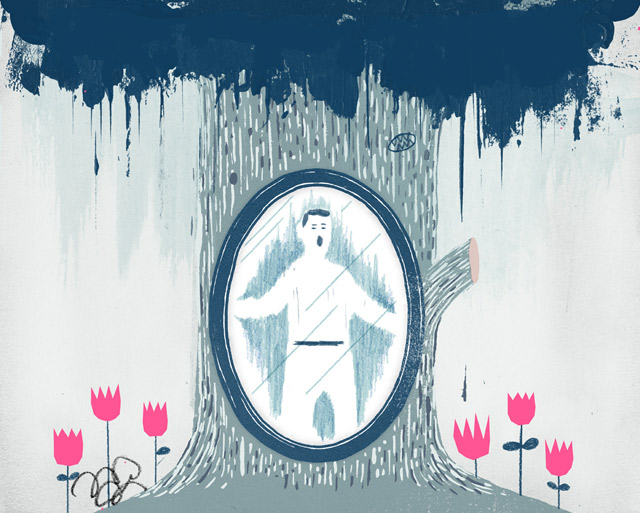
“Swift, Brutal Retaliation” by Megan McCarron was published at Tor.com and was nominated for a 2013 Nebula Award.

A few years ago, one of my college-composition students read the Christian inspirational novel, The Shack. In the book, a man receives a letter from God. I asked what seemed like a reasonable question: “Where was the letter from? What city was on the postmark?” The student just shook her head. For her, and for the book apparently, details like that were besides the point.

But for a writer, details are exactly the point. (For theologians as well. For instance, did Adam have a belly button? The answer matters more than you might expect.)

Meghan McCarron embraces this sort of mystifying detail in her story, “Swift, Brutal Retaliation.” You can read the Nebula Award-nominated novelette here at Tor.com.

How the Story Works

McCarron uses a classic ghost-story concept: Look into a mirror and see someone else’s face. It’s an easy way to move a ghost into a story. But once you have a ghost, what do you do with it? The answer depends on the sort of world the ghost has entered. In the novel The Shack, the world is one that God enters easily, where obvious questions such as   “Where did this letter come from?” are never asked. The world of that novel isn’t the world we live in. But what if it was? Part of the beauty of “Swift, Brutal Retaliation” is that it takes one of the oldest sci-fi/fantasy premises and adapts it to a contemporary world. As a result, the fantastical elements almost become realistic. Here are a few examples of the details that McCarron shows us:

  • “Sinead carried a thermometer and a compass, which the internet had told her were useful for detecting paranormal presences.”
  • “Sinead remembered reading somewhere, or maybe seeing in a movie, that you had to ask ghosts what they wanted.”
  • The ghost, when still alive, loved Facebook, and so his sister logged on and typed, “Ian, r u haunting the house?”

The world that McCarron creates—and that the ghost inhabits—becomes almost tangible. We, the readers, believe this place exists because we can see it in such sharp focus. As a result, when the ghost becomes angry, its fury and frustration are manifested in ways that now seem highly plausible—lasagna, hair-removal liquid. We’ve bought into the world, and now we’re scared when it becomes dangerous.

The Writing Exercise

In some ways, this story answers the age-old question, “What would you do if you saw a ghost?” The question has many possible answers, but the sisters’ responses are not limitless because they are shaped both by their personalities and by their world. So, for this exercise, let’s create a premise and a world.

  1. Choose an unusual premise. Ideally, you’ll pick something fun, something you’ve always wanted to write about: zombies, vampires, ghosts, magic, any one of a thousand sci-fi/fantasy/superhero/whatever premises. 
  2. Now, choose a specific place. It could be your living room. Or whatever is outside your window. Or it could be place in town that you know well. It could even be imagined.
  3. Fill the place with things: silverware, a piano, a fire hydrant, a church pew, a filing cabinet. Give yourself plenty of objects to use later.
  4. Put people in the place—main characters, anonymous faces, it doesn’t matter.
  5. Now, wind the premise like a toy and watch it run. Imagine a scene: If someone has otherworldly powers, how do those powers affect the things you’ve given yourself? If someone must react to a character with otherworldly powers, how are the things used as protection/weapons or for cover? Play around with the premise and things. In other words, do the ghosts use Facebook?

Have fun.

Setting Up A Scene

9 Feb
A Memory of Light is the final novel of the bestselling Wheel of Time series.

A Memory of Light is the final novel of the #1 bestselling Wheel of Time series.

Fantasy doesn’t have the greatest reputation among literary writers–despite the efforts of crossover authors like Neil Gaiman, China Mieville, and Ursula K. Le Guin. While it’s true that fantasy novels—and many novels of all genres, including literary—often contain cringe-worthy sentences, that doesn’t mean they’re not well written. Case in point: The Wheel of Time series by Robert Jordan (completed by Brandon Sanderson). The fourteenth and final installment of the series, A Memory of Light, was released in January and spent weeks atop the bestseller lists. Certainly, the series boasts its share of amusing lines. But the latest book also kept me awake long past my bedtime, which was good because, at 909 pages, it took me a while to get through it.

How the Novel Works

Ironically, such a long book requires a great deal of telling. The cliche in writing is “show, don’t tell,” but in a series with hundreds of characters, a map full of countries and armies, and countless scheming factions within factions, showing everything would take a thousand books. Even the most dedicated reader would give up out of boredom. As it is, the novel’s compression of certain facts—the way it tells the reader what is happening—actually heightens the tension.

Here is a passage from A Memory of Light that illustrates effective telling. Notice how quickly the writer sums up a huge amount of information: a battle spread across a huge city:

“If there was human resistance anywhere in the city, it would be the Palace. Unfortunately, fists of Trollocs roved the area between Talmanes’ position and the Palace. They kept running across the monsters and getting drawn into fights.

Talmanes couldn’t find out if, indeed, there was resistance above without getting there. That meant leading his men up toward the Palace, fighting all the way, and leaving himself open to being cut off from behind if one of those roving groups worked around behind him. There was nothing for it, though. He needed to find out what—if anything—remained of the Palace defense. From there, he could strike further into the city and try to get the dragons.”

How does the writer condense a sprawling scene into two short paragraphs?

  • The first sentence sets the stakes. Yes, there’s a battle involving tens of thousands, but it all boils down to a simple statement: If anyone is left to fight back, they’ll be in one particular place, the Palace.
  • The next two sentences locate the Palace within the two sides of the battle, the main character’s men and the monsters.
  • The next paragraph explains the consequences of the previous three sentences: the character’s men will have to fight their way to the Palace, which means likely being surrounded by monsters. The reader has been given something to look forward to: an all-or-nothing race to safety.

Because the huge tapestry of a scene is boiled down so neatly, the writer is able to quickly move in subsequent paragraphs to the particular drama of Talmanes’ quest without constantly reminding the reader of what is going on around him. In other words, the novel gets the requisite info out of the way so that the story can begin.

The Writing Exercise

  1. Choose a scene that you have already written.
  2. Strip the scene of everything but dialogue and action sentences. (You’ll likely want to cut and paste the rest into a separate document so that you don’t lose anything.)
  3. Read what remains on the page and answer this question: What does the reader need to know in order for this scene to move as quickly and effectively as possible? In other words, what would you need to tell the reader up front so that you could avoid slowing down the dialogue and action with detail. Make a list of everything the reader must know.
  4. Write a paragraph or two that will preface the scene. Use the paragraph to tell the readers what they need to know—to set the scene. Be concise. Keep in mind your list and focus every sentence on delivering necessary information.
  5. Now that the scene is set, you can return to the dialogue and action and add in any details necessary to heighten the mood or tension or to adjust the speed of the narrative.

As you work with this exercise, you may find that telling the reader the right information up front makes the scene that follows easier to write.

Good luck.