Archive | Setting the Stakes RSS feed for this section

How to Capture an Entire Society

21 Apr
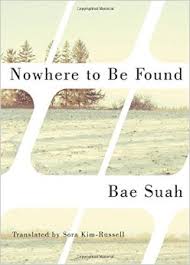
Nowhere to Be Found by Bae Suah tells the story of a young woman trying to make sense of her life and world in South Korea.

Nowhere to Be Found by Bae Suah tells the story of a young woman trying to make sense of her life and world in South Korea.

Some stories are about individuals, and the drama between them is so intense that the backdrop could be the Death Star or a blank wall and it wouldn’t matter. In other stories, the backdrop matters. Take it away, and the story vanishes. Whether the story is about a society as a whole or a particular town or neighborhood, the challenge is to establish the backdrop as quickly as you’d establish a character. This is, of course, not easy.

One story that shows how it can be done is Bae Suah’s novella Nowhere to Be Found. It was originally published in 1998 in Korean and was recently translated into English by Sora Kim-Russell and published in the United States. You can read the opening pages here.

How the Novella Works

Here is how the novella begins:

In 1988 I was temping at a university in Gyeonggi Province.

Mostly what I did there was send lecture requests to part-time instructors, make adjustments to their class schedules, mail them their paystubs, and field complaints from students. As far as the work went, I didn’t have any major complaints of my own. It was the kind of clerical work that anyone could have done without any special qualifications or expertise.

Many readers will likely be familiar with the tedium of such work and also the way it was done:

At this job we could chew gum or do our nails while answering the phones and take over two hours to type even the sparest syllabus. We weren’t lazy or indifferent or anything. It was just the nature of the work…I didn’t have too many tasks, but I also wasn’t so idle that I could have passed the time knitting. When I was working, the hours went by at what I can only call a measured pace.

Another writer might have dug into the absurdities that are intrinsic in such work, but Bae has something different in mind:

We got a month off while classes were out of session. I spent that month working part-time in a dye factory close to my house. My job was to screw caps onto tubes of dye using a mechanical device. That was a long time ago. I’m sure that dye factory has since found a more modern solution to that primitive final step of production. But then again, if they had modernized any earlier, I wouldn’t have spent that summer wrapped in the suffocating smell of acrylics.

Bae is up to something larger than the story of a single person stuck in a soul-killing job. The novella’s target is 1980s-era South Korean society as a whole, and, as you might expect given the nature of the work, there is some large, inhuman imagery:

“That’s how things get done, just as the less delicate components of a machine submit to the will of the machine without any conscious thought or shred of volition while being ground down.”

What makes this novella bold and interesting is that it finds perverse ways of bringing the machinery of society to bear on the components. Here is a great example from early on:

Even now I think maybe my family is just a random collection of people I knew long ago and will never happen upon again, and people I don’t know yet but will meet by chance one day.

These are recurrent themes in the novella: larger, impersonal forces and disconnection. They’re powerful and interesting, and yet they have the potential to lose their power as soon as the reader becomes used to them. And so Bae introduces the novella’s first dialogue, between the narrator and a “guest lecturer on criminal sociology”:

“This week’s topic is murder.”

“Oh.”

When I was an undergrad, one of my literature professors made fun of 1920s political poetry, with its predictable imagery of downtrodden masses and greedy capitalists. This novella is different because it so often jolts the readers out of their expectations—causing them to lean forward to really pay attention and setting them up to be smacked down by the societal machinery all over again. Nowhere to Be Found manages to replay that cycle—beat-down, jolt, beat-down, jolt—for 100 pages. It’s an impressive feat.

The Writing Exercise

Let’s try writing about society (without becoming predictable) using Nowhere to Be Found by Bae Suah as a model:

  1. Create a machine for the society. Another way to put this is this: Create a metaphor. In Nowhere to Be Found, the jobs are clearly representative of the society as a whole. The jobs are noteworthy because of how they reveal the mechanics of the society. While you can create a metaphor by thinking, “I’m going to create a metaphor now,” you can also approach the task from another angle. Try finishing this sentence, “When I think about (the place), I immediately think of _____.” Trust your imagination to fill in the blank with a job or hobby or whatever. Don’t worry about if it’s a good metaphor. If it’s an essential part of the place—not to everyone but to you—it will eventually take on the role of a metaphor.
  2. Acknowledge the machinery. In other words, give the narrator or characters some awareness of the situation. (Without that awareness, you risk writing a morality play.) There are different levels of acknowledgment. The highest level requires a statement like this: “The whole society was about _____.” While this is possible (Bae writes sentences like this), it’s also difficult to pull off. It’s often more manageable to let the characters think practically about their immediate surroundings, as the narrator does in this sentence: “It was just the nature of the work…” Try using that word, nature. Let the character ponder or make a statement about the nature of whatever surrounds her. You may find yourself working up the scale to the nature of the society as a whole. Or, you won’t. Stop when the writing begins to crumble under its own weight.
  3. Give the characters agency. Part of the reason that Albert Camus’ The Stranger is so powerful is that the narrator acts. He chooses to do things. The motive behind those actions isn’t always clear, but the action is dramatic. This is an important lesson to remember: even if characters are just floating along, they need to occasionally act as if they have some control over themselves. (In The Stranger, the narrator chooses to help set up his friend’s girlfriend for a cruel joke.) In Nowhere to Be Found, some of the moments of highest tension occur when the narrator behaves in ways that grind against the machinery she’s caught in. A good rule of thumb is this: When a scene feels like it’s about to end on a down note, keep writing. What if the character suddenly pushed back and refused to accept that down note? What would happen then?
  4. Reveal the machine at work in a surprising way. Machinery tends to work on several levels: the obvious one and the less obvious one. In Bae’s novella, the machinery is the economics of South Korea: the way that low-paid, tedious work turns people into laborers and into automatons. In other words, the machine is exterior to people. What’s surprising is when Bae makes the machinery interior as well, as in the passage about family members seeming like random people. Don’t create an impermeable wall between a character’s interior and exterior. How can her thoughts or actions reveal the presence of the forces she tries to resist?
  5. Throw a wrench into machine. Make the readers believe that the machine can be broken or that it’s possible to step outside of it for a period. Again, there are obvious and less obvious ways to do this. There’s the V for Vendetta method: bomb Parliament. Then, there’s the Nowhere to Be Found method: introduce a wild card: “This week’s topic is murder.” These wild cards don’t need to become part of the plot, they only need to throw askew the reader’s expectations. No society is totally flat. Every place contains pockets of unexpected absurdity or evil or goodness. Create those pockets in your story. How can you introduce a character, even momentarily, who is working not against the system but on a different plane altogether? He or she may still be part of it, but the level of acknowledgement or the choices he makes are different and upend our perhaps simplified ideas of the place.

Good luck.

How to Use an Omniscient Narrator

14 Apr

Ru Freeman's novel On Sal Mal Lane "soars [with] its sensory beauty, language and humor," according to a New York Times review.

Ru Freeman’s novel On Sal Mal Lane “soars [with] its sensory beauty, language and humor,” according to a New York Times review.

One of the most tempting points of view for a novel is the omniscient, godlike POV. It’s also, perhaps, the most difficult to pull off. The literary critic James Wood has called it almost impossible. Yet, it’s also the case that certain stories require a narrator who exists on a different plane than the characters, who can focus on a few of them for a while but can also speak authoritatively about very large groups of them (entire countries, even).

Not many novels actually attempt an omniscient point of view. One that does is Ru Freeman’s On Sal Mal Lane. It was published by Graywolf, and you can read an excerpt at that its website.

How the Novel Works

The novel is set in Sri Lanka, just before its recent civil war. Such a premise poses a particular challenge: the novel must focus on a few people who are affected by the war and also explain the origins, politics, and geography of the war. This can be difficult for any war but is especially difficult for a war that most Americans know little about. That ignorance is important because the novel is not a translation. Freeman was born in Sri Lanka but lives primarily in the U.S. and writes in English; the novel was published by an American independent press. So, how does Freeman convey the basic outline of the war? With an opening worthy of Star Wars.

As everyone knows, Star Wars begins with a two-paragraph intro that scrolls up the screen, prefaced, famously, with the line, “A long time ago in a galaxy far, far away…” Just as the text that followed laid out the basics of the war (who is fighting, what’s at stake, and one of the characters), the opening paragraphs of On Sal Mal Lane lay out the basics of Sri Lanka’s civil war. The problem, though, is that a novel is not like a film, or, at least a literary novel is not like a B movie (which Star Wars absolutely was). If the voice that opens the novel vanished suddenly like the text that opens Star Wars, the reader might close it and walk away. It would be like a film changing from color to black and white, which can be done, but only under very special circumstances. Rather than risking that readers might not make the jump, the novel creates a narrator that can handle both the large scale of the war and the small scale of a few characters affected by it.

Of course, many readers will encounter that narrative voice and quite naturally ask, “Who is telling this story?” So, the novel provides an answer:

And who, you might ask, am I? I am nothing more than the air that passed through these homes, lingering in the verandas where husbands and wives revisited their days and examined their prospects in comparison to those of their neighbors. I am the road itself…

This self-identification goes on for a bit and ends this way:

To tell a story about divergent lives, the storyteller must be everything and nothing. I am that.

You can’t state the problem and solution more neatly than that. Now, how does such a voice operate, on a practical level?

Mostly, it follows different groups of characters, with each getting their own sections in the novel. In these sections, characters will be spoken about as groups (an entire family, for instance) and as individuals. But the voice will occasionally speak about things in general, as it does here:

God was not responsible for what came to pass. People said it was karma, punishment in this life for past sins, fate. People said that no beauty was permitted in the world without some accompanying darkness to balance it out, and, surely, these children were beautiful. But what people said was unimportant; what befell them befell us all.

So, it operates by speaking in a kind of godlike voice but also, quickly, zooming down to a more human perspective—a perspective that we’re more comfortable with, being, as we are, humans and not gods.

The Writing Exercise

Let’s try writing from an omniscient point of view,  using On Sal Mal Lane by Ru Freeman as a model:

  1. Create a reason for such a point of view. The reason should be practical: what about your novel cannot be conveyed by a narrator with a limited point of view? Freeman’s reason is the complexity of explaining the context and development of a civil war. Your reason may be similarly political. Does the novel’s conflict involve parties larger than a single person or handful of individuals? Does it involve groups and national or international politics or movement (like migration)? Does writing the book require the occasional use of a kind of professorial or journalistic mode? If so, you might need an omniscient narrator.
  2. Identify the registers the narrative voice must hit. What is the range the voice must cover? Every novel (at least every one that I can think of) follows individual characters. But what is the opposite end of the spectrum? To use the language of film, how far out must the camera move? Will the voice talk about a community as a whole? About a region or country? About the entire world? The universe? The range doesn’t really matter; the important thing is to know in advance how much ground you must cover.
  3. Identify the voice. This may be the trickiest part. Freeman writes that the voice is the wind and the road (in other words, the world itself and also the people as a whole). Some reviewers have found this identification awkward. You can probably imagine how such a move would be met in workshop: “How can the wind talk?” But the move is probably also necessary. Without the identification, the same reviewers might ask, “Who is telling this story?” There’s no perfect solution. The short passage about the narrator’s identity is a bit like the scene from the original Rocky, when Apollo Creed is choosing his challenger, eventually picking Rocky Balboa. It’s the most contrived part of the film, a scene where the mechanics are laid out in the open, and yet it’s necessary because, without it, Rocky will keep collecting debts and will never meet Apollo. In short, without that scene, one of the most iconic American films of all time doesn’t exist. In the same way, without the passage about the narrator’s identity, Freeman’s great novel might not have come together. So, think about the identity of your narrator. Is it God? Is it some manifestation of the world? If so, what manifestation would make sense for your novel’s particular world?
  4. Write from the broadest register. What is the grandest, largest scale the voice can manage? Think about the Book of Genesis: “In the beginning when God created the heavens and the earth…” Or think about Star Wars: “A long time ago in a galaxy far, far away…” How can you craft a voice that is vast enough to make such statements?
  5. Transition to a more narrow register. Unlike Star Wars, a novel must make this transition as smooth as possible. This is where Freeman’s novel really shines. In two sentences, she moves from “God was not responsible for what came to pass” to “surely, these children were beautiful.” The first part is vast and the second is beginning to focus on specific characters: these children. Freeman links the two with a single world: surely. It’s not a causal connection but a logical one. Here’s the full sentence: “People said that no beauty was permitted in the world without some accompanying darkness to balance it out, and, surely, these children were beautiful.” Basically, the sentence says, “Beauty exists in the world, and these children are beautiful.” It’s moving from a general statement to an illustration of the statement. This is a great way to transition. Make a general statement and then illustrate it: “and here they are.”

Good luck. Take risks. Have fun with the exercise.

How to Write Self-Conscious Prose

7 Apr
Jaime Netzer's story, "How to Die," appeared in Black Warrior Review and was reprinted in LitRagger.

Jaime Netzer’s story, “How to Die,” appeared in Black Warrior Review and was reprinted in Litragger.

It’s been said that every writer secretly wishes to be a musician—on stage, performing before a crowd. The experience is very different from the life of a writer, working alone in a room and being read by people who are far removed in other rooms. Yet the idea of performance has a place in writing. In fact, when it comes to first-person narration, a writer’s voice often becomes a consciously public act. You can see this clearly in Tim O’Brien’s masterpiece, The Things They Carried, in stories like “How to Tell a True War Story,” when the narrator says things like, “This one does it for me. I’ve told it before—many times many versions—but here’s what actually happened.” The narrator is performing for his audience, and the effect is powerful; as a reader, you can feel yourself leaning forward into the prose.

This is the same strategy used (to the same effect) by Jaime Netzer in her story, “How to Die,” which was published recently in Black Warrior Review and reprinted at Litragger, where you can read it now.

How the Story Works

The writer’s performance begins with the title: “How to Die.” It’s a particular kind of title (a How to) that has become almost a genre in itself. Tim O’Brien has written a version, and Lorrie Moore has written several. The genre often employs a second-person narration (You do this, you do that), and even in first-person stories, you tends to pop up a lot. It’s the nature of the story, not unlike when you were assigned to stand in front of a middle school classroom and deliver a demonstration: how to make a peanut butter and jelly sandwich or how to give someone a buzz cut (at least that’s the speech that I gave). It’s a story that’s difficult to tell without directly engaging the audience. That engagement is an inevitable part of the story’s voice, as you can see in the first two paragraphs of “How to Die.”

Everybody knows this, but, die young. I look around at my fellow contestants and start to smirk. I’m only twenty, won’t even be drinking legal for months and months. I can see them peering at me, thinking thoughts they don’t realize are petty and unflattering, thinking, for example, why would little One-Eye want to win her own death?

But they’re here, too. We aren’t any different. Except I have a better story.

In the first sentence, the narrator is speaking directly to us. She doesn’t say “you,” but it’s understood who “die young” refers to. The narrator is also self-conscious in her performance. She’s aware of the effect she is trying to make and is delivering a spiel that feels rehearsed, if not in front of an actual audience, then to herself in her head.

The entire story is about performance. The narrator is auditioning for a reality show in which the contestants are competing to receive a show-assisted suicide at centerfield of Arrowhead Stadium in Kansas City. They “win” by being both sexy and appealing and also miserable enough to want to die. The very nature of this premise requires the characters to put on an act and to think about how best to put on that act. This is why the narrator says things like, “Die sexy,” and “Die while you’re still sharp, smart, with it. Don’t let them pull one over on you.” She is calibrating her performance for the audience but also calibrating her own ideas for how to live, which is the subject of most fiction—how to be in the world.

What Netzer has done, then, is create a narrator who feels compelled to tell her audience how to be in her particular world—in the immediate, reality-show sense and in the broader, 20-year-old-in-America sense. It’s this voice telling us how to be that pulls us into and through the story, not the premise, as outlandish and engaging as it is.

The Writing Exercise

Let’s write narration that tells the reader how to be, using “How to Die” by Jaime Netzer as a model:

  1. Create a narrator with something to say. In real life, we have obsessions that feel the need to explain to people: what it means to grow up in _____ or what it’s like to be _____ or do _____. Sometimes these obsessions center around traumatic or elevated experiences (going to war or encountering racism or sexism), but just as often these obsessions involve nuances that most people probably overlook but which are important to us. For this exercise, try giving your obsession(s) to a narrator. Or, if you’re a born fiction writer, create a character with an obsession that he/she feels compelled to explain. Obsession, of course, can mean something unusual (licking lamp posts) or something quotidian (how to die).
  2. Give the narrator a reason to explain the obsession. Most of us don’t need much of an excuse to talk about the things that preoccupy our minds. But, as an audience, we’re more receptive to those thoughts if there’s some reason for us to listen. This is the difference between wanting to listen to someone rant or lecture and wanting to run away. The reason doesn’t need to be something huge. Mostly, it needs to be dramatic. In Lorrie Moore’s story “How to Be an Other Woman,” the reason we listen is because we can’t help but want to know about affairs. So, rather than wringing your hands over that age-old workshop question, “Why is the narrator telling us this?” instead ask yourself, “What is the story or dramatic action that has prompted the narrator to start talking?” Give your character a story to talk about—not just an obsession to talk about.
  3. Shake the character. In a story like this, the narrative arc takes a toll on the narrative voice. In other words, the narrator has changed by the story’s end and that change is evident in how he or she talks. Often, this means undermining the narrator’s certainty about the world he or she is narrating—making the narrator vulnerable. For all her bluster about how to die and how to appeal to a reality-show audience, the narrator in “How to Die” doesn’t end up quite where she expected, in part because she did not anticipate something essential about her world. When that unanticipated thing arrives, her voice is shaken. So, in your story, find a way to introduce an element that will shake the narrator. If the voice talks as if it knows everything, introduce something that it does not know.

Good luck.

Why a Story Should Show Its Dramatic Elements Twice

31 Mar
Nicole Haroutunian's story, "Youse," was published at The Literarian and is included in her debut collection, Speed Dreaming.

Nicole Haroutunian’s story, “Youse,” was published at The Literarian and is included in her debut collection, Speed Dreaming.

When working on plot, we tend to think in terms of major scenes: singular moments of tension and drama when significant character traits are revealed. That’s the idea, anyway. When we actually write these moments, we often discover that we’re burdening them with too much expectation. A scene can only do so much work, and that’s why it’s often a good idea to write a scene into your story twice. It gives you twice as much dramatic space to work within and, thus, the potential to reveal a lot more about a character.

A great example of showing a scene twice can be found in Nicole Haroutunian’s story, “Youse.” It is included in her debut collection, Speed Dreaming, and was published at The Literarian, where you can read it now.

How the Story Works

Showing moments twice in a story gives you the opportunity to create parallels. In life, we tend to see something and then react when we see it again because the first experience has stayed with us. In fiction, letting this happen gives characters a chance to reveal more complex sides of themselves. It also provides a sense of depth of vision. The statue of liberty, for instance, might look small if shown by itself, but when a tourist is standing in front of it, you perceive its actual size. The same can be true for stories.

Haroutunian’s story contains two scenes with the same bronze SUV. The first time it appears, the main character, Rae, is walking home from school with her friend, Joanna:

The man inside yells, “How about youse sit on my dick?”

That’s the end of it. The man drives off. What’s more important is the girls’ reactions:

“Did he say ‘youse’?” Rae asks, shuddering.

Joanna rubs her arms as if she’s showering. “Dirty,” she says. “Bad grammar makes me feel dirty.”

“I bet he’s married,” Rae says. “My dad never believes me when I say that men do that. He can’t conceive of it.”

The scene ends with this bit of foreshadowing:

“Next time that dude drives by,” Joanna says, “let’s make sure he knows that one of us is a pro.”

Of course, this means we’re expecting the dude to drive by again, and, of course, he does (it’d be a tremendous missed opportunity if he didn’t). It begins in the same way:

Then the bronze SUV—the same one, it has to be—is slowing down beside them. They hear a familiar voice. “How about youse…” he starts.

The scene diverges from the first one in how the girls react:

Rae does not want to hear the rest of his sentence. “How about we fucking kill you?” she yells, kicking her foot in the direction of the car.

“I’m going to scream,” Joanna murmurs. “Let’s scream.”

“No,” Rae says, walking faster. “We’ll get in trouble if someone comes. He just wants attention—he’s full of shit.”

This reaction prompts a response from the man in the SUV:

“What are you going to do?” the guy asks, keeping pace with them. His voice is deep and mean; he’s also dropped the “youse.”

And this is how the scene ends:

Joanna grabs for Rae’s wrist and starts off toward someone’s yard. Rae leans back in opposition. Their tug of war paralyzes them in place. It’s not that she’s being stubborn by not changing course—the yard is full of shrubs, shrubs she can picture lying dead in.

He rolls down the window a little farther. No one is moving.

“I can see you,” Rae says, although she can’t. “We know what you look like.”

He says, “Oh yeah?” in this threatening way, like there’s more he has to say, but before he does, he pops open the passenger door. It swings so close it almost hits them.

Then they’re running.

It’s pretty clear how much this scene appearance of the SUV adds to the story. The first time it rolls up, the girls react the way anyone would: with surprise. It’d be unbelievable if they had the wherewithal to respond to the man in any meaningful way; few people have that kind of presence of mind. So, by reintroducing the SUV later, it gives the girls a chance to respond in almost premeditated way—in a way that reflects some essential thing about their characters. Because those essential things aren’t necessarily compatible with most people’s deeply embedded desire to avoid confrontation, their responses increase the dramatic tension.

On their own, these scenes don’t carry a ton of weight—though they’re certainly compelling. It’s when they’re put into the larger context of the story that they become truly interesting.

The Writing Exercise

Let’s write a scene twice using “Youse” by Nicole Haroutunian as a model:

  1. Write a short scene that interrupts the thread of the story. Fiction is often structured around routine; drama comes from the interruption of that routine. The routine can along the lines of “Everyday Joe read the paper at his favorite coffee shop until one day.” Or it can be the sort of routine that Haroutunian uses. The story begins with two high school girls talking and quick, awkward sexual encounter—pretty common high school behavior. Then the SUV rolls up. So, think about a story that you’re already writing or that you’ve written but which seems incomplete. Find a way to interrupt whatever routine the story has established. Here’s the catch: the interruption doesn’t need to seem significant at first. In “Youse,” the SUV drives away as quickly as it appeared. It’s only when it returns that it really impacts the story. So, don’t make too much of your interruption; just be sure it’s something that can be repeated in some way.
  2. End the scene with foreshadowing. This doesn’t need to be subtle. In “Youse,” the character says, “Next time that dude drives by…” The difference between that phrase and “Wow! Wasn’t that weird?” is the difference between the scene ending with no impact and ending with a bit of resonance that carries forward into the story.
  3. Write the scene again. This time, let your characters respond in a more thoughtful way. This is similar to those moments we all experience, when something happens and we think of the right thing to say only after the moment has ended. In your story, you’re basically giving your characters the chance to react the way that they wished they’d reacted the first time. The nature of this reaction will depend on the kind of story you’re writing and the context for the scene.
  4. Don’t put too much pressure on the scene. It’s no accident that “Youse” doesn’t end with the second appearance of the SUV. Instead, the story continues on, with the emotional impact of the scene carrying forward into what the story is really about—Rae’s relationship with her mom, in the aftermath of her father’s untimely death. So, don’t make your entire story about the scene. Simply use it as a way to provide depth of vision for the part of the story that is foregrounded.

Good luck.

How to Write Energetic Character Descriptions

24 Mar
Chinua Achebe's novel Things Fall Apart remains a staple of the World Literature canon, though it reads as contemporary as any fiction written today.

Chinua Achebe’s novel Things Fall Apart remains a staple of the World Literature canon, though it reads as contemporary as any fiction written today.

The great Nigerian writer Chinua Achebe died two years ago, but he was given a second passing a few days ago when The New York Times’ Twitter post announcing his death was somehow reposted. A lot of people were fooled, but it was a good opportunity to remember how great a writer Achebe truly was. It’s astounding at how contemporary and fresh the writing in his novel Things Fall Apart remains, despite having been written half a world away and fifty years ago. In particular, the character descriptions have a vitality to them that any writer today would be lucky to emulate.

The American writer James Baldwin felt the same way. Achebe was an admirer of his, and here is Achebe writing about the day they finally met:

What he said about my novel Things Fall Apart was quite extraordinary. He read it in France, he said. It was about people and customs of which he knew nothing. But reading it, he recognized everybody: “That man, Okonkwo, is my father. How he got over, I don’t know, but he did.”

Here the opening chapter of Things Falls Apart.

How the Novel Works

In the following passage, Achebe is describing his main character, Okonkwo, a man who gained fame for a fight with an undefeated fighter nicknamed The Cat. Notice how much time the descriptions spans and how active it is.

Every nerve and every muscle stood out on their arms, on their backs and their thighs, and one almost heard them stretching to breaking point. In the end, Okonkwo threw the Cat. That was many years ago, twenty years or more, and during this time Okonkwo’s fame had grown like a bush-fire in the harmattan. He was tall and huge, and his bushy eyebrows and wide nose gave him a very severe look.

He breathed heavily, and it was said that, when he slept, his wives and children in their houses could hear him breathe. When he walked, his heels hardly touched the ground and he seemed to walk on springs, as if he was going to pounce on somebody. And he did pounce on people quite often. He had a slight stammer and whenever he was angry and could not get his words out quickly enough, he would use his fists. He had no patience with unsuccessful men. He had had no patience with his father.

It’s startling how much Achebe packs into this description. It starts with a fight, moves to a physical description that focuses on eyebrows, of all things, and then moves to breathing, the way he walked, the way he talked, and his relationship with his father. It’s an incredible jumble of information that makes absolute sense. So, how does Achebe pull it off?

The description depends so much upon the fight, those nerves and muscles stretched to a breaking point. This is a man of not only strength but also intense drive, and those ideas (the high energy of a fighter in action) carry the description forward: bushy eyebrows, heavy breathing, walking on springs, stammering, fighting, and finally lack of patience with people he viewed as lesser than him, especially his father. By establishing Okonkwo’s fighting ability, Achebe created a way to think about every part of the character’s personality and life.

The Writing Exercise

Let’s write an active character description using Things Fall Apart by Chinua Achebe as a model:

  1. Establish the character in action. It’s tempting to describe a character as a portrait, with as much action as a still-life painting of flowers. But people are rarely still, and, in writing as in life, we tend to learn about characters and people by what they do, how they encounter the world and its obstacles. So, choose a moment where your character is struggling with something. It can be another person, as in Okonkwo’s fight, or it can be an inanimate object: a lunch box or a seat belt. Think about how people act when stuck in traffic. Do they bang on the steering wheel? Sit back and sigh? Pull out their phone? Before painting a picture of the character in repose, show us the character in action.
  2. Distill that action to a phrase or image. Okonkwo’s taut and stretched muscles serve as a kind of guiding post for the rest of the description. How can you do something similar with your character? Think of the character stuck in traffic. Is she leaned forward or back? Is her jaw clenched or does she turn on the radio and close on eye? Does she text furiously? Scroll through Twitter casually? Use the adjectives or adverbs as an opportunity for repetition.
  3. Carry the idea of the phrase or image forward. Try to repeat the adjective or adverb without literally repeating it. You’re trying to find other ways to suggest the idea of those adjectives or adverbs. So, it’s no accident that Okonkwo’s eyebrows are bushy. Bushy fits better with the idea of taught muscles than thin. And, it’s no accident that he breathes loudly. It would be weird for him to be exaggerated in one sense and quiet and invisible in another sense (or, it might work, but it would be a contrast that would need to be suggested and created). So, think about every aspect of the character and try to convey the same adjective or adverb that you established in the initial moment of action.

Good luck.

How to Write Complex Characters

17 Mar
D Watkins' essay, "Too Poor for Pop Culture," examines the reach—or lack of—of popular media into East Baltimore.

D Watkins’ essay, “Too Poor for Pop Culture,” examines the reach—or lack of—of popular media into East Baltimore.

In fiction and essays, it’s tempting to write about characters and people so that they’re merely vehicles for a larger point. The piece begins to feel like an allegory or morality play: See how tragic these poor people’s lives are? See how awful these rich people are? See how mundane these suburban lives are? Categorization is often the enemy of good writing. Think of all the novels and films with smiling, dopey Midwesterners or rude New Yorkers. And, of course, when it comes to race and ethnicity, categorization leads to the flattening effect of the oldest stereotypes in our culture. These caricatures may seem familiar and right to us, but they’re inevitably too simple, and the story or essay, as a whole, suffers. So, how do we write more complex characters?

One answer: give the characters and people in your fiction and essays a chance to be as smart and funny. Don’t let the work become a monologue by you, the author. Instead, let the characters and people speak for themselves. A great example of this strategy is D Watkins’ essay, “Too Poor for Pop Culture.” It was published at Salon, where it became on of the most-read pieces on the Internet in 2014. You can read it here.

How the Story Works

The title of Watkins’ essays sums up its point pretty clearly: some communities do not have access to the media (24-hour news, Twitter, Facebook) that most of us take for granted. It’s an interesting, complex argument that carries with it the risk of oversimplification. The essay’s setting is East Baltimore, a neighborhood made visible to national audience by the HBO series The Wire. In other words, it’s a neighborhood and a community that many of us think we know, either from TV or from general ideas about black, inner-city poverty. Given those expectations, look how the essay begins:

Miss Sheryl, Dontay, Bucket-Head and I compiled our loose change for a fifth of vodka. I’m the only driver, so I went to get it. On the way back I laughed at the local radio stations going on and on and on, still buzzing about Obama taking a selfie at Nelson Mandela’s funeral. Who cares?

No really, who? Especially since the funeral was weeks ago.

The dynamics at work are immediately clear: national media trends versus the isolation and segregation of inner-city poverty. See how quickly I’m able to sum up those first sentences? The essay could work at the level of the categories I just created and still make its point. Yet something would be lost, and that something would be the people at the heart of the essay. These people (Miss Sheryl, Dontay, and Bucket-Head) are not characters whose lives stop at the end of the page. They don’t exist just for readers to learn about poverty. If the essay proceeded from the general categories I created, those lives would be reduced. But that’s not what Watkins does. Instead, he moves back and forth between broad categories and the idiosyncratic and personal.

Here is an example of categorization:

Two taps on the door, it opened and the gang was all there — four disenfranchised African-Americans posted up in a 9 x 11 prison-size tenement, one of those spots where you enter the front door, take a half-step and land in the yard. I call us disenfranchised, because Obama’s selfie with some random lady or the whole selfie movement in general is more important than us and the conditions where we dwell.

Note the terms and phrases he uses: “disenfranchised” and “one of those spots.” It’s a language that plays into expectation, that assumes the reader knows something already about these people.

Now, here is how Watkins moves away from the general and toward the personal:

“A yo, Michelle was gonna beat on Barack for taking dat selfie with dat chick at the Mandela wake! Whateva da fuk a selfie is! What’s a selfie, some type of bailout?” yelled Dontay from the kitchen, dumping Utz chips into a cracked flowery bowl. I was placing cubes into all of our cups and equally distributing the vodka like, “Some for you and some for you …”

“What the fuck is a selfie?” said Miss Sheryl.

“When a stupid person with a smartphone flicks themselves and looks at it,” I said to the room. She replied with a raised eyebrow, “Oh?”

Imagine how John Steinbeck might have written this scene, the kind of plodding march he would have made toward the thematic conclusion. You can’t miss the point in any of Steinbeck’s writing or in any number of political speeches. And you can’t miss the point here, either. But the essay also allows the people at its heart to participate in the discussion. They aren’t dumb puppets in a morality play. They’re actively engaging with the information they have and seeking out answers. Another writer might have left out the line, “What’s a selfie, some type of bailout?” because it reveals that the speaker, Dontay, a man drinking vodka in a tenement, knows about corporate bailouts. It complicates the characterization of someone who is disenfranchised. These are people with thoughts and opinions of their own—and they aren’t always predictable, as Watkins later reveals:

“Put me on that Obamacare when you can, college boy!” Sheryl says to me as I contemplate the number of books I can make out of my shitty hand. We all laugh. I am the only one in the room with the skill set to figure it out, but we all really see Obamacare as another bill and from what I hear, the website is as broke as we are. We love Barack, Michelle, their lovely daughters and his dog Bo as much as any African-American family, but not like in 2008.

Good writing should hit the mark it aims for. If it has a point, it should make it. But the writing shouldn’t make that point while honoring the complexity of the world it portrays.

The Writing Exercise

Let’s create complex characters using “Too Poor for Pop Culture” by D Watkins as a model:

  1. Summarize your point. In a story, this point is usually dramatic: where should the drama/tension stand at the end of the scene? In an essay, this point can be dramatic or thematic. Either way, it’s important to know where you’re headed. Can you sum up the conclusion or how things stand in a phrase as easy to understand as “Too Poor for Pop Culture?”
  2. Categorize the characters or people. You can use the same phrases as Watkins: I/they call us/them _____. One of those places that ______. You’re connecting the characters, and, by extension, the setting, with the knowledge or expectations that the readers bring with them.
  3. Let the characters or people speak. The power of dialogue is that it often defies generalization. People use language in surprising ways. The phrases and diction they use can make us pause, force us to pay attention. In dialogue, people and characters also tend to reveal the inner workings of their minds. We see them from the outside and develop ideas about them, but dialogue has the power to show us what we cannot see or guess at. So, give your characters the opportunity to speak for themselves. Create an opening for them to talk about what is going on, dramatically or thematically. In “Too Poor for Pop Culture,” Watkins doesn’t just show us that his friends don’t know what a selfie is. He lets them talk about how they don’t know what it is. How can you let your characters or the people in your essay talk about the thing at the heart of your writing?

Good luck.

How to Write a Quick-Starting First Paragraph

10 Mar
Bess Winter's story, "Are You Running Away?" appeared in Covered w/ Fur, the new weekly digital magazine from Austin indy press A Strange Object.

Bess Winter’s story, “Are You Running Away?” appeared in Covered w/ Fur, the new weekly digital magazine from Austin indy press A Strange Object.

Literary journals receive hundreds, sometimes thousands, of submissions every year. These submissions are read by volunteers—on the weekend, at night, when they could be reading a favorite novel or, who knows, parasailing. Imagine yourself in these volunteers’ shoes, a tall stack of submissions in front of you and an approaching deadline to complete them. As a writer, these are not the ideal conditions for appreciating your carefully crafted manuscript. But this is the world you’re sending your stories into, and so it’s important to consider the audience. What will make your story easier to read? What will catch this busy volunteer’s attention?

One answer: a quick-starting opening paragraph. One of the quickest and most interesting first paragraphs that I’ve read lately is from Bess Winter’s story, “Are You Running Away?” It was published in Covered w/ Fur, the weekly digital magazine published by Austin’s indy press A Strange Object. You can read the story here.

How the Story Works

Here is the first paragraph. Watch how quickly it kicks into gear:

Val says, fuck school. She eats another cracker. Wouldn’t it be great if school were cancelled? And I say, Yeah, it would be great. And she says, I know a way. She scrapes her shoed feet along her parents’ couch. And I say, How? And she says, There are these pipes.

In just 51 words, the story introduces two characters, a sense of their personalities and relationship, and a mystery: what are the pipes and how will they cancel school. How does the paragraph do this? By beginning with drama, not information. Think about what we’re not told: the characters’ ages, the nature of the situation, the time of day. Rather than set up the drama, the story immediately zooms in on a moment when a choice is made: Wouldn’t it be great it school were canceled? What is said next (Yeah, it would be great) might not seem like a conscious decision, it functions that way, giving Val permission to proceed. In other words, it’s sometimes not enough to simply introduce a mystery. You also need to introduce a decision that leads to that mystery (even if that decision, at the time, seems like no decision at all).

Once that mystery has been set, you can spend time re-introducing the reader to your characters: who they are, their typical behavior.

In the second paragraph of “Are You Running Away?” Winter does exactly that:

She shoves everything aside. Goldenrod, green, purple study notes. Her chem binder clicks open and the sheets slide everywhere, across the Persian rug and the hardwood and into corners of the room and up against Rolph the snoring yellow lab. She steps on the notes, leaves her dirty shoeprints on them. She doesn’t care. I love Val because she doesn’t care about anything. The first time we met, in the changing room before gym, she looked me up and down and said, Those boobs are low. I could have hated her for that, I guess, but instead I was like, who says that? And I said, Thanks! And, from then on, we were friends, even when everyone else pushed her away. Even when they asked Her? Why? and made sour faces. Later, we snuck things from the pockets of the backpacks they looped onto the outside of their lockers when they went to gym: silver bracelets, digital watches, lip gloss.

Though the paragraph is building character, it also deepens the mystery from the story’s opening. If the characters are already stealing things and acting in other socially unacceptable ways, what else will they do? If I’m a reader working my way through a slush pile, my attention has been grabbed before the end of the first page.

The Writing Exercise

Let’s start a story quickly, with drama, using “Are You Running Away?” by Bess Winter as a model:

  1. Introduce a strong desire. In Winter’s story, the desire is the nearly universal desire of so many school stories and real-life students: get out of school. In other words, the desire doesn’t need to be something we’ve never seen before. Most desires are pretty common. Why else would love stories and stories of adultery be among the oldest we possess?
  2. Introduce a plan to satisfy the desire. At the very least, a character could say, “I have a plan.” But you can do better than that. Hint at the nature of the plan. Be sly. In Winter’s story, Val mentions pipes but not what they’re for or how they might be used. If you read the story, you’ll see that the plan is pretty simple—it’s horrible and frightening, but simple, too. You don’t need something convoluted. The important thing is to tease the reader. In this case, Val also teases the narrator, who is allowed to discover the plan along with us.
  3.  Make the plan hinge on someone’s assent. Someone needs to give the plan the go-ahead. The need for this agreement or cooperation forces the character with the plan to be conniving, to try to persuade another character to go along. Without this external approval, the plan may roll out too easily, without encountering opposition or obstacles. In short, you’re making the characters act on different levels from the very beginning, and those different levels will give the story room to grow and develop.

Good luck.

How to Write Human Stories amid Cosmic Conflict

3 Mar
Anabel Graff's story, "The Prom at the End of the World," won the Prada-Feltrinelli Prize and was published in Prada Journal.

Anabel Graff’s story, “The Prom at the End of the World,” won the Prada-Feltrinelli Prize and was published in Prada Journal.

The risk in using high-concept plots for your stories is that your characters may end up as nothing more than dinosaur food. This is what happened in all of the Jurassic Park movies (and books). Who was the star? The T-Rex. The raptors. In that tense scene in the first film, when the kids are hiding from the raptors in a kitchen, the kids exist primarily to highlight the terrible power of the dinosaurs. Almost certainly, the scenes that you remember from the films involve water trembling in a glass and close-ups of inhuman eyeballs. It’s tempting to blame the thin characterizations on Michael Crichton, but the truth is that plots of apocalyptic proportions can challenge even the most literary of writers. How can we possibly pay attention to nuances of human drama when oil field workers are trying to blow up an asteroid?

A story that has figured out this problem is Anabel Graff’s “The Prom at the End of the World.” It recently won the Prada-Feltrinelli Prize (which involves a ceremony at, seriously, Prada’s headquarters in Milan) and was published in Prada Journal, where you can read it now.

How the Story Works

The story begins with two things: an asteroid hurtling toward Earth—an event that we’re immediately told will lead to either complete or near destruction—and a high school prom that is scheduled for the same day as the asteroid’s impact. It’s clear, then, what the source of tension will be. Will the story be told from the cosmic level, at the same level as that photograph of Earth taken by the Voyager 1 space probe, in which the planet appears as a small dot in the vastness of space? In other words, will the asteroid win out and dominate the story? Or, will the story be told from the level of prom, an event of pure human invention and meaning? The conflict has both human and storytelling dimensions. In life, imagine how difficult it would be to concentrate on prom as an asteroid barrels toward you. And yet, you wouldn’t cease to be human, either. This story manages to retain that humanity. It starts with a dress. The narrator has the dress but no date—or even any hope for one. And then she’s asked at the last minute:

Martin Hemley, my science partner, had ended up asking me though, a week before the prom, four days before the news announced that the end was near. “Jenny,” he had said mid throat clear, and my name emerged from his mouth coated in phlegm. “Seeing as we both don’t have a date and—

It’s the end of the world, and this is the best that the narrator can hope for. “Pick me up at seven,” she says, but here is her interior reaction:

I read online once that loneliness is physically painful. Just as you have a drive to avoid physical pain, you have a similarly powerful drive to connect with others and seek companionship—in order to avoid the pain of loneliness. I also read that when you blush, the lining of your stomach blushes too.

In that passage, Graff manages to create an impulse—the need to connect and avoid loneliness—that is more immediate and visceral than the approaching asteroid. The power of the passage is such that what comes next—after a space break—is not a reference to the asteroid as you might expect. Instead, it’s this:

Have you ever done this thing where you rub your eyes so much that when you close them you begin to see things?

The passage has dropped us so cleanly into the narrator’s head that it’s natural to stay there. We don’t need to look up at the sky. We will eventually, but our attention has been trained on the interior and not the cosmic. It’s this directing of our attention that makes the story great. Recently I was teaching a class and mentioned how I dislike stories that become such page turners that I’m skimming and skipping ahead. A student said, “But doesn’t that mean the book is good?” I don’t think it does. As a reader, I prefer to read the words as they come. I want to stay in the moment of the story and not race ahead. The way to achieve that, as a writer, is to maintain the reader’s focus on the personal and not whatever plot the personal has been involved in. The plot, if it hovers on the periphery, will provide all the forward momentum the story needs.

The Writing Exercise Let’s focus the reader’s attention on the person amid a cosmic conflict, using “The Prom at the End of the World” by Anabel Graff as a model:

  1. Choose the conflict. Think high concept: asteroid, dinosaurs, time travel, alien robots that turn into cars, zombies, vampires, pandemics, superheroes, mutants, hobbits, dragons, Old Testament floods, or any of the story lines used by the top grossing movies of the past year. Some of the best books of this year use similar plots but keep the focus on the personal and human. Kelly Link’s Get in Trouble features a story about a superhero convention that manages to focus on a girl visiting the hotel. Laura van den Berg’s Find Me manages to keep a pandemic in the background. So, choose whatever story you’re drawn to on the big screen or in beach reads but often find yourself wishing were better than they actually are.
  2. Choose the personal need. Rather than thinking about character in terms of demographic (single white female, old Hispanic male), think about basic human desire: to be loved, to be wanted and valued, to be happy, to be safe and secure, and to make others feel that way, too. Draw from your own life if necessary. When did you feel an acute need for those things? What was the situation? Graff has chosen a prom, which carries with it an almost built-in desire to be wanted. What other common situations are often accompanied by basic desires? Choose one and use it as the focus of your character’s personal conflict.
  3. Introduce the cosmic conflict as a matter of fact. In Graff’s story, an asteroid is coming, and nothing can be done about it. The asteroid simply is, and so it cannot be the primary focus of the story because it’s no more interesting than grass or a wall or other things that exist. It’s interesting because of it’s placement. Like a wall that separates people from one another, the wall instigates the drama but then falls into the background, the way furniture recedes from view in a room. We’re more interested in the people sitting on it. So, introduce the conflict as something that cannot be changed.
  4. State the need. An easy way to do this is to allow the character a moment of reflection, an opportunity to think, “I’m so lonely that…” or “I want to be happy so much that…” Graff does this in a particularly artful way, letting her narrator think about her need as something that exists independently of her. Rather than writing, “I’m so lonely that…” she instead writes, “I read online once that loneliness…” It’s a distancing mechanism. Your character can do something similar. Instead of thinking, “I’m so lonely that…”, let the character think, “I’ve heard that some people are so lonely that…” or “I heard once that loneliness…” Then, when the reflection is over, don’t cut away. Keep our attention focused on the personal. Locate the need in something particular. In Graff’s case, that something is a prom date and the trappings of the night.

Good luck.

How to Write Moments of High Emotion

24 Feb
Antonio Ruiz-Camacho's story, "Madrid," is included in his new collection Barefoot Dogs

Antonio Ruiz-Camacho’s story, “Madrid,” was published by StoryFront and is included in his new collection Barefoot Dogs.

Robert Olen Butler has a theory that stories are written from a white hot center. Your job as a writer is to find it. But what happens when you do? That center often carries significant emotion, and the challenge is how to dramatize that emotion without verging into sentimentality or melodrama. In other words, you need to hit the note at the right pitch and for the right amount of time.

A story that hits that moment just right is Antonio Ruiz-Camacho’s story, “Madrid,” from his new collection Barefoot Dogs. The moment comes at the end, in a ghostly encounter, and the dialogue that carries the moment is quick and affecting. You can buy the story for $1 here.

How the Story Works

The story is about a son who is beginning to realize how much he misses his father. The reason for this realization? His father has been kidnapped by members of a Mexican cartel, and the son (the narrator) has fled to Madrid with his wife, dog, and newborn son. At the story’s end, a moment comes when the father and son share the page. The father is not present in the traditional physical sense, but he’s there, and the two talk for a minute. (Spoiler warning, obviously, but the ending will make you want to read the entire story).

At first, they talk about nothing (parking) and share the usual gestures (a hug). The son is dumbfounded, and that disbelief is focused on something particular, the father’s feet (read the story and you’ll know why). They talk about the feet and the father’s shoes for longer than you might expect, but the details of their back-and-forth build the establish the father’s reality (at least as far as the narrator and we are concerned):

“Whose feet are they?”

He clears his throat, and my stomach cramps for everything looks and feels so real, his voice, his gestures, his presence around me, that always soothed me, regardless. “To be honest with you, I’m not sure. I got them at a flea market, and I preferred not to know all the details about the previous owner, if you know what I mean.”

The strangeness of the dialogue (feet bought at a flea market) tells us how to read the scene: real but not real.

Next, the characters say what they need to say: “I miss you” and “I’m so proud of you.”

Then comes the white hot center—at least for this scene. A story often has several hot spots. The son says this: “You could have told me that before.” What makes this moment interesting is how quickly it passes. The narrator feels regret at saying this, and then the conversation shifts and they talk about daily life and how to be in the world. Eventually, the father offers advice about the dog, which the son recently took to the vet. There is a connection between the dog and the father, but it’s not overplayed, and the story ends. What is important is how the scene surrounds the moment of high emotion with details that locate us physically and, on the emotional side, set and continually re-establish the tone: not too high, not too low. Just right.

The Writing Exercise

Let’s write a moment of high emotion, using “Madrid” by Antonio Ruiz-Camacho as a model:

  1. Choose the white hot center. You do this by choosing your characters and the tension between them. The characters (like real people) will have developed mechanisms for being together without getting sucked into the white hot center—the place of highest tension between them. To use another metaphor, there’s often an elephant in the room and they’ve figured out how to avoid walking into it or getting stepped on. So, your job is to uncover the elephant, the white hot center, the point of conflict. If there is more than one, you will likely craft scenes around each of them.
  2. Figure out what must be said. If the story or scene is inevitably headed toward that point of conflict, what will the characters say when it gets there? The writer and teacher Debra Monroe has said that every story what can be distilled to a phrase from a Hallmark card or a Lifetime movie, and that’s true, of Ruiz-Camacho’s story as well. “I miss you,” the son says. “I’m so proud of you,” his father says. The white hot center and the dialogue in it doesn’t need to be original, just affecting.
  3. Accept that the reader knows what is coming. A few stories manage to fool the reader, but most develop a sense of direction. The reader knows where the story is going and anticipates scenes that begin to feel inevitable. So, when those scenes arrive, rather than sneaking them into the story, set them up. Give details that locate those scenes specifically within the story. Ruiz-Camacho does this by showing the reader a white Lincoln Town Car, the exact car his father drove. He shows the car once, fleetingly, and then shows it again. As a result, when the father gets out, we’re ready for the scene that will follow.
  4. Set the tone. Start too high, and you’ll have nowhere to go. Start too low, and the reader will be bored. So, where do you start? One strategy is to present an obvious question and then deal with it in an unexpected tone. This is what Ruiz-Camacho does in the story. The son immediately looks at his father’s feet (again, read the story, and you’ll understand why), and rather than handling that question in a sad or tragic way, the father gives an answer that is both absurd and inscrutable (found them at a flea market). The result is that we’re thrown off-balance, which is a good place to be in an anticipated scene. For your scene, choose a question that must be answered or an uncertainty that must be made certain and answer it in a tone that is not less or more but different than what is expected.
  5. Write the moment. Move quickly into the moment. Don’t work your way up to it. In the case of “Madrid,” Ruiz-Camacho doesn’t even let the father finish a sentence about his feet before the son says, “I miss you.” Once the tone is set, move into the moment as fast as possible. Remember, the reader knows it’s coming and will get restless waiting for it.
  6. Get out of it. If you know what must be said, then as soon as it’s said, move on. Don’t draw out something that has accomplished what it needed to do. One approach is to move next to what the characters would talk about once they got the big stuff out of the way. How do they chitchat? How do they talk with one another when they’re relaxed and nothing is on the line. Of course, something is on the line, which is why the scene exists, but once the tension breaks, how do the characters try to revert back to their normal relationship and selves? Ruiz-Camacho lets his characters talk about daily life: parking, jobs, connections that might be useful. All of this is colored by the question of how a man and father should be, which at the center of the white hot moment that we just read. That’s the great thing about finding that emotional tension: find it, and everything else will be colored by it and made more dramatic.

Good luck.

How to Write from the Headlines

17 Feb
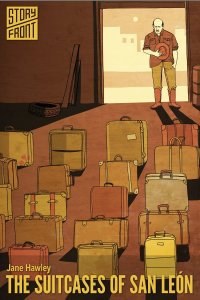
Jane Hawley's story, "The Suitcases of San León," tells the story of bus depot workers who must decide what to do with the suitcases of travelers murdered by the Mexican drug cartels.

Jane Hawley’s “The Suitcases of San León” tells the story of bus depot workers who must decide what to do with the suitcases of travelers murdered by the Mexican drug cartels.

In a recent interview, the late New York Times journalist David Carr was asked if cable news drove coverage of events, and he answered, in short, no. The current news cycle, he said, is so full of large, complex stories that news organizations don’t know where to look. In other words, the news is driving the news. As writers, we inhabit and absorb this same news cycle, and because of the size and savagery of some of these events, it’s tempting to incorporate the headlines into our fiction. The question is how to do it?

A terrific example of a story based on an actual news event is Jane Hawley’s “The Suitcases of San León.” The story was inspired by a narco massacre in the Mexican border city of San Fernando and, more generally, on stories about suitcases arriving at depots without their murdered owners. You can buy the story for $1 at Amazon, where it was published as part of the journal Day One.

How the Story Works

The real-life massacre in San Fernando—or any massacre, for that matter—has a two essential sets of people involved: the murderers and the victims. Focusing a story on characters based on these real-life people is possible but difficult. It involves detailed research, which may or not be possible from a safe remove. It also involves some sticky questions of ethics: Is it okay to fictionalize the lives of real people? The less historical remove the writer has from those people, the more difficult it is to answer this question.

The next level of involvement in the headline includes people with direct connections to the event but not an immediate presence at the actual massacre: the narco bosses who ordered the murders, the officials who provide cover to the narcos, the victims’ families, witnesses, the police, and the people who discovered the bodies. Generally speaking, the farther the story moves away from the immediate event, the more freedom it has to roam. An event like a massacre acts as a kind of black hole, overpowering everything around it with its gravitational pull. A story about a victim of a massacre is likely to be almost purely about the massacre. But a story about a witness or an accessory or family member can give those people lives beyond the event—but that freedom is not limitless.

A third level of involvement includes people with no direct connection but whose lives are impacted in specific ways by the massacre. When fictionalized, these are characters whose connection to the central event is thin or tangential. They are removed from it by several degrees, and, as a result, they can have problems and concerns in their lives that, to them, rival the problem that the event causes. There is inherent tension between those problems—how does the character balance them? A victim’s brother or mother or spouse will drop everything to deal with the event. But someone at a remove will not.

It is at this third level that Hawley writes “The Suitcases of San León.” The story is told from a group point of view—the “we” of the workers at the San Leon bus depot. Their connection to the massacre is indirect. When the victims were pulled off of the bus, their suitcases were not pulled off with them, and so they arrive ownerless at the depot. The workers must decide what to do with the suitcases, and when they decide, they must live with the consequences (mental, emotional, and situational) of those choices. As you read the story, you’ll notice that the narcos become a stronger presence toward the end, and their presence suggests the gravitational pull that the massacre exerts on everything around it. By setting the story at a remove from that event, Hawley gives the characters room to develop. If she had set the story closer to the actual massacre, that room might have been very difficult to create. As a result, the story might not have added complexity or depth to the headline where it began. The distance from the massacre also gives the story a chance to surprise us. We’ve all heard about the atrocities committed by narcos, but it’s likely we haven’t thought about the way those crimes alter even the most mundane aspects of Mexican life. Empty suitcases are such a great starting point for a story that it’s hard to imagine it being written about anything else.

The Writing Exercise

Let’s write a story from a headline, using “The Suitcases of San Leon” by Jane Hawley as a model:

  1. Choose the headline. There is no shortage of news to choose from: geopolitics in Ukraine, Syria, Iraq, and Libya and internal politics and/or savagery in Nigeria, Mexico, and Venezuela; racial and ethnic strife in Ferguson, New York, and, most recently, in North Carolina; political unrest in, of all places, my home state of Kansas; drones; surveillance; a train derailment in West Virginia; and blizzards across the northeastern U.S. Simply choose the news you’re following the closest and that you find yourself imagining yourself into.
  2. Chart out the first level of involvement. Who bears the most immediate impact of the headline? Who is it about? Are there sides? If so, what are they?
  3. Chart out the second level of involvement. Who is connected to the news but not immediately present? Or, who is present but not at the focus of the headlines? Who are the journalists not talking to? This level often contains family members, police, witnesses—people who are among the first to react to the event.
  4. Chart out the third level of involvement. Who is not present or connected to the event/news but is impacted by it? People in this group are often going about their business, only to discover that the news has forced its way into their lives. In the case of the winter storms, most of the stories are from this level, people whose lives have been disrupted, sometimes urgently (first responders) and sometimes with unforeseen consequences (a couple on the verge of divorce but now trapped together by the snow).
  5. Choose the level for your story. To do this, you will likely need to determine how much of the headline you want to write about. Are you interested in the event itself or the way it ripples outward, effecting everyone? A lot of great fiction has been written about war, some of it from the point of view of soldiers (first level), some focusing on family members (second level), and some focusing on the people back home without relatives in the fighting (third level). Once you decide how much distance to put between your characters and the event, you can think about how the event will intrude into their lives. The closer they are, the more forcefully and overwhelmingly it will intrude. The farther they are, the more subtle its effects may be.

Once you choose the level of involvement and know how the event will sneak into the story, you may find that the story begins to write itself. You’ve given yourself something to write toward and, once the event arrives, tension to work with.

Good luck and have fun.