Archive | Writers on Writing RSS feed for this section

An Interview with Justin Taylor

6 Aug
Justin Taylor is the author of three books, most recently the story collection Flings.

Justin Taylor is the author of three books, most recently the story collection Flings.

Justin Taylor is the author of the story collection Everything Here Is the Best Thing Ever and the novel The Gospel of Anarchy. He lives in New York City and co-edits the arts journal Agriculture Reader. His most recent book is the story collection, Flings.

To read Taylor’s story “So You’re Just What, Gone?” and an exercise on digging into a scene, click here.

In this interview, Taylor discusses the moral universes of stories, creating bombs and aftershocks in fiction, and his testing process for writing characters’ text messages.

Michael Noll

One of the writer-sayings from workshop is that a story should walk characters through danger doors–situations that put them at risk. This story does a terrific job of that. First, Charity is seated next to a pervy older man on a plane. Then, he gives her his number. Then he invites her to meet him. As empathetic humans, we don’t want Charity to go along with any of this, but as readers, of course, we want her to choose poorly since it makes a better story. Given all of this, I’m curious about how you approached the ending. She has the opportunity to meet Mark but talks herself out of it—with some help from his aggressive behavior. I love this ending, but I’m also curious if, in early drafts, Charity ever met Mark as he asks? How did you know when to put an end to the chain of bad events?

Justin Taylor

I’ve never heard that expression before—“danger doors.” It reminds me of old-school video games, specifically those colored bulbs in the original Metroid or the ante-chamber to the boss room that you’d find in any given Mega Man. Anyway, to answer your question, there are no drafts in which Charity meets up with Mark. To me, the story is about Charity’s inner life, her self-perception, particularly with regard to questions of age and maturity. To me, the major conflict of the story is between the part of her that still feels young—like a daughter, like a child—and the part of her that craves independence, wants to grow up faster. Mark’s intentions are predatory, but he’s not a very effective predator. Charity’s autonomy and safety are never truly put at risk. The public space of the airplane, and later the distance of the phone, conspire to place a concrete limit on the damage that Mark can do, and that’s because the story is far less interested in what he wants from her, than in what she thinks about it. In the moral universe of this story, questionable choices (and/or the mere fact of being an adolescent girl) are not understood as debts to be repaid through suffering. Mark’s impatience and his demands are somewhere between the ravings of a tyrant and the tantrum of a child. To hook up with someone like that would be to cede the very independence she’s been fighting for, and as soon as she sees that, she’s repulsed. That in mind, I wanted to end the story with Charity on her own, to reinforce that this is not a “him and her” story, but just hers—he was just this weird interlude in her life, like a bottle episode on a TV show, where it doesn’t quite connect back to the main arc of the season. That’s how I came back to the aquarium: she’s on her own, and doing exactly what she wants to do. It may be that the most dangerous thing you can do with a teenager is pay her the same respect that you would someone your own age. That, to me, is the main “danger door” the story walks through.

Michael Noll

Justin Taylor's story, "So You're Just What, Gone?" appeared in The New Yorker.

Justin Taylor’s story, “So You’re Just What, Gone?” appeared in The New Yorker.

I’m interested in the pacing of the story. It begins with a long scene aboard the plane that occupies about 1/3 of the story, and in that long scene, we’re introduced to the character and the plot (will Charity call the guy?), but I can also imagine a workshop teacher suggesting that it all get condensed to a paragraph, which sounds right in theory but, of course, would have been terrible advice. How did you keep that scene going without losing tension?

Justin Taylor

You cannot condense those pages into a paragraph. They are, as you have said, 1/3 of the whole story, and therefore are doing 1/3 of the work. That scene establishes Charity’s psychology through her perceptions of the world around her, her relationship with her mother and various other establishing and background details. Maybe most important of all, it builds up mood. When Mark assaults her, that mood is (hopefully) shattered. I wanted his change in tone and behavior to feel like a bomb going off in the story, and then for the rest of the story to sort of reverberate with the aftershocks of that blast.

Michael Noll

The story contains some extended text conversations. Do you approach those any differently than you would spoken dialogue?

Justin Taylor

I tried to write my texts the way most people actually text—the language clipped, the punctuation light or absent—but mostly I wanted to be true to the characters themselves. They should sound less like “a person texting” than like the people who they each actually are. Charity, for example, is a more deliberate texter than Mark is. There are a couple places where he runs two sentences together in a hash of unpunctuated shorthand (“Cmon sumthing to look fwd to ur teasing me bad here”) whereas she bothers herself to put a comma in the middle of “Pajamas I guess, like a shirt”. She also prefers “you” to Mark’s “u,” though at the end of the conversation she adopts his style, possibly because she wants something from him—“Will u send one back?” Originally, I wanted Mark to be borderline incoherent, because I liked the idea that he was this rabid bro falling all over himself, but then I did some test-runs with my own phone’s autocorrect and saw that it tended to save him from the worst of himself. Overall the punctuation is pretty true to an iPhone 5, though I took a few liberties, such as the un-capitalized “I”, which reads like hasty texting but in real life could only be the result of extra effort, because the phone would always fix it for you unless you stopped it from doing so. Also, “Now were talking.” The phone has enough grammar to know that you meant “we’re” in that sentence. Or anyway mine does. But it’s also true that autocorrect learns from usage, so it’s at least plausible that Mark’s phone wouldn’t make that fix. Also—and I know I’m giving away the depth of my own insanity here—I originally had Mark using “2” for “to” but I eventually realized that while 2 is faster on a computer keyboard, on a phone screen it takes several extra touches to get over to the number screen and then to get back. So he wouldn’t do that.

Michael Noll

The story is about a 15-year-old girl’s sexual encounter with a 30-ish man. It’s a story in a similar vein as Lolita, and when that novel was published, a lot of early reviews claimed that the young girl had somehow entrapped or seduced Humbert Humbert. The reviewers were, it seems, reading Lolita as older than she was because of the way she was viewed by the narrator. In your story, did you worry that the reader would somehow forget that Charity, because she’s interacting semi-sexually with an older man, is only 15? Did you build in reminders of her age?

Justin Taylor

I don’t see how you could forget Charity’s age—the story is entirely defined by it. She’s only on this trip in the first place because her mother thought she was too young to stay home alone. Plus there’s her homework, her friends back home, the presence of her mother and grandmother, and Mark’s own word choice with regard to her. Lolita is 12 years old when the novel begins, and is literally kidnapped by a murderer. If she can be said to eventually “seduce” Humbert, it’s only in the sense that a captive figures out how to “seduce” her captor. I think Nabokov himself is very clear about this, even if the critics haven’t always been—most of the book doesn’t make any sense without this element, and the ending certainly doesn’t. Charity’s problems aren’t nearly as grave—she has a lot more power than Lolita, and she’s older. Not “older than her years” (which is what all abusers of children tell themselves—it’s a fantasy of permission) but old enough to understand the world, and the body, she inhabits. To the extent that, as I said before, the story places superlative value on Charity’s capacity for self-determination, it would have to respect her decision to hook up with him just as much as it does her decision not to. She doesn’t cut him off because she suddenly realizes he’s too old for her—that was the main thing that made him attractive in the first place. She cuts him off because he’s a creepy scumbag, which to me is a better reason. Adolescence comes and goes, but a well-tuned creep-detector is something you carry with you through life.

August 2015

Michael Noll Michael Noll is the Editor of Read to Write Stories.

An Interview with Herpreet Singh

30 Jul
Herpreet Singh

Herpreet Singh work has appeared most recently in The Bitter Southerner and The Intentional.

Herpreet Singh writes fiction and personal essays, exploring the intersection between culture and geography, especially the Indo-American experience in the deep South. Her work has appeared in The Bitter Southerner and The Intentional. She coaches clients who are trying to write their own true stories in the book form. She’s a mother and partner and is at work on a novel.

To read Singh’s essay “Choking Out the Natives” and an exercise on creating multifaceted characters, click here.

In this interview, Singh discusses beginning an essay, using subheadings, and the challenge of writing about family.

Michael Noll

The part from that essay that will stick with most people is your father-in-law’s line about dots. But what I really admire is how you set up that moment so that it has as much shock value as possible. It seems like you do this by treating him with humor and admiration at the beginning of the essay: the description of his commercials and the fact that he adopted your husband. Did the essay always begin this way?

Herpreet Singh

It did. But initially, the set-up was intended to bring readers into Christmas. My in-laws’ Christmas tradition is humorous. It’s generous. It’s problematic in some ways. But it is also something I look forward to. It’s unlike any family Christmas I’ve ever heard about. I’d wanted to write about it for sometime, though I wasn’t sure what I had to say about it, beyond, “here is this crazy, wild, fun time.”

When I sat to write, I felt I could not convey the grandiosity or special appeal of Christmas without giving readers a glimpse of my father-in-law. So much of who he is and what he does could easily seem ordinary; but actually, he is innately creative, and he finds outlets for his creativity in his business endeavors and with creating events and traditions like this for his family. I was surprised that the set up led to a less flattering trait, his bigotry.

As I wrote about my father-in-law, it opened a portal to explore my husband. I started wandering as I wrote, exploring aspects of my husband and in-laws and being a part of their family that I hadn’t intended to explore. I permitted myself to go with that wandering, revealing the larger question: how does one take root in a family, whether one is brought into it, born into it, or has married in, especially when that person does not fully ‘fit’? In particular, I explored my specific experience of this more universal experience, and thus came the line about dots. The essay is exploratory in the truest sense.

Michael Noll

You use subheadings in the essay: Mixed Babies; Red, White and Fused; Foreign Relations, and so on. Are these headings part of your drafting process? In other words, do you write the essay in sections? Or do you add them later as an organizational tool or as a guide to the reader?

Herpreet Singh

Have you ever watched someone braid hair? My dad is a natural storyteller, but his stories, delivered orally, unfold in a long, interlacing ramble. I have always admired the way he draws listeners in, and we feel like we are, at first, just taking in the scenery as we follow. Then we realize we are actually observing clustered strands being braided together.

In school, we are usually discouraged from taking this approach, and it’s too bad. A meandering writing style is most natural to me; I attribute it both to my dad’s storytelling and to the geography in which I grew up. South Louisiana has its own meandering way of being. You can go to New Orleans for a full day, and by the next morning, you can feel like you’ve done so much and nothing all at once. In writing, this works for some readers and turns others off.

But I did not draft in sections or with subheadings. Because the essay took so many turns, after it was written, I felt it was important to offer readers some directionality, road markers to indicate, “Hey. We’re taking another turn; just stick with me! There is a clear destination. We will arrive!”

Adding those organizational headings did help the revision process. It forced me to identify the core truth or message in each section, and from there, I was able to cut whatever was too divergent or simply irrelevant.

Michael Noll

Herpreet Singh's essay, "Choking Out the Natives," appeared in The Bitter Southerner and tells the story of a mixed marriage in Louisiana.

Herpreet Singh’s essay, “Choking Out the Natives,” appeared in The Bitter Southerner.

One of my favorite parts of the essay is Chris’s explanation of why he’s not racist. He tells a story and then, you write, “Not satisfied with his explanation, I remember he shrugged and said, “It just made an impression on me.” I don’t think Chris can make any more sense than I can out of who he is in relationship to his family.” I love this because it resists explanation and knowing. And yet essays, by their very nature, seem designed to explain things. Did you struggle at all with finding a balance between trying to convey some things with a degree of certainty (this is how it is) while leaving other things open ended or unexplained?

Herpreet Singh

I think an argumentative essay is meant to explain definitively, to offer a thesis and to prove it. An exploratory essay, particularly one that is also personal, ought to foster the use of language and observation and feelings and analytical skills to try to understand a subject, to simply think on the page. Of course, you go back, clean it up, see what part of the exploration yielded nothing or took you too far off path. But the writer should not go in knowing what he wants to prove. He should go in knowing he wants to better understand something, and that maybe that something is not entirely knowable.

I never intended to write about the night at the bar and what my sister-in-law shared. I don’t even think I knew how deeply it still bothered me, or how closely I associated that night with my in-laws’ Christmas. But there it landed on the page, and I gave space to it; I let it take up geography.

Then I wondered why it still mattered. Why was I holding tight a single painful memory when I loved this family and recognized the ways they loved me? After writing, I recognized the reason was my son. (And once I made sense of this, I revised to include his arrival earlier in the essay.)

So, no, I didn’t struggle to find a balance between certainty and uncertainty; I hold the worldview that some things, some people, some experiences, are not fully knowable, or that they possess many contradictory truths.

I did struggle to find a balance between attempting to understand what could be understood and accepting what I could not understand, and in presenting these in the essay, I aimed to not demonize my family. The more intentional balance struggle was whether I drew these people in with kindness while I also drew in some hard truths about them and my experience.

The most surprising revelation to me in the writing was to state of my father-in-law, “I don’t love him.” Those words landed on the page without conscious forethought. Five years after writing the essay, and seeing it published now, I struggle with that single line. I think I’ve made progress in my acceptance, because I do know that I love this family completely, and my father-in-law cannot be extracted from the unit. In fact, they are all who they are, to varying degrees, because of him.

Michael Noll

A lot of people who write personal essays struggle with knowing that their family or friends will read the work. How have you handled this issue? Will your family read this essay? Do you talk to them about it’s published?

Herpreet Singh

I am fairly new to publishing; my work has only begun to gain some traction. So with the publication of this essay I learned something: in nonfiction I intend to publish, I need to read it with this question in mind: Do the details and particulars included give life to the essay and its larger meaning that outweighs the real lives of the people the essay depicts? If the details only add color, like nice accessories, but could be hurtful to the people they depict, remove them. On the other hand, if the details contribute to the larger meaning and are delivered with fairness, leave them in.

There are several line edits I would make to this piece to remove purely “colorful” details (such as the Christmas “cocktail” I talk about my brother-in-law having), or else to ensure that particulars are balanced (such as referring to my nieces as “loud-mouthed and not-so-tactful” which both lumped several people together and did not explicitly relay their good intentions or traits). With these kinds of changes, the exploration and complexity in the essay would not have been diminished.

I’m not sure whether I will, in the future, talk to people ahead of time. That may be something I consider on a case-by-case basis.

My family did read the essay, though I had not intended them to. Ultimately, I think this is a good thing. It gives me space, not as a writer, but as a human being and family member, to live truthfully in a way I have not, to change the trajectory of these relationships and how I exist as a part of that family. And as a writer, I don’t regret writing or publishing personal work. I know there is a larger message that will reach an audience that is starving to have it; as an Indo-American who grew up in south Louisiana, I was thirsty to see myself and my experiences depicted. When I did identify my own experiences and truths in another’s writing, I felt the enormous relief of not being alone in the world. That is a largely why I write and why I share my writing.

July 2015

Michael Noll Michael Noll is the Editor of Read to Write Stories.

An Interview with Sarah Layden

23 Jul
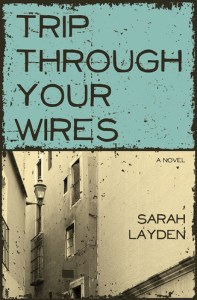
Sarah Layden's novel Trip the Wires has been called "compulsively readable" and "a welcome antidote to despair."

Sarah Layden’s novel Trip Through Your Wires has been called “compulsively readable” and “a welcome antidote to despair.”

Sarah Layden is the author of the novel Trip Through Your Wires and the winner of the Allen and Nirelle Galson Prize for fiction and an AWP Intro Award. Her short fiction can be found in Boston Review, Stone Canoe, Blackbird, Artful Dodge, The Evansville Review, Booth, PANK, and the anthology Sudden Flash Youth. A two-time Society of Professional Journalists award winner, her recent essays, interviews and articles have appeared in Ladies’ Home Journal, The Writer’s Chronicle, NUVO, and The Humanist. She teaches writing at Indiana University-Purdue University Indianapolis and the Indiana Writers Center.

To read Layden’s story “Bad Enough With Genghis Khan” and an exercise on withholding plot information, click here.

In this interview, Layden discusses crime fiction and Gone Girl, lyric versus story impulses, and plot twists that cause readers to make Scooby Doo noises.

Michael Noll

The story begins with “The week after my husband’s retrial and acquittal,” but we don’t learn what he was accused of until much later, almost at the end. When that information arrives, it’s stunning. In fact, I’d completely forgotten about the retrial–the opening paragraph moves on from the trial so quickly. I think I may have made a Scooby Doo noise when I realized what I’d just read. So, I’m fascinated by this strategy of delaying the info. Did you always do that in the story? How did you approach the structure?

Sarah Layden

I know exactly the Scooby Doo noise you mean, and couldn’t be happier that the story elicited it from you. The structure of this piece was always in short vignettes, I think starting with three or four. Initially I’d numbered them, though the numbering was discarded later. Each vignette initially had some sort of tie to Genghis Khan, even if it was a distant link. It took several drafts before I started seeing what some of the connections were between the different parts. That first sentence about the retrial and acquittal was built into the last revision I did: I finally had a sense of the characters and what had –or had not—happened, and I realized that because the narrator had that information prominently in mind, that it should be prominent in the beginning, too.

Michael Noll

The story is doing something really interesting with Genghis Khan. At times, past and present blur together, as they do here: “We don huge fur hats and pound our utensils on the table. Bring us all that we desire, we growl, even if we don’t know what it is. We stab our meat with sharpened knives I pull from my purse.” I’ll admit that when I first read these lines, I was confused. But it was a good confusion. It was such an odd shift that I wanted to keep reading to figure out what was going on. But it’s a strategy with risks. How do you know when a passage is confusing in the good way as opposed to the bad way?

Sarah Layden

Having good readers is crucial to me for this very thing. When I began writing this, I was experimenting: I didn’t know what it would become. My friend Bryan Furuness, also a writer and editor, gave me early feedback that helped me see places where it was confusing rather than mysterious. Part of our conversation was about the lyric impulse versus the story impulse, and how they can work together. Early on, I was probably writing more toward the lyrical. As I revised, it turned more narrative. It’s funny that you mention past and present and the blurring of boundaries, because that does seem to be something that crops up in my work. My novel, Trip Through Your Wires, alternates between past and present, and concerns itself with memory. That interests me in fiction: a character wondering, in the Talking Heads song sense of the line, “How did I get here?” (By the way, one of my all-time favorite songs, “This Must Be the Place,” just came on. Talking Heads asks, Talking Heads answers.)

Michael Noll

In general, there are some amazing shifts of tone in the story. At one point, a paragraph moves from “flecks of charred flesh between his teeth” to “Genghis didn’t give a fuck about floss” to “Jengis was a guy who conquered and then didn’t call because he was high and playing Xbox and just, like, forgot.” I love this. Is it simply the stuff your creative mind is spitting out? Or is there a method to the madness? If not, how do you put yourself in the right mind frame to write prose that seems, at first glance, to move in idiosyncratic rather than linear ways?

Sarah Layden

Thank you. It’s definitely associative. The title, in fact, does come from a line I overhead in a café: “It was bad enough with Genghis Khan.” From there, I started thinking up links and connections and was writing in sections. Those sections took on their own voices, and at first I wondered if I was writing different characters. Instead, the story pointed to a narrator across different moments in her life. At times she’s mimicking the person she describes, as if trying to take on his perspective, to be the conqueror rather than the conquest.

I’ve always been a little bit of a mimic, and as demonstrated, a big eavesdropper. I love trying to recreate different voices and train my ear. I used to be a reporter and I strove to quote people accurately. What’s fun about fiction is stretching accuracy into a shape that fits a story. Or making it weirder, more complicated, and multi-layered than the thing that was actually said, such as an offhand remark about Genghis Khan.

Michael Noll

In Trip Through Your Wires, a new clue causes a woman to retrace the mystery of her boyfriend's death.

In Trip Through Your Wires, a new clue causes a woman to retrace the mystery of her boyfriend’s death.

You’ve published a novel, Trip Through Your Wires, that involves a murder and some uncertainty about a character’s culpability. Now, you have a story about an unsolved murder/disappearance. You’re working over material that is the heart and soul of the thriller genre. Do you ever consider going “full thriller?” Or, what’s the difference between your stories and those?

Sarah Layden

Unexpectedly, this does seem to be the material I’ve been returning to. I’ve read a little in the thriller genre, and it’s so intricately plotted and painstakingly resolved. I hesitate putting my work in with that type of craft, because I’m definitely a novice there. Someone described my novel as a “literary thriller” or “literary mystery.” I like that a lot, maybe because it gives me some wiggle room to focus on place, character, and scenes that drive the story forward, but not necessarily at a breakneck pace. Moments of being or reflection or ambiguity are definitely more characteristic of literary fiction than something shelved under Mystery, and I’ve been learning that mystery readers definitely want closure. And may be a little upset if you don’t give it to them.

Michael Noll

Out of curiosity, what’s your verdict of Gone Girl? At a writer’s conference last weekend, I heard two very different opinions about the book from people I respect. Care to weigh in?

Sarah Layden

I thought it was a terrifically entertaining read. The writing was fun, lively, and engaging. My sister passed it on to me when we were on vacation a few years back and kept asking me where I was in the story. I’d tell her what I thought was about to happen and usually was right or at least close. There’s a little reading thrill in confirming your predictions.

There’s been lots of criticism about the book and how it portrays women, and I’d like to reread it with that in mind. You certainly don’t want to reaffirm stereotypes of women as fakers and man-trappers (I’m trying not to spoil it for the three people who haven’t read it yet.) But as I remember it, both the male and female leads behaved with equal awfulness, thus leveling the playing field.

July 2015

Michael Noll Michael Noll is the Editor of Read to Write Stories.

An Interview with Sequoia Nagamatsu

16 Jul
Sequoia Nagamatsu's forthcoming debut collection, Where We Go When All We Were Is Gone, is a collection of twelve fabulist and genre-bending stories inspired by Japanese folklore, historical events, and pop culture.

Sequoia Nagamatsu’s forthcoming debut collection, Where We Go When All We Were Is Gone, is a collection of twelve fabulist and genre-bending stories inspired by Japanese folklore, historical events, and pop culture.

Sequoia Nagamatsu is the author of the forthcoming Japanese folktale and pop-culture inspired story collection, Where We Go When All We Were Is Gone (Black Lawrence Press, 2016). His work has appeared or is forthcoming in Conjunctions, ZYZZYVA, Bat City Review, Fairy Tale Review, and Copper Nickel, among others. He is the managing editor of Psychopomp Magazine and a visiting assistant professor at The College of Idaho.

To read Nagamatsu’s story “Placentophagy” and an exercise on defamiliarizing the familiar, click here. In this interview, Nagamatsu discusses first lines, his process for outlining stories, and why realism sometimes falls short.

Michael Noll

The story starts with a solid impact: “My doctor always asked how I would prepare it, the placenta.” I’m curious about the genesis of that line. For some writers, first lines simply appear and the challenge is finding the story that follows, but I know others who start with a scene or an idea and then need to find a line to kick it all off. Was this first line always present in the story?

Sequoia Nagamatsu

For me, I like to do a lot of “writing” in my head long before I actually put any words down. I knew I wanted to write a story about Placentophagy but it took another week or so of thinking about the idea to attach a grieving couple to the practice vs. the story focusing on folk medicine and celebrity mothers who have eaten their placenta (i.e. Alicia Silverstone). Once I had the grieving couple tied to pieces of folklore, I knew I had the necessary emotional tension plus the fun facts that interested me to begin writing.

I believe first lines (and first paragraphs) are crucial to pretty much any story (but especially so for flash pieces where you need to draw the reader in, provide some kind of map of what the story will be about (even if only via tone), and establish character and world building in short order. As an editor, I want a story to provide the central characters, introduce a central tension, and do something unexpected and interesting within the first few lines. Don’t reveal all your cards certainly, but I don’t believe in messing with readers too much. Give them a map of an unfamiliar town. Give the reader something they can navigate as more information is revealed.

As a writer, I don’t continue with a story until I’m satisfied with at least the first few sentences. For this story, the first lines came pretty quickly (with other stories, it can be more of a slog . . . and sometimes I’ll think I have a first line I’m happy with until I finish the story and realize my first line is actually buried somewhere else b/c, as a writer, I was navigating to a destination just askew from where I thought I was going when I started).

This question has made me revisit many of my first lines. A few from my forthcoming collection:

Mayu called me from the train car that Godzilla had grabbed hold of––no screaming or sobbing, no confessions of great regrets, no final professions of love.

Our daughter, Kaede, has returned to us five years after the police fished her out of the community pool, her body sodden and distended like the carcass of a baby seal when I identified her in the morgue.

On our wedding day, you weighed 115 lbs. When you died, you weighed 97. You are now 8.7 cups of ash, and I figure I can make enough 1:25 scale figurines of you from what you’ve left behind, so we can see the world.

Michael Noll

Where We Go When All We Were Is Gone is "an exhilarating debut that serves up every guilty-pleasure pop-culture satisfaction one could hope for while simultaneously reframing and refashioning those familiar low-art joys into something singular, unanticipated, and entirely original," according to Pinckney Benedict.

Where We Go When All We Were Is Gone is “an exhilarating debut that serves up every guilty-pleasure pop-culture satisfaction one could hope for while simultaneously reframing and refashioning those familiar low-art joys into something singular, unanticipated, and entirely original,” according to Pinckney Benedict.

Backstory is crucial to the present action in this story, but it’s handled in a quick, compact line: “Somewhere in the building Ayu’s tiny body, caught in the strained expression of her first and last cry, rests in drawer, waiting for someone to fetch her.” Again, I’m curious how much revision was required to achieve such efficiency. Many of your other stories are quite long, which would seem to require a different process than a piece of flash fiction like this.

Sequoia Nagamatsu

When I conceive of a story or a character or a place that I think could contain some kind of world, I start with sketches and summaries. For a longer short story, this might take the form of a rough synopsis. For the novel I’m working on, these sketches might take the form of bulleted points which represent important scenes within an act. I knew from the get go that Placentophagy would most likely be a flash piece, so instead of thinking about my initial sketches as guidelines to be fleshed out later, I made more of a concerted effort to make my notes resemble lines that could potentially be included in the story. The line in question was born from knowing that I needed to capture the loss of a child. Instead of noting “enter scene of miscarriage,” I immediately played around with a couple of variations that captured the essence of this plot point. In other words, when I’m writing smaller and shorter, I inhabit the atoms that make up the molecules of a larger story’s architecture. I need to capture what’s going on at that level.

Michael Noll

I love the essay-ish section about the practice of eating placentas, but I can also imagine workshop readers advocating for it to be cut—because that’s the sort of thing that workshops do. How did you approach that section so that it moved the story forward?

Sequoia Nagamatsu

Whenever I become fascinated with something and consider treating the topic in a story, I tend to be cautious b/c there’s a real danger that I might dilute forward motion and character with unnecessary minutiae. With that said, I don’t think there is anything inherently wrong with tracts of reportage and “essay-ish” writing in fiction so long as 1) the conventions of the story have been firmly established to allow for such asides (esp. if they are lengthy and a bit more detached from character) and/ or  2) the momentum for characters and the overall story are not completely lost or forgotten. For this section, considering the length of the piece, I knew I would have to pick and choose a couple of interesting facts, tie them to the emotional tension of my narrator, and quickly move on. The facts in this story, while certainly stepping outside of my main character, illuminate her research, as well as her relationship to her children and to her body, so if I chose, I probably could have added a line or two more without much lost momentum.

Michael Noll

When I first read this story, it seemed like a piece of horror fiction. Then, I read some of your other work, which involves science fiction situations and characters, and it all seemed to cohere as a single vision. Horror and sci-fi are obviously different genres, but both depend, to some extent, on defamiliarizing the familiar. Is that what attracts you to these types of stories?

Sequoia Nagamatsu

Defamiliarizing the familiar is something present in pretty much all fiction. But to the degree of horror and fantasy and sci-fi (and its genre-bending cousins by various names: magical realism, slipstream, fabulism), the defamiliarizing is often illuminating aspects of reality whether that be racism or rampant consumerism via what many might consider obviously unrealistic, surreal, or fantastic.

I’ve long been a fan of literature and film that forces me to suspend my disbelief, that takes me to other worlds. I love these kinds of stories because I find them entertaining and imaginative. I love these stories because the primal part of me wants to be afraid, wants to use that fear. I love these kinds of stories because they force me to consider the gadgets around me and how they factor into who I am and who I’ll be 10, 20, 50 or more years from now. To quote the title of a Chan-Wook Park film (of Oldboy notoriety): I’m a cyborg, but that’s okay.

These kinds of stories are important and increasingly necessary because we live in complex times and sometimes “realism” falls far short of what we need to comprehend how fast we are evolving, how we process information, and how we define personal, cultural, and geographic borders and spaces. What we consider fantastical fiction used to simply fall in the realm of story or religion. Our stone age ancestors needed a way to understand and process the world around them. For countries who have had to deal with colonial and post-war transitions, the fantastical has become a vehicle where the distant native past and the unhinged identities of the present intermingle. Today we’re compounding these past relationships born from colonialism and warfare with globalization and technology.

Many of my stories are set in Japan. And for me, Japan is a unique case b/c it is a country that has had to reinvent itself multiple times over a short amount of time (notably in the 1800s when there was a push to westernize and again after WWII when the country shifted from military empire to technological and commercial super power). These shifts occurred so rapidly that Japanese culture & identity couldn’t keep pace, and you’ll note that creatures of Japanese folklore often share the stage with technology or modern society gone awry in anime, showcasing the tenuous relationship between the past and present. Akira was released nearly thirty years ago but has never been more relevant for Japan and the rest of the world.

In short, I’m drawn to and write in the realm of the fantastic because, for me, they are the stories that help me navigate the many spheres constituting who we are.

July 2015

Michael Noll Michael Noll is the Editor of Read to Write Stories.
An Interview with Natashia Deón

9 Jul
Natashia Deón's debut novel will be published in 2016 by Counterpoint Press.

Natashia Deón’s debut novel will be published in 2016 by Counterpoint Press.

Natashia Deón is a Los Angeles attorney, writer, and law professor. She is the creator of the reading series Dirty Laundry Lit and was named one of L.A.’s “Most Fascinating People” in L.A. Weekly’s 2013 People Issue. A 2010 PEN Center USA Emerging Voices Fellow, her writing has appeared side-by-side with Pulitzer Prize winning writer, Yousef Komunyakaa in The Rattling Wall, in B O D Y, The Rumpus, The Feminist Wire, and Asian American Lit Review. Deón has been awarded fellowships and residencies at Yale, Bread Loaf Writer’s Conference, Prague’s Creative Writing Program, Dickinson House in Belgium, and the Virginia Center for Creative Arts. Deón’s debut novel is due out in the summer of 2016 from Counterpoint Press.

To read two of Deón’s Facebook posts that were republished as stand-alone pieces, plus an exercise on writing artful sentences, click here. In this interview, Deón discusses Facebook’s positive effect on her fiction, the benefit of reading your work aloud, and the importance of being a generous writer.

Michael Noll

What role does Facebook play in your creative life as a writer? Do you have a rhetorical strategy to writing posts? Does the personal aspect of Facebook posts serve as a relief from your fiction writing? I ask because your forthcoming novel is set after the Civil War and so would seem to be at quite a remove from your life.

Natashia Deón

I spend way too much time on Facebook like most people. By too much time, I mean, I know that there are other things I could be doing but I often find myself multitasking in my real life and on social media. Between work and family and volunteering, I’m rarely sitting at home on a computer or somewhere where I can quietly contemplate a post, so my posts are things that randomly strike me in the day, things that I think other people might think are funny or poignant or helpful or sometimes there’s no point, I’m just venting or sharing a day. Is that a strategy?

Honestly, my FB behavior hasn’t really changed since my first sign-on to Facebook years ago after having my first baby and I thought, if I post these photos here, I don’t have to talk to grandma right now. I’ll text her and say, “SEE MY POST!”

Sometimes I say too much. Like having a drink at a bar and talking to a stranger. I’m sure there’s a hazard to this “strategy”–online footprint and all–and I’ve been known to delete posts, but for me, making mistakes matter less to me than connecting with people.

I do think I’ve gotten better at writing short-short stories because of Facebook. You have to get to the point, be clear, or get the dialog right. But that said, I still post long paragraphs that annoy people. But sometimes, that long post is the one that gets the most attention. I try to keep it interesting.

Sometimes I wish I could be like friends who only share other people’s posts, or Bible verses, or encouraging words, but I’m not that girl. I’m the one who’s tapping the microphone saying, “Is this thing on?”

It’s not that I think my thoughts are any more important than anyone else’s but what I’m beginning to understand is that people are afraid. Especially when it comes to social issues, topics that artists for centuries have represented in their work and have been the central voices in positive change. People today, even artists, are afraid of their thoughts and questions and not having the answers or fear that they’ll come to the wrong conclusions.

So I speak for them sometimes. To show people, especially artists, that I don’t know either and it’s O.K. It’s the conversation that matters. There’s still a lot more convincing to do because the trolls will always regulate as they do, convincing people that they shouldn’t have a voice and that we don’t have anything in common.

And yes, breaking away to post on social media is relief. Writing, in general, is relief. It’s emptying out old thoughts and replacing them with new ones. The same as I would in my fiction. And in my debut novel SWEET TEA AND HONEY—the title is about to change—I get to traverse time and through research am reminded that human beings are still the same. We all have hungered, loved, laughed, hurt, are born, die. I’ve read somewhere before that every person alive is the result of thousands of years of love or painful interactions. I’m privileged to live in this time and imagine some of those stories.

Michael Noll

You organize the Dirty Laundry Lit reading series. How important is it for writers to perform or read their work publicly? Do you think it benefits the work that eventually winds up on the page?

Natashia Deón

The Dirty Laundry Lit reading series was called a "raucous, all-inclusive party" by L.A. Weekly.

The Dirty Laundry Lit reading series was called a “raucous, all-inclusive party” by L.A. Weekly.

In the last five years or so as I’ve run Dirty Laundry Lit, I’ve seen over a hundred writers take our stage and some are incredible readers and some are so-so readers. So-so is rare on our stage. Both of these “classes” of writers, if you will, are all tremendously talented writers. But sometimes what I hear about the great reader is that he or she is “a great performer” and that’s why he or she did a great job reading, where another reader who might be so-so, is considered to have work that “stands on the page.” It’s one of those double-sided compliments that imply if you’re a great reader, your work does not equally stand.

What I believe and what I have seen is that great work stands when it’s played aloud. Period. Great work stands even when the writer is not a good reader and shines even more when the writer is a good reader.

Readings build confidence in the work. It’s the difference. Not just on the stage but before, as we prepare to take the stage and sometimes while we’re in the throes of reading it. We edit ourselves and armed with the honesty that voice gives our pieces, we become our best editor-selves. We skip things—sentences, words—we make new word choices as we read, playing the sentences aloud. We hear the pacing problems, the unneeded repetition, we become better judges of ourselves, our work. We discover how we can deliver our stories better. Make them more clear. Sometimes we see new things that we hadn’t seen on the page. The solitary side of the writer needs to get dressed and go outside some days. Reading publicly is one of those days. We make ourselves better for the crowd.

Michael Noll

As an organizer of a reading series, you are, in a way, playing a role in the publishing and book industry: you’re giving a voice to writers, giving them a chance to promote themselves and become known and advance their craft. This is an industry that is sometimes criticized for the voices it promotes. In response to that criticism, the small press And Other Stories recently announced that it would publish only women authors in 2018. Given Los Angeles’ rich diversity, it would seem like you could play a similar role with Dirty Laundry Lit, pushing against tendencies within the publishing industry? How do you find readers for the series?

Natashia Deón

When I created Dirty Laundry Lit, diversity was one of my three main goals. And by diversity, I do mean race and gender, and also other larger categories like economic diversity, religious, sexual preference and identity, age, physical ability, etc. This diversity isn’t the exclusion of anyone. It’s the inclusion of all. Or, as many as we can get. Diversity has to be intentional. And without a lot of money, creating diversity means we have to give a lot of personal time and effort to seek and find people, not waiting for them to find us. Our goal for each show is that any person can walk into a Dirty Laundry Lit event and see themselves on the stage; their experience represented. And if not this time, the next, or the next.

This aspect is important to me because when I became part of the literary community here in L.A. that’s not what I saw. Black writers were with Black writers, White with White, Asian with Asian, women with women, most experienced writers with the same, etc. We put ourselves into these ghettos of sameness for protection, support, for encouragement, to even have a space, and I get it. I need that, too. There is richness there but there’s magic when we put our differences together. I believe in creating the world I want to see. We all have a role. Where one repairs, another builds up, and so on as the saying goes. It’s community. The magic is in discovering what’s out there, smoking out the wonder. I believe that’s what we’re doing at Dirty Laundry Lit. And by doing this, we are telling people, you belong here, too.

I choose readers based on diversity, recommendations, and their involvement in the literary community. Dirty Laundry Lit goes hard in promoting writers and we do it with more passion than a paid publicist. We do it because we love it. We truly celebrate writers which is a rare experience for most writers. I was lucky to have first felt “celebrated” as a PEN Emerging Voices Fellow. There were six of us and for the eight months of the fellowship, we were treated like literary rock stars. That’s what I want to share with every writer who signs on to be on the slate of a Dirty Laundry Lit event.

And because we’ve been successful in doing this, there is a wait list to become one of our readers. Writers of all levels come to us and essentially say, “Celebrate me. I’m good.” We want to, but there’s limited time and space. So we tend to choose writers who are generous as we are generous. Writers who are giving back to the literary community already through volunteer work and other ways, and are also making space for other writers. This writing journey is impossible without community.

July 2015

Michael Noll Michael Noll is the Editor of Read to Write Stories.

An Interview with Christine Grimes

2 Jul
Christine Grimes' story, "The Window," appeared in 2 Bridges Review.

Christine Grimes is a Texas-born writer living in upstate New York. Her story, “The Window,” appeared in 2 Bridges Review.

Christine Grimes teaches at SUNY Jefferson and has led writing workshops and craft seminars for Black River Writers and Fort Drum’s women’s conference. Grimes’ work has been included in From Where You Dream, a collection of craft lectures by Robert Olen Butler. She also hosts the North Country Writers Festival in Watertown, NY, annually, as well as the monthly reading and performance series, First Fridays, in Sackets Harbor, NY. Her stories have been published in journals such as Harpur Palate, Cutthroat, Passages North, and 2 Bridges Review. She is currently at work on a collection of stories and a supernatural thriller set in Sackets Harbor, NY.

To read “The Window” by Christine Grimes and an exercise on structuring a plot around a character’s lack of change, click here. In this interview, Grimes discusses the ten-year road to publication for “The Window,” the problem of where to begin a story, and the legal issues of using real-world references in a fictional story.

Michael Noll

I know that “The Window” has had a long life between first draft and publication (ten years?). How did it change in that time? Or, what revisions finally got it to the final draft?

Christine Grimes

I first drafted this story for a Texas State University MFA workshop in 2004 and it finally found a home when it was published in 2015 with 2 Bridges Review. Remarkably, the story’s structure and who the character was didn’t change drastically during those eleven years. A lot of my stories are rooted in working-class monotony that stretches into the weird and absurd. I wanted to portray a woman who truly believes she’s destined for greatness and is stuck in a dead-end job that moves from unpleasant and slides into a surreal nightmare without her quite realizing that it’s occurring until it does.

Like many MFA students, I revised shortly after workshop and sent it out into the world for rejection. I submitted a couple times a year and when I’d hear back from journals, sometimes there would be an encouraging note, but mainly it was those little scraps of paper (in the days before Duotrope) saying thanks, but no thanks. Every time it came back, I’d read it through again and cut some words, some lines, some paragraphs. I’d rework a passage or two. Then I’d send it out during the next 3-day weekend or block of vacation time I had. I landed a few other stories I’d written for Tim O’Brien’s workshop at journals during those years and that, coupled with the encouraging rejections, was enough to keep me still sending this one. 

When I wrote newer stories, I sent those instead, but something always drew me back to this one, so I kept tinkering. I removed filters, cut some more words, and sent again. When I compare the 2004 draft to the 2015 published version, many of the original lines are still included, but they are cleaner and the chaff has dropped away. I also have added lines to each key scene that either roots it in sensory description, calls back to something else in the story, and/or transitions between ideas. In the final paragraph for instance, the middle of the paragraph was added: “The cloudy smear shrinks as the impression from his hot breath fades until the window is clear.” Before that sentence was added, the paragraph moved too quickly and the beats didn’t effectively root the reader with the narrator in that final, isolated moment. When I look through the story, there are sentences like this throughout, but I doubt I ever would have gotten to those without the cuts that made the space and air for them to arrive.

Michael Noll

I really like the opening scene at the bar, where the narrator gets embarrassed by the guy she met. It’s an interesting scene to begin the story with because it’s set outside of the chip factory, where the entire story is basically set. It also happens outside the time frame of the day that the story is mostly set in. Did the story always begin with this scene? Or, did you add it to achieve a particular effect?

Christine Grimes

The story always included this scene, but it wasn’t until I revised the story several times over that I realized its importance to the narrative. Originally, I’d written it to set her in small town ambiance, show her life outside of work wasn’t much better, and make her late to work. While it did create that effect, I thought of cutting it and starting in the chip factory during revisions. Then I realized that it’s important that she has the man’s attention and hopes for romance until his friends mock him for his interest. It sets up a parallel for the final scene where she is on display and falls at the mercy of several guys together. Although she is able to convince herself the first event doesn’t matter, her willingness to hope for some connection with the final guy who exposes himself leaves her in an even more vulnerable position. Her inability to recognize the reality of a situation repeats throughout the story.

Michael Noll

I also love the daydream about becoming a food critic. I remember this part from all those years ago in workshop. Since this an internal moment for the narrator (as opposed to a present-tense scene), it probably has the ability to move about the story until it finds its right location and size. Was this the case? Or was this daydream always present in the story in basically this same place, in the same way?

Christine Grimes

Christine Grimes' story, The Window, appeared in 2 Bridges Review, Vol. 4.

Christine Grimes’ story, The Window, appeared in 2 Bridges Review, Vol. 4.

Thanks. It was something I had a lot of fun with, particularly because her idea of becoming a food critic is vastly different from what many would imagine. She isn’t cooking up exciting dishes at home and no one is coming to her for restaurant recommendations. The daydream always appeared in this format and was one of the few things I decided not to tinker with in the story.

Surprisingly, one of the most difficult challenges with revision to this story was centered around food. I’d named the factory after a well-known corn chip company and used it throughout. Sometimes it was a benefit I suppose – a kind editor at Carve wrote to tell me the story had made it through the  early rounds for their contest but didn’t make it to the finals, then noted she was a sucker for those chips and any story that featured them. However, ultimately, when I worked with Rita Ciresi at 2 Bridges Review, she accepted the story noting that I’d have to take the name out for the sake of liability. I agreed and immediately brainstormed 15-20 names that conjured up the same type of oily corn chip sound with my favorites at the top.  When I began researching those, I found Mexican restaurants, East and West coast chips companies, vegan chips, and weight loss companies, until I finally landed on Gornitos. While I’d seen different writers debate whether or not to use companies for the sake of verisimilitude, I never expected to have to change it for liability purposes.

Michael Noll

I cringed at the fact that the narrator eats ten bags of chips a day. I mean, I love to eat and I can pretty easily eat way too much food, but that is a lot of chips. It’s an interesting thing for the narrator to know about herself—she seems aware of her own actions yet also unable to change them. That seems like it would be a difficult balance to find. How did you make her aware but not so aware that the reader wouldn’t believe that she was still stuck in a job she felt was beneath her?

Christine Grimes

Two for lunch, two for dinner, a few in the afternoon? Nope, you’re right. That is a ton of chips. One of things that fascinates me about people are the disconnects they are able to have in their own lives. That’s certainly one of the things I wanted to explore with this character. She’s overweight, unhappy, and stuck, but doesn’t see that eating all of these bags, and even logging more tastings than she’s supposed to, could be detrimental. And she’s proud of her work and her work ethic, even though she shows up late and sabotages her boss. So I tried to illustrate her goals and dreams, the reality of her life, and the disconnect between the two. That was something I really wanted to capture – the ways in which we are woefully short of the visions we keep of ourselves. Of course, it’s easier to see in others, particularly people who might seem so different from ourselves.

July 2015

Michael Noll Michael Noll is the Editor of Read to Write Stories.

An Interview with Katherine Fawcett

25 Jun
Katherine Fawcett's debut story collection, The Little Washer of Sorrows, has been compared to the work of Kelly Link and Donald Barthelme.

Katherine Fawcett’s debut story collection, The Little Washer of Sorrows, has been compared to the work of Kelly Link and Donald Barthelme.

Katherine Fawcett is a Canadian writer living in Pemberton, British Columbia. Her short fiction has been published in Wordworks, Event, Freefall, subTerrain, and Other Voices, and her plays have been performed by several community theatre groups. She teaches music at the Whistler Waldorf School, plays violin with the Sea to Sky Orchestra, and fiddle whenever possible. Her debut story collection, The Little Washer of Sorrows, includes stories about banshees, mermaids, and half-feral boys coming of age.

To read “Dire Consequences” by Katherine Fawcett and an exercise on increasing tension by shifting gears, click here. In this interview, Fawcett discusses writing fables, humor mixed with horror, and Stephen King’s Night Shift.

Michael Noll

When I read the story’s final line, I laughed and gasped at the same time. In a way, the story is structured like a well-told joke. The end is almost like a punchline. How did you find this structure? Did it simply occur to you as you wrote, or did you have the ending in mind when you began the story?

Katherine Fawcett

I’m delighted that the ending made you laugh and gasp. I do enjoy going for goosebumps. I think the horror of inevitability is really powerful. To be funny and devastating at the same time reflects the inescapable reality of being human.

The structure of this particular story did fall into place as I wrote it. I knew it was a fable, and that in telling it the loss of the girl would have to somehow come around again. But no, I didn’t plan the ending in advance. When I neared the ending, I had no choice in how to finish.

Michael Noll

I also love the quick pacing. This is something I’m seeing a lot of lately, in stories by Sheila Heiti, Amelia Gray, and Dina Guidubaldi, to name a few writers. The stories don’t really descend into scene and stay there. Instead, they zoom along over a series of events, as this story does, with the result being a story that feels a bit like a fable. Does this seem like a fair description of the story? What attracts you to this form?

Katherine Fawcett

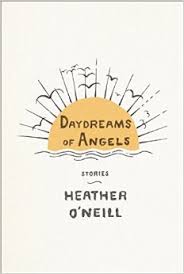
Daydreams for Angels is the first story collection from Heather O'Neill, the bestselling author of Lullabies for Little Criminals.

Daydreams for Angels is the first story collection from Heather O’Neill, the bestselling author of Lullabies for Little Criminals.

I recently read Heather O’Neill’s collection Daydreams of Angels, another Canadian author whose short stories often trip quickly along with gorgeous images and snapshots of events. I like how this style can feel intense–almost dream-like. I think the short story lends itself to this form very well. I love a story that is organized in such a way that readers feel they are swinging Tarzan-style from vine to vine with every turn of the page.

Michael Noll

This story was originally published as part of a series titled “Thrilling Tales of Torment.” As such, I guess it’s a kind of horror story, which makes sense—after all, two children die. But it’s a peculiar kind of horror story in that it’s funny. (At least, I laughed at the end.) But it’s also a weird kind of humor since the thing that is funny is also horrible, and so as I was laughing, I was also feeling a lot of empathy for the characters, especially the boy. Was this story intended as horror? Is that a genre you’re drawn to?

Katherine Fawcett

To be honest, I didn’t write this as a “Thrilling Tales of Torment” story, but when I was asked to submit a Halloween story, it was the most suitable one I had at the time. It certainly isn’t horror in the traditional sense, but you’re right–a couple of dead kids is a pretty nasty and no one wants to laugh at that, so it’s kind of a blend of bad, distasteful humour and weird, funny horror.

I do like reading horror–although I sometimes find it too disturbing to read at night. The first short story collection I ever read was Stephen King’s Night Shift. I must have been 11 or so–I remember being terrified and thrilled, and sharing the stories around campfires to scare my friends.

Michael Noll

One review of the book uses the term “fabulist” and compares you to Kelly Link, the incomparable giant of the weird stories that seem to now officially fall under that label. What do you think of that term: fabulist? It’s relatively new, and so it seems that the definition of what belongs is a bit fuzzy. Does it seem like an appropriate category for your work?

Katherine Fawcett

I am honored to be spoken of in the same breath as Kelly Link. I’d never defined myself as such before, but if the Link is a fabulist and NPR says I’m following in her tradition, then yup, you can call me a happy fabulist too. The word is appealing because it is like “fantastic” and “beautiful” and “marvelous” going out for drinks together.
But to properly answer your question, I looked it up and found out that fabulist has two meanings:

  1. Someone who recounts fables.
  2. A liar.

I suppose all fiction is lying by definition, but a fable is something that brings to light a truth. So yes, lying to find truth would be a great category for my work.

I read somewhere that fiction is simply a craft that arranges letters and spaces and punctuation in a way that makes us empathize with the fake struggles of pretend people. It seems to me the whole process of categorization (fabulist, magical realist, satirist, sci-fi writer etc) has more to do with marketing than actually sitting down and telling stories–lying to find truth. But if lumping me into a category will pique readers’ interest, lump away.

June 2015

Michael Noll Michael Noll is the Editor of Read to Write Stories.

An Interview with Dina Guidubaldi

18 Jun
Dina Guidubaldi's debut story collection, How Gone We Got, features robots and sea creatures and characters that seem intimately familiar.

Dina Guidubaldi’s debut story collection, How Gone We Got, features robots and sea creatures and characters that seem intimately familiar.

Dina Guidubaldi’s first book, the story collection How Gone We Got, has drawn comparisons to Gabriel Garcia Marquez. Her work has appeared in Prairie Schooner, Ninth Letter, the Santa Monica Review, Cup of Fiction, SPIN, the Austin American-Statesman, and Other Voices; she has been an editor for Callaloo and American Short Fiction. A graduate of Texas State’s MFA program, she currently lives in Austin.

To read an exercise on making high-concept stories unpredictable and Guidubaldi’s story “What I Wouldn’t Do,” click here. In this interview, Guidubaldi discusses how to create realistic characters and following your instinct as a writer.

Michael Noll

How did “What I Wouldn’t Do” begin its life? Did you sit down and think, I’m going to write about a guy who builds an actual city for the woman he loves and see how far I can take the idea? Or, were you writing about a relationship when the idea of building a city occurred to you?

Dina Guidubaldi

This was one of those actually “fun” stories to write. I think it started with the idea of the narrator as this kind of obsessive, impractical nut. It also started with me thinking about the concept of “true” love, how there’s something selfish about it. My dad bought me a book when I was little, called The Reward Worth Having, about these brothers (?) who travel a long distance to vie for the hand of this ailing princess. The one who woos her in the end is of course the underdog, who just brings her a bird and a song and no money or promises. The idea was supposed to be “Aw, be yourself and people will see your value,” but I guess what I took out of it was “He doesn’t even know that princess! She could be awful! Why bother? He just wants to be the One who gets her, the One who gets written about.” And so that fuzzy memory sitting somewhere in my head got the ball rolling.

Michael Noll

I love how the story takes phrases that would normally seem sweet (“you were my hours and my half-pasts”) and makes them oppressive and creepy. This is part of what made the story seem strangely realistic to me. It’s a kind of fable or allegory (or something), and the risk with such stories is that they’re too clever for their own good. But this story seems like a real portrait of a relationship that many people have had; in fact, the fantastic-ish elements seem to create the opportunity for the moments that seem most authentic. How did you achieve this balance? In other words, how did you keep the metaphor trained on real emotion?

Dina Guidubaldi

Hm. Right, I think if it does achieve that realness, it’s because this is an honest problem people have—obsession is just selfishness. This guy’s trying his best to make things work, but for what? I also think the female character helps balance things out. She figures things out way before he does, that it’s not about her at all. And again, that fable bit—because it is loosely based on the premise of the knight aiming for the princess, you can get all crazy with the details. Also, he’s rich, and rich people come up with fantastic ways to spend their money, in real life. Or so I like to think.

Michael Noll

I laughed out loud at this line: 

It’s not like you’re a prisoner here, I said. You’re free to walk out of your turret room and down the spiral staircase and through the antechamber and into the foyer and out the front door and past the rosemary and lavender bushes and into the hedge maze and down the cobblestoned circular streets and out into the world. 

It makes me curious about the story’s tone. It’s told in first person, but a line like that seems to reveal a certain amount of self-awareness in the narrator. Was that tone/awareness easy to find, or did you have to write your way into it?

Dina Guidubaldi

Not to sound like a writer jerk, but that’s just the way the character talks, to me. He’s so blustering and headstrong that he almost grasps it—in fact, he does grasp it, I’d say—but he’s heedless, he doesn’t care. He has this little war brewing inside him—Should I keep doing this? Heck, I’ll keep doing it!—and I love that he just quashes any self-doubt before it can get big enough to rise up before him, before his many, many failures catch up to him.

Michael Noll

How did you approach the story’s ending? I can imagine other tempting ways to end it: when the woman leaves or with the narrator’s realization that “I’d been building us your city for me.” But you keep going and end with the great, creepy moment with the microscope. How did you know you’d found the right image or line to end on?

Dina Guidubaldi

I think I kinda like this guy, and I didn’t want him to be sad. I didn’t want him to realize anything much, or to change for very long. I wanted him to keep living blindly and blithely in his world, and the idea of a child—or, for him, a brand new generation of something to love and obsess over—seemed a good way of extending his quest. I also like that he doesn’t care if it’s his child—any one will do. Which kinda circles around the true love idea: is he truly loving or is he truly selfish? And I guess I (inadvertently) revisit this whole idea in a later story in the collection—the “Press Repeat” clone one.

June 2015

Michael Noll Michael Noll is the Editor of Read to Write Stories.

An Interview with David James Poissant

28 May
David James Poissant's debut collection, The Heaven of Animals, has a

David James Poissant’s debut collection, The Heaven of Animals, has a “rogue touch,” according to Rebecca Lee in a New York Times a review.

David James Poissant’s debut story collection The Heaven of Animals received a rave review in The New York Times. His stories and essays have appeared in The Atlantic, The Chicago Tribune, Glimmer Train, The New York Times, One Story, Playboy, Ploughshares, The Southern Review, and in the New Stories from the South and Best New American Voices anthologies. He teaches in the MFA program at the University of Central Florida and lives in Orlando with his wife and daughters.

To read an exercise on developing a rapport with readers and Poissant’s story “Stealing Orlando,” click here.

In this interview, Poissant discusses why there is no such thing as a timeless story and why directly addressing there reader is a natural convention in stories.

Michael Noll

The story does a couple of things that might get called “risky” in workshop. The first is that it directly references pop culture. Plus, it’s a very specific reference—Orlando Bloom in the film Elizabethtown. I’m curious what your thinking was about this reference. I guess you could have written, “My wife wanted to have sex with a famous movie star, so I stole a promotional cutout with his picture on it.” What impact does the specificity of the Orlando Bloom reference have on the story?

David James Poissant

In workshop, we often hear about concrete details, about specificity, about “no ideas but in things.” Then, when it comes to pop culture, we often hear the dictum about avoiding concrete or specific brand names and pop culture references. I think the theory here is that you can better give your fiction a “timeless” quality if you don’t pinpoint an era too specifically with the name of a TV show or song or actor, or whatever. Or else, some people feel that, acknowledging the American entertainment industry, you pollute your literary story with low culture stuff. I think that both of these are bogus reasons to avoid cultural references and time-specific touchstones. Even if you leave those things out, a story will never feel timeless. Let me repeat that: No matter how vague you are, you have no shot at creating a sense of timelessness.

Already, stories are marked by pre- and post-cell phone usage. Having cellular phones easily available to most residents of the Western world has dramatically changed how living writers shape plot and plausibility in contemporary narratives. If you have a character hurt in a car accident and have another character run for help instead of pulling out a phone, your reader won’t think, Oh, this is timeless! She’ll think, Oh, this must be set before 2000 but after 1920. Then, the reader will waste time and energy focusing on minor details and trying to ferret out clues that reveal the story’s time period more specifically. Point is, your story is always marked by time. And, besides, what makes historical fiction more “literary” than contemporary fiction set in the current time period? Also, look at the classics. The Great Gatsby is full of its time period’s pop culture. Great fiction doesn’t have to look away from reality. Instead, great fiction can grapple with reality, even if that reality is Hollywood (Nathanael West’s The Day of the Locust) or pop music (Teddy Wayne’s The Love Song of Jonny Valentine).

Michael Noll

The other potentially risky move is that the story directly addresses the reader: 

“I could tell you, Did the marriage make it, yes or no?
But I’m not going to tell you, not yet, because where’s the fun in that?
And also because read, you lazy motherfucker, read.”

I love that it sets out the stakes (will the marriage make it?), and I’m not sure if that could have been done so quickly without this passage. Was this passage always in the story? Or was it added in the course of revision? 

David James Poissant

One Story editor Hannah Tinti called The Heaven of Animals

One Story editor Hannah Tinti called The Heaven of Animals “Wild as two men wrestling an alligator, tender as a father stretching out on the floor next to his sleeping son.”

I love to address the reader directly. Think of Jane Eyre‘s “Reader, I married him.” I don’t know why this convention has been discouraged by some in contemporary fiction. Maybe because it sounds old-fashioned? I don’t know. But, in a sense, all stories are told, so all stories have an implied listener or listeners. Denis Johnson makes great use of this convention, addressing that “you” in both Jesus’ Son and The Name of the World, two of my favorite books.

As for foregrounding what’s at stake in a narrative, I think that some stories do better to set up the bowling pins on the first page, while some stories make great use of what screenwriters call a “slow reveal.” For this story, because it’s so weird and meandering at times, I wanted to put some heat on it and let the reader know pretty quickly what she’s reading for. I believe that those lines, or something close to them, emerged in the early drafts of “Stealing Orlando.”

Michael Noll

I’ve previously asked David Gordon and Melissa Falcon Field about writing sex scenes. Gordon uses a lot of specific details. Falcon Field focuses on what the scene means to the characters. You do something a little different. There are a lot of details, but they’re told in summary (“edible panties, sex toys, food, porn, food-porn, once the lubed length of a Harry Potter wand”). There’s a lot of lead up to the sex, but the sex isn’t actually shown. Was that always the case? Or did you write the actual sex and then think, in revision, “Hmm, maybe not?”

David James Poissant

I think that a lot can be implied when writing sex. I wanted to get the point across that there was an imbalance in these characters’ sexual appetites. I wanted to convey an energy and carnality that makes the narrator uncomfortable. But, I rarely want to make my reader unnecessarily uncomfortable. So, here, I decided that I could name some objects and ideas, then leave the sexual acts themselves to the readers’ imagination, rather than having to describe the sex acts themselves along with the implementation of those objects, etc. Additionally, trying to stay in character (when writing in first person) means saying what this guy would say and skipping over the parts he’d skip over. He probably wouldn’t go into too much detail if he was already kind of shy about what they’d been doing in the bedroom.

Michael Noll

I love the story’s ending, the way it jumps forward in time and then flashes back again. What made you save that final piece of dialogue between the characters for the end? Why not end it with “Some things, they end just this way”? To my ears, it’s not as nice an ending, but it could work. How did you know where to end it?

David James Poissant

First, thanks for the kind words. That ending, it was the hardest part of this particular story to get right. I played around with the end a lot and moved things around in the story’s chronology many times. The airport scene is the last scene that I actually wrote. I realized very late in the process that these two ought to have one more scene together. But, in the end, there was something more fulfilling about ending with the two committing to one another, even though we know that the commitment is doomed to fail. So, jumping around in time provides that tonal shift, or whatever you want to call it. The trick, then, was to avoid playing the moment for irony’s sake. I wanted to end on a note closer to melancholy sweetness than irony or cynicism. If I’ve hit that note with this ending, then I feel like I’ve done my job.

May 2015

Michael Noll Michael Noll is the Editor of Read to Write Stories.

An Interview with Nicelle Davis

21 May
Nicelle Davis is the author of three books of poetry, most recently the novel-in-poems In the Circus of You.

Nicelle Davis is the author of three books of poetry, most recently the novel-in-poems In the Circus of You.

Nicelle Davis is a California poet, collaborator, and performance artist whose most recent book is the novel-in-poems, In the Circus of You. Her poems have appeared or are forthcoming in The Beloit Poetry Journal, The New York Quarterly, PANK, and SLAB Magazine. She is editor-at-large of The Los Angeles Review and currently teaches at Paraclete and with the Red Hen Press WITS program.

To read an exercise on writing description and Davis’ poem “In a Note Not Given to the Addressee,” click here.

In this wide-ranging interview, Davis discusses Borges’ “The Aleph,” Mikhail Bakhtin’s view of poetry as monolithic, and why poetry is not going extinct.

Michael Noll

I love the poem “In a Note Not Given to the Addressee,” especially the way it uses a hole punched through a door as a means of viewing something quite larger about a relationship. It’s not unlike Jorge Luis Borges’ story, “The Aleph,” in which the characters can put their eye to a point located in the cellar of a house and see everything that exists in the universe. What was the genesis of your poem? Did you start with the hole in the door? Or with some other detail that then led you to the hole? In other words, do you start with the aleph or with the entire universe and work backward?

Nicelle Davis

Thank you for taking the time to love any work of writing. And wow, what a question.

I can’t say that the poem “In a Note Not Given to the Addressee” was directly in conversation with Borges’s story, but I can’t deny that they might share a similar desire. I want a love that moves along the mirrors of the infinite, which expands and inverts simultaneously—a love that is so intensely real that it is no longer possible. The impossible—this is what I want. And my only chance of even glimpsing such a love is in metaphor. So I write poems.

“The Aleph.” That is such a perfect, perfect madness.

It’s difficult to talk about that story without becoming its characters. Discussing “The Aleph,”  I will easily gush like Carlos Argentino, the madman poet, who sees what he wants in every line—I just as easily become the sour Borges who robs others of magic out of the raw envy of everything mystical. That is to say, for me, there is an aleph, which means the hole is aleph and aleph is a hole. Whole is the word game here, isn’t it? It’s the blessing and the curse of being a writer—more like being a dreamer.

I love how “The Aleph” is something more than story; it is a poem that hates poetry; it is an essay that risks bending events past the conceits we use to construct truths. It is everything and nothing—that story IS its subject: “The Aleph”—the everything/nothing of us. It is hysterical both in humor and despair. I love how the protagonist is hyper focused on one point, the unrequited beloved, and is forced into revolving that one burning point into all and every angle of existence. In other words the obsession becomes the aleph or the aleph is in the obsession. Borges writes of the aleph, “And here begins my despair as a writer.”

This sort of despair is the only thing worth living for—yes? I’d gladly trade of lifetime of certainty for a glimpse of ever expanding uncertainty hidden in some weirdo-poet’s cellar.

Now the real challenge is seeking such a love without going insane or becoming a complete asshole; that is the warning in Borges’s “The Aleph.”He warns that those who seek the universe—that is, those who dwell in metaphors—are mad poets and assholes Not exactly exciting options, but the reward of such pursuits is that we find an entire universe hidden in the beloved’s skin.

In the Circus of You is mindful of such complications.

Michael Noll

The poems comes from In the Circus of You, a novel-in-poems, which is a strange hybrid animal. I’m curious about how this form affects the individual poems. Because a novel, theoretically, coheres in a different way than a collection, does it put pressure on the poems to repeat images or, perhaps, make certain images clearer or more spelled out in order to gain that overall coherence?

Nicelle Davis

Nicelle Davis latest book is the illustrated novel-in-poems, In the Circus of You.

In the Circus of You pairs the poems of Nicelle Davis with the illustrations of Cheryl Gross.

Sometimes it’s fun to look at the etymology of things. The root of “fiction” is new work, or new story. The root of “poetry” is to make. Yes, I would like to make new work—to enter and break open words. I’m not sure if this is possible, but I want to try.

The concept of a novel in verse is old; every epic poem has novel like characteristics. The Iliad and the Odyssey are novel(s) in a way, yes? Every novel has poetic elements, yes? It just so happens that the world (I would say, has always) chosen to privilege linear narratives over the stories manifested in poetry. I sometimes wonder if this privileging the linear over the nonlinear is similar to the world favoring war over peace; ecofeminism would say this correlation holds some merit. Instead of writing a lyrical novel, I wanted to make a novel comply with the dream rules of poetry.

Michael Noll

I’m a fiction writer, not a poet, and so when I pick up a novel-in-poems, I’m approaching it from the novel end of the label, not the poetry end. How do you think the form fits into the form of “the novel,” generally speaking? Or, what draws you, as a poet, to the novel form?

Nicelle Davis

Much of what I do is out of rebellion—In the Circus of You was in part written in response to Mikhail Bakhtin. Bakhtin views poetry as largely monologic: that is, the text speaks with one voice, using one language—that of the author—admitting no possibility for outside voices (heteroglossia), and thus diversity of meaning within the text. Bakhtin concludes that “the language of poetic genres […] often become authoritarian, dogmatic and conservative, sealing itself off from the influence of extraliterary social dialects.” He seems to be saying that poetry is,at best, the worst form of navel gazing. I wanted to fuck with that; how much can one find in a navel; maybe an entire sideshow lives there?

Even more rabble-rousing is Christopher Ingraham’s recent article in the Washington Post, claiming that “Poetry is going extinct, government data show.” He writes on how the latest numbers from the SPPA show “poetry is less popular than jazz.” Well fuck, the only thing I might love more than poetry is jazz.

Okay, okay, I hear it all; all the voices telling us “if poetry isn’t dead, it should die.” Maybe part of writing a novel in poems was to tell those voices to fuck-off. I mean, the world still continues to process information and dreams in metaphor. The end of poetry is the end of dreamers; I’m not interested in such a world—I can’t imagine the world being interested in a dreamless existence.

Poetry traditionally has been the voice of the subversive, disfranchised—the voice of other. I find it convenient that during times of intense “speech oppression” that poetry is declared dead. A novel in poems, in a way, is the voice from the grave—the voice says, “Poetry is synonymous with human.”

Michael Noll

The illustrations in the book are beautiful and amazing. I found that they affected how I read the book. They slowed me down, preventing me from jumping immediately from one poem to another, which seemed to benefit my readings of each poem. When you decided to include illustrations in the book, did you do so simply because they’re so wonderful? Or did you have a particular effect in mind?

Nicelle Davis

Anne Sexton's Transformations was praised by Kurt Vonnegut and called "blood-curdling" by Stanley Kunitz.

Anne Sexton’s Transformations was praised by Kurt Vonnegut and called “blood-curdling” by Stanley Kunitz.

I’d be lying if I didn’t say that Anne Sexton’s Transformations didn’t inform my wanting illustrations to couple with poetry. Also, I’m a huge fan of graphic novels and comic books; Spiderman is a rather perfect creation.

Even more influential than Sexton and Spiderman is just dumb luck. My path crossed with the incredible Cheryl Gross. I wasn’t going to miss the opportunity to work with her. I fell in love with her illustrations at first sight, and I asked if she would be willing to work with me. That was six years ago, and we continue to work together. This is a miracle, and I don’t take miracles lightly. Any form of art is a miracle.

As you pointed out in your lovely question, the pairing does slow down the read. I didn’t mindfully consider reader’s speed with the pairing of visuals and text, but I did intend for the words and pictures to feel like a conversation—for the reader to know they are part of that conversation. All art is ultimately meant to be a gift to some unknown love—the imagined voice at the larger table we dream of.

May 2015

Michael Noll Michael Noll is the Editor of Read to Write Stories.