Archive | Writers on Writing RSS feed for this section

An Interview with Joni Tevis

14 May
Kirkus Reviews called Joni Tevis' essay collection, The World Is On Fire, "fiercely, startlingly bright."

Kirkus Reviews called Joni Tevis’ essay collection, The World Is On Fire, “fiercely, startlingly bright.”

Joni Tevis is the author of two books of essays, The Wet Collection, and, most recently, The World Is On Fire. She has worked as a park ranger, factory worker, and seller of cemetery plots, and her nonfiction has been published in Oxford American, Bellingham Review, Shenandoah, the Pushcart Prize anthology, and Orion. She teaches literature and creative writing at Furman University, and lives in Greenville, South Carolina.

To read an exercise on writing with Keats’ negative capability Tevis’ essay, “Fairy Tales of the Atomic Age (Rock City),” click here.

For this interview, Tevis wrote about the inspiration behind her essay in what is perhaps the most detailed recollection of a writer’s zigzagging mental process that you’ll ever read.

Michael Noll

This is such a wide-ranging essay: Fairyland Caverns, the nuclear test in New Mexico, Rip Van Winkle, the preacher from your childhood, and a Civil War battle. The connections made complete sense as I read the essay, but I was also aware that these were connections that you made. They weren’t simply lying around, ready to be reported on. So, I’m curious about the origin of the essay. How did you begin making associations between these very different stories and events and places? How did you keep so many balls in the air without letting them drop? Was it difficult to keep the connections straight in your head as you worked?

Joni Tevis

I like to start research for an essay by going somewhere that intrigues me and just seeing what I can see. This essay began that way; I remembered Rock City from my childhood and went back for a visit as an adult, with the idea of writing about it. For me, this impulse isn’t primarily rational. I might not know why a place or idea or image appeals to me, but I try not to question that, at least initially. I’ll just go and see what’s there.

So I tried to approach the visit with a very porous mind and took notes on everything I noticed there, from the stuff in the gift shop, to the painted barns and handmade signs along the road up the mountain, to the recorded music and running water within Fairyland Caverns. And I’ll add that even though I like to start essays via this travel experience process, sometimes that impulse doesn’t lead anywhere—I have plenty of dead-end trip notes languishing in my notebooks. But you just never know what you might find.

The big surprise on that trip was the black light in the Caverns. I hadn’t remembered that at all, and I found it unsettling—the juxtaposition of childhood scenes with this very trippy light, light that we associate with drug culture. How to make sense of it? When I discovered that the sculptor who created those scenes did much of her work in the late 1940s, I made the connection to early atomic history, a period that had long fascinated me.
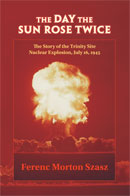
The Day The Sun Rose Twice has been called "definitive account of the days and hours leading up to the first nuclear explosion in history and the legacy it left."

The Day the Sun Rose Twice has been called “definitive account of the days and hours leading up to the first nuclear explosion in history and the legacy it left.”

And this is where the traditional research component came in. I was teaching at UNC-Chapel Hill at the time and had access to the terrific libraries there. One day I was browsing the stacks when I saw The Day The Sun Rose Twice, a great book about the Manhattan Project and the Trinity explosion. The book pulled me—in a not-fully-rational way, the same way that the impulse to revisit Rock City had been. I couldn’t put the book down. It hit me that when I had been a child, worrying about the end-times sermons on Sundays, I was also worrying about the reports I heard on the evening news, about nuclear tensions with the Soviets. So that led me to more research about the Trinity test—which led, in turn, to a visit to the Atomic History Museum, out in Albuquerque—and then to archival research about the woman who created the scenes at Fairyland Caverns.

I traced some of the other stories from the Caverns back—that’s where the Rip Van Winkle research came in, and by moving back in historical time, I read more about the Civil War battle that had taken place on Lookout Mountain sixty years before Rock City was created. Research about the material culture of the place led me to the See Rock City barns that had helped to advertise it. And what had many of those those barns held? Tobacco leaves, which were fascinating to research as well.

Someone painted the barns. Someone planned the scenes in the caverns, poured the plaster. Someone even now changes the black lightbulbs. Just like someone built the bomb. I’m satisfied with the essay now in part because it draws attention to the things we make, and the meaning we make with those things. And I think it evokes this sense of “living in a haunted world” with which the rest of the book also grapples—the reality that we’re not the first to step onto this patch of ground or handle this clay or stone, and that by examining the relics and words that our forebears left us, we can live in a more deep, enriched way.

May 2015

Michael Noll Michael Noll is the Editor of Read to Write Stories.

An Interview with Melissa Falcon Field

7 May
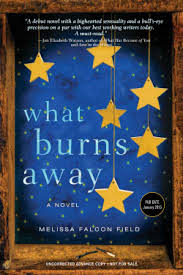
Melissa Falcon Field's debut novel, What Burns Away, explores the narrator's sudden isolation after having a child and finding her marriage in trouble.

Melissa Falcon Field’s debut novel, What Burns Away, explores the narrator’s choices after finding herself suddenly isolated after having a child and finding her marriage in trouble.

Melissa Falcon Field is the author of the novel, What Burns Away. She was born in Hartford, Connecticut, and earned her MFA in Fiction Writing from Texas State University. She has been the writer-in-residence at the Katherine Anne Porter and a Bread Loaf fellow, worked as an inner-city teacher with Teach for America and AmeriCorps, and helped develop and pioneer the YEAR UP writing curriculum used nationally. Her writing has appeared in various literary magazines and journals, including Hip Momma: The Parenting Zine, Kaliope Literary Journal, The Portland Phoenix, Across Curriculums, The Austin American Statesmen, The Ballantine Books Reader’s Circle, The Hartford Courant, and The Maine Scholar. She lives in Madison, Wisconsin with her young son, her husband, and four chickens.

To read an exercise on creating tension in a story and an excerpt from Falcon Field’s novel, What Burns Awayclick here.

In this interview, Falcon Field discusses her approach to space breaks, love triangles, and sex scenes.

Michael Noll

I’m interested in your use of space breaks, something that a lot of beginning writers struggle with. For instance, early in the novel, you begin a passage with the sound of the narrator’s son waking her and then move into a flashback about the narrator’s childhood. When the flashback ends and the scene returns to the present scene with the son, the move is punctuated with a space break. The next section uses a similar structure: son as window to something else—in this case, the narrator’s husband. What is your approach to space breaks? Is it about thematic structure? Is it to help the reader avoid confusion?  

Melissa Falcon Field

In the novel, I use space breaks for a variety of reasons, first and foremost, as a way of showing readers a normal break in the narrative, but here, in the sections you reference, because so much of this early part of the novel toggles between back story and the present timeline, space breaks work to clarify those shifts, and they also serve to re-direct the reader in and out of Claire’s reflections, helping to avoid reader confusion with those time shifts. At other times, later in the novel, space breaks serve as a breather from the continual present time narrative, and allow Claire’s reflection and internal world to stand alone, giving them weight, and a wink a their importance, when punctuated by the space break.

Michael Noll

One of the so-called rules promoted by writing workshop is to eschew adjectives. However, your use of the adjective “steadfast” in describing the narrator’s husband (“the steadfast Dr. Miles Bancroft”) is pretty sharp, in part because it comes from a first-person narrator. The description of the husband is pretty spare. Besides this line, there is only one other descriptive phrase early on: “a new breadbasket of weight pooled at his waist.” How did you approach this all-important description? Were you aiming for a particular attitude toward the husband?

Melissa Falcon Field

Great question, Michael. I would say that, in general, the eschewing of adjectives in a novel is to foster finer writing and to encourage streamlining of sentences, avoiding language that reads as clunky, or feels heavy. But when a confessional is being written, as it is here in What Burns Away, Claire is zooming in on her husband, observing him, and so those adjectives work to establish her voice and are the adjectives that she, as the narrator has chosen, thus giving the reader access to her perception of her husband, Miles, guiding the reader to view him within the portrait of their marriage. So, although I prefer to keep the use of adjectives relatively limited in my fiction, I do find them necessary in some places to invoke decisive descriptions in sections where the pacing needs to be slowed down, with intention, as it is in the sections you have pointed to here.

Michael Noll

The novel pretty quickly sets up the triangle between the narrator and her husband and her former boyfriend. Was it difficult to get both of those men into the novel quickly—to basically juxtapose them on the page? I’m curious how much revision was required to make that juxtaposition happen.

Melissa Falcon Field

That triangle was there in my earlier conception of the novel when I knew I wanted to write from the vantage point of a new mother, who feels like everything desirable about her has moved past. So it was my hope that by incorporating Dean, a former lover, juxtaposed with Miles, Claire’s absentee husband, I could better capture that moment in a woman’s life when she feels desperate to reclaim her girlhood-self, just as she realizes her youth is more behind her than it is in front of her, which in this case, forces Claire to decide what and who she must let go of, and what and whom she must hold close. Because the story is ultimately about the ways characters redefine themselves, I sketched out that triangle for the first draft very loosely. That said, it was Dean who I focused on first, as I worked to establish the backstory of the novel.  Later, in second, third and fourth drafts, I worked more specifically to redefine Claire inside her family dynamic and within her marriage, in relation to her husband Miles. And because the two male characters work in polar opposition, I was able to play-out Claire’s surrender, which is both brutal and transformative, and why I felt compelled to capture that tension of a love triangle in What Burns Away.

Michael Noll

I’m always curious how writers handle sex scenes, and so I was interested in the flashback about the narrator’s first time with Dean, her high-school boyfriend. Other than a reference to rough palms, there’s almost no physical description. Instead, the passage focuses on what the sex and intimacy meant to the narrator. Did you play around with other ways of writing this scene? Did you always keep the physical description spare? 

Melissa Falcon Field

What Burns Away, the debut novel by Melissa Falcon Field, has been called "thrilling" and "perceptive" by Tin House executive editor Michelle Wildgren.

What Burns Away, the debut novel by Melissa Falcon Field, has been called “thrilling” and “perceptive” by Tin House executive editor Michelle Wildgren.

Sex that is any good is characteristically over the top, so I have always been more interested in redirecting readers beyond the obvious, toward the more unique secrets of the act, focusing on the minutia of rough palms, a freckle at the curve of a lover’s hip, or the tiniest bead of sweat on the tip of a nose. I did experiment with how to write those scenes, and at first it all read a bit more like pornography, which don’t get me wrong, has its place, but it wasn’t in that moment. So, I stepped back and thought more about the importance of that scene, which for Claire is a memory about desire and intimacy, and what being wanted felt like, so I focused on that, which is, after all what she has been missing and yearning for and what, in the end, gets her into big trouble, leading to later sex scenes with a more physical quality to them—cast into another kind of heat.

Michael Noll

You’ve spent years working as a teacher and writing coach. How does this work inform your writing? Writers often complain that the time demands that teaching places on them takes away from their writing, but given how much teaching you’ve done, I’m curious if you feel differently.

Melissa Falcon Field

Teaching, if you do it well, requires a huge amount of creative energy. But I love it. And, I do believe that for the most part, excluding midterms and final papers, it feeds my writing life. Over the years, teaching the craft and working along with my students, writing and revising and remembering how it is to first read, or conceive of a character, plot, or setting has been a source of great joy, and has always driven me to better hone my work and my ability to talk about narrative. Selfishly, I gain as much from the fresh perspectives of my students, as I give them back. It’s a wonderful kind of relationship, and one of the most important roles I play. And, I should also say that I would never have written a word without those who taught me, and the idea of being that person for someone else motivates me to read and write harder for my students, and to continue to learn more to be the best version of reader, writer and teacher for my students, as we all do the hard work together.

May 2015

Michael Noll Michael Noll is the Editor of Read to Write Stories.
An Interview with Ru Freeman

4 May
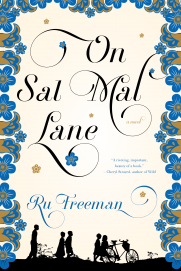
Ru Freeman's novel On Sal Mal Lane was called, by Cheryl Strayed,

Ru Freeman’s novel On Sal Mal Lane was called, by Cheryl Strayed, “Piercingly intelligent and shatter-your-heart profound.”

Ru Freeman was born in Colombo, Sri Lanka, and is the author of the novels Disobedient Girl and On Sal Mal Lane. She is also the editor of the forthcoming anthology, Extraordinary Rendition, a collection of the voices of American poets and writers speaking about America’s dis/engagement with Palestine. She has worked in the field of American and international humanitarian assistance and workers’ rights, and her political writing has appeared in English and in translation. Her creative work has appeared or is forthcoming in VQR, Guernica, World Literature Today and elsewhere. She is a contributing editorial board member of the Asian American Literary Review and a fellow of the Bread Loaf Writer’s Conference, Yaddo, Hedgebrook, and the Virginia Center for the Creative Arts. Freeman won the 2014 Janet Heidinger Kafka Prize for Fiction by an American Woman. She calls both Sri Lanka and America home.

To read an exercise on using an omniscient narrator and an excerpt from Freeman’s novel, On Sal Mal Laneclick here.

In this interview, Freeman discusses the challenges of explaining historical context in a novel and creating an omniscient narrator and the politics of Sri Lanka and On Sal Mal Lane.

Michael Noll

On Sal Mal Lane begins with a prologue that functions very much like the infamous prologue to Star Wars. It sets up the politics, geography, and history of the place—and also indicates that, in the story’s beginning at least, the major conflict is some miles away from the main characters. What was your approach to this prologue? Do you think it would have been written the same if you could assume that your readers knew a lot about Sri Lanka and its civil war?

Ru Freeman

I like the way you use that to discuss the book. The prologue in this form was added after I had written the first draft. The original prologue, several pages longer, focused mainly on the characters, and all of it eventually got whittled down to that last paragraph. When I finished writing the book, I felt that there was a sense of longer-term history that couldn’t be contained within the main text of the book without burdening it with those kinds of explanatory treatises on history that can kill momentum. It was necessary that people understood that there was this regional and international context, this history of colonization and brutality, but also that, in the end, none of those things were relevant to the daily lives of ordinary people like those who lived on Sal Mal Lane. As a way of tracing immediate history to a pivotal moment, I included the murder of Alfred Duraiappah and the call to war by Prabhakaran. Whether people knew this history or not, setting it down with those few brushstrokes helped to establish the voice of the narrator who is, to continue with your image, a Yoda like character who knew all that came before and all that was to come to pass and could maintain both warmth and distance from every composite part of the story—the human and the inanimate.

Michael Noll

The prologue also has this remarkable pair of sentences:

“And who, you might ask, am I? I am nothing more than the air that passes through these homes, lingering in the verandas where husbands and wives revisited their days and examined their prospects in comparison to those of their neighbors.”

In essence, you have created an omniscient narrator and then embodied it in something of the novel’s world. Was this a conscious decision—in response, perhaps, to readers or yourself wondering who was speaking? Or did these sentences arise spontaneously in an early draft?

Ru Freeman

Ru Freeman's novel On Sal Mal Lane

Ru Freeman’s novel On Sal Mal Lane “soars [with] its sensory beauty, language and humor,” according to a New York Times review.

It was an asking of myself as I tried to wrap my head around this voice that had come into being while writing the earlier version of the prologue, and the novel itself. It occurred to me that the narrator here was someone (or in this case perhaps something, the road), who was intimately familiar with the this place, with compassion for everyone, but a particularly keen fondness for two of the characters, Mr. Niles, and Nihil. In the scheme of things there is no one main character here, but the ties that bind these two are elevated above all the other bonds that form—and are broken— between the people of Sal Mal Lane. Why this voice lingered over those two characters got me thinking about the entity to whom the voice belonged. So, it was spontaneous, in one sense, but also deliberate.

Michael Noll

Each chapter gets a title. Obviously this is something that some books do and some don’t. What made you choose to title them?

Ru Freeman

In my first novel, I alternated the story between Biso (an older woman leaving an abusive husband, taking her three children with her on a journey that lasts just about 36 hours, all related in the first person), and Latha (a little girl who comes to live in a house as a companion to a girl her own age who lives there, and whose story covers about three decades and is told in the third person). When I began this book, I imagined that I’d write it by alternating the voices of the children, staying close to each in turn, sort of like what Barbara Kingsolver did with Poisonwood Bible. I must have written about a third of the book when I began to feel oppressed by this framework. I abandoned it as a strict guideline and began to simply write the story, though, as you can perhaps tell, I do concentrate on one or the other of the children as I go along, at least in certain parts. I decided to break the book up by year into sections, and then title the chapters. I enjoyed coming up with those titles. It’s not something people do too often, as you point out, but it is a lot of fun and if I’m having fun then the writing tends to be better than when I’m straining.

Michael Noll

At the risk of veering into politics, I was reading this novel when Sri Lanka held its presidential election in January, and so I couldn’t help holding the two events (the events of the novel and the election) side by side. In the novel, animosity is rising between Tamils and Sinhalese. Now, the war is over, and the minority groups (including the Tamils) who suffered during it have managed to vote out the president who claimed credit for ending the war. Do you imagine Sal Mal Lane today? Do the current events cause you to think about the years of the novel in a different light or way?

Ru Freeman

Freeman's website contains what is, perhaps, the most comprehensive list in existence of Sri Lankan writers.

Freeman’s website contains what is, perhaps, the most comprehensive list in existence of Sri Lankan writers.

There is never a veering into, I think. We are always situated quite firmly and centrally in the middle of politics. As far as the election goes, while it is true that many ordinary citizens came together to vote out the former president, there were machinations that went beyond Sri Lanka, including the United States, to bring the current one into power. When I hear the rhetoric from the new leadership, I don’t feel optimistic; the alignment of the new president is with the United National Party, which in its time of power reigned over the massacre of more than 60,000 youth. The language used is old, it panders to American interests, and it is, frankly, disorderly. That combination can be deadly in a country like Sri Lanka, with a highly educated, enfranchised, and engaged civil populace.

Be that as it may, the Sal Mal Lanes of my country never disappeared. They went on through another quarter century of war, they mended fences, came apart, celebrated and mourned. There was a weight felt by everybody as they did these things, that was only lifted in May 2009, when the war officially ended, when the walls and barricades and checkpoints were dismantled, and the soldiers went to work on reconstruction and other support work. Devi, therefore, was a symbol to me of a fragile beauty that underlined all life in Sri Lanka, as well as a stand-on for the country itself. How people dealt with her presence and absence was and is similar to how they dealt with what happened during those decades of war.

May 2015

Michael Noll Michael Noll is the Editor of Read to Write Stories.

An Interview with Stefanie Freele

30 Apr
Stefanie Freele

Stefanie Freele “recasts suburban ennui as existential terror,” according to J. Robert Lenon. Her latest story appeared in Tahoma Literary Review.

Stefanie Freele is the author of two short story collections: Surrounded by Water and Feeding Strays. Her story “While Surrounded by Water” won the Glimmer Train Fiction Award and “Us Hungarians received second place in the Glimmer Train Family Matters Contest. Stefanie’s short stories have appeared or are forthcoming in Mid-American ReviewWitness, Western Humanities Review, Sou’westerQuarterly WestThe Florida ReviewNight TrainAmerican Literary Review and Edge. Her work has twice been nominated for the Pushcart Prize.

To read an exercise on writing descriptive passages and Freele’s story, “Davenports and Ottomans,” click here.

Michael Noll

I’m interested in the story’s approach to close description. The first paragraph focuses on Maribel’s shoes and purse and then zooms in on her tights, particularly on the crotch. The language seems meant to make the reader feel claustrophobic (and from your blog post for Tahoma Literary Review, I know that feeling is intentional). I’m curious in the last sentence of that paragraph:

She hates these ill-fitting tights, the crinkly dress, the stiff polished shoes, and her mother for making her wear all of this nonsense. 

It’s a line that seems to sum up the details that we just read. This is a strategy that I actually teach in writing classes: present details and them sum them up by telling the reader what they mean. Did you wrote this sentence with any purpose in mind or were you were simply following the rhythm of the prose?

Stefanie Freele

Typically I don’t intentionally tell the reader what I’ve meant, because I assume they’ve caught what I mean, but in this case I think you are partially right: I was following the rhythm of the prose. Also, I think having this list emphasizes that for Mirabel, she is counting and focusing on her discomforts. While another child might be proud of this attire and show it off to the aunties, Mirabel is physically sensitive – pride and appearances aren’t her vices.

Michael Noll

In this story, the dialogue is italicized and not broken out into separate paragraphs. There are no quotation marks. This is a technical question that comes up a lot in drafts and in writing classes. Did you format it this way to avoid slowing down the prose? Were you trying to embed the dialogue within the voice, rather than getting caught up in prolonged scenes?

Stefanie Freele

Both. I very much enjoy prose that doesn’t break dialogue into paragraphs by quotes. I find it a distracting break from the story and I often jut out of the dream to inquire, who is talking now? I realize that some people abhor italic dialogue, but I may unapologetically continue writing this way.

Michael Noll

The narrator is listening to the grown-ups in the room and noticing them “using adult words like Naugahyde and paisley,” This is a recurring idea in the story, the distinctions marked by particular words and phrases: “something special” and “smile and shape up” and “smirk.” This seems like a really useful way to clue readers in to the narrator’s age and relationships with the other people in the house. Is it something you fell into—one of those happy accidents in writing—or was it an effect you were intentionally trying to achieve?

Stefanie Freele

Let us go with the happy accident theory. I think I am watcher, like all writers I suppose, and a collector of the phrases people say. There can be a ton of dialogue between people, but there are those certain words that will stand out and directly indicate something about the character. I try not to waste any words that don’t have to do with the revealing the character, the story or some sort of underlying message.

Michael Noll

I guess this story would be classified as “flash fiction,” both because of its length but also because it takes place in an instant. Was it always confined to this particular moment in time? Or, was it carved out of a longer piece of writing?

Stefanie Freele

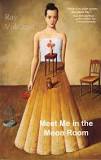
Ray Vukcevich's story

Ray Vukcevich’s story “The Sweater” is included in his collection Meet Me in the Moon Room from Small Beer Press.

It isn’t yet carved out of a longer piece of writing. I was exploring the idea of anxiety in children and what adults might miss or can’t see. I was also recalling certain memories (will never forget the awful tights) and that sensation that one feels like they might burst or rip apart due to discomfort from all angles.  To the other characters in the story, they have no idea what is going on with Mirabel, with that explosive distress. She has made some connections and decisions including that stealing what is forbidden is acceptable. So much is happening to her in a few minutes, in one room, in one scene, and nobody one knows. I love the idea of exploring what is happening to someone in an iota of time. Ray Vukcevich did this in his story “The Sweater” where the entire story is told while a character is trying on a sweater. A must read.

April 2015

Michael Noll Michael Noll is the Editor of Read to Write Stories.
An Interview with Sora Kim-Russell

24 Apr
Sora Kim-Russell lives in Seoul, where she writes and works as a teacher and translator.

Sora Kim-Russell lives in Seoul, and her translations of the Korean writer Bae Suah are among the first of that form-breaking writer’s work to appear in English.

Sora Kim-Russell is a literary translator based in Seoul. Her translations include Shin Kyung-sook’s I’ll Be Right There and Gong Ji-young’s Our Happy Time, as well as Bae Suah’s Highway with Green Apples and Nowhere to Be Found. Her translation of Hwang Sok-yong’s Princess Bari will be available on April 27, 2015 through Periscope (UK).

To read an exercise on characterizing an entire society and Bae Suah’s novella, Nowhere to Be Found, and also an interview with Bae, click here.

Michael Noll

The style of the language in Nowhere to Be Found is plain and direct. There are moments of metaphor and some lovely writing, of course, but from the first page, the narrator’s voice is very matter-of-fact. I’m not a translator myself, but I can imagine the difficulties of trying to find a match in English for the tone of the original prose. Did you have a strategy for this? Did you play around with different approaches until you found one that was right?

Sora Kim-Russell

I did play around with the narrator’s voice, especially in the opening pages. It was important to me to capture the narrator’s tone and attitude right from the get-go. Korean-to-English translation has an innate tendency to veer abstract and indirect, so I really tried to push against that and keep the language clear and direct. That way, when the story later takes its flights of fancy, those parts would have room to shine. As for capturing tone and voice, I think my approach is a combination of text analysis and method acting. In terms of text analysis, I look for rhetorical patterns—words or images or emotions that reappear, particular sentence styles and shifts in sentence structure, anything at all that gets repeated—in order to pin down how the narrator is telling her story. As for the “method acting” part, I thought about my own experiences in my twenties and tapped into those memories of dead-end jobs, dead-end relationships, fear of the future, and so on, in order to channel those emotions into my translation. By that, I don’t mean that I wrote myself into the character—it was more like orienting myself emotionally onto the narrator and mapping where our choice of words and phrasings aligned and diverged.

Michael Noll

I’m curious about challenges you had as a translator in finding English equivalents for basic aspects of the Korean setting. There aren’t very many well-known Korean writers in America and certainly not many who are being translated. As a result, I found myself realizing as I read how little I know about Korea, especially as it was during the 80s. In some ways, the narrator seems like any young, single person. In other ways, though, the effect that poverty and the cultural expectations for single women feels quite different from what an American might experience. Does the prose in Korean take for granted certain things that had to be illustrated or explained a bit for an American audience?

Sora Kim-Russell

There were a few “taken for granted” parts, though to be fair, at least one of those references would be just as tricky for young Korean readers today—namely, the “officer-in-training” system that Cheolsu was in. I got really stuck on how to translate Cheolsu’s rank (silseupsodaejang). I guess it’s very roughly analogous to the ROTC system in the US, with the critical difference being that most Korean men don’t choose to go to the military. In South Korea, all able-bodied men have to undergo two years of military service, usually right in the middle of their college years. Cheolsu’s situation is different because he goes into the service after college, his stint is very short, and he starts at a higher rank than other men. He has it easy, in other words. The writer explained to me that, back in the ‘80s when the novella takes place, the officer-in-training system offered a loophole intended to benefit men from elite families, but as the man on the phone (towards the ends of the book) explains, some lower-class men were able to take advantage of it if they could pass the exam. So that was a very specific historical detail that is not explained in the original but which sheds light on who this Cheolsu guy is. I opted to add in a brief explanation, because there was no way to pack all that context into a single word translation.

Also, more broadly, the whole system of military conscription and the idea of women providing support and encouragement (from food, visits, and letters to perhaps more than that) to men undergoing military service is a ubiquitous part of modern Korean culture. If you know that, then it might be easier to understand why the female protagonist resists it. It also helps with understanding South Korea in general, though I would argue that this notion of women feeling pressured to provide “comfort” to men in the military is close to universal and no doubt found in every patriarchal, militarized culture around the world.

Another “taken for granted” part worth pointing out is the title itself. The original title was “Cheolsu,” but it didn’t work in translation because Cheolsu is an extremely common male name in Korea, comparable to “John.” In English, the name comes across as exotic and foreign, which is exactly the opposite of its intended effect in the original, so we opted to change the title in order to convey that sense of ordinariness and anonymity in a different way.

Michael Noll

How much freedom did you take in structuring sentences? For instance, a street in Uijeongbu is described this way: “A perfectly gray street. An old and dirty street.” Were the original lines fragments as well, or is that a construction you used in order to achieve a particular effect?

Sora Kim-Russell

I actually stuck very close to the author’s original sentence structures. There’s something jarring about her sentences in Korean, especially the shifts from long, antithetical sentences where she takes a phrase and turns it back and forth before moving on, to abrupt fragments where the speaker seems to have run out of breath. If I changed anything, it was because it didn’t work grammatically in English, but wherever possible I followed the author’s lead. There were a few places where I had copy editors suggest changes, either deleting a fragment or changing a word choice that seemed out of place, but I stuck to my guns and insisted on keeping them, or looked for ways to smooth them out just enough to allow them to fold into the text but still assert their presence. Whenever there was any doubt, I checked with the writer, and she gave me her opinion on what she thought could be changed or deleted without hurting the text, and which things needed to stay in place. She likes to jar her readers, but the challenge was to find the right words in English that jar without completely unseating the reader.

April 2015

Michael Noll Michael Noll is the Editor of Read to Write Stories.

An Interview with Bae Suah

23 Apr
Bae Suah is a Korean writer living in Germany whose books set in South Korea are finally being translated for English-language audiences.

Bae Suah is a Korean writer living in Germany whose books set in South Korea are finally being translated for English-language audiences.

Bae Suah was born in Seoul and has published seven books in Korean, three of which have been translated into English: the novellas Highway with Green ApplesTime in Gray, and, most recently, Nowhere to Be Found. She currently lives in Berlin and translates German literature into Korean, including Martin Walser’s Angstblute and two works by W. G. Sebald. She is currently translating the Portuguese writer Fernando Pessoa’s The Book of Disquiet.

To read an exercise on characterizing an entire society and Bae’s novella, Nowhere to Be Foundclick here. The following interview was translated by Sora Kim-Russell.

Michael Noll

The narrator in this novella—as well the narrator in your story “Highway with Green Apples”—seems to be struggling with what it means to be a young, single woman in a place where the expectation of marriage is quite strong. Given that expectation, I was sometimes surprised at how “liberated” she sometimes sounded. For instance, in a passage about what makes a relationship special, she casually mentions watching porn. Even in the present American culture of TV shows with strong, sexually independent female characters like Girls and Broad City, this reference to porn still took me by surprise. Is it something that would have surprised Korean readers in 1998 when it was first published?

Bae Suah

Well, in that particular passage, the viewer of porn isn’t specified as either male or female, but I do think women watch porn. Of course, men probably watch it for different reasons… In this case, some readers may wonder why the act of watching porn in particular would remind a person (male or female) of someone. It’s not about porn, per se, but about the way a certain someone can suddenly come to mind when you’re busy doing something. I think most of the Korean readers of this novella have been young women, and they didn’t seem put off by this passage. Or at least, I don’t think they were. I don’t think they were surprised by it either.

Michael Noll

Near the end of the novella, there’s a jump in time. You write:

“That year was my beginning and my end. It was one year of my life that was neither particularly unhappy nor particularly happy. It wasn’t so different from 1978, and it wasn’t any more or less memorable in comparison to 1998. The things that happened in 1988 had also happened in 1978 and would happen again in 1998.”

The passage continues on that way. It’s a bleak sense of an absence of logic and progress that you end up calling “third person random.” It’s something that appears in “Highway with Green Apples” as well, a sense of disorientation and disconnectedness, not just between the narrator and her life but among almost all aspects of life. There’s a kind of cruel senselessness at work. It makes me wonder at the reception of these stories in Korea when they were first written. Did readers say, “Oh yeah! This is how it is.” Or did they bristle at the portrayal of their world and the people in it?

Bae Suah

As with the first question, I think that young female readers responded positively to this novella. I guess you could say that what I portrayed in this novella is a kind of volcano inside women’s hearts—volcanoes that threaten to, but never actually, erupt. However, older readers and male readers reacted differently. Male readers bristled at this book, and specifically said that they felt put off by the narrator. The female protagonist is not very nice to the male protagonist; she throws his food in a latrine just to dramatically demonstrate how she is feeling (one younger male reader told me that chicken was highly prized in the army back in the ‘80s); and she has a brusque way of speaking (in fact, she tends to be curt, unfriendly, and rude with others). In other words, she’s the opposite of what’s expected of a woman in Korean society, and that made older readers and male readers uncomfortable. Plus, the novella doesn’t take a delicate approach to emotion and makes no attempt to appeal to universal sentiments. It tosses out unfamiliar and idiosyncratic words and expressions without pampering the reader, and it offers no cause-and-effect explanation in a way that could be understood by anyone and everyone, and I think that is why Korean (male) critics weren’t too happy with this book.

Michael Noll

The novella contains a Kafka-esque moment when the narrator visits Kim Cheolsu at the army base. She ends up running around, being misinformed about his whereabouts, being told that there is more than one person by that name. Was it difficult to find scenes or actions that would convey that sense of “third person random” that is subtly present in so much of the novella?

Bae Suah

The events in the story are all based in reality: the fear a young woman feels as she’s on her way to visit a boyfriend in the army, the anxiety of an uncertain future, the terror of love, and so on. That fear and anxiety is not something that can be overcome simply by escaping poverty. As soon as one insecurity dissipates, another drops before us like a curtain. The young woman on her way to meet her boyfriend doesn’t know this yet, but the older woman narrating the story does. She’s no longer troubled by the pain and uneasiness that follows love (i.e. relationships with men), and she doesn’t regard it as the source of her misfortune. She accepts this anxiety as part and parcel of life and love. While writing this novella, I recalled how I felt back in my twenties, so it really wasn’t that difficult to follow the narrator’s emotional trajectory.

April 2015

Michael Noll Michael Noll is the Editor of Read to Write Stories.

An Interview with Jaime Netzer

10 Apr
Jaime Netzer's journalism has appeared widely, and her story,

Jaime Netzer’s journalism has appeared widely, and her story, “How to Die” was published in Black Warrior Review and reprinted at Litragger.

Jaime Netzer is a fiction writer and journalist living in Austin. She served as the L.D. and LaVerne Harrell Clark Writer-in-Residence in Smithville, TX, and the nonfiction editor for the literary journal Front Porch. Her fiction has appeared in Black Warrior Review, Parcel, and Twelve Stories; her journalism has appeared all over, including (most recently) Variety, USA Today Special Publications, Cowboys and Indians, and Austin Monthly.

To read an exercise on writing self-aware prose and Netzer’s story, “How to Die,” click here.

Michael Noll

The story starts really fast: right to the reality show and its irresistible hook. Did the story always start this way? Or was this a conscious decision that you made, to start in a way that would immediately grab the reader?

Jaime Netzer

I started this story in the thick of work on my thesis project at Texas State, back in the spring of 2012. I had been plodding away at this truly terrible attempt at a novel while also enrolled in a workshop with Tom Grimes, who asked me to turn in something other than part of the thesis, for everyone’s sake, I think. My memory is usually awful but I do remember the idea coming to me sort of whole, or something close to it. I wanted to write about a girl competing on a reality show to earn her own suicide. The published version is not that different from the version I sat down and wrote in one fell swoop—which is wholly unusual for me. Small things changed, but this story always felt more like play than work. Her voice was there from the start, which I think helped a lot.

Michael Noll

The story is set in Kansas City, which caught my eye, not just because I’m from Kansas, but because I so rarely read stories set in KC. In fact, I can’t think of another short story set there. Did you ever consider setting the story in a generic location, or did you always want to put it in Kansas City, at Arrowhead?

Jaime Netzer

I’m from Kansas too, just west of Kansas City. So I’ve sat in that weird concrete stadium and seen its shadows and felt the height and bowl-feeling of it—it’s an amazing place to watch a game, and it’s weird and cold and huge, and somehow that felt like the right place to start. The other part of this answer, honestly, is that I’m a chicken, and I don’t usually set stories places I haven’t had some serious experience with. The story is obviously a bit speculative, a bit not-here, not-now, but I wanted it very, very close to now and here. So I wanted to set it somewhere, and Kansas City felt right. Lawrence, the narrator’s name, is actually the name of my hometown.

Michael Noll

The thing I love most about this story is the demented sexuality of the narrator, the way she tries to seduce the guy who will interview her for the TV show. Her sexuality, and the way she wields it, is so unexpected. The story could have easily been about how the character lacks power and so wants to die, but the story gives her incredible power and control. Is this one of those characterizations that just appears in your head one day, or did you have to write toward a point of discovery, when you realized who the character was?

Jaime Netzer

She came to me fully formed, but I wouldn’t say her sexuality is demented at all, actually. And maybe it’s because she was always the voice in my head, but it doesn’t seem unexpected to me, either. Don’t we all wield our sexuality in an attempt to get what we want? I never saw her as lacking power, so in my head, the story hasn’t given power to her. She is the story, her power and control (and desires) are the story.

Michael Noll

A lot of readers will probably think of The Hunger Games when reading this story. I’m curious how much you thought about it. Did you read the books or watch the movies and feel compelled to write your own (different, weirder, better) version? Or is the connection coincidental or the result of reality TV’s prevalence in our lives?

Jaime Netzer

To be honest, I didn’t give The Hunger Games a moment’s thought when writing it—I saw one of the movies (now I’m curious about the timing) at some point, but it’s the opposite story, right? Those people are not fighting of their own accord, and they’re fighting to live. I have, however, long admired Shirley Jackson’s “The Lottery,” and The Hunger Games‘ premise is fantastic. I actually had three people ask me if I’d seen Black Mirror after reading the story. I haven’t, but apparently it’s similar in tone and there may have even been an episode with a reality show of some kind.

April 2015

Michael Noll Michael Noll is the Editor of Read to Write Stories.
An Interview with Nicole Haroutunian

2 Apr
Nicole Haroutunian's debut collection, Speed Dreaming, has been called

The Paris Review blog compared Nicole Haroutunian’s debut collection, Speed Dreaming, to the HBO hit Girls: “Her protagonists, all women, admit to melodrama, but they go one step further than the characters in Girls in that they question what’s behind their woe-is-me antics.

Nicole Haroutunian’s short fiction has appeared in the LiterarianTin House Flash Fridays, Vol. 1 BrooklynTwo Serious Ladies, and other publications. Her short story “Youse” was the winner of the Center for Fiction’s 2013 Short Story Contest. She is coeditor of the digital arts journal Underwater New York, works as a museum educator, and lives with her husband in Woodside, Queens. Her first story collection, Speed Dreaming, was recently published by Little A.

To read an exercise on showing dramatic elements twice and her story, “Youse,” click here.

In this interview, Haroutunian discusses the inspiration for her story, “Youse,” the process of revising a published story for inclusion in a collection, and one possible difference between literary and young adult fiction.

Michael Noll

“Youse” is a story that could have gone in a very different direction. We could have seen Margaret the way other people see her, as an object of pity, but the story doesn’t allow that view. Was it difficult to avoid sliding into that perspective, or did the story always see the world so firmly through Margaret’s eyes that pity wasn’t a possibility?

Nicole Haroutunian

As is often the case, I had to trick myself into starting this story with a self-devised writing exercise. I work as a museum educator at, among other places, the American Folk Art Museum. One of my favorite branches of the collection is schoolgirl art—amazing samplers, embroideries and watercolors done by 18th-19th century schoolgirls. Some of this work takes the shape of mourning drawings—ritualized drawings made to commemorate a death. I chose a selection of schoolgirl art, wrote descriptions of each work, and then tried to weave a contemporary story around those descriptions, with each new scene sparked by another artwork. One of the first paragraphs I wrote was about a mourning drawing created for the artist’s father, hence Margaret’s father’s death. Eventually, Margaret’s story took shape and the framework could be excised; there’s no explicit trace of the art in the story now. My residual positive associations with schoolgirl art still come through, though; these girls exhibited such strength, personal vision and insightfulness—I transferred those feelings onto, or into, Margaret. Of course it’s possible to feel pity for the schoolgirl artists—they dealt with a lot of death and had to live within the parameters of a pretty circumscribed life—but they also had a lot of privilege. The same is true of Margaret. At least half of the adversity she faces is of her own making and comes from a place of privilege, so although I have empathy for her, it’s hard to feel too sorry for her.

Michael Noll

The story contains a lot of heavy material: a dead father, catcalling from some pretty sketchy guys, and a trade of sexual favors for exam answers. How did you manage to keep all those balls in the air, so to speak? Did you ever wonder if you’d included too much for a single story?

Nicole Haroutunian

I see this story as being about the relationships between a pair of teen girls and their mothers. All the material you mention is there to serve the tension in and development of these relationships. So it didn’t feel like too much to me because the central concerns of the story seemed fairly straightforward in the midst of all the drama.

Michael Noll

The ending is lovely, a very small and intimate moment. Did you always have it in mind? Or did it occur to you as the story came together?

Nicole Haroutunian

Following from my last answer, it took me many, many drafts to decide which relationship was truly at the center of the story—Margaret and Joanna or Margaret and her mother. When I finally decided it was Margaret and her mother, I knew I wanted the last moment of the story to be between the two of them. When the story was originally published in the Literarian, a few things were different—the major one is that it was set in the 2010s rather than the 1990s (I knocked it back fifteen years so that it was plausible, in the context of my collection, that Margaret could grow up to become Meg, the protagonist of a few other stories). The last few lines, though, are in a slightly different order. It’s really subtle, but I think it does change the ending for the better.

Michael Noll

Since the story is about teenagers, I’m curious about how you would categorize your fiction. I’ve heard of writers who write a book that they imagine is literary fiction and then an agent says, no, this should sell as a young adult novel. (This happened with Margo Rabb’s forthcoming Kissing in America.) Do you think about these distinctions at all? Do you think there’s a difference?

Nicole Haroutunian

Before last summer, when I worked as a teaching artist for a book club summer camp for 9-13 year olds, I hadn’t read much, if any, young adult literature since I was a teenager. I’ve still read very little, so I don’t say this with a lot of confidence, but what I thought I noticed is that often the reader has to do less work when reading young adult literature and more work when reading literary fiction. YA books are forthcoming in a way that my stories aren’t. There’s more overt emotion, plot and resolution; there’s less ambiguity. In literary fiction, there’s often a lot of room for readers to make their own meaning. To me, it’s not about how old the characters in the story are, but how the fiction is written. I don’t think this is true in every case, of course, and it’s also not a value judgment. Some of my literary touchstones for this story were Lorrie Moore’s Who Will Run the Frog Hospital? and Jo Ann Beard’s In Zanesville, both of which I think are sometimes categorized as YA, but don’t read that way for me despite being about teenagers. I think a young reader would probably find “Youse” a little, or a lot, boring. It ends with the implication that someone is about to take a sip from a glass; a teenager would probably expect a little more in the way of payoff.

April 2015

Michael Noll Michael Noll is the Editor of Read to Write Stories.

An Interview with D Watkins

19 Mar
D Watkins' debut memoir, Cook Up, about growing up and selling drugs in East Baltimore, will be published by Grand Central Publishing in 2016.

D Watkins’ debut memoir, Cook Up, about growing up in East Baltimore, will be published by Grand Central Publishing in 2016.

D. Watkins is a writer and Baltimore native whose essays about living and growing up in Baltimore have been widely published. His essay for Salon, “Too Poor for Pop Culture,” went viral, and, since then, Watkins has been featured on NPR’s “Monday Morning” and “Tell Me More,” and sold a memoir, Cook Up, to Grand Central Publishing (forthcoming in 2016). Watkins holds a Master’s in Education from John Hopkins University and an MFA in Creative Writing from the University of Baltimore. He is a professor at Coppin State University.

To read his essay “Too Poor for Pop Culture” and an exercise on writing complex characters and people, click here.

In this interview, Watkins discusses avoiding one-dimensional secondary people in memoir, what it means to write about a community that rarely appears in literary work, and the incredible reception his work has received.

Michael Noll

In some parts of our national discourse, we have a tendency to make symbols out of people—for instance, Chris Kyle, the “American Sniper.” In our hurry to make a point, the real person at the heart of the symbol gets lost. I can imagine that this might have been easy to do with “Too Poor for Pop Culture.” You could have flattened Miss Sheryl, Dontay, and Bucket-Head to be only symbols of poverty, but they seem like much more. For one, you allow them to be funny: “Whateva da fuk a selfie is! What’s a selfie, some type of bailout?” You also let them show their own awareness of how things are: “Put me on that Obamacare when you can, college boy!” Does the ability to show this complexity come naturally to you because you know these people well? Or, do you have to guard against turning them into symbols for a point?

D Watkins

I think it came natural because these are my friends. I wrote “Too Poor” out of a place of frustration, and the layers that my friends and I share just spilled out. We are funny and hurting and tuff and smart and crafty. Sometimes secondary people in memoir can be one-dimensional and that would never work in my writing because my friends make me and we are all complex in our own special way.

Michael Noll

This essay is a really complex piece of cultural criticism. You’re making an argument about the availability of technology but also about politics and economics. How did you keep your point straight? And, where did this essay begin? With any of the points you make or with the story of drinking vodka with your friends in a housing project?

D Watkins

It’s easy for me to keep my point straight because this story is older than me. Black people have been slighted in America since we jumped off of the boat. And really, “Too Poor” was cut short because I could have added more of the convo—we talk about crooked cops, gentrification and everything else that plagues east Baltimore, most of which never makes the news cycle.

Michael Noll

D Watkins was profiled in a long feature in Johns Hopkins Magazine about his evolution from drug dealer to university lecturer and author.

D Watkins was profiled in a long feature in Johns Hopkins Magazine about his evolution from drug dealer to university lecturer and author.

I read and loved the novel Long Division by Kiese Laymon, and in it, the narrator reads a book called Long Division that is set in the part of Mississippi that he’s from. He says this:

“I just loved and feared so much about the first chapter of that book. For example, I loved that someone with the last name ‘Crump’ was in a book. Sounds dumb, but I knew so many Crumps in Mississippi in my real life, but I had never seen one Crump in anything I’d read.”

I thought of this quote as I read the first sentence of your essay, where you name the people you’re with: Miss Sheryl, Dontay, and Bucket-Head (names you created to protect their identities). You go on to write, “Bucket’s no angel, but he’s also not a felon and doesn’t deserve to be excluded from pop culture no more than Miss Sheryl or Dontay.” You’re talking about access to technology and, therefore, access to the pop culture sites and news that most of us take for granted, but it occurs to me that you’re also talking about the absence of people like Miss Sheryl, Dontay, and Bucket-Head in the news and sites that we consume. Was this something on your mind as you wrote?

D Watkins

Initially no. I did not read a fraction of the articles that I do now. Now I consume everything from cable news to all of the popular online magazines. I’m also a columnist for Salon, so now it’s my job, and in my journey I learned that the perspectives of people from neighborhoods like mine are always ignored or written about by outsiders. I now feel obligated to be that voice and hopefully inspire others to do the same.

Michael Noll

Parts of the essay strike me as academic in tone. For instance, you write, “The idea of information being class-based as well became evident to me when I watched my friends talk about a weeks-old story as if it happened yesterday.” The first part of that sentence would fit neatly in any article in a scholarly journal. The second part, though, and the first-hand account that you provide in the essay, might not appear in that scholarly article, which makes me curious about your views of academia and the writing that it encourages. You write in the essay about feeling like an outside in academia—”Not the kind of professor that…”—and so I wonder if you feel that, as a writer, the kind of writing you do is valued by the academic world you work in.

D Watkins

My writing is valued in the academic world—since “Too Poor.” I’ve lectured at 20+ universities in graduate and undergraduate programs covering an array of topics that range from creative writing to public health. I think I have a unique opportunity to create a new lane in academia, a lane where street education is respected amongst the tweed coated scholars.

March 2015

Michael Noll Michael Noll is the Editor of Read to Write Stories.
An Interview with Bess Winter

12 Mar
Bess Winter's fiction has been selected for the Pushcart anthology and was most recently published at Covered w/ Fur.

Bess Winter’s fiction has been selected for the Pushcart anthology and was most recently published at Covered w/ Fur.

Bess Winter grew up in Toronto, Canada, and has lived in Kansas City, MO, Victoria, BC, Sackville, NB, Bowling Green, OH, and Cincinnati, OH. Her work has been awarded a Pushcart Prize, illustrated in pen and ink, and adapted into musical numbers. She was Podcast Editor at The Collagist, served as a Guest Fiction Editor for the 2014 Pushcart Prize Anthology, and is currently a PhD-fiction student at University of Cincinnati.

To read her story “Are You Running Away?” and an exercise on writing quick-starting first paragraphs, click here.

In this interview, Winter discusses quick-starting stories, quick characterizations, and writing past epiphanies.

Michael Noll

I love how fast the story opens, moving from “fuck school” to a mysterious possibility for how to get school canceled in one short paragraph. Did the story always begin this quickly? Or did you have to cut and revise your way to this beginning?

Bess Winter

The story always began this quickly. In fact, I’m most comfortable with stories that are on the shorter side, so it takes a lot of coaxing and prodding to get me to write long, well, anything: sentences, paragraphs, etc. I’m envious of writers who can blast out a lot of material and then scale back. Also, because this is a story that’s more about what happens because of, and coincidental to, “the plan,” rather than the plan, itself, it felt best to get the big stuff out of the way A.S.A.P. and move on to the less causal elements of story. Make the most outrageous stuff a given. They’re going to get school canceled. Pipes will be involved.

Michael Noll

The story also quickly establishes characters: Val doesn’t care, and the narrator finds this trait interesting when everyone else finds it grating. Again, I’m curious about your approach to these characterizations. Do you write your way into them? In other words, do the characters take shape on the page, and eventually you’re able to sum them up quickly? Or do you start with a clash of opposites and see what happens?

Bess Winter

Usually I start with a key characteristic that serves the story I want to tell, and get that down on the page early. So you could say it’s more a “clash of opposites” than anything, though Val and the narrator aren’t necessarily opposite to each other. Then I build the character around that characteristic, try to add complexity. In the case of this story, and of many stories, I actually have a specific person in mind—often someone I’ve known in the past, but sometimes even film actors or historical figures—who either physically or emotionally resembles the character.

Michael Noll

The story expands in the middle, adding the perspective of a teacher and jumping out of the present action to past incidents. Then, it moves back and forth between these moments and the present action. Is this a structure that you use often? Or is it particular to this story?

Bess Winter

Bess Winter's story, "Are You Running Away?" appeared in Covered w/ Fur, the new weekly digital magazine from Austin indy press A Strange Object.

Bess Winter’s story, “Are You Running Away?” appeared in Covered w/ Fur, the new weekly digital magazine from Austin indy press A Strange Object.

This is a structure I’ve used a few times over the past few years, particularly because “Are You Running Away?” was intended to be part of a triptych. All three of the stories in the triptych were originally going to be structured this way, jumping through time and using this sort of filmic technique, a braided narrative. But it turned out that the third story in the series just didn’t work. Structurally, it wasn’t quite in line with the other two, and the subject matter was actually too close to the bone to make good fiction.

Recently I’ve started to use a similar, but looser, structure to write stories that deal specifically with the movement of objects in time. David Mitchell’s Cloud Atlas was a big influence on my thinking about this. He doesn’t quite “braid” in that novel so much as “saddle stitch” or loosely join different narratives at touch-points.

Michael Noll

The event at the heart of this story is astonishingly awful. As you were writing it, did you ever consider pulling back or moving in another direction? Or did you always feel pretty certain where the story was headed?

Bess Winter

In terms of actually hacking open the pipes, I knew the story was going in that direction when I sat down to write; the act, and its implications, was the idea that spurred the story, and was loosely based on an event that happened at my own all-girls school when I attended in the late ’90s-early ’00s. Maybe the story could have veered away from the actual hacking open of the pipe, focused more on the dissolution between friends or something else about their relationship. But, honestly, I was so dead set on writing about the pipe incident that it never occurred to me to go another way.

But, in writing the story, I did struggle—not with how far the event would go, as the natural dramatic shape of the fiction, and its style, seemed to demand the worst thing, but with how the characters would deal with it. There’s a point in the story (when she’s sitting on the grass in the park) where the narrator could have had some sort of epiphany, at least tried to make things right. Irony might demand that she try, and fail, to fix things. But when I sat down to write that section in the park—which was actually an addition—the failed epiphany didn’t feel right. I realized, at that point, this character’s flaw is that she’s a teenager—incredibly self-absorbed, melancholy, selfish and, in some ways, as spoiled and tortured as Val. In fact, she’s not very different from Val, at all, and it felt better for her to become more Val-like than heroic in that moment. That’s not to say Val is a horrible person, either, just a confused person—as many teenage girls are. If anything, this story actually helped me empathize with the sort of girl who used to tease and torture me in high school.

March 2015

Michael Noll Michael Noll is the Editor of Read to Write Stories.