Archive | Writers on Writing RSS feed for this section

An Interview with Domingo Martinez

17 Jul
Domingo Martinez's memoir, The Boy Kings of Texas, will soon become a HBO series.

Domingo Martinez’s memoir, The Boy Kings of Texas, is in works to become a HBO series.

Domingo Martinez is the author of the memoir The Boy Kings of Texas, which was a finalist for the 2013 National Book Award, the 2013 Pushcart Prize and was a Gold Medal Winner for The Independent Publisher Book Awards. It’s currently in development as a new series for HBO by Salma Hayek and Jerry Weintraub. Martinez’s work has appeared in Epiphany, The New Republic, This American Life, Huisache Literary Journal, All Things Considered, and Saveur Magazine.

In this interview, Martinez discusses building stories out of memories, his best-ever teaching moment, and taking the piss out of Rick Perry.

To read an excerpt from The Boy Kings of Texas, an essay Martinez wrote about the impact of the Affordable Care Act among immigrant communities in Texas, and exercises based on both, click here.

Michael Noll

The essay begins with a call you made to your grandmother, and that section ends with the lines: “Seeking medical advice is the last option, akin to giving up hope and faith. This is how poor people have learned to cope in South Texas.” Those sentences are addressing such big issues–the way that poverty and cultural barriers shape people’s lives. When you write about them, how do you begin? Do you start with sentences like those and work backwards, searching for anecdotes or details? Or do you start with a story (“I phoned my 84-year-old grandmother”) and wait for the right moment to open the story up to its larger implications?

Domingo Martinez

This was an issue I had when I first started in this business, in that my particular métier in writing is in anecdotes and storytelling; I’m not a journalistic/researcher-type writer. So when I begin on a topic, I scour my memory for something in my personal past that is at once relevant and, if I’m particularly lucky, unusual or comical in the cultural collision I’ve come to symbolize. Meaning that, I suppose I start from the project and let my imagination and experience wander, and hopefully where I end up, or the memories that surface, are still framed in the original intent. That’s why I usually bend the borders a bit. Which again, I suppose is my designation as an author. Ha.

Michael Noll

This is an essay about a Mexican immigrant living in South Texas published in a Washington D.C.-based journal. In other words, most of your readers almost certainly do not share your subject’s background or geography, and so you necessarily explain things that your grandmother’s community takes for granted. And yet, I’m guessing, you probably also wanted to write something that makes sense to readers in South Texas. So, there are sentences that seem aimed at less knowledgeable readers (“Many families there lived a dual life, on both sides of the border”) and details that are more intimate (“My brother, Dan, knew a kid whose grandmother made him eat Vicks VapoRub when he had a fever.”) How do you strike that balance? How do you know how much basic background information to explain?

Domingo Martinez

There’s a certain “sweet spot” you navigate when you’re writing about a culture that is at once so familiar and intimate to you, as the author, and unknown to your reader. First of all, you have to trust your reader, and trust that they’re capable of following insinuation or inflection, enough so that when you pause and explain something, they unconsciously register that this was important enough data to
 stop the story telling and define. If you stop and define every level of foreign information, it dulls the story, and comes off as condescension in a way. The best description I’ve ever come up with was at Breadloaf, this one fantastic woman in particular who was writing her own memoir, but was stuck very much in the “macro” telling of her origins, her family, their lives in Iran. The first part of her story read like the Old Testament, and I don’t mean the good parts. I sat with her and came up with the idea of the “dual
 perspective,” for her to write in the “micro” and have a constant awareness of the “macro.” Sort of like writing in a depth, with two
 points of view. That keeps your reader submerged in the particular of a story, and brings along the larger themes and intention of your
 work. It was a breakthrough, and she actually cried and hugged me. I think it was the best moment teaching I’ve ever had, and I really don’t like teaching.

Michael Noll

You write about the Republican presidential candidates in the last election promising to repeal the Affordable Care Act and, more specifically, about the cuts to medical services already made by Texas governor Rick Perry. And yet in South Texas, your grandmother is rubbing WD-40 on her arthritic joints. It would seem easy to become pretty angry while drafting this essay. How do you manage your emotions when writing about such a profound political disconnect?

Domingo Martinez

That was a depth I wasn’t really willing to tread in that piece, politically. Rick Perry is too easy a target to “take the piss out
 of” if you don’t mind the Britishism. So I wanted to stay away from him; he’s too cartoonish. (I do a great imitation of him, too, by the
 way.) It’s like when W was in the White House and every half-wit across the country felt he or she had the authority or superior
 to make fun of him, and that grew so tiresome so quickly. Anyhow, in this case, there is so much about Texas and its governance that I find absolutely appalling as a West Coaster from a nanny state, and probably in violation of several human rights. My younger brother lived in an apartment complex where, if he was two days late with rent, he’d be locked out of his apartment until he coughed up the full amount. I was astonished when this happened, while I was visiting. What if he was a diabetic? What if his kid lived with him? What if, like me, he had terrible asthma and his ventolin was in there? This would NEVER happen in Washington State. It just seemed so predatory. So I drove him to the Home Depot and figured out how to break in without the management knowing. That’s the sort of stuff that makes my blood boil, when it’s personal and immediate. Writing and witnessing the larger political objectives that are designed to cut support to impoverished (read: Mexican) communities in Texas, I’m overcome with more of a muted sense of defeat, especially because the Republicans in Texas are so good at getting Mexican American voters to vote for their pecuniary incentives as business owners because they hide their malicious political intentions behind a veil of religion and conservative “family values.” That disgusts me to no end, how easily Mexican Americans had been manipulated because “…Jesus wants it so. Jesus hates veterans and old people.” But that sense of defeat is as far as that goes, especially when it comes to Gramma and her weird choices in self-medication. I know her, and I know her people very well, and it wouldn’t really matter if she had access to healthcare at the Mayo Clinic: Gramma would augment her doctor’s prescriptions with WD-40 and anything else that would make sense to her, like chewing on rusty nails for the iron and sodium.

Michael Noll

Domingo Martinez's memoir, The Boy Kings of Texas, was a finalist for the National Book Award.

Domingo Martinez’s memoir, The Boy Kings of Texas, was a finalist for the National Book Award.

Your memoir, The Boy Kings of Texas, is being adapted into a series for HBO. HBO (and cable TV in general) has a good track record of offering shows that portray communities that are often hidden from national view (Baltimore in The Wire and Albuquerque in Breaking Bad come to mind). In the past, though, attempts at portraying Mexican-American communities near the border didn’t fare so well. The writer Dagoberto Gilb has written about his frustration in writing for a series set in Juarez/El Paso a decade or so ago. Do you worry about your story making the leap to television?

Domingo Martinez

I didn’t know that about Dago; I’ll have to ask him about his experiences. He briefly mentioned he’d taken a run at a script once but he didn’t expand on it. Truth be told, I’ve just developed momentum again on this project with Salma Hayek and her producer, so I’m not feeling like I can write about it here. It’s one thing I’ve learned in this business is that things are much better left untyped, as lawyers can’t sue you on insinuation alone. (Well, they can, but a good judge would throw it out.) However, I will say this: it’s certainly proving to be a challenge from the outset, and oddly, I’m really excited about it. Also, I’m incredibly naive and unsophisticated in the ways of Los Angeles, so I’m looking forward to being used, profoundly disappointed, and thrown aside as a spiritually desiccated husk, while the likes of George Clooney step over me on the sidewalk. It’s every author’s dream. (Not the success, but getting that close to success and failing, so that you can have something to write about.)

July 2014

Michael Noll

Michael Noll is the Editor of Read to Write Stories.

An Interview with Natalia Sylvester

10 Jul
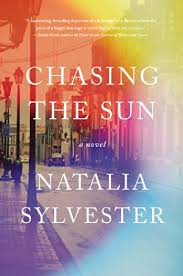
Natalia Sylvester's debut novel, Chasing the Sun, is set in Lima, Peru, during the terrifying years of the Shining Path. It tells the story of a marriage -in-crisis that is pushed to the brink by a kidnapping.

Natalia Sylvester’s debut novel, Chasing the Sun, is set in Lima, Peru, during the terrifying years of the Shining Path. It tells the story of a marriage-in-crisis that is pushed to the brink by a kidnapping.

Natalia Sylvester is a Peruvian-born Miamian now living in Austin, Texas. Her debut novel, Chasing the Sun, follows a frail marriage tested to the extreme by the wife’s kidnapping in 1990s Peru. Booklist called the novel’s ending “smart and unexpected.”

In this interview, Sylvester discusses restarting a novel after setting it aside for six years, the things that pull a marriage apart, and what happens when you pitch to American editors a novel set in Peru with an all-Peruvian cast of characters.

To read an exercise on moving the plot forward in a novel and an excerpt from Chasing the Sun, click here.

Michael Noll

I know the novel is based in part on the kidnapping of your grandfather in Lima in the 1990s. I’m sure that’s a story that you’ve been thinking about for a long time, not just what happened to your grandfather but the larger political situation in Peru at the time. What finally allowed you to turn that story into a novel? Was it a question of finding the right backstory for the kidnapping?

Natalia Sylvester

I think more than anything, it was time that allowed me to tell this story. I started writing it as part of my undergrad Creative Writing thesis back in 2005/2006, and back then (like I’d been most of my life) I was hesitant to talk to my family about my grandfather’s kidnapping. It’s something I’d known about and wondered about, but since we rarely spoke about it in much depth, I didn’t ask. I let all my questions pile up and even when I wrote the first drafts of Chasing the Sun, I wrote it quietly, keeping all my questions between me and the page.

Not surprisingly, the story didn’t come together the way I’d hoped. (Also, I was 21, newly engaged, and trying to write a story about a troubled marriage. I don’t really buy into the “write what you know” belief, but when I write I do need to find an access point into a story, and for me it can be almost anything, as long as it feels true.)

I set the book aside for nearly six years. I had no plans to ever revisit it, but my husband had read parts of it and would constantly insist, based on one scene he loved, that there was something there. This time I approached it with a heavy emphasis on research—not just on Peru and its political situation and the years of terrorism it experienced, but also the main thing I’d been avoiding all along, which was talking to my family about the kidnapping. Though none of the characters are based on my family, having their insights (and now I realize, their support) was so necessary because I wanted to restart this story from a place of truth and honesty.

Michael Noll

Speaking of the backstory, I loved the relationship between Andres and Marabela—it’s so complex. Even after Marabela is kidnapped, I found myself wondering not whether she’d survive but what would happen after she returned. This seems like a real accomplishment—to create a story that can rival kidnapping for suspense. How did you come up with it?

Natalia Sylvester

Natalia Sylvester's debut novel, Chasing the Sun, is a literary thriller that has drawn comparisons to Gillian Flynn's blockbuster Gone Girl.

Natalia Sylvester’s debut novel, Chasing the Sun, is a literary thriller that has drawn comparisons to Gillian Flynn’s blockbuster Gone Girl.

Thank you, I’m really touched by that. Their relationship took me by surprise from the very first draft. I’d originally written my thesis as a set of linked short stories, all told from different POVs, about Marabela’s kidnapping. I started with Cynthia’s POV, then Consuelo, then Ignacio, and then finally, Andres. When I got to his story, it was like they’d been keeping their troubled marriage secret from me all this time. And I thought that was pretty fascinating, because life never happens in a vacuum, even (or maybe especially) the kinds of things we most fear. I wondered if Andres would be able to compartmentalize, and not let his feelings about his failing marriage affect the decisions he makes as he tries to save Marabela. Their relationship became almost like an additional character I wanted to explore and dissect and understand.

Also, in the six years that I’d set the story aside, I’d gotten (happily!) married but seen a lot of marriages around me fall apart. So I became kind of obsessed with how that happens. How does something as huge as two lives, lived side by side for decades, fall apart to practically nothing? I thought it’d have to be something equally big and traumatizing, like a kidnapping, when really it’s the little things, the everyday, mundane gestures and regrets that can build up and pull us apart.

Michael Noll

I love the way the beginning of the novel sets up Andres’ value system (hard work pays, be assertive in business, honor your promises) and also the holes in that system (he doesn’t really pay attention or express concern for his family’s domestic employees). How important was it to establish those values early in the novel?

Natalia Sylvester

It’s interesting that you mention it because a huge chunk of that early scene, I didn’t end up writing until after the book had sold and I was working on my first round of revisions for my editor. Looking back, I feel very lucky the book sold like that, because I think it’s crucial to establish who a character is, what they stand for, and what world they’re living in, before you disrupt it all with something as earth-shattering as a kidnapping. What good is the “after” picture without the “before”? In fiction we’re often told, “Start with the inciting incident” but the false sense of security in the calm before the storm is equally rich in possibility.

Michael Noll

It’s not unusual to set novels in “exotic” locations, but it’s less common for American novels set in one of those places (in this case, Peru) to follow a cast of characters that doesn’t feature any Americans. I wonder if you encountered any resistance to the fact that it’s truly a Peruvian novel, about Peruvian characters. Did anyone, a reader or agent or editor, ever say, “Gee, couldn’t you make Andres an American?”

Natalia Sylvester

Not in exactly those words, but yes, several publishers that rejected the story expressed concern that it wasn’t tied at all to the U.S. Some wished there could be an American character, or maybe at some point, they go to the U.S. And you know, if there’s one thing I wish I could unlearn about publishing, or that I could make other aspiring authors unlearn, it’s this. Because I was blissfully unaware as I wrote Chasing the Sun that it being so Peruvian was unusual. I just thought, I’m writing a story, and of course I’m going to set it here, and these are the people who live in that world. It never occurred to me that they’d be seen as “difficult to relate to” because I’ve always believed we’re more alike than we are different, and that universal stories are just that—they can belong to any of us.

I’m very lucky that my publisher understood this; they actually loved that the book was so Peruvian. But my heart breaks when I realize what a struggle it was, and what a struggle it still is, for us to get our stories heard because they’re not perceived as part of the mainstream world.

July 2014

Michael Noll

Michael Noll is the Editor of Read to Write Stories.
An Interview with Smith Henderson

3 Jul
Smith Henderson's novel Fourth of July Creek is already in the works to become a television series.

Smith Henderson’s novel Fourth of July Creek is already in the works to become a television series.

Smith Henderson’s novel, Fourth of July Creek, made news before it was even released, in part due to the bidding war it inspired among publishers. So far, the novel has been called “the best book I’ve read so far this year” by the book editor of The Washington Post and “a hell of a great book” by Esquire. The novel is set in Montana and follows a social worker whose life becomes entwined with the delusional and grandiose actions of a would-be prophet and revolutionary, Jeremiah Pearl.

Henderson was the recipient of the 2011 PEN Emerging Writers Award in fiction. He was a 2011 Philip Roth Resident in Creative Writing at Bucknell University, a 2011 Pushcart Prize winner, and a fellow at the Michener Center for Writers in Austin, Texas. He currently works at the Wieden+Kennedy advertising agency, where he wrote the Chrysler Super Bowl ad featuring Clint Eastwood. His fiction has appeared in American Short Fiction, One Story, New Orleans Review, Makeout Creek, and Witness. Born and raised in Montana, he now lives in Portland, Oregon.

In this interview, Henderson discusses the challenge of dramatizing a character who spends much of his time off the page and his method for capturing the voice of a man who believes the Antichrist is alive and well.

To read an exercise on using summary in dialogue and an excerpt from Fourth of July Creek, click here.

Michael Noll

I love the way that you make Jeremiah Pearl present in the novel, even when he’s not actually on the page. The biggest way you do this is with the coins that have had holes somehow cut into them. Pete finds one of the coins in his change, and then he runs across individuals who’ve encountered the coins and are collecting them, which leads him to someone who’s had a face-to-face encounter with Pearl. I’m curious if the coins were always present in the novel or if you introduced them to solve some issue you were having, perhaps the difficult of writing about a guy who would necessarily spend much of his time in hiding.

Smith Henderson

I’m sure the coins were a solution, as you suggest, but it was also just one of those things that felt right, and may have been something I was going to have him do all along. You have a character in mind and you start to think of things he or she does and what those things could mean for the plot.

But as you say, Pearl is in hiding quite a bit, so it began to be important that he do enough things that he wasn’t hiding from nobody. People—not just the protagonist, Pete—needed to want to find him. And so then you just start to look at things that a guy like that would do that would draw attention. The coins were definitely part of that.

If there’s a craft takeaway from all this, it’s probably that a character’s actions should both move the plot and be expressive of that character’s core identity.

Michael Noll

While Pearl makes his first appearance early on in the novel, he isn’t seen a second time until about halfway through. In that span of pages, you’ve created a tremendous amount of suspense about his activities and who, exactly, he is. Did you worry about how you’d satisfy the intrigue you’d built up? In other words, how did you approach the scene that you must have known that your readers would be dying for—Pete’s second encounter with Pearl?

Smith Henderson

I honestly don’t recall approaching that scene. I remember being more concerned with making Pearl off-stage as compelling as scenes with him in them. A scene with characters in the same time and place is technically easier to do than having a character relate a story to another character.

But of course, there was pressure to make Pearl-in-the-flesh as vibrant, interesting, and troubling as possible. To have earned that intrigue. But then, the intrigue itself gives the character a certain degree of power. Playing against the created image of the man was a large part of the fun in writing those scenes.

Michael Noll

Smith Henderson's highly anticipated debut novel, Fourth of July Creek, was called "the best book I've ready so far this year" by Washington Post fiction editor Ron Charles.

Smith Henderson’s highly anticipated debut novel, Fourth of July Creek, was called “the best book I’ve ready so far this year” by Washington Post fiction editor Ron Charles.

One last question about Pearl (he’s tremendously fascinating). How much research was required to write his rants? Did you try to research the kinds of things he would have read about? Or did you research people like him to see what they talked about?

Smith Henderson

Well I’ve been to churches where people spoke in tongues and where the religious intensity was hotter than say, at a Unitarian church or something. I was privy to conversations about who exactly was the antichrist. So a lot of Pearl’s basic worldview was familiar to me, as it is to millions of Americans.

Also, people in Montana are generally suspicious of “outside” authority…so I was steeped in that kind of thinking before I ever conceived of Pearl. But as it came time to bring him to life, I did research into separatist movements and militias and the different flash points of the past 30 years. The Unabomber’s capture, the Ruby Ridge standoff, the hunt for Eric Rudolph. But Pearl’s voice was drawn from more older sources. I read a lot of Thoreau, Emerson, and even Nietzsche to get his pronouncements to sound properly grand. He’s as much a product of the Jesus who threw the money-changers out of the temple as he is Timothy McVeigh.

Michael Noll

The novel is written from a few different points of view, and in the sections about Pete’s daughter Rachel, you use a Q&A format. Was this a way to break up the pace of the novel? Her story takes place pretty far from Pearl’s story, and so I’m wondering if you felt the need to give her sections some extra velocity, some snap, to keep the reader’s mind from wandering back to Pearl and Pete.

Smith Henderson

The Q&A format is basically a way for me to generate material. I will often write that way to figure out a character or write my way out of a problem. With the Rachel sections, I just found that I liked them in the Q&A style. For a couple reasons. First, the identities of the Q&A aren’t really identified and work like a Greek chorus, sort of commenting on the action as they disclose it. But also, there is an inherent anxiety to the questions, which I felt really gave the reader Pete’s perspective on his daughter’s fate, his worry, his fear, his imagination running away with the possibilities…it’s as if every question is some version of “Is she okay is she okay is she okay is she okay…?” I found that much more satisfying experience as a reader.

July 2014

Michael Noll

Michael Noll is the Editor of Read to Write Stories.

An Interview with Murray Farish

12 Jun
Murray Farish

Murray Farish’s story collection, Inappropriate Behavior, includes stories about Lee Harvey Oswald and John Hinckley, Jr.

Murray Farish’s debut story collection, Inappropriate Behavior, was called “the best first collection I have read in years” by Elizabeth McCracken. Farish’s short stories have appeared in The Missouri Review, Epoch, Roanoke Review, FiveChapters, and Black Warrior Review, among other publications. His work has been awarded the William Peden Prize, the Phoebe Fiction Prize, and the Donald Barthelme Memorial Fellowship Prize. Farish lives with his wife and two sons in St. Louis, Missouri, where he teaches writing and literature at Webster University.

In this interview, Farish discusses the accretion of American pain, the despair of not finding the right ending, and writing stories in a world in which CEOs make 350 times the salary of their workers.

To read the collection’s title story, “Inappropriate Behavior,” and exercises on breaking narrative rules, click here.

Michael Noll

Early in the story, George and Miranda are discussing their son’s behavior and the problems he’s causing at school, and George says, “I just thank God that he’s healthy.” The conversation that followed really struck me for a couple of reasons. One, I have kids, and I think that I’ve probably said something similar to this. Two, the conversation seems to announce that this story is going to run counter to some basic ideas about propriety. Generally, thanking God for a child’s health wouldn’t be considered morally bankrupt, but that’s exactly what Miranda suggests, and both the reader and George come to realize that she’s right. Did the story always begin this way, or did you write the dialogue to perform a particular function within the story?

Murray Farish

The first thing I wrote that made the cut in the final draft of “Inappropriate Behavior” was a version of a much later scene where Archie is lying on the couch trying to figure out which of his toys he’s taking to heaven when he dies. I have to write a lot of pages and take a lot of false paths before I figure out what a story is about and what I want to do with it. Once I figure that out, I try to orchestrate everything—scene, setting, dialogue, situation, character—around that realization. That orchestration became even more important in this story, which I think of as nearly plotless and almost totally free of character development.

Michael Noll

In several places, you create catalogues of George’s thoughts and snippets of news that he hears. I’ve seen stories make similar moves before but never to the extent that you make them. The catalogues are very long–and so there’s the inevitable risk of losing the narrative thread. But that’s not what happens. The juxtapositions in the catalogues are savage, and the paragraphs contain some of the most gut wrenching lines in the story. This is generally true of the story as a whole. There’s another section about paying bills that isn’t a catalogue but works in a similar way. I can imagine a lot of writers drafting a couple of lines about bills and then moving forward into the story, but you stay with the bills for ten paragraphs. I kept expecting the narrative to stall, but it never did. How did you keep the momentum moving?

Murray Farish

Especially in a story that is plotless and free of character development? I worried about it a lot, until I decided to trust in the orchestration—or if that’s too grand a term to keep repeating—to trust the design of the story. Once I figured out that the story I wanted to write was about the Great Recession and how it was the natural result of four decades of political, legislative, and cultural malpractice and neglect of the commonwealth—of the failure to live up to ideals that we the people are obligated, by ink and by blood, to try to live up to . . . well, you can see the problem, for a fiction writer. But if that’s the story you’ve got to write, that’s the story you’ve got to write, so you’ve got to figure out how to write it. I decided to create this little family and inflict upon them a steady accretion of American pain, and hope to build narrative momentum out of that accretion.

Michael Noll

I have to admit that I felt a thrill at the story’s description of St. Louis: “It feels like exactly what it is: a static, lifeless, dead-water burg, a place that lacked enough imagination to remake itself when people stopped using beaver pelts as currency, and that runs, after a fashion, on the inertia of old money.” And that’s just one sentence in a long paragraph that ends with a line of bitter sarcasm: “Here’s something people say about St. Louis: It’s a great place to raise kids.” I can’t remember the last time I read such a brutal takedown of a place. I’m not sure I’d have the courage to write something like that. Given that you live in St. Louis, do you worry that someone you know will read this story and get upset?

Murray Farish

Well, of course that’s George’s description of St. Louis, and St. Louis is a place he feels victimized by, in a way. All this bad stuff is happening to him and there’s no one around to try to help him out. But however St. Louisans would feel about the description, to the extent that they would find it accurate, we also have to realize how places like St. Louis have themselves been victimized by that same neglect I talked about before. One of the most troubling things I’ve seen in my forty-some years as an American is precisely that lack of imagination, a fearful inability to conceive of how things might be different, might be better. That lack of common vision hits places like St. Louis particularly hard. To the extent that a St. Louisan might find the description inaccurate or unfair, I guess I’d have to plead artistic license.

Michael Noll

By the story’s end, you’ve put the characters in such an intensely difficult situation that it’s natural as a reader to want to look away, to avert our eyes from what we suspect will happen. And that’s exactly what you do–you shift the point of view in a way that’s bound to bother some readers who will expect a neat conclusion. But I actually loved the ending. In a way, it reminded me of what Richard Ford does in Independence Day: His narrator, Frank Bascombe, fails repeatedly to connect and successfully parent his son, and when it seems as if nothing good can happen, Ford knocks the kid out of the novel–literally. The kid gets hit in the head with a baseball and is knocked unconscious. I found that particular move frustrating—a cheat on Ford’s part—because then everything starts going Bascombe’s way again. But in your story, the shift in POV (the looking away) doesn’t change the characters’ fortunes. But it makes them easier to read—not less disturbing or emotional but readable, as if there’s only so much misery readers can take before they walk away. Your ending kept me with the story. That’s a lot of words to ask, how did you approach the ending?

Murray Farish

Finding the ending was as close to real despair as I’ve ever had as a writer. I had worked for months to winnow hundreds of pages down to the final version, up to the scene where George goes for the last meeting at Archie’s school. I knew I loved this story, but the steady accretion of pain had left the Putnams, and me, in a corner where there was no way to write a narratively satisfying and honest ending that would change their fortunes in any way. Do some sort of Horatio Alger bit? Launch an alien invasion or some other cataclysm that renders the economy irrelevant? Have George blow his brains out? I wrote versions of all of these, and many others, including one ending replete with learned footnotes and pie-charts and bar-graphs, which I think you’ll agree with everyone else who read that version that it was a bad idea. Somewhere in the midst of that despair I looked at the school principal’s statement at the end of the last “realistic” scene: “I’m sure you have questions.” So I put the story away and just started making this long list of questions—some from George, some from Miranda, some from American lit and American history, recent and ancient. My notion was not that this catalog of questions would become the ending, but I hoped that some question in there would trigger an ending. Then I saw that those questions could be orchestrated in a way that felt to me very honest and risky and perhaps even resonant, and if I couldn’t do narratively satisfying, I could at least do those things. Jumping out of the third-person, realistic mode also allowed me to return to the Putnams in the voice of Archie and the style of the fairy tale. Archie may be in a lot of trouble, anchored to this sinking family of his, but at least he still has imagination, and he’s not afraid. That’s about the only note of hope I could stand to build into this story, the notion that the future might be better if we don’t lose our courage and our imaginations. But realistically, Archie’s probably screwed.

Michael Noll

A. O. Scott of The New York Times didn't like the way the film Away We Go portrayed red America. You can read his review here.

A. O. Scott of The New York Times didn’t like the way the film Away We Go portrayed “regular” Americans. You can read his review here.

Many stories create unlikable side characters and then reveal some redeeming part of them. But not this story. George thinks this: “The greater part of what my neighbors call good I believe in my soul to be bad, and if I repent of anything it is very likely to be my good behavior: what demon possessed me that I behaved so well?” Because I think we’re supposed to empathize with George and his point of view, this is a pretty damning indictment of a great swath of the population of St. Louis. It reminds me of the Dave Eggers film, Away We Go, about a couple on the verge of parenthood who travel America trying to find a good place to raise their kids. But everywhere they go, they find people they don’t like. The New York Times critic A. O. Scott angrily criticized the film’s “smug self-regard” and its portrayal of “red state grotesques” and said, “This movie does not like you.” Do you feel any obligation to find the good in every character? Or, to put it in the negative, do you think fiction suffers when it’s too nice and open-minded?

Murray Farish

The quoted question about good behavior is from American lit, one that Thoreau asks in Walden, but of course it applies to George as well, as well as to the overall point that this section and this story is trying to make—what is “inappropriate behavior?” Is it the stuff this goofy kid does to get in trouble at school, or is it unnecessary wars and drone strikes and cutting off people’s unemployment benefits? Is it one little kid hugging some other little kid or is it the Trail of Tears? Is it hyperactivity or the abjuration of our responsibilities to one another? If the fact that CEOs make 350 times the salary of their workers isn’t at the very least inappropriate, I don’t know what is. I think the only obligations fiction writers have are to write the best story they possibly can, and to give the reader something they can’t get from anyone else.

June 2014

Michael Noll

Michael Noll is the Editor of Read to Write Stories.

An Interview with Jennifer Ziegler

5 Jun
Jennifer Ziegler's new middle-grade novel Revenge of the Flower Girls, has X

In Jennifer Ziegler’s new middle-grade novel Revenge of the Flower Girls, three flowers girls set out to ruin their sister’s wedding.

Jennifer Ziegler’s latest middle-grade novel is Revenge of the Flower Girls. She’s also the author of How Not to Be Popular and Sass & Serendipity. She teaches writing workshops, edits other writers’ work, and creates writing programs for The Writer’s League of Texas. She lives in Austin, TX, with her husband, the writer Chris Barton, and their four children.

In this interview, Ziegler discusses inventing characters, the importance of villains, and her method for keeping the plot straight in her head.

To read an excerpt from Revenge of the Flower Girls and an exercise on creating villains, click here.

Michael Noll

I’m interested in how you invent characters. Some of the characters in the book, especially Mrs. Caldwell, exude a kind of essential Texan-ness. Her last name is even a famous Texas name. But other characters are much more idiosyncratic. For instance, you describe Aunt Jane this way: “She’s tall and strong. She played professional basketball for a while and then taught PE classes here in Blanco County. Now she lives in Boston, where she runs a bar.” What do you draw on to create your characters?

Jennifer Ziegler

The way I invent characters is a mystery even to me. I often feel that characters gestate in my mind for a long time until the right story concept comes along. How they get planted there, I don’t really know. I suspect that they are amalgams of people I know or used to know or observed from afar. They are never close replications of individuals from my life. Even when I’ve tried to put friends or family in my novels the characters based on them morph into their own distinct beings. At times I’m aware that I’m borrowing elements from real people (their mannerisms or looks or habits of speech), but more often I have no idea. There have been instances when I’ve flipped through a published book of mine and suddenly realized who a character was partly based on – subconsciously. That’s always a strange revelation. But I suppose all novelists can at least be partly psychoanalyzed through their fiction.

Michael Noll

There are several instances in the book where the triplets create a plan of action and describe it in detail—and then, of course, the plan goes off the rails. I know that you’re a thorough outliner of plot, and I’m curious how these sorts of plans factor into your outlining. From a reader’s perspective, they’re great at creating suspense. But are they useful to you as a writer as well?

Jennifer Ziegler

Yes very. The triplets’ schemes are integral to the book’s plot. I had to make sure I got everything straight before I started writing because logistics aren’t my strong suit. I like to disappear into the story as I go along and whenever I get yanked out of that world in order to work out the cause and effects, it slows down my momentum. I knew who the triplets were and what they wanted, so it was just a case of figuring out how they would approach this problem and what would be the outcome of each of their plans.

Knowing who they were told me what they would do. Because the girls are big history buffs, it made sense that they would brainstorm complicated operations – that they would be action oriented rather than just mope. But, of course, they are only 11, so their lack of worldly experience translated into somewhat unrealistic schemes. The plans show just how far the girls will go to help their sister, what they’re good at, how they assume the world works, and how they work together – so they also help reveal character.

Michael Noll

The novel features three narrators who are triplets. Each of them takes turns telling the story, which must have presented an enormous challenge to you as the writer: how to distinguish between them. One thing I noticed is that you give the triplets, and all of the characters, tags. For instance, the triplets are history buffs, and so they judge each other and everyone else based on their choice of favorite president of the United States. For instance, Darby mentions that their big sister’s ex-boyfriend liked Thomas Jefferson, and says, “We all respect that.” But the big sister’s fiancé likes Franklin Pierce, and she says that “we all agree that Pierce was not one of the best.” This reminds me of the way George Lucas used motifs in Star Wars: a particular musical phrase that corresponds with each character. Is this technique essential for the kind of story you’re telling, or is it something you use regardless of the story?

Jennifer Ziegler

I use it regardless of the story. It’s showing rather than telling. You, as storyteller, know so much more about the characters with regard to who they are and where they came from. The problem is, you can’t put it all in the book, and you don’t want to interrupt the action with big information dumps. So instead you impart key aspects of character through dialogue, action, description, and these nuggets of revealing information – or tags. The fact that Burton names Franklin Pierce as his favorite president tells the triplets (and the reader) that he either A) doesn’t know his presidential history or care about it or B) is judging by very different, perhaps very superficial, standards. Both possibilities are alarming to the triplets.

Michael Noll

The novel has a very clear villain. At every opportunity, Mrs. Caldwell does something unlikable. For instance, when the wedding menu is being planned, she refuses to include meat-free options for the bride, who is a vegetarian. She says, “Yes, but this wedding also includes a big strong boy who needs nourishment.” And, “Yes, but the meat eaters who will be attending the wedding will far outnumber the vegetarians.” Her lack of empathy or sense of compromise is pretty astonishing. How important is it to create a character like this—and to create moments where she can be bad?

Jennifer Ziegler

In this story it was critical that there be a clear antagonist. For one thing, the title sort of promises it, and for another, the mayhem created by the girls would be excessive and mean-spirited if there wasn’t a clear reason for it. The readers have to believe in their mission, too.

At the earliest concept stages, there was no mother-in-law character and I intended to make the groom the antagonist. But that didn’t work. It didn’t make sense that Lily – even if she was on the rebound – would fall for someone villainous. Burton isn’t a bad guy, he just isn’t the right guy. It’s clear to the sisters, and hopefully to readers, that Lily is about to make an awful mistake. But for them to go to such extremes and be thwarted meant there had to be some equal opposing force. Thus, the pushy Mrs. Caldwell was created. Her son is basically her whole life and she will stop at nothing to get what she wants for him. Plus, she is the type of woman who is used to getting her way. It is gradually revealed that she is meddling in her own fashion as much as the triplets are. The difference is that she’s trying to manipulate her vision of her son’s future regardless of what’s right for everyone involved. The girls, on the other hand, just want to make sure their sister is happy. I liked this juxtaposition.

June 2014

Michael Noll

Michael Noll is the Editor of Read to Write Stories.

Henry Louis Gates on the Legacy of James Baldwin

29 May
James Baldwin

James Baldwin once appeared on the cover of Time after writing a best-selling book of essays. In the essay, “The Fire Last Time,” Henry Louis Gates discusses the complex legacy of Baldwin’s work.

In Texas, many high school required-reading lists include To Kill a Mockingbird, a novel that often provides the students with their sole glimpse of the Civil Rights era and issues of racism. Sometimes the students also read Dr. Martin Luther King Jr.’s “Letter from Birmingham Jail,” which is a start, but clearly more African-American voices are needed in high school curricula. One of those voices ought to be James Baldwin.

Baldwin was, for a time, one of the most famous writers in America. Time put him on the cover in 1963, following the publication of his book of two essays, The Fire Next Time. (This was three years after the publication of To Kill a Mockingbird. To say that the books portray the world in different ways is putting it lightly.) Baldwin was also the author of many novels, including Go Tell It On the Mountain and Giovanni’s Room, and collections of essays, including Notes of a Native Son, which contains a complex discussion of Richard Wright’s novel. Baldwin was gay, and because of the way this fact was received, he eventually moved to France, where he spent most of the rest of his life.

Ironically, despite his immense literary output and former prestige, most high school and college students today rarely encounter Baldwin’s work, the lone exception being the story “Sonny’s Blues.” I’ve taught college composition and literature for almost ten years and used many different anthologies, and the only other work of Baldwin’s that I’ve ever encountered in a course text is his essay about living in Switzerland, “Stranger in a Village.” 

There are likely numerous reasons for the absence of Baldwin’s work in many classrooms and texts: American’s enduring racism, Baldwin’s sexual identity, his criticism of Christianity, the fact that he lived most of his life in Europe, his at-times contrarian attitudes toward some of the major African-American of the time. Rather than attempting to discuss these, I’ll leave that work to someone much more knowledgeable and smarter than me. A few years ago, Henry Louis Gates wrote an essay, “The Fire Last Time,” for The New Republic. In it, Gates talks about meeting Baldwin and wrestling with his work. The essay is one of those shining examples of a highly erudite and entertaining intellectual discussing and assessing a writer’s work in the context of changing movements and aesthetics. In other words, it’s very good. You can read it here at The New Republic.

May 2014

Michael Noll

Michael Noll is the Editor of Read to Write Stories.

An Interview with Bret Anthony Johnston

15 May
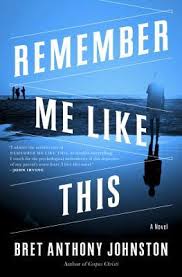
Bret Anthony Johnston's story collection, Corpus Christi, was named Best Book of the Year by The Independent and the Irish Times. He has just published his first novel, Remember Me Like This.

Bret Anthony Johnston’s first book, Corpus Christi: Stories, was named Best Book of the Year by The Independent and the Irish Times. His new novel, Remember Me Like This, tells the story of a boy who disappears in Corpus Christi and then mysteriously turns up.

Bret Anthony Johnston new novel Remember Me Like This, tells the story of a Corpus Christi family whose young son disappeared for years and then mysteriously reappeared. A review in the Washington Post says that the book asks, “But what happens after the cable news hysteria fades away, and the mayor issues a proclamation and the tearful grandparents fly back home? Are these rare families like lottery winners who celebrate in public and then, in the months that follow, squander their good fortune?”

Johnston is the author of Corpus Christi: Stories, which was named a Best Book of the Year by The Independent (London) and The Irish Times, and the editor of Naming the World and Other Exercises for the Creative Writer. He currently serves as Director of Creative Writing at Harvard University.

In this interview, Johnston discusses suspenseful imagery, the challenge of finding the right tone, and his approach to place in fiction.

To read an excerpt from Remember Me Like This and an exercise on setting the mood in fiction, click here.

Michael Noll

The novel begins with a body facedown in the water. This image doesn’t return until almost the end of the novel. In fact, it’s almost possible to forget about it since it’s not long before the drama of the novel takes over. What went into your decision to open the novel with that image? Did you worry that the reader would become impatient with wanting to return to it?

Bret Anthony Johnston

My hope was that the image would embed itself in the reader’s subconscious memory, that it would be something of a shadow that followed them through the story. I wanted them to wonder about the body; I wanted it to keep them from getting too comfortable in the story, to preclude them from taking survival for granted. That is, I wanted them to share the experience that the family endures. Starting the book that way seemed to invite a necessary kind of empathy. Of course you’re right, though, in that it’s almost possible to forget about the image. That’s the gamble I had to take so that when the body returns, the reader is jolted and yanked back toward a kind of raw vulnerability. I hope it works. If it didn’t, don’t tell me.

Michael Noll

The scene where Justin appears for the first time is really well done and uses a deft trick of misdirection. I can imagine that scene was difficult to write. The readers been waiting for it intently, and so there’s a need to both meet and confound their expectations. How did you approach that scene?

Bret Anthony Johnston

Your reading of the scene, the craft behind it, is incredibly accurate and I really appreciate such close reading, Michael. Thank you. What you’re pointing out, though, actually came with relative ease—meaning, it was stunningly difficult and time-consuming, but still not as difficult or time-consuming as other scenes—because it was the result of empathizing with the characters. I only had to understand what the characters would be feeling in that moment, and because I knew them well by that point in the book, their reactions were readily available. Once I understood that she would fixate on her memory him being afraid of snakes, I felt really at home in her reaction.

What took an enormous amount of time was striking the right balance in what might be called tone. I revised and revised and revised to get the scene to move evenly toward the revelation. I struggled with the pace for many drafts. I struggled with the cop’s reaction and the district attorney’s entrance. As you say, it was a scene that we were all waiting to see—not least the writer and the characters—and I took care not to speed through it or linger in an indulgent, self-defeating way. One of the pieces of advice that I regularly dole out to my students is to engage the opposite emotion of what the reader would expect, and I relied on that here. The expectation, I thought, would be hopefulness, but I didn’t think these characters had much hope left in them. I saw that as an opportunity, a way in.

Michael Noll

Bret Anthony Johnston's debut novel, Remember Me Like This, has, according to Esquire, a "driving plot but fully realized characters as well"

Bret Anthony Johnston’s debut novel, Remember Me Like This, has, according to Esquire, a “driving plot but fully realized characters as well.”

The novel returns to certain places (the empty pool at the “half-razed TeePee Motel” and the Marine Lab). The places begin just as places where the characters go, but over the course of the novel, several of the most important events occur there. Did you have certain dramatic scenes in mind when you first introduced those places into the novel? Or, did you explore the places and return to them until the drama presented itself?

Bret Anthony Johnston

The latter. When I start writing anything, I have no intentions of any kind, and the novel was no different. I approach every piece of fiction the same way, which is to pay attention to the details, images, and artifacts of the story and take nothing for granted. My impulse is to reach backwards in a story rather to stretch forward, so I’m always asking myself what’s already in play that I can use again, that I can recycle in a manner that will reward the reader’s attention. It’s a mechanism of repetition and evolution. In this case, I returned to various places until those places evolved to mean something other than what they had. I think a lot of new writers are excited by the prospect of constantly bringing in new material, new imagery or settings or objects, but I think the more satisfying move is often to juggle what you already have so that the reader sees something familiar in a new, more revelatory light.

Michael Noll

It’s been ten years since Corpus Christi: Stories was published. Since then you’ve continued to write stories, and you’ve also published a book of creative writing exercises and written a film documentary about skateboarder Danny Way. Plus, you direct the writing program at Harvard. In other words, you’ve been pretty busy. And yet, I can imagine there was pressure to produce a novel, especially since your first book was so well received. How were you able to resist that pressure, to discover the novel you wanted to write and then write it at a pace that would allow it to become the book you had in mind?

Bret Anthony Johnston

You’re absolutely right about the pressure, but I regard any kind of pressure as a privilege. I’m incredibly fortunate to have editors and readers who want to read my work, and I refuse to take that as a given. Honestly, it still surprises me. It really does. It surprises me to the degree that I don’t fully believe anyone when they ask to read something I’ve written; I think they’re just being nice.

And yet it’s always been clear to me that I’m a slow writer and there will be years between the books that I’m lucky enough to publish. Meaning, I don’t want to publish something until I think it’s ready, until I’ve written the book I want to read, because it will be a long, long time before I have the opportunity to redeem myself. What this means is that I’ve missed many deadlines. I know I missed at least three for the novel, though maybe I missed more. The book just wasn’t ready, and publishing it would have seemed a kind of malpractice. I always gave the publisher the opportunity to cancel my contract, and I apologized profusely, but I also wouldn’t show them the book until it was ready. I worked with an amazing editor named Kendra Harpster, and she was beyond supportive. Not only would the book not have been published without her, the published book wouldn’t be nearly as successful without her guidance. It’s another way that I got lucky. I’ve been lucky my whole career. Lucky and slow, that’s my life as a writer. I wouldn’t change it for the world.

May 2014

Michael Noll

Michael Noll is the Editor of Read to Write Stories.

An Interview with Sarah Bird

8 May
Sarah Bird's eighth novel, Above the East China Sea, has been called her most powerful book yet.

Sarah Bird’s ninth novel, Above the East China Sea, has been called her most powerful book yet.

Sarah Bird is the author of eight novels that have been honored by the New York Public Library’s 25 Books to Remember list, Elle Magazine Reader’s Prize, People Magazine’s Page Turners, and Library Journal’s Best Novels. Her latest novel, Above the East China Sea, tells the entwined stories of two teenaged girls, an American and an Okinawan, whose lives are connected across seventy years by the shared experience of profound loss, the enduring strength of an ancient culture, and the redeeming power of family love. Bird has written screenplays for many studios and independent producers and has contributed articles to The New York Times, Salon, O Magazine, and Texas Monthly. As a kid, she moved all over the world with her air force family, and now she lives in Austin, Texas.

In this interview, Bird discusses composting research into story, writing in bed, and why some surprises aren’t good for readers.

To read excerpts of Above the East China Sea and an exercise on moving characters around in fiction, click here.

Michael Noll

You’re an American writing about a place—Okinawa—that has a long, difficult relationship with Americans and the United States. You spent part of your childhood in Okinawa, and so you’re familiar with the island from the American perspective. In this excellent interview with Mary Helen Specht, you said that you tried to imagine yourself “outside of the fence and ask questions like, How would an American would feel if, say, the entire eastern seaboard, were occupied by foreigners?” That seems like a necessary but difficult imaginative leap. How did you approach the problem of crossing that fence, so to speak, and trying to see things from the Okinawan view with as little of the inherently residual American view clouding your perspective? 

Sarah Bird

The major question I wanted to look at in this novel is how the price of imperial ambition is always borne most heavily by the young. That was true when Japanese industrialists seized control of the government around the turn of the century and began militarizing that country. And it’s been tragically true for our country.

History is a kaleidoscope that can be twisted in an infinite number of directions. Settling on the correct lens through which to view both the contemporary and historical stories in this novel required years of education. Like most writers, I was a born observer, outsider, and almost burdened by a high degree of imaginative empathy. So shifting perspective wasn’t hard, but getting the factual context right did require lots of research.

Michael Noll

At one point in the novel, the characters visit a strip of Sōpus, or bath houses. The passage approaches these places a couple of ways. There’s direct description (“The two-story building is covered in bathroom tile and features giant posters of young Japanese girls in sexy nurse uniforms and pink scrubs.”) and also historical summary (“Whorehouse? Technically, no, since prostitution has been illegal in Japan since the mid-fifties.”). The latter seems easier than the former to write: in theory, you’re relaying your research to the reader. But in the direct description, you’re bringing that research to life. How did you approach these kinds of scenes and descriptions? Or, in other words, how did you convert the facts of research into the breath of story?

Sarah Bird

Michael, I love the entire process of converting research into fiction and think of it as composting. I try to toss rich, nutritious items onto the pile, horse manure, food scraps, along with grass clippings and dead leaves. I let it steep for months in a spot that receives ample sunshine. And I trust that a dark, buried world of microbial beings will convert the whole mass into a medium capable of sustaining a character, a story.

For this novel in particular, I spent many happy months researching in libraries, online, and doing personal interviews. Most useful, probably, of all these avenues in creating a character are diaries, personal narratives, and fiction set in the time and place of interest. Then, when it comes time, after this mulch pile has stewed in my brain long enough, I put all my books and notes aside and channel the character. If I’d absorbed enough of the right ingredients, something good usually sprouts.

Michael Noll

Sarah Bird is the best-selling author of The Yokota Officers Club and, now, the much anticipated Above the East China Sea.

Sarah Bird is the best-selling author of The Yokota Officers Club and, now, the much anticipated Above the East China Sea. Signed, personalized copies of the novel can be pre-ordered from BookPeople, the Austin independent bookstore.

The novel takes place in two different time periods (1945 and present day). An inherent risk in this structure is that every time you switch between time periods and stories, you break, at least momentarily, the narrative momentum. Did you find that this was something you had to think about in structuring the chapters and novel as a whole? 

Sarah Bird

Without intending to, I seem to gravitate toward telling stories from two points of view. It was essential for this novel since I wanted to show how we are all formed by our national narratives. This was a right-brain, left-brain process so distinct that worked in two entirely different spots. When I was in full fiction mode, the dreaming, empathy, channeling part, I wrote in bed, in longhand on a yellow pad. That was where the characters spoke to me and I took dictation. For the shaping part I sat at my desk edited the material and made the two girls’ stories cohere.

In the end, I was astonished at how well the two narratives braided together. How, guided by their deepest yearnings, they told stories that wove together and amplified each other.

Michael Noll

The promotional copy for Above the East China Sea describes the novel as a “stunning departure.” I’m curious what this phrase means to you. It’s not like you’ve been writing zombie erotica. At a recent panel sponsored by The Writer’s League of Texas, you described your books as midlist literary fiction. What makes this novel different?

Sarah Bird

Okay, the “stunning departure” thing is a way to signal to readers that this one is not funny. I’ve written both intensely serious books and others that are regarded as comic novels. And, whoa doggies, judging by reviews on Amazon, if a reader comes to you expecting larfs aplenty and they get, oh say, the invasion of Okinawa when more people died than at Hiroshima and Nagasaki combined, well, that is not a happy reader. And that reader departs. Stunned.

May 2014

Michael Noll

Michael Noll is the Editor of Read to Write Stories.

An Interview with Óscar Martínez

1 May
Óscar Martínez is a staff writer and editor at El Faro and the author of The Beast: Riding the Rails and Dodging Narcos on the Migrant Trail

Óscar Martínez is a staff writer and editor at El Faro and the author of The Beast: Riding the Rails and Dodging Narcos on the Migrant Trail.

Óscar Martínez spent two years traveling with Central American migrants to the United States through Mexico. He visited places and people (sites of cartel massacres, coyotes who work for the cartels, mountain trails where migrants take their chances) that almost no journalist had ever seen. His reports were published in the Salvadoran online newspaper El Faro, collected in the book Los migrantes que no importan, and translated into English as The Beast: Riding the Rails and Dodging Narcos on the Migrant Trail.

Martínez lives in El Salvador and edits El Faro‘s “Sala Negra,” a continuing investigation of gang violence and organized crime in Central America.

In this interview, Martínez discusses telling violent stories, the verisimilitude of a hit man, and planning trips into areas controlled by drug cartels. You can read Martínez’s original answers in Spanish, along with English translations. (Thanks to Chris Dammert for helping with translation and interpretation.)

To read the first chapter of The Beast and exercises on ending stories and distinguishing fact from fiction in essays, click here.

Michael Noll

You write about Saúl, a 19-year-old who is deported from Los Angeles to Guatemala. He is beaten and captured by a gang led by a man who turns out to be his father. The story ends this way: “He only got out alive by covering himself (and the 18 tattooed on his back) in mud and pretending to be insane.” That last sentence is stunningly short. How did you know or figure out which details to leave out and which to include?

Óscar Martínez

For me, there is a logic to the narration of violence: don’t embellish or elaborate what is already a very heavy subject. To add my assessment to Saul’s already convincing story would have been a distraction. His story is valuable just for that: how distinct and forceful it is. The only proof I have that it is true is because he told it to me in such a very frank way and with a context that made it plausible. I obviously never knew his father. Sometimes the narrator of nonfiction puts the reader in this dilemma: do you believe me or not believe me? It’s your decision.

Para mí hay una lógica en la narración de la violencia: no pretendas exagerar, no pretendas engordar lo que ya es pesado de por sí. Agregar mis valoraciones a la contundente historia de Saúl hubiera estado de más. Hubiera generado distracción. Su historia-mínima es valiosa por eso, por lo contundente, por lo integral, por lo sucinta. La única prueba que tengo de que es verdad es que así lo creo, que me lo contó de una manera que me pareció franca y que en el contexto su historia es verosímil. Yo, evidentemente, nunca conocí a su padre. A veces, un narrador de no ficción pone en ese dilema a su lector: ¿me crees o no me crees? Es tu decisión.

Michael Noll

You describe a migrant on the train as crucified on the front of the car and talking with his cousin and two Nicaraguans. Other writers might have focused on the danger but not the dull routine. How were you able to find this balance?

Óscar Martínez

Other writers would have ruined the story. This is how it happened, how it was told to me. It was right this way. The daily nature of the scene adds verisimilitude to the lives of these people: Who the hell flees, kills, dies all the time? People need to shit, get tired, play cards, eat, discuss, fall in love, and think. If they don’t, they don’t exist. Who empathizes with Rambo?  Can you see your brother or father as a hit man all the time? I don’t think so. Sometimes in nonfiction we create Martians, people who cannot exist. We take pieces of them that are thrilling. But that kind of story, without those real moments of calm, would be boring, empty.

Otros escritores habrían arruinado entonces la escena. Así ocurrió, así me lo relató. Así era justo contarlo. Lo cotidiano de la escena agrega verosimilitud a las vidas de estas personas: ¿Quién demonios huye, mata, muere todo el tiempo? Los personajes necesitan cagar, estar cansados, jugar cartas, comer, discutir, enamorarse, peinarse. Si no, no existen. ¿Alguien puede sentir empatía por Rambo? ¿Alguien puede ver reflejado a su hermano o a su padre en un sicario a tiempo completo? No lo creo. A veces, en la no ficción creamos marcianos, gente que no puede existir, de quienes solo recortamos aquello que es emocionante. La acción, sin sus remansos reales, es aburrida, vacía.

Michael Noll

El Faro is the first online newspaper in El Salvador and one of the leading sources of investigative reporting in Central America. Óscar Martínez edits Sala Negra, which focuses on organized crime.

El Faro is the first online newspaper in El Salvador and one of the leading sources of investigative reporting in Central America. Óscar Martínez edits Sala Negra, which focuses on organized crime.

You often became a participant in your story. For example, your photographer frightened bandits off the train by shining all of his lights at them. As a result, I wondered why the cartels allowed you to move about in their areas. Are they so powerful that they simply don’t care if anyone finds out what they’re doing? Are they so focused on drugs that someone interested in migrants doesn’t matter? Now, you’re working with Sala Negra. Have the cartels and organized crime organizations become less tolerant of your reporting?

Óscar Martínez

The simple reason: time. I had time, we created a project with my paper that allowed me to do pre-production on each one of my trips. I had time to find a reliable source to plan my route, to find hostels. In short, to crack the system of the criminal world. Sometimes we would get counterintelligence against the mafias in order to penetrate their areas. With respect to life at Sala Negra: yes, it is more difficult. El Salvador is not Mexico, where I could take a trip to Tamaulipas or a trip by train to Tenosique and then return to a city like Mexico City, where I was anonymous. We would go one month and then we would take time to write what we had seen, to edit the photographs. In San Salvador, even though I live a privileged life, I live much closer to that black mass all the time.

La respuesta es sencilla: tiempo. Tuve tiempo, creamos un proyecto junto a mi periódico que me permitió hacer pre-producción de cada uno de mis viajes. Yo tenía el tiempo que deseaba para encontrar a la fuente de confianza, para planificar mi ruta, para permanecer en un albergue. En fin: para quebrar esa lógica de dominio criminal. A veces, hacíamos contra-inteligencia ante las mafias para poder penetrar en sus zonas. Respecto a la vida ahora en Sala Negra: sí, es más difícil. El Salvador no es México, donde yo realizaba una incursión a Tamaulipas o un viaje en tren o una visita a Tenosique y luego volvía a una ciudad como DF, donde era anónimo. Íbamos un mes y luego nos retirábamos para escribir lo que habíamos visto, para editar las fotografías. En San Salvador, aunque mi vida es privilegiada, vives mucho más cerca de esa masa oscura todo el tiempo.

Michael Noll

In an interview with The Texas Observer, you said that people in the United States have “no idea at all that what the migrants are going through is actually a humanitarian crisis.” The same is true in Mexico. Many people don’t know or don’t want to know. How does it affect the way you tell the story when you’re one of the first people to tell this story?

Óscar Martínez

For me it was a luxury. Being one of the first was what gave us such a wide, panoramic view, unlimited possibility, virgin territory in many places. Tenosique criminals never imagined that an international reporter would be interested in getting to Ranch La Victoria or Macuspana, which was why they didn’t have any way to detect us. That being said, it was a ninth-month process to organize the book. To tell what hasn’t been told much makes the task even greater because you have a blank page and the possibilities are unlimited. You have notebooks that are full, hours of recording, videos, photographs, and yet a blank page that’s asking, from all of this, what will you tell? And what will you leave out?

Para mí eso fue un lujo. Ser de los primeros fue justamente lo que nos dio un panorama tan amplio, unas posibilidades ilimitadas, un terreno virgen en muchos lugares. Los criminales de Tenosique nunca se imaginaron que un reportero internacional se interesaría por llegar al Rancho La Victoria o a Macuspana, por eso no tenían controles para detectarlo. Eso sí, fue un reto de nueve meses ordenar el libro. Contar lo que se ha contado poco duplica el reto ante la página en blanco, porque las posibilidades siguen siendo interminables. Tienes libretas llenas, horas de grabación, videos, fotografías, y una página en blanco que te pregunta: ¿Qué de todo eso contarás? Y por tanto, ¿qué dejarás de contar?

May 2014

Michael Noll

Michael Noll is the Editor of Read to Write Stories.

An Interview with Adrian Van Young

24 Apr
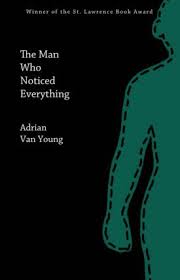
Adrian Van Young is the author of the story collection The Man Who Noticed Everything.

Adrian Van Young’s story collection, The Man Who Noticed Everything, has been called “seedy, even unnatural” and full of “Cthulian horror.”

Adrian Van Young’s story collection, The Man Who Noticed Everything, won the 2011 St. Lawrence Book Award from Black Lawrence Press. His fiction and nonfiction have been published or are forthcoming in LuminaGiganticElectric Literature, The American Reader, Black Warrior ReviewThe Believer and Slate, among other publications. Van Young has taught writing at Boston College, Boston University and Grub Street Writers, in Boston, and writing and literature at the Calhoun School, 826 NYC and the Buckingham, Browne and Nichols School. Currently, he teaches writing at Tulane University in New Orleans, LA, and lives in New Orleans, LA with his wife.

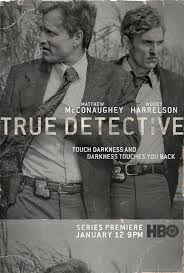
In this interview, Van Young discusses monster creation, mall gothic, and genre-benders like True Detective.

To read “The Skin Thing” and an exercise on writing one-sentence paragraphs, click here.

Michael Noll

I love the monster in the story, the actual The Skin Thing. It’s such a simple concept. There’s no origin story, no technical explanation of its mechanics or motives. It’s just a blob that sometimes eats people and sometimes doesn’t. How did you come up with the monster? Did you start with The Skin Thing and write the story around it? Or did you have a sense for the kind of story you wanted to tell and create a monster to fit?

Adrian Van Young

Thanks! I was happy with the way it turned out. To begin to answer the first part of your question, the story was solicited by Gigantic Worlds, a terrific anthology of flash science fiction forthcoming from Gigantic Books and featuring a great many writers who I slaverously admire such as Brian Evenson, Laird Barron, Meg McCarron, Alissa Nutting and Adam Wilson, to name just a few. So the genre was somewhat decided in advance.

But I knew from the get-go that I wanted to write an alien story and that moreover I wanted the alien itself to be Lovecraftian—a creature that presides terribly over human destiny but from a point beyond human knowing. Of course, when you’re going the Lovecraftian route, you don’t always want to hew to what’s been done, you want to make it new, so I started thinking, as well, about the scariest element of successful horror-inflected science fiction, which in my mind is always the human element. It’s a simple but effective principle. Take the Alien trilogy, for example. In the second film—which also takes place in a ruined space colony on a planet not unlike Oblivia—sure, H.R. Giger’s Xenomorph creature is responsible for a lot of the bloodshed, yet were it not for The Company’s decision to send the colonists and then the space Marines into a potentially dangerous situation or The Company’s decision, via Burke the corporate shill, to harvest a human host for military research, then a lot of what transpires over the course of the story would be moot. Which is a roundabout way of saying that I wanted the true horror in “The Skin Thing” to be not the creature itself but rather—not to belabor the obvious—what the colonists put on the creature and how they react to it in a setting of isolation and privation. Thus came my decision to call the creature The Skin Thing and to have it share with humans the largest and most superficially recognizable human organ: skin. So while the creature is “The Skin Thing” by name, the colonists themselves, whether they want to admit it or not, are doing “the skin thing,” i.e. the human thing— segregation, violence, cruelty, oppression, what have you, which humans have done with remarkable skill since they first crawled out of the ocean, notwithstanding hideous creatures to expedite the process.

So I guess you could say that, yes, I tailored the monster to fit the story, more or less. On another level, though, the look of the monster emerged partly from my obsession with Jim Henson Puppet Factory creatures and the like—the painstaking craft that at one point in time went into fashioning grotesque bodies. Guillermo Del Toro, god bless him, carries on the tradition today in film, Laird Barron and Caitlin R. Kiernan in literature. And somewhere in there must’ve been the sandworms from Dune, combined with a sort of eyeless sloth, combined with a terrestrial bat.  I was—and am!—a super nerdy and monster-obsessed little kid. After watching Star Wars and Dune, or reading The Tommyknockers and At the Mountains of Madness, all I could think of for days were the monsters.

Michael Noll

You write a lot of one-sentence paragraphs in the story. For example, this passage about the people who were sacrificed as a series of one-sentence paragraphs:

McSorls came first. McGaff. McShea. McVanderslice. McGuin. McGreaves…

Colonists total: two-hundred and forty. Colonists fed to the thing: thirty-six. Colonists saved on account of this practice (not to mention the onions): one hundred, at least.

Life was, for an instant, as right as it could be. 

Until the matter of McGrondic.

Is this style simply the way you find yourself writing? Or did you discover this style in an attempt to achieve a certain voice or tone or effect?

Adrian Van Young

The Man Who Noticed Everything has been called, by John Wray, "the secret love-child of so many authors I admire, from Ambrose Bierce to H.P. Lovecraft to Sherwood Anderson to Tobias Wolff."

The Man Who Noticed Everything has been called, by John Wray, “the secret love-child of so many authors I admire, from Ambrose Bierce to H.P. Lovecraft to Sherwood Anderson to Tobias Wolff.”

That’s an interesting question; I’m glad that you asked. Before a couple years ago though, I think you would’ve found that my fiction trafficked in lengthy, solid blocks of text that scrolled endlessly down the page. And unless you’re Thomas Bernhard—who I sometimes wish I was!— that’s not always going to work, especially with the modern reader. I learned from writers like Denis Johnson and Lydia Davis and Peter Carey, to name only a few, the indelible power of a well-placed one-sentence paragraph. It can just slam you, if you do it right. I also think it strengthens the bridge between fiction and poetry—namely, treating fiction as a kind of long-form, narrative poetry that demands equal if not more attention to rhythm, word combination and line-breaks, as it were. When I myself am writing a piece of fiction I always have a rhythm in my head that I want the words to conform to—so much so that at first I end up choosing words irrespective of precision, allusion or inflection and solely based on whether or not they fit rhythmically into the musical scheme of the sentence. That rhythm can be imprisoning. In drafting, of course, I go back and end up recalibrating the music of the sentence to fit the aims of the words but in the first draft, at least, rhythm is everything to me. One-sentence paragraphs further this sense of rhythm because they each signify a clean break from and a full stop after the sentence before. They also speak with a lovely straightforwardness to the writer’s intent—take note of this sentence!—and serve to move the story along in accord with how a reader’s eye moves down the page and how that eye, in turn, translates those words into brain matter, i.e. image, image, scene, image, scene, scene, image, etc. As you can see, my writing is heavily influenced by film, but at this point I’ve seen so many, how could it not be!

 Michael Noll

This story reminds me a lot of “The Ones Who Walk Away from Omelas” by Ursula K. Le Guin. (It’s also set in a place not unlike the colony in her novel The Dispossessed.) Both stories are science fiction, of course, and they’re both written in first person plural and formal in tone. Both read like myths, though your story has more narrative (I suppose, in that sense, it’s not unlike Shirley Jackson’s “The Lottery”). I’m curious what draws you to this style and form. Are you after that mythic sensibility, and science fiction/speculative fiction is a form that allows for it?

Adrian Van Young

Funny you should mention that Le Guin story, because in spite of the fact that several other people had noted a similarity, I’d never actually read it until yesterday when I started answering these questions. It’s a good one—though I think I like other Le Guin better. “Vaster Than Empires and More Slow,” also from The Wind’s Twelve Quarters, is a marvelous space opera that does volumes with characterization and world building in less than 50 pages. Of course, I can see the resemblance between “Omelas” and “The Skin Thing,” though I’d argue that “The Skin Thing” is bleaker. “The Lottery” you’re dead-on with, though. That story was at the forefront of my mind when writing this one. I have always been a tremendous Shirley Jackson fan—We Have Always Lived in the Castle and The Haunting of Hill House rank among my favorite novels—and “The Lottery” is no exception.

But the “mythic sensibility” that you cite in Le Guin is something I’m absolutely drawn to as a writer. That sort of epic, indelible quality to the prose, the themes. The writer’s way of saying: this happened. It was terrible, terrible, and it cannot un-happen. Near as I can recall I first encountered that quality in Edgar Allan Poe in stories like “The Fall of the House of the Usher” and “The Masque of the Red Death”—even though he was very much writing out of the 19th century. And then subsequently people like Angela Carter, Cormac McCarthy, William Gay and Annie Proulx, who all riff on 19th-century-inflected modes of speech and storytelling to manufacture their own modern-day myths. Granted this technique can seem hackneyed and super-imposed, especially if you go about it half-assedly, and so I would argue that the more wholly you give yourself over to the high, operatic quality of this kind of storytelling, the more a reader will be inclined to believe you, to go where you’re taking them. You really have to go full ham, I think. Carter does this extraordinarily well in her stories—“The Lady of the House of Love” from The Bloody Chamber, for instance, which is a feminist retelling of “Sleeping Beauty” with vampires in it, and goes so utterly over-the-top that it works. Which is all by way of saying, yes, I think this tone can be well suited to speculative fiction.

On the other hand though, you have people like Kelly Link, Victor LaValle and George Saunders who strive to incorporate more banal elements alongside more fantastic ones in their fiction, giving rise to something newer and subtler probably than anything I’m capable of producing. Shirley Jackson excelled in this, too, especially in “The Lottery,” which begins: “The morning of June 27th was clear and sunny, with the fresh warmth of a full summer day…” Or to touch again on Saunders, there is no better descriptor in criticism than the term that’s been used to characterize his early work (CivilWarLand in Bad Decline and Pastoralia): mall gothic.

Michael Noll

Your story collection, The Man Who Noticed Everything, was published by Black Lawrence Press, an imprint of Dzanc. For a long time, the attitude toward small, independent presses like Black Lawrence has been that they publish the writers whose work is too weird or experimental or nontraditional (whatever these terms mean) for the big publishing houses. But I wouldn’t say that’s entirely true anymore. Your work–and the work of writers like Kelly Luce (published by A Strange Object) and Daniel Jose Older (published by Crossed Genres)–is firmly within some very popular genres, most obviously the speculative fiction of Le Guin and horror of Lovecraft but also what’s sometimes called the New Fabulism of George Saunders, Aimee Bender and, now, Karen Russell and Manuel Gonzales. In short, the big houses are publishing some of the same kinds of fiction as the independent presses–“literary” fiction that is incorporating various genre elements. Do think this is a case of the big houses finally catching on to a style that was discovered and promoted by small presses? Or, are presses like Black Lawrence and Dzanc growing large enough that they now exist in the same sphere as the big houses?

Adrian Van Young

Well, given that Black Lawrence recently separated from Dzanc, I guess the last part of that question’s up for debate. Certainly both presses (Dzanc and Black Lawrence) are expanding every day, putting out top-quality fiction, poetry and non-fiction, genre-inflected and not. But I mean, yes, I definitely feel like New Fabulism, as it’s been called, has been inching its way into the mainstream for a couple years now to the point where genre-barriers are breaking down. In my opinion, this is ideal for literature in general. These distinctions between genre fiction and literary fiction, which have been picked over ad infinitum, are essentially meaningless when it comes to quality—and yet they’re incredibly meaningful, too, when it comes to form and tradition insofar as understanding the ways in which various genres work can help one into a greater appreciation for fiction that blurs the lines between them. Ultimately, I think that a more useful distinction exists between commercial and non-commercial, i.e. 50 Shades of Gray vs. The Piano Teacher. But then again, there are some jaw-droppingly adept novels out there that are superficially “commercial”—Gone Girl by Gillian Flynn, for instance—and some jaw-droppingly absorbing novels out there that are superficially “non-commercial”—say, Never Let me Go by Kazuo Ishiguro. I suppose in the end that all of these distinctions are silly, that a really excellent piece of fiction will decimate them forwards and backwards. Yet in the end they’re very human, and they’re useful to us as writers and readers. Distinguishing and discerning between types, after all, is its own form of doing “the skin thing”—it’s just what people do.

In his recent essay at Slate, Van Young argues about the TV series True Detective that "the cosmic-horror genre—rooted, as it is, in humankind’s subprime position in the pecking order of the universe—is deeply entwined with the character of Louisiana’s physical and cultural landscape."

In his recent essay at Slate, Van Young argues about the TV series True Detective that “the cosmic-horror genre—rooted, as it is, in humankind’s subprime position in the pecking order of the universe—is deeply entwined with the character of Louisiana’s physical and cultural landscape.”

And while I wouldn’t group myself in with the so-called New Fabulism school of Aimee Bender and George Saunders—as much as I admire those writers—I do think it’s catching on and I’m glad of that. It was wonderful, for instance, to see Saunders receive so much attention for The 10th of the December, which although accessible in some ways is objectively a very bizarre, eclectic collection of stories. As bizarre and eclectic as any of Saunders.

All the same, though, I don’t think you could realistically say that Black Lawrence and Dzanc, along with Coffee House, Two Dollar Radio and others, are in the same sphere as the big houses—and this is purely from a standpoint of promotional resources, distribution reach, market clout. The sheer ability that the bigger houses have when it comes exposing their authors, getting their books reviewed, getting their books in bookstores. What is interesting to me recently are the larger houses who’ve embraced the indie model as a sideline—say, FSG Originals, who has been publishing work by ostensibly experimental or genre-bending writers like Laura Van Den Berg, Jeff VanderMeer, Amelia Gray. That goes for Riverhead too (a division of Penguin), who published Manuel Gonzales’ collection.

That said, no, I don’t think it’s a case of bigger houses co-opting what was originally promoted by smaller presses. In many ways, I think it just marks a shift in the cultural sensibility at large. Which is to say a shift toward genre-bending, a gleeful sort of category crisis. You see it in TV (True Detective), in film (Let the Right One In, District 9), and now in literature. If the 80’s and 90’s were a time for largely embracing the conventions of genre when it comes to narrative art forms, then maybe the 2000’s have been a time for exploding them. You could chalk this up to post-modernism, blah, blah, blah, but in the end I think it just comes down to the fact that people as artists and consumers of art crave ingenuity, and the surest path to achieving that is through hybridization. Everyone loves a good mash-up.

April 2014

Michael Noll

Michael Noll is the Editor of Read to Write Stories.