Archive | Writers on Writing RSS feed for this section

An Interview with the Editors of Huizache

19 Nov
Diana López

Diana López

Diana López is managing editor of Huizache: The Magazine of Latino Literature and  the author of the adult novella, Sofia’s Saints; the middle grade novels, Confetti Girl and Ask My Mood Ring How I Feel; and the young adult novel, Choke. She was featured in the anthologies Hecho en Tejas and You Don’t Have a Clue and appeared as a guest on NPR’s Latino USA. She won the 2004 Alfredo Cisneros del Moral Award and the 2012 William Allen White Award. Lopez teaches English and works with the organization, CentroVictoria, at the University of Houston Victoria.

 

A.J. Ortega

A.J. Ortega

A.J. Ortega is the assistant editor of Huizache. He has lived all over the Lone Star State but calls El Paso his home. His focus as a writer is short fiction, which is inspired by living in the Southwest and the complexities of border culture. He is currently working on his first book, a collection of short stories. He also writes poetry, creative non-fiction, and book reviews. Some of his writing has appeared in The Rio Grande Review, Front Porch Journal, American Book Review, Southwest American Literature, and various newspapers.

To read an exercise about portraying relationships with a single, specific detail based on Michele Serros’ essay “A Bedtime Story” that appeared in Huizache, click here.

In this interview, López and Ortega discuss the mechanics of putting together an issue of a literary journal, why “Honda CRX” is better than “sports car,” and what it means to be publishing Latino literature.

Michael Noll

One of the challenges of running a literary journal is identifying good submissions from okay ones. Obviously, Michele Serros was a known writer, and this essay may have been solicited. That said, it’s easy to read the opening passage that introduces the situation and see how this essay could have leaped out of a slush pile. How soon into reading this essay did you know, yep, this one’s going in the journal?

Diana López

The first issue of Huizache was entirely solicited. We were a new magazine, so it was important to establish our character. In a way, it served as a thematic and stylistic template for the issues to come. Michele’s piece is in our second issue, the first open to unsolicited submissions, and we received some good stories through the slush pile. Dagoberto Gilb, our Executive Director, reached out to Michele to solicit her work for two reasons. One, we were feeling a little panicked because we hadn’t received enough submissions from women, and two, we want our magazine to feature both new and established voices. Including Michele in our sophomore issue helped establish a sense of balance.

She sent Dagoberto two stories, and both were great fits for Huizache. We really deliberated about which to include, but ultimately “A Bedtime Story” felt like a stronger complement to the other works. This was an angry year for readers and writers of Chicano literature because of the Tucson ISD book ban. In many ways the second issue of Huizache is a reaction to that event. It opens with a defiant grito from Lorna Dee Cervantes in “A Chicano Poem,” and it also includes a narrative by El Librotraficante, Tony Diaz, about the caravan that toured the Southwest to establish underground libraries of the banned books. Immediately preceding Michele’s story is a poem about a minuteman tracking immigrants the way a hunter tracks prey.  So you have this dark poem followed by something funny. That’s why Michele’s story is centrally located in the magazine, to provide an emotional counterpoint. One of Michele’s greatest gifts is that she reminds us that we need to laugh, too.

Michael Noll

Tolstoy wrote that happy families are all the same and unhappy families are unhappy in their own ways, but I’ve read enough essays and stories about unhappy marriages to know that the same sort of trouble dooms a lot of relationships. As a result, my eyes tend to glaze at the average divorce/affair story. What about this essay made it stand out from the unhappy crowd?

A.J. Ortega

The second issues of Huizache included Serros' essay, plus a poem by Lorna Dee Cervantes and an essay about smuggling books into Tuscon, AZ, by Tony Diaz.

The second issues of Huizache included Michele Serros’ essay, plus a poem by Lorna Dee Cervantes and an essay about smuggling books into Tuscon, AZ, by Tony Diaz.

Most stories when looked at from a birds-eye view can’t be entirely new or unique in terms of the general premise. But when you zero in, it is the minutia, the little details, that separates it from the pack. While on the surface, Michele’s piece is a breakup/divorce story, it stands out because of Serros’ voice and the specificity in the concrete details. Details like the narrator listening to Howard Stern or the chocolate donuts and goat’s milk at the end make this something more than another breakup story.

My favorite details are in the opening. We are introduced to two older couples: Happily Married 20 Years and Happily Married 38 1/2 Years. They aren’t named. They aren’t described. They are purposely unspecific and vague. But, do you see what is described on that first page? The car. The focus on the car, the Honda CRX, is what makes this story charming, funny, real. The whole punchline is about having sex at the beginning of a relationship, in a car. Readers know the “sex in the car” bit. In fact, it’s overdone. But, in this story, Michele makes sure to specify that she is referring to the front seat of the car. I think you lose something in the story if you say “sports car” or “two-seater” instead of Honda CRX. On top of this, being precise about the make and model places this story in the early 90s. Then you get to the mention of Howard Stern, who has been around forever but was never as polarizing as he was in the early 90s. All of the details, what we get to zoom in on, are deliberate and calculated in this piece.

Michele’s charm as a writer is that she is quite funny. This particular story doesn’t attack the issue of the breakup of a relationship in a sad or overly sentimental way. Instead, the break up is enveloped in humor. Just like readers are familiar with the idea, the act, the ritual of having sex in a car, we also know the ritual of the break up. It’s awful, it hurts, it’s sad, your cry, they cry, you love them, you hate them, they hate you, and on and on and on, and then time passes and it becomes a story, a chapter of your own life.

What’s great in “A Bedtime Story” is that we don’t see the nastiness of the couple at their worst nor do we see their subsequent sadness. What for? Most of us have lived it. In this piece, we don’t see a big blow up of an argument or fight, complete with the crying and snot and dry heaving. Instead we get the mattress-rotating scene. Even if the scene plays out like a comedy routine, I bought it, and I know other readers did too. They aren’t fighting about the mattress. They are fighting about everything else in their relationship, whatever that may be. We never see that on the page, but, the way the story is crafted, it’s there. Sometimes the “real” story is revealed in the ellipses or line breaks.

Michael Noll

Huizache bills itself as “The Magazine of Latino Literature,” and so I’m curious how you view that word, Latino. I live in Austin, and so my sense of the word is Texas-centric, but, of course, if you go to New Mexico or Arizona or California, it’s not really referring to the same group of people, or not exactly, anyway. (As an example, I just heard a story on NPR about the need for translators of indigenous Mexican languages in California because so many of the farm workers don’t speak English or Spanish.) When you focus on Latino literature, what do you mean? Is it a focus on culture? Language? Geography? Some combination of all three?

A.J. Ortega
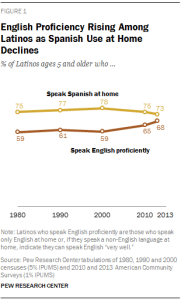
Rates of English usage among Hispanics, according to Pew Research Center.

Rates of English usage among Hispanics, according to Pew Research Center.

Way to ask the tough questions, Michael. Our magazine focuses on Latinos, those of us from Latin America, or with ancestors from Latin America. I will say, though, that language doesn’t always have to do with identifying as Latino. There are Latinos in the U.S. that speak little or no Spanish. And, as you pointed out, some speak indigenous dialects. You know, I read one of those Pew Research Center things recently that made claim that more Latinos are proficient in English than before. Obviously! At this point, most of us are from here, American. Most of us speak English, and proficiently. This is why a magazine like Huizache has to exist. A lot of people, unfortunately, aren’t aware of these issues. I don’t know how many people are unaware, except that it’s a lot. Enough to warrant a magazine centered on giving Latinos a voice in the world of literature. Huizache aims to focus on Mexican American writing, mostly from the West and Southwest, as that subset makes up 60%-70% of the Latino population, but we are open to all Latinos, and everyone else.

As our country evolves, there are more and more Latinos all over the country. Our numbers are many but our voices, sadly, limited. Sometimes I think the obsession with labels used to describe different authors might be solely to figure out what shelf to put their books. But, it is all more complex than that. People need to understand that when navigating these labels, and how they apply to each individual, they will not be perfect at it. Even I’m confused. Labels are tough. Figuring out who you are is tough. That’s one thing a lot of Latinos have in common. Some of them grow out of one label and into another. Others are headstrong and stick to one. I, for example, don’t like the label Hispanic. The word refers to people from Spanish-speaking countries. However, the label was adopted by the U.S. government, specifically the Nixon administration, in order to count the Spanish-speaking population in the Census. And, as you and I both pointed out, some Hispanics don’t actually speak Spanish. Going further, some people feel that Hispanic also has echoes of the Spanish conquest and colonization in it, since that is how we got to speaking Spanish in the first place. (It also has the word “panic” in it, which is a little irrational but makes me feel weird anyway…especially when you hear it on the news.) I use Latino mostly, but when I can be more specific I prefer to do that. I say I’m Mexican American. The only way I can resolve my own identity, and subsequent identity issues, is by including the two things that have me confused in the first place – having cultural roots from Mexico, with Mexican family, parents, but being born in Houston, growing up in Texas and appreciating that I’m American. But, I’ve also known people who, for some reason, recoil at the uttering of “Mexican” like it is a bad word, and use Hispanic instead because it sounds softer.

I do like the word Latino because it seems to have been sprung from the community itself, rather than imposed by the government like I explained above. As a population of people who have different cultures, with different versions of Spanish, from different places, we at least share some struggles. One of these is the lack of exposure of our brilliant writers. Huizache aims to fill that gap.

Michael Noll

I’m interested in the meaning of Latino especially in terms of Michele Serros. The words Chicana and Chica appear in three of her book titles, and she grew up in California. But she also married a well-known rock musician, and her work inspired both at least three mega-famous bands (Red Hot Chili Peppers, Smashing Pumpkins, and Rage Against the Machine). This latter part isn’t the standard Latino biography that we see on TV—and not just with ignorant statements by people like Donald Trump. Latinos don’t seem to appear in the news unless it’s a story about migration. All of this is to ask this: How important was Michele Serros, not just in carving out space for Latino writers but also in broadening a national sense for who Latinos are?

A.J. Ortega

Rage Against the Machine's Zach de la Rocha appeared onstage with Los Tigres del Norte on their song "Somos Más Americanos" for a MTV Unplugged special.

Rage Against the Machine’s Zach de la Rocha appeared onstage with Los Tigres del Norte on their song “Somos Más Americanos” for a MTV Unplugged special. The New Yorker wrote a long feature about the norteño band here.

True that the latter part is not part of image of Latinos that we see on TV…but Latinos know otherwise, especially when it comes to the rockstar part. Mexicans and Mexican Americans love Rage Against the Machine. Zach de la Rocha, the lead singer, is a Chicano and the band was/is a huge success in Mexico. If you check out their Battle of Mexico City concert, you’ll see what I mean. Zach de la Rocha even joined the Los Tigres Del Norte, a norteño group, during their MTV Unplugged rendition of “Somos Mas Americanos,” a song that addresses the complexities of immigration and Mexican heritage. This is exactly the point of a lot of the conversation we’re having.

So, that’s a good segue into discussing how Michele Serros has been a tremendous influence on her own community of Latinos, women, writers, and even rock stars like Zach de la Rocha, Billy Corgan and Flea. I think what we can take away from the impression she had on people like these superstars is that she was able to transcend the label. I heard in an interview that she was once called a “Chicana falsa,” that is, she wasn’t the stereotypical Chicana according to her peers during her adolescence. She made it clear that the label isn’t her entire identity, but only part of it. Her upbringing in SoCal, with the beaches and malls, was part of her identity, thus the skateboarding and surfing. She was a lot of things, not just one. I think that’s a normal pressure that Latino writers have on their shoulders, wondering how you will be viewed, how you will be labeled, and how you will represent your community. Once your work is out there, it’s out there and people will think what they want. Michele, by putting certain words in her titles, took a certain amount of control over that, and that is something to admire. She had agency of her own identity as a Chicana, and even plays with it, challenges it, flips it on its head.

She reminds us that Latinos are a diverse group of people. The more people who realize this the better. Some Latinos are women and they call themselves Latinas. Some Latinas prefer to be called Chicanas. Some Chicanas are skaters. Some Latinos are brown. We also have white Latinos and black Latinos. A lot of Latinos speak English. Some, like me, speak Spanish but with an American accent. Others can’t speak a lick of Spanish. Some Latinos are teachers and some are rockstars. Some Latinos drink at bars, others are bartenders, and some even own the bar. And still, some are writers.

As long as we have authors like Michele Serros (que en paz descanse) to tell our complicated stories that don’t fit the dominant narrative, the people outside of the Latino community, and even those within it, will hopefully begin, or continue, to understand who Latinos really are and, in turn, their value to American literature and the country as a whole. Michele may be gone from this world, but her work and contribution to the literary arts keeps us moving forward.

Thanks for the questions, Michael. Wish you could have communicated with her directly. Your readers can get over to huizachemag.org and order Huizache, including issue two which includes Michele Serros’ work, for their collections. We have five issues now with a long list of award-winning authors, established and new, with attractive covers from Latino artists that’ll look great on their bookshelves. Read them, and enjoy them.

November 2015

Michael Noll Michael Noll is the Editor of Read to Write Stories.

An Interview with Caille Millner

29 Oct
Caille Millner is the author of the memoir The Golden Road: Notes on my Gentrification.

Caille Millner is the author of the memoir The Golden Road: Notes on my Gentrification.

Caille Millner is the author of The Golden Road: Notes on my Gentrification and an editorial writer and weekly columnist for the San Francisco Chronicle, and she has had essays in The Los Angeles Review of Books and A New Literary History of America. Her awards include the Barnes and Noble Emerging Writers Award and the undergraduate Rona Jaffe award for fiction.

To read her story “The Surrogate” and an exercise on subtext, click here.

In this interview, Millner discusses first lines, writing about class, and moments of attempted—and failed—communication.

Michael Noll

Something I’ve found myself stressing lately in writing classes is the need for directness, rather than subtlety, when it comes to plot and situation. So, I was immediately drawn to the opening lines of this story:

“Cecily is six months pregnant with someone else’s child when her husband tells her that he wants a baby of his own. It’s not a complete surprise — if he never grew jealous of all the other babies she’s carried, she’d wonder.”

Did the story always begin with this line, with this directness, or was it something that you discovered through revision?

Caille Millner

It wasn’t part of the first draft, but it came fairly early on. I knew from the beginning that the action of the story would be driven by a simple question—will she choose to have her own baby?—and that all of the tension would arise out of the complexity of her family dynamics and the stark limitations of her opportunities. But since it takes time and detail to create the tension, there’s nothing lost by stating the plot upfront. It’s a way to keep the reader interested enough to stay with me while I unwind the rest of the skein.

Michael Noll

Of course, there’s a great deal of subtlety in the story. For example, huge class distinctions lie in plain sight but are never directly remarked upon. For example, Rebecca can take maternity leave while Cecily’s job is maternity, and Rebecca can afford doctors that Cecily can’t. Did you ever comment directly on these disparities in earlier drafts? Or did you always know that the reader would intuitively see and understand them?

Caille Millner

No, I never made direct comment on these things, for two reasons. The first was that I built tension by building details. This is an unspoken experience in public life, so the emotional toll takes on weight as you, the reader, learn what goes into it.

The second reason I never commented directly was that it felt more realistic to me. In situations where the class aspect underlies the very existence of the transaction, it makes the participants very uncomfortable to talk about it and to think about it.

Rebecca doesn’t want to think about all of the dominoes that had to fall for this moment to be possible for her – she just wants her baby. Cecily’s day to day existence is fraught enough—she just wants her money. Why would either of them rock the boat? The reader is the one who’s granted the right to consideration, to judgment, as the outside observer.

Caille Millner's story,

Caille Millner’s story, “The Surrogate,” appeared in Joyland Magazine.

Michael Noll

My favorite moment in the story is the conversation between Cecily and Rebecca about what it means to know you’re ready for a baby. The characters are talking to each other, but they’re not really talking about the same thing. The subtext for each character is different. Is a scene like this the magical result of writing into a situation? Or was it a scene that you knew, from the beginning, that you would eventually write?

Caille Millner

How interesting that this scene is your favorite moment. It came from the situation. Two women, thrown into intimacy with each other, but an intimacy with strained circumstances and painful limits. They know nothing about each others’ lives. They’re having an idle, tedious moment. It seemed like a chance for one of them to risk an intrusive question.

And of course those moments of trying and failing to communicate with someone, to try and fail to find common ground—those moments are so frequent and frustrating and human.

Michael Noll

I recently interviewed Matthew Salesses, and we talked about something he’s written about: how, in his words, “We need more books where people of color do things white Americans have done in fiction for ages.” I thought of this need as I read “The Surrogate.” We don’t learn that Franco is from Mexico or that Cecily’s mom had returned to Mexico until deep into the story. And, both characters have names that don’t carry regional or ethnic assumptions with them, unlike the name of Franco’s daughter, Marisol. Did you begin the story like this on purpose—focusing on the story (surrogate’s husband wants a baby of their own) first and on the characters’ backgrounds second?

Caille Millner

Franco’s name would’ve been a tip-off to me, but I understand your point. Again, I was conscious of lived experience. Their backgrounds are secondary to the action because they aren’t thinking about their race or their experience as immigrants all the time. On the other hand, it certainly has played a role in their current situation.

October 2015

Michael Noll Michael Noll is the Editor of Read to Write Stories.

An Interview with Lincoln Michel

22 Oct
Lincoln Michel's debut story collection, Upright Beasts, was described in The New York Times as reading

Lincoln Michel’s debut story collection, Upright Beasts, was described in The New York Times as reading “something like translated Kafka.”

Lincoln Michel is the editor-in-chief of electricliterature.com and a founding editor of Gigantic. His fiction has appeared in Granta, Oxford American, Tin House, NOON, and the Pushcart Prize anthology. His essays and criticism have appeared in The Believer, Bookforum, Buzzfeed, Vice, and The Paris Review Daily. He is the co-editor of Gigantic Worlds, an anthology of science flash fiction, and the author of Upright Beasts, a collection of short stories. He was born in Virginia and lives in Brooklyn.

To read his story “Dark Air” and an exercise on merging literary and genre stories, click here.

In this interview, Michel discusses the differences, if any, that exist between literary and genre fiction.

Michael Noll

I was on a panel recently, and the question was posed about the difference between literary and genre fiction. The usual things were said, with the eventual answer being a bit like the Supreme Court justice’s line about obscenity: we know genre or lit fiction when we see it. But when it comes to this particular story (and several in the collection), any distinction between genre/literary seems impossible to find. I can’t remember another story in Granta that was so devoted to genre elements, yet the characters are developed and the language is tight, so it’s easy to see why Granta selected it. You’re part of a large group of writers who are straddling both worlds (Adrian Van Young, Manuel Gonzales, and, obviously, Karen Russell). What do you think? Is any distinction left?

Lincoln Michel

I seem to have a different stance on this question than most people I know in either the genre world or the literary world. I don’t believe that genre distinctions are meaningless, but I also don’t believe that there is anything inherently inferior to genre work. To me, genres are literary traditions and conversations between writers, readers, and critics. Part of the enjoyment of “genre-bending” or genre mashing is seeing the different tropes and styles subverted, complicated, or tweaked in different ways. If we didn’t understand what, say, a hardboiled detective story was or what a Lovecraftian horror story was, then a hardboiled cosmic horror story simply wouldn’t work.

When I write in a genre (or in two or three), I’m both participating in a conversation with other authors in that literary tradition, and I’m working in a form and hoping to subvert/complicate/expand it.

“Literary” is a tougher term, because I think it has a lot of different usages and definitions that frequently contradict each other. (That’s true of “genre” too actually.) To avoid going on a thirty-page rambling rant, I’ll just say that I think of “literary” fiction as fiction that is complex, language-focused, and challenges instead of simply meets readers’ expectations. As such, writing can be simultaneously literary and genre. Le Guin, Delany, Chandler, Atwood… their fiction is as complex, beautifully written, and boundary pushing as anything on the “literary fiction” shelf of a bookstore. (By the same token, fourth-generation Raymond Carver knockoffs are the realist version of genre pulp.)

Lincoln Michel's collection Upright Beasts is a genre-bending debut (O Magazine), full of monstrous surprises and eerie silences (Vanity Fair).

Lincoln Michel’s collection Upright Beasts is a genre-bending debut (O Magazine), full of monstrous surprises and eerie silences (Vanity Fair).

In my book, Upright Beasts, some of the stories use genre elements from science fiction, fairy tales, and horror, but I don’t believe there is any quality distinction between them and the Kafkaesque parables or realist Southern stories. They are just playing with different forms and styles.

So genres exist, but I think you are right that we’re finally tearing down the borders separating the writers who work in them. It used to be that the literary world was separate from the SF world that was separate from the crime world, and so on. As a writer you kind of had to pick one little patch of land to grow your garden in, or maybe two if they were adjacent plots like SF and fantasy. But now Le Guin just got a National Book Award lifetime achievement medal, the Library of America series publishes Philip K. Dick and Kurt Vonnegut alongside James Baldwin and Philip Roth, the New Yorker has issues devoted to SF and crime, and authors are feeling increasingly free to write in different genres, to plant lots of different gardens in lots of different plots.

And that’s how it should be. No one wrinkles their nose at the fact that a Kubrick directed the best horror film ever in The Shining AND directed one of the best science fiction films in 2001 AND directed great black comedies, war films, and other films in other genres. Why shouldn’t writers have the same freedom?

Gigantic Worlds is an anthology of 51 science flash fiction stories from writers as varied as Jonathan Lethem, Charles Yu, and Kelly Luce.

Gigantic Worlds is an anthology of 51 science flash fiction stories from writers as varied as Jonathan Lethem, Charles Yu, and Kelly Luce.

I actually just co-edited an anthology of science fiction called Gigantic Worlds that had this ethos, so I’m definitely interested in genre as both a form and as great literature. Gigantic Worlds is a mix of fantastic SF writers (Ted Chiang, Laird Barron, Meghan McCarron, etc.) and great literary writers working in the form of SF (Catherine Lacey, Alissa Nutting, Kyle Minor, etc.). There is no reason those writers shouldn’t be read, enjoyed, or studied side by side.

(Adrian Van Young is also in that anthology, and I’m glad to hear you give him a shout out as he’s a fantastic writer—and one of my best friends—whose work is definitely simultaneously genre and literary.)

That’s what I want for my own writing. I want to write a book in every genre! I want to play with different genres like I play with different structures, different voices, and different POVs. I think you have to do that with a love and understanding of the genres—and I grew up reading Le Guin and Chandler alongside Carver and Calvino—but otherwise, go forth and write whatever you love. Sculpt weird beasts out of the different elements that speak to you. Make them yours.

October 2015

Michael Noll Michael Noll is the Editor of Read to Write Stories.

An Interview with Rene S. Perez II

1 Oct
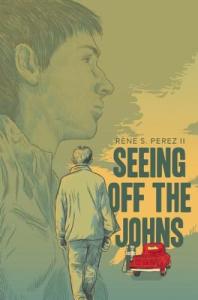
Rene S. Perez II won the Alfredo Cisneros del Moral Foundation Award for his story collection, Along These Highways. His latest book is the novel Seeing Off the Johns.

Rene S. Perez II won the Alfredo Cisneros del Moral Foundation Award for his story collection, Along These Highways. His latest book is the novel Seeing Off the Johns.

Rene S. Perez II is the author the story collection, Along These Highways, which won the Alfredo Cisneros del Moral Foundation Award and the 2013 NACCS Tejas Award for Fiction. His newest book is the novel Seeing Off the Johns. Perez was born in Kingsville, Texas, and raised in Corpus Christi. He received an MFA from Texas State University and currently teaches high school in Austin.

To read an exercise about backstory inspired by Seeing Off the Johns, click here.

In this interview, Perez discusses why teens want realistic stories, even if those stories are sad; the formatting challenges of italics in POV shifts, and what happens when the novel you’re writing suddenly disappears from your computer.

Michael Noll

This book is ferociously sad—and not in a gratuitous way, I might add. There’s a kind of firm reality to it that I recognize from my own childhood and hometown, and so I was able to connect with these characters very easily. And yet—whew, that opening is a tear-jerker. Did this make it a difficult novel to pitch and sell? Young Adult novels aren’t strangers to sad topics (John Green, The Fault in Our Stars), but this feels somehow different, if only because it’s a more realistic novel than that one, less of a romantic comedy (even though it has a romance). I’m curious if anyone (publishers, readers, writers) pushed back against the opening.

Rene S. Perez II

I never considered that I was writing a YA book. I think the very fact that I stumbled upon one by virtue of the age of my protagonist while not trying to write one can be both a big help and potentially a detriment. When I finished the first draft of the novel, I thought that I could get at least considered/read by presses and agents. I queried four agents. Three replied back, likely due to the “success” of my first book. Each of those who responded all said the same thing: It’s too sad. They wanted me to highlight the romance, and one even asked, if it were possible, focus less on the deaths at the center of the story.

When I found my eventual publisher, they got what I was going for and were all in. What they did want to change, initially, is the ending. I was hesitant to do so and mentioned that in my first conversation with my editor. When she read through again, she saw why the novel has to end how it does. It’s basically stayed the same, story-wise.

So, in those regards, sure, there was some pushback. I do think, however, that since this is being marketed as a YA book, the fact that I never initially set out to write a YA book but to write a realistic novel about the weight of a tragedy on a town, it will resonate more clearly with young readers. I really do think young readers want to be taken seriously. They want to engage in discourse on the big questions. They appreciate knowing the kiddie gloves have been taken off.

Michael Noll

The POV shifts are fascinating. In the first, we have so much empathy for the Johns and their families. Then we’re introduced to Chon, and we begin to see the Johns, especially John Mejia, in a less empathetic way. We begin to dislike him, just as Chon does. But then this feeling gets complicated by more shifts. This seems like a difficult thing to pull off, to successfully get the reader to reconsider an attitude toward a character. How did you approach this challenge?

Rene S. Perez II

The shifts are from close third-person focus on Chon, our protagonist, to an omniscient third-person narration that zoom out wide to show the tragedy’s effect on the town. With that, we get to see how Chon’s initially low opinion of Mejia is counter to the town’s adulation of him. But as the novel goes on, we see the town shifting—forgetting or divesting from the promise Mejia, and both Johns, had. We see Chon recognize it, and the curve of his feelings toward the Johns, Mejia in particular, and the curve of the town’s feelings intersect. Shifting from Chon to the town, zooming in and out, helped to show Chon change, and it changes the reader too.

Seeing Off the Johns, the debut novel from Rene Perez II, is a BookPage Teen Top Pick and has been called "a searing, mature novel."

Seeing Off the Johns, the debut novel from Rene Perez II, is a BookPage Teen Top Pick and has been called “a searing, mature novel.”

Michael Noll

Still on the subject of POV, how much planning did you do? When you began the novel, did you have a sense for which characters would receive their own POV and where those chapters would appear in the novel? Or was this something you discovered while writing the book?

Rene S. Perez II

As far as planning goes, I knew from the first time I filled the blank page that I would move from the town to Chon and back out. In fact, the original manuscript of Seeing Off the Johns had the town sections in italic typeface. I decided before word one that there would be italic sections and regular sections. Having allowed myself that, within the italic sections, I was able to really stretch out and get comfortable within the omniscience. I am able to jump ahead and back in time. I am able to tell biographical details of people in town or histories of places. I really gave myself license to push that as far as I needed, because I knew that the visual cue of the italics would let the reader know toe expect those shifts.

When Lee Byrd, my editor at Cinco Puntos, gave me her first notes, she did away with the italics. Just like that. It was a lot to get used to for me after having written in so specific a way. But now that I read it without the italics, it makes for a more interesting read. It certainly makes it seem like I was being more daring formally than I really was.

Michael Noll

You’re a high school teacher, and an English teacher to boot, and so I know you’re putting in a lot of hours on planning and grading. Where do you find the time to write? What’s your strategy?

Rene S. Perez II

I wish I would tell you that I have some solid work ethic that I organize my life into being able to write every day. Hell, I can’t even motivate myself to write every day. What I do is make sure to always have access to notes. In various forms ranging from texting myself to notes on my phone to e-mailing myself to always having my notebooks handy, I am always ready to put down ideas for characters or stories or plot points of larger works. Then, as that becomes more fruitful, I pick times when I can sit and either transcribe paragraphs or sentences I’ve handwritten into a larger work or get started on a story.

That’s how I work. I always allow ideas to at least start. I always have a couple stories and, as has been the case for the last 5 years, a novel in progress. That way I can always turn from one project to another. I tell myself I work best on something when I’m stealing time from something else. If I always have something I’m itching to work on, when I am done with school work and the baby’s bathed and in bed, or on weekends when my wife is stepping up so I can sequester myself in one of my writing holes, quality writing happens.

Michael Noll

A few years ago, I heard you say that you’d just lost a novel through a computer failure. Was this novel? What happened? Did you rewrite the entire thing?

Rene S. Perez II

Ah, the lost novel! I started writing Seeing Off the Johns while waiting for the first book to happen. When I finished SotJ, the collection, Along These Highways, was out. I showed SotJ to an editor who gave very thoughtful feedback. She said something was missing. I could feel it too. Now, while waiting to hear back on SotJ, around 2011, I had started to write another novel. It was cool and noir-ish and rolling along quite well. I was almost done with a first draft when I lost it. At that point I knew I only had two options: I could either set about to rewrite the lost novel or I could fix SotJ. I chose to write a play instead. When I finished that, push came to shove. I tore SotJ apart. I felt like a mechanic in a hollowed out car needing to find a faulty plug and put the damn thing back together. I figured it out (in the first draft, I was satisfied with the novel being 3-dimensional because of the POV shifts, but I’d neglected to make Chon fully rounded) and fixed it, and now the Johns is almost out.

A postscript on the lost novel: I’m still chipping away at the rewriting in notes and on the manuscript, but I’ve also started a new novel. We’ll see which happens first.

September 2015

Michael Noll Michael Noll is the Editor of Read to Write Stories.

An Interview with Matthew Salesses

24 Sep
Matthew Salesses is a Ph.D. student in Creative Writing at the University of Houston and, already, the author of three books, most recently the novel The Hundred Year Flood.

Matthew Salesses is a Ph.D. student in Creative Writing at the University of Houston and, already, the author of three books, most recently the novel The Hundred Year Flood.

Matthew Salesses is the author of The Hundred-Year Flood. His other books include the essay collection Different Racisms and the novel I’m Not Saying, I’m Just Saying. He was adopted from Korea and has written for NPR Code Switch, The New York Times Motherlode, Salon, The Good Men Project, The Toast, The Millions, Glimmer Train, PEN/Guernica, and has received awards from the Bread Loaf Writers’ Conference, Glimmer Train, Mid-American Review, PANK, HTMLGIANT, Emerson College, Inprint, and the University of Houston.

To read an excerpt from The Hundred-Year Flood and an exercise on finding a story’s beginning, click here.

In this interview, Salesses discusses chapter beginnings, the inspiration of The English Patient, and how the critical rhetoric around a book matters.

Michael Noll

The first paragraph of Chapter II is dazzling in how much information it handles in such a compact, tight narrative passage.
 How long did it take to get it into its current form? 

Matthew Salesses

It was actually shorter before. I added Tee’s response and the container (as a way to show Tee’s version of passivity and activeness) very late in my edits. Tee’s girlfriend’s words in Boston act like a kind of prophecy. She says things that can guide him either by following them or resisting them, but they break up before the plot starts. Her words echo.

Michael Noll

I’m curious about the pacing of this novel. There’s a kind of dreamlike quality to it. It switches back and forth between characters (Katka and Ynez, for instance) in a way that they begin to blend together. And in the switch, the narrator will do things like pick up a book and read a line like this: “The presence of want awakens in him nostalgia for wholeness.” It’s such an ethereal, meaning-packed line. What models did you have for this sort of narration?

Matthew Salesses

I thought a lot about Ondaatje’s The English Patient, even as far as the books he uses in it as a guide. The line from Anne Carson [“The presence of want awakens in him nostalgia for wholeness”] was, for a long time, a line from Henry Miller: “the guardians of secret crimes” or something.

Michael Noll

Matthew Saleses' novel The Hundred-Year Flood has been called "epic and devastating and full of natural majesty." It follows a young man to Prague as he struggles to understand his identity and how it fits into the world.

Matthew Salesses’ novel The Hundred-Year Flood has been called “epic and devastating and full of natural majesty.” It follows a young man to Prague as he struggles to understand his identity and how it fits into the world.

The novel is very much about art and questions of how the artist and subject are revealed (or not) in a piece of artwork. So, the characters discuss poetry, we see various paintings and their creation, and the narrator spends a lot of time thinking about big questions about identity, memory, and art. This seems to be where the heart of the novel lies, which makes me curious about plot. How did you find or develop a plot mechanism that would give you the space needed for the characters to address these questions?

Matthew Salesses

Interesting! It makes me happy that different readers can bring to the book different interpretations. I didn’t think about the art/subject question in terms of plot. The plot is basically a love story. Though it’s a love story that begins with Tee as an artist’s model, as an object, of sorts.

Michael Noll

You’ve written in various places about how people of color are treated in American literature. It’s not, you’ve said, simply that most books are about white characters but that when people of color do appear in novels and stories, they’re portrayed in a handful of predictable ways. There aren’t many novels in which, as in this case, a Korean-American travels abroad. The Innocent Abroad and The Ugly American are almost always white. Do issues like these inform your writing? In other words, do you see a lack or absence in the books around you and think, “I’m going to fill that absence?” Or are you simply writing the stories that occur to you and then realizing that there is very little else like them?

Matthew Salesses

I was actually thinking of books about other Americans abroad as “like mine.” Most people don’t seem to see the book as part of that tradition. It’s kind of fascinating. We need more books where people of color do things white Americans have done in fiction for ages. But on the other hand, the fact that my book is seen as filling an absence creates the situation where we don’t get more of those books. It’s like we’re expected to plug holes.

September 2015

Michael Noll Michael Noll is the Editor of Read to Write Stories.

An Interview with Steve Adams

17 Sep
Steve Adams has won multiple awards for his writing, most recently a Pushcart Prize for his memoir, "Touch."

Steve Adams is a writing coach has won multiple awards for his stories, plays, and essays, most recently a Pushcart Prize for his memoir, “Touch.”

Steve Adams lives in Austin, Texas, where he is a writing coach. His memoir, “Touch,” appeared in The Pushcart Prize XXXVIII. He also has been published in Glimmer Train, The Missouri Review, The Pinch and Notre Dame Magazine. His plays and musicals have been produced in New York City.

To read Adams’ essay, “Waiting Till the Wait Is Over” and an exercise on directing the reader’s gaze, click here.

In this interview, Adams discusses writing for an imagined audience, shifting POV without knowing it, and circumventing chronology.

Michael Noll

You make an interesting nod to the reader at the beginning of the second paragraph: “People who have issues with hunting do not understand hunting as I experienced it.” Did this line always exist in the essay, or were you anticipating something about the particular audience for this particular magazine—that readers might have issues with hunting?


Steve Adams

I did not write this essay for that particular magazine, but wrote it, as I do most of my pieces, because a story or essay idea came to me. Afterward I try to find a home for it. That particular line was for my imagined audience while writing it. I’m a liberal, but I’m also a liberal from Texas with a hunting background, and posts from friends on Facebook and elsewhere in social media are not always forgiving or understanding toward hunters. I have a paranoid vision of a reader out there who’s screaming “Bambi killer!” at me. And though I happen to be one, I haven’t hunted since I was a teenager. So I placed that line there to try to buy time from that reader, to establish the possibility that there might be more going on with hunting, at least under proper conditions, than just slaying animals.

The original concept, before I even knew an essay would come from it, occurred in a random conversation at a party in 2002 when I was finishing up my MFA at The New School. I’d developed a reputation for being a guy who produced pages (whether good or bad) regularly, and classmates began asking me for advice along those lines. Writing’s tough for everyone, but I had no idea of the degree that a lot of otherwise gifted writers struggle to simply get words to the page. I’m a writing coach now, and I realize The New School is where I began coaching writers. Anyway, this friend and I were talking in 2002—I specifically remember we were standing a door frame leading to a living room—and somehow via the conversation (thanks, Rebecca!) we discovered that I wasn’t just a natural at producing pages, but that I’d had perhaps the best training possible for such work, and at a very formative age. It was a huge “Aha!” moment for me. Then maybe three years ago I came across the crazy/stupid/wonderful German word “sitzfleisch,” which describes the same capacity, namely being able to keep your butt (or your sit-flesh) in a chair and see a project through to completion.

Michael Noll

You also make a cool chronological move: telling the history of your experience with hunting from first grade to age 14 and, then, shifting back in time (“But I’ve jumped ahead. I want to go back to age 5.”) This seems like a move that many writers could borrow since chronology can be such a trap. We get caught in it and can’t escape, which limits our ability to make sense of events (a process that tends to be circular, not straightforward). How did you find this strategy? Purposefully or through happy accident?

Steve Adams

Good point regarding chronology. I worked with those sentences quite a bit trying to get the passage to feel “right.” First I listed a brief sequence of events, then circled back through expanding on them, and then told the reader I wanted to stop and go back and explore the larger meaning, the larger story they tell. I didn’t decide on that technique beforehand, but tried to follow what the essay seemed to want at the time, which is what I always do if I can. By the circling, as you noted, I think I was instinctively trying to circumvent being locked into strict chronology. I wanted the reader to pull up at that moment, to look back and instead of seeing those moments as separate and linear, to see them as a whole. I also wanted the reader to stop and consider what it might mean that as a child I carried a lethal firearm beside my father and knew full well it was lethal, as well as that if I did something really stupid I could accidentally take his life. He gave me an enormous responsibility by putting a gun in my hands, but also a staggering trust. The gesture carries immense personal weight for me.

Michael Noll

Steve Adams' essay, "Waiting Till the Wait Is Over," is a meditation on hunting and writing and the surprising connection between the two.

Steve Adams’ essay, “Waiting Till the Wait Is Over,” is a meditation on hunting and writing and the surprising connection between the two.

I love your shifts in perspective. For example, you start one paragraph like this: “Picture me beside him, our feet hanging off the platform’s edge.” And the very next paragraph starts this way: “Here is how you manage your presence on the deer blind.” This is the sort of thing that would seem to be forbidden by workshop teachers, but it’s really effective in drawing in the reader. Do you have a particular strategy for switching POV?

Steve Adams

I don’t have a particular strategy so much. And frankly, I wasn’t even aware I’d done that until you brought it up. But I went over that passage a lot, and again, in a focused creative state trying to make it “right.” And I just made that move and worked with it, much as a painter might intuitively decide their painting needs more yellow in the upper right hand corner, and without analyzing why (“why” doesn’t matter as much as “what”), does the work of adding it in. I was keenly aware of how the words sounded. But looking back and putting on my analytical goggles, I think part of my attempt was to break up the narrative flow. Like in the passage above where I break up chronology, I wanted to get the reader to slow down and consider not just the facts of this child’s experience (freezing, feet going to sleep, nose running, unable to move except in the smallest and smoothest of increments), but the fact that this particular child raised in this particular tradition wouldn’t even think twice about such discomforts, thereby (hopefully) causing the reader to frame them and that unit of thought as a whole unto itself that would connect to the discipline of writing.

Michael Noll

The essay is about the writing process, which is surprising given that it’s published in a general-interest magazine, not one aimed solely at writers. Is that why the writing aspect of it doesn’t appear until the end? Were you trying to draw the reader in with hunting and then make the connection with writing after the reader has bought into the story you’re telling?

Steve Adams

Notre Dame Magazine is an interesting hybrid sort of magazine. It’s general interest and focuses a lot on work from Notre Dame alums, but also has a section toward the back called Crosscurrents devoted to more personal essays. They’ve racked up a number of “notable” mentions from the Best American Essay series, and I know of one essay that was published in the series in 2013. My essay went in their magazine almost as-is. I’ve just placed a second piece with them so clearly we’ve got a sympatico relationship happening. They don’t shy from a piece that has a spiritual or ethical component (and not just Christian), and there’s definitely a strain of spiritualism through my essay and the next essay they took.

More than anything with this piece I just wanted to find a way to connect hunting, once I realized the impact it had on my life, with the discipline of writing. By my way of thinking, done right, both are spiritual disciplines. Both demand patience and endurance and usually a degree of hardship before you experience a shift in perspective. And I believe my instinct with this piece was to establish hunting as such a discipline first and foremost, then take a quick dip into meditation, and finally do that swoop into writing at the end, hopefully bringing it all together in a single gesture.

September 2015

Michael Noll Michael Noll is the Editor of Read to Write Stories.

An Interview with J. Ryan Stradal

10 Sep
J. Ryan Stradal's debut novel Kitchens of the Great Midwest was called "an impressive feat of narrative jujitsu" by The New York Times Book Review.

J. Ryan Stradal’s debut novel Kitchens of the Great Midwest was called “an impressive feat of narrative jujitsu” by The New York Times Book Review.

J. Ryan Stradal is the author of the debut novel Kitchens of the Great Midwest. He edits the fiction section of The Nervous Breakdown with Gina Frangello. His writing has appeared in The Rumpus, the Los Angeles Review of Books, and McSweeney’s: The Goods. Born and raised in Minnesota, he now lives in Los Angeles and has worked as a TV producer, notably for the History Channel’s Ice Road Truckers and Discovery Channel’s Deadliest Catch.

To read an excerpt from Kitchens of the Great Midwest and an exercise on writing character descriptions, click here.

In this interview, Stradal discusses the challenge of covering large time periods, novel pacing, and the influence of Minnesota’s most famous writer.

Michael Noll

You cover a lot of ground in the first chapter, from Lars’ childhood to his post-high school days to married life. Spanning so much time would seem to pose a challenge for the narrative: how to make individual events taking place over a decade or more cohere? How did you approach this problem? Lutefisk seems to be a big part of the answer.

J. Ryan Stradal

I just tried to concentrate on the moments that I considered to be essential. They weren’t always the most apparent life-defining moments, but moments that, if a character looked back, they would consider to be a vital fork in the road. Lutefisk and the other food that enjoyed their moments in the sun as window dressing for each chapter just helped give these disparate moments a unifying theme.

Michael Noll

The first page contains a couple of story-propelling lines. Here’s one:

“Lars blamed his sorry luck with women on his lack of teenage romance, and he blamed his lack of teenage romance on the fact that he was the worst-smelling kid in his grade, every year.”

A line like that seems to beg for an explanation: Tell us why he smelled so terrible! Here’s another line:

“Fish Boy” they called him, year round, and it was all the fault of an old Swedish woman named Dorothy Seaborg.

Again, that line begs for more. It suggests a story. Both lines seem carefully crafted to drive the reader deeper into the novel. Was this purposeful on your part, or did lines like these simply occur to you?

J. Ryan Stradal

No, I’m not lucky enough to have those natural storytelling instincts. I try to ask a lot of questions during a chapter to keep it moving forward, and give the reader a reason to keep going if they’re invested, and these are two pretty flagrant examples of that. This section was one of the last parts I wrote in the entire manuscript, so as such I was propelled by my own knowledge of what was to come, and attempted to pace the establishing narrative to set up the novel as efficiently as possible while still trying to be entertaining.

Michael Noll

It seems inevitable that a novel that contains lutefisk, Lutherans, and Minnesota will draw comparisons to the work of Garrison Keillor. Your novel is quite different from his writing, but it does share some characteristics, especially with his novels, which tend to be about young men grappling with their dour, Lutheran, Minnesota upbringing. How did you approach writing a story that takes place in a kind of Yoknapatawpha County, a place that has been famously mined by one particular writer? I’m curious because the shift in main characters between the first two chapters seems like a move away from Keillor (away from young Lutheran men), but the fact that the novel ends up telling so many characters’ stories seems to have a bit of Lake Wobegon to it. Did you feel any need to write purposefully toward his influence—or away from it? Or did it not affect you at all?

J. Ryan Stradal

It didn’t really affect me at all. I enjoy Keillor and his work, but I don’t listen to it often, and haven’t heard it regularly since I lived in Minnesota, almost twenty years ago. My mom and grandma were/are big fans, and I may have been influenced by what they enjoyed about it, but there was a conscious effort on my part to not hew too close to any existing narratives or styles of characterizing my home region. The Midwest I attempt to capture isn’t quite like any I’ve read or heard. I hope I’ve succeeded at making the world of Kitchens its own universe; I personally can’t wait for an even greater array of diversity of setting and voice among Midwestern authors.

September 2015

Michael Noll Michael Noll is the Editor of Read to Write Stories.
An Interview with Will Boast

27 Aug
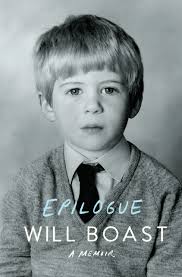
Will Boast's memoir Epilogue was called "hands down the most moving book I’ve read this year" by Anthony Marra.

Will Boast’s memoir Epilogue was called “hands down the most moving book I’ve read this year” by Anthony Marra.

Will Boast was born in England and grew up in Ireland and Wisconsin. His story collection, Power Ballads, won the 2011 Iowa Short Fiction Award. His fiction and essays have appeared in Best New American Voices, Virginia Quarterly Review, Glimmer Train, The American Scholar, and The New York Times. He’s been a Stegner Fellow in fiction at Stanford and a Charles Pick Fellow at the University of East Anglia. His most recent book is the New York Times bestselling memoir, Epilogue. He currently divides his time between Chicago and Brooklyn, NY, and is currently a Literature Fellow at the American Academy in Rome.

To read the prologue to Boast’s memoir Epilogue and an exercise on framing chronology, click here.

In this interview, Boast discusses structural challenges of memoirs, writing dialogue from memory, and using concision to handle emotion.

Michael Noll

One of the challenges for memoir writers, at least in some memoirs I’ve read, is that they get trapped by chronology. They have something they want to talk about or some particular story to tell, but that thing or that story isn’t enough to fill an entire book. And so, at a certain point, the book moves into “and then this happened and this.” That isn’t the case for this book, and it seems, in part, to be due to the structure you chose, which is centered more on thematic units than chronological ones. Did you always have such a structure in mind? How did you discover it?

Will Boast

I agree. A strictly chronological telling is very tempting for writers starting on any story, whether nonfiction or fiction. And sometimes it does work. But, in memoir anyway, it can be deadening. Too much of life is mundane to just make it “and then and then,” and very few, if any people, have real experiences that naturally take the shape of a good story. So you splice and rearrange and follow patterns rather than doggedly follow a timeline. Sven Birkerts’ The Art of Time in Memoir is very good on this subject.

Every book finds its own shape, but memoirs seem to present special structural challenges. I often say that, If fiction is the art of invention, memoir is the art of arrangement. Honestly, only an enormous amount of effort and trial and error helped me move forward. But I did have in mind, through many drafts, an emotional progression. That, more than anything, was my guide. It’s difficult for me to talk about themes, because I think those only become truly clear in nearly the final drafts. Certainly, I thought about ideas I wanted to express in the book. But more often than not, I found that they dropped away in the long process of revision, and that the ones that stayed became so tightly wound into the story itself that I almost hesitate to call them themes now.

Michael Noll

The book contains so much loss, but you write mostly about living in the aftershocks of the loss and only a little about the loss itself. For example, you cover your mother’s death in a single paragraph. Was such concision always part of your sense of the book? Or did you write a great deal that you ended up cutting?

Will Boast

I wrote an incredible amount that I ended up cutting: several very long drafts and many, many alternate versions of each chapter. A certain concision, even reticence, ended up becoming part of the way the book handles emotion. At times I found that passages that had once sprawled over pages could be condensed into single sentences, and gain in power because of it. That’s actually quite a realization, that editing out whole episodes of your own experience can help the whole cohere. At first, it all seems important. But then you start to see the most relevant through lines, and they begin to guide you.

Michael Noll

Will Boast's memoir Epilogue describes a family tragedy and revelation the force Boast to reconsider his definition of family.

Will Boast’s memoir Epilogue describes a family tragedy and revelation the force Boast to reconsider his definition of family.

One of the questions that memoir writers face is how to handle dialogue, how to write spoken lines that are only half-remembered. So, I’m curious how you handled these conversations. For instance, you talked on the phone with your dad on the day that he died. During the call, you were, as you write,”hungover and pissy about being woken early,” which would seem to not lay fertile ground for remembering. How did you approach recreating this conversation for the book?

Will Boast

That phone call I do remember pretty vividly. Even though my brain was a little addled at the time, it’s simply one of those conversations you can’t forget, even if you wish you could. There are several instances of that in the book. There were also moments where, later in the timeline of the book, I actually thought to take notes, so that helped in places.

But you’re also right to wonder how much of actual speech can be remembered. I don’t think that many people who’ve written memoir would claim to recall verbatim who said what and when. And, really, that isn’t the point of memoir. No one has tape recordings of family dinners from twenty years ago. It’s important to understand that memoir is not simply a transcript of what happened. It’s not even simply remembering things. (If it was, it would be rather easier to write.) There’s a necessary process of distillation. Every single person, after all, says the same things over and over again. Our little refrains are a huge part of who we are. And those I find very easy to recall with great accuracy. So some of the dialogue you see in the book is made up of those things that were said habitually, day after day, dinner after dinner, fight after fight, bad joke after bad joke.

Michael Noll

At times, you mix present action (for instance, preparing for your father’s funeral) with memories from childhood (giving your father a knife that you prized so that he could sell it). Is this mixing simply the result of your imagination and unconscious churning out material? Or the result of something more logical and planned?

Will Boast

Memory is not linear. Though we always live in the present, our minds are constantly casting into both the future and the past. In a way, I think of the stuff of memoir as being that which is so constantly on our minds that it keeps intruding on and interrupting the present. (This is the definition of trauma, I think.) The process of drafting, then, should be in part associative. This moment recalls another moment. Some of this just happens in the notebook. But, by the final drafts, yes, everything is intentional and very carefully planned.

August 2015

Michael Noll Michael Noll is the Editor of Read to Write Stories.
An Interview with Andrew Malan Milward

20 Aug
Andrew Malan Milward's collection I Was a Revolutionary zeroes in on the complex radicalism of Kansas.

Andrew Malan Milward’s collection I Was a Revolutionary zeroes in on the complex radicalism of Kansas with stories that range from the burning of Lawrence to the assassination of George Tiller.

Andrew Malan Milward, a Lawrence, Kansas native and graduate of the Iowa Writers’ Workshop, is the author of the story collection The Agriculture Hall of Fame, which was awarded the Juniper Prize in Fiction by the University of Massachusetts. He has served as the McCreight Fiction Fellow at the University of Wisconsin, a Steinbeck Fellow at San Jose State University, and has received fellowships and awards from the Lannan Foundation, Jentel, and Yaddo. He lives in Hattiesburg, Mississippi, where he teaches at the University of Southern Mississippi’s Center for Writers and is editor-in-chief of Mississippi Review. His most recent book is the story collection I Was a Revolutionary.

To read Milward’s story “I Was a Revolutionary” and an exercise on building plot, click here.

In this interview, Milward discusses using specific cultural references, trusting the reader, and mixing history with present action.

Michael Noll

One of the things I love about the story “I Was a Revolutionary” is that it contains references to things I grew up with. For example, the narrator goes to a bar and drinks a “schooner of Boulevard Wheat,” a beer that I know well. I’m curious, though, whether you ever questioned such specific references. Did you ever consider just having him go out for a beer, rather than a Boulevard Wheat? 

Andrew Malan Milward

Yeah, I know what you mean, and it did give me momentary pause. However, I realized with a story like this that is so interested in examining a specific place, in this case Lawrence, Kansas, it was important to render that place as specifically as possible. So it was important to me to have the protagonist not only drinking Boulevard but to have him doing so in Louise’s and later in the 8th St. Taproom—real bars in downtown Lawrence where I’ve passed many boozy nights—even if most readers won’t have done so themselves. Obviously the story doesn’t depend on the reader knowing these specific references, but it’s a nice little winking fist-bump to those who do.

Michael Noll

The history that you tackle in the book as a whole is fascinating. Of course, I’m a native Kansan, so I love this stuff, but my wife, who’s from Delaware, also became interested in the history when she read the book. So, there seems to be an inherent appeal to the Bleeding Kansas days. But, the stories must still, at some point, give the reader a reason for the history’s presence. How did you approach that problem? Did you start with the history and find a plot to contain it? Or, did you start with a story (adjunct college instructor whose wife leaves him) and build the history into it?

Andrew Malan Milward

Yes, this was a real challenge. I knew that my fictional characters and their predicaments couldn’t just be excuses to introduce the reader to a whole bunch of Kansas history I happen to find fascinating. In certain failed early drafts I did just that. For example, in the early versions of “A Defense of History,” the Assistant’s storyline was slight and underdeveloped because I was basically just using him to try to tell the story of the Populists. This made the story lopsided and I had to find a way to make his story matter as much as the Populists’. This was a macro-level challenge for the whole book. I had to find a way to give my characters the dignity of human complexity. They couldn’t be afterthoughts. I had to make their situations as interesting, dramatic, and relevant as the history I was attempting to limn.

Now as for how I did that, I tried different strategies. Sometimes, as in “O Death,” it was an attempt to mimetically recreate the history, placing my fictional characters right into the drama of the time. And sometimes, as in “The Americanist” or “A Defense of History,” the history is mediated by a character in more contemporary times. A story like “The Burning of Lawrence” does both at once.

Michael Noll

Andrew Malan Milward's collection, I Was a Revolutionary, takes a fresh look at the complex history of Bleeding Kansas and its role leading up to the Civil War and the aftershocks that are still present today.

Andrew Malan Milward’s collection, I Was a Revolutionary, takes a fresh look at the complex history of Bleeding Kansas and its role leading up to the Civil War and the aftershocks that are still present today.

The title story, “I Was a Revolutionary,” contains several unexplained references—to history, to books (What’s the Matter with Kansas), and to the Obama presidential campaign. For example, the story mentions “the Ayers stuff” but doesn’t explain what it is, relying on the reader to know. How did you know to trust the reader to figure it out? 

Andrew Malan Milward

As a writer I always try to respect the reader as much as possible and that involves a lot of trust, because as readers we’ve all had the unpleasant experience of a writer not trusting us and we resent it. Oftentimes this is an unintended consequence of writers with good intentions—they’re trying to invite us into the story and don’t want us to feel confused. But we don’t like to have our hand held because it feels condescending. As readers we like to feel smart and when a writer doesn’t trust us enough to know something or “get” something, when they’re trying too hard to guide us through their work, we react against it. We think, I knew that. You didn’t have to tell me.

And you’re right, the title story has more references than the others because as the final story in the collection it’s working on two levels: it’s no only the story of Paul and his radical past, it’s also the story of all the stories in the collection. It the one that talks about everything that has come before it. A lot of the references in it are to events and people that have been explored in previous stories in the collection (which I why I strongly suggest/hope readers read the stories in the order they have been arranged). However, there are a lot of references to people and events not covered previously in the book. I suppose I’m trusting the reader to either know or maybe be curious enough to look them up. I like to think, however, that the story still holds together even if they don’t.

Michael Noll

Kansas is at an interesting political moment. Its governor, Sam Brownback, has enacted tax cuts that are the dream of every Tea Party member, and, as a result, the state has experienced a revenue shortfall and is struggling to fund basic things like schools and highway construction. Not surprisingly, Brownback has become massively unpopular. And yet I’m not sure what will happen in the next election. In the recent past, when Republican governors and candidates have veered too far to the right, Kansans have elected Democrats (Joan Finney and Kathleen Sebelius). But, as you point out in I Was a Revolutionary, this is a state that also has a long history of political extremism. I’m curious how you’d read the state’s political tea leaves. Do you think it will move back toward centrist politics? Or are there enough voters with an extremist conservative ideology to keep pushing the state further to the right?

Andrew Malan Milward

It’s incredibly hard to square Kansas’s warring instincts for progressivism and conservatism. Much of the book was guided by that question: How did such a forward-thinking state that was founded very bloodily to enter the Union as a free state instead of a slave state—inciting what would become the Civil War—arrive at its reactionary present of the Westboro Baptist Church, a militant anti-abortion movement, and the top-down class warfare of the Koch Brothers and Governor Sam Brownback? As the protagonist of the title story tells his students in class one day, “Kansas is and always was a radical state.” I certainly found that to be true. And, you’re right, the present isn’t very pretty—all the risible insanity that makes Kansas look like the meth-lab Winnebago of American democracy. I’m not sure what will happen, but if there’s one thing that Kansas’s history has proved it’s that the state and its inhabitants are capable of dramatic change, which is certainly what’s required right now. Personally, I’m hoping we become as smart and civilized as farmers in Kansas were 125 years ago. Those Populists organized a true grassroots party, the People’s Party, as an alternative to the Republicans and Democrats that at its core was a movement against corporate hegemony. Think about that for a moment: a movement against corporate domination of society in 1890. Incredible. They certainly saw the direction we were heading and they had the courage to try to do something about it.

August 2015

Michael Noll Michael Noll is the Editor of Read to Write Stories.

An Interview with Sarah Smarsh

13 Aug
Sarah Smarsh is a Kansas native whose essay,

Sarah Smarsh is a Kansas native whose essay, “Pride, Poverty, and Prejudice in Kansas” examines the relationship of political power and poverty.

Sarah Smarsh is a Kansas-born journalist, public speaker and educator. Her writing has appeared in Harper’s, The Believer, Creative Nonfiction, The Guardian, Guernica, and The New Yorker. Her forthcoming book, In the Red, combines memoir, literary reportage, and social analysis to examine the life of poor and working-class Americans as seen through the lens of Smarsh’s own turbulent upbringing in rural Kansas.

To read Smarsh’s New Yorker essay “Poverty, Pride, and Prejudice in Kansas” and an exercise on raising the level of analysis in an essay, click here.

In this interview, Smarsh discusses strategies for beginning essays, the challenge of explaining complex and technical material, and the delicate balance of writing truthfully and respectfully about family.

Michael Noll

I love the way this essay begins, with the story of a vandalized ATM that you encountered in Italy. It’s vivid stuff, but it’s also from 2001 and set in Europe; the essay that follows explains a 2015 Kansas law. This makes me curious how you approached the problem of introducing this essay. It’s about a law, which means you’re tasked with explaining something dry and convoluted. Did you sense that, without some striking imagery at the beginning, readers might not follow you through the details of the law?

Sarah Smarsh

Thank you for the good words.

The essay’s opening isn’t quite what journalists call an “anecdotal lede,” starting with a quick story to humanize an issue and grab the reader’s attention. But while nothing happens in the opening, the image has the tangible components of a real person interacting with an environment in a way that is metaphorically rather than directly tied to the story’s news component. As poets and photographers know, a poignant, true image cuts as deep into the psyche as story. When I was a nonfiction professor I’d do close-reads of essays with students and then have them close their eyes. I’d ask them to picture the contents of the essay, write down the first image that came to mind, and then go around the room reading their answers. Almost every time, most answers were the same; some visual had been most searing for everyone.

The bloody ATM jumped into my mind after I started working on the essay. I’d thought of it a few times in the past fourteen years, but it was deep in my memory files. At first I wasn’t sure why or how it was relevant, but I trusted that if my brain had made the connection, readers’ would too. I researched the political protest that was cause for the ATM’s vandalization, and it turned out to involve the Bank of Rome funding the arms trade. A long leap from welfare allocation in Kansas! In an early draft I referenced that bit of global economic history to demonstrate the power of banks—they control not just poor people’s pocketbooks but international warfare. But what was more relevant to the essay was why the image had stayed with me: my relationship to the ATM as a cold, inhuman middle-man between me and scarce money, as Kansas legislators now stand between poor citizens and their funds.

I could have opened with a modern-day image of a Kansas welfare recipient at an ATM, but I was more interested in digging into the symbol of what these machines represent to us as a culture. (My editor wisely struck from the piece an overwrought description, “robotic foot soldiers for plutocrats,” which I’m happy to exhume here.) One of my favorite things about nonfiction is that one needn’t contrive or strategize real-life metaphors. They materialize on their own, from the actual, if you’re paying attention.

Michael Noll

The details of the law pretty complex: understanding them requires understanding not just the wording of the law but several types of financial transactions: ATM fees and food stamps. Explaining this stuff would seem to require a skill set that is completely different from those used to describe animal guts smeared on an ATM. How did you convey the basic info about the law and the transactions to readers who likely have only casual knowledge of such things?

Sarah Smarsh

Writing what I like to think of as literary nonfiction about wonkish topics takes a lot of work because I myself only have casual knowledge of them before I dig into the research. This essay had about thirty footnotes linking to public documents for the New Yorker’s fact-checkers, and I consider this light work since I didn’t conduct interviews (though I did make a few calls to verify this or that). In that process, one can get hung up in red tape very easily. Having reported on municipalities, laws, cops, public schools and other bureaucracies from hell for many years, I’m confident that some of that confusion is by design; in this piece, for example, I had to consult several state sources to figure out what private financial company holds a contract to administer welfare funds, since its umbrella corporation has factions and subsidiaries legally referred to by different names. Once I have the info, though, I have a pretty easy time describing it. What would I need to know in order to understand the gist? Whatever the answer is for me, it’s the same for the reader. A harder task is knowing where to stop. An earlier version of the ATM piece had a sizable tangent on the rise of electronic debit cards in public assistance programs, along with numbers from other states demonstrating the enormous amount of public money that now ends up as private-bank fees.

You’re right, though, that two different writerly sensibilities are in play with this and many of my essays. I remember attending an Investigative Reporters & Editors conference in New York in 2000 when I had an internship in the news unit of the NBC affiliate there, and being struck by how razor-like the reporters’ minds were in cutting straight to one particular narrative within a story. My brain is more of an artsy-fartsy thing that relishes how everything is connected to everything. I like to juxtapose and suggest expansive ideas rather than directly explain hard facts. Maybe my upbringing is why I can put on a reporter hat all the same. It was not an environment that indulged in daydreaming and philosophizing. “Cut the bullshit and get to the point,” my grandma might say.

Michael Noll

I’m a huge fan of James Baldwin, and so I was happy to see the reference to him later in the essay. I was also surprised. You make a jump from the specifics of the law to a broader discussion of the particular costs of poverty. Did you always know that such a widening of the essay’s frame would happen, or did you stumble upon it during the writing process?

Sarah Smarsh

When an editor asked me to weigh in on the new law, it had already been covered elsewhere. I knew right away that what I could offer that other stories hadn’t was a big-picture understanding of why this abstract discourse about laws and ethics might matter to a woman living in poverty—how a policy plays out at the ground, and even how it feels to be affected. I’m careful to not speak for anyone but myself, but yes, I immediately saw the law as springboard to a broader experience rarely represented first-hand in the media.

Michael Noll

At the end of the essay, you describe your childhood experience of using a free-lunch card in school and how embarrassed you were. You also mention at the beginning of the essay that your family was eligible for welfare but, out of pride, didn’t apply for it. This gets at a tricky part of writing about family and, more broadly, experiences that you share with others. How you do you accurately write about stories that may still evoke strong emotion, even embarrassment, in others while respecting their feelings?

Sarah Smarsh

Sarah Smarsh wrote about the prevalence of poor dental care in impoverished families and the shame it brings in middle-class society.

In her essay, “Poor Teeth,” Sarah Smarsh wrote about the prevalence of poor dental care in impoverished families and the shame it brings in middle-class society.

However simple and factual a statement, so much context often is missing by necessity of length or keeping momentum. My family didn’t apply for benefits out of pride, yes, but probably for a lot of other reasons—lack of information or access and so on. We also managed to be employed in manual and service labor; what if we hadn’t had those skills or the health to perform them? Regardless, we might have made a comparable income—when factoring in income tax—on public assistance, but to us that was unthinkable. When I was writing the story, my grandma confided in me that she had in fact received public benefits in the 1960s. That was long before I was born and Reagan started yapping about “welfare queens,” but it’s still a small piece of my family’s survival story. I then wrote the following, that didn’t make the cut in the final piece:

To suggest that recipients would be able to splurge under such constraints even if they wanted to is to cast every impoverished Kansan as the dastardly welfare queen of lore. This sneer from the capital is not lost on the poor, who in my considerable research would rather have a job with a living wage than a “handout.” Only as I was discussing this story with her did my grandmother—who, like myself and our whole family spent much of her life doing manual labor, juggling at least two jobs and turning clever frugality into a satisfying art form—admit that she briefly went on the dole as a teenage mother with a newborn to feed in the early 1960s, when her abusive husband went AWOL from the Army and their military payments stopped. “I’m ashamed to say it,” she told me. She only took assistance for a few weeks after giving birth; then she fled her husband for another state and went—by grit and by choice—off welfare and onto a factory floor. There, she made enough to pay for rent, baby formula, gas to get to work and a babysitter who lived in her apartment building with padlocks on the doors. With what remained, she calculated, the most filling meal available was a frozen chicken pot pie, and she ate exactly one per day for months—a story I share not to tug heartstrings but to demonstrate the resilience and ingenuity of people so often categorized as “lazy.” Where I’m from, there is no more hurtful word, and to demoralize our poorest citizens, as the new welfare-restrictions does, is not just bad form but bad economic strategy.

Since I was writing about my family as I was growing up, it’s accurate to say my family “didn’t apply,” but there’s a bit more to the story. I accept these limitations of writing as we all must—you will never write the whole story, I used to tell students—but I try to include brushstrokes that suggest whatever nuance I don’t have room to describe at length.

Nuance is often at the heart of a subject’s experience in reading a piece. I’ve been written about only a handful of times, and I know it’s not an easy thing. I always try to put myself in my subjects’ shoes and consider their experience as important as my own—especially when it comes to matters as sensitive as class. But I think there’s a way to go right at the truth, however painful and ugly, and still respect all involved. I try to do that by writing from a place of “we” rather than “me” and “them”—not just in matters of family but politics and all else.

Clear communication with people about the contents and intentions behind a piece of writing goes a long way in softening the experience of being turned into subjects or characters. I messed up on that once as a young writer doing a cover story for an alt-weekly, and though the story was factual, it was unnecessarily traumatic for the subjects (and, thereby, since these things matter to me very much, for me). Sometimes investigative reporting requires sly maneuvering for the sake of revealing corruption or being a “watch dog” for democracy. Even with more personal stories I’d never share a draft for someone to review. But my writing often intersects with vulnerable populations—say, a teacher who could get fired for sharing her opinion or a guy whose small-town banker could turn him down for a loan because he talked to me about his poverty. So I try to be as upfront as possible about what’s going down with a story.

At the most personal level, I tell my family about writing projects that mention them and give them an opportunity to say, “no.” I’m grateful that they never have. They aren’t a crew that’s sitting around offices reading online think pieces, and perhaps I could let publications slip by without their knowledge, but I offer to share them. They don’t always read them, which is perfectly fine, but I want them to know there’s this thing in the world that has appropriated, channeled and hopefully honored their energy. I would never not write something that felt essential to me because someone told me to keep my trap shut. But something that leaves a loved one vulnerable without her blessing will never be essential to me.

Occasionally something I write stings them, and that’s probably inevitable. Last winter I told my grandma that an essay I wrote about dental health as class signifier was on some fancy best-of-the-year lists. She said, “Well, I guess now the whole world knows I have false teeth.”

In this ATM piece, I describe myself as “the first member of my household to finish ninth grade.” My mom told me she was “taken aback” reading this, as she left school after eleventh grade and got her G.E.D. I explained that I was describing my grandparents, with whom I lived permanently from age 11 to 17, though I often spent weekends and summers with my mom. In a family and class where “household” can be complicated, to me that grandparents’ farm unequivocally was my “household,” with a grandpa who quit school after sixth grade to work the family farm and a grandma who left in ninth grade to wait tables. “I know, but people won’t know that,” Mom said. And she’s right; most readers would assume I was talking about my parents.

Furthermore, the sentence, while accurate and succinctly effective in conveying my life experience to readers, does a disservice to my grandparents; in the seventies my grandma got a government grant to attend “business college” and admirably worked her way into the Wichita court system, where she served as a probation officer for many years. Most readers probably picture a very different person when they picture a “high school dropout.” Meanwhile, my mom had her IQ tested when I was a kid, and it’s statistically probable that she’s considerably smarter than the vast majority of New Yorker readers.

Mom, it turns out, didn’t care about the majority of readers. She cared about her close friends, all former co-workers in the real-estate industry, who might click the story from my Facebook page and think she left high school at an earlier grade than she did, or that she’d been a poor student, or that she’d not actually gotten her G.E.D. She’d just been through the most harrowing, near-death cancer battle of her life, so knowing I’d written something she found misleading and painful was brutal. I asked the New Yorker if we could tweak the sentence, but it would’ve required some hullabaloo, potentially including an asterisked explanation of why the change was made. Mom had said not to make a fuss, so I offered to instead provide public clarification somewhere in the future. Thanks for the opportunity to do that here. This is the only time in the course of many thousands of words written about my family that a small quibble has arisen, so I’d like to think we’re doing pretty good.

There’s a famous book by Janet Malcolm about these things, and I got to ask her some questions once in New York. She’s a goddess on earth who rightfully tired of having this line referenced twenty years ago, but I disagree with her provocative opening statement about a journalist’s work being morally indefensible. A blanket statement that journalism is inherently jacked-up strikes me as a dangerous carte blanche for those tempted to use their subjects in callous ways. Welp, regardless of how I conduct myself, journalism is shady, so might as well trot this starving child out for a Pulitzer and then hit the road back to New York! For me the ethical quality of a piece of writing falls along a continuum like any other human action. In my experience, the care you put into it is never lost.

Michael Noll

Here’s a political question: The essay is about a controversial law in Kansas, a state where the governor has introduced all sorts of controversial legislation. He’s now massively unpopular, and yet I’m not sure what will happen in the next election. In the recent past, when Republican governors and candidates have veered too far to the right, Kansans have elected Democrats (Joan Finney and Kathleen Sebelius). But, this is a state that has a long history of political extremism and a Democratic party without any infrastructure. I’m curious how you’d read the state’s political tea leaves. Do you think it will move back toward centrist politics? Or are there enough voters with an extremist conservative ideology to keep pushing the state further to the right?

Sarah Smarsh

Brownback enacted his far-right policies in his first term and managed to get re-elected in a close race. He is uber-conservative for ideological reasons that appeal to some voters, and his very wealthy supporters in Kansas are uber-conservative for fiscal reasons that by most economic estimations hurt voters. That has been a perfect storm for pushing state policies destructively far to the right.

Out on the streets in Kansas, though, as in all places, you’ll find a diverse spectrum of political views not represented by the stories out of our infamous legislature. Historically that sort of divide between people and government leads to an extremely pissed-off populism. Pissed-off populism is what Kansas was founded on, in fact; the state’s early years were all about abolition, women’s rights, workers’ rights.

I’m a good enough student of Kansas and life to know there’s no predicting where state politics will go. But there are many new bipartisan movements and organizations afoot within the state that share a goal of repairing and preserving Kansas’s historically good outcomes in health, education and other public systems. Kansans are switching parties, getting involved in ways they’ve never been. Our former insurance commissioner, elected as a Republican, boldly fought on behalf of the Affordable Care Act in an extremely inhospitable administration. For all their Midwestern reserve, and whether they got themselves into this mess or not, Kansans are pissed off. I’m a fifth-generation Kansas farm kid and can tell you this: My grandpa didn’t blow up very often, but when he did, you’d better run like hell.

August 2015

Michael Noll Michael Noll is the Editor of Read to Write Stories.