Tag Archives: creative writing prompts

How to Escape the Trap of Ideological Language

1 Dec
Extraordinary Rendition: (American) Writers on Palestine, edited by Ru Freeman, follows a vision of art stated, here, by Edwidge Danticat: "It is both the artist’s burden and duty to witness what is going on in the world."

Extraordinary Rendition: (American) Writers on Palestine, edited by Ru Freeman, follows a vision of art stated by Edwidge Danticat: “It is both the artist’s burden and duty to witness what is going on in the world.”

In the novel 1984, George Orwell famously coined the term newspeak: language that is manipulated to reinforce the beliefs and ideology of the ruling party. The most famous example of newspeak is blackwhite, which has multiple meanings, the most important being “the ability to believe that black is white, and more, to know that black is white, and to forget that one has ever believed the contrary.” This ability is an example of doublethink, which begins as the capacity for holding in one’s mind two incompatible ideas (black and white) but becomes a kind of mental self-erasure: “consciously to induce unconsciousness, and then, once again, to become unconscious of the act of hypnosis you had just performed.” In other words, a person knows one thing to be true (black is black) but consciously tells a lie stating otherwise (black is white)—and then willingly forgets both the act of lying and the original, actual truth. Black becomes white.

Many people before me have pointed out the relevance of newspeak and doublethink in today’s public discourse. Our political beliefs are often revealed by the terms we use: illegal or undocumented, unborn child or fetusmigrant or refugee, terrorist or gunman. These words color our perception and are consciously chosen: black lives matter or all lives matter. The real danger comes when we forget that these terms were created for a purpose and that we’ve chosen to use them. When they become as essential to how we view the world as floor or sky, then we’ve become victims of doublethink.

Writers are as susceptible to doublethink as anyone else, and so it’s crucial to be thoughtful about what terms we use—in fiction as well as in nonfiction. The choices matter. After all, we craft narratives that shape how our readers see the world. Using words thoughtlessly can lead to narratives that unintentionally reflect a particular rhetoric more than any reality.

A timely reminder of the dangers of doublethink and the importance of choosing the right word can be found in the new book, Extraordinary Rendition, an anthology of Americans writing about Palestine, edited by Ru Freeman. You can read an excerpt from the book here.

How the Book Works

Naomi Shihab Nye's poem, "Before I Was a Gazan," can be read in full at the Academy of American Poets website.

Naomi Shihab Nye’s poem, “Before I Was a Gazan,” can be read in full at the Academy of American Poets website.

Extraordinary Rendition brings together poems and essays by sixty-five writers. One of them is the poet Naomi Shihab Nye, whose poem “Before I Was a Gazan,” which begins like this:

I was a boy

The poem cannot be read without the title, and so it effectively begins with this construction: “Before I was a Gazan/I was a boy.”

The distinction between Gazan and boy matters. The first is a political term, indicating that someone lives in the Gaza Strip, a small area of Palestinian territory along the Mediterranean Sea, between Israel and Egypt. To call someone a Gazan highlights geography, something we do on a daily basis. I am an American. Since I was born in Kansas, I consider myself a Kansan. I live in Texan and can probably be called a Texan—though “real” Texans might disagree with this statement (and now we can begin to see how fraught such simple geographic terms can be).

Someone’s identity as a Gazan can be important to know, but it can also color everything that we see, hear, or read next. Shihab Nye’s poem is about a bombing, and its title and first line point out the fact that, for many of us, these two sentences will not be read the same way: “Some Gazans died in an explosion” and “A boy’s uncle and teacher died in an explosion.” For most American readers, the word Gaza almost always appears alongside a report of violence. As a result, when we see the word Gazan, we anticipate violence. We expect it and are not shocked by its presence.

But if, instead, the violence happens to a boy, we’re more likely to pay attention. As writers, it’s important to understand the associations that readers have with the words we use. If we want our characters to be viewed as people, not political furniture, then we should use terms that highlight humanity, not politics: boy, not Gazan.

That’s the first step. The next requires that the writer invest the character with the texture of humanity, as Shihab Nye makes clear in the poem’s next lines:

I was a boy
and my homework was missing,
paper with numbers on it,
stacked and lined,
I was looking for my piece of paper,
proud of this plus that, then multiplied,
not remembering if I had left it
on the table after showing to my uncle
or the shelf after combing my hair

The boy is not doing anything political. He’s being a boy, a child, and so that is how the reader sees him, as a person doing things that all people do. When the politics arrives in the poem, when the boy becomes a Gazan, we experience the violence differently than if we’d only viewed the boy as a political figure. He isn’t collateral damage or any of the other dehumanizing terms we invent to reduce our guilt over the victims of war. He’s a person. We’re invested in the boy’s humanity. This is one of the purposes of art, to combat the dehumanizing effects of political language and make us see people as people.

On Pandering

Claire Vaye Watkins’ essay, “On Pandering,” is based on a lecture she gave during the 2015 Tin House Summer Writers’ Workshop.

Of course, endowing our characters and writing with humanity isn’t easy. We often use words and phrases without thinking about their source or the intent behind their creation. So, we must be thoughtful and self-aware. Thanks to writers like Junot Diaz and Matthew Salesses, among others, there is now an active conversation about the experience of writers of color in writing workshops. Claire Vaye Watkins’ recent essay, “On Pandering,” has reminded us that women are part of that conversation as well.

Anyone who has read student writing has, no doubt, seen a story with a black or Hispanic character or a female character who acts, talks, and thinks like a Black or Hispanic Character or Female Character. (Many of us have written drafts of such stories and then shelved them.) It’s been my experience that the authors of such stories don’t usually mean to fall into cliché. They may even be actively writing against it. But the characters never realize any kind of humanity. Instead, they’re representatives for the beliefs and attitudes of the writer or the discourse informing the writer’s prose. If you believe that art has any mimetic property—that it’s intended, on some level, to represent or reveal or portray the world around us—then these purely ideological characters are an artistic failure.

This failure can impact an entire story, novel, or essay. Plot is determined by characters: they make choices that are influenced by their circumstances, personalities, preferences, vices, virtues, and desires. If a character represents an ideology or bias, then that character will make a choice or act in a way that fits within that ideology or bias. The plot becomes a kind of ideological allegory and, as a result, predictable and clichéd. Prose that thoughtlessly parrots politically-created language is bad prose. A novel, story, or essay that reinforces or follows ideology, even unconsciously, is almost always bad art.

Of course, some will say, well, what about this book, Extraordinary Rendition? Doesn’t it have a clear political bent? It’s true that some readers will take issue with some of the essays or poems. But it’s also true that the overriding ideology in the book is the need to recognize the humanity of the Palestinians. This means actively dismantling the language of politics and ideology, seeing black as black.

So, how can we write prose that escapes the trap of ideology, bias, and politics?

  • First, to create “real” characters, the writer must be willing to imagine how the world might look from those characters’ eyes. This means stripping away received rhetoric and its corresponding ideology. It also means filling in the gap left by that rhetoric, whether by research or observation or by the general trappings of humanity: “paper with numbers on it,/stacked and lined.”
  • Then, the writer must re-examine what he or she has written—this potentially “real” character. I give some strategies for this below, and some of these constitute a kind of test. Just because a writer—and, let’s say it, a white writer or a white male writer, like myself—has tried to escape bias and create, for example, a “real” African-American character doesn’t mean that he has succeeded. Trying doesn’t guarantee success. As with all aspects of writing, sometimes we fail, and we need to learn to recognize those failures, especially if they reinforce a bias. Sometimes this means scrapping a novel, story, or essay.

No writer is perfect, but, as writers, we have an obligation to ensure, to the best of our abilities, that our failures don’t advance beliefs that contribute to oppression and human misery.

The Writing Exercise

Let’s try to escape ideological or biased language, using “Before I Was a Gazan” by Naomi Shihab Nye as a model:

  1. Avoid words that can’t be drawn as a picture. Gazan can’t be drawn. Boy can, as can a stack of paper. This is an old idea. In his novel A Farewell to Arms, Ernest Hemingway’s narrator expresses disgust at the language that brought him to war. He says, “Abstract words such as glory, honor, courage, or hallow were obscene beside the concrete names of villages, the numbers of roads, the names of rivers, the numbers of regiments and the dates.” Glory cannot be drawn in a picture. Courage cannot be sketched. The point of much of Hemingway’s early writing was to escape such abstractions, as he most successfully did in “Big Two-Hearted River,” which contains a two-page passage about making coffee, pancakes, and onion sandwiches and ends with the sentence, “It was a good camp.” The language is aggressively plain and concrete. I’m not saying to never, ever use abstractions, but there’s a real risk that a story that begins with such words may never become more specific and concrete.
  2. Consider your audience. Certain words are used by politicians like dog whistles. Some of them are invented terms, like Islamofascism. Others invoke real things but with a consistent connotation, like welfare. Some, like mugger or terrorist, have been given racial associations—not for everyone, but certainly for some people. If your readers may have such associations, you should be careful about using words that trigger those associations. An interesting test is to find a purely biased website, something that every reasonable reader would identify as biased. Read it for a few minutes and then read a passage from your novel, story, or essay. Does any of the language get repeated? If so, you don’t necessarily need to cut those words, but you should be aware that they have been politicized. Or, simply imagine that you’re a reader with a particular set of beliefs. Read your passage with that reader’s eyes. Are there words or images that trigger a kind of automatic ideological or biased response? If so, you might consider revising those words in order to complicate that response.
  3. Build a character with mundane details. Characters need to inhabit a concrete world, whether that world resembles ours or is some invented world. The character should take up space in that world. The dust should get kicked up when your characters walk across it. The boy in Shihab Nye’s poem is looking for his homework, “papers with numbers on it/stacked and lined.” In his novel Long Division, Kiese Laymon (whose work is included in Extraordinary Rendition) begins with a sentence that focuses on race (“LaVander Peeler cares too much what white folks think about him.”) In that same first page, though, we also learn that Peeler wears “blue-black patent leather Adidas” and has “an ellipsis tattoo on the inside of his wrist.” He “smells so good that sometimes you can’t help but wonder if a small beast farted in your mouth when you’re too close to him.” Writing about race, ethnicity, gender, religion, geography, and politics doesn’t require generalization. Specific details drawn from the mundane grit of the character’s world give breath and odor to the character and bring him or her to life.
  4. Put your character into a scene with other similar characters. A scene with all white characters and one character of color carries a great deal of risk. It’s true that such scenes exist in life, but it’s also true that these scenes are often the only times that white people encounter people of color. In these scenes, as in life, it’s tempting to make the token character a standard-bearer for his or her race, ethnicity, or gender. No real person can bear the weight of such expectations, and neither can a fictional character. So, to test whether your character is merely a standard-bearer, put him or her into a scene with other black characters, other Latino characters, other women, other Muslims, etc. Make them argue about something simple: where to eat, what to watch on TV. Can you write that scene? If not, you may need to re-conceive the character as something more than a manifestation of a group or ideology. Political figures, such as Gazans, are framed by politics; it’s what they talk and think about. Humans, such as boys, are not restricted by frames. They worry about where their homework has gone, who farted, and what’s for dinner.
  5. Identify what your characters believe. Some writing teachers like to say that no character should voice the writer’s own views—or that you should put your opinions into the mouth of the worst character in the story. That’s not bad advice, though I’d add something to it. If the characters who most resemble you consistently believe things that you don’t or act in ways that you wouldn’t, and if the characters who don’t resemble you consistently state things that you do believe or act in ways that confirm your beliefs, you may have a problem. We tend—both as writers and humans—to endow the other with our hopes and fears. If the other in your work always confirms something you believe to be true or that you find comforting, then that character may be an ideological construction, not a fully realized character. A good example of this is the magical negro, a term for a black character who exists primarily to teach a white character a lesson. If characters who don’t resemble you exist mostly to impart some knowledge or experience on the character who more closely resembles you, you may need to re-conceive of both characters and the narrative itself.

The goal is to use language that is free from politics and ideology and to create characters that have the idiosyncrasies of humanity, not the consistency of bias.

Good luck.

How to Put a Mind into Conversation with Itself

24 Nov
Megan Kruse's novel Call Me Home left the writer Dan Chaon "astonished by her talent."

Megan Kruse’s debut novel Call Me Home left the writer Dan Chaon “astonished by her talent.”

Dialogue involving only one person might seem, on its face, impossible. In plays, a character can talk to no one, and there are terms for this: monologue, soliloquy, or (if the character is talking to the audience) aside. This can be accomplished in prose through narration. After all, first-person narration is really just a series of scenes with bits of soliloquy in between. But that kind of narration still suggests a single speaker, and this isn’t always the case. We have many voices in our heads. Some belong to other people, but others are different versions of ourselves, and these versions can, at times, talk to one another.

A great example of this kind of interior dialogue happens in Megan Kruse’s novel Call Me Home. Kruse was recently named one of the National Book Award’s 5 Under 35, and her book includes an introduction by Eat, Pray, Love‘s Elizabeth Gilbert. You can read an excerpt of the book at The Nervous Breakdown.

How the Novel Works

The novel is organized into three different points of view: a woman who leaves her abusive husband, her daughter who she takes with her, and her son who she leaves. Only the daughter, Lydia’s, sections are told in first-person. There rest of the novel is in third person, except for a short chapter that takes place in a women’s shelter in Alamogordo, New Mexico. The chapter belongs to Lydia, but it’s told in alternating styles: second-person passages in italics and first-person passages in regular font. The passages speak to other each other in different ways.

At times, the italicized passages suggest a plan of action:

First, gather everything. The credit cards and your birth certificate. The bank statements. The social security cards. If they are gone, it’s because he has taken them. This will make things harder, but not impossible.

The passage ends like this: The world is big. It’s best if you keep going.

Here is part of the first-person passage that follows:

We drove for four days to get to New Mexico, through the mountains, the red Utah canyons, the flat sand. I watched the lava fields and they were ghostly as the moon. At the shelter there was a room with a sink and a tall window I couldn’t see out of. We sat for hours in a little room talking to the caseworkers.

The passage ends with the caseworkers talking about the place where the mother and Lydia have come from:

It was a small town, they told us. He knew the car. He might have had surveillance equipment. They told us that it’s different, now.

When the next italicized sections begins, we realize that it’s the voice of the caseworkers as filtered through Lydia’s consciousness. What gets said in the passage is a version of what the caseworkers actually said, but there’s more there, too, as you can see here:

Try not to think of the times when things were not what they seemed: when your mother carried in a bowl of yellow pears that had been eaten to lace by insects, and how you watched her from the kitchen window as she cried, wondering at her despair.

The first-person passage that follows begins like this:

It was as if I went to sleep and woke up in a dry and brittle country, and I was older, with a different name, and I had no brother.

Kruse has created a narrative structure that allows her character to think about what has happened to her, to hold the past and present side by side in her head, and to allow her feelings about one to inform the other. In short, these different parts of her experience (what Lydia has been told by the caseworkers, her mother’s flight from home, and Lydia’s reflection on both) are put into conversation with her. It’s a kind of dialogue of a character’s selves.

The Writing Exercise

Let’s create a dialogue of a character’s selves, using Call Me Home by Megan Kruse as a model:

  1. Choose an experience for a character to reflect upon. In Kruse’s novel, Lydia is remembering leaving her hometown and escaping to a women’s shelter on the other end of the country. That’s the wide-lens version. She’s also remembering specific moments: the counselors at the shelter talking to her and her mother and moments from her childhood in her hometown. That’s the narrow-lens, intimate version of the “experience.”
  2. Identify the different voices in the passage. In Call Me Home, there is Lydia’s voice and her mother’s voice (through traditional dialogue), and the voice of the counselors. So, decide who is talking and who is doing the reflecting (for instance, the passage would read differently if Lydia’s mother was doing the reflecting rather than Lydia).
  3. Identify the different selves in the conversation. In Call Me Home, there is Lydia’s self as she sits and reflects in Alamogordo, her self as she listens to the counselors, her self on the road away from home, and her self as a young child when her mother carried the bowl of pears. These are not the same selves because the circumstances, ages, emotions, and stakes are so different. We feel this intuitively about ourselves. We compare ourselves now to our selves as kids and think, “I’m a completely different person now.” But we also sometimes think back to our childhood selves and think that we’re basically the same person that we were then. That sense of continuity is what allows us to tell stories that run intelligibly from childhood to adulthood. But that sense that we’ve changed, perhaps often, is what informs much of our reflection. So, consider what moments in your character’s life have caused her to feel that she’s changed a great deal, even completely.
  4. Separate those selves into different sections. Kruse uses italicized, second-person sections and non-italicized, first-person sections. These don’t align neatly with all of the different selves at play in the chapter. The point isn’t to create a neat replica of the character’s consciousness. Instead, the point is to create a structure that puts the character’s selves into conversation, or dialogue, with one another. This may require combining selves or grouping them. Try this: Divide the passage into two parts. In one, a voice in the character’s head (which may be someone else’s voice, like the counselors in the novel) are talking to the character. In the other section, the character is responding to or thinking about what is said.

You may end up using italicized and non-italicized sections. You may switch between types of POV. Or, these different voices may get mixed up into a single paragraph, with no stylistic distinctions between them. Don’t get hung up on trying to faithfully imitate Kruse’s structure. Instead, try to pull together all of your character’s selves, voices, and experiences into a single passage, as Kruse has done.

Good luck.

How to Portray a Relationship with One Well-Chosen Detail

17 Nov
One of the last pieces that Michelle Serros ever published appeared in Huizache, a journal dedicated to Latino Literature.

Michele Serros was a groundbreaking Latina writer from Los Angeles who recently passed away. Her essay, “A Bedtime Story,” appeared in Huizache, a journal dedicated to Latino Literature.

It’s probably not surprising that good writing avoids abstraction. But abstraction doesn’t only mean terms like justice or goodness. For example, take a relationship or a marriage. We talk about these things as if they are as actual and real as, say, a gala apple, but that isn’t quite true. When you see a relationship, you see two people. When the relationship seems to be going well, or when it’s headed south, that judgement is based on various cues that we pick up—and those cues often involve specific behaviors or conversations, not generalizations about the relationship as a whole. As a result, when writing about not-quite-tangible details like a marriage, it’s useful to replace something complex with something simple.

This is exactly what Michelle Serros did in her essay, “A Bedtime Story.” It was published in Huizache, where you can read it now.

How the Essay Works

The essay gets straight to the point, connecting the relationship to something specific:

A week into our marriage, I insisted to my new husband that we buy a new bed, immediately. Two older couples we both highly respected, Happily Married 20 Years and Happily Married 38 1/2 Years, advised us that there wasn’t just one secret in keeping a marriage happy, but rather two: a good refrigerator and a good bed.

This move immediately makes writing about this marriage much easier. For example, rather than Serros trying to describe the dynamics of her marriage, she can show us how she and her husband felt about this most-important part of their marriage. For example, details that might not mean much suddenly become potentially quite meaningful, like this:

As a newly married couple with individual credit card debt, there was no way my husband and I were going to shell out four digits for a so-called good mattress.

Also, rather than showing all the ways that the marriage begins to deteriorate (which might be many and too complex for an essay), Serros is able to use that single detail to convey the entirety of the marriage’s problems:

Six months later, during the summer solstice rotation, the arguing continued.
“Why do you always give me the heavier side?” I complained.
“The heavier side?” my husband smirked. “There isn’t no heavier side. It’s a mattress. It’s the same all around.”
“You’re not even holding up your end!” I accused him.
“I am totally carrying my side. You’re the one letting it drop. God, you’re so antagonistic!”

In case we’re beginning to grow suspicious of the neatness of the bed-as-metaphor, Serros gives us reason not to worry:

My husband and I slowly discovered that even between each solstice we had many non-mattress rotation issues to argue over.

Serros has managed to write about something as complex as a marriage using an image that anyone can easily see.

The Writing Exercise

Let’s replace an abstraction with a specific detail, using “A Bedtime Story” by Michelle Serros as a model:

  1. Identify the abstraction. While it might be something like peace or anger, it’s more likely to be a relationship. After all, it’s what most stories are about: relationships between couples, between parents and kids, between friends. Figure out which relationship is at the center of the story.
  2. Connect an object to that abstraction. It can be something that is generally associated with that type of relationship. Serros uses a bed to portray a marriage. But the object can be anything as long as it’s important to the characters. The most famous works of literature do this. What is at the heart of Bob Cratchit’s conflict with Ebenezer Scrooge? Low pay? Sure. Miserable working conditions? Long hours? Yes. But the object that we remember is the coal that heats the office and that Scrooge rations so heartlessly.
  3. Develop a conflict around the object. If characters disagree generally, how will they disagree over the object? As most of us know, when we’re feeling disagreeable, we don’t need a reason to argue, only an opportunity. The opposite is also true. If we’re in love or full of happiness, we find joy in everything. How the object you’ve chosen bring the characters together or drive them apart?
  4. Show the world around the object. One of the most important lines of Serros’ essay may be the one where she tells us that she and her husband “had many non-mattress rotation issues to argue over.” Let the reader know that you, the writer, are aware of your own trick and that the object you’ve chosen to focus on is, indeed, a good stand-in for the entire relationship.

The goal is to take the characters’ attitudes and personalities—the nature of their relationship—and make those things concrete with a detail or object. This object, then, can focus those characteristics and relationship in order to create conflict.

Good luck.

How to Keep Your NaNoWriMo Novel Alive

10 Nov

November is National Novel Writing Month, and if you’ve taken the challenge, that means you’ve written approximately one-third of a novel. Since novels tend to follow a three-act structure, this also means you’re entering the second act—otherwise known the place novel manuscripts go to die. Why? First acts are relatively easy: you’ve got a burning idea, and you begin in a rush. At some point, though, that idea is going to run into the mechanical reality of the second act. The story often becomes larger, expanding beyond the original frame of the opening pages. Multiple narrative lines are more important than ever to sustain the tension. If you’re writing a first draft, you may be discovering that you don’t know where to go or what happens next. You’re writing aimless passages.

There is no easy solution to this problem; just ask any novelist. However, there are a few strategies that can give your prose direction until the overall structure of the novel reveals itself.

Here are twelve exercises to help push your novel forward, based on twelve great pieces of published writing.

1. Turn Your Ideas into Story

Aliette de Bodard is the author of the Aztec mystery-fantasy series, Obsidian and Blood, and the science fiction novel On a Red Station, Drifting.

Aliette de Bodard is the author of the Aztec mystery-fantasy series, Obsidian and Blood, and the science fiction novel On a Red Station, Drifting.

It’s tempting, as a writer, to use a story as a platform for your ideas about politics, culture, or whatever. But the risk that any story runs when stating its ideas outright is that it can begin to feel more like a rant than a narrative. Aliette de Bodard demonstrates how to turn ideas into narrative in her story “Immersion”:

It takes a Galactic to believe that you can take a whole culture and reduce it to algorithms; that language and customs can be boiled to just a simple set of rules. For these girls, things are so much more complex than this; and they will never understand how an immerser works, because they can’t think like a Galactic, they’ll never ever think like that. You can’t think like a Galactic unless you’ve been born in the culture.

Or drugged yourself, senseless, into it, year after year. (From “Immersion” by Aliette de Bodard. Find the entire exercise here.)

2. Choose the Right Plot for Your Character

Kiese Laymon's collection of essays, "How to Slowly Kill Yourself and Others in America" stunned the writer Roxane Gay "into stillness."

Kiese Laymon published two books in 2014, the novel Long Division and a collection of essays, “How to Slowly Kill Yourself and Others in America,” that stunned the writer Roxane Gay “into stillness.”

It’s often said that stories gradually limit the possibilities available to a character, finally reaching the moment where this is only one possibility (and it’s probably not a good one). But when you’re beginning a story or novel, it often seems as though every possible avenue is open. The challenge is to pick the right one for your particular character. Kiese Laymon’s novel Long Division shows how to turn find the right plot for your character:

“We’d like to welcome you to the fifth annual Can You Use That Word in a Sentence National Competition,” the voice behind the light said. “We’re so proud to be coming to you from historic Jackson, Mississippi. The state of Mississippi has loomed large in the history of civil rights and the English language. Maybe our next John Grisham, Richard Wright, Margaret Walker Alexander, William Faulkner, or Oprah Winfrey is in this contest. The rules of the contest are simple. I will give the contestant a word and he or she will have two minutes to use that word in a dynamic sentence. All three judges must agree upon the correct usage, appropriateness, and dynamism of the sentence. We guarantee you that this year’s contest will be must-see TV. (From Long Division by Kiese Laymon. Find the entire exercise here.)

3. Set the Mood of Your Story

baj-bio-pic

Bret Anthony Johnston’s debut novel, Remember Me Like This, features, according to Esquire, a “driving plot but fully realized characters as well.”

Every story tries to reveal the kind of story it is from the opening page or opening shot, in the case of film and TV. If you were to encounter Breaking Bad, for instance, with no knowledge of it, you’d understand after about five seconds what kind of world and narrative sensibility you’d entered. Novels and stories must set the mood as quickly as any TV show, and a great example is the beginning (or pretty much any chapter) of Bret Anthony Johnston’s debut novel Remember Me Like This:

Months earlier, the June heat on Mustang Island was gauzy and glomming. The sky hung close, pale as caliche, and the small played-out waves were dragging in the briny, pungent scent of seaweed. On the beach, people tried holding out for a breeze from the Gulf, but when the gusts blew ashore, they were humid and harsh, kicking up sand that stung like wasps. By midday, everyone surrendered. Fishermen cut bait, surfers packed in their boards. Even the notoriously dogged sunbathers shook out their long towels and draped them over the seats in their cars, the leather and vinyl scalding. Lines for the ferry stretched for half an hour, though it could seem days before the dashboard vents were pushing in cool air. Porpoises wheeled in the boats’ wakes, their bellies pink and glistening. (From Remember Me Like This by Bret Anthony Johnston. Find the entire exercise here.)

4. Build Stories (Genre or Literary) on Logistics

Rahul Kanakia’s story, “Seeking boarder for rm w/ attached bathroom, must be willing to live with ghosts ($500 / Berkeley)” was published in Clarkesworld, which recently won a Hugo Award for best Science Fiction and Fantasy Magazine.

Rahul Kanakia’s story, “Seeking boarder for rm w/ attached bathroom, must be willing to live with ghosts ($500 / Berkeley)” was published in Clarkesworld, which recently won a Hugo Award for best Science Fiction and Fantasy Magazine.

A story’s success is determined, in part, by how imaginatively it digs into the practical details of its idea. Ghosts are ghosts, for instance. We’ve seen them countless times in books and movies, and, as a result, we tend to grow accustomed to the rules and conventions of the ghost-story genre. A good ghost story (or any kind of story), then, will play with the practical logistics of those conventions in order to make us see them with fresh eyes. Rahul Kanakia’s ghost story, “Seeking boarder for rm w/ attached bathroom, must be willing to live with ghosts ($500 / Berkeley)” does exactly that:

Chris once told me that human beings are hard-wired to feel an “urgent sense of distress” at the crying of a baby. Well, that’s not true. You know how many times I’ve gone down to the Kaiser Hospital over on Howe Street and sucked the ghost of a crying baby out of one of their incubators? Just maybe like two hundred times. Crying babies? That’s a Wednesday for me. (From “Seeking boarder for rm w/ attached bathroom, must be willing to live with ghosts ($500 / Berkeley)” by Rahul Kanakia. Find the entire exercise here.)

5. Create Conflict with Subtext

Diana Lopez is the author of the YA novel Ask My Mood Ring How I Feel, two middle grade novels, and an adult novella.

Diana Lopez is the author of the YA novel Ask My Mood Ring How I Feel and the managing editor of the literary journal, Huizache.

Conflict is essential to fiction, and, of course, the easiest way to create conflict is by pushing characters into a fight or argument. But how do you set the stage for the big confrontation? One way is to establish competing needs or desires (I want my neighbor to cut his grass, and he wants me to keep my opinions to myself). Relying on this strategy too often, though, can lead to predictable scenes. A story needs unexpected arguments. One way to set those up is with good intentions. In fiction, as in real life, we’re often stunned to find out that our good deeds are not always appreciated. Diana Lopez uses this strategy perfectly in her middle grade novel Ask My Mood Ring How I Feel:

He pulled out her chair. He could be a real gentleman, but since he pulled out Mom’s chair only at fancy dinners or weddings, this was weird. Mom must have thought so too, because she hesitated before sitting down. Then Dad went to his seat and told us to dig in. We did. Quietly. For once, Carmen wasn’t acting like a know-it-all and Jimmy wasn’t begging for something to hold. It was a perfectly quiet dinner like Dad had wanted, but it sure wasn’t peaceful. (From Ask My Mood Ring How I Feel by Diana Lopez. Find the entire exercise here.)

6. Create Villains

Jennifer Ziegler's new middle-grade novel Revenge of the Flower Girls, has X

Jennifer Ziegler’s middle-grade novel Revenge of the Flower Girls, was so popular that a sequel is already forthcoming.

For a reader, one of the most satisfying parts of a novel is the presence of a villain. We want someone to root against—this is true for books as well as films, sports, politics, and often everyday life. And yet as writers (especially literary writers) we’re often reluctant to create characters of pure malicious intent. We have a tendency to attempt to view the situation from the villain’s point of view, if only briefly, if only to make the character a little bit redeemable. In real life, this is probably a virtue. But in fiction, it’s often necessary to behave worse than our real selves. A great example of the appeal of a villain—and how to create one—can be found in Jennifer Ziegler’s middle-grade novel Revenge of the Flower Girls:

“Well, then,” said Mrs. Caldwell, dabbing at the corners of her mouth with a napkin. “I think it’s obvious that these meatballs would be best, along with some salmon-topped canapés and bacon sliders.”

“But…Lily doesn’t eat meat. She’s vegetarian,” Darby said, louder and more slowly than when she’d said it before.

“Yes, but Lily isn’t going to be the only person eating at the wedding,” Mrs. Caldwell said.

“Yes, but Lily is the bride,” Delaney said. (From Revenge of the Flower Girls by Jennifer Ziegler. Find the entire exercise here.)

7. Create Meaningful Spaces

donnajohnson_headshot_rgb

Donna Johnson’s memoir, Holy Ghost Girl, portrays the author’s experience growing up as part of the inner circle of a revivalist preacher.

Every writer has heard this piece of advice: Don’t write a scene in a vacuum. Choose a setting that will impact the characters’ decisions. Not all settings are created equal. Force two characters to have an argument in the bathroom, and the result will be different than if they have it at the dinner table. In Donna Johnson’s memoir, Holy Ghost Girl, the sense of place is vividly palpable in the book, as the first pages of the opening chapter make clear:

The tent waited for us, her canvas wings hovering over a field of stubble that sprouted rusty cans, A&P flyers, bits of glass bottles, and the rolling tatter of trash that migrated through town to settle in an empty lot just beyond the city limits. At dusk, the refuse receded, leaving only the tent, lighted from within, a long golden glow stretched out against a darkening sky. She gathered and sheltered us from a world that told us we were too poor, too white trash, too black, too uneducated, too much of everything that didn’t matter and not enough of anything that did. Society, or at least the respectable chunk of it, saw the tent and those of us who traveled with it as a freak show, a rolling asylum that hit town and stirred the local Holy Rollers, along with a few Baptists, Methodists, and even a Presbyterian or two, into a frenzy. (From Holy Ghost Girl by Donna Johnson. Find the entire exercise here.)

8. Write Surprising Sentences

Our Secret Life in the Movies by Michael McGriff and J. M. Tyree was the subject of this interview at NPR's Morning Edition.

Our Secret Life in the Movies by Michael McGriff and J. M. Tyree is a collection of linked stories inspired by films from the Criterion Collection such as Bladerunner and Devilfish.

Stories are built out of sentences. Almost everything that happens on a story level (plot twists and reversals, slow-building suspense) also happens at the sentence level. So, it pays to study good sentences and try to imitate them. You won’t find better sentences than those in Our Secret Life in the Movies, a collection of stories by Michael McGriff and J. M. Tyree:

When she discovered the little bottle of morphine—the secret stash under the kitchen sink that I had lied about throwing away—she was so angry that she took off her blue Nikes and threw them at me, one after the other, the second one clonking off the back of my head and clattering into the unwashed dishes. She unfolded her knife and stabbed the bottle on the counter as if the poor thing were a possessed child’s toy in a horror movie. Then she tried to set fire to it with her Zippo, leaving a mangled and melted heap, while screaming, “Happy Birthday!” It was like watching someone burn down a forest or kill a kitten. (From “Yuri Gagarin Explores Outer Space” from Our Secret Life in the Movies by Michael McGriff and J. M. Tyree. Find the entire exercise here.)

9. Stretch Prose to Include More Than Plot

Jeffrey Renard Allen's latest novel, Song of the Shank, about Blind Tom, a former slave and piano prodigy, has been named to a list of best-of lists for 2014.

Jeffrey Renard Allen’s latest novel, Song of the Shank, about Blind Tom, a former slave and piano prodigy, has been named to a list of best-of lists for 2014.

The Onion once ran the headline, “Nation Shudders at Large Block of Uninterrupted Text,” and that may be the reaction of many readers to the first paragraph of Jeffrey Renard Allen’s novel Song of the Shank, which continues for more than two pages. This is an approach to writing that we’re not used to. In fact, as writers, I’m willing to bet that most of us would struggle to write a paragraph that lasts two pages. The present action is stretched so much that we almost forget what is happening and, instead, focus on what is happening around the action:

A clear track, left foot and right, running the circumference of the house, evidence that someone has been spying through the windows, trespassing at the doors. Had she been back in the city, the idea would already have occurred to her that the journalists were to blame, those men of paper determined in their unstoppable quest to unearth the long-lost—three years? four?—”Blind Tom”—Half Man, Half Amazing—to reproduce the person, return him to public consumption, his name new again, a photograph (ideally) to go along with it, the shutter snapping (a thousand words). (From Song of the Shank by Jeffrey Renard Allen. Find the entire exercise here.)

10. Set Up the Second Half of Your Novel

Natalia Sylvester

Natalia Sylvester’s debut novel, Chasing the Sun, is set in Lima, Peru, during the terrifying years of the Shining Path and tells the story of a marriage-in-crisis that is pushed to the brink by a kidnapping.

One of the inescapable truths of storytelling is that you must get to the story quickly; it’s the reason readers won’t be able to put down your book. This is true for every kind of story, but it’s especially true for a novel that fits into the category thriller. Yet if the novel focuses solely on kicking off the plot, it won’t give itself enough material to keep going once the initial plot mechanism runs its course. This is why many early novel drafts tend to stall out after 70 to 100 pages. The question is how to do two things at once: hook the reader and also plant seeds that will sprout later in the book. An excellent example of planting seeds can be found in Natalia Sylvester’s novel Chasing the Sun:

He sighs, unsure how to explain the less concrete aspects of his business. “Sometimes those kinds of things help the situation along. A man like Manuel wants to know the person he’s about to do business with shares his values. That he’s a good husband, a family guy. That he can be trusted.” (From Chasing the Sun by Natalia Sylvester. Find the entire exercise here.)

11. Use Plot Spoilers

Screen Shot 2014-08-24 at 9.27.10 PM

Sean Ennis is the author of Chase Us, which “expertly captures the tumultuous lives of youth on the streets of Philadelphia.”

Every writer will likely at some point begin a story with a spoiler—by giving away a major plot point. It’s an effective strategy. The reader wants to know what happened—how did the story get to that point? But it can also be a surprisingly difficult strategy to pull off. You can give away too much, or you can reveal an ending that the reader isn’t interested in. So, how do you make it work? Sean Ennis does an excellent job of using this kind of opening in his story, “Saint Roger of Fox Chase“:

The night Roger was beaten to death, I was out there running, too. For weeks, he had been trying to convince Clip and me to hang out at the Fox Chase playground on Friday nights. The older kids were buying beer and selling cups for a buck. The girls that came were getting wild, dancing to the music blasting out of car stereos, and flashing their chests.

I was skeptical. The guys that hung around the playground at night were not my friends; they got in fights, smoked. I knew some of them from soccer, and we had a tenuous truce because I could play, but I didn’t want to tempt things and didn’t care much about drinking beer. Seventh grade is a tenuous time. (From “St. Roger of Fox Chase” by Sean Ennis. Find the entire exercise here.)

12. Take a Detour Away from Plot

Homer Hickam is the author of numerous books, including the memoir Rocket Boys, which was adapted into the film October Sky.

Homer Hickam is the author of numerous books, including the memoir Rocket Boys, which was adapted into the film October Sky. He recently published a prequel to that book, the novel, Carrying Albert Home.

When I was a kid, I had a book called Tootle about a train that wanted to play in the meadow but was told, over and over, to stay on the track no matter what. Tootle resisted this advice but was eventually beaten into conformity. As you might expect, the best parts of the book are when Tootle is frolicking in the buttercups with the butterflies. This is good to keep in mind when thinking about plot. We often focus on driving the story forward down the track, which is good for creating suspense but can also become dull. Sometimes a narrative needs to hop off the tracks. Homer Hickam offers a good example for how to temporarily derail a plot in his novel Carrying Albert Home:

Homer was in a strange place. The quick journey he’d planned to carry his wife’s alligator to Florida had come completely undone. The Captain would have probably called it kismet, but if that’s what it was, it didn’t much matter. It seemed the whole world outside the coalfields was crazy. Homer was embarrassed that he hadn’t been up to the challenges and now found himself stranded. He’d considered wiring the Captain with a plea for enough money to get home but his pride wouldn’t allow it. After the two-week deadline had passed for when he was supposed to return to Coalwood, he thought about wiring the Captain about that, too, but he couldn’t bring himself to do that, either. The Captain had a calendar and would surely notice the number of days that he had been gone and would take appropriate action. He required no sniveling telegram from his former assistant foreman to do what had to be done. He’d probably even consider it an insult. No, when Homer returned to Coalwood, he’d come up with the one hundred dollars he owed and he prepared to take his medicine. In the meantime, all he could do was try his best to get back on track. (From Carrying Albert Home by Homer Hickam. Find the entire exercise here.)

How to Escape from a Plot

3 Nov
Homer Hickam is the author of the bestselling memoir Rocket Boys, which became the film October Sky. The novel Carrying Albert Home is a prequel to that memoir.

Homer Hickam is the author of the bestselling memoir Rocket Boys, which became the film October Sky. The novel Carrying Albert Home is a prequel to that memoir.

When I was a kid, I had a book called Tootle about a train that wanted to play in the meadow but was told, over and over, to stay on the track no matter what. Tootle resisted this advice but was eventually beaten into conformity. As you might expect, the best parts of the book are when Tootle is frolicking in the buttercups with the butterflies. This is good to keep in mind when thinking about plot. We often focus on driving the story forward down the track, which is good for creating suspense but can also become dull. Sometimes a narrative needs to hop off the tracks.

A good example of how this works can be found in Homer Hickam’s new novel, Carrying Albert Home. You can read a sample here.

How the Novel Works

The novel is based on stories Hickam heard about his parents. In one of them, his mother was given an alligator for a wedding present by her old beau Buddy Epsen. Eventually, strife between the newlyweds leads to an ultimatum, and so the couple decides to return the alligator to Florida by driving from their home in a West Virginia coal mining town. The plan is to return in two weeks. There are adventures, of course, but the journey keeps chugging along toward Florida. And then this happens:

Homer was in a strange place. The quick journey he’d planned to carry his wife’s alligator to Florida had come completely undone. The Captain would have probably called it kismet, but if that’s what it was, it didn’t much matter. It seemed the whole world outside the coalfields was crazy. Homer was embarrassed that he hadn’t been up to the challenges and now found himself stranded. He’d considered wiring the Captain with a plea for enough money to get home but his pride wouldn’t allow it. After the two-week deadline had passed for when he was supposed to return to Coalwood, he thought about wiring the Captain about that, too, but he couldn’t bring himself to do that, either. The Captain had a calendar and would surely notice the number of days that he had been gone and would take appropriate action. He required no sniveling telegram from his former assistant foreman to do what had to be done. He’d probably even consider it an insult. No, when Homer returned to Coalwood, he’d come up with the one hundred dollars he owed and he prepared to take his medicine. In the meantime, all he could do was try his best to get back on track.

This derailment (the novel even uses the word track) does a couple of key things:

  • It provides a philosophy for the derailment—or some possible philosophies: kismet, the craziness of the world. This is important because it hints to the reader that the novel knows what it’s doing, that it hasn’t simply veered onto a wrong path.
  • It suggests strategies for mitigating the damage for getting derailed: wiring the Captain for money or an excuse. But the novel makes clear that these strategies aren’t an option, at least not for these characters (“he’d probably even consider it an insult”).
  • It promises that the novel will get back on track eventually, but not yet, giving the reader permission to enjoy what comes next and have confidence that the novel hasn’t lost course.

The Writing Exercise

Let’s derail a plot, using Carrying Albert Home by Homer Hickam as a model:

  1. Summarize where the track is headed. Hickam does this at the beginning of the chapter, reminding the reader that the plan was to drive to Florida and return two weeks later. If you struggle to summarize where the plot is headed, that could be an indication that you don’t know—and you may not know precisely where it’s going, but you probably ought to have a general sense. Otherwise, the reader may think you’re lost.
  2. Invent a derailment. What throws the novel off its tracks? It can be something mechanical (running out of gas, a storm), or it can be something within the character (realizing that he doesn’t want to do _____. Try out different possibilities until you find one that feels right.
  3. Provide a philosophy for the derailment. Is it fate? The result of a character’s fatal flaw? How do the characters understand or reconcile what is happening?
  4. Suggest strategies for mitigating the damage. Some strategies may actually work. Others might not. Generally, the worse the potential damage, the higher the stakes, so you probably want to render most of the strategies useless or unworkable, though you may want to allow one of them to work to keep the reader engaged.
  5. Promise the reader that the story will eventually get back on track. Hickam does this by letting his character make an intention to follow through on his plan. This can be enough: the sense that the characters haven’t forgotten where they’re going.

The goal is to create an opportunity for a novel to step out of a pollen and play around in the buttercups, so to speak.

Good luck.

How to Create Moments of Clashing Subtext

27 Oct
Caille Millner's story,

Since Caille Millner’s story, “The Surrogate,” appeared in Joyland Magazine, it has been the subject of several admiring essays, including in The Rumpus.

In high school English classes, students are sometimes introduced to the terms round character and flat character. These same terms occasionally pop up during writing workshops, often accompanied by the statement, “I want to know more about So-and-so.” But as a piece of advice, “I want to know more about…” isn’t very helpful. Let’s assume the writer does as suggested and brainstorms pages and pages of backstory and character description—then what? Knowing more about a character doesn’t automatically result in a better story or even in a rounder character. The more needs something to do. It needs a purpose.

One possibility is to use this information as subtext for a scene. A great example of how this works can be found in Caille Millner’s story, “The Surrogate.” It was published in Joyland Magazine, where you can read it now.

How the Story Works

The premise of “The Surrogate” is pretty neatly summed up by its title and opening paragraph:

Cecily is six months pregnant with someone else’s child when her husband tells her that he wants a baby of his own. It’s not a complete surprise — if he never grew jealous of all the other babies she’s carried, she’d wonder.

The first thing we’re introduced to is Cecily and her husband’s home:

They live on the dusty edge of a desert city. The neighborhood is small, bleached-out, and quiet. Their house is a bright one-story with a chain-link fence in front and a little patch of yard out back. An arm’s length of space separates the houses on either side.

We’re also introduced to the woman whose baby Cecily is carrying:

Cecily is carrying this baby for Rebecca, a woman who has the most incredible smell. Whenever she sees her, Cecily closes her eyes and inhales deeply, trying to guess what’s in her perfume — is it cedar?

It must be cedar. Franco sometimes smells of it when he comes home after work. On Franco it’s mixed with the smells of sweat and tar, and on Rebecca it’s mixed with smells that are too nice for her to recognize, but she knows cedar when she sniffs it.

The difference in class between Rebecca and Cecily is clear—and the difference matters. Rebekah can take maternity leave from her job, but for Cecily surrogacy is a necessary source of income. Her husband often experiences year-long stretches of unemployment. This class difference is the context for the story—what is happening in the background.

It becomes subtext when it is put into action. This occurs throughout the story, but here is one particularly clear example:

“How’d you know you were ready for a baby?” Cecily blurts out. She’s surprised as soon as the words appear, and stares ahead at them, as if they were cigarette smoke.

Cecily senses Rebecca’s back straightening in the chair beside her.

“That’s a good question, Cecily,” she says, and it sounds to Cecily like she’s never thought about it before.

On the surface, Cecily’s question is pretty simple. If the story was stripped of its context and this bit of dialogue was all that we saw, the scene wouldn’t be very compelling. It’s interesting because of what lies behind the question—what Cecily is thinking about as she asks it. In Rebecca’s response, it’s clear that although she understands at least a little of Cecily’s life and context, she’s thinking about them in a different way—and she’s also thinking about other things, her own context. In the dialogue that follows, you can see the moments where the subtexts collide:

“I guess…it was always something I wanted?” Rebecca says. “Something Derek always wanted? We’d better want it, with everything we’re going through.” She chuckles.

They sit there for a moment.

“But I guess you’re always sort of ready, right?” Rebecca says. “Once you have your life together.”

“Hmm,” Cecily says.

Cecily is thinking about the obstacles that she’ll face to getting pregnant: giving up the income of surrogacy, providing for a child, the effect on her body, and the emotional consequences of a child. Rebecca is thinking about the fact that she’s using a surrogate and her own obstacles that have led her to this moment.

In some ways, the subtexts for each character overlap, and the characters are aware of this. But there isn’t so much overlap (they aren’t thinking about the same thing in the same way) that the tension dies. Conflict often arises out of moments in which character interact with different subtexts (different intentions or thoughts). These characters’ awareness of this difference in subtext–and inability to completely smooth over the resulting awkwardness, despite trying—is partly what makes the scene so compelling.

The Writing Exercise

Let’s create an opportunity for a collision of subtext, using “The Surrogate” by Caille Millner as a model:

  1. Identify the different contexts for each character. Choose a scene to create between two or more characters. What is going on in the background for each of them? Think about context like a green screen in a film. What is going on behind the actors affects how they act and how we understand what their actions. So, what is going on in your characters’ lives? What is their situation and backstory?
  2. Turn that context into action. As anyone who’s gone through workshop knows, backstory isn’t the same thing as drama. It needs to be put to work. In “The Surrogate,” Cecily needs money, and so she turns to surrogacy. Rebecca has money but can’t have a child, so she turns to surrogacy. Think about the context you’ve created for the characters. How do they act on it? What does it force them to do?
  3. Create complications from that action. What are the limitations that the action places on a character. For example, Cecily can’t have a child of her own when she’s carrying someone else’s baby. Or, what are the mental effects of the action. For example, Rebecca must accept a weird sort of enlargement of the self: it’s her baby, and so the womb it resides within is, from a particular point of view, also her womb. It’s a potentially uncomfortable relationship dynamic.
  4. Bring the different contexts together. Context becomes subtext when it informs how the character behaves and how we, the readers, understand that behavior. When two characters with different context experience the same moment, the way that subtext informs their reactions will often lead to different responses. So, two characters might see a child carrying a balloon and respond quite differently. Or, if two characters are talking about something, their different subtexts for the conversation can cause them to, essentially, be having two very different experiences. The key is to put two characters with different contexts together.
  5. Give the characters some awareness of what has happened. When the characters interact, and when their different subtexts are revealed, it can be useful to have at least one of the characters aware of this revelation that their contexts/subtexts are quite different. This is what “The Surrogate” does with both Rebecca and Cecily. There’s a sense that each is aware (if only vaguely) of why the other responds the way she does, and it makes the conversation awkward. They try to smooth it over, but the effort is not entirely successful. What happens when one of your characters tries to smooth over the awkwardness from realizing that she has a different context/subtext than the person she’s talking to?

The goal is to create suspense and drama from an encounter between two characters with different subtexts for the moment.

Good luck.

How to Merge Literary and Genre Stories

20 Oct
Lincoln Michel's collection Upright Beasts is a genre-bending debut (O Magazine), full of monstrous surprises and eerie silences (Vanity Fair).

Lincoln Michel’s collection Upright Beasts is a “genre-bending debut” (O Magazine), full of “monstrous surprises and eerie silences” (Vanity Fair).

Perhaps the most significant movement in American fiction is the genre-bending mashup. Karen Russell nearly won the Pulitzer Prize for Swamplandia, a novel whose setting (alligator theme park in the Florida Everglades) would have fit perfectly with the campy premises of 1960s sitcoms like The Munsters and The Addams Family or many of today’s reality shows. In a similar way, George Saunders combines speculative fiction with a literary narrator in his story “The Semplica-Girl Diaries,” and Kelly Link merges a lush southern landscape with a world of fairies in “The Summer People,” the first story in her latest collection, Get In Trouble. It’s a good bet that almost every writing workshop in the country includes someone writing a monster story or some other genre-inspired piece of literary fiction.

The problem that those beginning writers often encounter, though, is that genres don’t merge easily as you might imagine when reading Link, Saunders, and Russell. As readers, we have expectations for realist fiction, and we have quite different expectations for stories featuring a Weekly World News roster of characters: werewolves, aliens, psychopaths, and alligator wrestlers. A story that begins in one genre tends to begin with a particular tone, a nod to the readers’ expectations, and then when the genre shifts, so must the tone. It’s this shift that gives so many writers fits.

Lincoln Michel demonstrates how to negotiate this shift in his story, “Dark Air,” which is included in his collection Upright Beasts and is almost certainly one of the most genre-bending stories ever to appear in Granta, where you can read it now.

How the Story Works

The story is about an alien that infects other creatures, transforming them physically and giving them the telepathic powers. As you might expect, the story includes a fair amount of gore and a few scenes that would fit neatly into a horror film. But none of this is evident in the story’s opening. Here are the first two sentences:

How we ended up in those backwoods hills was Iris said we needed to ‘get a little air,’ and Dolan added, ‘country air!’ and that was that. Iris was my lover, and Dolan was her roommate I’d never liked.

This opening has a sense of foreboding (backwoods hills), but there’s no sense yet that the story will inevitably become a kind of horror story. At this point, it could just as easily become a version of E. B. White’s super-literary essay “Once More to the Lake,” but with some relationship drama thrown in. But that’s not where the story is going, as the next sentence makes clear:

All of us were alive, at that point.

That line telegraphs the general twist the story will take, which is necessary, but the story is attempting to have a foot in both genre and literary. It’s engaged in a balancing act, and so what follows is a nuanced mix of realism and horror. After this death prediction, the story immediately refocuses on non-genre elements:

I had no problem with city air. I figured it was the same air out there as in here, but the decision had been made in my presence without my participation.

‘You know what we mean, goofus,’ Dolan said. ‘The noise. The lights.’

Iris giggled and put her hand on Dolan’s arm. They had their own private definition of humor.

A few hours later we were rolling through the hills. We’d been in a car the whole time and we had the windows up, AC blasting. We hadn’t yet felt the country air.

Into these realist elements, Michel introduces hints of danger, which are amplified given the prediction of death:

The roads up in these mountains were littered with signs. Caution for this, danger about that. Falling rocks, bobcat crossing, dangerous incline. There must have been a dozen ways for us to be crushed or torn apart.

‘You never see green like this in the city,’ Iris was saying. She clicked away with her phone as we rounded a chunk of mountain that had been blown open with dynamite.

Caution signs are, of course, part of the natural setting of the story, but in this passage they’re clearly establishing a tone and setting the stage for less realistic forms of danger. When that danger arrives, it literally break into the midst of a realist moment:

Dolan had his headphones on and Iris was pretending to sleep.

‘Hey, I said –’

I think that’s around when the creature burst from the bushes on the side of the road.

The realist moments don’t vanish at this point in the story, but the genre elements become increasingly visible. The balance between the two is easier to strike because it’s been introduced on the first page.

The Writing Exercise

Let’s merge literary and genre stories, using “Dark Air” by Lincoln Michel as a model:

  1. Identify the expectations of the genre element. Horror stories are, well, horrific. So, a suggestion of imminent danger and the risk of death or pain is needed. Speculative fiction often has a technical focus—the details of the technology or futuristic detail. Detective fiction, crime fiction, romance, and fantasy (classical and otherwise) all carry with them particular expectations. If you’re not sure about what these are, you can open almost any book that is situated firmly in a genre. The first page almost always tells the reader in both clear and nuanced ways what kind of story it is.
  2. Include a clear marker of genre. Michel does this with the sentence, “All of us were alive, at that point.” Speculative or science fiction might include a direct reference to technology. Detective fiction might allude to a crime or mystery. Blunt is good.
  3. Find ways to hint at those expectations (and marker) within realist prose. I keep saying realist because that is the default mode of contemporary American and English-language fiction. It may be different in other countries, cultures, and languages. But since it’s the starting point of most (though not all) American literary fiction, it’s a good place to begin. So, find ways to drop genre hints into that realistic prose. Michel does this with the caution signs on the side of the road and the dynamited mountain. They carry forward the tone set by the marker without directly referring to it. To do this, think about the tone of the marker you’ve used or the usual language and images of the genre. Is there diction from the genre that overlaps with realist diction? Or, vice versa, is there realist diction that carries the same tone or connotation as the language of the genre? You can play with image in the same way. How can you use the realist aspects of the setting (warning signs, dynamited mountain) to convey the same tone that genre-specific images might convey?

The goal is to use images and word choice to set the stage for the shift from realist fiction to genre fiction in order to create a new hybrid. When done well, the inevitably introduction of the genre element won’t feel out-of-place but, rather, something that is part of the natural fabric of the story.

Good luck.

How to Create Depth of Time in Dialogue

13 Oct
A Chicago Tribune review called Debra Monroe's memoir, My Unsentimental Education, a genuine look at how "sometimes you go sideways or down before you go up."

A Chicago Tribune review called Debra Monroe’s memoir, My Unsentimental Education, “a genuine look at how ‘sometimes you go sideways or down before you go up.'”

Good prose isn’t tied to any moment, scene, or place. A passage may be set in a bar on Friday, but the prose can move to a park on Thursday if it wants. It’s this ability to hover and jump that makes a the language of a story or essay seem dynamic. If, at any moment, the writer can take us by the hand and leap, like Dickens’ Christmas ghosts, into another place and time, then we always quiver with just a bit of expectation: what will the writer do next? We’re used to this quality in narration, but skillful writers can achieve the same effect in dialogue.

A good example of dialogue that moves in and out of time can be found in Debra Monroe’s essay, “You’re in Trouble. Am I Right?” You can read it now at Longreads. It’s also included, in slightly longer and different form, in Monroe’s new memoir, My Unsentimental Education.

How the Essay Works

The essay is about Monroe’s experience as a young college student, struggling to find her way in a writing class and with a new boyfriend. At one point, after meeting the boy, she receives a call at the restaurant where she worked:

I was waiting tables one night when my boss, Kristine, called me to the phone. “Debra!” she said, accented, authoritarian. She was German. She’d married an American soldier during the Allied Occupation. She left the receiver uncovered. “It is a phone call from a boy!”

Here is what the boy says (after Monroe has expected to make a date for later in the week). Pay attention to how smoothly the passage moves in and out of time:

Tonight, he said. With Kristine listening I didn’t feel I could say I didn’t get off work until late and had class in the morning. I said I’d call him when I got home. I hung up. Kristine said: “Our poetess has an admirer.” She’d once seen notes I’d scrawled on a napkin. For what class? she’d asked. For a poem, I’d answered, embarrassed. Poetry was a private emission I couldn’t seem to stop. Wonderful, she’d said. And did I know the work of Gottfried Benn? I didn’t.

“Young people are naturally interested in opposite sex,” she said now. “But no more phonings at work.”

A couple of things are immediately noticeable:

  1. Some dialogue is put into quotation marks, and other dialogue is not. There is probably an editor out there with rules about this, but I don’t know them. The rules, if they exist, probably change depending on the circumstances. In this case, the dialogue from the past isn’t put into quotation marks, and the dialogue from the present is, with the exception of when the boy says, “Tonight.” A better way to look at this distinction (quotation marks versus no quote marks) might be this: the dialogue that reveals voice is put into quotation marks, which tend to highlight something, make it stand out. The less distinctive lines are not put set off in the same way.
  2. The present action vanishes. After Kristine says, “Our poetess has an admirer,” there is no attribution or description of scene before she next says, “Young people are naturally interested in opposite sex.” This is a sophisticated piece of craft. Even good writers fall into the tick-tock of dialogue-description: “Blah blah,” he said, scratching his nose. What Monroe does is give a line of dialogue that references something from the past (which we do all the time in conversation, continually referencing past things we’ve said, inside jokes, conversations interrupted, movie quotes). Rather than describe how Kristine says, “Our poetess has an admirer,” Monroe gives the context for the line and even writes dialogue that took place in that contextual moment.
  3. The present action returns, unannounced. Monroe doesn’t write, “Back in the restaurant, Kristine said…” She immediately jumps into what Kristine says, trusting the reader to keep up. The result is a rush through time and context and between exterior action and private revelation (“Poetry was a private emission I couldn’t seem to stop”). This rush is what makes the prose dynamic and interesting. Like a waterbug or Steph Curry, it never moves in a straight line, and so we lean forward, waiting to see what will happen next.

The Writing Exercise

Let’s write dialogue that jumps through time, using “You’re in Trouble. Am I Right” by Debra Monroe as a model:

  1. Choose the moment of dialogue. Don’t choose a moment of high suspense, like a dying character’s last words. Choose a moment that is simply part of your narrative, not the last note of a passage but a moment that exists somewhere in the middle. (The more intensely the reader is waiting for something, as at the end of a scene, the harder it is to avoid, or jump away from, that thing they’re waiting for.) Ideally, the dialogue occurs between characters who have a history, long or short, rather than characters who’ve just met.
  2. Write a line of dialogue that references something from the past. As humans, we have a lovely tendency to reference moments from our past, moments of connection between us and the ones we love (or simply the people around us). It’s why you can spend time with a group of friends and learn a great deal about an absent friend: the others can’t help talking about her. It’s also why the new person to a group is often occasionally lost in conversation, unable to understand the references to shared moments that the others make. So, include one of these moments in your dialogue. Let your character reference a past joke, conflict, or conversation. Or let the character make a joke, observation, or reference to something from the past (it can be anything, really). In other words, let the dialogue reveal the history of the relationship between the characters.
  3. Jump into the reference. Your readers are the new members of the group. They don’t understand the reference. So, tell them about it. Jump into the moment being referenced and either explain or show through scene what was being referenced.
  4. Return to the present moment without transition. It’s almost always the case that transitions are unnecessary. The reader, if you’ve set the scene and context clearly enough, will keep up. Plus, transitions are boring. Plus, sharp juxtapositions are interesting. Monroe juxtaposes Gottfried Benn and “Young people are naturally interested in sex,” which is charming and weird, and so we’re drawn into what gets said next.

The goal is to write dialogue that conveys a sense of time. As a side effect, you may also be able to replace a mundane dialogue tag and description with a flashback or reference that must be explained.

Good luck.

How to Jump Out of Scene into Backstory

29 Sep
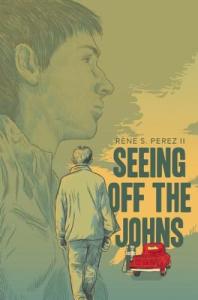
Seeing Off the Johns, the debut novel from Rene Perez II, is a BookPage Teen Top Pick and has been called "a searing, mature novel."

Seeing Off the Johns, the debut novel from Rene S. Perez II, is a BookPage Teen Top Pick and has been called “a searing, mature novel.”

Some famous writer or another once said that stories and novels don’t portray a life but, rather, a glimpse of one part of the life that suggests the entirety of the whole. This is all well and good until you try it. You find yourself wondering, “Which snapshot is the right one?” or “What part of my life suggests the whole thing? I hope it’s not the part where I forgot to put on deodorant.” It can be an impossible question to answer. A better question might be this: How can a particular scene or moment reveal the constant process of change that is part of any life?

This is what Rene S. Perez II does in his debut novel, Seeing Off the JohnsIt will be published on November 3, which means you can take off work to buy it and tell your boss that you were voting.

How the Novel Works

Early in the novel, there is a scene with two couples meeting for dinner. Their sons are long-time friends and have just left home together to attend the University of Texas and play together on the baseball team:

He held out a glass of bourbon to Andres while Angie poured a couple of margaritas in stemware waiting on the table. They raised their glasses, the four of them, and looked at each other as though they’d all just rolled out of bed after an afternoon of intimacy.

“To our boys,” Angie said.

The novel uses this moment as an opportunity to give a brief history of the relationship between the Mejias and Robisons, a history that begins this way: “They had always gotten on this well, despite their difference in age.” We learn that the Robisons are older. They’re white and the Mejias are Hispanic. They’re upper class, and the Mejias are working class. The history of the relationship, then, is, to some extent, the history of how the couples dealt with these differences.

The passage tells that history from the Mejias’ point of view and begins with a description with the meals that the Mejias prepare for guests:

The Mejias rarely strayed from their standard foods—fideo and meat, tacos and chalupas, easy ricotta-free lasagna, beef and, more rarely, chicken enchiladas.

Then, the novel sets up the difference between the Mejias’ food and the Robisons’ food:

The Mejias had felt a sting of embarrassment when they went to the first of their dinners with the Robisons. They knew the Robisons were well off—Arn was the youngest grandchild and sole remaining Greentonite of Samuel and Wilhelmina Robison, who’d made a small fortune on a ranch outside of town. Arn had inherited money from them. He’d worked hard all his life as a horse doctor and hit big on some investments. But the Mejias weren’t prepared for the kind of food the Robisons were used to.

And what is that difference?

That first meal together, the Robisons served blackened catfish, which Julie thought was too fancy for her taste.

But what makes the passage interesting is the next line:

Over a decade of dinners, though, the Mejias accepted that there would be the occasional lobster tail or swordfish or prime rib or hundred-dollar bottle of bourbon.

This is how a novel or story uses a snapshot to suggest a life. Seeing Off the Johns starts with a dinner and uses it as touchstone for the entire 20-year relationship between the two couples. In that history, we learn not just the differences between the couples but how they’ve navigated those differences, and it’s that struggle that reveals the life and makes for interesting drama.

The Writing Exercise

Let’s reveal a life with a scene, using Seeing Off the Johns by Rene Perez II as a model:

  1. Choose a scene that contains a recurring moment. Perez builds his scene around a dinner, something that occurs every day and is shared by these couples on a regular basis. There are many potential, daily moments like this, and there are also other less mundane ones: recurring arguments, recurring obstacles, recurring bad habits or giving-in to vices. Even first-time moments (sex, drugs, murder) are often part of longer arcs: “the character walked this street every day until…” or “she’d been coming to the same bar for years, but on this night…” So, first, figure out which scene you’ll use as the jumping-off point for the backstory.
  2. Jump from scene to backstory. You can make the jump by reversing the order of the lines used to introduce the scene. “She’d been coming to the same bar for years, but on this night…” becomes “On every other night at the bar…” This is essentially what Perez does: “They had always gotten on this well, despite their difference in age.” The line could have read, “Every other time they’d met for dinner, they’d gotten on this well.” What he adds is the word despite, which is a great way to add tension. It adds a charge to the mundane: “She’d been coming to the same bar for years and never been hit on despite…” Give the line a try by combining the usual with the word despite.
  3. Build a narrative upon that despiteThe word inherently suggests story. Why didn’t guys hit on the woman? Why did the Mejias and Robisons get along? The answer almost certainty involves a revealing detail about human nature (She was six-foot-five and intimidating to the sort of men that drank at the bar) or a character’s decision (Over a decade of dinners, though, the Mejias accepted that there would be the occasional lobster tail or swordfish or prime rib or hundred-dollar bottle of bourbon.) Note that word accepted. They could have refused to accepted the difference in wealth, but they didn’t. They decided to get along. What you get, then, is a narrative that goes something like this: ___ has been happening for a long time despite ___, and the only reason this scene is happening now is because _____.

The goal is to craft piece of backstory that jumps out of a scene and illuminates the lives behind the scene.

Good luck.

How to Fast Forward to the Real Story

22 Sep
Matthew Saleses' novel The Hundred-Year Flood has been called "epic and devastating and full of natural majesty." It follows a young man to Prague as he struggles to understand his identity and how it fits into the world.

Matthew Salesses’ novel The Hundred-Year Flood has been called “epic and devastating and full of natural majesty.” It follows a young man to Prague as he struggles to understand his identity and how it fits into the world.

A smart guy named Aristotle once wrote that a dramatic structure (story) has three parts: a beginning, a middle, and an end. This sounds like common sense until you try to put it into action. Pretty quickly, you’ll realize that something as simple as a beginning is actually difficult to find. Where does a story begin? Unless the story starts with your character’s birth or conception or with the Big Bang, the first page won’t necessarily be connected to any chronological beginning. So, you must locate a moment somewhere in the character’s lifespan that makes sense as a place to start.

Matthew Salesses uses a great fast-forwarding strategy to discover such a beginning in his new novel The Hundred-Year Flood. You can read an excerpt at Hyphen Magazine.

How the Novel Works

When I was in grad school, it was a running joke in workshop that the professor would, at some point in a class, hold up the story being discussed and tear off the first three pages. The point was that writers, like old television sets, often needed time to warm up. The place where the story began was usually on page four, not page one. What got dropped to the floor usually consisted of backstory. With that in mind, look how Salesses begins The Hundred-Year Flood. (It’s actually the start of Chapter 2. The first chapter is a teaser for where the novel is headed: a hospital rehabilitation center, with the character remembering who he is.)

The day Tee decided to go to Prague, his girlfriend pulled him aside at a birthday party in Boston. The talk had turned to 9/11. “Stop acting so tragic,” his girlfriend said in his ear. “For God’s sake, others are suffering worse. Your uncle only killed himself. He didn’t die in the towers.” That was when Tee knew he couldn’t stay in America. He downed his IPA and said, “Only?” Everyone was talking about death, but he had to keep quiet. He was filling a container inside of him. Into it, he put the things he couldn’t say—about the seduction of forgetting. When his container was full, he would dump himself out in one dramatic move. A case in point: by the end of that week, he had broken up with his girlfriend and requested a leave of absence.

This paragraph contains multiple opportunities to begin a story: 9/11, the day Tee’s uncle committed suicide, and any number of scenes that would have charted the rising conflict between Tee and his girlfriend. All of these could have been good places to start. In fact, another writer might have chosen one of them. But Salesses did not. He chose to begin the novel with his character moving to Prague, and all of the action takes place there, with the flood from the title serving as a kind of ticking clock for Tee to resolve the issues that took him to the city in the first place. As an arc, it makes perfect sense, and it gives the novel a sense of coherent wholeness.

That said, given the events identified in the paragraph above, there was no structural requirement for Salesses to frame the story as he did. One of the mistakes that beginning writers often make is believing that there is some golden ratio for narrative, that if they can simply locate that ratio in their story, everything will come together. This is part of the allure of screenwriting books that lay out story beats like connect-the-dots puzzles. Those guides can work for some writers, but for many other writers, discovering the arc for their stories is a process of trial and error. The genius of Salesses’ novel is not that it frames the story as it does but that it identifies its frame and then quickly moves the reader into it. There’s no need to rip away the first three pages. He condenses them into a single paragraph, orienting the reader, and then the novel is on its way.

The Writing Exercise

Let’s write fast-forward through alternate beginnings using The Hundred-Year Flood by Matthew Salesses as a model:

  1. Identify the story you want to tell. One approach is to think about what will appear on the back cover of the book. Here’s what appears on Salesses’ novel: “Tee contemplates his own place in life as both mixed and adopted and as an American in a strange land full of heroes, myths, and ghosts.” This is what the novel is about, and the story is whatever series of events best allows Salesses to portray Tee’s contemplation. In literary fiction, the story, or plot, often stems from an internal conflict as much as from an external one. So, figuring out where to begin often requires knowing what that internal conflict is. Try summing it up with an internal action word: contemplates, struggles, grapples, wrestles.
  2. List possible starting points for that conflict. Perhaps the conflict predates the character, which is sometimes the case with internal conflicts that result from external conflict (war, bias, hatred). Perhaps it begins with a relationship gone sour (romantic, parental, work, neighbor). It might start with an event with a quick resolution (like death, as in the death of Tee’s uncle or the deaths on 9/11) but with emotional consequences that ripple away from the event. Or, as in Salesses’ novel, the conflict might begin in earnest when the character makes a decision. After all, a conflict requires two actors. If one side is doing nothing or not resisting (even passively), then there isn’t really a conflict, only the potential for one. List as many possible starting points for your conflict as you can.
  3. Pick one. The story has to begin somewhere. Which of the points on your list seems to have the most immediate potential for narrative? The answer might leap out at you, or you may need to start writing from each point and see where your writing sustains itself and keeps going and where your writing peters out. To some extent, a beginning is about energy. Without that energy, the story can’t go anywhere.
  4. Summarize the points leading up to the chosen beginning. Try giving yourself a temporary title for a paragraph: How the character/narrator got to this point. Keep it short and quick. If you’ve got kids, imagine telling someone this summary over the phone while your kids jump up, reaching for your phone. You may end up using this paragraph to start your story. Or, it may serve as a warm-up that eventually is discarded. Either way, the paragraph can prepare your mind for the narrative you want to tell and the arc that you’ve created.

Good luck.