Tag Archives: creative writing prompts

Narrating a Crime Scene Investigation

23 Apr
Steve by Marcus Pactor can be found online at this journal and also in his new collection of stories, vs. Death Noises.

“The Archived Steve” by Marcus Pactor can be read online at Timber and also in his new collection of stories, vs. Death Noises.

Literary fiction could learn a lot from the TV show CSI. If that claim sounds absurd, consider this: The show does not follow a traditional plot structure. No episode can be summed up with the old saws “Stranger Comes to Town” and “Character Goes on a Trip.” Those plot lines are present in the show, but they occur quickly—usually, within the first two minutes—and serve only to introduce the true story: the investigation, which consists almost exclusively of people standing around, talking to one another. Sounds pretty cerebral, right?

The problem with most detective shows is that their investigations have the same emotional impact as piecing together a jigsaw puzzle. The detectives remain untouched by their work. In a literary investigation, however, the characters are forever changed by the information they uncover.

A recent story that illustrates the dramatic potential of an investigation is “The Archived Steve” by Marcus Pactor. It appears in his new collection vs. Death Noises, and you can read it online at Timber.

How the Story Works

Here is the story: Steve is dead, and the narrator is searching through the items left in his apartment. With each discovered item, the narrator begins to piece together the story of Steve’s death. A show like CSI would maintain its focus on this search and puzzle solving. But the focus of “The Archived Steve” shifts away from the corpse and onto the man searching the apartment, a man who will learn that he is partly culpable in Steve’s death. The story, then, becomes about the emotional consequences of his investigation.

So how does the story work? While its premise may seem disconcerting at first—some readers may be thrown off by the matter-of-fact listing of evidence—the story does not plunge into the evidence without purpose. The first paragraph makes clear that the narrator’s goal is to “correct that fool doctor” and his autopsy report.

Aside: I’ve mentioned this idea several times on the blog, and it bears repeating. It’s important to give readers a sense of where the story is going. There are many ways to do this. For more examples, check out these exercise based on Manuel Gonzales’ story “Farewell, Africa,” Owen Egerton’s chapter “Nativity,” and Stacey Swann’s story “Pull.”

Once Marcus Pactor establishes the direction of the story’s investigation, he quickly sets it into motion, offering and explaining evidence. Notice how the type of evidence changes, moving from the concrete (“technological equipment and books”) to the more abstract (“Steve’s Inverted Pyramid of Suffering”). As this shift occurs, the reader requires more explanation from the narrator, which leads the narrator to insert himself more fully into the story. As a result, the pronouns begin to change halfway through the story. The words “we” and “I” appear more frequently as the story becomes the narrator’s, rather than the corpse’s.

What begins as the search through items left in an apartment becomes the story of a man’s growing sense of guilt and failure.

The Writing Exercise

Let’s use “The Archived Steve” as a model. Just as Marcus Pactor’s story focuses on items rather than the dead man who left them behind, let’s create a story from the things that our characters pull in their wakes.

  1. Choose a mysterious premise: someone has disappeared, someone has died from undetermined causes, something has been stolen, something has gone missing.
  2. Put yourself into a room where the person was last seen or where he/she spent a great deal of time—or the room where the item went missing from. What is in the room? Make a list. Be exhaustive.
  3. Now that you’ve created the items, give yourself an investigative goal: to sift through the items in order to find/figure out X.
  4. Begin explaining the relevance of each item to the missing person or the connection to the missing thing. Keep in mind your goal. What clue does each item offer you in your effort to reach the goal?
  5. If you find that explanations of certain items tend to veer unexpectedly or slide into unexpected tangents, that’s great. Follow those tangents. Just as a true crime investigator leaves no stone unturned and follows every tip, you should follow every trail that your subconscious provides. Keep in mind: you’re uncovering a story just as your narrator or character is uncovering a crime. Give yourself permission to explore.

Have fun and good luck.

The Inscrutable Stranger Comes to Town

16 Apr
Kirstin Valdez Quade's story "Nemecia" won first place in Narrative Magazine's Spring 2012 Short Story Contest.

Kirstin Valdez Quade’s story “Nemecia” won first place in Narrative Magazine’s Spring 2012 Short Story Contest.

The writer Charles Baxter once wrote in an interview that he liked “to throw characters together into situations that create stress so that as the story goes forward, something in the situation or the characters is forced to reveal itself.” And yet Baxter has also written, “When all the details fit in perfectly, something is probably wrong with the story.”

This contradiction is faced by all writers. We must seek to understand the motives and meanings of our characters’ actions, but if we understand them too well, the story loses any sense of mystery. As a result, some of the greatest stories—such as “Bartleby the Scrivener”—are those about the search for understanding. In Melville’s story, the narrator nearly drives himself  mad trying to figure out why his employee, and then former employee, Bartleby, responds to all requests with “I would prefer not to.” In the end, though, Bartleby resists explanation. He remains a cypher.

That same inscrutability can be found in Kirsten Valdez Quade’s story “Nemecia.” The story won the Narrative Magazine Spring 2012 Short Story Contest, and you can read it here.

(Note: Registration is required–but it’s free and definitely worth the few seconds required to do so.)

How the Story Works

The story is about Nemecia, an unsettling character who has joined, under chilling circumstances, the narrator’s family. The narrator’s attempt to understand Nemecia’s odd behavior shapes the story. The first section acts as an introduction.  Here are some select lines:

  1. Nemecia had an air of tragedy about her, which she cultivated…At night she stole food from the pantry, handfuls of prunes, beef jerky, pieces of ham…The quick efficient bites, the movement of her jaw, the way the food slid down her throat—it made me sick to think of her body permitting such quantities.
  2. I was afraid of Nemecia because I knew her greatest secret: when she was five, she put her mother in a coma and killed our grandfather.

The next section operates in the same way as Nathaniel Hawthorne’s “Young Goodman Brown.” The narrator’s new knowledge affects her view of the entire community. Here are some select lines:

  1. The next day, the world looked different; every adult I encountered was diminished now, made frail by Nemecia’s secret.
  2. I wondered if they were afraid of what she might do to them. Perhaps the whole town was terrified of my cousin.
  3. At night I stayed awake as long as I could, waiting for Nemecia to come after me in the dark.

A great story can put goosebumps on its readers’ arms, and following that last line, the story leaps into action. With each new awful attack by Nemecia, the narrator tries to understand her nemesis, to comprehend what has made her so cruel. But she repeatedly fails and, by the end, she can only watch as “Nemecia held a wineglass up to the window and turned it. “See how clear?” Shards of light moved across her face.”

Nemecia remains inscrutable.

The Writing Exercise

This story is a fresh version of the age-old tale “Stranger Comes to Town.” Let’s try our own version. As you brainstorm for each step, write quickly. Don’t think too hard. Let your subconscious spit out material. You can edit it later.

1. Pick a town/neighborhood. Describe the main street, the stores, the residential streets, a house. Who lives there? What objects are important in the street, the stores, etc. Be specific.

2. Pick a stranger. Keep in mind that the best strangers have poker faces; they do not give away their thoughts. Some people will consider them sweet, and others will find them menacing. Give the stranger behavior that suggests both views—but that also suggests something isn’t quite right.

3. Pick one of the objects described earlier in Step 1. Make it go missing. Or make it malfunction. Or make it suddenly turn up in the stranger’s possession. In other words, disrupt the world that you created. Regardless of what disruption you choose, the stranger should be implicated.

4. Provide the stranger with a logical excuse—or simply allow the stranger to remain quiet so that others will make the excuse for him/her.

Your goal is to slowly increase the pressure on the town to discover why the stranger has behaved in this way, to understand what is happening. Yet you must also allow the stranger to resist this understanding. When done well, this can produce an incredible tension in your story.

Good luck.

How to Reveal Plot with Dialogue

9 Apr
The Dead We Know is a zombie novel in the tradition of epics like The Walking Dead and Stephen King's The Stand

The Dead We Know is a zombie novel in the tradition of serial epics like The Walking Dead

Can literary writers do genre? Many people think not. A literary writer will get bored with the conventions, they say, and begin experimenting, producing a pulp/literary hybrid.  Recent history shows many examples of this: Michael Chabon won a rash of prizes for his detective novel The Yiddish Policeman’s Union, and New Fabulists like George Saunders, Manuel Gonzales, and Karen Russell embrace and explore the conventions of fantasy and science fiction.

But what about the pure genre novel? Is it really off-limits to literary writers?

T. J. Danko is the pseudonym of a literary writer who has published stories in various journals, but his latest work embraces one of the most popular forms of genre literature—zombies. The Dead We Know is not a Chabon-like crossover or a Saunders-esque ironic treatment. It’s old-fashioned page-turner that keeps you up after your bedtime.  You can read the first chapter of The Dead We Know here.

How the Novel Works

Works of genre, like all novels, deliver pieces of information gradually. One way to accomplish this is through dialogue, and this is where The Dead We Know excels. For instance, look at Nick and Eduardo’ argument about whether the truck window should be rolled up or down:

“I’m freezing. Why aren’t you freezing?”

He closed his eyes and began to drift off. Eduardo punched him.

“Ow.”

“What are you doing? You close the window and you go to sleep? Fuck you. You want me to crash or something?”

“Fine. Turn on the radio.”

“Fantastic,” Eduardo said. He switched on the radio, and there was a sharp crackle. He kept turning the dial, but there was only more noise.

“Nothing?” Nick asked.

“The whole trip I get nothing but static.”

Nick yawned loudly. “We’ve been driving in the middle of nowhere.”

“Help me stay awake,” Eduardo complained. “It’s boring driving in the middle of the night.”

The scene’s realism—Nick and Eduardo behave like every road-tripper who’s ever lived—is what heightens the tension. Through a realistic argument, we’re being told, indirectly, everything that will happen. Of course they will crash, and of course the crash will happen in the dark, in the middle of nowhere. This is a zombie novel, after all. It might be tempting, as a writer, to “reinvent” the genre, but the best genre novels stick to conventions. The writer’s skill is in making those conventions seem fresh and new. One way to do this is to avoid giving the reader information directly. Instead, focus on the characters, the ways their personalities clash. Give the characters lives that exist prior to the zombies. In other words, give the characters something to talk about, and then let the story intrude.

The Writing Exercise

Let’s play around with dialogue. For this exercise, write a scene (two pages max) in which you use only dialogue.

  1. Choose a setting (exiting a movie theater, approaching a rope bridge over a lava flow with pterodactyls flying everywhere).
  2. Choose a relationship dynamic (they’re fighting over…, they’re upset because…, they’re relaxed because…).
  3. Choose a goal (character will confess his/her love for the other, character will reveal a hideous secret)
  4. Now write the scene. But here are the rules: The characters cannot state outright the relationship dynamic or the goal. They must allude to or approach the dynamic/goal from an angle or under cover of some other piece of conversation.

These rules may seem difficult, yet you may discover that your scene begins to move in unexpected ways. Try it out.

Good luck.

Put Snakes on a Plane

2 Apr

Stacey Swann’s story “Pull” was published in Freight Stories.

No movie ever had a better premise than Snakes on a Plane. If good fiction traps incompatible characters in a room, then what could better than a crowd trapped 20,000 feet above ground with humanity’s oldest enemy. The problem, however, was that the trapped characters had shallow motivations and desires—bite, not get bitten. As a result, the movie had no way to advance or explore the premise. Why do the snakes want to bite the people? Who cares? They’re snakes. It’s what they do. What is the passenger’s ulterior motives? I’ll let Samuel L. Jackson fill you in

So what does great fiction have to do with a B movie? Like Snakes on a Plane, fiction seeks to trap together incompatible characters. The difference is that the incompatibility itself is complex. A clear example can be found in Stacey Swann’s story, “Pull,” which was published here at Freight Stories.

How the Story Works

Unlike the snakes and the passengers, who hate and despise each other equally, the characters in Stacey Swann’s story, “Pull,” suffer from a far more complex incompatibility: unrequited love. As the story makes clear in the final, devastating line, the two characters are incompatible, but only one of them knows it—and even that knowledge cannot save them.

So how does Swann do it?

First, she carefully sets the stage: Jo and Lou are in love.

Then, she defines each character: Lou is a depressive who drops out of Texas A&M and only feels better when Jo returns home while on break from Stanford. Jo, on the other hand, realizes that “she was sad every time she saw him.”

At this point, a lot of writers might wonder what comes next. If Jo is at Stanford, how do you get her back to small town in Texas that she doesn’t like? How do you trap them together? Swann does it by making Jo a casualty of the economy. Her newspaper job has vanished, and Jo, like so many young people, has no choice but to temporarily move home—where her old boyfriend awaits. Perhaps, Jo thinks, the old romantic fire still smolders. Maybe they’ll catch on together. But, of course, that’s not what happens. The events that occur must occur, and, as a result, we read this brilliant final line: “There will always be things we can’t keep ourselves from doing, no matter who it hurts.”

The Writing Exercise

Let’s follow Stacey Swann’s model:

  1. Create a premise: X and Y are in love. X and Y are in prison. X and Y are sailing across the ocean (Life of Pi), X and Y are college friends.
  2. Define each character, stressing the incompatability: X loves Y, but Y is way too old (Harold and Maude); Y is X’s only friend, but Y is an invisible 6-foot-tall rabbit (Harvey); X is neat and uptight, and his roommate Y is an easygoing slob (The Odd Couple); X loves Y, but Y is impotent and can never be with X (The Sun Also Rises).
  3. Trap the characters in a confined place: a lifeboat, a car, an apartment, a small group of friends in a strange city.
  4. Explore the situation. Don’t worry about story or plot. Write a few scenes and see what happens. For instance, what happens if impotent Jake is at a bar and sees the love of his life Brett with another man?

An effective entrapment will make the situation seem inevitable. Of course Jake Barnes is impotent; he was in the war, and the war was terrible, and many soldiers came home injured, and everything that came afterward was bad. Of course Jo returns to her small Texas hometown; where else would she go after losing her job? She couldn’t afford to live in San Francisco without money.

Spend some time thinking about the entrapment. If you find the right approach, and if your characters are compellingly mismatched, you may find that it sparks your imagination and the story begins to write itself.

Good luck.

Twist Endings

26 Mar
Brian Evenson's story "Windeye" was first published in PEN America 11: Make Believe. The story was later selected for the 2010 PEN/O'Henry Prize Stories.

Brian Evenson’s story “Windeye” was first published in PEN America 11: Make Believe. The story was later selected for The 2011 PEN/O’Henry Prize Stories.

Twist endings are one of the great pleasures of literature, yet in contemporary fiction, they’ve gone the way of the dodo and the epiphany. No one would dare write a modern version of O’Henry’s classic “Gift of the Magi,” and for good reason. That twist—and others like it—seem manipulative and implausible to modern readers. Perhaps it’s our attachment, as Americans, to realism, but we tend to relegate sudden reversals of fortune or circumstance to reality TV and schlocky movies. As a result, it’s tempting to ask whether a twist ending is even possible in literary fiction.

Brian Evenson would say yes, and he pulls of a doozy in “Windeye.” The story appeared in The 2011 Pen/O. Henry Prize Stories and was first published by PEN American Center. You can read it at PEN America’s site, here.

How the Story Works

Evenson uses an old trick: Introduce a character, weave her into the fabric of the story, and then—when our attention is focused elsewhere— make us question the character’s reality.  It’s not unlike the strategy used by Ron Howard in A Beautiful Mind; the brilliant mathematician’s friend is real, and when, suddenly, he’s not, we’re as dumbfounded as the mathematician. In “Windeye”, the reader doesn’t fully understand the truth until the mother says, “But you don’t have a sister.” And like the boy, we can’t quite believe it.

In a classic reversal, such as the one used by M. Night Shyamalon in The Sixth Sense, the viewer or reader’s sense of what is true is completely reversed. In other words, we realize that Bruce Willis is, in fact, not alive but dead. “Windeye” operates differently. The twist is incomplete. The sister likely never existed, but the boy can’t be certain of it – and more importantly, the boy will never be certain. Evenson creates this uncertainty with the fifth and final section, jumping forward in time, explaining the reversal’s emotional consequences. The boy can never shake the feeling that one day his sister will “simply reappear, young as ever, ready to continue with the games they had played.” This is similar to the strategy that Alfred Hitchock used in Vertigo, when Jimmy Stewart’s character discovers that he’s been fooled. Instead of ending with the revelation, the film continues, revealing the twist’s emotional consequences.

Once you’ve read the story, it’s easy to go back, section by section, to see how the twist (the fact that the sister isn’t real) is hinted at but not revealed. It’s worth checking out to learn how seeds planted at the beginning gradually sprout and reveal more of themselves.

The Writing Exercise:

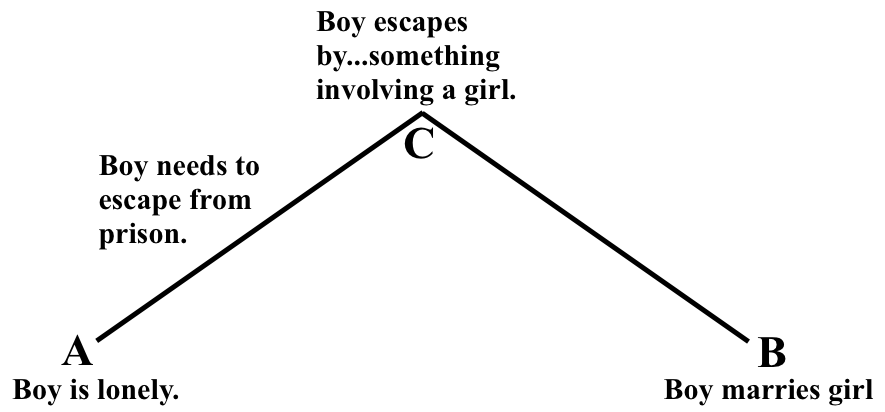
  1. Write down an ending (boy gets girl, woman discovers fortune, man finds happiness, woman is revealed to be a zombie). Don’t be afraid to go boldly where you normally wouldn’t dare.
  2. Now, write down a beginning that is the complete opposite of the ending (girl doesn’t know boy exists, woman is poor, man is miserable, woman is the leader of the free world).
  3. You may think that the trick will be getting from Point A to Point B, from leader of the free world to the realization that she’s a zombie. But a story with a twist—in truth, most stories—depends on a point between A and B. So, give the character a goal that has nothing to do with the Point B (boy needs to escape from prison, woman needs to hide from ex-husband, man wants to become the world’s greatest ventriloquist, woman must pass a national budget).
  4. Screen Shot 2013-03-25 at 8.45.45 PMOutline the events that must occur or the stages the character must go through to reach the destination he or she is aiming for. At the same time, outline backward from the Point B ending. The moment where the outlines meet will be a point of high tension (hopefully). If you can create the outline, all that is left is to flesh out the story, dropping hints of Point B in the beginning.

If you’re working on a story and don’t want to start a new one, try this exercise:

  1. Reread the ending of your story. Then fast forward in time (six months, sixty years, whatever). Summarize the emotional consequences of the ending you have already written. How do the characters live with the ending you’ve given them?
  2. You may discover that the story isn’t over. The story’s true conflict may still be unwritten. Or, you may realize that your original ending is the best one. That realization can be as valuable as any.

Have fun writing.

How to Use Mystifying Detail to Create Conflict

19 Mar
full_swiftbrutal

“Swift, Brutal Retaliation” by Megan McCarron was published at Tor.com and was nominated for a 2013 Nebula Award.

A few years ago, one of my college-composition students read the Christian inspirational novel, The Shack. In the book, a man receives a letter from God. I asked what seemed like a reasonable question: “Where was the letter from? What city was on the postmark?” The student just shook her head. For her, and for the book apparently, details like that were besides the point.

But for a writer, details are exactly the point. (For theologians as well. For instance, did Adam have a belly button? The answer matters more than you might expect.)

Meghan McCarron embraces this sort of mystifying detail in her story, “Swift, Brutal Retaliation.” You can read the Nebula Award-nominated novelette here at Tor.com.

How the Story Works

McCarron uses a classic ghost-story concept: Look into a mirror and see someone else’s face. It’s an easy way to move a ghost into a story. But once you have a ghost, what do you do with it? The answer depends on the sort of world the ghost has entered. In the novel The Shack, the world is one that God enters easily, where obvious questions such as   “Where did this letter come from?” are never asked. The world of that novel isn’t the world we live in. But what if it was? Part of the beauty of “Swift, Brutal Retaliation” is that it takes one of the oldest sci-fi/fantasy premises and adapts it to a contemporary world. As a result, the fantastical elements almost become realistic. Here are a few examples of the details that McCarron shows us:

  • “Sinead carried a thermometer and a compass, which the internet had told her were useful for detecting paranormal presences.”
  • “Sinead remembered reading somewhere, or maybe seeing in a movie, that you had to ask ghosts what they wanted.”
  • The ghost, when still alive, loved Facebook, and so his sister logged on and typed, “Ian, r u haunting the house?”

The world that McCarron creates—and that the ghost inhabits—becomes almost tangible. We, the readers, believe this place exists because we can see it in such sharp focus. As a result, when the ghost becomes angry, its fury and frustration are manifested in ways that now seem highly plausible—lasagna, hair-removal liquid. We’ve bought into the world, and now we’re scared when it becomes dangerous.

The Writing Exercise

In some ways, this story answers the age-old question, “What would you do if you saw a ghost?” The question has many possible answers, but the sisters’ responses are not limitless because they are shaped both by their personalities and by their world. So, for this exercise, let’s create a premise and a world.

  1. Choose an unusual premise. Ideally, you’ll pick something fun, something you’ve always wanted to write about: zombies, vampires, ghosts, magic, any one of a thousand sci-fi/fantasy/superhero/whatever premises. 
  2. Now, choose a specific place. It could be your living room. Or whatever is outside your window. Or it could be place in town that you know well. It could even be imagined.
  3. Fill the place with things: silverware, a piano, a fire hydrant, a church pew, a filing cabinet. Give yourself plenty of objects to use later.
  4. Put people in the place—main characters, anonymous faces, it doesn’t matter.
  5. Now, wind the premise like a toy and watch it run. Imagine a scene: If someone has otherworldly powers, how do those powers affect the things you’ve given yourself? If someone must react to a character with otherworldly powers, how are the things used as protection/weapons or for cover? Play around with the premise and things. In other words, do the ghosts use Facebook?

Have fun.

Show the Narrator’s Evolution

12 Mar
Nina McConigley's story "White Wedding" was first published in Memorius and will be included in her forthcoming debut short-story collection, Cowboys and East Indians.

Nina McConigley’s story “White Wedding” was first published in Memorious and is included in her debut short-story collection, Cowboys and East Indians.

If someone asks, “What happens in the story?” the answer can tell you a lot. Maybe it’s a series of actions: guy gets killed in the Louvre, and so another guy interviews people, solves puzzles, meets Jesus’ great-great-etc granddaughter, and together they catch the killer. The main character probably doesn’t have much of an interior life. All changes are plot changes.

But what if the answer is “It’s about this guy, and at first he felt this way, but then he realized he felt this way?” The story is in his head. A story like this can present a problem: if the character’s interior life is the story, how do you show any of it? Most of us want to avoid writing this sentence: “Now he felt different.” But how?

Nina McConigley solves this problem masterfully in “White Wedding.” The story is included in her debut collection from Five Chapter Books, but you can read it here at Memorious.

How the Story Works

The narrator, Lakshmi, lives (and has chosen to live) in Casper, Wyoming, a city and state with an almost-entirely white population. She claims to be comfortable with standing out, but by the story’s end, she has perhaps decided to leave, in part because of her feelings about identity and place. As a result, the reader can gauge Lakshmi’s movement toward “the speed of [her] own escape” by how she feels about Casper.

Here are a few examples of her evolution:

  • The first paragraph ends with this statement: “We were used to white people.”
  • Halfway through the story, the narrator remembers her dying mother’s wish not to be “buried in Western clothes.” Instead, her mother asks to be buried in a sari. The problem is that the “people in the funeral home won’t know how.” But neither does the narrator. As she practices putting on the sari, her mother tells her Lakshmi that she should wear one more often. The narrator remembers thinking, “I would like to wear them more often. But where? To the Wonder Bar? To work?” Suddenly, the narrator isn’t so certain about her relationship to the place’s whiteness.
  • By the day of the wedding, the narrator has learned to dress someone in a sari. But that ability does not give her a connection to her Indian identity. When asked how she feels about being bi-racial, the narrator has usually answered, “It’s the best of two worlds! I get to be American, and Indian. I have two cultures to choose from!” But she’s learned that “the halves did not make a whole.” She is satisfied with neither white Casper nor her Indian heritage. As a result, she perhaps decides to strike out and find her own place and identity.

Notice how McConigley invests the narrator’s feelings about ethnicity in a specific object: a sari. The writing is never vague. The first paragraph even gives a statistic about the whiteness of Casper. The lesson, then, is to give the narrator an existential concern—Who am I? What am I doing?—and embody that concern in a particular place, object, or person.

The Writing Exercise

  1. Pick a character. You can invent one from scratch or choose an existing character from a story draft. 
  2. Find an existential problem. Answer this question: When the character can’t sleep at night, what does he/she think or obsess about? Write the answer as a general statement (Carl wonders if he’ll ever find love.)
  3. Locate that problem in something concrete. Embody your answer in a place, object, or person. For example, my character Carl might be really ugly, and so he obsesses about a particular feature of his face or body. Or perhaps he lives in a place where no one shares his interests (canning, video games, musicals).
  4. Change the character’s attitude toward the problem. Brainstorm how the character’s feelings toward that place, object, or person change over the course of time. So, Carl might become less self-conscious about his looks. Or he might decide to move somewhere that has people like him. Or he might change his views on the requirements of love—maybe people don’t need to share interests. Maybe there’s something else that can attract lovers. Once you find the change that will occur, you can create a story (obstacles for the character to encounter) that will allow them to take place.

It’s possible that this exercise will feel too didactic, as though you’re telling the reader too much. Keep in mind that these notes are for you. If you know how your character feels (and evolves), it will be easier to keep the story moving in the right direction.

Good luck!

Disorient the Reader

5 Mar
The opening chapters of "Threats" by Amelia Gray can be read at Newfound.

The opening chapters of Threats by Amelia Gray can be read at Newfound. For a listing of AWP events featuring Gray, click here.

Reviewers love a page turner. It’s the highest praise a book can receive, right? The story becomes so tense that you begin flipping pages, moving from highlight to highlight: dead body, mysterious note, late-night phone call, threatened detective, terse cover up. Soon you’re skimming, propelled by the urge to find out what happens. All those words on the page actually get in the way. They slow us down. We might even ask, what are they for? What is the purpose of words in a page turner?

Amelia Gray answers this question in her novel Threats. She takes a genre (murder mystery) that we know so well that the usual stories make an impression only by being more exciting, more page-turning, than the rest. But Threats scrambles the form, shaking us into paying attention. The novel was published by Farrar, Strous, and Giroux (and named a finalist for the PEN/Faulkner Award), and you can read the opening pages here at Newfound.

How the Novel Works

Many novels will begin with a wide-angle lens, showing us the place where events will occur. Even nonfiction does this; think about Truman Capote’s In Cold Blood and its description of the rural Kansas landscape. But Gray doesn’t let us see the world of her novel right away. Instead, we’re shown a package. Then string. Then fingernails, styrofoam carton, thick tape, and a receipt. Notice how long it takes to get to the casual mention of a cremation charge. This is a conscious choice by the author. The entire excerpt is designed to confound and disorient the reader. Imagine how different the novel would be if it instead started this way: “The postal carrier walked up the sidewalk of the small, neat house. He was carrying a box from a mortuary, and inside was an urn full of ashes.”

The novel also mixes up the order in which information is revealed. Rather than telling us that Franny is dead at the beginning, the novel first shows us Franny’s magazines, her height, and the backstory of how she met David. Even her death scene is scrambled. When the paramedics arrive, David sees himself (and his wife’s corpse) through the eyes of the fire fighter. As a result, we’re disoriented. We know we’ve seen this premise before, but it’s so unrecognizable that we’re forced to slow down and pay attention.

As a reader, you may hate this. Or, you may love it. If you do—if you want your eyes held to each word , never skimming—then try this exercise to help achieve the effect in your own writing.

The Writing Exercise

Here are two different exercises. In the first exercise, we’ll think about frame:

  1. Pick a scene you’ve already written or begin a new one (Here’s an easy way to begin: two or more people in a specific place, in the midst of a long-simmering argument).
  2. First, introduce the reader to the scene with a wide frame. You’ll not only show the people involved but also the space around them—the room, the building, the surrounding land. The frame will gradually narrow and focus on the individuals involved in the scene.
    1. For example: The park was green and shaded except for three picnic tables where the trees had been cut down. This was where Mark and Grace were setting up for the party. Every other table was taken. The temperature was barely 80 degrees, but they were already drenched in sweat.
  3. Now, take that same scene and introduce the reader to it using a narrow frame (like Gray does in Threats). Squeeze the reader’s view as small as possible, focusing on a single item or even part of an item (such as the package, the tape, the fingernails in Threats). The frame will gradually widen to include the people involved and perhaps even the place.

Neither frame (wide or narrow) is by default better than the other. Each is simply a tool that can be used.

The second exercise focuses on the release of information.

  1. Choose a sequence of events that culminates in an action that cannot be undone.
    1. For example: Eat, wash dishes, break plate.
    2. Here is the sequence in Threats: Franny hurts herself and dies, paramedics arrive, ashes arrive.
  2. Write a paragraph for each part of the sequence. Each paragraph will focus on one part. You can also write a paragraph that sets up the sequence.
  3. Once you’ve written the paragraphs, scramble the order in which they appear in the story.
    1. Here is how Threats scrambles the sequence: box of ashes, backstory (setting up sequence), Franny’s injury, paramedics, Franny’s corpse.

Happy writing. Also, if you’re at AWP, you can catch Amelia Gray every day of the conference. For a schedule of events, click here.

Show It Once, Show It Again

26 Feb
images-2

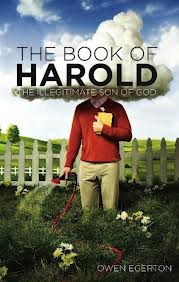
“The Book of Harold” by Owen Egerton is out in paperback from Soft Skull Press. You can read the first chapter here.

Maybe you’ve heard this one: A doctor, a corpse, and a rabbit walk into a bar. The doctor says, “Give me a stiff one.” The corpse says…

Or this one: Three little pigs each built a house. A big, bad wolf knocked on the first pig’s door and said…

Or possibly this one: A man named Ocean gets 11 thieves to break into a casino. First, they plan the heist, then they practice it, and then they do it for real, except…

These three stories share one of the world’s oldest storytelling strategies: put characters in a situation that will be repeated, but each repetition is slightly different—different enough to keep the reader’s attention but also essentially the same. The storyteller allows the reader to develop an expectation for how a situation will play out. But of course, there is a twist in the final repetition; the sequence goes awry. The success of a story is often determined by how well its sequence goes off the tracks.

A great example of this strategy can be found in Owen Egerton’s novel, The Book of Harold: The Illegitimate Son of God. The paperback edition of the book was published by Soft Skull Press, and you can read the first chapter, “Nativity,” on Amazon here.

How the Chapter Works

Count how many times Egerton shows us the Christmas pageant:

  1. We’re told that the pageant “was a Christmas tradition for our church.”
  2. Next, we’re shown the casting and introduced to the doll that will play Baby Jesus.
  3. Then, we’re shown the children practicing the pageant, running through the entire show.
  4. Next, we’re given a quick description of the first two nights of the pageant.
  5. Finally, the last performance is upon us. We know the drill by heart, and so do the characters. Notice how they begin to alter the routine: the donkey drop “balls of dung every other step,” a Wise Man slips on the dung, and chaos ensues.

Because the story repeats the pageant five times, the reader develops an expectation for what will occur—and also that something will go wrong. Notice how each telling involves a bit of irregularity: the introduction of the drummer boy, the casting of the narrator as Joseph, the drummer boy mis-delivering his line, angels crying, and finally donkeys pooping. Yet, even though the reader expects an unexpected turn of events, there is no way to foresee what actually happens. The thrill, for the reader, is in waiting for the predicted, yet unpredictable, twist.

The Writing Exercise

  1. Choose a scene that will repeat itself. The scene could be one that involves planning and practice (a wedding, shouting “Surprise!” at a birthday party). Or it could center around someone involved in a routine activity (door-to-door salesman).
  2. People the scene with characters (wedding/party guests, salesman/homeowners).
  3. Tell the reader how the scene will play out, and then show the scene once or twice.
  4. Finally, show the scene a final time, adding unexpected challenges.

It helps if you give the main character a sense that something might go wrong—or if you generally introduce the idea that all might not go according to plan. You can introduce the idea subtly or in an obvious way. The point is to show the sequence of events while hinting at a twist in the sequence.

Be inventive with this exercise. Remember, you want to surprise an expectant reader.

Happy writing.

Make the Reader Want to Know

19 Feb
images-1

“Farewell, Africa” by Manuel Gonzales was published in Guernica. You can read the story online here. Or, you can check out the story collection The Miniature Wife.

The writer Ron Carlson once began a story workshop by listing the things that we, as writers, would love to be told—but would never hear—in a workshop. Number one was, “If you stop writing, I’ll die.” The truth is that we’ll never receive the praise we truly want. No one’s life hinges on our work. Our readers won’t die if we hang up our writing shoes.

But that doesn’t mean we can’t make them curious—maybe even make them sweat.

Manuel Gonzales’s new story, “Farewell, Africa,” rivals any potboiler for its ability to create suspense. By the end of the first sentence, we want to know something very badly, and we’ll read until we find it out. “Farewell, Africa” is included in the new story collection The Miniature Wife and was also recently published by Guernica. You can read it here.

How the Story Works

Kenneth Burke, in his essay “Psychology and Form,” explains the relationship between writer and audience. To create suspense in the reader’s mind, Burke claims, requires “the creation of an appetite in the mind of the [reader], and the adequate satisfying of that appetite.” To create the appetite, the writer first dangles a prize in front of the reader—saying, in effect, “You know you want this, reader.” Once the appetite is created, the writer delays handing over the prize as long as possible, introducing, as Burke writes, “a temporary set of frustrations.”

Let’s look at how “Farewell, Africa” creates and then delays the satisfaction of an appetite.

The story begins this way: “No one, apparently, had thought to test the pool before the party to see that it worked.” Immediately the reader wonders what went wrong. Or even, more basically, how can a pool not work? The statement is so unexpected and odd that we naturally want to know more.

But the story withholds the answer for several paragraphs. It shifts gears, explaining the pool’s size and architect and the fact that it “had been commissioned as a memorial installation for the Memorial Museum of Continents Lost.” Now we’re really intrigued. What continents were lost? What is this world we’ve entered? In effect, the story has pulled a bit of sleight of hand, replacing the initial prize that we wanted with something else that we also want. We want to know why the pool didn’t work, but we’re distracted with the sheer strangeness of a world with disappearing continents. When, at the end of Part I, the story finally returns to the pool, it’s with a savage, understated rush that catches us by surprise: “’The damn thing’s not working.’ Then he took a sip of champagne and said, ‘Too bad this didn’t happen with the real Africa.'”

As readers, once we’re hooked so firmly, we’ll follow the story wherever it goes.

The Writing Exercise

  1. Begin a scene by selecting a place (i.e. kitchen) and at least two characters (man, woman).
  2. In the first sentence of the paragraph, tell the reader what will happen in the scene (man will propose, woman will reveal she’s pregnant). There are many different ways to approach this first sentence, but, for now, simply tell the reader the information, either in third person (The man practiced his marriage proposal as he walked into the kitchen) or in first person (I didn’t want to tell him I was pregnant right away, so when he came into the kitchen, I asked if he’d picked up take-out).
  3. In the second sentence, introduce a diversion—or, as Burke calls it, a frustration. The diversion can be anything (take-out or the lack of). The idea is to get the reader interested and distracted by this new piece of information.
  4. Follow the diversion for as long as you can (argument about take-out).
  5. Then, surprise the reader by coming back to the info promised by the first sentence (Oh, by the way, Honey, we’re having a baby).

In short, promise the reader something, delay delivering on the promise for as long as possible, and then deliver. That’s one way to create suspense.

To learn more, look for an interview with Manuel Gonzales on Thursday.

Happy writing.