Tag Archives: how to write a novel

How to Set the Rules Your Characters Must Live By

13 Aug
Shannon Thompson's novel "Minutes Before Sunset" was a Goodreads Book of the Month in July.

Shannon A. Thompson’s novel Minutes Before Sunset was a Goodreads Book of the Month in July and tells the story of two young adults trying to balance their supernatural gifts with a desire to live in the human world.

Every story has rules. In comic books, the superheroes have certain powers and not others. In horror stories, monsters can be killed only with silver bullets or certain chants. In romances, the heroine falls for certain kinds of men and not others. Pam Houston wrote a novel titled Cowboys are My Weakness. The rules of the novel are announced before you even open the book. Every story ever written or told must announce the rules it will play by.

The trick, as a writer, is to show those rules without disrupting the narrative. Shannon A. Thompson sets the rules clearly and quickly in her Young Adult/Paranormal novel Minutes Before Sunset. You can read the first chapter here. 

How the Story Works

Once you’re aware of how stories set the rules that their characters must live by, you can’t avoid seeing it’s done. Whether the fiction is genre or literary, the need to impose boundaries and limitations on characters is the same.

Here’s an example from the title story of Ethan Rutherford’s excellent new collection The Peripatetic Coffin. The story’s about the crew of a Confederate submarine trying to break the Union blockade of the port of Charleston:

“On deck, we had an unobstructed view of what Augustus had dubbed our Tableau of Lessening Odds. The Federal blockade was stupefyingly effective. Union canonships patrolled the mouth of the harbor, just out of range, and sank anything we tried to send through with the insouciance of a bull swatting blackflies. At night, they resumed the bombardment of the city. High, arching incendiaries, numbering in the thousands, painted the sky. You felt the concussion in your chest.”

The world is imposing clear boundaries on the characters: literally, a blockade with cannon balls and bombs. At no point in the story will the characters be able to act as if these impediments do not exist.

But the boundaries and rules can be mental as well as physical. To see how, read these two excerpts from Shannon A. Thompson’s novel, Minutes Before Sunset:

“It was Independence Day, and I stood with my family on Willow Tree Mountain. They called it Willow Tree Mountain, but, in reality, it was Willow Tree Hill, and the town denied that reality.”

Here’s the second excerpt:

“I moved my foot closer to the edge of the hill. I wanted to ride the wind down to the crowd. I wanted to dance and smile. I wanted to throw my arms in the air and listen to the exploding fireworks. I wanted to run around in endless circles until I fell down from exhaustion. I wanted to enjoy everything.

But that couldn’t happen. It was impossible.”

In these two passages, we learn the fundamentals of the story: the town has an Ignorance-is-bliss attitude. The narrator would like to join the smiling townspeople, but, for a reason that will be revealed later, he’s prevented from doing so. This mental and physical limitation defines his character and determines how the story will move forward.

The Writing Exercise

Let’s practice setting the rules, using Minutes Before Sunset as a model:

  1. Choose a character and a world for that character to inhabit.
  2. Define the world with a single adjective: happy, sad, fearful, proud, bored, etc.
  3. Free write about that adjective. Your goal is to find an image of the world or the people in it that demonstrates the adjective, if possible without actually stating it. The image will set the rules for the world. Future descriptions of the world should adhere to this early image in some way. So, in Minutes Before Sunset, the town’s denial of the supernatural elements in its midst is suggested by the fact that it calls a hill a mountain. In Gone in 60 Seconds, the stovetop burns out of control to suggest Kip’s lack of control.
  4. Now, free write about the character. How does he/she feel about the image you just created? Try to find an action that suggests the character’s attitude toward the world. For instance, in The Hunger Games, the fact that Katniss sneaks through the fence in order to hunt suggests that she’s willing to break the rules to protect her family. Thus, the big event at the end of the first chapter—volunteering for the Games in place of her sister—feels like a natural extension of her character, of the attitude that we’ve already witnessed.

Good luck and have fun.

An Interview with Matt Bell

1 Aug
Matt Bell's novel In the House Upon the Dirt Between the Lake and the Woods has been called not "just a joy to read, it's also one of the smartest meditations on the subjects of love, family and marriage in recent years."

Matt Bell’s novel In the House Upon the Dirt Between the Lake and the Woods has been called not “just a joy to read, it’s also one of the smartest meditations on the subjects of love, family and marriage in recent years.”

Matt Bell is the author of the new novel In the House Upon the Dirt Between the Lake and the Woods from Soho Press, which has received the kind of positive reviews that writers dream about. He’s also written Cataclysm Baby, a novella, and How They Were Found, a collection of fiction.  He is the Senior Editor at Dzanc Books, where he also edits the literary magazine The Collagist, and he teaches creative writing at Northern Michigan University.

In this interview, Bell discusses conveying emotion in fiction, his revision process, and words of wisdom from great writers.

(To read excerpts from his novel, and to find exercises based on them, click here and here.)

Michael Noll

In the excerpt of the novel that appears at The Good Men Project, every paragraph begins with the phrase “And in this room.” It’s a powerful piece. Each time the phrase “In this room” appears, it hits with greater impact. The effect is not unlike reading a forceful essay or listening to a speech. Did you have something like that in mind? What drew you to this device/strategy?

Matt Bell

Thank you: I think the part of the book that section is from is the heart of the book, in many ways, and I was lucky to discover it as I was writing. I’m not sure exactly when I first found the form of that section, but in a lot of my work there are similar constructs, some kind of structure or system by which emotion can be organized and then interacted with. My characters often externalize their emotions in order to deal with them, and in this case it’s the wife who creates the deep house, so that her husband might be able to experience their marriage and its component parts anew, one by one, room after room.

Michael Noll

The sentence structure in both excerpts is very formal: long sentences, often structured around a series of repetitions. Here is one example: “And then, in another, the first time, long after those first times, when I realized she’d done this to herself.”

And here is another: “The genes of a killer, the genes of someone killed; half of what her parents had, but which half?”

And a final example: “And what bruises accompanied these words. What burns and shallow cuts. What years those wounds lasted, scabbed over, healed, replaced, scarred white.”

Sentences like these have the effect of fixing the reader’s gaze, of expanding the space for reflection. How much revision is required to make these sentences work? Is the rhythm of these sentences in your head from the start, or do you tease it out through the drafting process?

Matt Bell

The amount of revision required was fairly staggering. There’s rarely a sentence that appears whole and then remains untouched over the years it takes to finish the book. I’d say that an approximation of the rhythm appears early on—I can’t begin without the voice, or at least a version of it—but the fuller, final version of the voice takes a long time to emerge. The first draft of the book contained a sketch of the husband’s voice, but it took years of rewriting to get it into this final form.

Michael Noll

Both excerpts use unlikely vocabulary: exhalations, immolations, sequestered. What draws you to words like these?

Matt Bell

In this book, the diction is somewhat determined by the voice, which has a certain archaic feel to it. I’d say that some of the words are suggested by the setting of the book, which has mythic and biblical overtones, and others are determined by sentence acoustics, by the other words of the sentences. There’s a little King James Version here, a little Greek myth, a little Old Norwegian folklore, a smattering of words gleaned from 19th-century American dictionaries. All together, these words perhaps allow the book to exist outside any specific time or place, which allows it to be its own kind of myth, without overdetermining any particular association.

Michael Noll

Matt Bell's website offers quotes from writers about craft and the writing life.

Matt Bell’s website offers quotes from writers about craft and the writing life.

Every day on your website and Facebook page, you post a quote from a writer. They’re often about the mentality required to be a writer, the need for persistence and doggedness and self-criticism. Now that you have three books out, I wonder what these quotes mean to you now as compared to when you were

Matt Bell

If anything, they mean more to me than ever. The career of a writer is long, not short. Nothing is finished, nothing is good enough, nothing lasts. All of the publication and reviews and so on won’t sustain me in the same way the work will. I knew that before I had a book, and I know it more now. So I’ll take inspiration wherever I can find it. Anyone that can push me to get up everyday and hit the keys again is someone worth listening to and learning from.

August 2013

Profile pic

Michael Noll is the editor of Read to Write.

How to Use Unusual Words

31 Jul
Matt Bell's novel

Matt Bell’s novel, In the House Upon the Dirt Between the Lake and the Woods, has been called “fiercely original” and “a gut punch.” It’s also the only novel you’ll read this year where one of the conflicts is Man vs. Bear.

Ernest Hemingway didn’t mince words about style. About William Faulkner’s, he wrote, ““Poor Faulkner. Does he really think big emotions come from big words? He thinks I don’t know the ten-dollar words. I know them all right. But there are older and simpler and better words, and those are the ones I use.” But what if the two sides are not exclusive? What if you can use ten-dollar words that are also old and simple?

Matt Bell offers a lesson in using unusual vocabulary in his new novel In the House Upon the Dirt Between the Lake and the Woods. You can read a few of those words in this excerpt published at Guernica.

How the Story Works

Here are a few of the words used in the excerpt:

kith, kin, circumscribing, exhalations, remove (used as a noun), rankled (used as an adjective), sequestered.

Some of these words belong to languages other than fiction’s: sequestered is now a political word. Exhalations belongs to biology, physiology, and yoga. Circumscribing comes from geometry, mapmaking, and travel. Kith and kin belong to another age. To see just how specific our ideas can be about when certain words are appropriate, try this simple experiment: Use any of these words in casual conversation. Example: What were you doing this weekend? Oh, just hanging with my kith and kin. You’ll get some odd looks. Someone might ask, “Why are you talking that way?” But you would have accomplished a sometimes-difficult feat. That person would paying attention to you, trying to figure out, “Why is he talking that way?” or “Who is she that she uses words like that?” Part of the battle of fiction is just to get the reader to wake up and pay attention. Using unusual words can do that.

The Writing Exercise

Let’s practice using unusual words:

  1. Find your source. Words seem unusual only when they’re used outside of their usual contexts. So, pick up a trade magazine or one that caters to a hobby or special interest. Or visit a website that serves the same purpose. Write down all the words that you understand but would never use in conversation.
  2. Create a character who would use those words. The easiest way is to write a character who is part of the words’ trade or special interest; obviously, doctors don’t talk like studio engineers. But you can also shoot for idiosyncrasy. Ask yourself, what kind of person would use these words casually in a sentence outside of their usual context? Try to hear the person’s voice as he or she speaks.
  3. Write a passage in which the character discusses something mundane: eating dinner, walking the dog, going on a date, putting the kids to bed. If it’s a character with a specific job or interest, make him/her discuss the topic with someone else from that job/interest. If it’s an idiosyncratic character, just let him/her talk. Try to use as many of the unusual words from your list as possible. Some won’t make any sense, or they’ll feel forced. But others will surprise you. They’ll become part of the fabric of the character’s speech, and when that happens, you may discover that you’ve created a character with a voice you’ve never heard before.

Good luck and have fun.

How to Write about Remembering

30 Jul
Matt Bell's novel

Matt Bell’s novel was published by Soho Press and has been called, by the New York Times, “a gripping, grisly tale of a husband’s descent into and ultimate emergency from some kind of personal hell.”

A novel that’s getting some well-deserved attention is Matt Bell’s In the House Upon the Dirt Between the Lake and the Woods. If you’re not yet familiar with it, the synopsis will give you some sense of this novel’s ambition:

In this epic, mythical debut novel, a newly-wed couple escapes the busy confusion of their homeland for a distant and almost-uninhabited lakeshore. They plan to live there simply, to fish the lake, to trap the nearby woods, and build a house upon the dirt between where they can raise a family. But as their every pregnancy fails, the child-obsessed husband begins to rage at this new world: the song-spun objects somehow created by his wife’s beautiful singing voice, the giant and sentient bear that rules the beasts of the woods, the second moon weighing down the fabric of their starless sky, and the labyrinth of memory dug into the earth beneath their house.

Think about that phrase: the labyrinth of memory. Many novels—and certainly memoirs—feature narrators telling stories from memory. But what if the novel seeks to represent the act of remembering? It’s not an easy task. In a way, storytelling and memory are incompatible. Fiction moves forward while memory tends to return endlessly to an image or moment. So, it takes a gifted writer to reconcile the two.

Matt Bell is one of those writers. Find out how he writes about remembering in this excerpt from his novel In the House Upon the Dirt Between the Lake and the Woods at The Good Men Project.

How the Story Works

Every paragraph from the excerpt begins with the same four words: And in this room. The effect is powerful and clear. The passage is drilling down into a room, into and through moments, details, revelations that might otherwise have been forgotten.

The first two encounters with memory may seem familiar: “The love letters we wrote to each other” and “the moment of our first lovemaking.” But then comes the third encounter:

“And in this room: a moment even earlier, the first time my wife raised her dress to me, exposing her battered shins. And then in another the first time I saw the bruises that blacked her knees and tendered the skin of her thighs. And then, in another, the first time, long after those first times, when I realized she’d done this to herself.”

As the passage develops, the phrase “And in this room” continues to be repeated, leaving the narrator no choice to not only confront the darkest memories from his marriage but see them from every angle. He (and through him, the reader) begins to see fully a life that was lived in the rush of real time and initially recalled only in snapshots. That is the beauty of a strategy of repetition: And in this room. The character or narrator can’t leave until all has been revealed or confronted.

The Writing Exercise

Let’s encounter a memory without looking away. (This exercise works for both fiction and nonfiction.)

  1. Choose a powerful memory to write about (yours or the character/narrator’s). It could be something funny or sad, happy or tragic. The best memories often cannot be easily labeled; that is why we remember deaths and births. They’re some of the few times that we, as adults, will encounter something that is wholly and completely outside of our experience.
  2. Let’s borrow from Matt Bell and use the phrase “And in this room.” If the memory takes place outside, substitute the appropriate noun for room.
  3. Write a series of paragraphs that begin with “And in this room.” You’ll write about the obvious things, of course, but don’t stop there. Keep going. Exhaust your memory; excavate the contents. Discover things that you thought you’d forgotten or that the character never realized she knew. Focus on objects in the room and their role in the memory. Think about relationships that define the room and the objects that were picked up or leaned against or sat on by the people in that relationship.
  4. Once you’ve written about a moment, try to remember the moment that occurred immediately before or afterward. You can worry about arranging and rearranging the details later. For now, let your mind surprise you.

Good luck and have fun.

How to Reinvent a Stock Character

11 Jun
M. John Harrison's Light is X.

M. John Harrison’s Light has been called “space opera for the intelligensia,” and Neil Gaiman said it was one of his favorite SF books of the last ten years. Light is the first in a trilogy that includes Nova Swing and Empty Space: A Haunting.

Almost every story begins with an idea that has been written about a thousand times. Detective stories can begin only so many ways. Stories about immigrants to America feature characters who, despite their far-flung origins, share a certain kind of experience. The problem is not to invent a story that’s never been written but to reinvent an age-old tale.

This is what M. John Harrison has done in his novel Light, the first of a science fiction trilogy. The book features space ships and aliens, but Harrison moves far beyond the typical versions of these things. You can read the opening of the novel here, or you can read the short passage below.

How the Story Works

For an example of how Harrison reinvents a stock character, read this passage about an alien invasion:

Drawn by the radio and TV ads of the twentieth century, which had reached them as faltering wisps and cobwebs of communication (yet still full of a mysterious, alien vitality), the New Men had invaded Earth in the middle 2100s. They were bipedal, humanoid—if you stretched a point—and uniformly tall and white-skinned, each with a shock of flaming red hair. They were indistinguishable from some kinds of Irish junkies. It was difficult to tell the sexes apart. They had a kind of pliable, etiolated feel about their limbs. To start with, they had great optimism and energy. Everything about Earth amazed them. They took over and, in an amiable, paternalistic way, misunderstood and mismanaged everything. It appeared to be an attempt to understand the human race in terms of a 1982 Coke ad. They produced food no one could eat, outlawed politics in favour of the kind of bureaucracy you find in the subsidised arts, and buried enormous machinery in the subcrust which eventually killed millions. After that, they seemed to fade away in embarrassment, taking to drugs, pop music and the twink-tank which was then an exciting if less than reliable new entertainment technology.

Thereafter, they spread with mankind, like a kind of wretched commentary on all that expansion and free trade. You often found them at the lower levels of organised crime. Their project was to fit in, but they were fatally retrospective. They were always saying:

“I really like this cornflakes thing you have, man. You know?”

Notice how the passage begins with an alien image we’ve seen before (humanoid, bipedal, white-skinned) but then quickly moves into unexpected territory (red hair, Irish junkies). But the genius of the passage is how Harrison describes the aliens’ attitude. He starts by making them the opposite of the creepy, emotionless creatures from TV and the movies. But then he develops the idea: what would it mean for an alien race to be attracted by Earth’s TV and radio ads? If human culture drew them to the planet, how would they behave? Rather than making the aliens sinister, the passage presents them as both curious and dopey enough to take that culture seriously but also technologically advanced enough to nearly destroy the world. By the passage’s end, Harrison has created an alien race that is entirely new to fiction.

The Writing Exercise

Let’s develop a stock fictional character the way that Harrison develops the alien invader.

  1. Pick a stock character: hard-boiled detective, crooked cop, bloodthirsty pirate, ambitious drug dealer, too-serious doctor, laconic cowboy, Medieval knight, bold dragon hunter.
  2. Describe the character. Feel free to include setting. Start with a cliche.
    1. A thin and weary private eye in a small, dirty office
    2. A single woman asleep in her cluttered apartment and awoken by a call from the hospital).
  3. Move the description in an unexpected direction. One way to do this is to include an unusual trait and then use that trait to make an unexpected comparison (red hair, Irish junkies).
    1. He had a mustache with the ends pulled to a thin point, like a villain who’d tie a woman to railroad tracks or a hipster with a custom-made bicycle.
    2. She was missing the pinky finger on her left hand. No one at the hospital had yet noticed the absence, but they inevitably would, just as a pickpocket’s victim inevitably pats his pocket to find his wallet gone.
  4. Answer the question of how someone in that character’s position would behave given that unusual trait.
    1. The mustache made it hard to blend in, but he wouldn’t give it up—the greased tips had taken him more than a year to grow out—and so as a result he only took business that involved the low-rent but becoming-gentrified part of town.
    2. The patient in which the finger resided would also discover it, which is why the doctor took a drink before going into work, a habit that was, in part, the reason she lost the finger in the first place.

The key to this exercise is to begin with a stock character and develop him/her by first adding a small, unexpected detail and then imagining how that detail would affect the character’s life.

Have fun.

An Interview with Jedah Mayberry

30 May
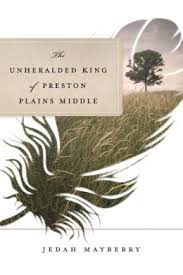
Jedah Mayberry's debut novel The Unheralded King of Preston Plains Middle is out now from River Grove Press.

Jedah Mayberry’s debut novel The Unheralded King of Preston Plains Middle is out now from River Grove Press. You can read the opening pages here.

Jedah Mayberry is the only writer-engineer combination that I’ve ever met. He holds degrees in engineering from Georgia Tech and North Carolina A&T, and amassed several US and foreign patents before returning to his first love, fiction writing. His debut novel, The Unheralded King of Preston Plains Middle, is set in southeastern Connecticut, where he spent most of his youth. He lives with his wife and teenage daughters in Austin, TX.

In this interview, Mayberry discusses country-boy/city-boy story lines, the influence of Edwidge Danticat, and how he’s built a writing community without an MFA.

Michael Noll

I  really like the opening paragraph from the chapter titled Turnabout. You manage to tell us the history and geography of the town of Preston in a way that gives it a personality. You do this, in part, by focusing on what the town is not. How did you approach this passage?

Jedah Mayberry

It was primarily a way to place Preston on the map: north of this, west of that, removed from the other. I started with a hill-and-dale, stroll-through-the-meadow description, and then decided that approach wouldn’t work for what I wanted to accomplish. First, there is very little mass to Preston itself. The town literally sits at the intersection of a couple of two lane roads leading off in either direction through farmland and cow pastures. Second, the contrast between Preston and the surrounding urban centers is where the story derives much of its energy, placing Langston and Trajan outside their element when the time comes to venture to Norwich or New London. The setting introduces a new wrinkle on the country-boy/city-boy encounter when the country-boy would appear,at least by skin tone, more at home with his city counterparts. Yet, quite the opposite is true, giving the brothers a fish out of water feel when they start high school. Focusing attention on what Preston is not underlines the gap the boys need to cross, uneasy footing in part contributing to the various difficulties each encounters along the way.

Michael Noll

The novel approaches an intimate story about a family from the viewpoint of history and migration. How does the large-scale world of the story inform the events that take place? Why start with the broad view of history and geography?

Jedah Mayberry

Rearranging things to preserve a linear progression in scope is the single most outstanding contribution the substantive editor made.

The Unheralded King of Preston Plains Middle is the debut novel from Jedah Mayberry.

The Unheralded King of Preston Plains Middle follows the story of Trajan Hopkins, an African-American teen in a small Connecticut town and the tragic accident that forever changes his life and that of his brother, an Olympic-hopeful athlete whose dreams come to an end.

I invariably encounter people who are surprised to learn that I grew up in CT, that people of color actually live there. I felt it was important to trace the roots a bit to lend credible explanation as to how this family tree grew into (and out of) CT in the first place, how these two boys wound up in close proximity to Norwich yet still managed to fall culturally outside the reach of the kids whom they most resembled.

(Interesting to note, the boys’ appearance is only the surface telling to the story. Later in the narrative, we learn that Langston’s name originated with Langston Hughes, a deep cultural root that ultimately bridges his connection with one of the first Norwichton girls he encounters.) As the story progresses, I introduce a friend/turned villain as well as a suspected villain/turned pseudo-savior. I weave their threads in a similar way using a bit of family history to explain how they wound up in the River Valley as well.

Michael Noll

I know that you’re a fan of the work of Edwidge Danticat. How has her writing influenced your own? Do you at all borrow from or find inspiration in her language, voice, structure, or mixture of biography and fiction?

Jedah Mayberry

I have certainly tried to emulate her voice, speaking as plainly as possible while attending to the world surrounding the characters, working to provide a somewhat out-of-the-ordinary description of a scene without it seeming outlandish or overly ornate, e.g. melding the interrelationship between tribes in molten lava, characterizing the arrival of New Yorkers and Bostonians as a Martian Landing. I’ve gotten lots of feedback on those passages, how they stuck with the reader. I also worked to have something of interest going on in the background to help propel the story: the Eastern Pequot’s petition to be recognized as a sovereign state (which incidentally is still ongoing, not to mention the casino’s impact on the surrounding area). This isn’t quite as traumatic an uprising of one people against another as the one that plays backdrop in Danticat’s The Farming of Bones, ultimately resulting in the massacre of scores of Haitians working as laborers and domestics on the Dominican side of the island. But, based in truth nonetheless, the Native American sub-theme lends color to the region, contributing to the story in its own right.
Michael Noll

There is sometimes an expectation among aspiring writers that they must attend a MFA program. But many writers find different routes to becoming published. That was the case for you. As a result, I’m curious what your writing community looks like? What has helped in your development as a writer?

Jedah Mayberry

I read somewhere recently that a stocked bookshelf is a poor man’s approximation of an MFA. I spend lots of time reading, working to identify what in a particular piece worked for me, how the author succeeded in connecting me to his/her characters, to the story line.

Connect with Jedah Mayberry and find out what he's reading at Goodreads.

Connect with Jedah Mayberry and find out what he’s reading at Goodreads.

Right now, I’m reading Ghana Must Go (Taiye Selasi) as part of a goodreads book group I joined. She uses a lot of singsong in her language, which I worry some might find distracting. However, her description of things (various degrees of snowfall most notably, how the most crippling blizzard starts with a flutter of the first few flakes) is remarkable. She deals with some very complex human interactions, starting with a father to his children, a pair of twins, the connection between which always seems fascinating. She gives each character a special ability to read people or see people or appease people, and then works those characteristics consistently throughout the book. I look at it as an intense study in character development.

So, my community consists of book groups enabling me to discuss openly my take on a piece we’ve read alongside oftentimes differing opinions. A bunch of people from my undergrad (I have a masters in science as opposed to fine arts) started a group on Facebook that caters to alumni in the arts. There are a half-dozen published authors in the group, mostly spiritual-based or strongly Afrocentric. My aim is to push the literary bent first, undoubtedly with a strong cultural base. I’ve gotten lots of insights from them on things related to the publishing industry itself if not actual writing content.

There is an active Tumblr community out there as well, though I’m finding its somewhat diffuse. I’ve discovered a few literary sites. I was recently “followed” by a member funded library based in Brooklyn, NY (mellowpageslibrary). I sent them a copy of the book over the weekend to add to their collection. (BTW, they posted a picture of Amelia Gray with a copy of Threats in recent weeks. She’s someone I met at an ASF sponsored reading a year or so ago. Seeing her photo solidified credibility for me in what mellow pages is doing.)

I also claim the short fiction workshop you facilitated as invaluable in my establishing confidence in my voice. I recognize there were a couple of people in the group who didn’t really dig what I was sharing (as well as one who pretended to). But, a couple others really resonated with it and shared with me at the conclusion of the workshop how much they looked forward to seeing me do something with it. And, you were the first person to tell me that I wasn’t a short story writer necessarily, that I should focus on scene, but write longer, put the story down end-to-end then work to fill in detail. That’s essentially the formula I followed with this latest project. So thank you for that.

May 2013

Profile pic

Michael Noll is the editor of Read to Write.

Describe Setting Without Getting Lost in the Details

28 May
The Unheralded King of Preston Plains Middle is the debut novel from Jedah Mayberry.

The Unheralded King of Preston Plains Middle is the debut novel from Jedah Mayberry. You can read the opening pages here.

In a story or novel, how do you describe an entire town or geographical area without getting lost in the details?

Many writers have done it, memorably Toni Morrison in Sula and F. Scott Fitzgerald in The Great Gatsby. Add to that list Jedah Mayberry, whose debut novel, The Unheralded King of Preston Plains Middle, begins with a description of a small New England town that demonstrates how to distill history, culture, migration, geography, and demography into a single short passage.

The novel is new out from River Grove Press, and you can read the opening pages here.

How the Story Works

Ernest Hemingway famously claimed that the best writing omitted far more detail than it included–meaning that a story or novel resembles an iceberg, ninety percent of which is underwater. Critics have turned this idea into a theory for art, but, in truth, it merely describes an inevitable problem faced by all writers: if you’re writing what you know, then you know more than can fit into the story. But you can’t simply include and leave out details randomly. You need a method. Mayberry’s method in The Unheralded King of Preston Plains Middle becomes clear in the first sentence:

“The village of Preston is largely defined by the things it is not, by the things its expanse of working farms and decaying historic landmarks serve to divide.”

The novel tells us explicitly how it will organize details about the town. Any that do not fit into the idea of absence or division are left out. The Great Gatsby does something similar in its opening description of East and West Egg:

“I lived at West Egg, the—well, the less fashionable of the two, though this is a most superficial tag to express the bizarre and not a little sinister contrast between them.”

In this passage, the writing quickly moves to descriptions of Jay Gatsby and Tom Buchanan. Those characters stand for the difference between the two places. As a result, the setting helps create character.

So that you can see how common this strategy is, here’s the opening of Sula by Toni Morrison:

“In that place, where they tore the nightshade and blackberry patches from their roots to make room for the Medallion City Golf Course, there was once a neighborhood. It stood in the hills above the valley town of Medallion and spread all the way to the river. It is called the suburbs now, but when black people lived there it was called the Bottom.”

Morrison gives us her organizing principle right away: the way the neighborhood looks now versus the way it looked then. That difference helps introduce the story, which is in part about the relations between the people who once lived in the neighborhood and the ones who have turned it into a golf course.

In all of these examples, the writers clearly identify the way they will organize details about a town or area. A place that is vast and filled with innumerable things is reduced to a single passage in a book. In other words, only the tip of the iceberg is revealed.

The Writing Exercise

Let’s follow the example set by Jedah Mayberry, F. Scott Fitzgerald, and Toni Morrison.

  1. Choose a town or area to describe.
  2. Write a definition of the town that creates two groups, a la Fitzgerald and Morrison. For instance: “Everybody there was dumb except for the cops.” Or, “The town had a railroad line running through the middle of it, but the division wasn’t between poor and rich but between people living in rundown shacks and people sleeping on the ground.”
  3. Now, try writing a definition of the town that identifies a broad organizing principle, a la Mayberry. For example: “The town was defined by the opportunities it had missed.” Or, “So many people had ended up in the town by accident that everything about the place seemed ruled by random chance.”
  4. Finally, describe the town. Use the definition as inspiration and as a guide for the details.

In both #2 and #3, you can switch the order around. So, you can write the definition but save it. List the details first and then finish the description with the definition. Either way you use the strategy, you’ll begin seeing it in almost every story and book that you read.

Good luck.

Three Ways to Write Dialogue

21 May
Walter Mosley's novel, Little Green, is the latest installment in the Easy Rawlins series.

Walter Mosley’s novel, Little Green, is the latest installment in the Easy Rawlins series. You can read an excerpt from the novel at NPR’s website.

It’s become a cliche of writing workshops that, in good dialogue, the characters talk past one another. But how? For a primer, pick up any book by Walter Mosley. His most recent is Little Green, the latest in the Easy Rawlins detective series.

You can read an excerpt from the novel, here, at NPR’s website.

How the Novel Works

There are two easy ways to get characters talking past one another. The first is to give them different ends they want to achieve in the scene. The other is to provide the characters with different levels or forms of information or knowledge. (Of course, a third method is to give the characters vastly different personalities.) All of these methods are on display in these two lines from Little Green:

“I’m lookin’ for somebody for Raymond,” I said when the laughter subsided. “Evander Noon.”

 “That’s just the seesaw action,” Jo replied. “You lookin’ for yourself.”

Method 1: Notice how the first speaker, Easy Rawlins, makes his goals clear. But Jo doesn’t give a clear answer. She wants to help him but in a different way.

Method 2: Jo claims that Easy has another, deeper goal, one that only she knows. She possesses knowledge that he doesn’t. As a result, the dialogue takes on the manner of a common person talking to a sage.

Method 3: Easy is a detective, and Jo is a voodoo queen. Thus, he is direct, and she speaks in code. Their styles are determined by their personalities.

As a result, the characters talk past one another. They can’t help it. They’re different types of people with different goals and levels of information.

The Writing Exercise

Let’s trying writing dialogue using the three methods described above.

  1. Create two characters with vastly different personalities, jobs, or situations. Think about how their speaking style would be affected by the job or situation. For instance (relying on broad types), motivational speakers are intensely positive and assertive. Cops tend to speak as if everything they say has been said a thousand times before, which it has. What would happen if you put a cop and a motivational speaker together in a scene? Their styles would probably clash.
  2. Give the characters different goals for the scene. The easiest version of this is a scene involving a couple: one person wants to go out and the other wants to stay in. But there’s another way to approach the method. Make the characters’ goals different in terms of type. So, in the scene with the couple, one person wants to go out, and the other wants to leave. The goals become fundamentally different.
  3. Give the characters different levels or types of knowledge/interest. Imagine if someone has a broken toilet and so calls the plumber. The person wants a particular task to be done, but when the plumber shows up, all he wants to talk about is the metaphysical implications of cracked porcelain. Their interests and knowledge-bases will clash in the dialogue.

Good luck.

An Interview with TJ Danko

11 Apr
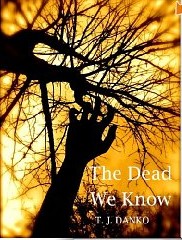
The Dead We Know is a zombie novel in the tradition of epics like The Walking Dead and Stephen King's The Stand

The Dead We Know by T. J. Danko is a zombie novel that follows in the tradition of The Walking Dead.

T. J. Danko’s novel The Dead We Know has been called “a smart twist on the usual zombie lore” and “gripping, tense, creepy, edge of your seat.” The Kindle-published e-book follows a pair of oil-field workers and two teenage girlfriends who set out in an apocalyptic zombie world where they must work together to survive.

In this interview, Danko discusses the tricks of genre fiction: dialogue, the rules of survival in a zombie world, and the reason why zombie stories always begin with the main character waking from a coma. A writing exercise inspired by the opening of the novel—especially how key information is parceled out through dialogue—can be found here.

Michael Noll

I love the dialogue that opens the novel. The banter between Nick and Eduardo is short and snappy and really establishes the dynamics of their friendship. A lot of writers would struggle with this opening scene. They know that something big must happen–a zombie encounter–and that they must somehow set the stage for the encounter. As a result, a lot rides on everything that comes prior to that encounter. How did you approach this scene?

T J Danko

Thanks! There were a few things I wanted to work out in the opening scene, but you’re right, it was a balance between providing what was necessary to establish character and set up the plot without telling too much. The priority of the release of information had to be in the scene itself, knowing there was plenty of time to tell how the epidemic began. Partly it’s a little easier on a zombie book because there’s a familiarity to the scenario.

But the opening scene was also a way to try new things by writing an unfamiliar type of story. In many ways, my zombie book was a reaction to my own dissatisfaction with pieces I’d been working on. When I read stories that could be classified as genre, whether it’s Gone Girl or the Stieg Larsson books, I often found myself compulsively flipping through the pages, eager to get to the next part. When I looked at my own stories, I worried that people wouldn’t read it with the same excitement. There sometimes was a static quality, a lack of forward propulsion, which bothered me. I wanted to study how those writers did it and try it out for myself.

The dialogue was not only to establish character and hopefully be funny, it was a way to put off the zombies, to try to heighten the expectation of their introduction. My thoughts tied into Alfred Hitchcock’s famous idea of suspense versus surprise. He says that the difference can be illustrated by a story. You have two people at a table, talking. A little while passes, we listen in. And suddenly, a bomb goes off under the table. Surprise. Now
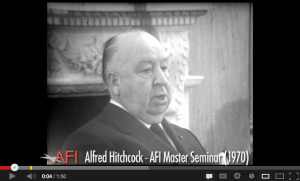
Alfred Hitchcock on Mastering Cinematic Tension

Click to watch video of Alfred Hitchcock discussing bombs and tension in an AFI Master Seminar.

if we take the same scene, a couple having a conversation, but this time the camera pans down to show the bomb, or we heard earlier about someone plotting to blow up the coffee shop and how the bomb will go off at 1 PM and we see it’s 12:45, and we show the couple talking about trivial matters, the audience will be watching tensely, waiting for the bomb to explode, wanting to warn them. That’s suspense.

In a similar fashion, I approached the initial dialogue as a way to stretch out the moment before the zombies appear. They’re going to make an appearance; we know that. But if we can extend the scene for as long as possible, there’s hopefully a chance to increase the sense of dread. And also, I thought there might be a chance that the tension would make the dialogue a little funnier by contrast.

Michael Noll

The opening scene also hews pretty closely to horror-story convention: two characters on the road, late at night, and a chance encounter that goes horribly wrong. If this scene was being discussed in workshop, people might advise you to find a less cliche way of entering the novel. But it seems to me that in a work of genre, cliche is important. First, as the writer, you know where to start the story, rather than needing to create a beginning out of the limitless possibilities. Second, the cliche/convention exists in the first place not only because it’s a convenient way to begin the story but also because it rings true to us. Driving at night in the middle of nowhere is a little scary, even under the best circumstances. Walking alone through the woods is scary. As a result, it seems to me that you must begin the novel this way. But, of course, you need to make the convention seem fresh, which you do. How did you choose this opening scenario?

T J Danko

It is a pretty standard scene in a horror movie. I wish I could say that it was some clever idea about fairy tales and how walking in the woods is a subtle message that we’re moving out of our world into something supernatural, or that I was deliberately tweaking the genre. But it was mostly because I had an image of a family of zombies illuminated by headlights on the side of the road, and I wanted it in the opening chapter.

Could I bring up another thought? The fact that Nick and Eduardo were ignorant of the sickness and were driving into a world where the zombie apocalypse was already going full-swing was due to a reluctance to begin with the first diagnoses of the first zombie. The spread of zombie-ism is like an epidemic: a slow rise before it reaches the tipping point and spreads rapidly. If you start at the first incident of the disease, it would take too long for the story to ramp up. I think that’s the reason why The Walking Dead and 28 Days Later begin with their main characters in comas, waking up to a world already overrun with the infected.

How important is a coma to The Walking Dead? Check out this official plot summary from the show's website.

How important is a coma to The Walking Dead? Check out this official plot summary from the show’s website.

For this reason, I tried to side-step this beginning of the epidemic by isolating Nick and Eduardo, having them hear the rumors but not believing them; I could save the spread of the sickness in a later scene through a short flashback. But how to isolate them? I had a news story I’d been holding onto for a long time. Have you ever found research just because it’s interesting and you thought you might be able to use it someday? I have a list of those. A year or so ago, I heard about temporary communities set up in North Dakota for oil drilling. They’re called “Man Camps,” where the workers are paid very well but stay in these sprawling camps, next to the oil fields, populated almost exclusively by men. I’d been holding onto this place, waiting patiently for a story to fit it in. Even though it only appears at the beginning of the book and I’m not sure it’s the most elegant solution in isolating the characters, I was happy to finally find a place for it.

While the cliché of the opening scene wasn’t necessarily a conscious decision, I did want to start in a familiar setting as a jumping off point to the rest of the book. In my mind, my real main character is the teenager Carly, who is introduced in the next chapter. This novel is her story: she’s the protagonist and the one who changes the most, moving from insecurity to the reluctant leader of the group. She turns from someone who is traumatized to a more action-orientated character. But the opening to her story wasn’t going to have the same immediacy or potential cinematic quality as Nick and Eduardo, alone in the woods being attacked by a family of zombies. Also, clichés are often clichés for a reason. They play to our fears, perhaps connect to something familiar that just feels right. My hope is that the opening is specific and individual enough to break out of the cliché.

Michael Noll

I once heard someone claim that horror stories tell us something about the national mood, our insecurities and fears. So, Godzilla came out of our fear of nuclear energy and the classic zombie films were born out of the Cold War. Also, in those early zombie movies, the zombies were always attacking teenagers parked on the edge of town, making out. In a way, the zombies were enforcing our threatened moral code. I often think about this claim whenever some natural disaster arrives, and someone like Jerry Falwell blames the death and destruction on homosexuals. Perhaps it’s in our genetic makeup to view disaster as God’s wrath and punishment. Have you ever thought about horror stories this way? Why did you choose zombie and not vampires, werewolves, witches, or mummies or any of the other standard monsters?

T J Danko

Those are good questions. When I started writing, I was thinking this exact thing, about how many monsters seem to be directly connected to cultural concerns. Zombies seem to have a strange place within the realms of monster stories. Vampires in the Western culture circle around transgression and sexual repression – Bram Stoker’s Dracula and the Twilight series, as far as I’ve heard – and werewolves are about our nature and our own animalism. The George Romero zombies are often used as a metaphor for larger societal issues, where the films tackled themes like racism or consumerism. But somewhere these concerns seemed to change, and now the underlying sub-text behind zombies is the apocalypse and survival. It seems to be a concern for everyone, no matter where you stand in the political spectrum. The world’s warming up. Meteors are crashing into Earth. Survivalists are building bunkers and hoarding supplies. Zombies represent the breakdown of order, the worry about how we would survive when social structures collapse. I don’t think it’s an accident that many modern zombie stories explore the idea that other survivors end up being more dangerous than the zombies.

I did start writing with a sense of dread for the future. But there was another idea for the book. I thought about the rules of survival in the movie Zombieland, not to mention the CDC of all places. I thought this was a clever way of pushing the zombie genre further, but part of me also thought how these lists wouldn’t help you survive, not really, and would probably kill you. You think you know what a disaster will look like, but it will never be exactly as you expect. In other words, when the zombies do come for us (and they will!), the tactics will probably be useless, simply because zombies will not behave like the zombies in movies or TV shows. That was one of the central notions I had when I started the story.

 Michael Noll

You’ve written literary short stories and now a genre novel. Were the experiences completely different, or have you found one feeding or influencing the other?

T J Danko

While really great writers have dabbled in genre work, I sensed they were often winking at the audience. I didn’t want to do that. There’s a real power to genre that shouldn’t be discounted. There were some good lessons that I learned by expanding the scope of my writing.

Still, writing genre is different from literary fiction, especially if you add the self-publishing, e-book aspect into the equation. A literary novel can generally take three years or so, often much longer. The e-book market thrives on quantity. From what I’ve learned, you’re probably not going to sell much or be as able to market yourself if you only have one e-book. In genre, on the Kindle, it’s not atypical to publish two or three books a year, sometimes more. The speed in writing has to mean less time spent agonizing over sentences or worrying over plot and characters. Since I’m neurotic, I found writing in a genre liberating, concerning myself mostly with establishing forward momentum and creating set pieces. That said, it was impossible to let go of the tendency to want to write the best sentence possible, and I really hope my sentences are well-crafted.

In the end, I do think writing both genre and literary stories has enriched my work. I talked about how The Dead We Know gave me a place to explore tension. It also made me think about pacing and my relationship with audience. Readers of the horror genre want to be scared; they want to be entertained. While there is a tendency in a literary book to turn the camera inwards, to search for truths and expand the mysteries, it’s also useful to think about how you can play with the audience, how they can be shocked or surprised, how they can be kept in suspense. And maybe it’s helped me a little in finding new ways to make them turn that page.

April 2013

Michael Noll is the editor of Read to Write.

How to Reveal Plot with Dialogue

9 Apr
The Dead We Know is a zombie novel in the tradition of epics like The Walking Dead and Stephen King's The Stand

The Dead We Know is a zombie novel in the tradition of serial epics like The Walking Dead

Can literary writers do genre? Many people think not. A literary writer will get bored with the conventions, they say, and begin experimenting, producing a pulp/literary hybrid.  Recent history shows many examples of this: Michael Chabon won a rash of prizes for his detective novel The Yiddish Policeman’s Union, and New Fabulists like George Saunders, Manuel Gonzales, and Karen Russell embrace and explore the conventions of fantasy and science fiction.

But what about the pure genre novel? Is it really off-limits to literary writers?

T. J. Danko is the pseudonym of a literary writer who has published stories in various journals, but his latest work embraces one of the most popular forms of genre literature—zombies. The Dead We Know is not a Chabon-like crossover or a Saunders-esque ironic treatment. It’s old-fashioned page-turner that keeps you up after your bedtime.  You can read the first chapter of The Dead We Know here.

How the Novel Works

Works of genre, like all novels, deliver pieces of information gradually. One way to accomplish this is through dialogue, and this is where The Dead We Know excels. For instance, look at Nick and Eduardo’ argument about whether the truck window should be rolled up or down:

“I’m freezing. Why aren’t you freezing?”

He closed his eyes and began to drift off. Eduardo punched him.

“Ow.”

“What are you doing? You close the window and you go to sleep? Fuck you. You want me to crash or something?”

“Fine. Turn on the radio.”

“Fantastic,” Eduardo said. He switched on the radio, and there was a sharp crackle. He kept turning the dial, but there was only more noise.

“Nothing?” Nick asked.

“The whole trip I get nothing but static.”

Nick yawned loudly. “We’ve been driving in the middle of nowhere.”

“Help me stay awake,” Eduardo complained. “It’s boring driving in the middle of the night.”

The scene’s realism—Nick and Eduardo behave like every road-tripper who’s ever lived—is what heightens the tension. Through a realistic argument, we’re being told, indirectly, everything that will happen. Of course they will crash, and of course the crash will happen in the dark, in the middle of nowhere. This is a zombie novel, after all. It might be tempting, as a writer, to “reinvent” the genre, but the best genre novels stick to conventions. The writer’s skill is in making those conventions seem fresh and new. One way to do this is to avoid giving the reader information directly. Instead, focus on the characters, the ways their personalities clash. Give the characters lives that exist prior to the zombies. In other words, give the characters something to talk about, and then let the story intrude.

The Writing Exercise

Let’s play around with dialogue. For this exercise, write a scene (two pages max) in which you use only dialogue.

  1. Choose a setting (exiting a movie theater, approaching a rope bridge over a lava flow with pterodactyls flying everywhere).
  2. Choose a relationship dynamic (they’re fighting over…, they’re upset because…, they’re relaxed because…).
  3. Choose a goal (character will confess his/her love for the other, character will reveal a hideous secret)
  4. Now write the scene. But here are the rules: The characters cannot state outright the relationship dynamic or the goal. They must allude to or approach the dynamic/goal from an angle or under cover of some other piece of conversation.

These rules may seem difficult, yet you may discover that your scene begins to move in unexpected ways. Try it out.

Good luck.