Tag Archives: how to write a short story

An Interview with Nahal Suzanne Jamir

9 May
Suzanne Jamir

Nahal Suzanne Jamir’s story “In the Middle of Many Mountains” was first published in Meridian and is the title story of the new collection from Press 53.

Nahal Suzanne Jamir’s debut collection of stories, In the Middle of Many Mountains, grapples with a question that is perhaps unanswerable: Where did I come from? What values and cultures combined to make me who I am? In praising this bold, new book, the writer Debra Monroe puts the question succinctly: How do “we lonely humans trapped in a single life seek the wisdom handed down to us and chafe against it, too”?

Nahal Suzanne Jamir earned her PhD from Florida State University. She’s won numerous story prizes, including First Prize in the 2012 William Van Dyke Short Story Prize, by Ruminate Magazine, for “Stories My Mother Told Me.”

In this interview, Jamir discusses family betrayal, story truth, and why the best fiction resists formal tidiness.

Michael Noll

The story opens with uncertainty—the narrator isn’t sure how to begin. I can imagine a workshop leader claiming that the story should simply start after it’s figured out where to begin. But that seems like poor advice here. In this case, the story seems to be, in part, about the narrator trying to wrap her mind around something awful that has happened—and will happen. The story is about her search for narrative as a way to understand. As you worked on this story, how did you think about the question of where to begin?

Nahal Suzanne Jamir

Yes, and I did get some of that type of feedback when the story was workshopped. I think some readers, workshoppers, and authors expect characters and the stories they live in to be too neat–despite this overwhelming stamp of approval that postsecondary institutions give to postmodern and experimental literature. Yet, stories may be raw both in form and content. We can’t expect the main character to have an inner conflict and insist that the form or approach of every story be neat or rigid. I love stories and novels that de-evolve, like Vonnegut’s Breakfast of Champions. So, I wanted to try to start at that point, to use its rawness and see how far I could push not just the characters but also the form. A neat beginning was out of the question.

The question of where to begin with this story was also strongly influenced by my nonfiction writing. As a younger writer, I only wrote two stories where I engaged with semi-autobiographical material, and I felt odd using material from my life. I felt like I was lying instead of telling the truth. So, in 2004, I started writing nonfiction, and that task required me to retell stories—family stories, religious stories, to even “retell” letters. Retelling epitomizes the struggle to find one’s place and to understand others, especially those who came before.
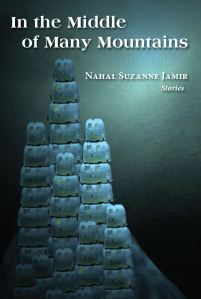
In the Middle of Many Mountains by Nahal Suzanne Jamir

The stories in In the Middle of Many Mountains by Nahal Suzanne Jamir have been described as “a magic that is real.”

The narrator of “In the Middle of Many Mountains” isn’t sure how to begin because she hasn’t wrapped her mind around all of the different facets of her life, and toward the end, you see the struggle to begin a story linked with her retelling stories.

Though tertiary, with this story, I was also inspired by the Canongate myth series in which authors like Jeanette Winterson and Margaret Atwood retell myths. Winterson’s Weight, a re-telling of the Atlas myth, in particular caught my attention. She merges the myth with her own autobiographical material and has this recurring line “I want to tell the story again.” I love this notion because she uses this line and this notion to link her myth and her (real-life) story. So, she is retelling her story when retelling Atlas’s, discovering both.

Michael Noll

The story asks a fascinating question: “Who is the betrayer?” The suggestion is that the answer won’t be clear, otherwise the question wouldn’t be necessary. How do you tackle such a complex, multi-faceted idea in a story? Was this a story you had to sit with for a long time? Just as the narrator struggles to wrap her mind around the events, was it difficult to wrap yours around the nuances of the betrayal?

Nahal Suzanne Jamir

The notion of betrayal is one that has always been intrinsically linked to family because families are supposed to be a certain way. We have family “duties” and “roles.” But I didn’t want to let any of the family members off the hook in this story. When something goes wrong in a family, it usually affects all members. It’s a mess, and no one behaves well. The questions don’t stop. The guilt and anger don’t stop. I also made a conscious choice to have the family be a family that wasn’t new, so to speak. They’d been together as a family for a while. The parents are old. The daughters are not these young innocent children. The betrayals are small and large. The role of the betrayer belongs to each family member—even the mother because she cannot save her husband or her daughters. Marjan betrays by betraying herself (her body) and by leaving the family. The eldest daughter betrays her students and herself by quitting her job, which is her passion. The eldest daughter can also not save anyone and continues contact with the father. The father’s betrayal is obvious and rather cliché, but he also gets betrayed by his own idealism, what he believes a romantic relationship should be.

Most importantly, this line, this question, appears in the story right after the subject of language, the Persian language, which the eldest daughter doesn’t understand. Yet, on a broader level, language or communication betrays all of these family members. Sometimes, though, the misunderstandings that result from these problems with language are funny or even beautiful.

With all of this family trauma unraveling, with all the betrayal, I tried to control the drama (keep it from being melodrama) by using a fragmented form so that no one character and no one scene could go on and on. I also tried to control the drama by contrasting it with stories and information that were tangential yet still relevant. Finally, when I got to a certain point, I realized that the story was long enough. I didn’t want it to be too long.

Michael Noll

The story begins with a place (Nayriz, Iran) where the narrator has never been. It also offers words and phrases from a language (Farsi) that she doesn’t understand well. How do you write about a place, language, and culture when the narrator has only a limited knowledge of them? In other words, the narrator and the reader cannot fully understand the mother without understanding her language and history, but that knowledge isn’t fully available to her or us. That’s an exceedingly tricky, yet often true to life, premise? How did you approach it?

Nahal Suzanne Jamir

At a certain point in my development as a writer, I started to enjoy the challenge of writing far outside of my realm of knowledge. On a literal level, one can obtain information and become some sort of expert on any number of subjects, but for me, acknowledging the lack of knowledge—for myself and for a character—is the most interesting approach because then the story becomes about the struggle. So, admission—or telling the truth or letting the truth just be—my first move with this story and the culture and language that neither the main character nor I knows. In “Good Form,” Tim O’Brien writes, “I want you to feel what I felt. I want you to know why the story-truth is truer sometimes than happening-truth.” So, I’m not going after authority but authenticity through story. I do have a lot of story-truth about Iran passed down to me that I can use or re-create.

The struggle is the story and vice versa. Moreover, the struggle shows both what is known and what is not. The main character in this story has some knowledge, and those pieces are present. I hope that her lack of knowledge also is present, just as white space is in poetry. I think this narrator does search and seek, despite a great deal of confusion on her part, and this is a concept very present in some novels that I greatly admire, like Percy’s The Moviegoer and Ellison’s Invisible Man.

Michael Noll

Near the end of the excerpt, you write about the feeling the narrator gets while talking to her younger sister. She thinks, “I don’t want to see. Her, barely there, five-year-old limbs stretched out to form an adult. We are always playing with dolls.” As someone with younger siblings, I know this feeling exactly, and I can honestly say I’ve never seen it so perfectly and eloquently captured. How do you create a description like that? There are two common metaphors about the writer’s experience, and I wonder which applies to you. Are you the medium transmitting a voice from beyond or the sculptor chiseling away at a rock to reveal the statue hidden within?

Nahal Suzanne Jamir

It begins with this strange moment when you look at someone you knew as a child and you can see that child overlapped with this adult in front of you. Sometimes, my mother will turn to me and say that a look or a sound I’d just made was the same one I’d been making my whole life. And I think we’re always trying to make these connections with our changing bodies. Of course, there is that strange phase where adolescents really do look stretched out. In the story, though, Marjan is anorexic and has done this to herself. So, there is this physical manifestation of her emotional state and reaction to her family’s changes. I feel that there are so many horrible images of those who suffer from anorexia, and there is definitely a stigma attached to it. I wanted to present it in a slightly different way, where her loss of weight brought her back to childhood somehow. The notion of dolls refers to the sisters’ childhood. Yet, the notion of dolls points to, of course, the false representation of the female body (Barbie dolls, etc.). More importantly for me is the notion of playing with dolls, playing out stories and scenarios, that act of creation, which is an act of control—and how by manipulating her own body Marjan is playing in both child-like and adult ways.

The Kingdom by Lars von Trier

The Kingdom by Dutch filmmaker Lars von Trier  inspired  Steven King’s Kingdom Hospital and, now, “In the Middle of Many Mountains” by Nahal Suzanne Jamir. The critic David Moats writes about the appeal of this subtly twisted and influential series at The Quietus.

I also have to admit that the description was influenced by a series titled The Kingdom, created and co-directed by Lars Von Trier. To say this series is weird would be a gross understatement. Toward the end of the series, a child is born to one of the doctors, and this child grows much too quickly. The child develops into a strange adult body (about 10-feet tall) in a very short time, and his voice and his desires remain those of a child. The hospital staff has to build a makeshift scaffold to hold the child up. It’s a haunting image that I’ve admired for a while.

Von Trier always struck me as a writer/director who transmits voices from beyond. I don’t really view my process that way, or as a sculptor either. If anything, I’m the kid who broke that vase that had been in the family for generations—and I’m putting it together piece by piece…and before anyone can figure out what I’ve done and punish me. Gloria Anzaldua writes of one of her books having a “mosaic pattern” that in the end is an “almost finished product. . . .an assemblage, a montage, a beaded work with several leitmotifs and with a central core, now appearing, now disappearing in a crazy dance. The whole thing has a mind of its own. . . .It is a rebellious, willful entity, a precocious girl-child forced to grow up too quickly, rough, unyielding, with pieces of feather sticking out here and there, fur, twigs, clay.” I think there is intense fear, anxiety, and even shame involved in the writing process. This process is very messy and very personal for me. The writing process is not just about hard work and understanding your craft. It’s about not having control. If you’re lucky, I think you have brief moments of sanity and balance.

May 2013

Profile pic

Michael Noll is the editor of Read to Write.

Raising the Stakes in a Fragmented Narrative

7 May
In the Middle of Many Mountains by Nahal Suzanne Jamir

Suzanne Jamir’s story “In the Middle of Many Mountains” was first published in Meridian and is the title story of a new collection, now out from Press 53, that has been called “a magic that is real.”

Stories are not true to life. Memoir writers quickly understand that they’re recreating moments from half-blind memory. They leave out as much as they put in. But even stories that make no claim for historical truth, that simply attempt to portray a life as it might be lived, tell a kind of lie. They offer a coherent storyline, a definite beginning and end, and a consistent narrative voice when life offers no such thing. As the writer Nahal Suzanne Jamir will say in Thursday’s interview, “We can’t expect the main character to have an inner conflict and insist that the form or approach of every story be neat or rigid.”

The problem is that readers want coherence. The  magic of stories is that they offer a clarity that is rarely present in life. Jamir’s story “In the Middle of Many Mountains,” finds a way to face this paradox. The story shares a title with Jamir’s new collection out from Press 53. An excerpt is available online at Meridian.

Or you can download their entire story here: “In the Middle of Many Mountains”

How the Story Works

The narrator is trying to understand how she has come to this present situation: her is dying, her father is living with another woman, and her sister is wasting away from an eating disorder. A once-tight family has unraveled for reasons that are not and may never be clear. As a result, the story is structured as a collection of fragments. Any other structure would force coherence upon the naturally incoherent.

And yet a story needs coherence in order to be read. Jamir manages this paradox with a simple strategy: Even though the narrative is fractured, the stakes are clear. Nowhere are they laid out more clearly than on page 5, when the sister, Marjan, says, “I need you to help me…but you’re not going to like it. You won’t want to hear.”

Though the form is fragmented, the characters retain a certain amount of wholeness. It’s possible to say what they want and do not want. These desires drive the plot. The narrator will be forced to do what seems impossible: to hear what she doesn’t want to hear and see what she does not want to see. Thus, the story uses the strategy used by all great stories. It pushes a character until the only option available is the one she never thought she’d choose.

The Writing Exercise

No matter how your story is structured—using some traditional plot or a shape invented on the spot—it’s important to make the stakes clear. It’s even more important when the story asks its readers to learn a new kind of storytelling.

So, let’s set the stakes. We’ll come at the problem from a couple of angles:

  1. Brainstorm the following: What do your main characters want more than anything? What do they avoid at all costs? What is the guiding principle of their lives? In your story, the characters’ desires will likely be tested. How badly do they want X? Will they be willing to do what they normally avoid? Will they even sacrifice their principles? It might help if you finish this sentence: X wants to…, and so he/she will be forced to… 
  2. Make the impossible possible. List the things in your story that seem permanent: relationships, geography, jobs, situations, existences, lives, etc. Now pick one or two and describe what it would take to make them impermanent; in other words, what force would be required to break an unbreakable thing? You can also flip this around and ask what force would be required to make permanent something that is either impermanent or not currently in existence.

Once you’re able to clearly answer any of these questions, you may find that your story comes into focus, both in shape and about-ness.

Good luck.

An Interview with Kelly Luce

2 May
Kelly Luce's debut collection of stories will be released in October by A Strange Object.

Kelly Luce’s debut collection of stories, Three Scenarios in Which Hana Sasaki Grows a Tail, will be released in October by A Strange Object.

Not many writer biographies can go toe-to-toe with the condensed history of Kelly Luce: She once attended a fiction seminar in Bulgaria, she was the writer-in-residence at the house where Jack Kerouac lived while writing Dharma Bums, and her forthcoming collection of stories has the knockout title Three Scenarios in Which Hana Sasaka Grows a Tail.

In this interview, Luce discusses first sentences, the challenge of finding the right publisher, and books that make her say, “Oh! Oohhhhh!”

Michael Noll

The story has a perfect first sentence: simple, yet absolutely essential to the story. It accomplishes in seven words what some writers spend paragraphs doing: creating and then breaking a routine in order to find where the story begins. What was your approach to writing this opening?

Kelly Luce

It’s funny; when I read this question I thought about the first sentence (“Since Rooey died, I’m no longer myself.”) and felt sure that it had been there since the start, from draft one. It seems like such an obvious opening. Maybe too obvious, you know? Then I dug up my early drafts. After having a drink to brace myself, I was able to face them…and I discovered that that line didn’t show up until draft 7. I don’t remember what the process was like that brought me to write it. Maybe this is a testament to how hard it is to put into words what is simple and true.

Michael Noll

Very early in the story, this paragraph appears:

“Here’s a story: two people are in trouble and the wrong one dies. There’s been a cosmic mix-up, but there’s nothing anyone can do about it, and they all live sadly ever after. The end.”

I love this paragraph because of its speed. The distance between “two people are in trouble” and “the wrong one dies” is vast—an entire story lies in between—and yet the paragraph doesn’t bother with any of that. It keeps rushing along, moving from the comedy (in the Shakespearean sense) of “cosmic mix-up” to the tragedy of “they all live sadly ever after.” Is this speed something you purposefully strive and revise for, or is it present in the earliest drafts?

Kelly Luce

Thank you. Though this paragraph also came fairly late in the drafting process, after I decided to try introducing the cover-story subplot, it came out fully formed in one of those rare moments when the writing goes on auto-pilot for a few lines. Rhythm and sound is one of my favorite things about writing, the way syllables and commas pile up and suddenly stop, the way long sentences full of short words interact with short ones made of long words, the interplay between vowels and consonants, the way internal rhyme can create gravity. It becomes very physical. So I feel like the answer to your question is, both: I strive and revise for appropriate rhythm, and sometimes it happens in draft one; other times the conditions aren’t right for it to show up until draft ten.

Michael Noll

When I was in graduate school, the term “magical realism” was popular, mostly due to the work of Gabriel Garcia Marquez and Salman Rushdie. There weren’t a lot of American writers working in that style, and some critics wondered if it was possible to use it in this country. Yet here we are a few years later, and the most influential American short story writers are Aimee Bender and George Saunders, whose absurdist, fantastical stories are perhaps an American adaptation of magical realism. Your writing also seems to fall into this category, so I’m curious how you would explain its appeal. How did the American short story move from the dirty realism of Raymond Carver to the contemporary mixture of fantasy/comic-book/genre/absurdist/supernatural elements?

Kelly Luce

I’d love to know more about this, myself. I have no idea why the American short story has moved beyond Carver’s realism, other than to say that things always change, and what’s fashionable in one era is sort of inevitably not in the next. I mean, what made Carver who he was as a writer (other than Gordon Lish)? What was he shifting away from? That might help us figure out why we’ve moved on from his example, at least somewhat. It could be that this generation of writers and readers is reacting to that generation, looking for something different, or at least being willing to consider something different. Certainly other countries have not suffered as much (I consider it a suffering) from a dearth of imaginative/non-realistic writing during this time. What was it about America, specifically, that made realism the desired form of expression during that time?
Still, from what I’ve read of lit mags and recently released collections, as well as at workshops I’ve participated in during recent years, I’d say the dirty realist story still has quite a following. Maybe, with the advent of online publishing, magazines have been able to take a few more chances on what they publish, so there’s both more supply and demand of the weirder stuff. Or maybe the rise of the reputable online venue let publishers who were outside the box get a foot in the box. A story from my collection, for example, was published by the Kenyon Review Online, which purports to publish more experimental work than the regular KR. Would they have printed my story five, six years ago, in KR proper? I don’t know. But a lot of readers have been able to connect with that story and say, hey, this is my kind of thing and I want more, and we’re lucky that there are places like Fairy Tale Review and KRO and Unstuck and a ton of others meeting that demand.
We all loved reading as kids, and kids’ books are often extremely imaginative. In this age of extended adolescence and “be yourself” messages, maybe those writers who wanted to play a bit more with fantasy/genre/supernatural stuff felt free enough to do so. Or maybe like me, they read Girl in the Flammable Skirt or Pastoralia and went, Oh! Oohhhhh!
Michael Noll

You’re a really talented writer with an enviable body of work—stories in reputable journals, prestigious fellowships. Your debut collection of stories, Three Scenarios in Which Hana Sasaki Grows a Tail, will be released in October, and reviewers will almost certainly compare the writing to that of Aimee Bender and Karen Russell, two highly regarded and popular writers.

A Strange Object is an independent press in Austin that publishes books that take risks, buck form, and build warm dwellings in dark places.

A Strange Object is an independent press in Austin that publishes books that take risks, buck form, and build warm dwellings in dark places.

As a result, your book seems like it would be awfully desirable from a publisher’s perspective.

Yet when readers open it, they won’t find the name of a major, New York-based publisher. Instead, they’ll see the name of a new independent press based in Austin—A Strange Object. Can you write a little about how this relationship with A Strange Object came about? What makes A Strange Object a great partner for your collection?

Kelly Luce

Will you marry me? Or can I pay you to come over every day and tell me nice things?

The relationship with A Strange Object started a few years ago, when Jill Meyers was editor of American Short Fiction and accepted a short-short of mine for a series on their website. That’s how I met her and Callie Collins, who worked at ASF as well. When they started A Strange Object, I was one of the writers they contacted about submitting a MS.

I always had a sense that I wanted this book to go to an indie press, and that my novel, which I’ve been at for a few years, would be the New York book. Maybe it’s because I heard so many rumors about story collections being treated like redheaded step-kids by the big house publishers, or maybe it’s because I never had the guts to push my agent, who represented my novel, to do anything with the stories. A\SO is the place for this book, absolutely. They get the strangeness, they love things about it I’d forgotten, and through editing they’ve made it a way better book than it was when I submitted it to them. The design is gorgeous, smart, clean. The cover artist is incredible. When you’re working with a small press, you’re pressed right up against the taste of the people who run it. And these guys are like…I don’t know. They’re not like anybody, which is the point. I have a crush on them.

May 2013

Profile pic

Michael Noll is the editor of Read to Write.

Short, Direct, and with Style

30 Apr
Kelly Luce Exercise

Kelly Luce’s story “Rooey” was first published by The Literary ReviewIt will also appear in her forthcoming collection Three Scenarios in Which Hana Sasaki Grows a Trail.

I’ve heard it claimed that you can teach writers plot, structure, and character, but you can’t teach them to write well, with style. As evidence, look at Vladimir Nabokov. His unpredictable sentences flash between subjects (picnic, lightning) at the wild speed of genius. They are impossible to imitate, I’ve heard. But I don’t believe it, if only because there are so many great writers crafting astounding sentences.

One of them is Kelly Luce. Her story, “Rooey,” was first published in The Literary Review, and you can read it here.

How the Story Works

Great sentences—and great lines of poetry—often work the same way. They strive for leaps in logic, for the unexpected juxtaposition of images. Readers are expected to keep up, to make the connections without the aid of explanation. Keep this in mind as you read the first paragraph of Kelly Luce’s story:

Since Rooey died, I’m no longer myself. Foods I’ve hated my entire life, I crave. Different things are funny. I’ve stopped wearing a bra. I bet they’re thinking about firing me here at work, but they must feel bad, my brother so recently dead and all. Plus, I’m cheap labor, fresh out of college. And let’s face it, the Sweetwater Weekly doesn’t have the most demanding readership or publishing standards.

The leaps of logic begin in the first sentence. The comma acts as a pivot point. Death we understand, but what does it mean to not be yourself? The first two examples (foods, humor) make sense within our common understanding of grief, but the third (“I’ve stopped wearing a bra”) is strange by almost any measure. The leaps continue: dead brother to cheap labor. By the end of the paragraph, we’ve moved from death and identity crisis to newspaper publishing standards.

The speed of those leaps is what gives the story its style. The sentences are not long or grammatically complex. They do not suggest but, rather, state things outright. Very often, beginning writers believe that good sentences are overwritten and overly subtle. The truth is usually quite the opposite. If you don’t believe me, here is part of the first page of Nabokov’s Lolita.

She was Lo, plain Lo, in the morning, standing four feet ten in one sock. She was Lola in slacks. She was Dolly at school. She was Dolores on the dotted line. But in my arms she was always Lolita.

Did she have a precursor? She did, indeed she did. In point of fact, there might have been no Lolita at all had I not loved, one summer, a certain initial girl-child.

Though Nabokov is known for his “poetic” style, the sentences are short, direct, and to the point. Their beauty is in the phrasing and the speed at which they move from “four feet ten in one sock” to loving “a certain initial girl-child.” That is fictional style.

The Writing Exercise

To be stylish, you need to know what your story is about. If you don’t know, then your sentences won’t know, either. If that makes you despair, don’t. The search for a story’s about-ness is often also a search for its style. Let’s start searching. We’ll write two paragraphs:

  1. Who is your story about? Why is the story about him or her or them? To answer the first question, begin by describing the person as plainly and directly as possible. Keep the second question in mind. Make it your goal to answer it by the end of the paragraph. So, you’ll likely move from literal description to a statement of causation: Because of her, I… or If it hadn’t been for him, she… (For a model, look at the example from Lolita.)
  2. What event is at the heart of your story? What are the implications or ramifications of that event? What is the story about? To answer the first question, state what happened (Since Rooey died… or When Billy got married…). Then, move onto the ramifications. What happened next? How did this event ripple forward into time? Make it your goal to answer the final question (what the story is about) by the end of the paragraph. So, you’ll move from what happened to why we’re reading the story. (For a model, look at the example from “Rooey.”)

Have fun!

An Interview with Marcus Pactor

25 Apr
Marcus Pactor's debut collection of stories is vs. Death Noises.

Marcus Pactor‘s debut collection of stories, vs. Death Noises, has been called “nothing short of dazzling.”

If some writers would kill for a blurb from a literary icon, then maybe we should keep an eye on Padgett Powell. Here’s how the old Southern master recently answered a question about his pick for the most exciting author writing today: “There is a young twisted fellow from Jacksonville Florida named Marcus Pactor. It’s the best I’ve seen in some time.”

Marcus Pactor‘s debut story collection, vs. Death Noises, won the 2011 Subito Press Prize for Fiction. One review claimed that the book “cuts to the bone like a scalpel in the hands of a master surgeon.” Pactor received his MFA from Texas State University and currently teaches at the University of North Florida.

In this interview, Pactor discusses the development of narrative voice and the gap between our technologically-burdened world and the fiction that represents it.

Michael Noll

In some ways, the story resembles a TV detective drama like CSI. It’s about a search for truth that leads to the haunting last sentence: “Somewhere in this archive he said what he needed me to know.” But this isn’t the only way the story could have been written. Because it involves a dead body, the story could have directly traced the events that led to the death. Why did you choose to focus on the search?

Marcus Pactor

Steve by Marcus Pactor can be found online at this journal and also in his new collection of stories, vs. Death Noises.

Marcus Pactor’s debut collection of stories, vs. Death Noises, won the Subito Press Prize for Fiction.

I never thought of writing more about the events leading up to Steve’s death. I’m never thinking about the big picture of my approach, really, except upon reflection. I’m thinking about the next word, the next sentence. But now you’ve got me thinking about the CSI formula. Henry James insulted a writer by saying that he had treated his subject in a most straightforward manner. I don’t much care for James’ fiction, but I think the idea is solid. Besides, Steve is dead. The current approach works (and we’re stipulating that it does work) because it focuses less on what happened to Steve and more on what is happening to the narrator.

Michael Noll

The narrator is searching through the items left in Steve’s apartment, beginning with personal property but then moving to the ideas explored in his writing. As this shift occurs, the narrator’s voice begins to appear more clearly, even going so far as to address the reader: “You’ve read it before.” Did this shift appear naturally as you wrote the story, or did you discover it in revision?

Marcus Pactor

Naturally. Most people think about voice first—if they don’t have that fully formed voice from the get-go, then they’re sunk. Writers hear this voice that makes them go. The comparison of writer to psychic medium is pretty common. I understand. In general, I agree with it. But in this piece the voice seems to emerge more and more clearly over time. In a way, it seems as though I began to find the voice as I wrote, and the story is almost like a record of that voice’s discovery. That’s one way to read it. The more I think about it, the more I like it.

But I think it’s also true that the emergence of the voice supplements the more clearly emerging relationship between Steve and the narrator. Even the verb “supplements” is inadequate. I think that’s especially true if you like the theory of discovery. In that case, the voice and its development are inseparable from that content.

“Emergence” may also be the wrong term. Another way to read it is that the narrator has been detached from this sibling relationship in all kinds of ways for a lengthy period of time. The voice mirrors that detachment. As the piece builds toward the climax, he feels more and more strongly his regret. In that case, too, the inseparability argument still holds.

Now, this is my third crack at this question. Until you asked, I hadn’t thought about how the voice in particular works in this piece. This means that I might be wrong about all the organic nature of the voice. But I think it’s true of any valuable story: the manner in which it is told is as important as what is told.

Michael Noll

Most writers will, at some point, feel enslaved to the need to move characters through time and space. It’s why Virginia Woolf (I think) once complained that it took her all day to walk a character through a door. But you avoid this problem by focusing on what a character has left behind rather than the actual character. Did this choice of focus feel freeing? Did it open avenues for the narration that would be more challenging within a typical chronological focus?

Marcus Pactor

I’m not entirely sure it was a choice. This is the way the story came out of me. If anything, it was a constraint, a good kind of constraint, the kind of constraint that forced me to create a character in a way that wasn’t comfortable. I couldn’t describe Steve physically. Instead, Steve generally had to be described in a doubly or even triply mediated fashion. The papers and property make up the first mediation. The narrator’s reading of that stuff make up the second mediation. The language is the third mediation.

 Michael Noll

The narrator writes that “we suffer from a surplus of trivial choices. This new suffering cannot be compared to the old. It cannot be expressed by time-honored methods, either.” Do you think this is true? Will each culture’s differences require differently shaped stories—not just different kinds of characters and events but different ways of telling?

Marcus Pactor

The short answer is “yes.” I have been fool enough to mention Henry James. Now I invoke Saul Bellow. The suffering of the average member of modern civilization is different in kind and quality to the suffering anyone has suffered before. I’m not talking about rape and murder suffering here. I’m talking about the suffering imposed upon us by magic phones that do everything but wipe our noses. App upon app, channel upon channel of TV, etc. We have so many ways of wasting time. It is impossible to live the way people lived in the past. I’m okay with that. I certainly don’t want asbestos buildings child labor, segregation, and the rest. But they suffered from asbestos, child labor, segregation, etc. The average person had plenty more to cry about. Crying was an appropriate response to these impositions upon their health and freedom. It expressed a desire for better options. We have those options now. They are hard to deal with, and must be dealt with differently.

But how? The circumstances of our lives are changing must faster than we can change ourselves. Intellectually, I think it is easy to recognize that if the suffering is qualitatively different, then our responses to the suffering must also be qualitatively different. The problem is that we haven’t yet developed those responses. Who knows how long it will take to do so?

Padget Powell, a Southern literary master whose strange, brilliant stories rarely enter the pages of the Best American Short Stories, has called Marcus Pactor the most exciting writer working today.

Padgett Powell, a Southern literary master whose strange, brilliant stories rarely enter the pages of the Best American collections, has called Marcus Pactor the most exciting writer working today.

If you accept all that, it is easy to see that our literature must also be qualitatively different. It’s happening somewhat with the college and other independent presses, but not yet at the mass level I think it needs to happen. Consider that twenty years ago few houses had the internet, satellite TV, or cell phones. Our social relations have changed immensely since then, yet people write stories that hardly reflect the depth and scope of that change. Instead, Obama is named president rather than the first Bush. Characters text one another rather than call. This is just the Mad Libs approach to writing literature. It is, of course, popular, because most people really are conservative. In the midst of change, they hold on to what is comfortable. That explains, in part, the popularity of Best American Short Stories.

There is a significant percentage of people who seem to recognize that those stories, and the methods by which those stories are told, do not reveal anything new about the lives they are living, or maybe that the stories in that anthology can only capture a limited range of feeling and experience, and that range has not been tested or questioned in years. These people are searching around for a new thing. We could say that these people crave “experimental” literature but I hate that term. And, of course, a large amount of what is called experimental is also dreck.

Michael Noll

The ritual of Bar Mitzvah plays a crucial role in the story. On one hand, it’s an ancient introduction of a boy into social and spiritual manhood. On the other hand, it’s a modern celebration of consumerism, with families (in America, at least) battling to have the most ostentatious party and gifts. If the shape of our stories reveals aspects of our culture, do you think this shift in the Bar Mitzvah reveals a change in the way modern (American?) Jews define and encounter God?

Marcus Pactor

It might have occurred with the Jewish parents who came of age during or after World War II. My guess is that those parents found that a big celebration of achievement, replete with gifts, would help make their kids feel both American and secure. It might have been a statement about their own need for security and Americanness. It perhaps divided them from the old worship of God, though I’m guessing it was more a symptom of that division rather than an active element. A need to assimilate was definitely at work, but to me it seems the Bar Mitzvah is just a particular version of everybody’s general need for stuff, and our suffering of it.

Now, at the end, I can reveal my hypocrisy. My Bar Mitzvah was in 1988, and it was a present-fest. I got checks and savings bonds and fifty dollar bills. I received the now-traditional monogrammed pen. Three umbrellas! I can’t say I loved the actual stuff, but I loved to get it.

April 2013

Michael Noll, editor of Read to Write

Michael Noll is the editor of Read to Write Stories.

Narrating a Crime Scene Investigation

23 Apr
Steve by Marcus Pactor can be found online at this journal and also in his new collection of stories, vs. Death Noises.

“The Archived Steve” by Marcus Pactor can be read online at Timber and also in his new collection of stories, vs. Death Noises.

Literary fiction could learn a lot from the TV show CSI. If that claim sounds absurd, consider this: The show does not follow a traditional plot structure. No episode can be summed up with the old saws “Stranger Comes to Town” and “Character Goes on a Trip.” Those plot lines are present in the show, but they occur quickly—usually, within the first two minutes—and serve only to introduce the true story: the investigation, which consists almost exclusively of people standing around, talking to one another. Sounds pretty cerebral, right?

The problem with most detective shows is that their investigations have the same emotional impact as piecing together a jigsaw puzzle. The detectives remain untouched by their work. In a literary investigation, however, the characters are forever changed by the information they uncover.

A recent story that illustrates the dramatic potential of an investigation is “The Archived Steve” by Marcus Pactor. It appears in his new collection vs. Death Noises, and you can read it online at Timber.

How the Story Works

Here is the story: Steve is dead, and the narrator is searching through the items left in his apartment. With each discovered item, the narrator begins to piece together the story of Steve’s death. A show like CSI would maintain its focus on this search and puzzle solving. But the focus of “The Archived Steve” shifts away from the corpse and onto the man searching the apartment, a man who will learn that he is partly culpable in Steve’s death. The story, then, becomes about the emotional consequences of his investigation.

So how does the story work? While its premise may seem disconcerting at first—some readers may be thrown off by the matter-of-fact listing of evidence—the story does not plunge into the evidence without purpose. The first paragraph makes clear that the narrator’s goal is to “correct that fool doctor” and his autopsy report.

Aside: I’ve mentioned this idea several times on the blog, and it bears repeating. It’s important to give readers a sense of where the story is going. There are many ways to do this. For more examples, check out these exercise based on Manuel Gonzales’ story “Farewell, Africa,” Owen Egerton’s chapter “Nativity,” and Stacey Swann’s story “Pull.”

Once Marcus Pactor establishes the direction of the story’s investigation, he quickly sets it into motion, offering and explaining evidence. Notice how the type of evidence changes, moving from the concrete (“technological equipment and books”) to the more abstract (“Steve’s Inverted Pyramid of Suffering”). As this shift occurs, the reader requires more explanation from the narrator, which leads the narrator to insert himself more fully into the story. As a result, the pronouns begin to change halfway through the story. The words “we” and “I” appear more frequently as the story becomes the narrator’s, rather than the corpse’s.

What begins as the search through items left in an apartment becomes the story of a man’s growing sense of guilt and failure.

The Writing Exercise

Let’s use “The Archived Steve” as a model. Just as Marcus Pactor’s story focuses on items rather than the dead man who left them behind, let’s create a story from the things that our characters pull in their wakes.

  1. Choose a mysterious premise: someone has disappeared, someone has died from undetermined causes, something has been stolen, something has gone missing.
  2. Put yourself into a room where the person was last seen or where he/she spent a great deal of time—or the room where the item went missing from. What is in the room? Make a list. Be exhaustive.
  3. Now that you’ve created the items, give yourself an investigative goal: to sift through the items in order to find/figure out X.
  4. Begin explaining the relevance of each item to the missing person or the connection to the missing thing. Keep in mind your goal. What clue does each item offer you in your effort to reach the goal?
  5. If you find that explanations of certain items tend to veer unexpectedly or slide into unexpected tangents, that’s great. Follow those tangents. Just as a true crime investigator leaves no stone unturned and follows every tip, you should follow every trail that your subconscious provides. Keep in mind: you’re uncovering a story just as your narrator or character is uncovering a crime. Give yourself permission to explore.

Have fun and good luck.

The Inscrutable Stranger Comes to Town

16 Apr
Kirstin Valdez Quade's story "Nemecia" won first place in Narrative Magazine's Spring 2012 Short Story Contest.

Kirstin Valdez Quade’s story “Nemecia” won first place in Narrative Magazine’s Spring 2012 Short Story Contest.

The writer Charles Baxter once wrote in an interview that he liked “to throw characters together into situations that create stress so that as the story goes forward, something in the situation or the characters is forced to reveal itself.” And yet Baxter has also written, “When all the details fit in perfectly, something is probably wrong with the story.”

This contradiction is faced by all writers. We must seek to understand the motives and meanings of our characters’ actions, but if we understand them too well, the story loses any sense of mystery. As a result, some of the greatest stories—such as “Bartleby the Scrivener”—are those about the search for understanding. In Melville’s story, the narrator nearly drives himself  mad trying to figure out why his employee, and then former employee, Bartleby, responds to all requests with “I would prefer not to.” In the end, though, Bartleby resists explanation. He remains a cypher.

That same inscrutability can be found in Kirsten Valdez Quade’s story “Nemecia.” The story won the Narrative Magazine Spring 2012 Short Story Contest, and you can read it here.

(Note: Registration is required–but it’s free and definitely worth the few seconds required to do so.)

How the Story Works

The story is about Nemecia, an unsettling character who has joined, under chilling circumstances, the narrator’s family. The narrator’s attempt to understand Nemecia’s odd behavior shapes the story. The first section acts as an introduction.  Here are some select lines:

  1. Nemecia had an air of tragedy about her, which she cultivated…At night she stole food from the pantry, handfuls of prunes, beef jerky, pieces of ham…The quick efficient bites, the movement of her jaw, the way the food slid down her throat—it made me sick to think of her body permitting such quantities.
  2. I was afraid of Nemecia because I knew her greatest secret: when she was five, she put her mother in a coma and killed our grandfather.

The next section operates in the same way as Nathaniel Hawthorne’s “Young Goodman Brown.” The narrator’s new knowledge affects her view of the entire community. Here are some select lines:

  1. The next day, the world looked different; every adult I encountered was diminished now, made frail by Nemecia’s secret.
  2. I wondered if they were afraid of what she might do to them. Perhaps the whole town was terrified of my cousin.
  3. At night I stayed awake as long as I could, waiting for Nemecia to come after me in the dark.

A great story can put goosebumps on its readers’ arms, and following that last line, the story leaps into action. With each new awful attack by Nemecia, the narrator tries to understand her nemesis, to comprehend what has made her so cruel. But she repeatedly fails and, by the end, she can only watch as “Nemecia held a wineglass up to the window and turned it. “See how clear?” Shards of light moved across her face.”

Nemecia remains inscrutable.

The Writing Exercise

This story is a fresh version of the age-old tale “Stranger Comes to Town.” Let’s try our own version. As you brainstorm for each step, write quickly. Don’t think too hard. Let your subconscious spit out material. You can edit it later.

1. Pick a town/neighborhood. Describe the main street, the stores, the residential streets, a house. Who lives there? What objects are important in the street, the stores, etc. Be specific.

2. Pick a stranger. Keep in mind that the best strangers have poker faces; they do not give away their thoughts. Some people will consider them sweet, and others will find them menacing. Give the stranger behavior that suggests both views—but that also suggests something isn’t quite right.

3. Pick one of the objects described earlier in Step 1. Make it go missing. Or make it malfunction. Or make it suddenly turn up in the stranger’s possession. In other words, disrupt the world that you created. Regardless of what disruption you choose, the stranger should be implicated.

4. Provide the stranger with a logical excuse—or simply allow the stranger to remain quiet so that others will make the excuse for him/her.

Your goal is to slowly increase the pressure on the town to discover why the stranger has behaved in this way, to understand what is happening. Yet you must also allow the stranger to resist this understanding. When done well, this can produce an incredible tension in your story.

Good luck.

An Interview with Stacey Swann

4 Apr
Stacey Swann's story "Pull" appeared in Freight Stories.

Stacey Swann’s story “Pull” appeared in Freight Stories.

Stacey Swann has been a Stegner Fellow at Stanford University and a contestant on Jeopardy!. Her fiction has appeared in Epoch, Memorious, Versal, The Saint Ann’s Review, and The Good Men Project, and she has served as editor of the journal American Short Fiction. She also edited the mixed-art project, The OwlsShe lives in Austin, Texas.

In this interview, Swann discusses her approach to “Pull,” which offers a contemporary Texan take on the age-old subject of unrequited love. A writing exercise inspired by the story—especially the way Swann traps together two incompatible characters—can be found here.

Michael Noll

Did you purposefully pair the characters from “Pull” to highlight their incompatibility? Or did Lou and Jo simply find their way to the page?

Stacey Swann

When it comes to drafting fiction, I always like to say that my subconscious is way smarter than my conscious brain. I didn’t set out to make Jo and Lou incompatible, but I suspect that my subconscious, after so many years of writing, tends to maximize tension when it can. I did intentionally want the relationship to make Jo feel trapped and limited, though. Can a person feel trapped and limited by someone they are essentially compatible with? I’m a pessimist by nature, so I’d probably say yes. I’d have to write another story, though, to figure out whether that scenario would have as much tension!

Michael Noll

The parallel between the human couple and dog couple—the dogs can’t help fighting—is very clear and seems intentional, and yet it’s not at all awkward or forced. Perhaps it’s the old saw about dog owners resembling their dogs, but I never thought, “Oh jeez, give me a break.” In fact, the story seems much richer because of the dogs’ presence. The beautiful final line couldn’t work otherwise. How did you make the parallel, highly literary and artificial by nature, seem so natural?

Stacey Swann

Jo’s dog Spider is actually based closely on my real dog (King) that I had as a child, right down to being shot by a neighbor. Funnily, he’s the only “real” character in the whole story. (Most of my settings are autobiographical in my fiction, but almost none of my characters are.) I’m glad you found the parallel natural! The naturalness probably stems from the fact that I didn’t start out with the dog/people parallel in mind. I started with Spider and this idea of Jo returning home to a depressed ex-boyfriend. I didn’t know yet how the story would end, that Jo’s actions would parallel Spider’s and Lou would suffer like his own dog. If I had, I fear the build-up might have been much more heavy handed.

Michael Noll

The first paragraph of the story is quite clear about how Jo feels about home. You write that Jo “doesn’t like what home turns her into. She’s less herself in the place where she should most be herself—if we are what we come from.” A lot of beginning writers would shy away from defining a characters’ feelings so clearly, yet you do it right away. How did this early, clear definition affect how you wrote the story?

Stacey Swann

The final version of that paragraph is actually not that different from how it came out on the first draft. It’s likely that I was nailing down the character for myself, as the writer, before I let her loose in a scene.  When I look at my short stories as a whole, I tend to think of them as pretty pared down and minimal. I suspect this is because of the short fiction I was reading at the time and the overall atmosphere of my MFA program, where I got my “training” as a short story writer. A lot of what was getting workshopped was dirty realism in the Raymond Carver vein. Always favor showing over telling. Now that I’m working on a novel, I find myself telling all over the place and those tend to be the sentences with the most heat.  Overtly dealing with my characters’ psychology is what I really want to write about, I just used to tamp it down more. I think that opening paragraph is an example of my natural inclinations. Of course, I still worry that once my novel is drafting, I’m going to have to edit down like Lish did to Carver. Maybe my natural inclinations are still wrong inclinations.

But I digress! As to the question of how it affected how I wrote the story, I think that by stating that Jo doesn’t feel like herself at home, it established a tension in the reader that Jo didn’t belong there. This tension is directly at odds with her stated intent to move back home, and so the engine of the story starts moving from that first page. Perhaps opening with “telling” is more effective if what the author is telling feeds straight into the central conflict of the story?

Michael Noll

In the story’s fourth section (the one that begins with “Lou’s depression started after they left for college”), you quickly sum up months and years of their relationship. Again, this is something that beginning writers often struggle with. How do you know what to summarize and what to dramatize?

Stacey Swann

I had a lot of trouble with the backstory in “Pull.” If you compare my earliest drafts to the final product, you’ll find much of the present day story is the same.  However, the backstory wound up changing quite a bit as I tried to make Lou a more sympathetic character. I knew I wanted the story to have two narrative arcs: Jo after she returns home alternating with the story of both their prior relationship and what happened to Spider. I like symmetry, so I wanted to balance those as equally as possible. Because the present day story was pretty short, covering just a day, I had to compress as much as possible of the backstory. I only put things in scene if they were hugely important. I think the key to good summary is still relying on specific details. It can almost trick you into thinking what you’ve read was really in scene. Stuart Dybek’s “We Didn’t” does this masterfully.

Michael Noll

I’m curious how editing other writers’ work affects your own work. Do you ever read a story and think, “Well, I won’t do that” or “That’s amazing, and I’m going to steal it?” It’s become a cliche that we should keep our editing brains and freewriting brains separate, but it also seems inevitable that the two will affect each other. What do you think?

Stacey Swann

I think my time at American Short Fiction had a huge impact on my learning curve as a writer. I started volunteering as a reader there while I was still in grad school and for the next seven or so years, I read dozens of submissions a month. For some reason, it is so much easier to see the flaws in our own work after we’ve seen them in someone else’s. And I likely picked up the good stuff simply by osmosis. My primary agenda was always whether or not I thought the story would be a good fit for ASF. But subconsciously, I was probably filing away plenty of things to steal.

I tell my writing students that while they are drafting, they should lock their internal critic in the trunk of their car and just drive. I find revision easier and more enjoyable than drafting, and that’s mostly because that internal critic is such a jerk while I draft. If I don’t put him in the damn trunk, he’ll drive me away from the computer. Of course, that also means my first drafts are huge messes, and it can take me multiple revisions to even pin down the basic plot arc. I used to think revision was 100% about the critical brain because that’s the only part I use when editing others. I certainly wouldn’t want to let my freewriting brain loose on someone else’s work, but I’m starting to think there may be room for it when I revise my own.

April 2013

Michael Noll is the editor of Read to Write.

Put Snakes on a Plane

2 Apr

Stacey Swann’s story “Pull” was published in Freight Stories.

No movie ever had a better premise than Snakes on a Plane. If good fiction traps incompatible characters in a room, then what could better than a crowd trapped 20,000 feet above ground with humanity’s oldest enemy. The problem, however, was that the trapped characters had shallow motivations and desires—bite, not get bitten. As a result, the movie had no way to advance or explore the premise. Why do the snakes want to bite the people? Who cares? They’re snakes. It’s what they do. What is the passenger’s ulterior motives? I’ll let Samuel L. Jackson fill you in

So what does great fiction have to do with a B movie? Like Snakes on a Plane, fiction seeks to trap together incompatible characters. The difference is that the incompatibility itself is complex. A clear example can be found in Stacey Swann’s story, “Pull,” which was published here at Freight Stories.

How the Story Works

Unlike the snakes and the passengers, who hate and despise each other equally, the characters in Stacey Swann’s story, “Pull,” suffer from a far more complex incompatibility: unrequited love. As the story makes clear in the final, devastating line, the two characters are incompatible, but only one of them knows it—and even that knowledge cannot save them.

So how does Swann do it?

First, she carefully sets the stage: Jo and Lou are in love.

Then, she defines each character: Lou is a depressive who drops out of Texas A&M and only feels better when Jo returns home while on break from Stanford. Jo, on the other hand, realizes that “she was sad every time she saw him.”

At this point, a lot of writers might wonder what comes next. If Jo is at Stanford, how do you get her back to small town in Texas that she doesn’t like? How do you trap them together? Swann does it by making Jo a casualty of the economy. Her newspaper job has vanished, and Jo, like so many young people, has no choice but to temporarily move home—where her old boyfriend awaits. Perhaps, Jo thinks, the old romantic fire still smolders. Maybe they’ll catch on together. But, of course, that’s not what happens. The events that occur must occur, and, as a result, we read this brilliant final line: “There will always be things we can’t keep ourselves from doing, no matter who it hurts.”

The Writing Exercise

Let’s follow Stacey Swann’s model:

  1. Create a premise: X and Y are in love. X and Y are in prison. X and Y are sailing across the ocean (Life of Pi), X and Y are college friends.
  2. Define each character, stressing the incompatability: X loves Y, but Y is way too old (Harold and Maude); Y is X’s only friend, but Y is an invisible 6-foot-tall rabbit (Harvey); X is neat and uptight, and his roommate Y is an easygoing slob (The Odd Couple); X loves Y, but Y is impotent and can never be with X (The Sun Also Rises).
  3. Trap the characters in a confined place: a lifeboat, a car, an apartment, a small group of friends in a strange city.
  4. Explore the situation. Don’t worry about story or plot. Write a few scenes and see what happens. For instance, what happens if impotent Jake is at a bar and sees the love of his life Brett with another man?

An effective entrapment will make the situation seem inevitable. Of course Jake Barnes is impotent; he was in the war, and the war was terrible, and many soldiers came home injured, and everything that came afterward was bad. Of course Jo returns to her small Texas hometown; where else would she go after losing her job? She couldn’t afford to live in San Francisco without money.

Spend some time thinking about the entrapment. If you find the right approach, and if your characters are compellingly mismatched, you may find that it sparks your imagination and the story begins to write itself.

Good luck.

An Interview with Brian Evenson

28 Mar
Brian Evenson's story

Brian Evenson’s story “Windeye” was published in PEN America 11 and selected for the 2010 PEN/O’Henry Prize Stories. It’s also the title story of this story collection.

Brian Evenson is the author of more than fifteen books of fiction, most recently the horror novel The Lords of Salem, co-written (as B.K. Evenson) with Rob Zombie. Such a book might seem like an unusual move since Evenson is also the chair of the Literary Arts program at Brown University, but his career hasn’t followed any typical literary path. On one hand, his novel Last Days won the American Library Association’s award for Best Horror Novel of 2009 and the novel The Open Curtain (Coffee House Press) was a finalist for an Edgar Award and an IHG Award. On the other hand, he’s won three O’Henry prizes and an NEA fellowship, and he has translated work by Christian Gailly, Jean Frémon, Claro, Jacques Jouet, Eric Chevillard, Antoine Volodine, and others. He was also named a finalist for the 2009 World Fantasy Award for the story collection Fugue State.

In this interview with Michael Noll, Evenson discusses his approach to “Windeye,” which mixes supernatural elements with the epistemological question of “How do we know what we know?” A writing exercise inspired by the story—especially the twist ending—can be found here.

Michael Noll

One of my favorite things about this story is how you set up the twist (the sister never existed). You could have dropped hints that she wasn’t real (not having her speak, not letting her interact with the world), but the story seems to take another approach, dropping hints that the world isn’t quite right. So, we’re introduced to the possibility that the house has a secret window not visible from the inside. We’re focused on this mystery—on the nature of the window/windeye— when, suddenly, the sister disappears. And then we’re focused on that mystery, on trying to understand what sort of world this is, when the mother says, “But you don’t have a sister,” suggesting that it’s the boy’s mind, not the world, that isn’t right. I’m curious if this misdirection was intentional? Did you know that the sister wasn’t real and so work to set up that revelation, or did you start with the mysterious window and discover that the sister wasn’t real?

Brian Evenson

I started with the window. The genesis of the story began when I was at a poetry reading and heard writer Dan Machlin speak about the old Norse word “vindauga”, meaning “windeye”, which our word for window comes from, and which still exists in slight variant form in Norwegian. That kind of percolated in my head for a while since the term windeye seemed so provocative to me. I actually didn’t realize that the sister would disappear until she did, and was surprised and a little exhilarated when I found myself writing those words, but then realized that there were subtle ways that that was prepared for and that the reader might not expect, so that my mind, while writing, was subconsciously directing things that way. And I didn’t end up revising that story much (unlike most of my stories)–there was a simplicity and elegance to the way that shift took place in the story that I was worried about compromising, and it felt nearly right in the initial draft.

Michael Noll

A lot of writers might shy away from a story with such a dramatic twist, believing that such a move is a cheap trick. (That was the criticism leveled against both The Sixth Sense and A Beautiful Mind, fair or not. On the other hand, Vertigo is ranked as one of the best films of all time.) Of course, the twist in “Windeye” isn’t cheap at all. But did you ever worry that you might not be able to make it work? What separates a “literary” twist from a hack’s trick?

Brian Evenson

There are things that I’ve done in stories that I worry about, but I think I mainly worry about them when I feel like I’m forcing them or trying to force a pre-existing idea onto the story. With this story, that twist just seemed right. I didn’t have to worry about making it work because it was there working before I almost knew it, so I felt like it had been given to me, so to speak. If I try to duplicate that effect deliberately while writing another story it rarely works. Still, I think my writing mind is both programmed to move toward moments where reality collapses and to be surprised when that happens, so that makes it possible for my subconscious to work through a series of thematic concerns that interest me but often to do so in a new way while my conscious mind is occupied with the language on the page–the sound and rhythm of the words, the patterns, etc. I think there’s a level of distraction I give the conscious mind that makes it possible for those things to work subconsciously. That may be the difference between “hack’s trick” and “effective trick” (I’m reluctant to call it “literary”): the first you consciously try to bring about, the other arrives organically in the development of the story, potentially surprising your conscious mind as much as it can surprise the reader.

Michael Noll

When thinking about the story, I remembered it as having a first-person narrator, and only when I reread the story did I see that I was wrong (it’s in third-person). The tone seems to waiver between the two points of view; one example of this is the end of the first section:

“So at first those games, if they were games, and then, later, something else, something worse, something decisive. What was it again? Why was it hard, now that he had grown, to remember? What was it called? Oh, yes, Windeye.”

The hesitation in the prose, the sense of a mind talking to itself, seems like a trait more often found in first-person narratives. And yet, if the story was told in first-person, it seems like it would be almost impossible to tell. The reader would expect the narrator to explain certain things that are never explained—or cannot be explained. How did you find the right perspective and tone for the story?

Brian Evenson

I love the ability of third person narrative to color itself with the ideas and feelings and words of a character within the story, giving you in effect the best of both first person and third person. It’s a way of both being close to the character and also continuing to see the character at least partly from the outside, of feeling an intimacy with him but also never being quite able to penetrate his head completely. It lets the narrative perspective slide just a little, which allows you to do a great deal. It can even have some of the characteristics of an unreliable first person voice, but still have narrative authority, which makes for a very unusual combination of authority and uncertainty. It’s a mode I use often for certain kinds of stories. I think I developed my own particularly usage of it when I wrote a story called “By Halves” (in a collection called Contagion) and initially wrote it in first person, but felt that it wasn’t quite right. In revision I ended up “translating” it into third person but tried to keep as much as I could, besides the pronouns, the same. That made me start to realize the possibilities of this sort of voice.

Michael Noll

In Scorcese’s documentary about Bob Dylan, Dylan (as I recall) says that he always knew he’d be successful and famous, but he couldn’t tell anybody. If he had, the dream would have just blown away. I’ve heard similar things from writers; they don’t like to talk about the projects they’re working on because their sense of what the project will become in no way matches its current state. They’re working on the book/story as a matter of faith. We admire this devotion to an idea in artists, but in other people (David Koresh, etc.), the sense of purpose or potential is viewed as dangerously delusional. It seems that this story is tackling this same idea. The boy sees his sister, and after she’s gone, he still feels that she existed. To believe otherwise condemns his life to dull meaninglessness. He struggles between accepting the world as it seems to others and believing in his own, personal, unsharable sense of the world. In order to portray this struggle, your story needs a supernatural element. Without it, the story would fall short of its aims. In other words, it seems to me that some stories cannot be told without elements of genre fiction. Is that a fair statement? What do you think?

Brian Evenson

I think that’s a fair statement. That’s of course nothing new in terms of literature—think for instance of the way that Henry James uses the ghost story or even the romance—so I feel like I’m in good company. At the same time, I do know that for some people these fantastical elements will make them wonder about whether a story counts as literature. More and more I feel that I want to read fiction that is lively and vibrant and intensive, and I’m not so worried as I once was about whether it is literature or genre: often the most interesting work is in a gray space between the two, taking advantage of tools that one mode or the other has forgotten or pushed aside and using it to reinvigorate a particular kind of writing. For instance, John Burnside’s The Glister is in a remarkable space where it feels very literary but it’s still drawing at least on the mood, and maybe more than that, of genre fiction. Or M. John Harrison’s Empty Space, which I’m in the middle of now, is unquestionably science fiction, but has a complexity and level of satisfaction that we more traditionally associate with literary texts. I’d much rather read either of those books than something that’s more firmly and defensively “literary” in a traditional way or that is committed to genre in predictable ways. The work that ends up revitalizing literature, I think, the most exciting work, exists on the edges.

March 2013

Michael Noll is the editor of Read to Write.