Tag Archives: how to write a short story

How to Make Dialogue Move Faster

26 Nov
X story "Paper Tiger" appeared in Fiddleblack.

Liz Warren-Pederson’s story “Paper Tiger” appeared in Fiddleblack.

Most dialogue is written with paragraph breaks every time the speaker changes. The result is clarity, but the downside is that even a short back-and-forth can fill up half a page. What if you want capture the speed of the conversation?

One way to make dialogue move faster is to write it in chunks that appear in a single paragraph. If you’re writing in first-person, you may find that this technique sends a jolt of electricity into the voice of your narrator.

To see how this works, check out Liz Warren-Pederson’s story “Paper Tiger.” It’s so good that you’ll read the first sentence and think, “That was great,” and then the next sentence will be even better. It was published at Fiddleblack, where you can read it now.

How the Story Works

Almost everyone has told (or heard) this story: “She said, then I said, then he said, then this total stranger jumped in and said, so I told him…” It’s one of the most natural storytelling methods in the world. It probably predates written language. Yet, it can’t be captured within the constraints of normal formatting rules for dialogue (paragraph breaks for every speaker change).

Here is how Liz Warren-Pederson captures that style of speaking in the first sentence of her story:

“I want to invite the kids for Thanksgiving this year,” Cynthia said, and I said, “What the fuck? Where will I eat,” and she said, “I was hoping you’d eat with me, next to me,” and I said, “What a fucking misery,” and she said, “That’s not what you said last night,” and I said, “Well, we weren’t under a microscope then,” and she said, “You worry too much,” which was so off-base that I didn’t bother to respond.

Imagine if this dialogue had been written in the usual way:

“I want to invite the kids for Thanksgiving this year,” Cynthia said.

“What the fuck? Where will I eat?” I said.

“I was hoping you’d eat with me, next to me.”

“What a fucking misery,” I said.

“That’s not what you said last night.”

“Well, we weren’t under a microscope then.”

“You worry too much,” she said.

That was so off-base that I didn’t bother to respond.

It doesn’t work—at all. In fact, some of the best lines from the original sentence become some of the weakest in the new version. For instance, “What a fucking misery” becomes plodding because it’s just another comeback. And, “You worry too much,” is stripped of all tension, as is the last line. Some things, like punk rocks and tit-for-tats, require speed to operate. Slow them down, and even if all the notes are the same, they fall apart.

The great advantage to chunking this dialogue into one paragraph is that it captures the narrator’s voice. Banter can tell you a lot about both characters and real people:

  • What tone does each person take?
  • What language does each person use?
  • How do they respond to negative (or positive) comments?
  • Who gets the last word?

While these questions can be answered by traditionally-structured dialogue, the compression of Warren-Pederson’s first sentence shoves the characters into a tight space, where they bump into each other. Any time you push characters into each other—in a room, on a street, in a sentence—the tension rises, and you’re bound to learn something about them.

The Writing Exercise

Let’s speed up dialogue by chunking part of a conversation into a single sentence or paragraph. We’ll use the first sentence of Liz Warren-Pederson’s “Paper Tiger” as a model. You can write new dialogue or rewrite dialogue that you’ve already written for a story-in-progress.

  1. Choose a speaker. Even though the dialogue will be between two people, it will be filtered through the perspective of a speaker, the person telling the story of what was said and done.
  2. Choose an argument. We almost always tell a story about a conversation because there was tension present, and an argument is the easiest way to find that tension. The argument can be about something simple: to go out or stay in, what to eat, where to sit, how to spend money, or how to spend the holidays (as in this story). It can be about an ongoing dispute: I always take out the trash, you never load the dishwasher, it’s always up to me to get the car fixed.
  3. Let the speaker relate what was said. Think about the knee-jerk ways that we tend to respond when we feel attacked, slighted, or insulted. It’s those sort of comebacks that make for quick conversation. The characters don’t think, just speak. The result will look something like this: “”She said___, then I said___, then she said___, and that was ___, so I said___, and then ____.” As you come to the end of the sentence, think about how the argument ends. Who ends it? Does it end with a white flag or with a devastating assault?

This is Thanksgiving Week, and you may find that you have plenty of inspiration for this exercise after Thursday’s family dinner. If you find yourself telling any stories about who said what, write them down. You can always find a story for the dialogue later.

Good luck!

An Interview with Charles Baxter

21 Nov
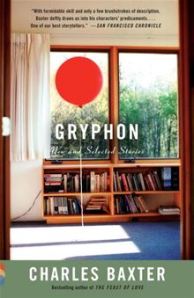
Charles Baxter's most recent book is Gryphon: New and Selected Stories. In her review of the book in The New York Times, Joyce Carol Oates wrote, "Beneath the shadowless equanimity of Norman Rockwell’s America, however, Baxter evokes something like the chilling starkness and human isolation of the work of Edward Hopper

Charles Baxter’s most recent book is Gryphon: New and Selected Stories. In her review of the book in The New York Times, Joyce Carol Oates wrote, “Beneath the shadowless equanimity of Norman Rockwell’s America, however, Baxter evokes something like the chilling starkness and human isolation of the work of Edward Hopper.”

Charles Baxter is probably as well known for his essays on craft as he is for his novels and stories, which is impressive given that his short story “Gryphon” is required reading for many students and his novel The Feast of Love was a finalist for the National Book Award and adapted as a film starring Morgan Freeman. His essays, though—especially the collection Burning Down the House—are a touchstone for almost everyone who has studied in a MFA program over the past 15 years.

Baxter’s most recent book of fiction is Gryphon: New and Selected Stories, which is now out in paperback.

In this interview, Baxter discusses entering the world of a wrongdoer, stumbling toward the write tone, and “rogue longings.”

(To read Baxter’s story “The Next Building I Plan to Bomb” and an exercise on raising the stakes in a story, click here.)

Michael Noll

The story is about a man who wants to be taken seriously, to be seen as someone with the potential to profoundly affect other people’s lives–essentially, to make his existence known and recognized. So, when he’s accused of being “harmless,” he sets out to prove that he isn’t. Here’s what I find fascinating about this story: The man wants to be recognized, but when he first walks into the police station to report the slip of paper he’s found, he chickens out. He fears that “if he showed what was in his pocket to the police he himself would become a prime suspect and an object of intense scrutiny, all privacy gone.” That’s a pretty serious contradiction. In some ways, it makes what follows seem less like a moral fable. The sequence of events is neatly laid out, but it’s less neat if we believe that the man at the center of it is unpredictable. Was this chickening out always part of the story?

Charles Baxter

Writers can’t always reconstruct what they were thinking while writing a story. Sometimes our thinking is so specific and so contextual and instinctive that we don’t know afterward why we did what we did. Anyway, here goes.

Many people in our society suffer from their own anonymity. This response is likely to occur in a culture built on celebrity, as ours is. Harry’s “harmlessness” is another word for a life that seems inconsequential, unimportant. But if you try to enter the world as a wrongdoer, or even someone who brings in the sign of wrongdoing (a slip of paper), you yourself may be judged, exposed. Think of Ted Kacynski. Notoriety is a double-edged sword. Everybody (or most people) carry around these contradictions in themselves. Fiction needs to point up those contradictions, to be honest to itself and its readers.

Michael Noll

After the man bristles at being called harmless, it’s not surprising that he acts out. But his preferred way to act out is unexpected. And then the scene proceeds through a series of unexpected moments: the kid’s guess at the drawing’s rendered location and the subsequent description of the kid as “slinky and warm, like a cat.” It would be so easy to write this scene toward what is expected, toward cliche: of course the societally-suffocated man is into boys. But in this case, the boy is not what we might expect, and the description is unexpectedly cuddly. Do you have, as you write, a kind of internal compass pointing you toward the unexpected, or do you stumble around a story, searching for the right detail?

Charles Baxter

Oh, I stumble. It’s all stumbling, all the time. But what you’re stumbling toward is a tone, an angle, that takes you by surprise. The slightly ‘wrong’ note in a scene is often the note that brings it to life. I keep listening for that note.

Michael Noll

I love this line of dialogue from the man’s wife: “You’re handsome and stable and you’re my sweetie, and I love you, and what else happened today?” The line clearly sets up the world that the man is acting out against. In other words, it’s a line that a literature teacher would pull out and read to students in order to illustrate the story’s theme, a word that probably makes makes most writers cringe. But it doesn’t seem theme-like on a first read because of the speed. Even on subsequent reads, it makes me laugh. I’m curious how you approached the line. Did you think, I need to have someone state the values of the world that the man is rebelling against–and then revise the line to achieve that speed? Or did it arise more accidentally?

Charles Baxter

I wasn’t thinking of the theme at all. I was just trying to imagine what Harry’s wife would say, in an effort to “normalize” everything within that marriage. Also, I like dialogue that changes direction within the same sentence–does a swerve–as that one did. So the line arose out of a combination of accident and calculation.

Michael Noll

As I write this, Tea Party politicians are shutting down the government and threatening to wreck the world’s economy so that the country will pay attention to them. In other words, they’re acting a bit like Harry Edmonds. The difference is that, unlike him, they’ve found a stage whose size is commensurate with the size of their fear of not being seen and heard. In your novels and stories, things generally don’t end well for these types of characters or for the people around them. Care to make any long-term predictions for our current set of characters? When people like Harry Edmonds begin to act out in order to be noticed–and when that need to be noticed stems from some internal deficit that can’t be filled with any amount of attention–are the only outcomes bad ones?

Charles Baxter

Someone, it may have been Christopher Lasch, once said that narcissists can’t negotiate. They suffer from insecurity and grandiosity simultaneously, a terrible combination. The other side of the Tea Party’s belligerence is fear, particularly a fear that the old world they knew is disappearing, and a world they don’t recognize is here. I didn’t think Harry Edmonds was a dangerous character, but just a guy who wanted to be more consequential than he actually was. Kafka would have recognized him. Standard married middle-class life is not enough for him. He has what I’d call “rogue subjectivity” or “rogue longings”–I think the Germans have a word for this: “sehnsucht.” Such people sometimes do free fall parachute jumping, or they do little protests against the settledness of their lives. You want a story to be “telling”–that is, to tell us about how people live now. And that was what I hoped that story would do.

November 2013

Profile pic

Michael Noll is the editor of Read to Write Stories.

How to Raise the Stakes by Challenging a Character’s Identity

19 Nov
Charles Baxter's story, "The Next Building I Plan to Bomb" is included in his latest collection, Gryphon, and was published at The New York Times.

Charles Baxter’s story, “The Next Building I Plan to Bomb” is included in his latest collection, Gryphon, and was published at The New York Times.

One of the most common suggestions for improving a short story is to “raise the stakes.”  The writer Lee K. Abbot apparently once “dismissed a graduate class in less than five minutes by holding up a story, asking “Is there anything at stake in this?,” and upon hearing silence, said they were done with class.” But how does one make something hang in the balance? One option is to dangle a sword over the character’s head as in the Greek tale of Damocles.

Another option is to give your character something to resist or push back against. Most often, this means impugning your characters’ reputations and watching them push back.

A perfect example of this can be found in Charles Baxter’s story, “The Next Building I Plan to Bomb.” It’s included in Gryphon: New and Selected Stories, and you can read it now at The New York Times.

How the Story Works

In John Cheever’s story “The Country Husband,” a man almost dies in a plane crash, but when he comes home, no one wants to talk about it. His wife and children essentially refuse to recognize him as a human being whose experiences and responses to those experiences might not fit into the neatly packaged world they’ve created for themselves. As a result, he begins to act in ways that force people to take notice of him–which is  what Harry Edmonds does in Charles Baxter’s story “The Next Building I Plan to Bomb.” Baxter introduces the one personal slight that Harry cannot bear and so must resist, even at the sake of his own security.

The story raises the stakes by having this personal slight delivered by the person closest to the character, his girlfriend:

“You’ve never committed a crime in your life. You’re a banker, for Chrissake. You’re in the trust department. You’re harmless.”

Harry sat back in his chair and looked at her. “I’m not that harmless.”

“Yes, you are.” She laughed. “You’re quite harmless.”

“Lucia,” he said, “I wish you wouldn’t use that word.”

“‘Harmless’? It’s a compliment.”

“Not in this country, it isn’t,” he said.

This conversation has a direct effect on the character and, by extension, the story’s plot. The story began with Harry stepping into the police station to turn in a possible bomb threat but, at the last minute, turning around and leaving. After this conversation, he returns to the police station. From there, the story takes off, with Harry acting out to prove that he’s not harmless. “in this country,” he eventually tells someone, “if you’re harmless, you get killed and eaten.”

For this character, the stakes are his own self-regard, the sense that he’s a potent actor in the world.

The Writing Exercise

Let’s raise the stakes in a story by giving a character a personal slight to resist or push back against. We’ll use the dialogue from “The Next Building I Plan to Bomb” as a model. (This exercise can be used to create a story from scratch, but it may work best with a set of characters and a story that you’ve been working on for a while.)

  1. Put two characters who are close to one another together in a room. The room should be somewhere intimate, a place where personal things can be said.
  2. Make one character tell the other character everything that he/she is and is not. People do this all the time, often to themselves, saying things like, “I don’t eat muffins. I don’t watch baseball. I don’t do roller coasters.” Or they do it to other people: “He’s such a boy. She’s the kind of person who…” But while people don’t mind labeling themselves, they almost never like being labeled by someone else. So, a great way to create tension in a story (which is a roundabout way of raising the stakes) is by letting one character label another.
  3. Let the other character respond. The character should defend him/herself. “You say I’m X, but I say that I’m not.” Or, “You say that I’m not X, but I am.” If you’ve been in any kind of relationship, then you know that this is how many arguments go. Any time a character’s sense of him/herself is challenged, the stakes are being set.
  4. Make the character prove his point. Once your character’s identity has been challenged, make him or her prove that the challenge is incorrect. The proof could be literal (hitting a home run to show that he’s good at baseball) or more unpredictable (yelling at someone for not returning a grocery cart in order to prove that she’s tough).

Good luck!

An Interview with Ali Simpson

14 Nov
Ali Simpson is a recent graduate of the MFA program at SUNY Southampton and works for X.

Ali Simpson is a recent graduate of the MFA program at SUNY Southampton and is at work on a collection of speculative fiction.

Ali Simpson received her MFA in creative writing and literature from SUNY Stony Brook Southampton. In addition to The Southampton Review, her work has been published or is forthcoming in The First Line and Carrier Pigeon. She is currently working on a collection of speculative fiction, When Meat is Given a Second Chance. She works as a publishing assistant and lives in the forest.

In this interview, Simpson discusses maintaining the sense of enchantment, the heart in the story machine, and why a monster story can be more truthful than realistic fiction.

(To read Simpson’s story “The Monster” and an exercise about how to create that monster, click here.)

Michael Noll

In the story’s first line, you state that there’s a monster in the closet. In the next line, you write, “He shouldn’t have been there—she wasn’t a little girl; she was a grown woman with a full-time job and a roof over her head that she paid for herself with her full-time job.” The rest of the paragraph lists all the reasons why the monster shouldn’t exist, and then the next paragraph begins, “So the monster came at the right time in her life.” It’s a really masterful piece of writing. You’ve let the readers off the hook, telling them, essentially, that, no, monsters can’t exist, but there’s one in this story, and that’s okay. How long did it take you to get that opening paragraph right?

Ali Simpson

I had to look at the paragraph from my first draft and the final version in order to be able to honestly say this: Up until the last line, the paragraph stayed exactly the same. The last line was the only part that is different—mostly a matter of cutting and smoothing out that first draft clunkiness that makes you write things like “she turned her head at a 90 degree angle in puzzlement…” rather than “Confused, she…”

The beginning was easy. It felt like a perfectly natural thing to write. There are all sorts of things out there that shouldn’t exist—but they do all the same. People accept a loved one has cancer, they accept mass shootings, they accept freak accidents, they accept random acts of cruelty. Telling someone, “This shouldn’t happen, but today, it is happening,” is life-stuff (and the beginning of a lot of great stories).The idea of a monster in the closet isn’t so outlandish.

What took a couple of months to get right was the middle and the end. Those were brutal. Maintaining the sense of enchantment even when the reader knows how the trick works is incredibly difficult, I can only think of a few people who have mastered it (Marquez, Atwood).

Michael Noll

In that same paragraph, the story suggests that the monster is, in part, a manifestation of certain monstrous qualities possessed by the character: “She suspected she had a few scary stories lurking inside her and spent the better part of some nights guessing what they might be.” I’m curious if this parallel between the character’s personal issues and the real existence of the monster was always present. In other words, did you begin the story with the monster and discover the character’s issues, or did you have a sense of the character from the start and then discover the monster? As readers, we only get to see the final draft, in which all details seem serendipitously inevitable. But, of course, that’s not how a story begins. What was your process for developing the story?

Ali Simpson

By the way, the line in the question was the one that changed. It was originally this mess of three lines: “Those stories were just the ones outside of herself. Lauren told herself awful stories every night, some sad, some angry, some fretful and some far more humiliating than they should have been. The stories were her past and what she thought her future might be.” Awful, right?

As for the actual questions—I started with wanting to write about a monster in the closet. I like monsters, robots, mutants, apocalypses, utopias, and outer space. These things are fun, and they offer a candy store full of possibility. Unfortunately, the fun is a lie. You can’t get far writing about a monster in the closet without asking questions. Why is it there? Why isn’t the main character afraid of it? Why is she taking it in and caring for it? What sort of person is attracted to repellent things? Monsters, machines, extreme conditions—these are all vehicles for exploring what makes human beings tick. Inevitably, the ride turns scary. I developed the story through reflecting on the above sorts of questions. The monster showed up in this particular woman’s closet for a reason. In hashing out the first draft, I worked to discover that reason. Whenever Laura did something, the monster would have to react and vice versa—until the monster and Laura at last become “inseparable.”

Michael Noll

Your former writing teacher, Susan Merrell, recommended this story at Electric Literature. In explaining why, she wrote that, in this story, you figured out that “a story has to have a reason for being. And if a story’s why is understood by its author, then its how—the means, the mode, the POV, the structure, the characters—will fall into place.” What, would you say, is this story’s reason for being? How did you find out what its reason for being was?

Ali Simpson

Susie was very kind to me in that introduction. She is also a genius.

This story’s reason for being started out as something personal. Someone was very cruel to me a long time ago, and I felt as if I couldn’t do anything about it because, despite everything I had been told, I was a depressed ghost of a person. As I wrote, I understood that the events in the story did not happen to me, but to a woman named Laura, and, in reality, to millions of other people. The story is for other people who feel the same way I felt. Part of growing up and being human is recognizing that your feelings are not necessarily unique to you. Everyone has their monsters. And we all feed our gremlins after midnight.

I like to think of a story’s reason for being as “the heart in the machine.” The machine is all of the cold, moveable, sometimes interchangeable parts. The POV, the structure, the characters. The heart is whatever compelled you to sit down and stare at the blank page, to craft imaginary people who live in made up worlds, to construct emotion, desire, and conflict out of a few scraps of black and white.

You have to have a reason to attempt to do something so stupid. Generally, the reason is love.

Michael Noll

This story falls into a genre of story that is sometimes called “fabulist.” Its practitioners include writers like Manuel Gonzales, Karen Russell, and Kelly Luce. When I featured Kelly’s story “Rooey” on this site, I asked her why this type of story–one in which certain conventions of genre fiction are integrated into the worlds and language of realism–has become not only popular but esteemed. After all, Karen Russell just won a MacArthur, and she nearly won the Pulitzer. Here is what Kelly Luce said: “We all loved reading as kids, and kids’ books are often extremely imaginative. In this age of extended adolescence and “be yourself” messages, maybe those writers who wanted to play a bit more with fantasy/genre/supernatural stuff felt free enough to do so.” (The entire interview can be found here.) How would you explain the prominence of these kinds of stories? What inspired you to write about a literal monster and not a figurative one?

Ali Simpson

I don’t agree with what Luce said above (although I find her complete answer to the question quite interesting!) The whole concept of extended adolescence always seemed a bit silly. I’ve been in the adult world long enough to know that most people are still scared, confused, jealous and a little bit petty. Also, no one buys that “be yourself” crap. Even little kids know that being yourself earns immediate approbation from the group. I don’t think people write fantastical stories based on whimsy or because they enjoy being weird.

If I had to offer a guess, I would say the prominence of these stories dates to the post-modern movement that began in the 60s. Along with the subversion of traditional narratives, writers also worked at reclaiming folklore and fairytale for the purposes of new kinds of storytelling. For the past few decades, I think many writers have felt that that fantasy and fairytales are true because these stories “know” that they are stories, whereas mediocre realism can feel like an illusion that is denying it is an illusion.

For me, writing about fantastical things such as monsters helps me get at the truth of what I’m trying to say. I’ve never been able to manage writing realistic fiction because I find myself slipping into the dishonesty of everyday life. For me, I have to look a monster—something not of this world—in the face in order to understand the world I’m living in.

November 2013

Profile pic

Michael Noll is the editor of Read to Write Stories.

How to Create a Monster

12 Nov
Ali Simpson's story

Ali Simpson’s story, “The Monster,” was first published in The Southampton Review and recommended to Electric Literature by Susan Merrell.

Everyone loves a good horror story. But anyone who tries to write such a story quickly discovers that it’s not enough to simply create a monster. You must also create a reason for the monster to exist. Or, to quote the great Albert Camus, who would have turned 100 this year, “A character is never the author who created him. It is quite likely, however, that an author may be all his characters simultaneously.” In all great horror stories, literary or otherwise, the monster is often a manifestation of a character’s inner monstrosity.

Ali Simpson’s story “The Monster” is a terrific example of this kind of character. The story was first published at The Southampton Review and reprinted at Electric Literature, where you can read it now.

How the Story Works

The story introduces the monster in the first line: “Laura was becoming unsure about what to do with the monster in her closet.”

Any reader who finishes that sentence has sentence has two immediate questions:

  1. What kind of world have I entered? (In other words, are there monsters in every closet? Is there some kind of society of closet-monsters?)
  2. What kind of monster is it?

Watch how the story clearly answers this first question in the opening paragraph:

“He shouldn’t have been there—she wasn’t a little girl; she was a grown woman with a full-time job and a roof over her head that she paid for herself with her full-time job. She had food in the fridge, dishes in the drying rack and dress pants pressed. Who had time or inclination to deal with monsters when there was work to be done, friends to have drinks with and love to pursue? Besides, the world was filled with enough scary stories as it was. Robbers, rapists, famines, and wars. Every day on the way to work, she passed people more unfortunate than she, and she knew if she stopped for a second, she would become a part of them, hungry all the time. She suspected she had a few scary stories lurking inside her and spent the better part of some nights guessing what they might be.”

So what kind of world is it? It’s a realistic world full of dirty dishes and jobs and wrinkled clothes. It’s a world with characters who have lives that do not involve monsters. This last part is important because it’s not true of all monster stories. Take the vampires out of Twilight, and the world evaporates. Take Voldemort out of Harry Potter or the gremlins out of Gremlins and you also remove the central conflict—and, to some extent, only conflict—facing the characters. But in this world, the narrator has a life and problems (and so does the rest of the world) that existed before the monster arrives.

Now, watch how the story answers the second question in the next two paragraphs:

So the monster came at the right time in her life. She had just put her dog to sleep because of his eye tumors. She had also recently kicked out her boyfriend because he thought she was his mother. She told him he was mistaken, that she was not his mother, and then she helped him pack his things, fed him lunch and kissed him good-bye. After Bumblebee went to sleep and the boyfriend was sent on his way, her apartment smelled empty and her sheets were cold. She lay around on the couch when she didn’t have to be at work and kept telling herself not to feel sad—she had a lot going for her.

The loneliness made her sick and pale. Nothing made her feel better and she wondered if the loneliness had been there all along but that she had somehow avoided looking it in the face until now.

So, what kind of monster is it? It’s a manifestation of the narrator’s deepest fears. In fact, we’re not yet sure if there really is a monster or if the narrator has simply conjured it out of her fear and doubt. As you read the rest of the story, though, you’ll see how that uncertainty is quickly put to rest.

The Writing Exercise

Let’s create a monster (real or imagined) using Ali Simpson’s “The Monster” as a model. To do so, we’ll answer the questions, “What kind of world is it?” and “What kind of monster is it?”

  1. Introduce the monster. To do this, you’ll need to state the following: Where is the monster? Who sees it? How does that person feel about the monster? (This last part is perhaps the most important. If the character is terrified for her life in the first sentence, the story will proceed much differently than if the character is amused or irritated.)
  2. What kind of world is it? Do monsters appear all the time? Is the world under siege by monsters? Or is this a regular world with a very personal monster. To answer this question, you’ll also need to figure out your character’s place in the world. If the world is a stage full of roles that people must play, which roles are being played by your character?
  3. What kind of monster is it? Why has the monster appeared to this character at this time? Even less-literary stories, monsters and victims are well matched. So, even in a novel like Twilight, the monster is a manifestation of Bella’s developing sense of her own sexuality. To answer this question, figure out the character’s life, problems, and conflicts that existed before the monster arrived. In a way, you’re adjusting the telescopic lens through which the story views the monster. If you begin by focusing on Conflict A, then Conflict A will always be present in the story (unless you stumble upon a better conflict; in that case, throw out Conflict A and switch to Conflict B). Regardless, if you make the character’s personal conflict part of the story from the beginning, the monster will naturally be viewed as part of that conflict.

Good luck and have fun! You’re writing a monster story. To paraphrase Kurt Vonnegut, if that isn’t nice, then I don’t know what is.

How to Write Plot by Answering the “Why” Question

5 Nov
Tiphanie Yanique's story "How to Escape from a Leper Colony" was first published at Boston Review.

Tiphanie Yanique was born in St. Thomas in the Virgin Islands and lives in Brooklyn. She was the 2010 recipient of the prestigious Rona Jaffe Prize in Fiction.

When we talk about plot, the focus is often on what happens–setting it up, teasing the reader with what will happen next, creating suspense. Sometimes, though, plot is built upon the question of why things happen.

Tiphanie Yanique’s story “How to Escape from a Leper Colony” perfectly demonstrates how to build plot by answering the why question. The story was first published at Boston Review, where it won the journal’s annual short story contest. It was eventually included in Tiphanie Yanique’s story collection, How to Escape from a Leper Colony (Graywolf Press). It’s as good a story as you’ll ever read. You can find it here at Boston Review.

How the Story Works

The title of the story—”How to Escape from a Leper Colony”—makes clear what will happen in the story:  someone, almost certainly the narrator, will try to escape the island. The question is why. The answer, of course, will be some version of Because they must or Because they have no choice. But that is not enough. The driving impulse to escape must be more than a plot mechanism. It must originate from the characters’ sense of themselves and their world—even if the cause is due to external events.

Here is how Yanique introduces the characters’ attitudes toward what will eventually happen:

“What evil thing Lazaro will do later we will forgive him for, because we know his past and because we know he is one of us.”

That sentence sets up two important ideas:

  1. Something has happened in Lazaro’s past that shapes his sense of the present
  2. He (and the narrator and others) are part of a group—which suggests that there is another group with different ideas about what will happen.

So, what is the belief system or attitude of Lazaro’s group? Much of the story is spent developing the particular way the group members view the world, and in this passage, that attitude comes into sharp focus:

“From my mother I learned that Christians love leprosy. Christians are not so passionate about polio or cholera. But Jesus had touched lepers. Jesus cured lepers. Leprosy gives the pious a chance to be Christ-like. Only lepers hate leprosy. Who wants to be the one in the Bible always getting cured? We want to be the heroes, too. We want to be like Jesus. Or like Shiva. Or like whomever you pray to.”

Because the story so clearly establishes the characters and their attitudes, the events of the story become not simply things that happen but the so-called straw that breaks the camel’s back. In other words, the plot is driven by the characters’ reactions to what happens.

The Writing Exercise

Let’s discover the attitudes of our character(s) using “How to Escape from a Leper Colony” as a model.

  1. Identity the source of the character’s trouble. In high school, many of us learned about literary conflicts: man vs. man, man vs nature, man vs self, man vs. society. While these aren’t particular useful outside of a classroom, they can point us in the right direction. Who or what is your character at odds with?
  2. Identity when the trouble began. You might create a timeline. At the least, you should know if the conflict is old or relatively new. All conflicts warp (or, to put it more positively, conflicts shape) a character’s sense of him/herself in the world. The older the conflict, the stronger the resentment or attitude is likely to be.
  3. Identify the character’s group. All people tend to classify themselves into groups, and those groups often take “an us vs. them” philosophy. The groups can be based on large ideas like class, ethnicity, gender, sexuality, or politics, or they can be based on behaviors. Try defining the group with a phrase such as “The kind of people who…” or “The kind of person who…” For example, there are the kind of the people who love Neil Diamond and those who do not. There are the kind of people who are kind to everyone and those who are not—the kind of people who like to try new food and those who do not.
  4. Introduce the conflict and let the character comment on it both as a member of the group and as someone with a history with the conflict. Think of the story’s conflict as being like herpes. The root problem–the virus–never goes away, and so the conflict occurs when the symptoms reappear. In many stories and novels, the characters’ problem is chronic, a reoccurrence or new manifestation of something he/she has been dealing with for a long time. Try reintroducing the problem–a new occurrence or manifestation of it–and let the character talk about it as someone experienced with dealing with it. Then, let the character view the conflict through the prism of the group beliefs. If it’s herpes, and the group is defined by people who complain and those who do not complain, you might write this: “There wasn’t any point in whining or moaning about it. You just had to get on with things, and people who couldn’t do that–well, he wasn’t going to hang out with those kind of people.”

Play around with these different steps. Try commenting on the conflict in a variety of ways. Once you find a comment that resonates with your character, you may find that the plot (and the way forward into the story) becomes clearer.

Good luck and have fun.

An Interview with Alex Perez

31 Oct
Alex Perez

Alex Perez’s story “Eggs” appeared in Subtropics, the literary magazine of the University of Florida.

Alex Perez is a graduate of the Iowa Writers’ Workshop. His stories have appeared in SubtropicsGuernica, and Esquire. He lives in Miami, where he recently completed a novel.

In this interview, Perez discusses writing about class and race, listening to characters, puzzling out how to integrate backstory, and his pick for the next Nobel Prize.

(To read Perez’s story “Eggs” and an exercise creating the world of the story, click here.)

Michael Noll

In student stories, dialogue tends to be focused on plot (what is going to happen, who is going to do what). As a result, the characters can sometimes seem lifeless, like props being shuffled around as the story dictates. What I immediately noticed about “Eggs” is that the boys have something to talk about. Even when they’re a few blocks away from the house that they’re about to vandalize, they’re not talking exclusively about their plan. Instead they’re talking about basketball goals with glass backboards and thinking about how the houses look like castles. The narrator thinks that he’ll never live in a house with such big staircases. Even at the story’s climax, he’s thinking about class differences–which is fascinating and tells us so much about him and his world. Was the story always about class in this way? Or did you have to write a few drafts and let the boys have some random conversations and observations before you figured out what their concerns were?

Alex Perez

The story was always about class, but it took me a couple of drafts to figure out what it was really about: the realization that class exists. The concern, of course, was that a socioeconomic “theme” would be too on the nose, or too writerly, which is why it was important that the two main characters be teenagers. They were never going to have a nuanced chat about economic theory or politics. It was simple: “Look, a glass blackboard. I want a glass blackboard. I can’t have a glass blackboard.” They were awed and angered—like most young men—so the dialogue, as well as the rest of the story, is dictated by that point of view. Basically, remove yourself as much as possible. Become your characters.

Michael Noll

The opening of the story makes clear that race/ethnicity will play a big role. The first section ends this way:

“So get ready to egg the hell out of him.”

“And the white lady?”

“The white lady too.”

But, for the most part, whiteness and Cuban-ness don’t really get talked about. Instead, they get wrapped up in discussions of class. By the end, it’s almost impossible to separate the two. Near the end, just before the boys start throwing eggs, the narrator thinks about his father this way:

He was in one of the biggest houses I had ever seen, and he’d become a certifiable bitch. I didn’t know why, but as I looked around the house, at the massive staircase and the leather couches, for one second, gave him the benefit of the doubt. Right then, I knew that I’d never make it to such a house. I wasn’t good enough for Harvard, and I certainly wasn’t about to massage feet for women who weren’t my wife.

This is a pretty powerful thought. It’s all about class and the narrator’s sense of his own worth and what he’s willing to do for money. It’s also, indirectly, about race/ethnicity. I’m curious how you developed this idea in the drafts. Was it a challenge to find the right way to approach tensions of race/ethnicity?

Alex Perez

Initially, race was going to play a big factor. Surely, I was thinking about writing a story that connects class and race and makes some grand statement. Thankfully, once the boys enter the neighborhood and notice the backboards and everything else, the story really hones in on what it wants to be. Once again, this is about point of view. The writer wanted to hammer together themes of race and class—searching for the proper balance or ratio—but the narrator was focused on glass backboards. I was smart enough to go along and allow the story to move in the direction it wanted to move in. I’ve learned the hard way that too much thinking—especially while writing—can destroy a story. Don’t question the choices a character makes. They know better. If it was up to me, I would’ve probably shoehorned more “race” into the story, but the characters were obsessed with “stuff” they didn’t have, which says everything that needs to be said about race and class and America, etc. They knew the proper ratio all along.

Michael Noll

The story takes place over a short period of time (the amount of time required to drive to a house and egg it). But the story does flash back to other moments in the boys’ lives (discovering their father’s affair, the day their father leaves home). Did the story always have that narrow frame? Or did earlier drafts try to span more time within the plot? In other words, did the story always begin with the boys in the car, on their way to the house, or did it begin earlier?

Alex Perez

I read a lot of stories that sputter along and take a few scenes to get going, so I always try to start a story with as much immediacy as possible. In “Eggs,” it seemed logical then to open with the boys in the car, the plan already in motion. We’re right there with them, listening in, wondering why they want to egg their father and this mysterious white lady. I also wanted the reader to feel like an accomplice, so trapping everyone in a car was the only way to go. The problem, as always, was what to do about the backstory. You can have chunks of backstory in a novel—such is the form—but short stories are all about forward progression. It was even trickier in “Eggs,” because the boys are in a car—literally moving forward—and I didn’t want the momentum deadened by the backstory. So the question was: to backstory or not to backstory? In the end, I realized that some history was indeed needed, so I had to write a couple of “background” scenes and somehow intersperse them into the narrative. Always a bastard, that backstory.

Michael Noll

In the spirit of the recent Novel Prize announcement, if you were able to give out an award for lifetime achievement in literature, who would you give it to? Which writer has most shaped both your conception of yourself as a writer and also your sense of what a good story/novel looks like?

Alex Perez

Philip Roth. Nobody does the combination of comedy and pathos better than Roth. I read Goodbye, Columbus, and that was it for me. His stories are fearless. He’s like Dylan in that they’re going to do whatever they want, and you either come along, or you don’t. That seems like the way to do it.

October 2013

Profile pic

Michael Noll is the editor of Read to Write Stories.

How to Create the World of the Story

29 Oct
Alex Perez's story "Eggs" was published in Subtropics, the literary magazine from the University of Florida.

Alex Perez’s story “Eggs” was published in Subtropics, the literary magazine from the University of Florida.

The writer Ron Carlson says that every story has two parts: the story and the world that the story enters. Another way of saying this is that the characters involved have concerns and obsessions that existed before the story came into their lives.

Alex Perez has created this fictional world beautifully in his story “Eggs.” It was published in Subtropics, where you can read it now.

How the Story Works

It’s not actually enough to create a world for the story to enter. That world must lean on the story, shaping it so that the story isn’t generic but specific to that place. Perez does this by giving his narrator an attitude about certain aspects of his world: poverty and ethnicity.

Notice how the narrator immediately compares his mom to the woman his father is sleeping with:

“My mother, always working in the kitchen, never wore anything that called attention to her. This woman, this white lady, must have dipped her entire wardrobe in glaze or something.”

This class difference gets picked up in every section of the story. Even when the the narrator’s father moves out and the narrator and his brother drive to his new house to egg it, they’re thinking not just about their plan but the class distinctions that inform it:

It’s a testament to the craziness of a city like Miami, how all the hoods, rich and poor, are connected by the highway, but people only get off where they’re supposed to. But here we were, on the side of town all the immigrants wanted to get to. Ten minutes from our place, and this was the first time Ricky had seen driveways littered with the finest in German engineering.

“All the backboards are made of glass. Like the NBA,” he said.

“You haven’t played basketball until you bounce it off the glass,” I said.

One problem that many beginning writers have is a tendency to write only about plot. In their stories, once the plot gets rolling, nothing else appears on the page. But good stories move in and out of plot. They advance it for a while and then step out for a few moments to talk about something else. Such moments allow readers to catch their breath, to absorb what is happening. Giving the characters in a story something to talk about besides the immediate plot also allows the story to gain meaning. It allows the story to have a paragraph like this one in which the narrator peers through the windows of his father’s mistress’ house and sees him rubbing her feet:

He was in one of the biggest houses I had ever seen, and he’d become a certifiable bitch. I didn’t know why, but as I looked around the house, at the massive staircase and the leather couches, for one second, I gave him the benefit of the doubt. Right then, I knew that I’d never make it to such a house. I wasn’t good enough for Harvard, and I certainly wasn’t about to massage feet for women who weren’t my wife. Maybe all those other women had been preparation for this moment, for the day that he’d finally make it to a house that justified his exodus all those years ago. I didn’t know, probably would never know, but I had to tell myself a story.

That passage that isn’t possible if the story doesn’t create its world and its characters’ attitude toward that world.

The Writing Exercise

Let’s create a world and a character’s attitude toward that world, using “Eggs” as a model:

  • Describe two characters from the viewpoint of a third character. When Perez compares his mother to his father’s mistress, he notices the difference in their clothes, and it bothers him. You’re looking for those kind of distinctions that bother the third character. So, you may want to describe characters who are not equally close to the third character: a family member and a stranger, a close friend and an acquaintance, a spouse and a co-worker. We tend to associate ourselves with people from “our world” and who have similar attitudes toward that world—and we often judge harshly the people from other worlds. Here are some ideas for distinctions you can make: class, ethnicity, geography, education, intelligence, athletic ability, attractiveness, sexuality, or even just likability.
  • Put your third character into the world that isn’t his/her own. When Perez’s characters egg their father’s mistress’s house, they leave one neighborhood and enter another. Because class distinctions weigh so heavily on them, everything they see is seen through that prism: the basketball backboards, the bases on the baseball fields. What details does your third character notice as he/she enters the world that isn’t his own? The key is to find a plot mechanism that will force your character into a world to which he/she doesn’t belong.
  • Filter everything through the difference between the worlds. We judge others most harshly—or become most conscious of distinctions between us and others—when we’re upset. So, as you write the story and approach the dramatic high points, find ways to return to the distinctions you’ve created. In Perez’s story, the narrator looks into his father’s new house, aware of how much bigger and fancier it is than his own. But his feelings toward those differences have changed. Very often, the reversal in plot or the epiphany will be accompanied by a similar reversal or change in the way a character views the world you’ve created.

Good luck and have fun.

An Interview with Mũthoni Kiarie

24 Oct
Mũthoni Kiarie grew up in Nairobi, Kenya. She earned her MFA from Mills College and is an alumna of the Voices of Our Nations Arts Foundation. A finalist in the Spring 2012 Story Contest, she lives in Oakland, California.

Mũthoni Kiarie’s story, “What We Left Behind” was a finalist in the Narrative Magazine Spring 2012 Story Contest.

Mũthoni Kiarie grew up in Nairobi, Kenya. She earned her MFA from Mills College and is an alumna of the Voices of Our Nations Arts Foundation. She lives in Oakland, California.

In this interview, Kiarie discusses her approach to intensely emotional moments in a story.

(To read Kiarie’s story “What We Left Behind” and an exercise based on the story’s indirect treatment of emotion, click here.)

Michael Noll

This story is about a mother and her two children who flee their village after it’s violently attacked by armed men. Though the story describes the attack, it only focuses on certain parts. So, for instance, the mother’s torn dress and bloody lip are clearly and specifically described, but the body of the murdered father is described less directly as “painting the ground a lush red.” Did you make a conscious decision to show certain people and things in greater detail than others? In other words, how did you know what to describe clearly and what to suggest more indirectly?

Mũthoni Kiarie

When writing this, I knew the story was going to be focused more on the mother and that the father would sort of fade into the background. However, it was important to show that his was still an important role in the story. The way he died to me showed in a restrained way, how that community was decimated. I also wanted to make sure that his death was also lovingly portrayed, while still showing that it was a violent death. The mother’s details, the dress, the bloody lip I almost felt were even more subtle than the father’s because she underwent what was possibly an even more violent experience that I didn’t necessarily talk about but give my reader a strong sense of what may have happened.

Michael Noll

The story begins with a list of the items abandoned in the desert, and great care is taken to distinguish between the different types of baskets and different sizes of sandals. The list is powerful–and the power doesn’t abate even after several reads. The items that are shown reveal so much about the characters’ live, and the fact that we see these items and not the people who left them is chilling. It reminds me of one exhibit at the Holocaust Museum in Washington D.C. It’s a room filled with children’s shoes—for some reason, when I visited the museum, those shoes affected me more than any of the horrifying photographs that I saw. Why do you think personal items like shoes or baskets or sandals have this effect on us?

Mũthoni Kiarie

I think as human beings, the value that we attach to material possessions defines our existence. Like your example of seeing the children’s shoes in the Holocaust Museum, you attached a certain child and their life to those items. This is really where this story came from. Thinking about these material things that hold so much value to us when we are alive and all is well in our worlds. But then, what do you take with you when you have three seconds to get out of the house? Your child or your shoes? That’s kind of an obvious question, but you get what I mean. I imagine that at each step when my characters or others who’ve been faced with a similar journey, have to chose what to leave behind. And those decisions must be excruciating.

October 2013

Profile pic

Michael Noll is the editor of Read to Write Stories.

How to Convey Emotion Indirectly

22 Oct
Mũthoni Kiarie's story "What We Lost" appeared in Narrative Magazine as a Story of the Week.

Mũthoni Kiarie’s story “What We Left Behind” appeared in Narrative Magazine as a Story of the Week.

Sometimes the best way to approach important moments in a story is indirectly. To that end, the writer John Gardner gave his students this exercise: Write a paragraph about a farmer grieving after his son’s death. But you can’t mention the son or his death or any words that signal emotion. Instead, you must describe the barn and, in the details you choose, convey the farmer’s sense of loss.

This can be a difficult exercise because we realize how dependent we are on direct treatment of everything in a story. If you try to describe the barn, though, and if you continue to find indirect approaches to key information in fiction, you might be surprised at the effect on your writing. You’ll also begin to see the strategy everywhere in stories.

A great example is in the opening paragraph of Mũthoni Kiarie’s story “What We Left Behind.” It was a finalist in the Spring 2012 Story Contest from Narrative Magazine, where you can read it now. (Note: Sign-in is required, but it’s free.)

How the Story Works

The premise of the story is very simple. A Kenyan village is attacked by armed men, and the survivors flee. Notice how long the story waits to state the premise—not until the fourth paragraph. What precedes that paragraph is, in part, an indirect description that conveys the survivors’ depth of loss:

“In the beginning, the sandy ground was littered with the things that those who went before us had abandoned: sisal sleeping mats, many with the threads that bound the fibers together loosening as they flopped in the wind; suitcases; water troughs; beaded jewelry; tin cooking utensils; thin cotton dresses, skirts, shirts, and trousers; woven baskets, the kind that carried cassava crops from one home to another, and bigger, more elaborate baskets, the kind that were given to a new bride on her wedding day; rubber-soled sandals, ones for tall men and ones for smaller men, and thinner ones for women, flimsier ones for children, and all black, blacker than the people whose feet they had once adorned. But as the days went by and we continued to walk, there were fewer and fewer of these things, and instead we began to see a scattering of carcasses from animals left to die in the dry desert heat.”

At first, the description merely lists the objects that litter the ground. But as the list proceeds, it begins to offer greater detail. For instance, it distinguishes between baskets that “carried cassava crops from one home to another, and bigger, more elaborate baskets, the kind that were given to a new bride on her wedding day.” And between types of sandals: “ones for tall men and ones for smaller men, and thinner ones for women, flimsier ones for children, and all black, blacker than the people whose feet they had once adorned.”

The passage ends by upending the list: the items are gradually replaced with animal carcasses.

Though the paragraph never shows the people fleeing the village, we get a strong sense of their presence (and of the narrator’s emotions) through the attention given to the objects on the ground.

The Writing Exercise

Let’s try to convey important emotional information without approaching it directly. We’ll use Mũthoni Kiarie’s story as a model:

  1. Choose an event that produces strong emotion. Ideally, the emotion should last for a while, as opposed to a flash of anger or frustration that is quickly forgotten. Examples of events include these: death, marriage, divorce, birth, moving to another house or city, losing a job, changing jobs, professional disappointment, professional success, winning the lottery, or your team winning a big game.
  2. Try the John-Gardner exercise. Describe the contents of a room or place that is significant to your character. Don’t state the emotion or anything related to the event. (And no cheating with synonyms or giving animals or inanimate objects human dimensions—ducks skipping, walls smiling, that sort of thing.
  3. Add an element of time. How does the room or place change as the minutes/hours/days pass? This may be easier since it makes the description active rather than static.
  4. Optional: End the passage with a single line that states the emotion or something related to the event. Sometimes a line that bluntly states what has become obvious after an indirect description can shake the reader a little. For an example of this effect, read the last paragraph and sentence of Mũthoni Kiarie’s story.

Remember, the idea is to get inside the character’s head. Bad fiction tends to state what it cannot show. It tells the reader that a character is excited or sad or angry, and it’s no accident that the prose in such fiction is mechanical. But when you read good fiction, you’ll notice passages that are not directly related to plot or character development—they’re simply the book/narrator telling us about things in the character’s world. It’s the ability to write passages like these, without falling into dull description, that opens up the range and possibility of a prose voice.

Good luck and have fun.