Tag Archives: how to write a short story

An Interview with Mary Miller

17 Oct
Mary Miller's debut novel, The Last Days of California, follows a 14-year-old girl whose father takes the family on a road trip from Montgomery to California in anticipation of the Rapture. A recent Publisher's Weekly review said that Miller has created a "narrator worthy of comparison with those of contemporaries such as Karen Thompson Walker and of greats such as Carson McCullers."

Mary Miller’s debut novel, The Last Days of California, follows a 14-year-old girl whose father takes the family on a road trip from Montgomery to California in anticipation of the Rapture.

Mary Miller’s debut novel, The Last Days of California, is finally out, and it’s already getting rave reviews. A reviewer for The New York Times wrote, “Why worry about labeling a book this good? Just read it.”

Miller grew up in Jackson, Mississippi. Her collection of stories, Big World, was published in 2009 by Short Flight/Long Drive Books. A graduate of the Michener Center for Writers at the University of Texas, she will return to Mississippi in the fall of 2014 to serve as the John and Renée Grisham Writer-in-Residence at Ole Miss. At this cool website, she discusses the stories she’s read lately.

In this interview, Miller discusses misunderstanding and subtext in dialogue and the challenge of transitioning from story writer to novelist.

(To read Miller’s story “I Won’t Get Lost” and an exercise based on the story’s dialogue, click here.)

Michael Noll

I love the dialogue in your story “I Won’t Get Lost.” The narrator has to explain gentrification to a man who’s never heard the term before. The basic premise of the conversation is weird–who hasn’t heard of gentrification. But instead of closing the distance between the two people (the man saying, “Oh, so that’s what gentrification is. Thanks for telling me”), the dialogue actually pushes them farther apart. By the end of this early portion, the man stops talking and takes out his phone to verify what he’s just been told. I’m curious how you approached this piece of dialogue. Our natural tendency is to make dialogue function as it does in the real world, which is toward understanding. Did you have to consciously make this dialogue work against that tendency, or did it move that way on its own?

Mary Miller

Thanks, Michael. This is a pretty much a conversation I had on the bus one day. I guess I thought it was odd, as well, because the gentrification discussion inspired me to write this story. And then it became more about the narrator, and how talking to this stranger made her feel exposed and self-conscious.

My natural tendency in writing is toward misunderstanding and confusion. When people speak to each other, particularly those who know each other well, there is typically a lot of subtext. I’m at home right now visiting my family, and when we talk I notice all of the things we aren’t saying, or how we’re saying one thing and meaning something completely different. In life, this kind of sucks, but it’s great for dialogue.

Michael Noll

The story’s title is “I Won’t Get Lost,” which is appropriate because every piece of dialogue, every internal thought, and every observation in the story is about dislocation and disconnection. Did you start with this theme in mind, or did it surface through various drafts of the story?

Mary Miller

I don’t think about theme when I write. I feel when something is coming together and creating a larger story, or when it’s not, but it’s not something I think about. I don’t ever want my writing to feel heavy-handed, for the reader to see me guiding him or her to some conclusion.

Michael Noll

Your first novel, The Last Days of California, will be published in January. It’s about a 15-year-old girl whose evangelical father takes her on a road trip across California to save as many souls as possible before the rapture. On one hand, a novel is always a big jump for a story writer, especially when the stories are often quite short, as yours sometimes are. On the other hand, a road trip novel has a unique structure: many short, sometimes disconnected scenes. Did you choose this structure on purpose? Was it a more manageable way to approach a novel for the first time? If so, that would seem like an awfully smart decision.

Mary Miller

Yes, yes, yes! I really don’t feel like I could have written a novel, at least not at the time, without this rigid structure. I had to keep moving the characters from Point A to Point B, which created a certain amount of tension. They’re behind schedule! They must keep going! They need to eat and use the bathroom and look at all of these odd things and people they’re coming into contact with… Each night, there’s a new motel, a new environment for them to explore. The structure certainly provided me a frame within which to work. It made it easier and more fun to write.

October 2013

Profile pic

Michael Noll is the editor of Read to Write Stories.

How to Write Away from Consensus in Dialogue

15 Oct
Mary Miller's story "I Won't Get Lost" appeared at New World Writing, an online journal founded by former Mississippi Review editor Frederick Barthelme.

Mary Miller’s story “I Won’t Get Lost” appeared at New World Writing. Her novel, The Last Days of California, is out now from Liveright.

In real-life conversations, we almost always seek common ground and compromise. Like the advice for married couples, we try not to go to bed angry. We want to leave a conversation having agreed upon something or with some shared understanding. But fiction is not like real life. In stories and novels, dialogue between characters who are seeking mutual understanding is boring. It kills, rather than heightens, tension. This means that good dialogue in fiction is actually the opposite of a good real-life conversation. It must veer away from consensus and not toward it.

Mary Miller demonstrates how to write dialogue that moves away from understanding in her story, “I Won’t Get Lost.” You can read it now at New World Writing.

How the Story Works

The story is about a woman riding a bus. A man asks her about the neighborhoods in the city, whether one of them is dangerous, and she says no, the area has been gentrified. Here is the conversation that follows, beginning with the man’s response:

What’s that?

Gentrified?

I’ve never heard of it, he says.

It’s when rich people move into a poor neighborhood and buy up all the houses and make them nicer. And then the property values go up and the poor people can’t pay their taxes and have to move out. He’s looking at me like I might be brilliant. It’s controversial, I add.

I’ve never heard of it, he says. Is that a real thing?

Yep, I say, gentrification.

I’m going to look it up, he says, and takes out his phone.

The dialogue begins with a simple question, which receives a simple answer. Normally, the natural, logical next step would be consensus. The man would say, “Ah, now I understand.” But that’s not what happens. First, he expresses disbelief. Then he steps out of the conversation in order to verify the answer on his phone. He is resisting the basic human impulse to agree. As a result, tension is created. In the next paragraph, the woman worries about her appearance. She’s disconcerted, and though the story doesn’t draw a direct line between the unresolved distance between the two speakers in the conversation, the discomfort is clear—and discomfort is one way to push a story forward, to create tension.

The Writing Exercise

Let’s write dialogue that veers away from understanding using “I Won’t Get Lost” as an example. The dialogue in Mary Miller’s story is between a person of authority and one with questions. The woman has the authority of knowledge (she knows the local landscape and the definition of gentrification). The man doesn’t have this knowledge but wants it. Let’s do something similar in the exercise:

  1. Choose two characters, one with authority and one who is requesting something of that authority. You could choose someone with an authority of knowledge, like the woman on the bus in Miller’s story, or you could choose a literal authority (teacher, police officer, administrator, parent, preacher, politician, or someone with the authority that comes with a particular expertise such as a scientific researcher, engineer, or car mechanic).
  2. Choose a place for the dialogue to occur. Keep in mind the way that place can enhance or diminish authority. So, if the dialogue takes place in the person of authority’s office or workplace, that person’s authority is enhanced. But if the dialogue happens in public or in some version of the private sphere, the authority might be diminished. In other words, on whose turf is the dialogue taking place?
  3. Begin with a question or request. Miller’s story begins with a request for information: Where should the man go that isn’t dangerous? It’s a simple question that assumes the other person’s authority—the man asks the woman because she’s from the city in question and, therefore, knows where to go. So, in your story, consider what question might be posed to the person of authority. The question might be posed out of necessity or out of curiosity. You might try posing a couple of different questions until you find one that you like.
  4. Supply an answer. Let the person of authority respond to the question.
  5. Ask for clarification. Let the questioner ask about part of the answer. In Miller’s story, the man asks about gentrification, which was part of the answer to where he should go. In your story, you might let the questioner ask about a term used by the authority or the rationale behind part of the answer.
  6. Supply clarification. This one’s easy. Let the authority answer again.
  7. Ignore or deny the answer. This is where the dialogue swerves off track. The normal expectation is that if a question is posed and an answer is given, then some level of understanding has been achieved. But we’re actually aiming to avoid understanding. So, let the questioner refuse to accept the answer by denying it’s accuracy or rationale or by acting as if no answer has been given at all. (If you have kids, then you’re familiar with ignored questions and requests and the tension that creates.) In Miller’s story, the man essentially ignores the woman’s answer and seeks out the same answer on his phone.

Your goal in this dialogue is to break the societal expectations for a certain kind of exchange. We expect to be listened to, to have our expertise respected, and when that doesn’t happen, it’s as if civilization itself has, in some small way, failed. The best dialogue is not an argument but rather a conversation in which one of the sides denies the other side’s authority or right to speak.

Good luck and have fun.

An Interview with the Editors of American Short Fiction

12 Oct
The latest issue of the Austin-based journal American Short Fiction features a story by Roxane Gay and a Pushcart Prize winner "Teen X" by X. ASF also publishes work online, such as this story by Anthony Abboreno.

The last issue of the Austin-based journal American Short Fiction featured a story by Roxane Gay and the Pushcart Prize winning “Teen Culture” by Elizabeth Ellen. The next issue will feature Joyce Carol Oates and Kevin Wilson. ASF also publishes work online, such as this story by Anthony Abboreno.

American Short Fiction was founded in Austin, TX, in 1991 by Laura Furman (editor of the O’Henry Prize Story Collections) and has published stories that have found their way into most of the big, yearly story collections. Like most literary journals, American Short Fiction gone through multiple incarnations. After a brief hiatus in 2012, ASF is publishing once again. The forthcoming issue features work from Kevin Wilson, Joyce Carol Oates, Kellie Wells, and others, including Barrett Swanson. The journal also publishes web-inclusive stories and essays at americanshortfiction.org. One of those stories, “Filler” by Anthony Abboreno, was featured this week here at Read to Write Stories.

In this interview, American Short Fiction co-editors Adeena Reitberger and Rebecca Markovits discuss the editing process, the limits of readers’ attention span for online fiction, and the advantages of publishing online content as well as a traditional print journal.

(To read Anthony Abboreno’s story “Filler” and an exercise based on the story’s character development, click here.)

Michael Noll

The funny thing about reading published stories is that you can’t imagine them existing in any other version. At least, that’s how I feel about Anthony Abboreno’s story “Filler.” And yet I know from experience that most stories that are accepted by journals are usually revised before being published. As a result, I’m curious about your role as an editor for this story. How close to the published version was the first draft that you read? What sort of suggestions did you make?

ASF

A huge part—in some ways the most important part—of an editor’s job is simply being selective. And “Filler” was definitely a case where this was the most important part of our job—choosing to publish the story in the first place. Filler came in already as very clean copy, which is lovely for an editor. I seem to remember we made a couple of tiny changes for clarity, added or removed a comma here and there for technical, grammatical reasons, maybe turned one sentence into two, or two sentences into one, but nothing which would have made you respond any differently to the story than the final version you read on our website. That’s not always the case, and sometimes we do make some significant changes to stories that come our way (especially, sometimes, stories we really love), but we try to trust the authors’ instincts as much as possible, and if we have too big an issue with something, simply choose not to publish the story, rather than trying to “fix” something that may in fact just be a question of taste preferences. We fell for “Filler” right away, though.

Michael Noll

American Short Fiction is a traditional print journal, but it also publishes stories online. Do you think there’s any difference in the way readers approach stories in print versus online? It would seem that someone who picks up the print journal has made a firmer commitment to the work than someone who happens across your website. Does that mean that an online story must have a catchier or somehow sharper-edged first paragraph?

ASF

That’s a great question. And as more and more print journals (both fiction and non-fiction) are being driven, by economic realities, to online-only existences, one wonders to what extent that’s changing the nature of our reading content. The easiest answer to your question is that our policy is fairly simple: we limit our online fiction to stories that are roughly 2000wds or fewer. Now, we might well publish a story that’s 2000wds in our print journal, but you won’t see us publishing a story that is 7000wds long online. I don’t know if it is so much a question of attention span, but it is simply physically a little unpleasant to focus on the same backlit computer screen for that long. And, as you say, relief is such an easy click away. But there are probably more complicated answers to your question, as well. The fact that our online fiction changes every month somehow gives us a little more freedom to experiment in that space than we perhaps feel we have in the tri-annual print edition. And of course the online space has dynamic potential that print lacks: our current online fiction exclusive, for example, was written as a companion piece to a track on an album, and we were able to embed the SoundCloud of the music file right there next to the story, which was great. We love how the online space gives us the opportunity to have fun like that.

Michael Noll

I’m curious about how a journal’s identity and mission are shaped by its online presence. In the past, a print journal needed to offer content only a few times a year. But being online requires you to offer new material on the website with enough frequency to keep people returning to it. Does this new publishing schedule change the way that you approach submissions or editing? You’ve run a literary NFL preview (which was great, by the way), and this is probably something that wouldn’t happen in a strictly print journal. On one hand, some people might say this is watering down the “literary” content of the magazine, but on the other hand, a feature like that one broadens our sense of what it means to be a writer (we don’t often think of writers as die-hard NFL fans). It also gave you the chance to publish a lot of writers all at once.

ASF

I’m so glad you enjoyed that NFL preview—it was a lot of fun, all credit to our fantastic managing editor Jess Stoner, whose brainchild that was. Jess actually offers me a good way into answering your “pretty big question.” She’s a great aficionado of Internet culture (do I sound geriatric enough yet?) and has what I think is one of the most important qualities in an editor: an always-open mind. That means that she’s full of ideas about how to use the web to expand the often too-narrow idea of what a literary journal can do, which can result in fantastic surprises like that NFL series. In our case, I think it would be accurate to say that our website and our print journal have pretty separate identities. For one thing, other than the monthly fiction web exclusive, the website features entirely non-fiction, where as the print journal is fiction-only. That makes it pretty easy to separate out the two without feeling anxious about image questions. To a certain extent, the audience for the website is also probably a little different than the audience for the print journal. The website offers us a chance to join in the conversation about wider cultural issues that aren’t necessarily fiction-related (we have a regular series called “Things American” that gives us a great outlet for that sort of thing). But most of all, we like to use the website as a compliment to the journal, so that if we publish an author in the journal, or have published someone in the past who, say, has a new collection coming out, we feature an interview with her on the site. Or we can use the site to add a fresh dimension to the content in the journal, in the way I discussed above, by having, for example, playlists or visual material that might compliment a story in print. Ideally, a reader of both the print and online versions of American Short Fiction will find the two experiences not redundant, but also not add odds; companionable; two sides of one coin.

Michael Noll

American Short Fiction is located in Austin, which has always had a strong literary community. But it also seems to be a community that is growing and developing a stronger national reputation. What does it mean to be an Austin literary journal?

ASF

We LOVE being an Austin literary journal! As you say, the writing scene here is lively and growing quickly, with new publications and independent bookstores springing up all the time, and it’s great to be a part of that. We’re also excited about getting involved with the artistic community in general, so, for example, we try to feature art by local artists on our covers, and local musical acts at our events, etc. Literary hubs like New York obviously present their own advantages, but it’s nice, as a national journal, to swim around in a smaller pond too, sometimes, especially as the other fish are so colorful, and we like the relaxed atmosphere down here in Austin. It just feels nice and neighborly, and it’s great to have a local community that’s really invested in what you do. Plus, the tacos are just better!

October 2013

Profile pic

Michael Noll is the editor of Read to Write Stories.

An Interview with Anthony Abboreno

10 Oct
Anthony Abboreno's story "Filler" was published at American Short Fiction.

Anthony Abboreno’s story “Filler” was published at American Short Fiction.

Anthony Abboreno is currently pursuing a PhD in Literature and Fiction Writing at the University of Southern California. In 2008, he earned a Master’s in the same subjects at the University of Southern Mississippi. He has work forthcoming in Reunion: The Dallas Review.

In this interview, Aborreno discusses organic surprise vs goofball chaos in character creation, how to begin a story, and whether present tense is the root of all storytelling evil (hint: he says it’s not).

(To read Abboreno’s story “Filler” and an exercise based on the story’s character development, click here.)

Michael Noll

I love the description of the daughter’s eating habits:

“She is a foodie, we would say: maybe she’ll be a chef. But the real issue was not whether she would be a chef, but the galaxy of other things that taste in food implied. She was going to be cultured and smart. She would never have to stand at the edges of a crowd and feel uncomfortable. She would always have something witty to say, and she would never be lonely, and neither would we.”

The passage captures so well the way that parents’ hopes for their children (and for themselves) color even basic observations. It’s also a great demonstration of how characters are built using the smallest details. I’m curious how you approached this description and, in general, how you created the characters in the story. Did you have a sense of them in your head from the beginning and find details that matched? Or did a detail occur to you that helped you to imagine the characters?

Anthony Abboreno

In general, I would say a little of both. I have a rough sense of characters when I first introduce them to a story, I think, but my ideas sharpen as I introduce details, or write the characters in a scene. For me, I seem to have the most success creating lively characters when I allow the writing to shape them a little spontaneously: for me, what makes a piece of fiction or a fictional character seem alive is that small element of surprise. When a person says or does something that doesn’t quite fit your preconceptions, but when you look at the context that led up to it, and the consequences that come from it, it all makes sense. The second part of that formula–the consequences–is especially crucial, I think, and is how you avoid things seeming totally random, or (heaven forbid), quirky.

The only way I know how to strike that balance–organic surprise vs goofball chaos–is to start with a rough image, but allow things to shape themselves as I write. If I allow myself to feel surprise as I write, and I follow through on that surprise, usually it works for the reader too. If I plan too much, I get bored with the writing, things start to feel contrived, and then the reader is usually bored as well.

Michael Noll

I was reading a few stories by a writer the other day and noticed that each story started immediately in scene: washing dishes in the kitchen or at a table in a restaurant. Your story doesn’t do this. It begins with the description of the daughter–and it’s a large-frame description, not one focused on the daughter in a particular moment in time but rather a facet of her personality. Did the story always begin this way? Or did you find the beginning through revision?

Anthony Abboreno

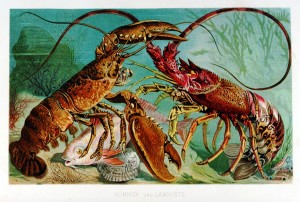
The story always began that way. It seems relevant to mention that I originally wrote this story for a workshop assignment, where I was supposed to bring in something around four pages–I knew the story couldn’t be too long. I had an idea that I wanted the story to traverse a large span of time, but I wanted all of that time to pivot around the key scene with the lobsters. The only way I knew how to do that in such a small space was to include some generalized description, and so I started with that.

If I were writing a much longer piece–something Alice Munro length, or even a novel–I might have tried to begin with more in-scene writing, but I’m not sure that the lobster incident could hold a longer piece. In general, I try to write as much in scene as possible: if I catch myself writing a lot of broad description in a first draft, it sometimes means I am dawdling because I don’t want to engage with the gross unpredictability of people doing and feeling things. The stories that result, if I let myself do that for too long, are usually pretty dull, and nothing happens in them. At the same time, however, sometimes a little generality is just the right way to go. The key for me, I think, is not to let it go on for too long. You don’t want to spend more time setting a scene than making a scene.

When I was a little kid, we had a bunch of car tires in the backyard that I could play with. My Dad would get annoyed throwing a baseball with me, because I always wanted to spend more time picking out which tire was going to be the catcher, or first baseman, or whatever, than throwing the actual ball. That made the game more interesting for me. But you want to make sure you don’t waste the whole afternoon picking car tires.

Michael Noll

The story’s main scene is told in present tense. I once heard a well-known editor say that stories should never be told that way. Obviously, you don’t agree–and, clearly, your story is successful. Did you ever question your use of present-tense? Did you try out any other ways of writing the scene with the lobsters?

Anthony Abboreno

I like the present tense. For one thing, it suits many of the characters and situations that I am interested in–occasions when people are self-aware, but maybe not as much as they should be, and impulsive action overtakes reasoned action. At times like these, consequences are only recognized later, if at all. The unpredictability of present tense–the sense that anything could happen because things have not yet happened–suits this type of situation, I think, and it’s why I used it in the scene with the lobsters.

My understanding of the anti-present-tense stance is that it creates stories that don’t engage with time in a measured enough way; that the stories which result blow past quickly without enough time for reflection. But that’s how life is experienced, much of the time, and there is a sadness in that that is worth capturing.

Michael Noll

You’re a PhD student in Literature and Fiction Writing at USC. The PhD in creative writing is a relatively new, but fast-growing, option in creative writing graduate studies. How is it different from your Master’s experience? What went into your decision to pursue a PhD?

Anthony Abboreno

A few things went into my decision to getting a PhD. For one thing, I would like to make my living as a teacher someday, and the PhD seemed like a way to make myself more competitive on an increasingly competitive market. I was tired of being an adjunct.

But it was mostly, to be honest, a way to get myself some more instruction and time to develop as a writer. I rushed into my Master’s program a little, almost straight from undergrad, and while I learned a lot, I think I could have gotten more out of it if I had been a little older, or more mature (of course, that’s hindsight, always). The PhD is a chance to give that another shot.

You know, since there isn’t much of a paying market for stories, landing a graduate fellowship is the only opportunity most beginning writers have to live off their fiction, and get a lot of useful feedback on it. You want to use that opportunity wisely, and take as much advantage of it as you can. I’ve done this whole thing on fellowship, and I am extremely grateful.

In terms of the coursework, it’s not terribly different–maybe more advanced. My MA was a split MA, with some measure of critical and creative writing involved, as was my BA, so I’ve balanced both sides, always. My understanding, talking to people who have received MFAs that were specifically in creative writing, is that they did relatively little critical writing in their programs. But I like the critical side! Sometimes literary criticism is very helpful in informing the craft of writing, and sometimes it isn’t, but it’s another enjoyable way of experiencing and talking about books. That’s the main thing writing stories or essays is really about, for me: enjoying fiction so much that I want to find new and better ways of enjoying it.

October 2013

Profile pic

Michael Noll is the editor of Read to Write Stories.

How to Use a Single Detail to Create a Character

8 Oct
Anthony Abboreno's story "Filler" was published at American Short Fiction.

Anthony Abboreno’s story “Filler” was published at American Short Fiction.

When creating a character, we tend to think about the entirety of the character—asking questions like, who is this person, really—but sometimes all we need is one good detail.

Anthony Abboreno demonstrates how a single detail can be used to create a complex character in his story, “Filler.” You can read it now at American Short Fiction.

How the Story Works

The story is about a father and his daughter, who likes food. It’s a minor detail (and not, at first glance, a terrifically unusual one), but watch how Abboreno uses that detail to create not only a fine-lined portrait of the daughter but also a dynamic picture of the hopes and dreams of the father as well.

In this first paragraph, the detail is introduced:

“One of the many things that I love about my daughter is that she loves food. When she was three, when most children are at their pickiest, my wife and I were amazed by what she enjoyed. Soup with kale in it, breaded veal, snails covered in butter that we would pry from their shells with a hat pin, then arrange on a plate for her to eat with her pudgy hands. And most of all she loved lobster—which is an easy food to like, but still outré for a three-year-old. On nights when my wife and I would hire a babysitter to go out with friends, we would brag about our daughter’s eating habits.”

In the next paragraph, the detail gains an added dimension:

“She is a foodie, we would say: maybe she’ll be a chef. But the real issue was not whether she would be a chef, but the galaxy of other things that taste in food implied. She was going to be cultured and smart. She would never have to stand at the edges of a crowd and feel uncomfortable. She would always have something witty to say, and she would never be lonely, and neither would we.”

This passage does two things:

  1. It places the daughter (and the one key detail about her) in context. Lines like “she was three, when most children are at their pickiest” and “still outré for a three-year-old” essentially tell the reader why the detail is noteworthy: she’s not like other kids her age.
  2. It lets the father talk about what this detail about his daughter means to him. A line like “the real issue was not whether she would be a chef, but the galaxy of other things that taste in food implied” clues the reader into the father’s attitude toward his daughter but also toward life and the world in general. The reader learns that his greatest fear is that one day he’ll be lonely.

At some point, every story must set a stake in the ground: the characters are moving toward the stake or they’re moving away from it. In “Filler” the regret and love that the father expresses at the end only make sense if we know that his greatest fear is that he’ll end up an outcast from society. And we learn that about that fear through a discussion of the daughter’s love for food. That is how a single detail can create a character.

The Writing Exercise

Let’s create two characters using the food paragraphs from “Filler” as a model:

  1. Choose two characters who know each other. They could be family members, friends, co-workers, neighbors, or people who regularly run into each other at restaurants or bars or cafes or any of the social places in the world.
  2. Choose something for one of the characters to like. Or choose a behavior for that character to exhibit often. The behavior or preference can be something mundane like smiling a lot, tapping a foot, clicking a pen, clearing a throat, or liking movies or avocados or sunny days. In “Filler,” the daughter likes food.
  3. Place the character’s preference or behavior in context. Is the preference or behavior unusual or taken to an unusual degree?  In “Filler,” the daughter likes foods that other three-year-olds wouldn’t touch. Perhaps your character smiles more than most people or at unusual times. Perhaps the character adds avocado to every dish or only goes outside on sunny days or simply talks an unusual about her love of these things.
  4. Give examples of the preference or behavior. Let the reader “see” the character expressing the preference or behavior, In the first excerpted paragraph from “Filler,” we learn all the things that the daughter eats. So, in other words, flesh out the preference or behavior that you’ve created.
  5. Let the second character comment on the first character’s preference or behavior. This part is important: the comment shouldn’t be neutral. The comment should be judgmental (either positive or negative). So, in “Filler,” the father brags about his daughter’s love of food.
  6. Finally, let the second character explain or suggest what the first character’s preference or behavior means. In the real world, we do this all the time, making claims about other people’s personality or value system based on minor details about them. These claims often tell us more about ourselves than the other people. Good fiction achieves this same effect. So, let the second character talk in a judgmental and “knowing” way about the first character. See what comes out. It may surprise you.

Good luck and have fun.

An Interview with Erin Pringle-Toungate

3 Oct
Erin Pringle's story "The Midwife" appeared in Glint Literary Journal and will be included in Pringle's next collection How the Sun Burns.

Erin Pringle’s first collection The Floating Order was called “poetic, lush, gripping” and “rather disturbing.” She recently finished her new collection, How the Sun Burns.

Erin Pringle-Tuongate’s first collection of stories, The Floating Order,  has been called “dense, experimental, thick with dread and the dead.” The stories are full of inventive language and powerfully weird images.  They’re also gripping reads, similar to the work of cross-genre horror writers like Brian Evenson and John Burnside.

Pringle-Toungate currently lives and teaches in Washington, where she was awarded an Artist Trust fellowship. One of her stories was a finalist in the Kore Press Short Fiction Chapbook Award (2012). Her work has been twice-nominated for a Pushcart Prize, selected as a Best American Notable Non-Required Reading, and shortlisted for the Charles Pick Fellowship. She recently completed her second story collection, How the Sun Burns.

In this interview, Pringle-Toungate discusses the challenge of moving through time in fiction, the structural requirements of writing in present tense, and the difference between the sentences “A man walks into a bar” and “A man walks into Hooters.”

(To read Pringle-Toungate’s story “The Midwife” and an exercise based on the story’s movement between the main character’s past and present, click here.)

Michael Noll

“The Midwife” switches between the past and present, a structure that can pose difficult questions: How often do you switch? How long do you stay in one time period? Your answer is to switch as often as every sentence. The result is that you sort of avoid those questions about block structure. Because past and present are so closely intertwined you can decide to stick with one thread for as long or briefly as you want. Did you experiment with different ways of mixing past and present, or did you know how you’d handle it even in early drafts?

Erin Pringle-Toungate

It took me about two years to get to this draft of the story. I wrote multiple versions, and many of those were attempts to deal with time and to avoid the problems caused by a previous version, such as staying in the past for so long that the present conflict seemed to lack energy, or staying so long in the present that the past began to belong to one character instead of all of them. The midwife’s age changed several times before I realized she needed to be expert now—the younger she was, the more the delivery became about sex and all sorts of junk that got in the way of the story I wanted to tell. Maybe as soon as a character has a history that is important to the present, time becomes an issue to be dealt with.

Michael Noll

I’ve read quite a few stories lately that explain the entire premise in the first paragraph(s) and then explore the consequences of the premise. But “The Midwife” withholds a basic piece of information about the premise until the end. It makes for an effective story–I wanted to know the secret. I wonder if you always structure stories this way (it’s not unlike the structure of a detective novel, except we’re the detectives). How do you know what to withhold and what to disclose?

Erin Pringle-Toungate

My stories are typically structured like this, or something like this—in which a key bit of information that is guiding the story is withheld. For example, in “The Only Child,” the main character is with her imaginary friend in a morgue, but I let these two facts remain unstated and what drive the suspense aspect of the story. This sort of structure is mainly due to my tendency to write in present tense. Because of that, it would seem contrived to begin with a recounting of a story that hasn’t occurred yet—and suspense can’t work quite in the same way. So, withholding is how I attempt to create suspense.

What I withhold is based on what is most obvious and familiar to the character because what is most obvious and familiar to the character is what he or she wouldn’t think to say to anyone. In “The Floating Order,” a woman has drowned her children, but she uses the terminology of floating her children and thinks she has saved them so that’s the language she uses, so it takes a while for readers to realize what she has done. This gives me time to make them learn about her. I think to make readers allow themselves to think about difficult issues, the writer has to figure out how to strip those issues of any familiarity so that they can be thought about. In my story “How the Sun Burns Among Hills of Rock and Pebble,” a girl is struggling to understand why anyone could let her sister disappear and die, but never does she say that or talk about it—until the end, when she’s begging a carnival worker to pretend to have seen the sister disappear. In “The Midwife,” she knows where she is going, so I let her walk—just like you know why you’re going to the grocery so you don’t bother to tell anyone why. But if someone saw you walking down the street at night, they may think they you’re going to do something else entirely. Whatever is most on the character’s mind, I delay revealing. It may help that I’m not sure what leads to the man’s death myself—it’s not only the woman, it’s not only the illness, it’s not only the whole decaying town, it’s not only. . . and so this also helps me, as there’s never any one thing in any story that has caused, or led from, any one event.

Michael Noll

“The Midwife” is quite long, about 8500 words. You’ve also written some stories (like this one) that fit within a paragraph. This ability, to write both long and short stories, is unusual. Many writers have a particular length that they’re comfortable with. What’s your mindset when you first begin a story? Have you written it already in your head? Or is there some process of discovery that happens on the page that tells you how long the story will be?

Erin Pringle-Toungate

The stories in The Floating Order are short mainly because I was teaching myself how to write. I was teaching myself how to use language—what its limits were, what its possibilities were, besides that the perspectives and ideas allowed a shorter form where the language had to work much harder than it has to work in long form. So the stories were somewhat like unbuilding houses in order to build the smallest, habitable house possible in order to understand what a house didn’t need in order to stand—and to understand whether or not a house had to stand in order to work.

All the stories in my next collection, How the Sun Burns, are longer stories. My characters are older and so the causes of their behaviors, or the background of their lives, or their thoughts, are more complicated. I think children’s lives are equally complicated, but typically most adults wouldn’t agree with me, so my characters are somewhat older (at least in this story) so as to avoid issues of verisimilitude. And I have to explain the complications so as to avoid readers assuming they know why the characters do what they do. The recent cultural tradition of leaving comments on newspaper articles has terrified me about what readers can think, and so the stories are longer in some ways probably so as to avoid myself imagining the comments readers might leave. I hope that tradition ends soon.

Michael Noll

Erin Pringle-Toungate's debut collection The Floating Order has been called.

Erin Pringle-Toungate’s debut collection The Floating Order tells stories that resemble the nightmares of children.

The Short Review called your first collection, The Floating Order, “a contemporary Brothers Grimm for adults.” Like fairy tales, many of your stories are set in a kind of everyworld. This seems true of the “The Midwife” even though it mentions strip malls, the 1980s, and a “heavy-hipped Midwestern woman in beige pants and a striped pastel shirt.” Maybe it’s because it’s about a barber performing deliveries, an activity that seems from another time. I’m curious how you think about place in your writing. Are you, in fact, writing fairy tales?

Erin Pringle-Toungate

I’ve found that if you don’t use names and don’t use advertising, every story sounds like a folktale. It’s a sort of sad situation that one of the ways our time is marked is by having characters sit at Starbucks instead of at a coffee shop. What’s the difference? Well, the focus, for one. Readers will probably always feel, these days, that they understand something more if they recognize a brand; this is not to say that readers are stupid but that all of us have been trained to feel that we understand someone more if he or she shops at the same store that we do—it’s knee-jerk. But if I’m writing a story, I don’t want readers to feel like they understand something about my characters just because they’re at Starbucks. Plenty of books demonstrate the depravity of living in a world of brand names. I don’t have anything to say about it, I’m not interested in it, so I’m not going to bring up details that make the conversation change its focus. A man walks into a bar. Good. A man walks into Hooters. What a stupid difference it makes. Now the man is no longer the focus. His life, his movement, his death—gone, erased. Now it’s all glaring orange and white T-shirts and opposing arguments about breasts and chicken wings and coupons and kitsch problems. Bring up that detail, and a writer has to work five times as hard to convince the reader that the man isn’t a chauvinist, that the man is—well, whatever he actually is.

October 2013

Profile pic

Michael Noll is the editor of Read to Write Stories.

How to Move Between Past and Present

1 Oct
Erin Pringle's story "The Midwife" appeared in Glint Literary Journal and will be included in Pringle's next collection How the Sun Burns.

Erin Pringle-Toungate’s story “The Midwife” appeared in Glint Literary Journal and will be included in Pringle-Toungate’s next collection How the Sun Burns.

In some stories, the events of the present gain meaning when viewed alongside the character’s past. The writer of a story like that, however, quickly discovers a problem that must be solved: How do you switch between the time periods? Do you block the periods into paragraphs or sections? Or is there a way to make the switch more fluid?

One writer who succeeds in finding a fluid movement through past and present is Erin Pringle-Toungate in her story, “The Midwife.” The story was published at Glint Literary Journal, where you can read it now.

How the Story Works

The trouble with blocking the past and present into separate chunks, set off by space breaks, is that the structure can begin to feel unwieldy. To avoid that problem, Pringle-Toungate does two things:

  1. Switches between past and present on a sentence-by-sentence level
  2. Does not announce that the switches are occurring.

To illustrate how this works, look at the story’s opening:

“Along the block of mostly abandoned storefronts, the barber turns the sign to Sorry we’re CLOSED Please come back tomorrow, and moves the red plastic arrow to 7 AM. No customers came in today, yesterday, or the day before. But no matter, you keep the same hours every day, said her father when, after her mother’s hysterectomy, he began officially training her for her inheritance.”

The first two sentences are set in the story’s present. They’re also written in present tense, which will serve as a reliable indicator of time. The switch comes with the third sentence, when the story adds the father’s voice, spoken from the past. Notice how we don’t learn that the words, “But no matter, you keep the same hours every day,” are 1) her father’s and 2) from the past until the attribution (“said her father”). In effect, we’ve slid from present to past without knowing it. In a way, this switch is the same used by our minds, which move back and forth in time—between present observation and memory—constantly, often blurring the two.

By introducing this switching strategy immediately, Pringle-Toungate makes it possible for the story to dip into the past at any moment, for as long or briefly as it wants—an unimaginable freedom to someone who has played with a block structure of time. For instance, Pringle-Toungate actually marks the next switch between past and present with a paragraph break, but because of how she introduces time in the first paragraph, this more formal switch seems just as natural:

“She sweeps the floor, cleans the mirror, wipes the counter, changes the disinfectant, ties up the laundry bag of towels, and lets down the blinds. She didn’t have a customer all morning, but she didn’t really expect to.

Work ethic, her father said. Dependability, he insisted. Same hours every day. Reliability is trustworthiness. Trustworthiness earns respect. Respect runs a business and fills our stomachs.”

If this seems impossible to pull off, you can take comfort in the fact that Pringle-Toungate didn’t arrive at this structure immediately, as you’ll learn in her Q&A on Thursday.

The Writing Exercise

Let’s switch between past and present using the first paragraph of “The Midwife” as a model. First, you’ll need to create the two time periods:

  1. Create a character engaged in an ongoing action. In “The Midwife” that action is the deliveries. The action could be anything that is an everyday routine: going to work, picking up kids from school, sitting in church or class, or pulling weeds in the garden. Or, the routine could be something more sinister. Keep in mind Hannah Arendt’s idea of “the banality of evil.” Even awful things can be become routine if you do them enough.
  2. Give the character a voice to listen to. The voice should be from someone in the past. In “The Midwife” the voice belongs to the character’s father. George Saunders uses a similar strategy in “Tenth of December”:

“He was so tired. What a thing. Holy moly. When he used to walk Sasquatch out here they’d do six times around the pond, jog up the hill, tag the boulder on top, sprint back down.

Better get moving, said one of two guys who’d been in discussion in his head all morning.”

Saunders introduces the voice, and soon after the story goes into the character’s past. In other words, the voice creates the doorway to that past.

Now, let’s put your character and the voice into conversation, which is essentially the way that Pringle-Toungate and Saunders both move back and forth in time.

  1. Begin with your character in the midst of the everyday routine. Don’t explain the routine, just describe the actions that the character performs with the thoughtless confidence that comes with having done a thing countless times. This robotic movement sets up the next step.
  2. Let the character think about the voice from his/her past. Don’t use a filter (She thought about So-and-so, who used to say…). Instead, drop the dialogue or voice into the sentence without introduction. The idea is that you’re letting the reader listen to the character’s thoughts as he/she performs the routine.
  3. Now, move back and forth between these two time periods whenever seems most natural. Play with it. Try staying in each period for longer and shorter amounts of sentences. While you’re using the voice as a portal to the past, you can move beyond the voice into more detailed memories

Good luck and have fun.

An Interview with Ethan Rutherford

26 Sep
Ethan Rutherford's story collection The Peripatetic Coffin was X

Ethan Rutherford’s story collection The Peripatetic Coffin was long-listed for the Frank O’Connor International Short Story Prize and was called “a revelation” by National Book Critics Circle Award Winner Ben Fountain.

The stories collected in Ethan Rutherford’s debut book The Peripatetic Coffin aren’t afraid to tackle big, novelistic premises.  The title story is about the crew of a Confederate submarine during the Civil War. In “Dirwhals!” a whaling ship in the future sails about the sands of an emptied-out Gulf of Mexico, hunting a new kind of whale. And in “The Santa Anna,” the crew members of a Russian ship trapped in Arctic ice slowly succumbs to the inevitability of their situation. The fact that Rutherford pulls off such ambitious stories is a testament to his talent. It’s no surprise that The Peripatetic Coffin was long-listed for the Frank O’Connor International Short Story Prize.

In this interview, Rutherford discusses his approach to plot, the horrible allure of whaling, and rock and roll as the antidote to the isolation of being a writer.

(To read Rutherford’s story “Dirwhals!” and an exercise based on plot development, click here.)

Michael Noll

I really admire how you up the major plot elements in “Dirwhals!” For instance, when Capt. Tonker warns the crew about the Firsties, you write this: “So, his order: spot the Firsties, and report them, but under no circumstances were we to engage, even if provoked. They had cameras, they wanted us to fire on them, and they would stop at nothing to manufacture an incident, even if it came at great cost to their organization.” This is the proverbial gun on the wall. We know there will be an encounter with the Firsties, and the crew will not follow orders. Some writers are afraid to be so direct, but when I read that scene above, I got excited. It gave me confidence that there would be a payoff for reading to the end. There’s nothing worse than finishing a story and thinking, “Well, what was that all about?” Were you always so direct in the early drafts (and did you always know about the encounter with the Firsties) or was this was the result of revision?

Ethan Rutherford

That’s a great question. I always knew that there would be a confrontation with the Firsties at the end of the story; things always pulled strong in that direction when I stepped back to think about what should—or had to—happen in order to put pressure on the narrator’s sense of who he was, and what he was supposed to be doing out there in the sand. John Gardner has written that in order for an ending to be successful it ought to be both “surprising and inevitable.” That seems like a straightforward assertion, but I’ve spent many a sleepless night, tossing and turning, thinking: what exactly does that mean? The truth is, I always know where a story is headed—I have to know that, or I cannot write it. And so in a story about people who are trying to hunt an endangered, but commercially lucrative, species and the organization trying to save that species, a confrontation struck me as inevitable, and was always the moment I was writing toward. And that, as you point out, was telegraphed from the beginning of the story (the “gun on the wall”). So then what to do about the surprise? I’ve come to understand “surprise” in a story as having less to do with What Happens than with a character’s emotional response to the role he/she has played in bringing these events about. And the surprising part, to me, is that the narrator of this story—who over the course of their hunting voyage has come to glimpse the full, devastating effect of what they are doing—accepts and even embraces his role in this one-sided confrontation, rather than rejecting it. He’s horrified by what he’s doing, but not horrified enough to stop, an emotional shift that should hit him harder than it does.

You don’t want to telegraph too much, but the “gun on the wall” is a great way to create tension, and plot-tension is one way to keep people reading. In the first paragraph of Lolita, we’re told that you can always count on a murderer for a fancy prose style, and you go: wait, there’s going to be a murder! And so you keep reading just long enough for that book to cast its complete linguistic spell, and you don’t care how sucker-hooked you were from the start (in fact, that’s one of the pleasures of that book).

So, finally, to your question: I tried to hide the moving pieces in this story a little more in the early drafts, but it wasn’t working. Finally I just said: well, I’m not pulling this off. What happens if the stakes are laid out directly, and then I can get on with the more interesting work in the story? And in this particular case, in this story, that happened to work best. I always forget just how long that story is. And since most of the story is just this futuristic sand-mobile cruising around in a desert, not seeing anything at all, it seemed important to let the reader know that if they hung in there until the end, that patience would be rewarded in a devastating way.

Michael Noll

I’ve read stories about the experience of sailing across the ocean and feeling hopelessly lost, but while reading “DIRWHALS!” it was as if I finally understood what it must have been like for the crew of a whaling ship to see a whale leap out of the water. Perhaps it’s an effect of the strangeness of ocean being replaced with sand—that’s what science fiction is all about, right? The defamiliarizing of the familiar? I’m curious if you started out with the premise intact (the futuristic world) or if you wanted to write about whaling but needed a fresh entry to the story.

Ethan Rutherford

I’d wanted to write about “actual” whaling, originally. I spent a summer doing nothing but research on the American whaling industry, and I had two Great Ideas for my Big Novel. The first was that it would be Moby Dick II, picking up where that book stopped, an historical novel that continued the story of the whaling industry, and followed it through to its death-rattle at the end of the 19th century. The second idea was that I’d write a Moby Dick-ish story, but replace the great white whale with a huge giant squid, who was opposed to the laying of the Trans-Atlantic telegraph cable (1854-58) and made his displeasure known. I have a poster depicting such a scenario, and I thought: Ding! Both of those ideas bottomed out on the shoals for one reason or another—mostly, though, because I re-read Moby Dick and thought: well, there’s no topping this.

If you've never read Moby Dick, you can check out the entire text online at The Literature Network. The book's known for its length and lengthy discourses about knot tying, but the first chapter is an old-fashioned adventure yarn.

If you’ve never read Moby Dick, you can check out the entire text online at The Literature Network. The book’s known for its length and lengthy discourses about knot tying, but the first chapter is an old-fashioned adventure yarn.

But what had always interested/horrified me about whaling, though, was the ruthlessness of the enterprise, the shortsightedness of it: that people either didn’t see or didn’t care that what they were doing—or, more specifically, the way they were doing it—all of it only moves one way, and that’s toward extinction. Add to that, near the end of the nineteenth century, if you are a whaler, you are going on expeditions that begin to take years at a time, push you into some seriously forbidding territory—and somewhere in your head you begin to realize your only purpose on the water is the depletion of an increasingly devalued (commercially speaking) natural resource, for which you won’t even be compensated fairly, since all of the money that is to be made is done so by the wealthy people ashore who have financed the expedition. And then, you know, petroleum enters the picture, and renders the entire industry obsolete. Meanwhile, the ocean is just awash in blood, and for what?

Whaling, drilling, fracking, etc. It’s not all the same, but there’s some thematic rhyming going on there, and things are getting much worse, as far as what we are willing to put up with in order to keep things running in a way we find convenient. And science fiction isn’t only about rendering the familiar less so (as you so nicely say above), it’s also about taking the social/economic/theoretical problems inherent in the way we live now and running them, logically—with a little extra juice added, a little exaggeration—to the end of the line. So, long and drifting answer to your question: yes, I wanted to write about whaling, and I think, in the end, I did (the basics of the hunt are the same, the terminology is largely the same). But shifting the story into the future allowed me skew the setting, and allowed me to wrap the story around the themes I found interesting, rather than the other way around. Lighter note? Writing science fiction, the world building that occurs, is just really, really fun. And you are right, this was, at least at first, just a way to write about whaling without having to get too far into the ring with Melville.

Michael Noll

The story is written as a journal-in-letters–a form that is nearly extinct in our social media age. We have personal blogs, of course, but they are written with the knowledge that each post will be read immediately. But the letters in this story won’t be read for months, if ever. As a result, the narrator’s voice sounds almost pre-modern. The sentences are long and carefully phrased, as if the narrator has plenty of time to think before putting the words to paper. For instance, here’s a description of the first Dirwhal sighing: “This creature was enormousness itself, more viscerally alive and mobile than I’d thought possible. We watched as it surfaced again: a dark stain against the sand, winding its rounded bulk across the basin floor, rolling sideways rather than cutting in a straight line as I had always imagined it would move.” This is not a description that was scribbled quickly. It’s deliberative. Did you think consciously about the voice–about how someone in this situation might sound in a letter? Or did the voice simply occur to you?

Ethan Rutherford

I did think about the voice, a lot. In the first draft of the story, it was written more traditionally: linear narrative, first person, present tense. But those choices eventually presented a huge problem for the story I wanted to tell, which was a story that spans a number of years. Time management in short stories can be really difficult—or, I should say, I find it difficult—and I found that each paragraph would open with something like “Five weeks later…”. You can do that once, or twice, three times in a story, perhaps. But in “Dirwhals!” it was getting repetitive, and it became clear that the narrative choices I’d made—the way I was telling the story—was getting in the way of the story I wanted to tell. It wasn’t coming out right at all. Form was determining content, in a bad, bad way.

I’d read a lot of ship’s logs while researching the afore-mentioned Moby Dick II, and it seemed, in many ways, like the perfect way to solve the time issues in the story. I don’t know how many ship’s logs you’ve read, but they’re really wonderful and harrowing in the way they compress time, and lay the mundane next to the extraordinary. You know, one entry will read: “August 14: Good wind today. Corrected course. Everyone in high spirits.” And two entries later it’s something like: “October 2: Ship now fully encased in ice. Four men lost overboard in rough crossing. Polar bears becoming a problem. Cabin lamps performing well.” So I took a week, and put the whole thing into a ship’s log of sorts, and was thrilled by that. It solved all of my time problems, and also moved a lot of drama that was necessary to the story off-stage, and into exposition (another way to compress your story). The story still wasn’t working, though.

Then my editor at Ecco, Libby Edelson, read the story and said: you know, it’s a fine ship’s log, but who cares? His relationship with his sister is the emotional heart of the thing for me, and you’re ignoring it. Why don’t you see if you can make this log, somehow, into letters for her? And that snapped the entire story into shape for me. I’ll never be able to thank her enough. That suggestion also gave the voice a chance to stretch out a little: to formalize, to set scenes, to become baroque and self-conscious. A ship’s log is exclusively detail. When you are writing a letter—to someone you miss, and feel, perhaps, you’ve wronged—you try, a little harder, to bring scenes to life, you chose your words a little more carefully; you try to explain your actions—to yourself, to another person—and ask for love and forgiveness in return.

Michael Noll

Every writer I know secretly wishes they were a musician. I guess the experience of playing music live, of watching the audience absorb and react to your art, sounds good when you’re locked away by yourself, writing. There’s no comparable experience for a writer. At live readings, you have to pay attention to the words that you’re reading. You can’t look up and watch the audience for more than a few seconds. But you get to do both! (I’ll include a link to Pennyroyal’s website.) How does the life of a writer mesh with the writing life? Do they feed each other? Compete?

Ethan Rutherford
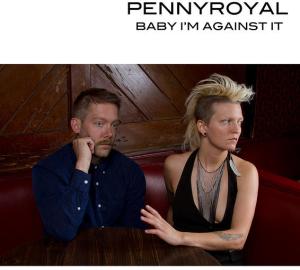
Ethan Rutherford is a member of Pennyroyal, a 4-piece rock band based in Minneapolis. The band's latest album is Baby I'm Against It.

Ethan Rutherford is a member of Pennyroyal, a 4-piece rock band based in Minneapolis. The band’s latest album is Baby I’m Against It.

Ha! Right. And when you do look up at a reading, it’s not like you’re not making anyone dance, no matter how much they might be enjoying your version of a “radio voice” (unless, of course, they’ve put the podium directly in front of the bathroom, which I have seen with my own eyes). To a certain degree, though, performance is performance, you’re trying to get something across, and it’s wonderful and thrilling and scary to get up in front of any size crowd and share something you’ve worked hard on. I get the flop-sweats to exactly the same degree before readings and concerts. The difference for me comes, I suppose, in the composition. When you’re writing a song, or ironing out the kinks, you are doing it with three other people, in real time, and you just know if it’s working or not. You know the sour notes as you hit them. When writing, I’ve found that it can take me years to figure out where the sour notes are. What I like about the process of creating music is exactly the opposite of what I like about writing. Being in a band, for me, is about camaraderie, compromise (in a good way! Perhaps teamwork is a better way to put it), and immediacy. Writing requires a great deal of patience, determination, and the weird desire to project a world of your own making. Writing also requires a particular and pleasurable kind of solitude that can veer, quickly, into loneliness. So you can see how the writing/music split is, in some ways, self-medication. When I’ve spent too much time alone, music can pull me out of that. And when I’ve had enough of being around other people, I know it’s time to go back to the writing desk. I’m a recent father, though, so this last year has really put that creative theory to the test, in the best way possible. My time isn’t my own anymore, not the way it once was. So I’m getting better at doing a little bit here, and a little bit there, and seeing where it all lands at the end of the week.

September 2013

Profile pic

Michael Noll is the editor of Read to Write.

How to Put the Gun on the Wall

24 Sep
Ethan Rutherford's story "Dirwhals!" was published at FiveChapters and included in his debut collection The Peripatetic Coffin.

Ethan Rutherford’s story “Dirwhals!” was published at FiveChapters and included in his debut collection The Peripatetic Coffin.

By now, everyone knows the Russian story writer Anton Chekhov’s suggestion, “If you say in the first chapter that there is a rifle hanging on the wall, in the second or third chapter it absolutely must go off.” In workshop, if a story needs more tension, it’s not uncommon for someone to say, “Put a gun on the wall.” Students tend to take this advice literally and hang up not only guns but knives, axes, chain saws, and mean dogs.

So, what if you want to set up plot without literally hanging something on your story’s wall? The writer Ethan Rutherford demonstrates another method in his futuristic whaling story, “Dirwhals!” It’s included in his debut collection The Peripatetic Coffin, and you can read it now at FiveChapters.

How the Story Works

The story is about a whaling ship in the Gulf of Mexico–except that the Gulf has been drained of water, and the whales are large whale-like beasts that burrow through the sand. Most of the dirwhals have already been killed, and so the ships hunting them must travel into unknown areas. In this scene, a ship’s captain is speaking to his crew, and what he says will set up a plot point as neatly as putting a gun on the wall:

“But what he had come to tell us was now that we were moving further and further into the basin, those on watch were to be spotting for two things: dirwhals, and other shipper-tanks, which, given our current location, would most likely belong to the Firsties. A collective groan, followed by hissing, went up among the crew. Protection kooks, someone explained to me when I asked who the Firsties were. Bushard added: kamikaze environmentalists; degenerates; cultists; criminals. Capt. Tonker held up his hand for silence.

Their aim, he said, is to put us out of a job.”

The captain’s speech neatly lays out the stakes, not only the crew versus the Firsties but also the forces that are pushing them into a confrontation. Now watch how Rutherford uses these stakes to set the crew on a course that will determine the plot for the rest of the story:

“So, his order: spot the Firsties, and report them, but under no circumstances were we to engage, even if provoked. They had cameras, they wanted us to fire on them, and they would stop at nothing to manufacture an incident, even if it came at great cost to their organization. He asked us if we understood. We answered: yes, of course.”

As savvy readers, we know that the crew will run into the Firsties and things will not go according to plan. The certainty of that encounter is the gun on the wall. The decisions that lead the crew into that inevitable encounter is the story’s plot.

The Writing Exercise

Let’s use the captain’s speech in “Dirwhals!” as a model for how to set up plot:

  1. Choose a resource that can be exhausted. In “Dirwhals!” that resource is the whale-like creatures. But most things in the world exist in limited quantities: time, money, and jobs but also less tangible things like patience and endurance.
  2. For most resources, there is one side that wants to deplete the resource and another side that wants to conserve it. For the resource that you chose, what are those sides?
  3. Let a spokesperson for one of the sides explain the situation that will lead to an inevitable confrontation with the other side. So, if the story is about a woman who works 50 hours a week and in her off-hours takes care of her kids and maintains the integrity of the house and family, she will feel that her time is limited. If her brother calls and says that their mom can’t take care of herself and so should move in with the woman, the woman will obviously not feel that such an arrangement is possible. But, let’s say her brother is in the army and about to be deployed overseas. Now, you have two sides: one (the brother) pushing to deplete an already limited resource (the woman’s time), and another (the woman) trying to conserve what little time she has left to herself. Imagine the rant she might deliver to her husband or kids about the situation–imagine if that rant ends with “One of these days, my brother and I are going to have it out, and that will be the end of things.” What follows–the events that lead to that confrontation–is the story’s plot.
  4. If you want, you can outline those events.

Good luck with this exercise. You may find that a plot outline is not necessary. Knowing where the story is headed can sometimes guide you as much as any outline.

An Interview with Jamie Quatro

19 Sep

Jamie Quatro’s collection I Want to Show You More was called the “most engaging literary treatment of Christianity since [Flannery] O’Connor,” by J. Robert Lennon in The New York Times Book Review

When you read Jamie Quatro‘s biography, it becomes clear that talent is not divvied up equally. She is the daughter of a physician father and classical pianist mother, and was herself trained as a classical pianist until the time that she left for college. She graduated from Pepperdine at age 20, knocked out a MA in English at William and Mary, and was then awarded a Presidential Fellowship from Princeton for doctoral studies in British Romantic Poetry.

She left Princeton when she found out that she and her husband were expecting the first of their four children. Since then, she has earned her MFA in Fiction from the Bennington College Writing Seminars, published fiction in numerous journals, published the story collection I Want to Show You More to wide acclaim, and most recently had a story chosen for the 2013 O. Henry Prize Stories anthology.

In this interview, Quatro discusses her revision process, her approach to writing backstory, and the moment in her story “The Anointing” that took her by surprise.

(To read “The Anointing” and an exercise based on its use of detail, click here.)

Michael Noll

One difficulty in writing about religious experience is translating the immediacy and intimacy of the experience to readers who do not share the character’s beliefs. You solve this problem in a single sentence. You write, “Anointings were eleventh-hour efforts—what you asked for after you’d asked for everything else.” In the story, Diane knows that the anointing is a long shot, and yet she’s desperate for a positive signs, any change for the good. It’s almost as if the story is saying to the reader, “Look, this anointing probably isn’t going to work, but it sure would be great it it did.” The religious element is understood through universal human feelings of hope, desire, love, and desperation. I’m curious if this sentence was always present in the story. Did you worry in early drafts that readers would not be sympathetic to Diane?

Jamie Quatro

Funny you should ask about that line — it was indeed a late addition to the piece. In fact, I rewrote the entire opening, right up to that line, almost five years after I finished the story. Originally I’d written “last-ditch efforts,” but when my editor and I began working together, she wondered if we might come up with a less cliche, more immediate phrase. “Eleventh-hour” felt like something Diane herself would think, as the term is used, of course, in the gospel of Matthew, the parable of the laborers in the vineyard. And no, I didn’t worry about readers being unsympathetic. I don’t think about readers, or publication in general, when I’m drafting. For personal reasons, this story stayed in the proverbial drawer for a long time. I didn’t think I’d ever publish it. It was the last piece accepted by a magazine before the book went to press. Cathy Chung — Guernica’s brilliant fiction editor — bought it.

Michael Noll

The first part of the story is spent with backstory—how a successful marriage and life got the point that a last-ditch effort was made to rescue it from ruin. The rest of the story is spent, essentially, in scene–in the moments prior to and following the anointing. One of the cliches of workshop is that writers should avoid clumps of backstory–always integrate it into the fabric of the scene, students are told. And yet you do precisely the opposite, and it works beautifully. The backstory held me to the page as much as the in-scene portions. What was your approach to the backstory?

Jamie Quatro

It’s difficult to talk about “approach” to backstory — as I mentioned, I don’t think about such things when I draft. I think each story comes to an artist with its own structure, its own cadence and music, and that the artist’s first responsibility is to listen. For me, drafting is very much like listening to a piece of music or watching a film. You simply let the work rush on and do what it wants to do, take the shape it wants to take. That might involve “clumps” of backstory, as you say; or it might involve interspersing the backstory throughout the piece; or it might involve using no backstory at all. To be honest, I’ve never heard the workshop rule you mention above. I’m always skeptical of rules. An upfront “tell” at the opening of a story — here’s what’s happened in the past to get us where we are — can be used to great effect. Look at some of the stories in Joyce’s Dubliners: “A Little Cloud” begins with “Eight years before he had seen his friend off at the North Wall and wished him godspeed.” Or “Araby,” which begins with the backstory of the priest’s death: “The former tenant of our house, a priest, had died in the back drawing room.” Even if you end up cutting the backstory, it can be a useful exercise, to spell out precisely what has happened in the past before entering the first scene.

Michael Noll

The story begins with the characters at the edge of a precipice–perhaps Mitch will kill himself, perhaps Diane no longer believes in God—and immediately offers a solution to both of these problems: the anointing. As a result, I expected a conclusion that resolved one or both of those problems. Mitch would be saved or become worse. Diane would be strengthened in her faith, or she’d give it up completely. But neither really happens. The situation remains mostly the same. The primary change is that Diane despairs, whereas at the beginning she was hopeful. I’ll admit that I was taken aback by the ending. But as I thought about it, the ending seemed truthful in a way that a neat ending wouldn’t have. In life, there are very few dramatic shifts. Was this ending always present? Did you consider ending the story differently?

Jamie Quatro

Yes, this has always been the story’s ending. In a way, that hand pressing on Diane’s head is an anointing of a very different kind, a more radical and truthful version of the oiled thumbprint on the woman’s forehead at the beginning of the piece. To me a it’s a redemptive moment: Diane has been deceiving Ellie about Mitch’s true condition, even as she’s been deceived by Ellie and Mitch. Neither of those deceptions will be possible from this point forward. The only path open to any of them will be one of honesty. What took me by surprise, as I drafted, wasn’t the ending, but the moment Diane discovers that her daughter has been hiding the pills in her little purse. That was a devastating realization. I didn’t want it to be true, but there it was.

Michael Noll

What are you working on now? Many short story writers are also working on a novel. Is that the case for you as well? Quite a few of the stories in your collection are very short, a few pages or so, and they’re so masterfully written that I wonder if a novel is even something you’re interested in.

Jamie Quatro

Ah, the novel question. You know, I love the story form, and I’m at work on a second collection right now, but I will say this: one of the pieces I thought was a short story is threatening to become something bigger. For now I’m pitching it to myself as a novella. Time will tell. I do write poetry and essays, and lately have been doing some longer book reviews. I also just wrote a film treatment. So who knows? Maybe a play is next.

September 2013

Profile pic

Michael Noll is the editor of Read to Write.