Tag Archives: Texas Writers

How to Build a Political Argument around a Personal Story

24 Jun
Domingo Martinez' memoir, The Boy Kings of Texas, will soon become a HBO series. His essay about the Affordable Care Act, "Quarantined," appeared in The New Republic.

Domingo Martinez’ memoir, The Boy Kings of Texas, will soon become a HBO series. His essay about the Affordable Care Act, “Quarantined,” appeared in The New Republic.

It’s no secret that personal stories can fuel political campaigns. The most successful example is the first campaign run by President Obama, but John Boehner does it as well (from a saloonkeeper’s son to the Senate) and so will/does Hillary Clinton. Watch the next presidential conventions, and you’ll notice that almost every single speaker crafts a political message from his or her life story. Some will be quite compelling, and others will come off as dull at best and crass at worst.

One of the better political/personal essays that I’ve read recently is by Domingo Martinez. His memoir, The Boy Kings of Texas, was a finalist for the National Book Award and will soon become a new TV series from HBO. But before the memoir, he wrote “Quarantined,” a short essay that you can read now at The New Republic.

How the Story Works

The essay is about the Affordable Care Act and was published in February, 2012, when the fate of the Act was still in doubt. So, Martinez had a clear goal for the piece: to explain why the ACA should be passed in its strongest possible version. He also knew that, to explain his argument, he wanted to talk about the people he grew up with in South Texas. The problem was how to connect the two without falling back on the usual talking points that every politically-engaged person in America had heard a thousand or more times. His solution is to find a third thing to spend most of the time discussing. Let’s look at how this works.

The essay begins with the author calling his grandmother in South Texas. Like many grandmothers everywhere, she ends up talking about her health. But, unlike most grandmothers, her medical treatment takes an unusual twist:

I tuned out her blessings and her current list of maladies until she told me about her terrible arthritis. I shouldn’t worry, she said, because, between the power of prayer and WD-40, her joints were working fine. I asked her, in my halting Spanish, to repeat what she had just said, especially that bit about the WD-40. “The spray stuff, that we used on the trucks, Gramma?” I asked. “El es-sprayo por los truckos?”

“Yes, that’s the stuff,” she said (en español). “I just say a prayer over it and spray my knees and my elbows, and, in the name of Jesus, the heat from the WD-40 loosens my arthritis.”

The interpretation begins at the end of the essay’s first section:

My grandmother’s not dumb or losing her mind. Like many immigrants faced with problems that demand solutions beyond their resources, she looks inward, and backward, for help—or at least delayed consequences—resorting to superstition, old wives’ tales, or illogical assumptions. Anything, so long as it does not cost money. Seeking medical advice is the last option, akin to giving up hope and faith. This is how poor people have learned to cope in South Texas.Seeking medical advice is the last option, akin to giving up hope and faith. This is how poor people have learned to cope in South Texas.

The essay, then, becomes about poverty and the methods a particular group of people have developed for living without some of the basic necessities that most Americans take for granted. He talks about his grandmother, who acts as a bank for her neighbors, who “hock pistols and rifles for small loans.” He explains the “cultural isolation and fundamental lack of understanding” that make delivery of government services a challenge. Because of those challenges, he explains the attitudes that develop around seeking out help, especially medical help: “If you’re not hemorrhaging or suffering from an embolism, then you don’t get to see a doctor.”

Eventually he zooms out from these fine-grain details:

Cameron County, where my grandmother lives, boasts one of the highest ratios of uninsured in the state; one in three people have no coverage. In Texas as a whole, one in four people live without health insurance, the worst percentage in the country.

He mentions the ACA briefly but then explains the cuts to medical services already made by Texas’ governor, Rick Perry. These cuts have affected his parents and grandmother, and they worry about what future cuts may mean for their health. By this point, Martinez is firmly within a political mode, explaining the necessity of the law. But this is not where he ends the essay. Instead, he returns to his point about the region’s poverty and challenges due to cultural barriers: even if the ACA is passed, will his grandmother take advantage of it? Or will she continue to treat her arthritis with WD-40?

Martinez writes, “Few people who speak their language have the time or inclination to try to persuade them—and even fewer are willing to pick up the phone and call.”

Rather than sticking to the well-worn arguments about expanding health care, he makes a larger argument about the political disenfranchisement of an entire group of people. In this way, by revealing the real issues faced by his family, he honors his personal story rather than simply making political hay with it.

The Writing Exercise

Let’s make a political argument with a personal story, using Domingo Martinez’s essay, “Quarantined,” as a model:

  1. Choose the general political argument that you want to make. It can be something that, when you hear pundits on TV talk about it, your blood starts to boil. Or it can be a more local issue that is usually ignored by national politicians. If possible, choose an issue that is personal to you. Doing so will help you avoid the typical arguments that everyone has begun to tune out.
  2. Choose the personal story you want to use. It doesn’t have to be a story, per se. A detail or series of details can work as well. Martinez uses the fact that his grandmother treats her arthritis with WD-40 and prayer. In short, you can use a detail or story that stands out to you or that you struggle to wrap your head around. Most of us have details about our childhood or the place where we’re from that we enjoy telling to people in order to get a reaction. Those are good details to use for a political essay because they’re usually rough-edged, whereas most political discourse tends to be polished and generic.
  3. Tell the story. Forget the political angle. Pretend it doesn’t exist. You want to tell your story in a true, authentic form, and that’s not possible if your point is already evident; the reader would become suspicious of your story. Use a basic structure: set the stage (when and where and who), what happened, and how this made you feel at the time and how it makes you feel now.
  4. Analyze the story. Why does this story stand out to you? Why do you still think about it? Martinez expresses disbelief at his mother’s use of WD-40: “The spray stuff, that we used on the trucks, Gramma?” I asked. “El es-sprayo por los trucks?” Then he offers an explanation for why she and others like her do such things: “Like many immigrants faced with problems that demand solutions beyond their resources, she looks inward, and backward, for help—or at least delayed consequences—resorting to superstition, old wives’ tales, or illogical assumptions.” While it’s true that there is an implicit political argument in this sentence (why does the U.S. not provide more assistance to immigrants?), it’s also true that Martinez is simply explaining the way things are. So, spend a few sentences explaining the behavior that you’ve just described.
  5. Analyze the story in greater depth. For Martinez, the paragraph mentioned in the previous step is just the beginning. Because he’s established the behavior and the reasons for it, he can elaborate on other types of the same behavior and other illustrations of the reasons. Try to do the same thing in your essay. Are there other things that people did/do that are like the story you told? Are there other ways to illustrate the reasons you’ve given?
  6. Zoom out from the story. Your story is almost certainly not an anomaly. But can you put numbers to it? Can you write a sentence like Martinez’s: “In Texas as a whole, one in four people live without health insurance, the worst percentage in the country.”
  7. Make your political point. Now that you’ve established the larger trend or picture as well as the personal element of the issue, you can make a suggestion for appropriate political action.
  8. If possible, move beyond the immediate politics. Martinez makes a point about the ACA, but then he makes a larger point about the reason his grandmother uses WD-40 for medical purposes, a point about political disenfranchisement. He’s explaining the deeper issue, the one that creates the need for the ACA law. So, if you can, think about what deeper political problem necessitates the law or action that you’re prescribing. You might not be able to do this, but it’s always worth a try.

Good luck!

How to Carve Out Space for Character Development in a Violent Setting

17 Jun
Benjamin Alire Sáenz won the PEN/Faulkner Prize for Fiction for his collection, Everything Begins and Ends at the Kentucky Club. The stories are set along the border between El Paso and Juarez and center on the Kentucky Club, two blocks south of the Rio Grande.

The stories in Benjamin Alire Sáenz’s collection, Everything Begins and Ends at the Kentucky Club, are set along the border between El Paso and Juarez and center on the Kentucky Club, two blocks south of the Rio Grande.

There are places in the world that dictate the type of stories that happen there. Violence exerts an overwhelming gravitational pull, and a story that at first has nothing to do with violence—a love story, or a story about family or business—will eventually get pulled into orbit around the violence that exists in the place. Set a story in Mosul, Iraq, and it will eventually run across militants and dead bodies. The key as the writer is not to avoid the violence at all costs but to resist it for as long as possible—in other words, to allow the story to develop dimensions beyond the inevitable.

An excellent example of this resistance can be found in Benjamin Alire Sáenz’s story, “He Has Gone to Be with the Women.” It was included in his collection, Everything Begins and Ends at the Kentucky Club, which won the 2013 PEN/Faulkner Award for Fiction. You can read it now at Narrative Magazine.

How the Story Works

If you hear a reference to Juarez, Mexico, you automatically prepare yourself to hear a story about violence. For a time, Juarez was one of the most dangerous cities in the world. Many of the residents on either side of the border knows real stories of people who have been murdered or kidnapped. From the safe distance of Washington D.C., it’s possible to believe that violence is the only thing happening there. And yet the people who live along the border go about their lives, and so, as a writer, it’s crucial to push back against the readers’ expectations of cartel executions. It’s necessary to find a way to create characters who have lives that exist outside of, or alongside, the violence.

This is exactly what Sáenz does in his story. In it, two men meet at a coffee shop in El Paso. One is American, and the other is Mexican. The border, and it’s associations, are present from the beginning but not at the center of the story, which instead follows the developing romance between the two men. It’s not until a third of the way through the story that violence forces itself onto the page:

Monday morning, I got this text from him: I thought about you when I woke up this morning. I read the text and then reread it. And then reread it again.

I felt like a schoolboy reading a note from a girl. No. A note from a boy.

I didn’t know how to answer his text. I only engaged in the practice because my nephews and nieces demanded it of me. We wrote silly and affectionate things to each other. But this was different. Finally around noon, I texted him back. Stay safe. That’s what I wrote. That’s when it occurred to me that I was afraid. I didn’t like to think of Javier walking the streets of Juárez, doing an errand, going to a store and getting killed, randomly, for no reason. What good does it do to be afraid? He was right. Of course he was right. But so many people had left already. Why couldn’t he leave too? I knew the answer to that question even before I asked it. He wasn’t the leaving kind. He loved his Juárez. I could see that in his eyes, in his unshaven face, in the way he moved and talked. I could almost taste his love for that poor and wretched city in his kisses. It enraged me that Juárez had become so chaotic and violent and capricious. A city hungry for the blood of its own people. How had this happened? I was sick to death of it, sick to death of the body count, sick to death that every killing went unprosecuted and unpunished. You could kill anybody. And what would happen? Nothing. The fucking city no longer cared who was killed. Soon, they would just be stepping over the bodies. Stay safe. Stay safe. Stay safe.

Because Sáenz has created characters with lives and concerns other than avoiding violence, he’s able to make their interactions with the violence personal, as opposed to the generic way that cable news viewers react against stories of border violence.

So, how does Sáenz create these characters without letting them be overwhelmed by the violence that surrounds them? First, he introduces us to them in a place that lies outside of the violence: a coffee shop in El Paso, the safer side of the border. Of course, a coffee shop doesn’t have to be safe. Think about the coffee shop scene in the film Children of Men. When the bomb explodes, the viewer understands that no place in the film is safe. Sáenz could have done that in his story, but if he had, we wouldn’t have gotten a chance to know the characters except as people caught in violence—which is how we know Clive Owen’s character in the film. But the point is to know these characters as more fully developed people. So, Sáenz puts them in a safe place and shows us nuances of their lives:

I always noticed what he was reading: Dostoyevsky, Kazantzakis, Faulkner. He was in love with serious literature. And tragedy. Well, he lived on the border. And on the border you could be in love with tragedy without being tragic.

He drank his coffee black. Not that I knew that.

Sometimes, I could see that he’d just come in from a run, his dark wavy hair wild and half wet with sweat.

He was thin and had to shave twice a day. But he only shaved once. There was always that shadow on his face. Even in the morning light he appeared to be half hidden.

Sáenz develops these details. The two men have conversations about their jobs and families, and when the violence is mentioned, it’s in the contexts of these things. For instance, here’s one of the men, Javier, talking about his uncle, who has cancer and whose care is being managed by Javier:

“He used to love to go out. He would laugh and tell me about how life used to be for him. Now, he won’t go out. He’s afraid. Before, the only thing he was afraid of was my aunt. Now, he’s like a boy. He cries. He reads the newspapers. He thinks he’s living in Juárez. I tell him that we’re in El Paso, that he’s safe. But he doesn’t believe me. He’s afraid to go out. Nos matan, he says. I try to tell him that no one’s going to hurt us. But it’s no use. Every time I go out he tells me to be careful.”

By the end of the story, when the violence cannot be avoided, its inevitable arrival is so much more personal than if it had been directly present all along.

The Writing Exercise

Let’s create characters in the midst of some overwhelming situation, using Benjamin Alire Sáenz’s story, “He Has Gone to Be with the Women,” as a model:

  1. Determine the overwhelming situation. As the writer Ron Carlson says, every story has two parts: the story and the world the story comes into. Almost every story, including blockbuster films whose sole purpose of existence is to blow stuff up, spends time developing the characters who will be consumed by the situation. In blockbuster films and many genre novels, though, the character development is as lean and minimal as possible (think of the description of Robert Langdon in The Da Vinci Code: “Harrison Ford in Harris tweed”). In those stories, the violence or destruction (or aliens, monsters) shows up almost immediately. But in Sáenz’s story, the violence doesn’t really appear until the end. So, decide what situation will eventually consume your characters: violence, family or marriage drama, economic distress, death, disease, or any inescapable deadline.
  2. Determine how that situation will affect the characters. You can be succinct. Someone will die, get sick, get divorced, get shipped off to prison or war or work in some far-off place, or get fired. Know where your story is headed.
  3. Put the characters in a place that is outside of the situation. You likely already know how the characters will behave or respond when the situation presents itself. There are, frankly, only so many ways that people can respond to inescapable deadlines or outcomes. Now, find out how your characters behave when the deadline is out of sight and (mostly) out of mind. Find a location where this is possible, some emotionally neutral or positive place. Put them there and see what they do. What other parts of their lives are revealed?
  4. Choose one of those parts and develop it. Sáenz gives Javier an ailing uncle, and that uncle’s health worsens. Think about the parts of your characters’ lives that you discovered: how can you make those parts dramatic? How can they change or develop (improve or worsen)? How can this change draw other characters into the person’s life? It is this dramatic arc that you’ll focus your story on. The inevitable deadline or outcome will arrive eventually, but if you make the reader forget that it’s there, its arrival will be all the more effective and impactful.

Good luck!

An Interview with Jennifer Ziegler

5 Jun
Jennifer Ziegler's new middle-grade novel Revenge of the Flower Girls, has X

In Jennifer Ziegler’s new middle-grade novel Revenge of the Flower Girls, three flowers girls set out to ruin their sister’s wedding.

Jennifer Ziegler’s latest middle-grade novel is Revenge of the Flower Girls. She’s also the author of How Not to Be Popular and Sass & Serendipity. She teaches writing workshops, edits other writers’ work, and creates writing programs for The Writer’s League of Texas. She lives in Austin, TX, with her husband, the writer Chris Barton, and their four children.

In this interview, Ziegler discusses inventing characters, the importance of villains, and her method for keeping the plot straight in her head.

To read an excerpt from Revenge of the Flower Girls and an exercise on creating villains, click here.

Michael Noll

I’m interested in how you invent characters. Some of the characters in the book, especially Mrs. Caldwell, exude a kind of essential Texan-ness. Her last name is even a famous Texas name. But other characters are much more idiosyncratic. For instance, you describe Aunt Jane this way: “She’s tall and strong. She played professional basketball for a while and then taught PE classes here in Blanco County. Now she lives in Boston, where she runs a bar.” What do you draw on to create your characters?

Jennifer Ziegler

The way I invent characters is a mystery even to me. I often feel that characters gestate in my mind for a long time until the right story concept comes along. How they get planted there, I don’t really know. I suspect that they are amalgams of people I know or used to know or observed from afar. They are never close replications of individuals from my life. Even when I’ve tried to put friends or family in my novels the characters based on them morph into their own distinct beings. At times I’m aware that I’m borrowing elements from real people (their mannerisms or looks or habits of speech), but more often I have no idea. There have been instances when I’ve flipped through a published book of mine and suddenly realized who a character was partly based on – subconsciously. That’s always a strange revelation. But I suppose all novelists can at least be partly psychoanalyzed through their fiction.

Michael Noll

There are several instances in the book where the triplets create a plan of action and describe it in detail—and then, of course, the plan goes off the rails. I know that you’re a thorough outliner of plot, and I’m curious how these sorts of plans factor into your outlining. From a reader’s perspective, they’re great at creating suspense. But are they useful to you as a writer as well?

Jennifer Ziegler

Yes very. The triplets’ schemes are integral to the book’s plot. I had to make sure I got everything straight before I started writing because logistics aren’t my strong suit. I like to disappear into the story as I go along and whenever I get yanked out of that world in order to work out the cause and effects, it slows down my momentum. I knew who the triplets were and what they wanted, so it was just a case of figuring out how they would approach this problem and what would be the outcome of each of their plans.

Knowing who they were told me what they would do. Because the girls are big history buffs, it made sense that they would brainstorm complicated operations – that they would be action oriented rather than just mope. But, of course, they are only 11, so their lack of worldly experience translated into somewhat unrealistic schemes. The plans show just how far the girls will go to help their sister, what they’re good at, how they assume the world works, and how they work together – so they also help reveal character.

Michael Noll

The novel features three narrators who are triplets. Each of them takes turns telling the story, which must have presented an enormous challenge to you as the writer: how to distinguish between them. One thing I noticed is that you give the triplets, and all of the characters, tags. For instance, the triplets are history buffs, and so they judge each other and everyone else based on their choice of favorite president of the United States. For instance, Darby mentions that their big sister’s ex-boyfriend liked Thomas Jefferson, and says, “We all respect that.” But the big sister’s fiancé likes Franklin Pierce, and she says that “we all agree that Pierce was not one of the best.” This reminds me of the way George Lucas used motifs in Star Wars: a particular musical phrase that corresponds with each character. Is this technique essential for the kind of story you’re telling, or is it something you use regardless of the story?

Jennifer Ziegler

I use it regardless of the story. It’s showing rather than telling. You, as storyteller, know so much more about the characters with regard to who they are and where they came from. The problem is, you can’t put it all in the book, and you don’t want to interrupt the action with big information dumps. So instead you impart key aspects of character through dialogue, action, description, and these nuggets of revealing information – or tags. The fact that Burton names Franklin Pierce as his favorite president tells the triplets (and the reader) that he either A) doesn’t know his presidential history or care about it or B) is judging by very different, perhaps very superficial, standards. Both possibilities are alarming to the triplets.

Michael Noll

The novel has a very clear villain. At every opportunity, Mrs. Caldwell does something unlikable. For instance, when the wedding menu is being planned, she refuses to include meat-free options for the bride, who is a vegetarian. She says, “Yes, but this wedding also includes a big strong boy who needs nourishment.” And, “Yes, but the meat eaters who will be attending the wedding will far outnumber the vegetarians.” Her lack of empathy or sense of compromise is pretty astonishing. How important is it to create a character like this—and to create moments where she can be bad?

Jennifer Ziegler

In this story it was critical that there be a clear antagonist. For one thing, the title sort of promises it, and for another, the mayhem created by the girls would be excessive and mean-spirited if there wasn’t a clear reason for it. The readers have to believe in their mission, too.

At the earliest concept stages, there was no mother-in-law character and I intended to make the groom the antagonist. But that didn’t work. It didn’t make sense that Lily – even if she was on the rebound – would fall for someone villainous. Burton isn’t a bad guy, he just isn’t the right guy. It’s clear to the sisters, and hopefully to readers, that Lily is about to make an awful mistake. But for them to go to such extremes and be thwarted meant there had to be some equal opposing force. Thus, the pushy Mrs. Caldwell was created. Her son is basically her whole life and she will stop at nothing to get what she wants for him. Plus, she is the type of woman who is used to getting her way. It is gradually revealed that she is meddling in her own fashion as much as the triplets are. The difference is that she’s trying to manipulate her vision of her son’s future regardless of what’s right for everyone involved. The girls, on the other hand, just want to make sure their sister is happy. I liked this juxtaposition.

June 2014

Michael Noll

Michael Noll is the Editor of Read to Write Stories.

How to Create a Villain

3 Jun
Jennifer Ziegler's new middle-grade novel, Revenge of the Flower Girls, is set in the Texas Hill Country and features triplets as narrators.

Jennifer Ziegler’s new middle-grade novel, Revenge of the Flower Girls, is set in the Texas Hill Country and features triplets as narrators.

For a reader, one of the most satisfying parts of a novel is the presence of a villain. We want someone to root against—this is true for books as well as films, sports, politics, and often everyday life. And yet as writers (especially literary writers) we’re often reluctant to create characters of pure malicious intent. We have a tendency to attempt to view the situation from the villain’s point of view, if only briefly, if only to make the character a little bit redeemable. In real life, this is probably a virtue. But in fiction, it’s often necessary to behave worse than our real selves.

A great example of the appeal of a villain—and how to create one—can be found in Jennifer Ziegler’s new middle-grade novel Revenge of the Flower Girls. You can read an excerpt from the novel here.

How the Story Works

The problem with creating villains is that the word usually makes us think of characters like Sauron from Lord of the Rings or Darth Vader—i.e. characters whose evil exists on a grand scale. Most stories simply don’t have room for that kind of character. Imagine dropping Darth Vader into the stands of a little league baseball game. In almost every scene I can imagine, the situation overwhelms the character. In other words, Darth Vader will not remain the dark Imperial lord but will instead inevitably become simply another cranky parent. So, the key to creating a villain is to find opportunities for villainy in your story’s particular circumstances.

Ziegler has created an occasion that often brings out a certain kind of villainy—a wedding. But rather than writing a bridezilla, which would be both predictable and understandable (wedding planning being slightly less than relaxing), she creates a character for whom things should be easy—the mother of the groom. In this scene, watch how she gives this character, Mrs. Caldwell, opportunities to play nice, to reach consensus, and then lets the character play the villain instead:

“Well, then,” said Mrs. Caldwell, dabbing at the corners of her mouth with a napkin. “I think it’s obvious that these meatballs would be best, along with some salmon-topped canapés and bacon sliders.”

“But…Lily doesn’t eat meat. She’s vegetarian,” Darby said, louder and more slowly than when she’d said it before.

“Yes, but Lily isn’t going to be the only person eating at the wedding,” Mrs. Caldwell said.

“Yes, but Lily is the bride,” Delaney said.

“Yes, but this wedding also includes a big strong boy who needs nourishment,” Mrs. Caldwell said.

Darby, Delaney, and I exchanged puzzled looks. “What big strong boy,” I asked.

“Why, Burton, of course.”

“Yes, but this is Lily’s house, and she needs nourishment, too,” I pointed out, my voice rising a little. “Burton can eat vegetables, but she can’t eat meat.”

“Yes, but the meat eaters who will be attending the wedding will far outnumber the vegetarians.”

Over and over again, the novel and the other characters give Mrs. Caldwell the opportunity to give in, even slightly, and not only does she refuse to do so but her refusal becomes pointedly selfish. Her villainy may be of a lesser scale than Sauron’s, but it breaks against so many commonly held conventions about civility that the reader roots against her. If a reader is wishing ill toward a character, then it’s probably fair to say that the character is the villain.

The Writing Exercise

Let’s create a villain and give him/her opportunities to act maliciously, using the passage from Jennifer Ziegler’s novel Revenge of the Flower Girls as a model:

  1. Create an occasion. Though villainy can happen in private (sabotage, vandalism, theft), the most dramatic forms tend to happen in public, in front of an audience. So, create an opportunity for people to come together. You can use an event (wedding, funeral, birthday party, holiday) or something more practical (meeting, dinner, classroom, workplace team). You should also flesh out the people or type of people who will be at the occasion.
  2. Create an opportunity for compromise. You’ve brought your people together. Now, make them come to a mutual decision about something. The decision can be mundane (what to eat, where to go, how to proceed). Anyone who’s ever sat through a meeting knows the frustration of dealing with somebody who obstructs for no good reason.
  3. Create the villain. Approach this from the character’s action, not personality or motive. So, don’t worry about why the character does the malicious thing. Just find the malicious thing and figure out motive later. In truth, motive isn’t that important. For instance, in Othello, we know that Iago is angry at being passed over for a promotion, but that’s really just a way to get the reader on board for the incredible, unexplainable evil that he causes. So, figure out how your character could obstruct the decision that’s being made. What contrary position could the character take? Or, how could the character delay the decision-making process?
  4. Give the villain chances to do right. Notice how Ziegler’s characters give Mrs. Caldwell plenty of rational reasons to abandon her position. They appeal to ethics (“Lily doesn’t eat meat”), authority and privilege (“Lily is the bride”), and finally to necessity (“she needs nourishment, too”). In other words, Mrs. Caldwell is given plenty of opportunity to give in. But she doesn’t. If you keep reading the scene, you’ll see that her mind is changed only by force. So, let the other characters try to persuade the villain to do right or change his/her behavior. Try different approaches: ethics, authority and privilege, necessity. If you’re rhetorically inclined, you can try the pyramid of ethos, pathos, and logos. You can also offer the villain compromises that are continually rejected. This isn’t so different from what parents do with kids, pleading with them in various ways to do some desired thing. And when the kids resist all overtures, they often seem like villains. Your villain can act the same way, resisting all overtures until their behavior becomes so unreasonable that the reader begins to wish him/her ill.

Good luck!

An Interview with Bret Anthony Johnston

15 May
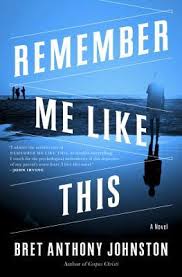
Bret Anthony Johnston's story collection, Corpus Christi, was named Best Book of the Year by The Independent and the Irish Times. He has just published his first novel, Remember Me Like This.

Bret Anthony Johnston’s first book, Corpus Christi: Stories, was named Best Book of the Year by The Independent and the Irish Times. His new novel, Remember Me Like This, tells the story of a boy who disappears in Corpus Christi and then mysteriously turns up.

Bret Anthony Johnston new novel Remember Me Like This, tells the story of a Corpus Christi family whose young son disappeared for years and then mysteriously reappeared. A review in the Washington Post says that the book asks, “But what happens after the cable news hysteria fades away, and the mayor issues a proclamation and the tearful grandparents fly back home? Are these rare families like lottery winners who celebrate in public and then, in the months that follow, squander their good fortune?”

Johnston is the author of Corpus Christi: Stories, which was named a Best Book of the Year by The Independent (London) and The Irish Times, and the editor of Naming the World and Other Exercises for the Creative Writer. He currently serves as Director of Creative Writing at Harvard University.

In this interview, Johnston discusses suspenseful imagery, the challenge of finding the right tone, and his approach to place in fiction.

To read an excerpt from Remember Me Like This and an exercise on setting the mood in fiction, click here.

Michael Noll

The novel begins with a body facedown in the water. This image doesn’t return until almost the end of the novel. In fact, it’s almost possible to forget about it since it’s not long before the drama of the novel takes over. What went into your decision to open the novel with that image? Did you worry that the reader would become impatient with wanting to return to it?

Bret Anthony Johnston

My hope was that the image would embed itself in the reader’s subconscious memory, that it would be something of a shadow that followed them through the story. I wanted them to wonder about the body; I wanted it to keep them from getting too comfortable in the story, to preclude them from taking survival for granted. That is, I wanted them to share the experience that the family endures. Starting the book that way seemed to invite a necessary kind of empathy. Of course you’re right, though, in that it’s almost possible to forget about the image. That’s the gamble I had to take so that when the body returns, the reader is jolted and yanked back toward a kind of raw vulnerability. I hope it works. If it didn’t, don’t tell me.

Michael Noll

The scene where Justin appears for the first time is really well done and uses a deft trick of misdirection. I can imagine that scene was difficult to write. The readers been waiting for it intently, and so there’s a need to both meet and confound their expectations. How did you approach that scene?

Bret Anthony Johnston

Your reading of the scene, the craft behind it, is incredibly accurate and I really appreciate such close reading, Michael. Thank you. What you’re pointing out, though, actually came with relative ease—meaning, it was stunningly difficult and time-consuming, but still not as difficult or time-consuming as other scenes—because it was the result of empathizing with the characters. I only had to understand what the characters would be feeling in that moment, and because I knew them well by that point in the book, their reactions were readily available. Once I understood that she would fixate on her memory him being afraid of snakes, I felt really at home in her reaction.

What took an enormous amount of time was striking the right balance in what might be called tone. I revised and revised and revised to get the scene to move evenly toward the revelation. I struggled with the pace for many drafts. I struggled with the cop’s reaction and the district attorney’s entrance. As you say, it was a scene that we were all waiting to see—not least the writer and the characters—and I took care not to speed through it or linger in an indulgent, self-defeating way. One of the pieces of advice that I regularly dole out to my students is to engage the opposite emotion of what the reader would expect, and I relied on that here. The expectation, I thought, would be hopefulness, but I didn’t think these characters had much hope left in them. I saw that as an opportunity, a way in.

Michael Noll

Bret Anthony Johnston's debut novel, Remember Me Like This, has, according to Esquire, a "driving plot but fully realized characters as well"

Bret Anthony Johnston’s debut novel, Remember Me Like This, has, according to Esquire, a “driving plot but fully realized characters as well.”

The novel returns to certain places (the empty pool at the “half-razed TeePee Motel” and the Marine Lab). The places begin just as places where the characters go, but over the course of the novel, several of the most important events occur there. Did you have certain dramatic scenes in mind when you first introduced those places into the novel? Or, did you explore the places and return to them until the drama presented itself?

Bret Anthony Johnston

The latter. When I start writing anything, I have no intentions of any kind, and the novel was no different. I approach every piece of fiction the same way, which is to pay attention to the details, images, and artifacts of the story and take nothing for granted. My impulse is to reach backwards in a story rather to stretch forward, so I’m always asking myself what’s already in play that I can use again, that I can recycle in a manner that will reward the reader’s attention. It’s a mechanism of repetition and evolution. In this case, I returned to various places until those places evolved to mean something other than what they had. I think a lot of new writers are excited by the prospect of constantly bringing in new material, new imagery or settings or objects, but I think the more satisfying move is often to juggle what you already have so that the reader sees something familiar in a new, more revelatory light.

Michael Noll

It’s been ten years since Corpus Christi: Stories was published. Since then you’ve continued to write stories, and you’ve also published a book of creative writing exercises and written a film documentary about skateboarder Danny Way. Plus, you direct the writing program at Harvard. In other words, you’ve been pretty busy. And yet, I can imagine there was pressure to produce a novel, especially since your first book was so well received. How were you able to resist that pressure, to discover the novel you wanted to write and then write it at a pace that would allow it to become the book you had in mind?

Bret Anthony Johnston

You’re absolutely right about the pressure, but I regard any kind of pressure as a privilege. I’m incredibly fortunate to have editors and readers who want to read my work, and I refuse to take that as a given. Honestly, it still surprises me. It really does. It surprises me to the degree that I don’t fully believe anyone when they ask to read something I’ve written; I think they’re just being nice.

And yet it’s always been clear to me that I’m a slow writer and there will be years between the books that I’m lucky enough to publish. Meaning, I don’t want to publish something until I think it’s ready, until I’ve written the book I want to read, because it will be a long, long time before I have the opportunity to redeem myself. What this means is that I’ve missed many deadlines. I know I missed at least three for the novel, though maybe I missed more. The book just wasn’t ready, and publishing it would have seemed a kind of malpractice. I always gave the publisher the opportunity to cancel my contract, and I apologized profusely, but I also wouldn’t show them the book until it was ready. I worked with an amazing editor named Kendra Harpster, and she was beyond supportive. Not only would the book not have been published without her, the published book wouldn’t be nearly as successful without her guidance. It’s another way that I got lucky. I’ve been lucky my whole career. Lucky and slow, that’s my life as a writer. I wouldn’t change it for the world.

May 2014

Michael Noll

Michael Noll is the Editor of Read to Write Stories.

How to Set the Mood

13 May
Bret Anthony Johnston's debut novel, Remember Me Like This, has, according to Esquire, a "driving plot but fully realized characters as well"

Bret Anthony Johnston’s debut novel, Remember Me Like This, features, according to Esquire, a “driving plot but fully realized characters as well.”

Every story tries to reveal the kind of story it is from the opening page or opening shot, in the case of film and TV. The opening shots of any given episode of Breaking Bad, for instance, are pretty different from the opening of any episode of Parks and Recreation. One is almost always foreboding and dark, and the other is light, fast, and witty. Even if you were to encounter these shows with no knowledge of them, you’d understand after about five seconds what kind of world and narrative sensibility you’d entered.

Novels and stories must set the mood as quickly as any TV show, and a great example is the beginning (or pretty much any chapter) of Bret Anthony Johnston’s debut novel Remember Me Like This. The book is set on the Texas coast, in and around Mustang Island, a place that can inspire many emotions. But the novel quickly focuses on a specific mixture of them that hints at the story to come. You can read an excerpt at the Random House website.

How the Story Works

Most writers are probably familiar with John Gardner’s famous exercise for emotion in description: “Describe a barn as seen by a man whose son has just been killed in a war. Do not mention the son, or war, or death.” This is a brilliant exercise—unless you can’t do it. I’ve seen very good writers in workshops tackle this exercise and come up with nothing. Yet, Gardner’s goal of establishing emotion and mood through description is still a valid one; the thing that might be tripping up some writers is the exercise’s focus on an emotion stemming from a specific event: the son’s death. Emotion and mood can also be general, as seen in this paragraph from the first chapter of Remember Me Like This. Pay attention to the word choices Johnston makes, the way they seem to have been pulled from a stream with a pan that lets all but a certain kind of word sift out the bottom:

Months earlier, the June heat on Mustang Island was gauzy and glomming. The sky hung close, pale as caliche, and the small played-out waves were dragging in the briny, pungent scent of seaweed. On the beach, people tried holding out for a breeze from the Gulf, but when the gusts blew ashore, they were humid and harsh, kicking up sand that stung like wasps. By midday, everyone surrendered. Fishermen cut bait, surfers packed in their boards. Even the notoriously dogged sunbathers shook out their long towels and draped them over the seats in their cars, the leather and vinyl scalding. Lines for the ferry stretched for half an hour, though it could seem days before the dashboard vents were pushing in cool air. Porpoises wheeled in the boats’ wakes, their bellies pink and glistening.

You may have paused at these words and phrases: gauzy, glomming, close, pale as caliche, played-out, dragging, holding out, humid and harsh, stung like wasps, surrendered, cut bait, dogged, scalding. And, of course, there’s the static image of the cars lined up, waiting for the ferry. Taken together, the words don’t describe a particular emotion so much as a general sense of an end of things. If this was a film, it might be called a tone poem: the mood is unmistakable. As readers, we’re made uneasy.

And then there’s that last line: “Porpoises wheeled in the boats’ wakes, their bellies pink and glistening.” Its tone is markedly different, even the opposite of everything that came before it. It might be tempting, if reading this in a workshop, to suggest cutting the sentence. But, in fact, it might be the most important line in the paragraph. It’s the postcard from Hawaii taped to the bathroom mirror in a Chicago apartment in February—the reminder, good or bad, that there are other ways of being and other perspectives on the world. Placing this bright line in a dreary description makes the dreariness even harder to bear. It also suggests that there are entities in the world that relish conditions that the rest of us find unbearable.

The Writing Exercise

Let’s set the mood in a story, using the passage from Bret Anthony Johnston’s novel Remember Me Like This as a model:

  1. Choose the place to describe. Be specific. Johnston shows us a particular spot on the beach. In the prologue, he focuses on the Harbor Bridge in Corpus Christi.
  2. Choose the moment to describe it. Descriptions tend to focus on moments of transition. So, Johnston shows us the beach as the weather is driving the surfers, fishermen, and sunbathers away. The bridge in the prologue is shown at its beginning and then in the moments before and after a group of people walking over discover something terrible. So, think about what often happens in the place you’ve chosen. Or think about an incident that occurs there in your story. Describe the place just before or after that moment has occurred.
  3. Choose the emotion or mood. Unlike your choice of place, specificity is less important here. It might even be easier to think in terms that are tangential to emotions: positive, negative, bright, dark, still, frenetic. Emotions like joy, sorrow, anger, or jealousy can be too pointed and produce obvious personifications: skies shedding tears, happy breezes, etc. Leave room for the language to surprise you. Sometimes you’ll discover lines like this one from Denis Johnson’s Tree of Smoke: “a child up on its knees on the mattress howled out of a face like a fist.”
  4. Choose a narrative arc. Think of the description as a story, with a beginning, middle, and end. For instance, Johnston begins with the weather conditions, which drive the people away, who then sit in line for the ferry while the porpoises swim. In other words, the end of the description should be different from the beginning: a narrative arc, no matter how small, is a way to ensure this.
  5. Write the description. Keep all of the above in mind: the moment of transition, the arc, the mood. After each phrase or sentence, take a look back at the nouns, verbs, and adjectives in it and ask yourself if they can be changed to fit the mood. Play around with the diction. In Johnston’s paragraph, the difference between “small waves” and “small played-out waves” is small but significant. That difference is the source of much of the pleasure in writing. Challenge yourself to lean toward the mood at every opportunity. If you lean too far, you can always pull back.

It’s possible that these steps may seem overwhelming. You might wonder if Johnston approached the paragraph in this way or if he simply wrote it. The odds are, he just wrote it, and perhaps you will, too. But one drawback to modeling your work after published writing is that you’re trying to achieve the same effect as someone who’s been working for many years. As beginners, we must sometimes parse out the processes that more experienced artists seem to manage naturally, without thinking. So, give yourself permission to scramble these steps, to forget some or focus more heavily on others. Let yourself experiment. You’re giving your imagination room to work.

Good luck!

An Interview with Sarah Bird

8 May
Sarah Bird's eighth novel, Above the East China Sea, has been called her most powerful book yet.

Sarah Bird’s ninth novel, Above the East China Sea, has been called her most powerful book yet.

Sarah Bird is the author of eight novels that have been honored by the New York Public Library’s 25 Books to Remember list, Elle Magazine Reader’s Prize, People Magazine’s Page Turners, and Library Journal’s Best Novels. Her latest novel, Above the East China Sea, tells the entwined stories of two teenaged girls, an American and an Okinawan, whose lives are connected across seventy years by the shared experience of profound loss, the enduring strength of an ancient culture, and the redeeming power of family love. Bird has written screenplays for many studios and independent producers and has contributed articles to The New York Times, Salon, O Magazine, and Texas Monthly. As a kid, she moved all over the world with her air force family, and now she lives in Austin, Texas.

In this interview, Bird discusses composting research into story, writing in bed, and why some surprises aren’t good for readers.

To read excerpts of Above the East China Sea and an exercise on moving characters around in fiction, click here.

Michael Noll

You’re an American writing about a place—Okinawa—that has a long, difficult relationship with Americans and the United States. You spent part of your childhood in Okinawa, and so you’re familiar with the island from the American perspective. In this excellent interview with Mary Helen Specht, you said that you tried to imagine yourself “outside of the fence and ask questions like, How would an American would feel if, say, the entire eastern seaboard, were occupied by foreigners?” That seems like a necessary but difficult imaginative leap. How did you approach the problem of crossing that fence, so to speak, and trying to see things from the Okinawan view with as little of the inherently residual American view clouding your perspective? 

Sarah Bird

The major question I wanted to look at in this novel is how the price of imperial ambition is always borne most heavily by the young. That was true when Japanese industrialists seized control of the government around the turn of the century and began militarizing that country. And it’s been tragically true for our country.

History is a kaleidoscope that can be twisted in an infinite number of directions. Settling on the correct lens through which to view both the contemporary and historical stories in this novel required years of education. Like most writers, I was a born observer, outsider, and almost burdened by a high degree of imaginative empathy. So shifting perspective wasn’t hard, but getting the factual context right did require lots of research.

Michael Noll

At one point in the novel, the characters visit a strip of Sōpus, or bath houses. The passage approaches these places a couple of ways. There’s direct description (“The two-story building is covered in bathroom tile and features giant posters of young Japanese girls in sexy nurse uniforms and pink scrubs.”) and also historical summary (“Whorehouse? Technically, no, since prostitution has been illegal in Japan since the mid-fifties.”). The latter seems easier than the former to write: in theory, you’re relaying your research to the reader. But in the direct description, you’re bringing that research to life. How did you approach these kinds of scenes and descriptions? Or, in other words, how did you convert the facts of research into the breath of story?

Sarah Bird

Michael, I love the entire process of converting research into fiction and think of it as composting. I try to toss rich, nutritious items onto the pile, horse manure, food scraps, along with grass clippings and dead leaves. I let it steep for months in a spot that receives ample sunshine. And I trust that a dark, buried world of microbial beings will convert the whole mass into a medium capable of sustaining a character, a story.

For this novel in particular, I spent many happy months researching in libraries, online, and doing personal interviews. Most useful, probably, of all these avenues in creating a character are diaries, personal narratives, and fiction set in the time and place of interest. Then, when it comes time, after this mulch pile has stewed in my brain long enough, I put all my books and notes aside and channel the character. If I’d absorbed enough of the right ingredients, something good usually sprouts.

Michael Noll

Sarah Bird is the best-selling author of The Yokota Officers Club and, now, the much anticipated Above the East China Sea.

Sarah Bird is the best-selling author of The Yokota Officers Club and, now, the much anticipated Above the East China Sea. Signed, personalized copies of the novel can be pre-ordered from BookPeople, the Austin independent bookstore.

The novel takes place in two different time periods (1945 and present day). An inherent risk in this structure is that every time you switch between time periods and stories, you break, at least momentarily, the narrative momentum. Did you find that this was something you had to think about in structuring the chapters and novel as a whole? 

Sarah Bird

Without intending to, I seem to gravitate toward telling stories from two points of view. It was essential for this novel since I wanted to show how we are all formed by our national narratives. This was a right-brain, left-brain process so distinct that worked in two entirely different spots. When I was in full fiction mode, the dreaming, empathy, channeling part, I wrote in bed, in longhand on a yellow pad. That was where the characters spoke to me and I took dictation. For the shaping part I sat at my desk edited the material and made the two girls’ stories cohere.

In the end, I was astonished at how well the two narratives braided together. How, guided by their deepest yearnings, they told stories that wove together and amplified each other.

Michael Noll

The promotional copy for Above the East China Sea describes the novel as a “stunning departure.” I’m curious what this phrase means to you. It’s not like you’ve been writing zombie erotica. At a recent panel sponsored by The Writer’s League of Texas, you described your books as midlist literary fiction. What makes this novel different?

Sarah Bird

Okay, the “stunning departure” thing is a way to signal to readers that this one is not funny. I’ve written both intensely serious books and others that are regarded as comic novels. And, whoa doggies, judging by reviews on Amazon, if a reader comes to you expecting larfs aplenty and they get, oh say, the invasion of Okinawa when more people died than at Hiroshima and Nagasaki combined, well, that is not a happy reader. And that reader departs. Stunned.

May 2014

Michael Noll

Michael Noll is the Editor of Read to Write Stories.

An Interview with Óscar Martínez

1 May
Óscar Martínez is a staff writer and editor at El Faro and the author of The Beast: Riding the Rails and Dodging Narcos on the Migrant Trail

Óscar Martínez is a staff writer and editor at El Faro and the author of The Beast: Riding the Rails and Dodging Narcos on the Migrant Trail.

Óscar Martínez spent two years traveling with Central American migrants to the United States through Mexico. He visited places and people (sites of cartel massacres, coyotes who work for the cartels, mountain trails where migrants take their chances) that almost no journalist had ever seen. His reports were published in the Salvadoran online newspaper El Faro, collected in the book Los migrantes que no importan, and translated into English as The Beast: Riding the Rails and Dodging Narcos on the Migrant Trail.

Martínez lives in El Salvador and edits El Faro‘s “Sala Negra,” a continuing investigation of gang violence and organized crime in Central America.

In this interview, Martínez discusses telling violent stories, the verisimilitude of a hit man, and planning trips into areas controlled by drug cartels. You can read Martínez’s original answers in Spanish, along with English translations. (Thanks to Chris Dammert for helping with translation and interpretation.)

To read the first chapter of The Beast and exercises on ending stories and distinguishing fact from fiction in essays, click here.

Michael Noll

You write about Saúl, a 19-year-old who is deported from Los Angeles to Guatemala. He is beaten and captured by a gang led by a man who turns out to be his father. The story ends this way: “He only got out alive by covering himself (and the 18 tattooed on his back) in mud and pretending to be insane.” That last sentence is stunningly short. How did you know or figure out which details to leave out and which to include?

Óscar Martínez

For me, there is a logic to the narration of violence: don’t embellish or elaborate what is already a very heavy subject. To add my assessment to Saul’s already convincing story would have been a distraction. His story is valuable just for that: how distinct and forceful it is. The only proof I have that it is true is because he told it to me in such a very frank way and with a context that made it plausible. I obviously never knew his father. Sometimes the narrator of nonfiction puts the reader in this dilemma: do you believe me or not believe me? It’s your decision.

Para mí hay una lógica en la narración de la violencia: no pretendas exagerar, no pretendas engordar lo que ya es pesado de por sí. Agregar mis valoraciones a la contundente historia de Saúl hubiera estado de más. Hubiera generado distracción. Su historia-mínima es valiosa por eso, por lo contundente, por lo integral, por lo sucinta. La única prueba que tengo de que es verdad es que así lo creo, que me lo contó de una manera que me pareció franca y que en el contexto su historia es verosímil. Yo, evidentemente, nunca conocí a su padre. A veces, un narrador de no ficción pone en ese dilema a su lector: ¿me crees o no me crees? Es tu decisión.

Michael Noll

You describe a migrant on the train as crucified on the front of the car and talking with his cousin and two Nicaraguans. Other writers might have focused on the danger but not the dull routine. How were you able to find this balance?

Óscar Martínez

Other writers would have ruined the story. This is how it happened, how it was told to me. It was right this way. The daily nature of the scene adds verisimilitude to the lives of these people: Who the hell flees, kills, dies all the time? People need to shit, get tired, play cards, eat, discuss, fall in love, and think. If they don’t, they don’t exist. Who empathizes with Rambo?  Can you see your brother or father as a hit man all the time? I don’t think so. Sometimes in nonfiction we create Martians, people who cannot exist. We take pieces of them that are thrilling. But that kind of story, without those real moments of calm, would be boring, empty.

Otros escritores habrían arruinado entonces la escena. Así ocurrió, así me lo relató. Así era justo contarlo. Lo cotidiano de la escena agrega verosimilitud a las vidas de estas personas: ¿Quién demonios huye, mata, muere todo el tiempo? Los personajes necesitan cagar, estar cansados, jugar cartas, comer, discutir, enamorarse, peinarse. Si no, no existen. ¿Alguien puede sentir empatía por Rambo? ¿Alguien puede ver reflejado a su hermano o a su padre en un sicario a tiempo completo? No lo creo. A veces, en la no ficción creamos marcianos, gente que no puede existir, de quienes solo recortamos aquello que es emocionante. La acción, sin sus remansos reales, es aburrida, vacía.

Michael Noll

El Faro is the first online newspaper in El Salvador and one of the leading sources of investigative reporting in Central America. Óscar Martínez edits Sala Negra, which focuses on organized crime.

El Faro is the first online newspaper in El Salvador and one of the leading sources of investigative reporting in Central America. Óscar Martínez edits Sala Negra, which focuses on organized crime.

You often became a participant in your story. For example, your photographer frightened bandits off the train by shining all of his lights at them. As a result, I wondered why the cartels allowed you to move about in their areas. Are they so powerful that they simply don’t care if anyone finds out what they’re doing? Are they so focused on drugs that someone interested in migrants doesn’t matter? Now, you’re working with Sala Negra. Have the cartels and organized crime organizations become less tolerant of your reporting?

Óscar Martínez

The simple reason: time. I had time, we created a project with my paper that allowed me to do pre-production on each one of my trips. I had time to find a reliable source to plan my route, to find hostels. In short, to crack the system of the criminal world. Sometimes we would get counterintelligence against the mafias in order to penetrate their areas. With respect to life at Sala Negra: yes, it is more difficult. El Salvador is not Mexico, where I could take a trip to Tamaulipas or a trip by train to Tenosique and then return to a city like Mexico City, where I was anonymous. We would go one month and then we would take time to write what we had seen, to edit the photographs. In San Salvador, even though I live a privileged life, I live much closer to that black mass all the time.

La respuesta es sencilla: tiempo. Tuve tiempo, creamos un proyecto junto a mi periódico que me permitió hacer pre-producción de cada uno de mis viajes. Yo tenía el tiempo que deseaba para encontrar a la fuente de confianza, para planificar mi ruta, para permanecer en un albergue. En fin: para quebrar esa lógica de dominio criminal. A veces, hacíamos contra-inteligencia ante las mafias para poder penetrar en sus zonas. Respecto a la vida ahora en Sala Negra: sí, es más difícil. El Salvador no es México, donde yo realizaba una incursión a Tamaulipas o un viaje en tren o una visita a Tenosique y luego volvía a una ciudad como DF, donde era anónimo. Íbamos un mes y luego nos retirábamos para escribir lo que habíamos visto, para editar las fotografías. En San Salvador, aunque mi vida es privilegiada, vives mucho más cerca de esa masa oscura todo el tiempo.

Michael Noll

In an interview with The Texas Observer, you said that people in the United States have “no idea at all that what the migrants are going through is actually a humanitarian crisis.” The same is true in Mexico. Many people don’t know or don’t want to know. How does it affect the way you tell the story when you’re one of the first people to tell this story?

Óscar Martínez

For me it was a luxury. Being one of the first was what gave us such a wide, panoramic view, unlimited possibility, virgin territory in many places. Tenosique criminals never imagined that an international reporter would be interested in getting to Ranch La Victoria or Macuspana, which was why they didn’t have any way to detect us. That being said, it was a ninth-month process to organize the book. To tell what hasn’t been told much makes the task even greater because you have a blank page and the possibilities are unlimited. You have notebooks that are full, hours of recording, videos, photographs, and yet a blank page that’s asking, from all of this, what will you tell? And what will you leave out?

Para mí eso fue un lujo. Ser de los primeros fue justamente lo que nos dio un panorama tan amplio, unas posibilidades ilimitadas, un terreno virgen en muchos lugares. Los criminales de Tenosique nunca se imaginaron que un reportero internacional se interesaría por llegar al Rancho La Victoria o a Macuspana, por eso no tenían controles para detectarlo. Eso sí, fue un reto de nueve meses ordenar el libro. Contar lo que se ha contado poco duplica el reto ante la página en blanco, porque las posibilidades siguen siendo interminables. Tienes libretas llenas, horas de grabación, videos, fotografías, y una página en blanco que te pregunta: ¿Qué de todo eso contarás? Y por tanto, ¿qué dejarás de contar?

May 2014

Michael Noll

Michael Noll is the Editor of Read to Write Stories.

An Interview with Diana Lopez

6 Mar
Diana Lopez is the author of the YA novel Ask My Mood Ring How I Feel, two middle grade novels, and an adult novella. She won the 2012 William Allen White Award.

Diana Lopez is the author of the YA novel Ask My Mood Ring How I Feel, two middle grade novels, and an adult novella. She won the 2012 William Allen White Award.

Diana López is the author of the adult novella, Sofia’s Saints; the middle grade novels, Confetti Girl and Ask My Mood Ring How I Feel; and the young adult novel, Choke. She was featured in the anthologies Hecho en Tejas and You Don’t Have a Clue and appeared as a guest on NPR’s Latino USA. She won the 2004 Alfredo Cisneros del Moral Award and the 2012 William Allen White Award. Lopez teaches English and works with the organization, CentroVictoria, at the University of Houston Victoria.

In this interview, Lopez discusses the importance of strong imagery, how to find a contemporary teen voice, and when to explain cultural/regional details to a broader audience.

To read the opening chapters of Ask My Mood Ring How I Feel and an exercise on creating conflict with subtext, click here. For those in Austin, Lopez will be reading at the Westbank Library on March 12.

Michael Noll

One of the more challenging technical aspects of fiction writing is getting characters onto the page for the first time. Your novel does this really effectively. The opening pages use a simple object (bikinis) to introduce four of the major characters (the narrator, her mother, her sister, and her little brother) and also the major conflict (the mother’s breast cancer). All of that happens in about three pages. How did you approach this introduction to character and story? Did the book always begin with the bikinis?

Diana Lopez

Yes. The original title of the novel was “9 Bikinis, 500 Names,” which are now the first and last chapters. I have no idea where the number nine came from, but I knew that I wanted to tackle breast cancer from a daughter’s perspective, a girl who is maturing and who has a lot questions about the body. I wanted her mother to be a strong character with a positive attitude, someone who was going to celebrate her days before the mastectomy by showing off. What better way than to wear bikini tops?

I can’t overstate the importance of strong imagery. The best way to make an okay story into a memorable one is specific imagery. My students often struggle with this. They miss so many opportunities. But consider all the power an image holds. First, it gives the reader a chance to experience via the senses—the bikini colors and patterns, the texture of the fabric, even the hot sun that we associate with them. Second, images hold connotative powers. I don’t have to say that Chia’s mom is fun loving, daring, and sexy. What kind of conclusion would the reader draw if the mother bought oversized T-shirts instead or if she threw away her bras the minute she came home from the doctor? In other words, a good image lets the readers co-create as they arrive at their own conclusions about the characters. Imagine all the assumptions we make about a forty year old woman driving a minivan versus a sixteen-year-old boy.

Michael Noll

There’s a really tender moment in the first chapter between the narrator’s dad and mom:

He pulled out her chair. He could be a real gentleman, but since he pulled out Mom’s chair only at fancy dinners or weddings, this was weird. Mom must have thought so, too, because she hesitated before sitting down.

When the narrator’s little brother demands juice, her dad gets it instead of her mom, which causes her mom to say, “Your father’s treating me like an invalid.” What I love about this moment is its complexity: the father is trying to be kind and considerate—and in most situations, his actions would be seen that way—but because of the situation, the mother interprets these actions as insulting and painful. As a result, the reader is shown something deep and powerful about the characters. Did you try to find scenes that would result in this kind of awkward collision of intention and effect? Or was a scene like this a happy accident? Did it just pop onto the page one day?

Diana Lopez

I am always looking for opportunities to heighten the conflict. It’s what drives a novel just as it drives a good conversation. Imagine how bored you are when your friend is relating the non-eventful details of her day, and then imagine how attentive you are when your friend is talking about someone in trouble. We love conflict.

I spent a lot of time figuring out my characters. I write a lot about each before I put them in scenes. What’s the mom like? Where does she come from and how does she spend her days? How about the dad? Where did they meet? Of course, this doesn’t make it into the final book but it definitely informs the scenes.

So to answer your question about that dinner, I imagined the family at the table and the parents having to deal with the mother’s breast cancer. It made sense for the father to be overprotective, and by then, we already know the mother has an independent streak. So the way she takes offense is natural and logical, given who she is. You could put two different people at the same table with the same looming news and get a completely different scene. In fact, that would be a good writing exercise, wouldn’t it?

Michael Noll

You don’t shy away from featuring technology in the novel. In the first chapter alone, the narrator texts her friend, searches through Google Images, and uses her iPod as a point of comparison for something as important as boys. Was it difficult to write about these things from an 8th grader’s perspective? I ask because my students at Texas State have a far different relationship to cell phones and technology than I do—and certainly different than I had at their age. These same students, however, tend to view their younger siblings as getting far more privileges than even they got. They sometimes sound like old geezers complaining about the kids these days. As a writer, how are you able to bridge the generational gap between you and your characters, especially with technology?

Diana Lopez

Good question and one that brings up a very important aspect of writing for young adults. You have to know your audience. I like writing contemporary books, so they have to take place in the here and now, not decades ago when I was a teen. This can be a challenge, but here’s where research comes in. The best way to bridge that generational gap is spend time with teens. Talk to them. Observe them. “Friend” them on Facebook or follow them on Twitter. Soon you’ll start hearing that contemporary teen voice and you’ll get a good sense of how they relate to each other and to technology. I teach too, and I’m still writing on the board. Instead of copying the notes, half the class takes a pic with cell phones. Many public schools are doing away with books and distributing iPads to their students. I only know these things because I’m out there paying attention. A good tool for writers is observation and engagement with the people you hope will read your book.

Michael Noll

I’m curious about the audience for this book. It’s about a Latino family living in San Antonio. They use corn tortillas for tacos—not flour—and take a trip to a cuarto de milagros. In other words, they have an intimate relationship with a particular culture and place. As a result, I was interested in this passage about migas:

Migas was our favorite Tex-Mex dish—a mix of corn tortillas, eggs, tomatoes, onions, and cheese. We loved the recipe. Thing was, migas were for breakfast, not dinner.

The description of migas is clearly meant for readers who do not have the same cultural knowledge as the narrator and her family. This seems to point to a tension that is inherent in a novel about characters who do not often appear in national fiction (though this is changing). How do you balance the need to clue in an audience not familiar with things like Tex-Mex food with the equal need for an honest depiction of a narrator who wouldn’t walk around explaining the basic elements of her life? How do you decide what to explain and what to leave to the reader to figure out?

Diana Lopez

Diana Lopez's middle grade novel Confetti Girl won the William Allen White Award and, according to ALA Booklist, "puts at its center a likable girl facing realistic problems on her own terms."

Diana Lopez’s middle grade novel Confetti Girl is featured the week at Latin@’s in Kid Lit.

Excellent question and one I have struggled with. I want my book to be accessible to many readers. That said, I don’t intentionally highlight these details. Seriously, they are part of my world so it doesn’t occur to me to give the recipe for things like migas or to explain the process of making cascarones like I do in Confetti Girl. This is where an editor who lives in New York comes in. We’ll get to this point in the revision process where she has highlighted places with unfamiliar images or words. I remember the first time this happened. I wrote a book set in Corpus and mentioned T-heads, never realizing how unique that term was. The editor had no idea what I was talking about, so I added an appositive phrase for clarification. Ultimately, that’s what I have to determine. Are there enough context clues or should I be little more explicit? The last thing I want is a reader to stop because she’s confused. In that sense, I am very grateful to have an editor who is not from my world and can point out these places—then lets me decide whether or not I should add that recipe or definition.

March 2014

Michael Noll

Michael Noll is the Editor of Read to Write Stories.

An Interview with Benjamin Reed

27 Feb
Benjamin Reed's story, "King of the Apes," appeared in Arcadia Magazine.

Benjamin Reed’s story, “King of the Apes,” appeared in Arcadia Magazine. He guest edited the most recent volume of the magazine.

Benjamin Reed’s fiction and essays have appeared in [PANK], West Branch, Arcadia Magazine, Blue Mesa Review, Sou’wester, and The Southern Quarterly. He won the 2013 Austin Chronicle Short Story contest, and Junot Díaz selected Reed’s “The Quiet Hunt” as winner of the Avery Anthology Small Spaces Prize. Reed was born in Houston, and grew up near San Francisco. He is a graduate of the University of Texas, and recently earned his MFA from Texas State University, where he currently teaches English. He lives in Austin with his wife and their two boys.

In this interview, Reed discusses Tarzan’s Faustian bargain, writing sex scenes, and the use of metaphor by nomadic hunter-gatherers.

To read “King of the Apes” and an exercise on unrequited love and writing inevitable scenes, click here.

(Reed will be reading at the AWP Conference this week at Big Fiction‘s event at Tony’s Coffee Bar on Saturday at 7:30.)

Michael Noll

In an interview with The Committee Room, you said, “Good stories often show relationships in transition. They often revolve around some kind of power imbalance.” In “King of the Apes,” this is certainly the case—in the jungle, Tarzan has power over Jane, but when he comes to America, the balance shifts in her favor—but it’s also not that simple. To some extent, the characters all use each other. Edgar Rice Burroughs uses Tarzan’s story for money and fame, but Tarzan also uses that relationship for money as well. In New York, the anthropologists and Tarzan use each other—for study and fame (anthropologists) and education and fame (Tarzan). Did that complexity of relationships always exist in the draft? Or, did you start with something simpler (anthropologists taking advantage of Tarzan, Tarzan fighting back) and discover the complexity during subsequent drafts?

Benjamin Reed

Originally, Edgar Rice Burroughs was dead the whole time, just a reference and a quick flashback. No dialogue. I decided to include Burroughs as a living, speaking character in a very late revision. Having him echo Tarzan’s original rejection from Jane totally refocused the nature or “aboutness” of the story: The loneliness and profound sadness a person feels when he can’t let go of someone who has let go of him. For me this was better and more specific than just focusing on my Tarzan’s “alienation” or “strangeness,” which is what I’d been working with before.

Edgar Rice Burroughs published Tarzan of the Apes in 1914 and wrote more than two dozen follow-up novels.

Edgar Rice Burroughs published Tarzan of the Apes in 1914. You can read it for free at The Gutenberg Project.

I’m really heartened by this question, because you totally recognize what I was trying to do. After Jane tilts the axis of power by leaving Africa, Tarzan never recovers. He becomes a man shipwrecked on an alien society. In civilized America, his relationships are transactional and exploitive, both parties using each other as a means to an end. These are Faustian bargains of self-sacrifice and bondage: the researchers who replace Tarzan’s social identity, the circus promoter who retains his liberty, and finally the pulp fiction writer who acquires and appropriates his very life story. He sells off his mind, body, and soul. This sinister trifecta has always been in the story, but it wasn’t until Burroughs showed up that I knew what everything meant.

Michael Noll

Early in the story, you’ve got this amazing passage about the love story that Tarzan wants told about Jane and him:

It’d be “a real literary affair where Tarzan has to find Jane. He has to seek her out. Possibly cover hundreds or thousands of miles. A story that spans the globe. He tracks her down, Jane, who’s in this kind of spell, or a haze, or a hypnosis or something. So Tarzan has to save her, not just from the darkness, but from herself, Edgar. A story where Tarzan reaches inside Jane to keep her from falling off some rocky precipice in her own heart.”

In Tarzan’s summary, it sounds hackneyed and ridiculous, but, of course, the line between hackneyed and emotionally-impactful is a fine one (just ask Nicholas Sparks). Were you ever tempted to write this story?

Benjamin Reed

“Hackneyed?” You’re dead to me, Noll.

No, but seriously, yeah, it’s supposed to be trite and make Tarzan look ridiculous, revealing how he sees things when he’s alone in his apartment, feeling sorry for himself. In a way I feel like I did get to explore this fantastic and divergent storyline by having Tarzan narrate it as a kind of embedded text, a story within a story, while also evincing that sometimes he can get a little drunk on his own a delusional sap.

 Michael Noll

The story moves very quickly over some important moments. For instance, Tarzan’s move from Africa to New York happens in a single paragraph. And, before that move, there are these lines about Jane:

When Jane’s stinking clothes finally fell into rags she covered herself in leaves until I could steal a lion pelt from a hunter’s cache. She taught me how to speak some of her language. And of course, she gave me so much more than that. For a brief time, the jungle flowered into paradise.

Again, another writer might have handled that passage very differently. Was it difficult to find the right way to say, “We had sex?”

Benjamin Reed

Isn’t that a lot of what we deal with when we write? Answering mundane questions like, “What does my character do for money?” or resolving issues of taste, such as how to convey that characters have had sex without engaging in the dreaded sex scene? Honestly though, I think I originally did have a less subtextual sex scene in that spot, and it was probably an orgasm of bad taste and falling flower petals. As writers are taught, I wrote my way out of it. I just revised and revised until what I had in front of me didn’t make me cringe.

Michael Noll

A character gives Tarzan a copy of Shelley’s novel Frankenstein; or, The Modern Prometheus, which is apt since both Tarzan and Frankenstein’s monster had to learn to speak. How did you approach the voice of Tarzan? It would seem challenging for a couple of reasons. For one, you have to invent a way of speaking that suggests the consequences of coming to any language (or, in this case, all language) late in life. In addition to that, you’re also working under the “Idea of Tarzan” that every reader will immediately have in mind once they learn your Tarzan’s name. What was your process for finding the right voice?

Benjamin Reed

It might surprise you how much of my time is preoccupied with this exact problem. Right now I’m working on a story about a tribe of nomadic hunter-gatherers in about 30,000 BCE, and figuring out how they speak is like creating a new language, but one whose only existence is in my own fluid translation. Lately I’ve been grappling with this clan’s dexterity with metaphor. It’s also been made clear to me how heavily English relies upon a modern and contemporary idiom. I thought my “caveman story” would be fun and relatively quick, but it’s become this huge project. I have to create these people’s entire culture and worldview, one word choice at a time.

Tarzan’s voice was easier. As the story is told in retrospect, I totally avoided having to figure out what a “primitive” or transitional Tarzan would sound like. Instead I gave him a normal, only slightly elevated diction, this slight lilting of an ironic aspiration to society, which I hoped would give him that bourgeois tinge of insecurity.

Dr. Kroeber was a real man, an early anthropologist from UC Berkeley who became famous for his work on Ishi, the last surviving member of the Yana people of California. In my story, Kroeber is trying to nudge Tarzan toward greater self-awareness. He gives Tarzan a copy of Frankenstein because, like Shelley’s terrible creation, Tarzan is also a construction, and a kind of monster.

March 2014

Michael Noll

Michael Noll is the Editor of Read to Write Stories.