Tag Archives: creative writing prompts

How to Write from the Headlines

17 Feb
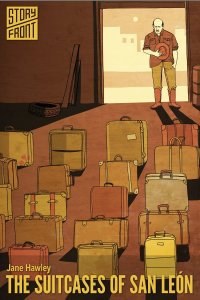
Jane Hawley's story, "The Suitcases of San León," tells the story of bus depot workers who must decide what to do with the suitcases of travelers murdered by the Mexican drug cartels.

Jane Hawley’s “The Suitcases of San León” tells the story of bus depot workers who must decide what to do with the suitcases of travelers murdered by the Mexican drug cartels.

In a recent interview, the late New York Times journalist David Carr was asked if cable news drove coverage of events, and he answered, in short, no. The current news cycle, he said, is so full of large, complex stories that news organizations don’t know where to look. In other words, the news is driving the news. As writers, we inhabit and absorb this same news cycle, and because of the size and savagery of some of these events, it’s tempting to incorporate the headlines into our fiction. The question is how to do it?

A terrific example of a story based on an actual news event is Jane Hawley’s “The Suitcases of San León.” The story was inspired by a narco massacre in the Mexican border city of San Fernando and, more generally, on stories about suitcases arriving at depots without their murdered owners. You can buy the story for $1 at Amazon, where it was published as part of the journal Day One.

How the Story Works

The real-life massacre in San Fernando—or any massacre, for that matter—has a two essential sets of people involved: the murderers and the victims. Focusing a story on characters based on these real-life people is possible but difficult. It involves detailed research, which may or not be possible from a safe remove. It also involves some sticky questions of ethics: Is it okay to fictionalize the lives of real people? The less historical remove the writer has from those people, the more difficult it is to answer this question.

The next level of involvement in the headline includes people with direct connections to the event but not an immediate presence at the actual massacre: the narco bosses who ordered the murders, the officials who provide cover to the narcos, the victims’ families, witnesses, the police, and the people who discovered the bodies. Generally speaking, the farther the story moves away from the immediate event, the more freedom it has to roam. An event like a massacre acts as a kind of black hole, overpowering everything around it with its gravitational pull. A story about a victim of a massacre is likely to be almost purely about the massacre. But a story about a witness or an accessory or family member can give those people lives beyond the event—but that freedom is not limitless.

A third level of involvement includes people with no direct connection but whose lives are impacted in specific ways by the massacre. When fictionalized, these are characters whose connection to the central event is thin or tangential. They are removed from it by several degrees, and, as a result, they can have problems and concerns in their lives that, to them, rival the problem that the event causes. There is inherent tension between those problems—how does the character balance them? A victim’s brother or mother or spouse will drop everything to deal with the event. But someone at a remove will not.

It is at this third level that Hawley writes “The Suitcases of San León.” The story is told from a group point of view—the “we” of the workers at the San Leon bus depot. Their connection to the massacre is indirect. When the victims were pulled off of the bus, their suitcases were not pulled off with them, and so they arrive ownerless at the depot. The workers must decide what to do with the suitcases, and when they decide, they must live with the consequences (mental, emotional, and situational) of those choices. As you read the story, you’ll notice that the narcos become a stronger presence toward the end, and their presence suggests the gravitational pull that the massacre exerts on everything around it. By setting the story at a remove from that event, Hawley gives the characters room to develop. If she had set the story closer to the actual massacre, that room might have been very difficult to create. As a result, the story might not have added complexity or depth to the headline where it began. The distance from the massacre also gives the story a chance to surprise us. We’ve all heard about the atrocities committed by narcos, but it’s likely we haven’t thought about the way those crimes alter even the most mundane aspects of Mexican life. Empty suitcases are such a great starting point for a story that it’s hard to imagine it being written about anything else.

The Writing Exercise

Let’s write a story from a headline, using “The Suitcases of San Leon” by Jane Hawley as a model:

  1. Choose the headline. There is no shortage of news to choose from: geopolitics in Ukraine, Syria, Iraq, and Libya and internal politics and/or savagery in Nigeria, Mexico, and Venezuela; racial and ethnic strife in Ferguson, New York, and, most recently, in North Carolina; political unrest in, of all places, my home state of Kansas; drones; surveillance; a train derailment in West Virginia; and blizzards across the northeastern U.S. Simply choose the news you’re following the closest and that you find yourself imagining yourself into.
  2. Chart out the first level of involvement. Who bears the most immediate impact of the headline? Who is it about? Are there sides? If so, what are they?
  3. Chart out the second level of involvement. Who is connected to the news but not immediately present? Or, who is present but not at the focus of the headlines? Who are the journalists not talking to? This level often contains family members, police, witnesses—people who are among the first to react to the event.
  4. Chart out the third level of involvement. Who is not present or connected to the event/news but is impacted by it? People in this group are often going about their business, only to discover that the news has forced its way into their lives. In the case of the winter storms, most of the stories are from this level, people whose lives have been disrupted, sometimes urgently (first responders) and sometimes with unforeseen consequences (a couple on the verge of divorce but now trapped together by the snow).
  5. Choose the level for your story. To do this, you will likely need to determine how much of the headline you want to write about. Are you interested in the event itself or the way it ripples outward, effecting everyone? A lot of great fiction has been written about war, some of it from the point of view of soldiers (first level), some focusing on family members (second level), and some focusing on the people back home without relatives in the fighting (third level). Once you decide how much distance to put between your characters and the event, you can think about how the event will intrude into their lives. The closer they are, the more forcefully and overwhelmingly it will intrude. The farther they are, the more subtle its effects may be.

Once you choose the level of involvement and know how the event will sneak into the story, you may find that the story begins to write itself. You’ve given yourself something to write toward and, once the event arrives, tension to work with.

Good luck and have fun.

How to Build a Tension Machine

10 Feb
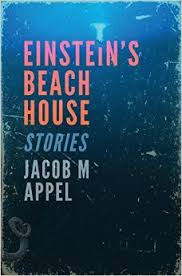
Einstein's Beach House by Jacob Appel has been called  "a collection that takes a sharp look at the moments when we, whether child or adult, see who we truly are and the inevitability of who we will become."

Einstein’s Beach House by Jacob Appel has been called “a collection that takes a sharp look at the moments when we, whether child or adult, see who we truly are and the inevitability of who we will become.”

There is an often-taught writing rule that backstory should be integrated into the present action. Don’t lump it altogether. Usually, this is pretty good advice, though I’ve read enough lumped backstory in excellent stories lately that I’m beginning to wonder if this rule isn’t trying to fix the wrong thing. The problem may not be chunks of backstory as much as backstory that doesn’t clearly connect to and build toward the present drama.

A good example of backstory that appears as a chunk and that also builds toward drama can be found in Jacob Appel’s story, “Einstein’s Beach House,” which first appeared in Sonora Review and is the title story of Appel’s latest story collection. You can read an excerpt from the story at Sonora Review.

How the Story Works

The story actually begins with more backstory than the excerpt shows (the excerpt picks up about two pages into the story). This story’s first paragraph is almost entirely backstory about a typo that led tourists to believe that the narrator’s house had once belonged to Alfred Einstein. In the excerpt, the section after the space break picks up on this backstory. Here is the first paragraph of it:

The two-story wood-frame bungalow at 2467 South Ocean Avenue had served my father’s family for four generations. Originally, “The Cottage” had been a “beach house”—a fashionable summer address for my great-grandparents—but after the stock market crash of ’29 forced my father’s grandfather from his Washington Square townhouse, the Scraggs took refuge on the Jersey Shore, and we’d been muddling along there ever since. I recently read in a magazine that, on average, it takes four generations to squander a large fortune; if that’s true, our family was People’s Exhibit A. My father completed our social descent when he eloped with Mama, a Jewish-atheist folk singer who’d dropped out of NYU to follow Jefferson Airplane on their West Coast tour. They’d met at Grand Central Station, on New Year’s Day, 1968, after my father absentmindedly wandered into the ladies’ restroom by mistake.

In the most literal sense, this paragraph tells backstory (or context), beginning generations before the present action begins. It’s the sort of passage that writers in a workshop might suggest cutting, but doing so would make some of the best moments in the story (the entire story, in fact) impossible to show. So, the question is how to keep the backstory and connect is to drama, which is where the readers’ interest naturally lies. That connection begins with the line about “four generations to squander a large fortune” and the narrator’s father in finalizing that “social descent” by marrying her mother.

Watch how, in the next paragraph, the story turns those two pieces of information into an opportunity for drama:

My parents had been a bad match from the get-go. Even at the age of eleven, I could sense this to be the case—and sometimes, while they were bickering, I wondered why they didn’t just get divorced. The fundamental difference between them was that, for all her superficial radicalism and musical aspirations, Mama could be ruthlessly practical when the occasion demanded it. But my father, rest his soul, teared up at Disney movies and never embraced a pipe dream that didn’t end in a pot of gold and a Nobel Prize. So the two of them argued about whether to withhold the tenant’s security deposit over a chipped mirror, and when to force Grandpa Byron into a nursing home, and even how much to tip the postman at Christmas. No decision was too trivial for a spat. At first, the Einstein error simply gave them one more issue to slam doors about.

The paragraph clearly describes the differences in temperament and philosophy in the father and mother. This is something that many stories do, but those differences are not the same as drama. It’s useful to think of them as a machine. Without a motor, they won’t run. They simply represent potential action. But when energy is applied (when the motor is switched on), the machine begins to work, grinding the characters together and producing sparks, tension, and drama. What is the motor? In this case, it’s Einstein’s beach house.

In a way, all of this backstory has been building the machine and the motor, and the rest of the story shows what happens when this machine is left free to run.

The Writing Exercise

Let’s use backstory to build a drama-creating machine, using “Einstein’s Beach House” by Jacob Appel as a model. You can try these exercises in any order. In fact, they may make more sense in another order, so feel free to switch them around:

  1. Create the parts that will grind together. This is almost always done, as Appel shows, by bringing together characters that will, by nature, come into conflict due to their differences. The differences can be in terms of personality, age, gender, religion, politics, job, sports team affiliation, or just about anything that people form their identities around. It may be possible to write a story with two characters who are identical in every way or who always get along, no matter what, but it’s difficult to imagine. In many stories, characters that seem well matched are often revealed to be not so well suited for each other by the plot. Backstory usually serves the purpose of introducing these parts.
  2. Build the motor. This is, essentially, the plot. You’ve got two characters, but they’re still, awaiting some force to put them into motion. That force is the motor of the story. Appel uses the house and its uncertain origins. When visitors ask for tours, the narrator’s father and mother react quite differently, and those reactions supply the story’s tension. So, what motor can set your characters into motion and conflict? Regardless of what you pick, the result will probably be differing reactions, goals, and plans. The thing at the center of those reactions, goals, and plans can be anything: gold (Treasure of the Sierra Madre), a tech startup (The Social Network), or a painting (The Goldfinch). It can be something desired, something necessary (food, water, shelter), or something intrusive (illness, neighbor, dog). When writing backstory, aim your introduction of the parts toward this motor.
  3. Switch on the machine. Once you have brought together the parts and motor, you can switch it on. Backstory often ends just before this machine begins running. Appel’s backstory ends with a kind of ready, set, go: “At first, the Einstein error simply gave them one more issue to slam doors about.” It’s clear that more will happen (the machine will create more tension) than simply slammed doors. How can you end your backstory on a similar note, summarizing the early workings of the machine in order to set up the highest tension and drama?

Good luck and have fun.

How to Incorporate the Internet into Your Fiction

3 Feb
Ben Lerner is an award-winning poet whose second novel, 10:04, was included in many best-of lists for 2014.

Ben Lerner is an award-winning poet whose second novel, 10:04, was included in many best-of lists for 2014.

Odds are, if you’re a living, breathing writer, then you have a smart phone. You’re probably on it more than you’d like, checking Facebook and Twitter and doing research via Wikipedia. And yet how often does any of this technology show up in our writing?

Ben Lerner’s latest novel, 10:04, breaks from the usual conventions of novel-writing in many ways, but one of the most striking is its seamless inclusion of our ability to search the Internet from the tips of our fingers. You can read an excerpt from the novel, published as the stand-alone story “The Golden Vanity” at The New Yorker.

How the Novel Works

The novel is, in part, about the mundane ways that we observe, encounter, and reflect on the quotidian elements of our days. Much of these encounters take place through or with our phones, which is why, perhaps, that Wikipedia makes three appearances in the book.

In the first, the narrator is walking and thinking:

I walked home through the park. “You have failed to reconcile the realism of my body with the ethereality of the trees,” I said to the mist. Because the park is on the flight path, the city corrals and euthanizes geese. Which mate for life, I confirmed on Wikipedia. The glow of the screen seemed to come off on my hand.

The second comes during remarks during a discussion by a panel of writers:

While preparing these remarks, I was reading up a little on Magee—by which I mean, why hide the fact, that I was reading his Wikipedia entry—when I noted a section called ‘Sources of Inspiration for High Flight.’

The third appearance actually appears twice, first as an illustration of a Brontosaurus skeleton in a book-within-a-book written by the narrator and then as an illustration credit in the back of the book—the illustration having been provided by Wikimedia Commons.

The different ways that Wikipedia is folded into the novel reflects the many ways it’s become part of the fabric of our experience of the world. When we think and question, we Google. When we hold forth on a subject, our holding forth has often been informed by an Internet search. And when we write books, the process has almost certainly been shaped or, at the very least, interrupted by the temptation to open the Internet browser.

The Writing Exercise

Let’s incorporate technology, especially Internet search engines, into our prose, using 10:04 by Ben Lerner as a model. We’ll try three ways of approaching the technology:

  1. An extension of thought. Much research has been done on how our phones have become extensions of our brains, which is why when they break or get lost or die, it’s as if we’ve suffered a stroke. We can’t think right. Most of us use our phones almost unconsciously, checking them as many as two hundred times a day. So, in your prose, try letting a character think about something—any kind of reflection will do: an act of problem solving or remembering or basic curiosity. We write those moments for our characters anyway. Now, simply add a line like Lerner’s: “I confirmed on Wikipedia.” Take it out, and the moment reads the same. The addition simply reflects our new reality.
  2. A reference during a discussion. If you spend any time at all around teenagers or twenty-somethings, then you know that it’s rare to talk with them for more than ten or fifteen minutes without a reference to something they saw on YouTube, Facebook, Twitter, or somewhere else online. Again, this makes the Internet not so much an addition to our discourse but a continuation of it. We’re doing what we’ve always done—talking about things we’ve seen or heard—but now we’re hearing and seeing them online. This can even be the case for a noteworthy poet, as Lerner shows in his novel. The poet references something he knows and adds, as an aside, that he learned this fact on Wikipedia. This feels authentic to real life. We tend to talk about videos and posts as if everyone knows what we’re talking about; it’s rarely necessary to state where we saw them. So, let your characters talk about something they’ve seen and simply add an aside, like Lerner: Oh, I saw it on _______.
  3. A direct insertion into the text. This one might be easy. You’re probably already switching back and forth between your writing and the Internet. That flipping back and forth is certain to influence your work: in content or in style. What would happen if you recognized a moment where this influence had occurred? What if you simply stated the influence as a kind of footnote. This may mean venturing into David Foster Wallace territory or, for a piece intended to be published online, including hyperlinks within the prose.

Have fun with this exercise. The fact that Lerner’s Wikipedia references stood out so sharply suggests that few writers are including the Internet in their work. So, if you play with this idea, you’re on the cutting edge of a new kind of writing. What’s more exciting than that?

How to Write Understated Violence

27 Jan
Amanda Eyre Ward's novel The Same Sky follows two Central American children migrating to the United States. Jodi Picoult said, "This one's going to haunt me for a long time."

Amanda Eyre Ward’s novel The Same Sky follows two Central American children migrating to the United States. Jodi Picoult said, “This one’s going to haunt me for a long time.”

In stories, violence has a way of dominating the scene, elbowing out character and setting so that the violence is all that you can see or remember. This is fine for some stories—sometimes violence does take over—but for other stories, it distracts from more important things.

So how do you keep violence in the background? A great way to learn would be to read Amanda Eyre Ward’s novel The Same Sky, which begins with a murder and a reaction that is noteworthy in its understatement. You can read the opening chapters here.

How the Novel Works

The novel begins with Carla, a young girl living in Tegucigalpa, the capital of Honduras. Her teacher has gone missing, and so she sets out to visit his house along with her friend, Humberto. The scene that follows immediately introduces us to a discovery of disturbing violence:

The front door was open. Our teacher and his wife were dead, lying next to each other on the kitchen floor.

Imagine the range of sentences and details that could follow this discovery. It would be natural for the characters and us, the readers, to dwell on the bodies, to become fixated on them, noticing and remembering particular details: some gruesome and some strikingly normal. But this isn’t what Ward does. Notice how she makes something else the focus of the scene:

The robbers had taken everything in the house. Our teacher, like me, had a mother in America, in Dallas, Texas, a gleaming city we had seen on the television in the window of the PriceSmart electronics store. The point is that our teacher had many things—a watch, alarm clock, boom box, lantern. Luckily, our teacher did not have any children (as far as we knew). That would have been very sad.

Humberto cried out when he saw the bodies. I did not make a sound. My eyes went to my teacher’s wrist, but his watch was gone. His wife no longer wore her ring or the bracelet our teacher had given her on their one-year anniversary. The robbers had taken our teacher’s shoes, shirt, and pants. It was strange to see our teacher like that. I had never seen his bare legs before. They were hairy.

Instead of grisly details, we’re shown their possessions. In fact, we see the possessions first, through a brief bit of context, and then we see their absence. It is through that absence that the bodies are revealed:  “I had never see his bare legs before. They were hairy.”

This misdirection accomplishes three important things:

  1. It keeps the gore at bay. Remember, this is the opening chapter of the novel. If those first pages contain a high level of uncomfortable detail, it begins to set a tone for the novel as a whole—a tone that might not be appropriate for the story. This isn’t a Quentin Tarantino film.
  2. It reveals the characters’ relationship with violence. Take this same murder and put it Austin, TX, where Carla will eventually end up, and the reaction would become quite different. In fact, Scott Blackwood has just published a novel about just such a murder: See How Small. The emotional resonance in that book is very different. In The Same Sky, the characters have become accustomed to murder and violence. As a result, they’re less visibly jolted when it occurs—whether through numbness or its routine nature.
  3. It gives us a sense for the characters’ real concerns. More important, perhaps, than what they don’t notice is what they do notice: “a watch, alarm clock, boom box, lantern.” It’s like the line from Sherlock Holmes: “When a woman thinks that her house is on fire, her instinct is at once to rush to the thing which she values most.” What these characters notice tells us what they value and need, and it is those values and needs that will help shape their decisions in the novel.

The Writing Exercise

Let’s write understated violence, using The Same Sky by Amanda Eyre Ward as a model:

  1. Decide on the type of violence. There are many kinds, not all of them physical. Some are emotional and mental. You can even think large scale and consider cultural violence: the aggression that groups enact against each other. An important distinction to consider is the difference between violence suffered by a person and violence witnessed by a person. Someone witnessing violence can, in some cases, turn away. But if that isn’t possible if the violence is being perpetrated against them—or, it’s more difficult and requires, perhaps, an interior numbness or turning away.
  2. Choose the new focus of the scene. Ward has the children focus on their teacher’s possessions. This makes sense because these are things that would be present in the house, along with the bodies, but their children’s familiarity with them allows the scene to step out of the moment and recall how they appeared before the violence occurred. So, think about what is in the room or place along with the violence: room furnishings, plants, cars, colors, sounds, smells.
  3. Create a reason for the character to pay attention to this new focus. What does the new focus (the thing, smell, color, etc) remind the character of? How does it make the character feel before the violence actually occurs? Does it highlight a scarcity or bounty in the character’s life?
  4. Add the violence to this setting. This addition will, of course, create a kind of contrast, a juxtaposition with the thing you’ve focused on. This contrast will create tension: where does the character look? It’s possible that the more severe and disturbing the violence, the more difficult it will be to look away. The more familiar or mundane the violence, the easier it will be to retain the character’s attention on the thing you’ve focused on. The closer you entwine the violence with the new focus, the more heightened the tension will become. This tension is important because only a severely disturbed person could totally ignore a scene of violence. The key, then, is to background the violence and, thus, insert the tension into the character’s thoughts. That tension will likely stay in their thoughts even after they’ve left the scene.

Good luck.

How to Build a Story around a Fairy Tale

13 Jan
Kseniya Melnik's story, "The Witch," was included in Granta's New Voices series.

Kseniya Melnik’s story, “The Witch,” was included in Granta‘s New Voices series.

Many writers will eventually try to write a story based on a fairy tale or folk tale. There are some powerful examples of such adaptations: Angela Carter’s The Bloody Chamber, Aimee Bender’s stories, and Gabriel Garcia Marquez’s One Hundred Years of Solitude. But writing a modern fairy tale can be easier said than done. How do you capture the essence of the original tale while also creating a story that fulfills our sense of a modern story?

Kseniya Melnik’s story, “The Witch,” achieves that balance beautifully. It was included in her collection Snow in May and published in Granta, where you can read it now.

How the Story Works

The story lays out its fairy tale inspiration in the second paragraph. The narrator is being taken to a witch for help with her headaches and, on the way, thinks about the most famous witch she knows:

I kept picturing the fairy-tale Baba Yaga, who lived deep inside a dark forest in a  cabin held up by chicken legs. Her home was surrounded by a fence of bones, on top of which human skulls with glowing eye sockets sat like ghastly lanterns. Baba Yaga flew in a giant iron mortar, driving it with a pestle and sweeping her trail with a broomstick, on the hunt for children to cook in her oven for dinner.

The challenge facing Melnik is how to craft a modern story around this well-known character. This doesn’t mean simply rewriting the fairy tale. Angela Carter once put the problem this way: “My intention was not to do ‘versions’ or, as the American edition of the book said, horribly, ‘adult’ fairy tales, but to extract the latent content from the traditional stories.”

In short, the writer must create a world that feels modern (which often means realistic, though not always) and somehow adapt the fairy tale to this world. To that end, Melnik follows her description of Baba Yaga with details from the trip deep into the woods:

The car smelled of gasoline, and a cauldron of nausea was already brewing in my stomach. I didn’t need the migraine diary to predict another cursed day.”

These details are entirely realistic and contemporary: gasoline, migraines, medical diary, and they also nod to the fairy tale with words like cauldronbrewing, and cursed. But if the story only nodded to the fairy tale in that simple way, we might feel cheated. And so Melnik further commits to the fairy tale in the next lines:

Soon the world would be ruined by blobs of emptiness, like rain on a fresh watercolor. Everything familiar would shed its skin to reveal a secret monstrous core. And, after a tug-of-war between blackness and fire, an invisible UFO would land on my head. The tiny aliens would drill holes on the sides of my skull, dig painful tunnels inside my brain, and perform their terrible electric experiments. I’d rather get eaten by Baba Yaga.

This description is contemporary since it describes the way a migraine feels (and also because it references UFOs). But it also introduces a surreal element that will continue through the story. As the narrator’s migraine sets in, the world around her begins to resemble something more at-home in a fairy tale than a story of modern-day Russia.

So, when the narrator arrives at the witch’s house, her mother appears as a rabbit, her grandmother becomes a bear, and the witch is transformed into a fox. These transformations have an utterly realistic cause, but they also fit the fairy tale at the story’s foundation. To some extent the way the story resolves this tension between realism and fairy tale sensibility determines the outcome of the story.

The Writing Exercise

Let’s begin to write a story based on a fairy tale, using “The Witch” by Kseniya Melnik as a model:

  1. Choose the fairy tale. It doesn’t really matter what story you choose. You can even move beyond the realm of fairy tales: folk tales, religious stories, Greek myths, etc. Steven Millhauser has a great story—”A Voice in the Night”—that is based on the Old Testament story of Samuel and Eli and was selected for the 2013 Best American Short Stories anthology.
  2. Choose a modern setting. This doesn’t necessarily mean contemporary or realistic. Instead, it simply means the story is written as if its readers are familiar with the literature and stories that have been created since your fairy tale was first told or written down. It’s not enough to simply rewrite the tale.
  3. Establish the language of the fairy tale. This is what Melnik does by telling us about Baba Yaga and her fence of bones and flying mortar. You’re telling the reader, in the original version of this tale, here are the language and images that were used.
  4. Establish the language of the modern setting. This is what Melnik does with the descriptions of gasoline odor. If your story is set in some historical time, give us details that put us in that time. If it’s set in some science fiction/fantasy world, create the nitty-gritty of the world so that we’re there. The important thing is to create a world that exists independently of the fairy tale.
  5. Connect the fairy tale and modern setting with plot. Melnik’s story is about a young girl going to see a witch in hopes of a migraine cure. The plot is drawn from the fairy tale (seeking a cure from a witch) but is also set firmly in the modern world (the problem is a migraine and the witch is a local healer). In most cases, fairy tale plots are relatively simple. In “Hansel and Gretel,” two kids are lost in the woods. The plot of “Sleeping Beauty” is not so different from the plot of “Rip Van Winkle.” Someone falls asleep or leaves, and when they awake/return, everything is weirdly the same or different. In “Little Red Riding Hood,” an evil character dresses up like someone familiar to the main character. When you think about plot, think about it in these simplified terms, not in all the nuances and trappings of the original tale.

Good luck and have fun.

How to Use Danger to Create Plot

6 Jan
summer12

“Out of the Mouths of Babes” by Monica McFawn appeared in The Georgia Review‘s Summer 2012 issue, along with an interview with Salman Rushdie and an essay by Scott Russell Sanders.

Everyone is familiar with Chekhov’s gun: If the story puts a gun on the wall in the first act, the gun needs to be fired by the third act. If a story presents something as dangerous, then it must face that thing directly, not avoid it. Of course, not every story needs a gun. The danger can be located in anything—even things that aren’t necessarily dangerous in every circumstance. All you need is for a character to say, “Don’t do that” or “That’s off-limits” or “Be careful” and you’ve got your dangerous element.

A really great example of creating plot around something forbidden can be found in Monica McFawn’s story, “Out of the Mouths of Babes.” It’s the first story in her collection, Bright Shards of Someplace Else, which won the 2014 Flannery O’Connor Award for Short Fiction. You can read “Out of the Mouths of Babes” at the Georgia Review.

How the Story Works

The story is about Grace, a woman who is babysitting Andy Henderson, a precocious nine-year-old boy. By the end of the first page, the story introduces something forbidden, through the instructions of Andy’s mother: “I said, keep him off the phone. He doesn’t need to be on the phone today.”

This doesn’t seem particularly dangerous, and it doesn’t need to be. If, as a writer, you rely on danger that is recognizably dangerous in every situation, then may end up needing dangers of greater and greater magnitude and end up writing terrorism/spy novels—which is fine, unless you’re not trying to write them. The important thing is that the act is forbidden. Next, the story must break the rule. The question is how. One option is to delay the breaking for as long as possible, perhaps ending the story with the forbidden act. Another option is to break it immediately and make the story about what happens next.

This story chooses the latter option. Grace wanders around the house, and Andy takes advantage of her absence to call an exterminator and bargain for the best extermination deal possible. Then, rather than punish the boy, as he expects, Grace instead says, “How would you like to make an even tougher call?” She challenges Andy to call her cell phone company and bargain the manager out of some overage charges. Andy pulls it off. Now what?

What this story does so well is escalate the danger. Grace asks Andy to make three more calls, each more personal and more important than the last: to a casino’s credit card company to reduce her payments, to her boyfriend to dump him, and to her sister to arrange a truce meeting. The stakes are higher with each call, and each call presents greater challenges to Andy, the nine-year-old trying to fake his way through them.

But what really makes this structure work is the effect it has on Grace. While wandering around the house at the beginning of the story, she discovers the liquor cabinet and pours herself a drink. With each call, she pours another until, by the final call, she’s close to passing out. Without these drinks—if the calls and the pressure to pull off the trick didn’t have any effect on Grace—then the story would feel flat. Suspense can be created by the knowledge that, even if something goes according to plan or succeeds against all odds, the character will still pay for it somehow.

The Writing Exercise

Let’s create a plot structure with an element of danger, using “Out of the Mouths of Babes” by Monica McFawn as a model:

  1. Forbid or warn a character. The dangerous thing can be, literally, anything. Every situation has no-no’s built in. Don’t leave the house without doing the laundry. Don’t step in a puddle. Don’t fall asleep while driving. Don’t go out with him/her. Be careful with that knife. Don’t run with scissors. Pay attention to what you’re doing while ______. Don’t take medication while operating heavy machinery. Don’t shake the baby.
  2. Break the rule a first time. There are varying degrees of brokenness. For the first breaking, keep the stakes low–so what if it’s broken? As you probably know from breaking any rule or taboo, the lack of consequences of the first breaking makes it easier to break the rule again, with higher stakes.
  3. Break the rule again, but raise the stakes. McFawn does this by making the challenges more personal, moving from financial bills to personal relationships. Another way to raise the stakes is to move the breaking from a private setting to a public setting.
  4. Make the breaking take a toll on the character. If the rule exists for a good reason (or if the consequences for getting caught are severe enough), then there is likely some stress involved. How does that stress impact the character? Does it lead to nail biting? drinking? eating? spending? cheating? lying? How is the character’s life and person affected by these decisions that she makes? The key is to give the story layers. Even if the plot succeeds on one layer (the rule breaking has a positive outcome), there should be a different result on another level.

Good luck and have fun.

12 Writing Exercises from 2014

30 Dec

It’s often said that when you learn to read as a writer, you’re no longer able to read for enjoyment. I disagree. I find that the pleasure is doubled. Not only do you enjoy the art for art’s sake, but you’ve also gained the ability to appreciate the craft behind the art. Here are 12 moments of exceptional craft from the stories, novels, and essays featured at Read to Write Stories in 2015.

1. Turn Your Ideas into Story

Aliette de Bodard is the author of the Aztec mystery-fantasy series, Obsidian and Blood, and the science fiction novel On a Red Station, Drifting.

Aliette de Bodard is the author of the Aztec mystery-fantasy series, Obsidian and Blood, and the science fiction novel On a Red Station, Drifting.

It’s tempting, as a writer, to use a story as a platform for your ideas about politics, culture, or whatever. But the risk that any story runs when stating its ideas outright is that it can begin to feel more like a rant than a narrative. Aliette de Bodard demonstrates how to turn ideas into narrative in her story “Immersion”:

It takes a Galactic to believe that you can take a whole culture and reduce it to algorithms; that language and customs can be boiled to just a simple set of rules. For these girls, things are so much more complex than this; and they will never understand how an immerser works, because they can’t think like a Galactic, they’ll never ever think like that. You can’t think like a Galactic unless you’ve been born in the culture.

Or drugged yourself, senseless, into it, year after year. (From “Immersion” by Aliette de Bodard. Find the entire exercise here.)

2. Choose the Right Plot for Your Character

Kiese Laymon's collection of essays, "How to Slowly Kill Yourself and Others in America" stunned the writer Roxane Gay "into stillness."

Kiese Laymon published two books in 2014, the novel Long Division and a collection of essays, “How to Slowly Kill Yourself and Others in America,” that stunned the writer Roxane Gay “into stillness.”

It’s often said that stories gradually limit the possibilities available to a character, finally reaching the moment where this is only one possibility (and it’s probably not a good one). But when you’re beginning a story or novel, it often seems as though every possible avenue is open. The challenge is to pick the right one for your particular character. Kiese Laymon’s novel Long Division shows how to turn find the right plot for your character:

“We’d like to welcome you to the fifth annual Can You Use That Word in a Sentence National Competition,” the voice behind the light said. “We’re so proud to be coming to you from historic Jackson, Mississippi. The state of Mississippi has loomed large in the history of civil rights and the English language. Maybe our next John Grisham, Richard Wright, Margaret Walker Alexander, William Faulkner, or Oprah Winfrey is in this contest. The rules of the contest are simple. I will give the contestant a word and he or she will have two minutes to use that word in a dynamic sentence. All three judges must agree upon the correct usage, appropriateness, and dynamism of the sentence. We guarantee you that this year’s contest will be must-see TV. (From Long Division by Kiese Laymon. Find the entire exercise here.)

3. Set the Mood of Your Story

baj-bio-pic

Bret Anthony Johnston’s debut novel, Remember Me Like This, features, according to Esquire, a “driving plot but fully realized characters as well.”

Every story tries to reveal the kind of story it is from the opening page or opening shot, in the case of film and TV. If you were to encounter Breaking Bad, for instance, with no knowledge of it, you’d understand after about five seconds what kind of world and narrative sensibility you’d entered. Novels and stories must set the mood as quickly as any TV show, and a great example is the beginning (or pretty much any chapter) of Bret Anthony Johnston’s debut novel Remember Me Like This:

Months earlier, the June heat on Mustang Island was gauzy and glomming. The sky hung close, pale as caliche, and the small played-out waves were dragging in the briny, pungent scent of seaweed. On the beach, people tried holding out for a breeze from the Gulf, but when the gusts blew ashore, they were humid and harsh, kicking up sand that stung like wasps. By midday, everyone surrendered. Fishermen cut bait, surfers packed in their boards. Even the notoriously dogged sunbathers shook out their long towels and draped them over the seats in their cars, the leather and vinyl scalding. Lines for the ferry stretched for half an hour, though it could seem days before the dashboard vents were pushing in cool air. Porpoises wheeled in the boats’ wakes, their bellies pink and glistening. (From Remember Me Like This by Bret Anthony Johnston. Find the entire exercise here.)

4. Build Stories (Genre or Literary) on Logistics

Rahul Kanakia’s story, “Seeking boarder for rm w/ attached bathroom, must be willing to live with ghosts ($500 / Berkeley)” was published in Clarkesworld, which recently won a Hugo Award for best Science Fiction and Fantasy Magazine.

Rahul Kanakia’s story, “Seeking boarder for rm w/ attached bathroom, must be willing to live with ghosts ($500 / Berkeley)” was published in Clarkesworld, which recently won a Hugo Award for best Science Fiction and Fantasy Magazine.

A story’s success is determined, in part, by how imaginatively it digs into the practical details of its idea. Ghosts are ghosts, for instance. We’ve seen them countless times in books and movies, and, as a result, we tend to grow accustomed to the rules and conventions of the ghost-story genre. A good ghost story (or any kind of story), then, will play with the practical logistics of those conventions in order to make us see them with fresh eyes. Rahul Kanakia’s ghost story, “Seeking boarder for rm w/ attached bathroom, must be willing to live with ghosts ($500 / Berkeley)” does exactly that:

Chris once told me that human beings are hard-wired to feel an “urgent sense of distress” at the crying of a baby. Well, that’s not true. You know how many times I’ve gone down to the Kaiser Hospital over on Howe Street and sucked the ghost of a crying baby out of one of their incubators? Just maybe like two hundred times. Crying babies? That’s a Wednesday for me. (From “Seeking boarder for rm w/ attached bathroom, must be willing to live with ghosts ($500 / Berkeley)” by Rahul Kanakia. Find the entire exercise here.)

5. Create Conflict with Subtext

Diana Lopez is the author of the YA novel Ask My Mood Ring How I Feel, two middle grade novels, and an adult novella.

Diana Lopez is the author of the YA novel Ask My Mood Ring How I Feel and the managing editor of the literary journal, Huizache.

Conflict is essential to fiction, and, of course, the easiest way to create conflict is by pushing characters into a fight or argument. But how do you set the stage for the big confrontation? One way is to establish competing needs or desires (I want my neighbor to cut his grass, and he wants me to keep my opinions to myself). Relying on this strategy too often, though, can lead to predictable scenes. A story needs unexpected arguments. One way to set those up is with good intentions. In fiction, as in real life, we’re often stunned to find out that our good deeds are not always appreciated. Diana Lopez uses this strategy perfectly in her middle grade novel Ask My Mood Ring How I Feel:

He pulled out her chair. He could be a real gentleman, but since he pulled out Mom’s chair only at fancy dinners or weddings, this was weird. Mom must have thought so too, because she hesitated before sitting down. Then Dad went to his seat and told us to dig in. We did. Quietly. For once, Carmen wasn’t acting like a know-it-all and Jimmy wasn’t begging for something to hold. It was a perfectly quiet dinner like Dad had wanted, but it sure wasn’t peaceful. (From Ask My Mood Ring How I Feel by Diana Lopez. Find the entire exercise here.)

6. Create Villains

Jennifer Ziegler's new middle-grade novel Revenge of the Flower Girls, has X

Jennifer Ziegler’s middle-grade novel Revenge of the Flower Girls, was so popular that a sequel is already forthcoming.

For a reader, one of the most satisfying parts of a novel is the presence of a villain. We want someone to root against—this is true for books as well as films, sports, politics, and often everyday life. And yet as writers (especially literary writers) we’re often reluctant to create characters of pure malicious intent. We have a tendency to attempt to view the situation from the villain’s point of view, if only briefly, if only to make the character a little bit redeemable. In real life, this is probably a virtue. But in fiction, it’s often necessary to behave worse than our real selves. A great example of the appeal of a villain—and how to create one—can be found in Jennifer Ziegler’s middle-grade novel Revenge of the Flower Girls:

“Well, then,” said Mrs. Caldwell, dabbing at the corners of her mouth with a napkin. “I think it’s obvious that these meatballs would be best, along with some salmon-topped canapés and bacon sliders.”

“But…Lily doesn’t eat meat. She’s vegetarian,” Darby said, louder and more slowly than when she’d said it before.

“Yes, but Lily isn’t going to be the only person eating at the wedding,” Mrs. Caldwell said.

“Yes, but Lily is the bride,” Delaney said. (From Revenge of the Flower Girls by Jennifer Ziegler. Find the entire exercise here.)

7. Create Meaningful Spaces

donnajohnson_headshot_rgb

Donna Johnson’s memoir, Holy Ghost Girl, portrays the author’s experience growing up as part of the inner circle of a revivalist preacher.

Every writer has heard this piece of advice: Don’t write a scene in a vacuum. Choose a setting that will impact the characters’ decisions. Not all settings are created equal. Force two characters to have an argument in the bathroom, and the result will be different than if they have it at the dinner table. In Donna Johnson’s memoir, Holy Ghost Girl, the sense of place is vividly palpable in the book, as the first pages of the opening chapter make clear:

The tent waited for us, her canvas wings hovering over a field of stubble that sprouted rusty cans, A&P flyers, bits of glass bottles, and the rolling tatter of trash that migrated through town to settle in an empty lot just beyond the city limits. At dusk, the refuse receded, leaving only the tent, lighted from within, a long golden glow stretched out against a darkening sky. She gathered and sheltered us from a world that told us we were too poor, too white trash, too black, too uneducated, too much of everything that didn’t matter and not enough of anything that did. Society, or at least the respectable chunk of it, saw the tent and those of us who traveled with it as a freak show, a rolling asylum that hit town and stirred the local Holy Rollers, along with a few Baptists, Methodists, and even a Presbyterian or two, into a frenzy. (From Holy Ghost Girl by Donna Johnson. Find the entire exercise here.)

8. Write Surprising Sentences
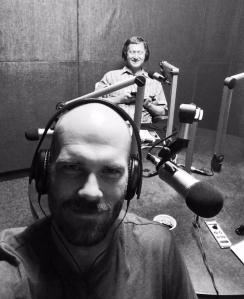
Our Secret Life in the Movies by Michael McGriff and J. M. Tyree was the subject of this interview at NPR's Morning Edition.

Our Secret Life in the Movies by Michael McGriff and J. M. Tyree is a collection of linked stories inspired by films from the Criterion Collection such as Bladerunner and Devilfish.

Stories are built out of sentences. Almost everything that happens on a story level (plot twists and reversals, slow-building suspense) also happens at the sentence level. So, it pays to study good sentences and try to imitate them. You won’t find better sentences than those in Our Secret Life in the Movies, a collection of stories by Michael McGriff and J. M. Tyree:

When she discovered the little bottle of morphine—the secret stash under the kitchen sink that I had lied about throwing away—she was so angry that she took off her blue Nikes and threw them at me, one after the other, the second one clonking off the back of my head and clattering into the unwashed dishes. She unfolded her knife and stabbed the bottle on the counter as if the poor thing were a possessed child’s toy in a horror movie. Then she tried to set fire to it with her Zippo, leaving a mangled and melted heap, while screaming, “Happy Birthday!” It was like watching someone burn down a forest or kill a kitten. (From “Yuri Gagarin Explores Outer Space” from Our Secret Life in the Movies by Michael McGriff and J. M. Tyree. Find the entire exercise here.)

9. Stretch Prose to Include More Than Plot
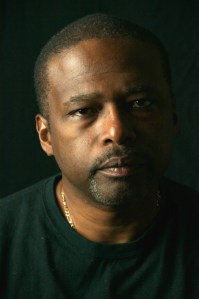
Jeffrey Renard Allen's latest novel, Song of the Shank, about Blind Tom, a former slave and piano prodigy, has been named to a list of best-of lists for 2014.

Jeffrey Renard Allen’s latest novel, Song of the Shank, about Blind Tom, a former slave and piano prodigy, has been named to a list of best-of lists for 2014.

The Onion once ran the headline, “Nation Shudders at Large Block of Uninterrupted Text,” and that may be the reaction of many readers to the first paragraph of Jeffrey Renard Allen’s novel Song of the Shank, which continues for more than two pages. This is an approach to writing that we’re not used to. In fact, as writers, I’m willing to bet that most of us would struggle to write a paragraph that lasts two pages. The present action is stretched so much that we almost forget what is happening and, instead, focus on what is happening around the action:

A clear track, left foot and right, running the circumference of the house, evidence that someone has been spying through the windows, trespassing at the doors. Had she been back in the city, the idea would already have occurred to her that the journalists were to blame, those men of paper determined in their unstoppable quest to unearth the long-lost—three years? four?—”Blind Tom”—Half Man, Half Amazing—to reproduce the person, return him to public consumption, his name new again, a photograph (ideally) to go along with it, the shutter snapping (a thousand words). (From Song of the Shank by Jeffrey Renard Allen. Find the entire exercise here.)

10. Set Up the Second Half of Your Novel

Natalia Sylvester

Natalia Sylvester’s debut novel, Chasing the Sun, is set in Lima, Peru, during the terrifying years of the Shining Path and tells the story of a marriage-in-crisis that is pushed to the brink by a kidnapping.

One of the inescapable truths of storytelling is that you must get to the story quickly; it’s the reason readers won’t be able to put down your book. This is true for every kind of story, but it’s especially true for a novel that fits into the category thriller. Yet if the novel focuses solely on kicking off the plot, it won’t give itself enough material to keep going once the initial plot mechanism runs its course. This is why many early novel drafts tend to stall out after 70 to 100 pages. The question is how to do two things at once: hook the reader and also plant seeds that will sprout later in the book. An excellent example of planting seeds can be found in Natalia Sylvester’s novel Chasing the Sun:

He sighs, unsure how to explain the less concrete aspects of his business. “Sometimes those kinds of things help the situation along. A man like Manuel wants to know the person he’s about to do business with shares his values. That he’s a good husband, a family guy. That he can be trusted.” (From Chasing the Sun by Natalia Sylvester. Find the entire exercise here.)

11. Use Plot Spoilers

Screen Shot 2014-08-24 at 9.27.10 PM

Sean Ennis is the author of Chase Us, which “expertly captures the tumultuous lives of youth on the streets of Philadelphia.”

Every writer will likely at some point begin a story with a spoiler—by giving away a major plot point. It’s an effective strategy. The reader wants to know what happened—how did the story get to that point? But it can also be a surprisingly difficult strategy to pull off. You can give away too much, or you can reveal an ending that the reader isn’t interested in. So, how do you make it work? Sean Ennis does an excellent job of using this kind of opening in his story, “Saint Roger of Fox Chase“:

The night Roger was beaten to death, I was out there running, too. For weeks, he had been trying to convince Clip and me to hang out at the Fox Chase playground on Friday nights. The older kids were buying beer and selling cups for a buck. The girls that came were getting wild, dancing to the music blasting out of car stereos, and flashing their chests.

I was skeptical. The guys that hung around the playground at night were not my friends; they got in fights, smoked. I knew some of them from soccer, and we had a tenuous truce because I could play, but I didn’t want to tempt things and didn’t care much about drinking beer. Seventh grade is a tenuous time. (From “St. Roger of Fox Chase” by Sean Ennis. Find the entire exercise here.)

12. How to Write a Story Ending

Óscar Martínez’s essays about traveling with Central American migrants were published in the Salvadoran online newspaper El Faro and collected in The Beast: Riding the Rails and Dodging Narcos on the Migrants Trail.

Óscar Martínez’s essays about traveling with Central American migrants were published in the Salvadoran online newspaper El Faro and collected in The Beast: Riding the Rails and Dodging Narcos on the Migrants Trail.

The Salvadoran journalist Óscar Martínez has written one of the best story endings I’ve ever read in his nonfiction book The Beast: Riding the Rails and Dodging Narcos on the Migrant Trail. Martínez spent two years traveling with Central American migrants through Mexico on their way to the United States. One of the migrants he meets is a teenager named Saúl, who was born in El Salvador but raised in Los Angeles, where he joined the M18 gang. He was deported after robbing a convenience store. The beginning of the story is pretty simple. He’s beaten by thugs, members of the Mara Salvatrucha gang, and taken to their leader, who, in turns out, is Saúl’s father. Watch how Martínez ends the story:

But in the days following, the man gave Saúl a gift. The only gift Saul would ever receive from his father. He publicly recognized him as his son, and so bestowed to him a single thread of life. “We’re not going to kill this punk,” Guerrero announced in front of Saúl and a few of his gang members. “We’re just going to give him the boot.” And then he turned to Saúl. “If I ever see you in this neighborhood again, you better believe me, I’m going to kill you myself.”

They left him in his underwear in another Mara Salvatrucha neighborhood. He only got out alive by covering himself (and the 18 tattooed on his back) in mud and pretending to be insane. (From The Beast: Riding the Rails and Dodging Narcos on the Migrant Trial by Óscar Martínez. Find the entire exercise here.)

How to Write an Ending that Doesn’t Resolve Conflict

23 Dec
Owen Egerton's essay about his parents' odd Christmas tradition appeared in Salon last Christmas.

Owen Egerton’s essay, “Jesus never gave Christmas porn,” about his parents’ odd Christmas tradition is heartfelt and excellent.

The best essay about Christmas that I’ve ever read is by Owen Egerton. I don’t make this claim lightly, given that there is no shortage of holiday-themed writing this time of year. The essay is notable for its perspective (Egerton grew up a humanist, became a fundamentalist Christian, and now writes searching novels about faith) but also its content: as a kid, the Egerton children rushed downstairs to find their stockings stuffed with pornographic magazines.

After Egerton experienced a religious epiphany as a teenager, these gifts still appeared, and the essay explores the inevitable tension with his parents. I can’t recommend the essay highly enough, especially its ending, which manages to draw the tension to a close without resolving it. “Jesus never gave Christmas porn” was published at Salon, where you can read it now.

How the Essay Works

The essay sets up two clear belief systems. The first belongs to Egerton’s parents, especially his father:

My father grew up as the son of a minister in rural England. He never embraced his own father’s faith. Instead he became a practical man of medicine who viewed sex as a pleasant and necessary part of the human life cycle. Sex was never a taboo subject in our house. Sex was something to talk about, laugh about and responsibly explore. Sure, buying your kids pornography might seem at tad unorthodox, but at the heart of the gift was my parents’ desire to instill a healthy view of sex in their children.

This humanistic view of sex was paired with Egerton’s parents’ attitude toward Christianity:

There was another reason my parents felt compelled to give flesh mags. Pornography was a way to simultaneously celebrate the holiday and keep its more religious themes at bay. Christ got no preferential treatment in our house.

The result was stockings filled with Christmas-themed pornography magazines. Like most children, Egerton went along with his parents’ beliefs when young. But as he reached his teens, he began to explore ideas outside of those accepted at home:

The summer of my 16th year, I spent a week at a Christian summer camp and came back home a born-again Christian. The very night I returned, before my bags were unpacked or my new Adventure New Testament was cracked, I opened my bottom desk drawer, removed three years of well-used Christmas pornography and dumped it in the trash. I didn’t even take a final peek.

With one swift act, I replaced my father’s humanistic view of lust for a moralistic, evangelical view. Lust, I now understood, was in itself a sin.

Like any teen with a new idea, Egerton tried to convince his parents of its worth:

I put my parents through laborious conversations and countless clumsy metaphors, trying to get them to see what I saw so clearly. They were patient, nodding at my testimonials and refilling their wine glasses, but they were not to be moved.

This is where the essay reveals its greatness. As readers, we want endings to resolve tension. But how can this tension be resolved? Egerton’s parents weren’t going to change his minds, and he wasn’t going to change his (at least not for several years). He could have ended by fast forwarding to that subsequent conversion, but what would it accomplish? Many people change their minds about things—even about beliefs that, like religious tenants, are often central to our identity. And, of course, most of us make ridiculous claims and arguments when we’re teenagers. So, an ending that resolves the religious conflict avoids, in a way, the basic tension of the essay: when you love someone but don’t agree with them, how do you live together?

As a teen, Egerton handled the conflict by giving his father a rolled-up scroll with a hand-written Bible verse. In the essay, he handles the ending like this:

We sat in our living room on that Christmas morning, he with the scroll of verses and me with an unopened Penthouse, both feeling his gift had not been appreciated, both sure the other just didn’t get it, both believing the other was drifting down a path that led to something like damnation and wanting more than anything to rescue them. I was trying to save my dad and he was trying to save me. And neither of us knew how.

In the end, Egerton doesn’t try to resolve the conflict. Instead, he can only acknowledge the impossibility of resolving it.

The Writing Exercise

Let’s conclude a moment of tension without resolving the underlying conflict, using “Jesus never gave Christmas porn” by Owen Egerton as a model:

  1. Identify the conflicting beliefs or desires. This likely seems like an obvious step, but it’s surprisingly easy to write an entire essay or story without clearly defining this conflict. Or, we’ll define one but fail to put that belief or desire into direct conflict with a competing belief or desire. (A story about someone in love who never makes the feeling known is a story without a conflict.) So, try this exercise with the major characters in your story or essay: Have them say, “I really want_____” or “I really believe_____.” Force them to make explicitly what might presently only be tacitly understood.
  2. Put the beliefs or desire into conflict. Perhaps you have a major conflict in mind (a clear destination for the story), and, if so, that’s great. But you may want to introduce the conflict in a smaller way before the big blowup arrives. In Egerton’s essay, we know that he’ll get porn in his stocking even though he’s become a born-again Christian. But Christmas morning is not the first appearance of the conflict. Instead, he shows public scenes of dinner-table debate and private signs of belief (dumping the old magazines in the trash). These scenes end politely but with the conflict clearly unresolved. How can you introduce the conflict so that everyone behaves well? How can you create the anticipation in the reader of a bigger blow-up to come?
  3. Consider the possibility that the conflict will never be resolved. An ending that resolves the conflict neatly—so that all tension that was created in the beginning is now gone—can be disappointing. To avoid this let down, consider this what-if question: If the conflict cannot be resolved, and the characters cannot permanently separate themselves, what then? This is the conflict that causes so much stress during the holidays. People move away from their families (often a source of conflict) but then are forced to sit at the same table and stay in the same house as them for a few days. Every year, you’ll hear people asking, “How do I get through the holiday?” Let your characters ask this same question. What does it mean to remain close to someone with whom you have an essential conflict? The answer may be your ending.

Good luck and happy holidays!

How to Stretch Present Action

16 Dec
The New York Times called Jeffrey Renard Allen's novel Song of the Shank,

The New York Times called Jeffrey Renard Allen’s novel Song of the Shank, “the kind of imaginative work only a prodigiously gifted risk-taker could produce.”

Some books come with warnings, a heads-up to readers that the text is demanding and challenging. On one hand, these warnings are necessary to allow readers to brace themselves for what might be slow going. On the other hand, it’s possible that these warnings turn off readers from prose that isn’t difficult so much as new. As a casual or even serious reader, it’s easy to devour the same kinds of books over and over (I’m certainly guilty of this). But when you take time to study a difficult book, the rewards can be enormous.

Song of the Shank by Jeffrey Renard Allen is one of these books. It was published by Graywolf Press, and the press’ hometown newspaper, the Star Tribune, called the novel “engrossing and demanding.” At first glance, this seems like an accurate description, but spend a few minutes with the prose, and I think you’ll find that not only does it become easy to read, it also creates possibilities that other prose styles don’t allow.

You can read the opening chapter of Song of the Shank at Graywolf’s website.

How the Story Works

The Onion once ran the headline, “Nation Shudders at Large Block of Uninterrupted Text,” and that may be the reaction of many readers to the novel’s first paragraph, which continues for more than two pages. This is an approach to writing that we’re not used to. In fact, as writers, I’m willing to bet that most of us would struggle to write a paragraph that lasts two pages. So, how does Allen do it?

Not that much happens in the paragraph. We’re introduced to Eliza, who realizes that Tom is missing and so goes out into the yard to look for him—that’s the extent of the action. The bulk of the paragraph is taken up by Eliza’s thoughts, close description, commentary on her thoughts and the descriptions, and context for those thoughts and the situation in general. The novel is essentially asking us to recalibrate our expectations, to focus on things that we tend to skim over.

Here are two early sentences that show how Allen stretches out the present action. Try to spot the transition between action and context:

A clear track, left foot and right, running the circumference of the house, evidence that someone has been spying through the windows, trespassing at the doors. Had she been back in the city, the idea would already have occurred to her that the journalists were to blame, those men of paper determined in their unstoppable quest to unearth the long-lost—three years? four?—”Blind Tom”—Half Man, Half Amazing—to reproduce the person, return him to public consumption, his name new again, a photograph (ideally) to go along with it, the shutter snapping (a thousand words).

The second sentence begins with a clear marker to the reader: the prose is moving from action (a clear track, evidence that someone has been spying through the windows) to context (Had she been back in the city…).

In these sentences, the prose moves from action to close description:

She turns left, right, her neck at all angles. The house pleasantly still behind her, tall (two stories and an attic) and white, long and wide, a structure that seems neither exalted nor neglected, cheerful disregard, its sun-beaten doll’s house gable and clear-cut timber boards long in need of a thick coat of wash, the veranda sunken forward like an open jaw, the stairs a striped and worn tongue.

The description continues for a few more sentences and then moves into commentary (then, notice how the commentary moves back into description):

Taken altogether it promises plenty, luxury without pretense, prominence without arrogance, privacy and isolation. Inviting. Homey. Lace curtains blowing in at the windows, white tears draining back into a face.

Finally, here is an example of how the prose moves from action to Eliza’s thoughts:

Winded and dizzy, she finds herself right in the middle of the oval turnaround between the house and the long macadam road that divides the lawn. Charming really, her effort, she thinks. In her search just now had she even ventured as far as the straggly bushes, let alone into the woods?

Taken individually, none of these moves out of present action is remarkable. Writers use strategies like these all of the time. But when they’re used together, the effect is powerful. The present action is stretched so much that we almost forget what is happening and, instead, focus on what is happening around the action. This is often where the most interesting parts of any novel lie. The difference is that Allen has found a way to direct our attention to them.

The Writing Exercise

Let’s stretch out present action using Song of the Shank by Jeffrey Renard Allen as a model:

  1. Introduce context. There are many ways to temporarily broaden the point of view. An easy way is to jump out of the scene’s immediate time and place. Allen does this with the phrase, “Had she been back in the city.” Try letting the character (or the narrator) suggest how things in the scene might be different if the time and place were different. In other words, give context for how the situation dictates the action.
  2. Introduce close description. Every writer at some point describes aspects of the setting or character, but one way to extend the description is to use simile (veranda sunken forward like an open jaw) and metaphor (the stairs a striped and worn tongue). Allen also moves beyond literal description and explains how the place seems (a structure that seems neither exalted nor neglected). He’s able to do this, in part, because of the prose’s pacing. If we’re leaning into the present action, waiting to see what happens next, then we don’t have much patience for extended description. But this prose moves more slowly. So, try to slow down your descriptions by extending them with metaphor and simile and statements of how the places or characters seem.
  3. Introduce commentary. This is really just an extension of that seeming description. A good way to do this is to follow a description with a statement that sums up its individual pieces. You (or your narrator or character) are essentially telling the readers how to view what they’ve just read.
  4. Introduce a character’s thoughts. One way to approach a character’s thoughts is to let them function as commentary. In other words, avoid writing thoughts like this: Oh no! I need to hurry! Instead, let the character observe him or herself doing the present action. In Allen’s case, he lets Eliza gently mock her search for Tom (Charming really, her effort, she thinks). We’re allowed to see her from different angles, which gives a deeper picture of her, one that is multi-faceted. The more facets you show, the slower your prose may move—but, as Allen proves, the more texture and depth you can provide.

Good luck!